Browsing Category

Literature

Leave mothers alone!

Here is the good news: you can keep the popcorn in the cupboards and avoid empty calories if you don’t watch the Korean and Dutch movies I’ll introduce today. However, both cinematic explorations under review have brain power and pretty amazing visuals. If you are a fan of disaster movies, science fiction films or mysteries, as I am, you’ll be riveted.

Here is the bad news: you will need a lot of buttered popcorn to erase a bad aftertaste left by watching the movies under discussion. Both delve deeply into psychological issues using women as projection screens of stereotypical, often misogynistic concepts, centered on versions of manipulative women and bad mothers. Sufficiently warned?

Alice Neel Mother and Child (1982)

SPOILER ALERT! I will reveal plots.

I turned to The Great Flood on Netflix without any prior knowledge, simply because I saw it was a Korean film; they are known for excellent apocalyptic movies. I find disaster porn to be the perfect distraction from real life affairs since they remind me that things could be worse, and usually have a happy ending for a select few. We can dream of being the lucky ones!

The story unfolds in the predictable manner; some catastrophic weather event (asteroid melts arctic – buy that!), sets all of Seoul under water; heroine plus child live in a 30 stories apartment building, stratified along class lines, inhabitants now jamming the stairways to get to safety. A male figure appears, half threat, half protector, to guide her and child to a helicopter waiting for them on the roof. It turns out she is the remaining lead researcher in a secret UN project. They are trying to develop AI programs intent on preserving humanity’s emotional tool bag for whatever comes after humanity gets wiped out. Without her being rescued the program is doomed. Along the way she encounters massive challenges, physically and morally, revealing herself to be a tough cookie and originally not particularly attached mother.

Suddenly the film switches gears, and it turns out (for all I could decipher, since there are enough plot holes to drive a truck through,) that she volunteered to be a subject in the data extraction of human emotions for her research project. Looks like it to me, though, that the extracting powers are not interested in human emotions per se, but the shaping of emotions deemed appropriate for a good mother. She finds herself in a time loop, going through thousands of simulations of the same disaster scenario, (conveniently indicated by the changing numbers on her t-shirt for the dull viewer), finding “better” ways to handle ethical dilemmas in order to reach the goal state: a reunion with and rescue of her child lost along the way. Who turns out not to be a child at all, but a preprogrammed AI creature. With some sort of diabetes, no less, making us wonder if they had bad programmers or this was another ruse to instill extra “nursing” tendencies in a woman who had not given birth.

Kaethe Kollwitz Mütter (1911)

Across all these re-iterations of her flight we see her develop from an emotionally distant care taker to someone who is deeply attached to the child. She is ever more engaged in being there for other people in distress, even if that might harm herself or her goals. Along the way AI is shaping her, by providing adaptive memory clues and selective reinforcers, tweaking algorithms towards a preferred outcome. Just as we, the viewers, are shaped by finding our own stereotypes confirmed – isn’t it comforting to see someone evolve to be nurturing, sensitive, present, attached, servile and self-less? A “good mother”, in other words?

Helene Schjerfbek Mother and Child (1886)

As someone who currently holds two young mothers closely in my heart, mothers who could not possibly do a better job than they are doing already, I was irked that the film regurgitated every single societal demand imposed on mothers, in order to bestow the final award, success of the mission. It overshadowed the larger philosophical – and interesting – question the movie raises, how Artificial Intelligence can shape us all – and theoretically in all directions, towards becoming good, or evil, or accepting evermore incoherent entertainment….when looking at the evolution of this film. In contrast to what I watched next, though, the movie rocked!

***

The Shouwendam 12 runs on Amazon Prime. I love to watch Dutch movies for a number of reasons. They help me keep in touch with the language, provide blissfully normal looking actors (no Hollywood glam here, ever) and offer glimpses into the darker aspects of the human psyche (which I attribute to Holland’s colonial past rather than the darkness of the northern latitudes of Scandi-Noir films.)

At first glance, the series presents the familiar script of whodunits: teenagers disappear from the village 25 years ago, someone with amnesia comes back to figure out if he is one of them, a suspicion shared by some in the village, but not others. Then someone gets murdered and a hastily called detective, with the help of the young village cop, tries to find the culprit, setting her eyes on the amnesic newcomer. So far, so typical.

All of a sudden, the series picks up rocket speed with multiplying subplots involving drug dealing, gay sex, child abuse and the like. People start dropping like flies, each killed in a different fashion, with our guy having alibis for many of them, but not all. The script is clever in the sense that we really don’t learn the full extent of a very complicated narrative until the last (10th!) episode.

Paula Modersohn-Becker Stillende Mutter (1903)

Spoiler: the whole set-up revolves around women who have lost their minds, quite literally, after having or losing a child. In the mildest version, the detective is deemed incompetent because she is still shattered by losing her son to suicide. Two cases of postpartum depression then depict women with murderous impulses, trying to kill their babies or killing someone else. Finally, the main culprit is a woman completely deranged after losing her lover to suicide and their unplanned baby in a subsequent miscarriage. She goes out to revenge those losses, murdering everyone who ever harmed her lover, who was one of the missing village kids ago from all those years ago. She drags her brother – hinted to be incestuously bound to her – along in the psychotic scheme, pretending to be the “returning” amnesiac to rattle the villagers into revealing the secrets tied to the disappearances. She escapes punishment by jumping off the church tower in the end, while he shows some redeeming feature by preventing her from killing yet another innocent victim, before he is sent to prison.

It is beyond infuriating. Women are presumed to be murderous harpies under the influence of hormonal imbalance. One is shown to be suffering the hallmarks of clinical depression before she tries to drown her daughter, others are depicted just as murderously aggressive crazies. Instead of giving the viewer tools to understand postpartum depression and its harrowing burden on new mothers, it simply terrifies us with what these women are capable of with destructive intensity.

Mary Cassat Mother and Child (1880)

No mention of the gradation seen in the real world. Up to 85% of mothers experience postpartum blues, a slight impact on mood with hormonal shifts, which remits spontaneously 2 weeks or so after delivery. Then there is postpartum depression, which is clinically indistinguishable from garden-variety depression, with sadness, anxiety and hopelessness often part of the picture for a longer stretch, infinitely treatable. And then there is postpartum psychosis, appearing directly after birth for maybe 1-2 in a 1000 women (if that – the data vary widely). A rare event, and often coinciding with the emergence of dormant bipolar disease, triggered by the stress of pregnancy and birth.

If movies want to raise larger questions – is AI a dangerous tool or possibly preserving the essence of humanity; are given life events a path to madness under certain circumstance – please find something that does not involve motherhood. Mother bashing has such a long and treacherous history, we should really move beyond that. True not just for movies, but also for books – just look at all the new memoirs about and by mothers, or the endless novels about bad mothers

Max Ernst- Die Jungdrau züchtigt das Christuskind (1926)

True, too, for operas: just think Madame Butterfly willing to give up her child, or Azucena in Verdi’s Il Trovatore with her fragile mental equilibrium, not knowing which baby went into the pyre and which she kept and raised as her own. Or Bellini’s Norma, who spares her child, but that was that for sane actions. The Queen of the Night is an ambivalent mother in Mozart’s Magic Flute, and Cherubini’s Medea is the worst of them all, killing both of her children in an act of revenge.

Enough mother bashing! Could you please leave them alone?

Here is a naughty child instead, for today’s music, in the end (at ca. 39 minutes into the video) crying for Maman, no less. L’enfant et les sortilèges is a beautiful opera by Maurice Ravel.

Mother and Child, 1902 by Pablo Picasso

Pablo Picasso Mother and Child (1902)

The Loneliness of Sonia and Sunny.

Proof positive that I have fallen in love with a book: coffee stains on the pages. Rather than sticking to my routine of reading in the evening, a book that truly grabs me is exposed to the arthritic clumsiness of early mornings, coffee cup in hand – or dropped, as the case may be.

It does not happen a lot these days – utter fascination, that is, not the spilling – but The Loneliness of Sonia and Sunny, a recent novel by Kiran Desai, managed to join the collection of mocha-tinged book spines in this household.

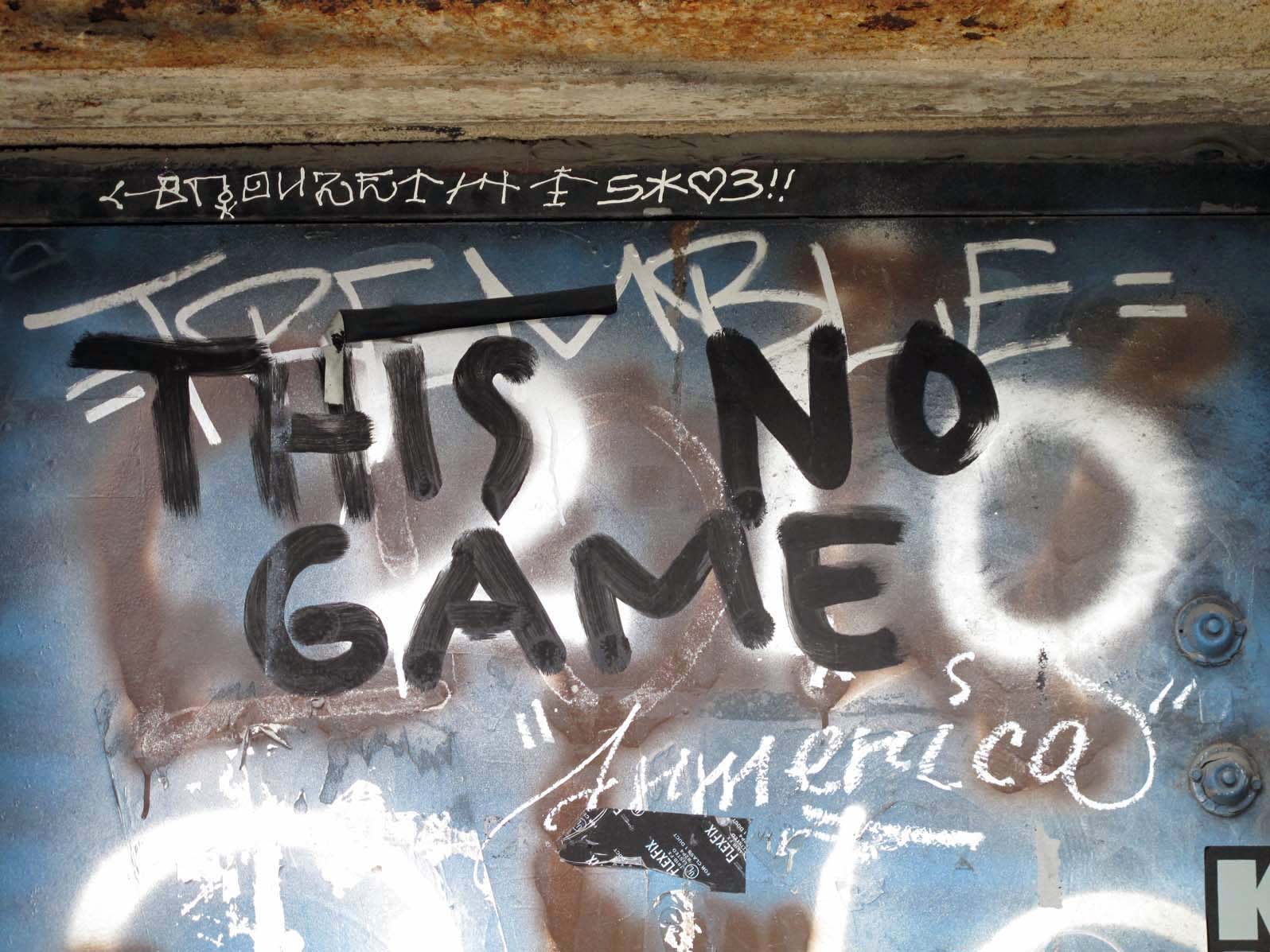
(The rest of today’s images are graffiti from NYC where part of the book unfolds – Bushwick, Williamsburg, and Flatbush I photographed across the years, some Miami thrown in. They are almost all of the kind that relate to the novel – ghost hounds, snakes, a variety of other critters. Eyes, (un)reflecting, play a role, as does swimming. Best I could come up with, given that I have never set foot into India, alas.)

***

The novel was short listed for this year’s Booker Prize. I bet the bank Desai would have won if not for her earlier Booker Prize in 2006 for The Inheritance of Loss. Instead, David Szalay was picked for his novel “Flesh,” its sparse language and focus on masculinity the exact opposite of the opulent, image-rich prose of Desai with her attention to the myriad external and internal factors constraining women’s existence.

In some ways, the Loneliness of Sonia and Sunny is an old-fashioned epic and a tentative love story – I grew up on those kinds of books, still infatuated by them, mourning the loss of novels that forced a 670 + page attention span, familiarity with multitudes of characters across generations, eras and geography, and protagonists who are allowed to progress linearly through the plot, while fighting to overcome various obstacles, with success, author willing.

And is she ever – Desai has an enviable generosity of spirit regarding most characters in play, allowing for many happy endings, no matter how deus-ex-machina they appear, from exploited household staff escaping with the help of micro-loans, to the main villain, a famous artist who is granted a disappearance into oblivion instead of a just punishment for his cruel narcissistic exploitation of the lives and souls of others. (Then again, maybe oblivion is the worst fate imaginable for a pathological narcissist.)

Both he and the titular male protagonist, a drifting, aspiring journalist who left a family of financial black market criminals behind in India for a job in New York, are set up as opposites to the choices one can make when trying to find a self outside the reach of overbearing, dominating mothers and societies that measure you by wild success only. Let’s add a third male, Sonia’s father, who is both an unbearable husband and a loving dad, pointing to the fact that things are never just black & white. Which also applies to various minor male characters, mixing it up between betrayers and supporters, exploiters and helpers, gawkers and touchers, liars and those who fess up to the truth. Come to think of it, all characters, really, independent of gender. No one is beyond reproach, most are in some ways admirable or can be, at least, understood – a blueprint of life that resonates for its verisimilitude.

Let’s turn to the women who for me carried this extraordinarily inventive story, spanning decades across continents, with central locations in India, particularly Goa, North America and Mexico. As so often in novels about loneliness, external settings that differ from the origins of the protagonists help to increase a sense of alienation: where do you belong?

This is doubly the case if the displacement is filtered through the prism of racial, gender and religious hierarchies, with brown people landing among white ones, Muslims among Hindus or Christians. However, the author cleverly introduces one of the initially most lonely people of the entire cast upfront, stuck with her Indian family of origin, returned after a failed marriage. Without means or profession of her own, the existential need for support is a suffocating corset that she can only unfasten after the death of her parents, an escape provided by a stroke of luck – a spot opens in a nearby convent, where she ultimately thrives. Should this all be about freedom to choose your life, rather than loneliness when ripped out of the context you grew up in?
Sonia, a young Indian woman and talented writer, gets her education in an American college, escapes her bone-deep loneliness there by falling in love with a much older artist, seemingly sleep-walks through life and an increasingly abusive relationship, until she breaks and returns home to India. There is a sense of passivity, helplessness, hollowness that in turn dismays and saddens the reader familiar with her kind of malaise; her family tries to arrange a marriage with the son of acquaintances, the proverbial Sunny who is anything but, but that falls through.

Sonia’s mother has long left the picture – she is able to escape her oppressive marriage to a mountain retreat, (inheritance of rent-producing property making it possible – precarity due to lack of funds a repeated theme overall) and only hesitantly tolerates a visiting depressed daughter who threatens to disturb her new-found solitude. The grandfather was a German artist whose own journey of self discovery went West to East ultimately ending in disintegration, the reverse of that of the younger generation, geographically and psychologically, both.

(An aside: German has only one word for both loneliness and solitude – Einsamkeit. if you want to refer to solitude, you have to add something like “self chosen” to loneliness. That implication of some kind of agency is still not enough to soften the negative associations with loneliness – while the English term solitude really radiates something positive – or so says this writer who thrives on solitude quite often. And speaking of German: the novel has been translated by Robin Detje, to be published next spring. I have recommended their remarkable blog here before for my German readers – do check it out.)

Sonia and Sunny meet by chance back on the subcontinent and fall for each other during various trips to Goa and later Venice, but are so riddled by doubts, neediness, trauma and passivity that they are unable to make it work. An episode of almost drowning while swimming in the ocean, hones in on the fact that they have to save themselves first, before rescuing the other. (Water and swimming play a central, symbolic role throughout the novel, with the ocean’s freeing, sometimes therapeutic, often treacherous connotations.) In fact, the lovers have to establish their own true sense of self to begin with, something they seem incapable of doing.

For ⅔ of the book we travel with them through their interior landscapes while they are dealing with family or professional issues, in a quasi somnambulistic state. You roll your eyes? Don’t know what you’re missing. Personified, this provides a mirror of our times with pandemic-induced isolation, languor, the increasing absence of collective settings, from religion to unions that might provide embeddednes, really the absence of institutional, social or cultural safety-nets that stretch under you. We are reminded that no matter how much these very constraints affect individuals’ choices, they clearly provide something of value, only to be realized when they are no longer available.

The last third of the book picks up the tempo, and opens the toolkit of the writer, so far sparingly applied, now in full force. For the first time, real-world, political events are introduced with barely hinted implication for the tenuous co-existence between Indian and Pakistani Muslim and Hindu populations. (For me this was an interesting contrast to Shadow Lines by Amitav Ghosh, whose novel about lonely Indian expats, and family relations between East and West, are completely defined by historical events of world war and the Partition.)

In any case, our current two protagonists are finally turning towards action. Sunny does something truly meaningful for Sonia and seeks her out again. Sonia commits to her own strengths, leading to a delightful plot twist, and a new willingness to take risks. As does the author: she adds a variety of tropes that were sparsely used before, introducing a hefty dose of magic realism. Here is a favorite paragraph that encapsulates everything I believe to be true about good fiction writing in general and this novel in particular:

“The fantastical felt right because it was only by fantasy that most people overcame their reality. If she continued to write multiple narratives until the truth of something she wrote became apparent – whatever those narratives might be labeled by others: surrealist, realist, orientalist, occidentalist, fable, legend, nightmare, daydream, myth, satire, kitsch, tragedy, comedy – wouldn’t every story become the equivalent to every other story? If the center did not hold, maybe it should not hold. Maybe if reality shifted shape, a writer should let it shift.” (p. 654.)

***

I think reality has shifted shape, for us readers in 2025. When I try to recall the loneliest people I remember reading about when I was younger, their alienation seems to have had a different quality.

Start with poor, poor, lonely Jude the Obscure by Thomas Hardy. Love interests thwarted, class barriers insurmountable, religion a slow poison, societal condemnation of living outside the norms leading to murder, mayhem and death. But he knows who he is, what he wants, and the entire novel explores the dramatic consequences of society’s refusal to question the proscriptions of lives appropriately lived, lest that would disturb established hierarchies and patterns of power.

Or take Rainer Maria Rilke”s “The Notebooks of Malte Laurids Brigge”, a semi-autobiographical novel narrated by a young man from Denmark visiting Paris. He is deeply lonely, writing to his wife, trying to understand a world full of death and disease, wondering about his place in it, but he has a solid sense of self in juxtaposition to what surrounds him and even draws artistic power from it.

Then there is the guy in the basement, Fyodor Dostoevsky’s unnamed narrator in Notes from the Underground who decided to retreat into a world of isolation. His solitude is agentic, he feels himself in his resentment and rejection, his stubborn hate for a world that denies him what he believes to be entitled to.

Swap loneliness in a cellar for isolation in a summer house in the boonies, and you have 17 year-old Edgar Wibeau in Ulrich Plenzensdorf’s retelling of the Goethe classic, The New Sorrows of Young W., set in the 1970s in East Germany. No matter how lonely, he knows who and what he is, with a sense of superiority only teenagers can pull off successfully, outraged at a society that denies him approval of his assumed specialness. Doesn’t end well, either.

My final pick, one of the loneliest women in the literature I know, is Franziska Linkerhand, protagonist of a novel by Brigitte Reimann set in East Germany between 1945 and the 1960s, a period of reconstruction and political and cultural upheaval. (Alas, still not translated into English even though the full, un-censored version has been around since the mid 1990s.) She is a complicated person, not a nice one, necessarily, but full of progressive aspirations as a young architect, extremely bright and brimming with an unfathomable longing for an unreachable lover. The clash between her desires and the restrictions built into the political system of the young GDR doesn’t make things easier. That book shaped me through multiple readings in my 20ies, just because there was such a sense of determination, a will to fight, a singularity set up against larger forces, a permission to capitulate if it became a fight against wind mills. Wanting a better, more just world defined the protagonist, her sense of self, loneliness be damned. She, like the others mentioned, knew who they were, but raged against the constraints imposed on them.

Reality shifting shape: Desai is onto something when she leads us to think about the obsession with identity in our current world. All choices seem to be on the table, and everything and everyone is or can be seemingly connected. The implied stress to develop and live up to one’s individuality, without the ability to shed the restrictions imposed by guardrails for more collective societies, throws people into unsolvable dilemmas. Never mind the barriers put up by individualistic Western societies who are unable to eradicate racism as a source of denying individualist advancement to those deemed inferior. Never mind classism and misogyny, inherent to both individualist and collectivist, capitalist as well as socialist cultures, which constrain free choice for individuals from the start.

The suggestion you can (and must!) “find yourself (nothing less than exceptional!),” in an environment of – falsely advertised – unlimited choices, leads invariably to a sense of failure when you experience yourself unable to do just that.

Pure snake oil…..

And so we dream up a possible solution: rescue through love. If someone holds our image in their heart, we can become that person, find a “self”.

Except that is not how it works, a lesson this perceptive, empathetic, generous book imparts. You yourself have to overcome anomy, your alienation and lack of purpose, before you can truly connect.

You can’t meet someone, love someone, if you don’t exist!” (p. 606.)

Preoccupation with who you are, implying belonging, or absence thereof, will not do the trick. Focus on what you can do – passionately acting in this world towards something meaningful – will allow the contours of a self to emerge.

Love matters, matters enormously, but it is an outcome of, not a precursor to, full personhood – a self not ruled by longing.

Will, of course, make ghost hounds more manageable as well!


Music today honors the ocean and eerie vibrations, Spirit Groove/ The Golden Sea in Shenzen.

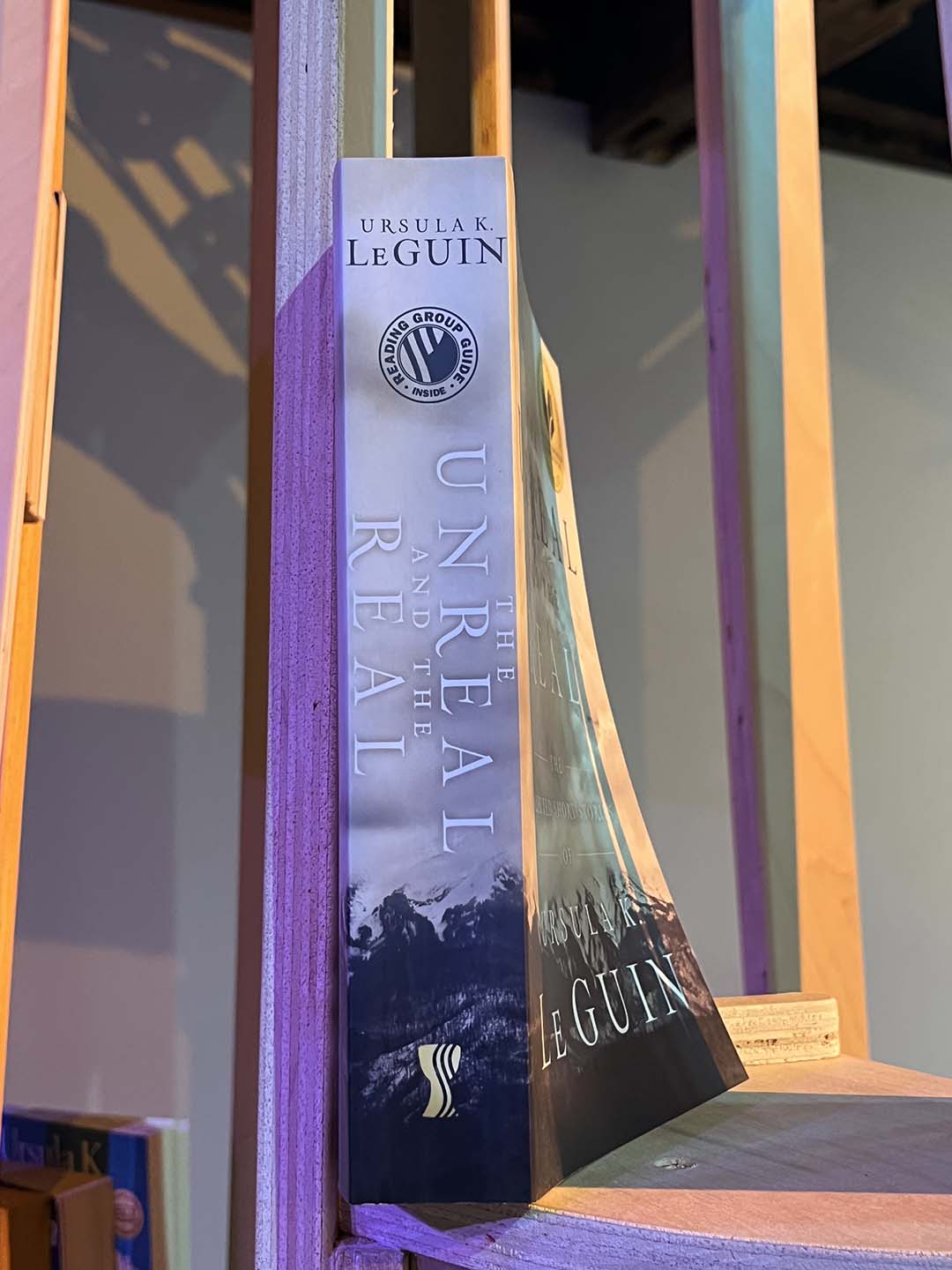
The Unreal and the Real.

· Oregon Contemporary presents: A Larger Reality: Ursula K. Le Guin ·

And eyes beholding radiance.
And the gnats’ flickering dance.
And the seas’ expanse.
And death, and chance.

Ursula K. Le Guin, second stanza in A Hymn to Time (From Late in the Day Poems 2010 – 2014)

Some people spend their entire lives reading but never get beyond reading the words on the page, they don’t understand that the words are merely stepping stones placed across a fast-flowing river, and the reason they’re there is so that we can reach the farther shore, it’s the other side that matters…

by José Saramago The Cave (p.60), (2003)

A few years ago I visited the Sigmund Freud Museum in Vienna’s Berg Gasse. Driven by a somewhat morbid curiosity, I guess, given that I ain’t buying what the man was selling. His claims of offering “science” out of step with how science proceeds, his concepts of memory often completely inaccurate, his assertions about children and child development flatly wrong, his analytic method for the therapeutic process, involving class and traditional gender stereotypes, having done more harm than good. I do concede, however, that the he was a literary giant, converting his extensive humanistic education into far-reaching and complex contemplations that challenge readers to think hard about his suggestions.

What can an exhibition about a literary figure, (or for those so inclined, the father of Psychoanalysis,) convey? A recreation of his environments, the typewriter here, the ashtrays there, the proverbial couch long moved to England, various photographs of different life stages, copies of manuscripts or even original pages, earned awards, and everywhere the collection of knick-knacks, or artifacts from ancient cultures: it all struck me as detritus of a life forced to abandon, or a shed carapace with the substance – his towering intellect – missing in the room.

Then again, the exhibition certainly fed our eternal craving for human interest stories, opening a window into the life of an (in)famous man, if not his mind (or even at the expense thereof.) And having opened this window into the personal details of an existence might, in turn, lure you to open the door into the more interesting part of the house: actually engaging with his writings.

All this came back to me, with trepidation, when I planned to visit a recently opened exhibition at Portland’s Oregon Contemporary. Another literary great on view, and one, in contrast, who I greatly admire: the author, poet, blogger and all around renaissance woman regarding creative modalities: Ursula K. Le Guin (1929 – 2018).

To come straight to the point: this exhibition is much more successful on many levels, although, it, too, suffers from the structural constraints around conveying at least some of the heft and style of the intellectual output of its literary protagonist. There were many things I delighted in, and there were some I sorely missed, that might or might not have been possible to introduce.

(I will skip biographic details that can be easily learned from her website. A compact overview was also recently offered by one of the talented StreetRoots writers – shout out to our local street newspaper! By her counting, it is pretty amazing to look at the volume of Le Guin’s output: 21 novels, 11 volumes of short stories, 12 children’s books (please see the popular picture book “Catwings”), four collections of essays, multiple volumes of poetry, and four of translation, including the Chinese classic text Lao Tzu: Tao Te Ching and the poems of Gabriela Mistral.)

The exhibition title A Larger Reality is ambiguously open to multiple interpretations, but LARGE unambiguously ruled sensory perceptions. The visitor enters a cavernous space, greeted by a larger than life portrait of the author. A brilliant choice among the many photographs available of a strikingly photogenic woman across her life-span, depicting Le Guin as we knew her during the last years of her life, no shying away from old age skin and sagging features. No pretense here, no softening of reality. I cannot think of a better promise that this will be no hagiographic show, but an uncompromising honoring of the truth embodied by this face, a face exuding wisdom and zest in equal measure.

An enormous dragon stretching across almost an entire wall, grabs your attention next – a fanciful mural that embodies the playfulness so prominent in the written work. The scales are dotted with photographs of the author across a lifetime, many including her family. The dragon spikes on top, or whatever they are called, contain the titles of her most successful output.

Small display cases accompany the mural, offering personal benchmarks, and glimpses of activities that cannot be separated from her life as a writer, or that mattered in addition to her professional career. I’ll get back to that in a bit.

Next we encounter a large accumulation of drawings of maps, all preceding the various worlds Le Guin created in her novels and stories. The facility with drawing, and as shown in subsequent display cases, water colors and sketches is enviable – but not as enviable as the fact that the quality of prose is absolutely matched by the quality of her poetry (something you would not learn from this show.) It was a smart curatorial choice not to dilute the impact of the geographic inventions and depictions by other illustrative output. The stunning variability of the maps themselves can be better appreciated this way. (Readers in GB: You can see some of this work as well. Open through December 6: The Word for World: The Maps of Ursula K. Le Guin at the Architectural Association Gallery, London, UK.)

Not done with large yet. There is Mother Oak, a humongous tree where you can sit and read her stories or listen to her voice (what a gift to have those recordings. I so miss the voice of my parents, unable to recreate them accurately in my mind, much more so than visual memories.) In contrast to the oak tree in her book Direction on the Road, this one does not expand and shrink depending on the approach or departure of people interested in its stories. It is just a – large – reality.

Multiple interactive stations invite the visitor to engage with some of the science fiction and fantasy ideas. A recreation of the author’s workspace, including the view out of her window, familiarizes us with her environment. Videos add more introductions to visual creativity.

In the next room we encounter numerous display cases offering ephemera of her various interests. The walls are exhibiting pieces by very different artists done in response to Le Guin’s work, and yet another large mural depicts a variety of people and anthropomorphic creatures offering books that had some impact on the author. Framed in pink, no less. It did not work for me, too contrived, and lacking the intellectual elegance that I so associate with the writer and that was captured in the mural by the entrance.

A wizard’s cape, created by one of Le Guin’s daughters, reminds us of the abolition of genders in Earthsea, times for great celebration marked by such a robe. She fashioned it from various hoods of doctoral gowns worn by the writer who received no fewer than 8 honorary doctorates. Smartly conceived and beautiful in one fell swoop!

***

Political writing of the highest order is rare. Moments at which a particular language is opened to a further range of possibilities – a new tone, a new conception of human purposes, a sharper or wilder rhetorical ascent – in any case happen very infrequently.

T.J. Clark Those Passions: On Art and Politics, p.327

The gallery website introduces the exhibition as such: “A Larger Reality: Ursula K. Le Guin offers a biographical and poetical portrait of one of Oregon’s best known artists. Examining important moments and themes in Le Guin’s life and oeuvre, the exhibition encompasses a rich variety of media, immersing guests in the ideas, playfulness and hope that course through Ursula K. Le Guin’s art.

The exhibition scores on most of those points. Yet, the important themes in her oeuvre just weren’t exposed enough (and, mind you, I am always willing to admit maybe I missed the relevant info. I will happily stand corrected.) For example, Le Guin’s political advocacy is represented with a variety of buttons on a bag with a tongue in cheek printing of “I have abandoned truth and am now looking for a good fantasy.” The signage there reads that she was advocating for a variety of causes in her life, from anti-war movements to tree preservation. The description of her as an anti-capitalist is softened with the humorous referral to her love of shopping, particularly shoes. These attenuations might bring her closer to the rest of us mortals, but they really underplay the intensity or progressiveness of her positions as they appear in her writings. Cloaked in science fiction, her writing was political of the highest order.

It would have been great to introduce, particularly to those new to her, the variety of political topics that forever reappeared, and associate them with particular books, to catch new readers’ interest. Curious about feminism or gender identity? Read Lavinia, or The Left Hand of Darkness, or The Wizard of Earthsea. Thinking about the evil of colonialism? Read The Word for World is Forest or Always coming Home. Can anarchism work as a form of political entity? Find out in The Dispossessed. I could go on about issues of power, our relations to the natural, world, you name it. But here is one I care about most: Want to know why the writer is considered by so many as the queen of moral dilemmas? Go straight to The Ones who walked away from Omelas, a short story that won the 1974 Hugo Award for Best Short Story, given annually for a ​science fiction or fantasy story, and appeared a year later in The Wind’s Twelve Quarters.

A city full of joy, prosperity, security relies on its citizens’ complicit acceptance that it is all maintained by a single child being tortured and kept in permanent isolation in a fetid hole. Only a select few walk away from the city and its immoral bargain after viewing the child, towards an unknown fate beyond the perimeters of “paradise.” We have obviously graduated from one child to several million who we currently willingly starve in our own country, or kill by omission around the world with the abandonment of USAID, or murder by commission of weapons sales for the Gazan genocide, which brings the issue of complicity in ever sharper focus.

Pat Barker, another inimitable writer, voiced in an interview with the Guardian’s Susanna Rustin almost 20 years ago: “Fiction should be about moral dilemmas that are so bloody difficult that the author doesn’t know the answer. What I hate in fiction is when the author knows better than the characters what they should do.”

I can’t think of a single novel that I’ve read of Le Guin’s that does not directly or indirectly force us to face a moral or ethical quandary and think through the consequences of free will, or the constraints on destinies imposed by oppressive powers.

The real is imported into the unreal, and vice versa.

What makes her so impressively different is the fact that none of this involves didactic scolding, or condescension, but always, always offers glimpses of hope, the possibility of change if courageously – and collectively – pursued. No defined solutions, but no Antigones for Le Guin either!

At the same time, she could be quite cutting in her answers to those of us (yes, myself included) who asked apparently stupid questions during readings and lectures. She did not suffer fools.

The refusal to accept black & white answers or cling rigidly to positions, made up for that. I remember vividly my college students’ reactions year after year, when we discussed a video of her talking about gender issues in my Social Psychology or Psychology of Women classes. The expected outline of the difficult position of women in societies organized around patriarchal principles was always counterbalanced by Le Guin holding forth on the fate of young men in those very same societies – they are expendable, good for canon fodder. Male and female students alike felt seen and were able to engage in much less defensive discussions.

And speaking of young people, it would have been great to have some knowledgeable sources provide an overview of how much of an influence this author has had on younger, aspiring writers across the years, including the awards given to them, like the 2025 Ursula K. Le Guin Prize for Fiction, which you can see for yourself here. Her breadth of interests is certainly reflected in the composition of nominees.

***

Theo Downes Le Guin introduces the prize ceremony in the video link above. He is also the main curator for the exhibition portraying his mother, with his sisters offering major contributions as well. I cannot help but wonder how you find a balance between (on one side) the desire for proud public display of your mother and all she achieved, and (on the other side) the need for privacy not just regarding the subject of the show, but your own relationship to a parent who, by public decree, was a Living Legend. 

Portland was hometown of all the Le Guin’s, with near cult status afforded to the elder sitting alongside of the fact that the younger ones have considerable standing in their own right. If curatorial interests clash between what is opportune for public display and what is important both for privacy and for keeping the spotlight on the mother, how do you solve the dilemma?

I have earlier described in Oregon ArtsWatch Theo’s curatorial prowess, but the current situation is unique, with a number of potential vulnerabilities. What does it imply psychologically when you set your task to be one of describing comprehensively the importance of your mother, while also mourning the absence of a beloved person, gone for good? Digging through life-long archives inevitably entails reminders of a childhood shared with her profession, no matter how often (and in this exhibition repeatedly stressed) she voiced her conviction that parenting and authoring were perfectly compatible, even complementary. What does it mean to be in the wake of your mother’s departing ship, likely happily engaged as her literary executor, building the Foundation, arranging traveling exhibitions (at least I hope, for this one should find a broader audience) but – as a result of all of this — no longer able to devote full energy to pursuing what you used to do?

These are all questions brought to mind in a year that has seen its share of biographies about larger-than-life mothers and the complexities of filial love – the off-putting How To Lose Your Mother: A Daughter’s Memoir by Molly Jong-Fast and the fascinating Mother Mary Comes to Me by the brilliant Arundhati Roy the most prominent ones.

I experienced the Le Guins’ curation as an act of generosity as well as a public service, keeping an important voice alive for all of us. Cannot imagine that it hasn’t been hard, though.

One last shout-out: Oregon Contemporary’s Executive Director Blake Shell not only checked people personally into the exhibition, but approached with serious interest at the end of my round, offering to engage in conversation. I was pressed for time and so had to leave promptly, but would have enjoyed that interaction with someone so intimately involved in the whole enterprise. The gallery is facing hard times, like so many of our cultural institutions. The National Endowment for the Arts revoked its federal funding for the 2026 Artists’ Biennial that was intent to showcase a diverse group of Oregon artists, many expected to defy the administration’s imperative to deprive us of “DEI” associated art. You can learn more and help here.

Oregon Contemporary
8371 N. Interstate Ave
Portland, OR 97217

Hours
Fri / Sat / Sun, Noon–5pm
Free and open to the public / ADA accessible

Suggested Donation $14.90 for those who can.

Additional events:

Saturday, December 6th
Event: First Saturday, Talk with Michelle Ruiz Keil & Ashley Stull Meyers and Screening of CROSSLUCID’s Vaster than Empires
Time: 5:00-8:00pm, 6:00pm start of event

Saturday, February 7th
Event: Todd Barton performance of Music and Poetry of the Kesh by Ursula K. Le Guin & Todd Barton with a screening of Kesh, a short film by Rankin Renwick
Time: 5:00-8:00pm, 6:00pm start of event

Clouds out of Balance.

I seem to be coming back to clouds. Not a surprise, surely, for a photographer. I wrote about them, among others, in the context of poetry of exile, or metaphorically linking them to the insights modern genetics can bring us.

What approach shall we take today? Start with Aristophanes’ Cloud Cuckoo Land (nephelokokkȳgía (νεφελοκοκκυγία), a satire of a bird-built city in the clouds meant to ridicule Athenians for living in a fantasy world rather than facing reality? Now used as an insult for naive, slightly deranged people bent on conspiracies that the impossible might happen?

Or start with Anthony Doerr’s novel of the same name, which links multiple narrators across 600 years in a time-traveling puzzle celebrating the power of stories? A puzzle that provides the hope – or fantasy? – that some permanence of tales told echoes the permanence of our world, despite predictions to the contrary? (I am not a fan of his, I think I reviewed All the Light that we can see here earlier in not too friendly a way. But Cloud Cuckoo Land is beloved by many readers who cling to the bit of optimism it provides.)

Shall it be Shelley, the poet famous for his poem, among others, that personified a cloud as a sentient narrator? The Cloud is a long poem (thus linked, not posted here in full,) beautiful, wistful, complex and, as it turns out, not entirely true.

By Percey Bisshe Shelley

The fourth line in the last stanza of the poem is both true and false – it turns out certain kinds of clouds ARE changing (at least where they are operating), and not for the better, leaving dead zones behind. Functionally dead clouds, then, in a challenge to Shelley. (And yes, as you might have anticipated, we are ending up with science, after all these longwinded throat clearings.)

Here is a summary of findings as reported in a long read from the NYT last month.

Basically, different clouds have different roles in the regulation of our climate systems. Some have a cooling effect of land or water, some warm the earth’s surfaces.

Low clouds – puffy cumulus, stratocumulus and flat stratus layers – help with cooling by reflecting light back upwards from their white surfaces and casting shade onto the world below due their density. They absorb heat from the earth and also radiate it back into space in equal measure, because the water droplets they consist of are warm, thus not trapping warmth overall.

High clouds – cirrus and cirrocumulus – on the other hand, are warming our world, counterintuitively so, given that they are much colder, filled with ice crystals. The sun permeates them, because they are less dense. And they act like a blanket to earth, not sending the warmth back into space.

Until serious global warming began, the clouds protected us on net, with the lower ones outweighing the damage done by the higher ones. But now we have a feedback loop where global warming is making the low clouds steadily disappear where they are needed, while the high ones further heat up the planet. Climate change has shifted wind patterns and expanded the tropics, the storm systems with cumulus clouds are drifting towards the poles, and so leaving large stretches open to sunlight. With heat thus increasing, it feeds into drift patterns that expand vulnerable land areas even further.

Succinctly put: the delicate energy balance of sunlight coming in, some of it being reflected, and some of it being absorbed, no longer holds. When low cloud cover diminishes, the scales tip. More solar energy gets trapped in oceans and land surfaces, leading to higher temperatures, more intense heatwaves, and increasingly unpredictable weather. (Ref.)

What can be done, specifically regarding cloud covers? We could certainly try and reduce contrails, (short for condensation trails), which are formed when hot exhaust from an airplane’s engines meets the cold upper atmosphere, causing water vapor to condense into visible ice crystals.

“When the air at cruising altitude is cool enough and moist enough, these contrails spread into high, thin layers that contribute to atmospheric warming. It’s entirely possible for airlines to avoid flying at altitudes where the air is conducive to forming contrails. A 2020 study found that adjusting the cruising altitude of just 2 percent of flights could reduce contrail warming by nearly 60 percent, without using much more fuel.”

(Not to be mistaken for the conspiracy theorists’ assumption of “chemtrails,” the idea that these trails are composed of harmful chemicals intentionally sprayed into the atmosphere for nefarious purposes, spreading Covid or other viruses, poisoning our environment with other chemical or biological agents. Cloud Cuckoo Land….)

Contrails can clearly be harmful in terms of producing blanket clouds aggravating global warming. Flying less, overall, might be suggested as a solution, rather than simply wishing for flying at lower altitudes! But we keep our head in the clouds….

Images from a series – Fragility – currently in the works, that contextualizes environmental harm and protection.

Music matches the mood.


All Kinds of Sisters.

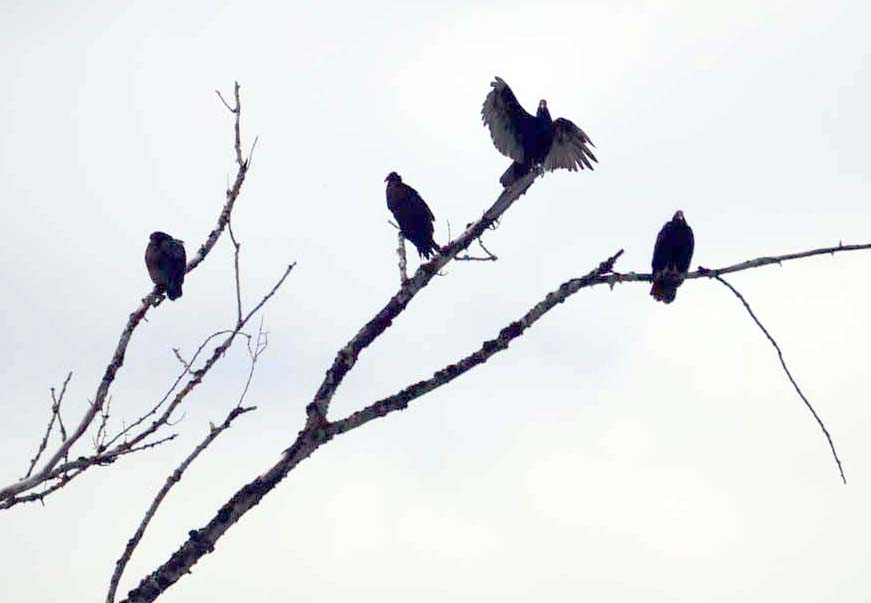
You know how it is, one thing leads to another. This time it started with the birds, so many of them, different ones. The vultures dominated, though, hanging out in the trees along the Columbia river among the bald eagles and ospreys, all ready to swoop down, all eerily quiet.

Then I saw the object of their concentration, or, more likely, their desire. A beached sturgeon, still fresh, no visible wounds other than a torn fin. A spectacular specimen. Perhaps killed by the ever surging water temperatures and dropping water levels – that warming was one of the causes for the recent die-off of sturgeons in our waters, both in 2015 and 2019. Sturgeons can get to be up to 100 years old, but they only spawn every 8-12 years, so their populations are extremely vulnerable at this point, despite many efforts by states, fisheries and environmental organizations to protect them.

In any case, I had just read a book review that started with the phrase “a beached sturgeon of ungodly proportions,” a phrase I found enticing. What followed had me rush to put my name on the library wait list (54 holds on 3 copies – what are you thinking, Multnomah County library?) for The Hounding, a debut novel by Xenobe Purvis. Set in 18th century England, it describes the fate of five sisters who are accused to be witches or worse, having caused a “season of strangeness,” claimed to transform themselves into dogs, now hunted by their neighbors. They try to save that fish, to no avail, and a man eventually kills it by violently stomping on the sturgeon’s head.

Apparently – again, I have yet to read it – many literary examples of sisters are invoked, from Pride and Prejudice, Mansfield Park to Hester Prynne. The main theme, though, seems to be the traditional one: the way society treats women, assigns them magical powers for which they are subsequently prosecuted, harms them by clinging to beliefs of malevolent witchcraft. And this brings me to a book about a different group of siblings that I just finished, The Sisters, by Jonas Hassen Khemiri.

It is a long, complicated novel, with constant shifts in time and several narrators, one of whom, the single male and potential half-brother to Ina, Evelyn and Anastasia, increasingly reveals himself to be quite the unreliable chronicler of the tale. Set in our own time, across Sweden, Tunisia and the U.S., its plot – if there is one, really – is also driven by superstitious beliefs in the supernatural. The sisters themselves believe that their family was cursed, and this guides their lives and decision making. The novel ropes us into deeply detailed worlds, both of behaviors and emotional interiors; it also makes it very clear that self-fulfilling prophecies interact with structural characteristics of misogynistic, patriarchal societies, exponentially affecting outcomes for women.

The book was not expressly plot-driven. I was more reminded of Susan Sontag’s adage that novels are education of feelings – they help us to escape the ever narrowing versions of ourselves, tied to habits in thinking and interactions. It certainly reminded me of how sibling relationships are fundamental to our existence, but their mechanisms are much more easily discerned when you observe other sibling relationships from the outside. In this case, the author managed to make each one of them increasingly more sympathetic, despite some being closer to me, the reader, in personality than the others. He also showed the futile or destructive power of competition, when they could have helped each other all along. But the novel’s real success lies in the ability to convey how potentially neutral or positive life outcomes can be thrown into disarray by the persistence of false beliefs, no matter how rational you try to be. Let that sink in.

***

I have one sister who I admire, and we love each other deeply, despite being very different from each other, but I also feel sisterly bonds to several of my friends. I thought this was described best in Adrienne Rich’s poetry. In the first poem, she alludes to a shared history (siblings are, after all the ones who know you longest and suffered the same family dynamics, even if in different roles), but does that allow you to claim true knowledge of the sibling? Is the stranger she uses as comparison really a travel acquaintance, or another version of the sister, or is it the poet herself, claiming we are unknowable even to ourselves in the end? Too complicated for my heat-addled brain.

By Adrienne Rich

Much more decipherable, then, and a hymn to sisterhood whether by biological bond or not, is this for me:

“Women”

My three sisters are sitting
on rocks of black obsidian.
For the first time, in this light, I can see who they are.

My first sister is sewing her costume for the procession.
She is going as the Transparent lady
and all her nerves will be visible.

My second sister is also sewing,
at the seam over her heart which has never healed entirely,
At last, she hopes, this tightness in her chest will ease.

My third sister is gazing
at a dark-red crust spreading westward far out on the sea.
Her stockings are torn but she is beautiful.

By Adrienne Rich

Here are three sisters sitting at the water’s edge, (no sturgeon in sight, alas,) on rocks of black obsidian. Obsidian is, of course, sharp volcanic glass formed by quickly cooling molten lava, used since the Stone age for weapons, daggers, spears and knives included, but also as ornaments. In the realm of supernatural beliefs, it is associated with healing, protecting us from negative influences. “Its reflective properties are thought to help us recognize false beliefs we may have about ourselves so they can be released.” (Ref.) Hmm.

So, here they sit, on top of those symbols of mostly violent destruction, and yet healing dominates associations. Stitching together a costume that reveals rather than masks you, vulnerabilities and all, being true to yourself, in public no less.

Stitching the scars of your broken heart, sewing as reparative action, such a familiar trope for women’s duties, but now these women mend themselves.

The third sister has gone far beyond: she can leave the torn stockings as they are, seeing the scab from her wounds drift off towards the horizon, self-generated skin a strong enough renewal. She might have fallen, but picked herself up. She might have been violated, but wounds will heal.

And given how most women I know see themselves reflected in one or the other of “our” sisters depicted here (on the mirror surface of the obsidian and in the hurt), this poem is a gift of encouragement and manifesting, with no further need for belief in talismans or other mystical powers. We might be fumbling towards repair, but we do have the power to heal ourselves.

Then again, being able to turn yourself into a dog on occasion, hunting with the pack of your sisters, might be quite the thrill, no?

I’ll report more when I’ve read The Hounding.

Music today is a phenomenal collaboration: Sisters doing it for themselves….

Spoiler Alert.

Here is a dilemma: I have read one of the most thought-provoking books in a while and would like to discuss the issues it raises, on multiple fronts. However, there is a major plot twist at the end, one that every review I’ve read – most of them GLOWING – has kept secret to avoid spoiling the reader’s reaction. Yet, that very plot twist opens a whole new perspective about everything else in the book. So what is a reviewer to do?

Tell you what: If you want to read the book, stop reading my musings now. You will be rewarded with a novel full of the most poetic language (some called it “half wised-up dude-speak, half soaring lyricism,” multiple takes on serious questions about contemporary life, and miraculous story telling that keeps you up until the book is finished.

I, on the other hand, will continue now with revealing the full story – and trying to find my own grip on the book, which I loved but had a hard time digesting (probably why I am writing at length about it here.) (I am annotating my text with photographs of street art from Brooklyn, where some of the story unfolds.)

The Persian lion for the Iranian main character of the novel, in approximation of the color of the Iranian flag, in my imagination -yes, yes I know, it’s more like the Rastafarian lion on the streets of Brooklyn, but indulge me….

Martyr!” by Kaveh Akbar was published last year, to great acclaim. Rarely have I seen so many critics elated and agreeing on so many details. (Here is the NYT, the New Yorker, NPR, and, for balance, something a bit more negative from the Guardian.) Akbar’s first novel (he is an award winning poet) is centered on Cyrus Shams, a young man who finds so little meaning in life that he attempts to derive meaning from death, trying to write a book about martyrs and reveling in occasional suicidal ideation that involves going out with a meaningful bang. Before you sigh “that sounds depressing,” rest assured, it is an extremely funny, laugh-out-loud book. Cyrus works, for example, as a mock patient in a medical school training program for doctors who need to communicate fatal diagnoses to patients and families. The encounters can be hilarious.

He is bi-sexual, trying to pass as not gay, recently graduated from an addiction program, and an orphan. His family comes from Iran, where he was born. He lost his mother as a baby, when she was shot out of the sky in a commercial airliner in 1988 by the USS Vincennes in Iranian airspace (an accident, they claimed.)

His father moves them to the US not much later and works himself to the bones at a chicken farm (mass production) trying to provide for his only child, a life of duty, blood, shit and feathers, that promptly ends with heart failure the minute Cyrus is off to college. Cyrus is mobbed as an immigrant, but neither immigration status nor his serious alcohol and drug addiction (and his miraculous ability to stay sober, once he is ready) are the main focus of the narrative.

The questions are how we find meaning in life, how we deal with loss, and how some losses are compounded by betrayal.

The story is told from different perspectives: Cyrus,

Zee, his sometimes lover and roommate who yearns for (not granted) reciprocity of his feelings,

the father,

an uncle who carries the notion of PTSD as an Iraq war veteran to new heights, (and revealing my stupid prejudices when I questioned the deep musical knowledge of an uneducated Iranian soldier,)

the mother (and a minuscule glimpse of her ex partner) all contribute.

If that sounds like too many perspectives, rest assured, they all meld to a decipherable image, little puzzle pieces gloriously true to their diverse voices. Interwoven are interludes that display the learnedness of the author: contemporary politics, literary allusions, bits and pieces of philosophy that beckons us to read up on them.

Zee convinces Cyrus to make a trip to NYC where an Iranian artist of renown is holding court at the Brooklyn Museum.

She is in the last stages of cancer and has decided to live and die in the museum, meeting people during the day who want to talk to her about death and dying, answering any and all questions, sort of a live installation. (Below are photographs from the Brooklyn museum. The museum is known for its Elizabeth A. Sackler Center for Feminist Art, organized around The Dinner Party, an important icon of 1970s feminist art and a milestone in twentieth-century art. The Dinner Party comprises a massive ceremonial banquet, arranged on a triangular table with a total of thirty-nine place settings, each commemorating an important woman from history. )

Cyrus meets her, feels curiously drawn to her, her immediate perceptions and appreciations of his ideas about martyrdom, and cannot wait to see her again. After two visits he suspects that she is actually his mother, which turns out to be true. Before he can confirm this, though, she ends her life, depriving him of any definite answers or connection, however short, and protecting herself from having to own up to her betrayal. He collapses after the news, and again after meeting with his mother’s ex partner who was and still is her gallery representative, confirming his suspicions.

As part of Groundswell’s Voices Her’d Visionaries program, a group of young women created A New Day, a mural theme of “Strong Women Build Safe Communities.” 2005 Prospect Heights, Brooklyn. Lead artist for the project was Katie Yamasaki.

The book ends in a dream sequence open to interpretation – Cyrus prays for death and it looks like he is going out in a volatile mix of love – something he was previously unable to feel – for Zee, and all kinds of imagery linked to glory. It might be that sepsis did him in (he had a festering foot wound that he ignored), froze to death (he is out in the cold on a Brooklyn park bench), that he died from sorrow, or it might be that he didn’t die at all and is just in need of an ambulance – take your pick. Anything but a glorious death, though, that would add meaning to a life squandered.

***

At this point I was torn. On the one hand, how could a mother abandon her child, including a trauma-inducing lie about the process, kept up to the bitter end? On the other hand, are we back to mother bashing, often our favorite mode when trying to explain the morbidity of young adults’ lives and fragile mental health? John Bowlby’s Attachment theories dominated psychology for many decades, with maternal attachment styles predicting (un)healthy social and psychological development of the infant. And it was just one generation ago that the medical establishment and psychoanalytical clinical approaches still viewed mothers as the cause for schizophrenia in their children. I was still taught that in grad school in clinical psychology courses in the early eighties, believe it or not.

It wasn’t until the mid-80ies that society opened up to other explanatory models, with Public Broadcasting shows like Madness by Jonathan Miller trying to educate about biological and physiological causes instead, now the dominant model in med schools. I am reminded of this mental illness in particular because of the new findings that it is frequently associated with autoimmune diseases – here is some research evidence that links treatment of autoimmune inflammation to reduction or disappearance of psychotic symptoms, and here is a recent New Yorker article about a human interest case. In this context you might also want to re-read an earlier New Yorker essay on the general problems with the Freudian approach. However, the same mother bashing was used for many other psychological problems of their offspring, from borderline to anti-social personality disorders. And the modern version of the “toxic mother”? Just look at what pops up at a cursory search of the internet – here are the first entries that popped up (I’d laugh if it wasn’t so depressing):

8 things that toxic mothers do; 17 surprising signs your Mom is toxic; Toxic Mother: Definition, Signs and how to Cope; 22 Signs of a toxic mother – choosing therapy.

Signs keep multiplying…..

Looking around from the Brooklyn Bridge.

So what do we know about Cyrus’ mother? She never wanted a child, got pregnant at the insistence of her husband. She feels stifled in marriage and an increasingly oppressive, theocratic society that robs her of all freedom, not able to breathe under the Mullahs. She falls briefly and intensely in love with another woman, and together they plot their escape, with switched roles dooming the lover to death by American missiles. She decides to live this lie and drowns her presumed (survivor) guilt and shame over the secretive abandonment in a monomaniacal devotion to art, with every creative act blotting out thoughts of destructive ones. She is never able again to form truly healthy, loving connections.

This was a poster for a play performed at The Invisible Dog 15 years ago, touching on some of the same issues of empty lives.

Is it her fault, then, that Cyrus became a drifter, eschewing responsibility in life (other than a sudden decision to get sober), failing to thrive despite loving friends, concerned sponsors

and certainly a nurturing and supportive father? Parents leave, for good reasons, and often to positive outcomes, since parental tension and depression have negative outcomes for child development. The fact that she seemed to have “been taken” from the family might even placate the sense of abandonment, replaced by a sense of anger at the warmongers in the world. Then again, the fact that she seemingly died a meaningless death, an accident statistic, might explain her son’s preoccupation with the deaths of martyrs, although when we read the snippets of his book in the making it seems rather a fan boy journey, than serious intellectual occupation with the topic of meaningfully trying to change the world.

I found it tempting to try and link Cyrus’ emptiness, his stimulation seeking and clandestine affairs, his inability to engage in faith, or applying himself to something worthwhile, to some “event”, some childhood experience. But aren’t we surrounded by young men like this, not all of whom had the hardship of losing a parent or immigrating to a xenophobic country? And in reverse, aren’t there many people who have gloriously overcome the traumatic events they went through and are living meaningful lives? So what is going on with generations marked by ennui, empty once you go below the surface? Why is there so much deep seated sadness in generations that did not face existential threat?

Just when you arrive at that question, though, the mother comes back in stark relief, refusing her son the answers she owes him, now that they face each other. Here we have true betrayal, and it makes Cyrus from a drifter into a tragic figure, in my view, with parental rejection ruthlessly targeting the child. Any fantasy that she would have, could have loved him, is now cut short, since her own needs mattered more.

Akbar does a fascinating, if frustrating, job in sticking to description rather than analysis of the psychological conundrums of those trying to escape hopelessness. He skillfully avoids sketching his characters in ways that would allow for simplistic explanations of their behaviors, from unabashed narcissism to addiction (art or drugs) as a means of obliteration. The result is a novel that keeps you wondering, looking for answers, curiously drawn to damaged characters and their struggles. A miraculous book and a troublesome one.

Music today is Songs of Hope – a kamâncheh album rooted in the ancient Persian dastgâh/maqâm tradition.

The next generation of colonizers.

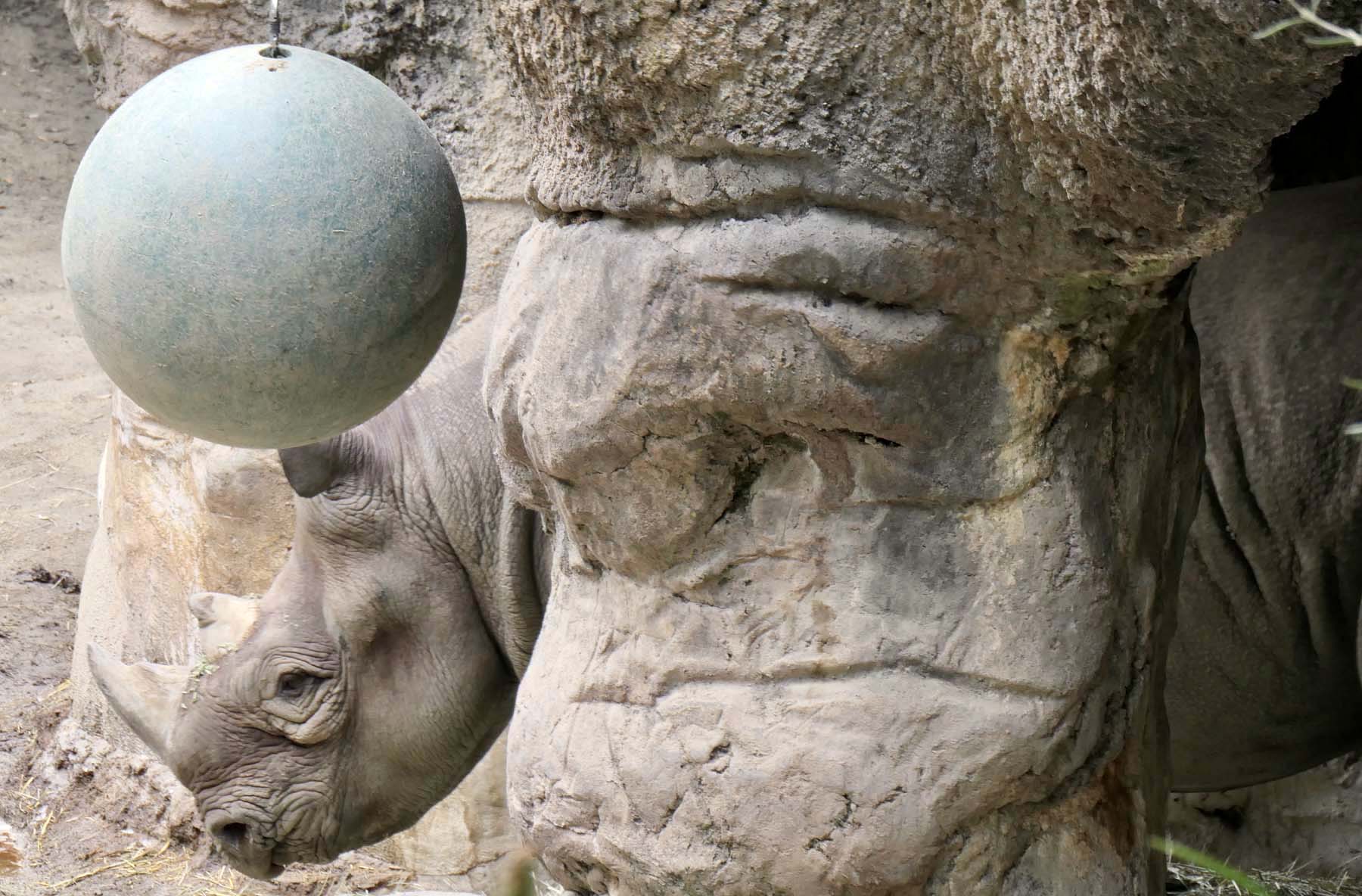
Count me among them. At least during the stretch when I was 9 or 10 years old, devouring books about Africa, and clueless about the indoctrination I received. Why my parents, serious liberals, did not discuss these books that I got from the (postwar!) library – familial and frequent German literature from the beginning of the 20th century for the young set – is a mystery to me. It all came back when I saw the rhinos recently, flooded with memories about the vicarious excitement of a white rhinoceros hunt where the white colonialists managed to kill them, when the Africans did not want to engage in the slaughter.

Rhinos can weigh up to six tons and run between 30 and 40 miles per hour – inconceivably fast. The white and the black rhino are threatened with extinction due to poaching for their desired horns. Both, by the way, are grey and differentiated really by their lip shape. The wide mouth of one, weit in Africaans, was mistranslated as white, thus the name. They are endangered due to poaching of their horns, believed to have medicinal properties, once ground into powder.

Africa has traditionally been a space for white projections, as well as a reservoir for stereotypes of Blacks. We associate the continent with untamed nature, wild animals, a place perfect for romanticized longing. That sure was the case for me, a kid bored growing up in a small village, dreaming of adventure in arid deserts and lush jungles (seemingly the only two ways African nature was presented.) Then again, the “dark” continent was also a dangerous and threatening place, defined by natural catastrophes, hunger, diseases and bloody wars. A mix, then, of fascination and aversion.

German children were educated about the needs of and justification for colonialism from the moment of its beginnings. Boys, that is. The girls were only included once the need for white brides became apparent, late in the unfolding, around 1904-1906 or so. “The stories appeared at a time when the ‘race laws’ in the colonies were becoming much stricter, and colonial policy, together with the bourgeois women’s movement, was encouraging the emigration of young, single white German women to the colonies, preferably German South West Africa, to prevent ‘mixed marriages’ between white German men and Black women.” (Ref this links to a scholarly article on the impact of colonial literature on education, a fascinating read. )

All of a sudden girls were encouraged by stories of feisty heroines who would be sent to Africa, build homes and gardens, allowed to be more independent than back home, including hunting in untamed nature, but eventually finding the love of their life in some colonial officer (often upward social mobility was hinted at as a prize), making white babies, and sending stolen treasure in form of cocoa, coffee, rubber back home, so direly needed by the fatherland. (Note, I was into rhino hunts, not nurseries…)Note also that some racist aspects of the narratives continued on into the 1960s, or even in contemporary kids’ books, long after many of the colonized nations became independent.)

Come to think of it, the expedited admission of South African white “refugees” to the US, per instructions from up on high, is not just based on lies about genocide, but also related to the desire for white babies. I hear a lot of them will be settled in Idaho, where they will find a like-minded community near the Arian Nation. But that is a topic for another day.

Typically, these stories involved white saviorism, helping the “primitive” population to survive and prosper, but also dominance: the young women had a mission to bring culture to the “savages,” the African continent conceived as having no history or culture, literally cultivating them as if they were animals or plants. Describing them as exotic (just like the surrounding fauna and flora), or stereotyping them as childlike, invited the female readers to see themselves as “educators.” The boys’ stories focussed on dominance: describing the population as lazy, amoral, bent on violence and bloodshed invited the strong hand (and if necessary gun) of the colonialist. The distortions applied to the perception of the native peoples helped solidify the identity of the rulers: privileged with knowledge, culture and power, dishing it out in benevolent or hostile ways, never doubting the god-given hierarchy of white over Black.

This is, of course, how belief systems, no matter how insidious, get transmitted from generation to generation – children’s literature seeds the stereotypes and lures you with identification with adventure, exoticism, wealth and romantic love. This is exactly why factions in the culture wars try to weed out anything that might oppose their tenets or inform about alternative interpretations. The purges of libraries right now, the shutting down of children’s TV programs that make racism, stereotyping, misogyny and/or colonialism a topic, are essential to the project of making white children believe they are a the top of the value pyramid, and entitled to submission from everyone else. As early as possible.

Here is a comprehensive overview of what is going on with public libraries, school libraries and issues of free speech. And here is an interesting review in the Los Angeles Review of Books of the ongoing purges and the effects on librarians who have to function in an ever more hostile, polarized world.

I was, of course, fortunate enough, to be provided with all kinds of literature, and higher education which eventually opened the door to critical thinking and insights about the project of colonializing Africa or any other place deemed inferior. But those old books sure stimulated fantasizing about adventures in an exotic world, immersion into unimaginably wild nature, one on one encounters with rhinos and elephants.

I blush thinking about it. Such easy fodder for the PR machine promising me I, too, could be an explorer, a pioneer, a discoverer. I made it to North Africa, but never further south. These days, I explore the zoo, but ended up thoroughly anti-racist. I guess I count that as a win.

Beautiful Kora music from Africa, naturally.

Tula-Tu is the newest calf in Portland.

Ghost Stories.

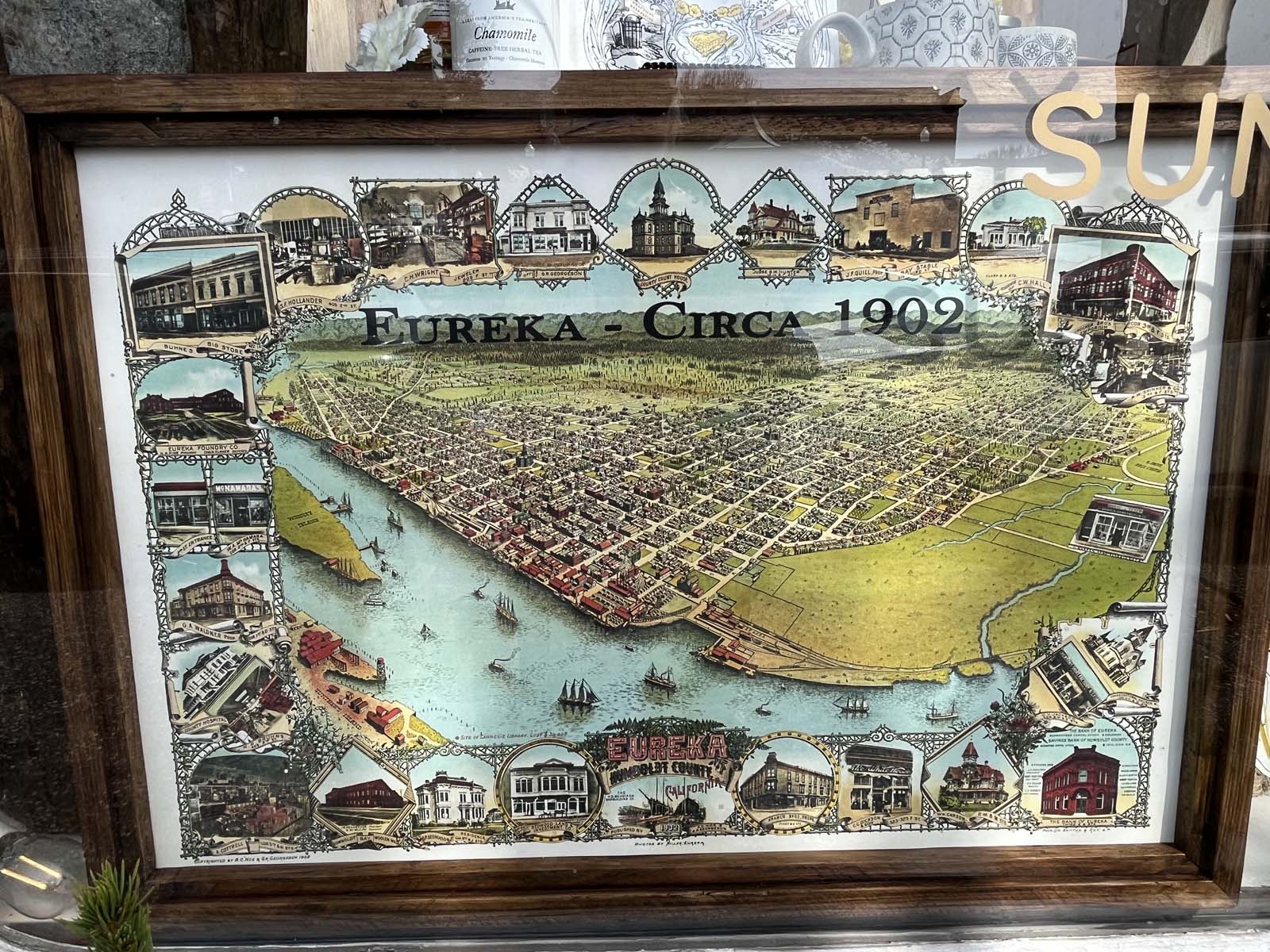
As per usual, one thing led to another while I was wandering among the Victorian houses of Eureka, CA on my most recent jaunt. Struck me as sort of a ghost town (more on that in a minute).

The Louvre Cafe has clearly seen better times…

Associative jump to Victorian ghost stories, and, inevitably, Montague Rhodes James (1882 – 1936). He was a British medievalist scholar, widely respected as provost of King’s College, Cambridge and of Eton College, as well as Vice-Chancellor of the University of Cambridge. He also authored numerous volumes of ghost stories which had a large impact on the horror genre, partly due to their juxtaposition of humor and the supernatural.

One of his most famous stories, Oh, Whistle and I’ll Come to You, My Lad (1904), can be found in a collection called A Warning to the Curious. It is a clever and funny tale named after a poem by Robert Burns, filled with often ironic allusions to world literature, Shakespeare and Coleridge as well as the bible. It is about a stodgy, slightly off Professor enamored with his own rationality, who spends a week’s vacation at the sea coast, pocketing a bronze whistle he finds in an abandoned Knights Templar cemetery along the beach. Soon he feels as if he is being followed. When he inspects the whistle in his room, with weird inscriptions seeming to reference the bible, strange noises begin startling him during the night. In short order things get sketchy and the Prof will never be the same again, as you will be able to see for yourself, when watching this remarkable, brilliant short film made for the BBC in 1968, and starring Michael Hordern. Watch it for the character acting alone. Such a difference from today’s horror flics. It’ll make your day! Well, it did mine.

Although my day was already pretty good, having listened to a new music album by Paul Roland, the expert on turning Victorian murders, supernatural experiences or horror stories into the most pleasant songs. He transformed James’ stories into ballads, sung with the voice of a bard found in your nearest corner pub, publishing this enchanting collection just last week. Here is his version of Whistle and I’ll Come to You. How can you not like a song that starts with the lines “Professor Parkins was a man of few words, but all of them were long, oh so long…” or a songwriter, who manages to get the essence of a story crammed in verse form into a ballad without losing any of the essential narrative and wit.

A warning to the curious could also be found on the walking path along the bay in Eureka. The path, lined with encampments of houseless people, runs behind the large mall and a strip of motels where I stayed.

This small town has seen its share of horrors, both on the extending and the receiving end. It is a harbor town in Northern California in Humboldt County, which derived its name from the Greek motto εὕρηκα (heúrēka), which means “I have found it!” It was missed by the European explorers for the longest time, due to a combination of geographic features and weather conditions which concealed the narrow bay entrance from view, and so was settled relatively late, around 1850. It did not take that long – but 10 years, in 1860 – for settlers and gold seekers to massacre the native population, the Wiyot people, mostly women and children, at a time when the adult males were away for an annual ceremony. The remaining populations sought shelter at Fort Humboldt, but over half died of starvation, with the army withholding proper care.

Not done yet. In 1890, with recent economic downturns and a growing sinophobia and violent acts against Chinese immigrants, a group of 600 White vigilantes forcibly and permanently evicted all 480 Chinese residents of Eureka’s Chinatown.

Photographs of Victorian beauties in Eureka from the city website.

The city thrived on the lumber trade, extracting what they could from the surrounding Red Woods, as well as fishing, and these days tourist trade. The timber economy of Eureka rises and falls with boom-and-bust economic times, certainly declined after the Second World War and even more so after the 1962 Columbus Day storm that felled so many trees that there was a glut in the market. The region is also site to large earthquakes and in danger of tsunamis. After 1990, regulatory, economic, and climate change-related events led to a contraction of the local commercial fishing fleet as well. The city these days is struggling, and it is visible in many closed or for sale properties when you walk around.

It is also quite evident that people are suffering – California is currently the state with the largest number of houseless people, and Humboldt County is having an above average share of them. There are opposing forces, as we, of course, see all around the country, that differ in ways how to approach this difficult situation. There are those who want to pursue actions that criminalize the people living in tents and cars for lack of available alternatives. They are bent on preserving public space for parking lots rather than low income housing for poor people, with the general idea that their presence impedes on commercial interests in town, always regressing to the long disproven claim that the presence of the poor will attract more crime.

But not all is a horror story! The good people of Eureka soundly defeated a measure meant to exclude houseless populations from housing availability in the city center in favor of parking lots during the last election. Despite a millionaire and his buddies investing $1.6 or so million in a campaign to maintain exclusion, ballot measure F passed in favor of the vulnerable population.

The story now unfolds around efforts to increase penalties for those living outside. City Council meetings have become land wars between the factions who want to criminalize homelessness and those who want to go about the problem by other means. Emotions run high, but there is clearly a movement that tries to protect those who cannot protect themselves.

The center of the city has a lot of spiffy stores for tourists, an opera house and a terrific bookstore, Bookleggers.

Mostly, you find interesting stuff a bit further away or in the back alleys, just like in San Francisco – lots of creative murals,

and a clear proclivity for cats…

Maybe we need to turn to witch stories next….

And as this day’s news of the Pope’ death demands some acknowledgment – he prayed daily with and for the Gazans and repeatedly rebuked the Trump administration over its stance on migrants and the marginalized – here is Mozart’s Lacrima. I got the musical idea from a different source – one of my steady readers has a cool website from which I derive news about rock and metal music. They had a Lacrima of a different sort today, by a band named Ghost no less…. thank you, Fox Reviews Rock!

This aged well…

In 1995, Umberto Eco (author of The Name of the Rose, among others) published an essay in the New York Review of Books called: Ur-Fascism with a sub-title Freedom and Liberation are an unending task. He had grown up under Mussolini’s regime and he was trying to assess in this essay when or under what circumstances it is legitimate to call something fascism.

He insisted “There was only one Nazism,” but “The fascist game can be played in many forms, and the name of the game does not change.” He then went on to outline 14 “typical” features that make up the qualities of what he calls “Ur-Fascism, or Eternal Fascism.”

“These features cannot be organized into a system; many of them contradict each other, and are also typical of other kinds of despotism or fanaticism. But it is enough that one of them be present to allow fascism to coagulate around it.”

I am copying them here (Ref.) and add some annotations posted by German analyst Marc Raschke on IG, put into my own words.

1. The cult of tradition. “One has only to look at the syllabus of every fascist movement to find the major traditionalist thinkers. The Nazi gnosis was nourished by traditionalist, syncretistic, occult elements.” Let’s go back to a (presumed) golden past : Make America Great again!

2. The rejection of modernism. “The Enlightenment, the Age of Reason, is seen as the beginning of modern depravity. In this sense Ur-Fascism can be defined as irrationalism.” Climate change? What climate change? Science? Vaccinations? Infectious or chronic disease research?

3. The cult of action for action’s sake. “Action being beautiful in itself, it must be taken before, or without, any previous reflection. Thinking is a form of emasculation.” Tariffs yes! Tariffs no! Let’s break organizations before we re-build them (if we rebuild them…)

4. Disagreement is treason. “The critical spirit makes distinctions, and to distinguish is a sign of modernism. In modern culture the scientific community praises disagreement as a way to improve knowledge.” Media? Critics? Scientists? Universities? Enemies of the People! More executive orders like “Restoring Truth and Sanity to American History.” 

5. Fear of difference. “The first appeal of a fascist or prematurely fascist movement is an appeal against the intruders. Thus Ur-Fascism is racist by definition.” Diversity? Let’s get rid of or demote anyone not fitting the norms set by white men… deport! deport! deport!

6. Appeal to social frustration. “One of the most typical features of the historical fascism was the appeal to a frustrated middle class, a class suffering from an economic crisis or feelings of political humiliation, and frightened by the pressure of lower social groups.” Frustrated? Status challenged? – It’s the fault of minorities, migrants, the elites or trans people! Remember the Great Replacement idea.

7. The obsession with a plot. “Thus at the root of the Ur-Fascist psychology there is the obsession with a plot, possibly an international one. The followers must feel besieged.” Obsessed with conspiracies? Too many to count here….

8. The enemy is both strong and weak. “By a continuous shifting of rhetorical focus, the enemies are at the same time too strong and too weak.” The Deep State is all powerful! The Deep state is ineffective and corrupt!

9. Pacifism is trafficking with the enemy. “For Ur-Fascism there is no struggle for life but, rather, life is lived for struggle.” Let’s have a war against the invading foreigners or the Deep State or the Law firms or whoever comes to mind this moment. What about Greenland? Canada? Panama Canal?

10. Contempt for the weak. “Elitism is a typical aspect of any reactionary ideology.” The weak need to be eliminated! Only the strong should rule! Let’s get rid of meals-on-wheels! Let cancer patients die, who needs research. FEMA is a waste. Scratch the financial support for heating and cooling.

11. Everybody is educated to become a hero. “In Ur-Fascist ideology, heroism is the norm. This cult of heroism is strictly linked with the cult of death.” We are a heroic mass movement with the biggest popular support (ignore the election statistics…) and our martyrs shall be heroes – like Ashli Babbit on January 6th…

12. Machismo and weaponry. “Machismo implies both disdain for women and intolerance and condemnation of nonstandard sexual habits, from chastity to homosexuality.” Men rule, women serve – they will be protected (and fertilized… ) whether they like it or not. Let’s have a household vote only from male head of household. Let’s eliminate choice and control of one’s own body. Let’s do away with marriage equality. Project 2025 spells it out in detail.

13. Selective populism. “There is in our future a TV or Internet populism, in which the emotional response of a selected group of citizens can be presented and accepted as the Voice of the People.” PBS be gone! Billionaire-owned media rule.

14. Ur-Fascism speaks Newspeak. “All the Nazi or Fascist schoolbooks made use of an impoverished vocabulary, and an elementary syntax, in order to limit the instruments for complex and critical reasoning.” Newspeak? Fake News, Woke Mind Virus, Deep State anyone?

1995 – 2025. You can draw your own conclusions.

Music today by Luciano Berio who was a close friend of Eco’s, and at times collaborating on projects that combined semiotics and music. (I chose one of his more traditional compositions.)

Graffiti with tongue-in-cheek suggestions for an antidote to fascism, from Vienna, during my last visit. The Italian one I photographed in Trieste, in 2018.

Thoughts on Change.

A friend sent me an essay from the New Yorker this week – I somehow managed to avoid subscribing to the magazine for all of my decades on American shores. Lessons for the End of the World is a moving, lyrical piece by poet and MacArthur fellow Hanif Abdurraqib. It braids together strands of reactions to loss, material and immaterial. I read it as a flock of robins descended on the Hawthorne tree in front of my window, in search for the last remaining berries.

I agreed with the author’s acknowledgement that the loss of personally meaningful, irreplaceable objects requires psychological adjustment, regardless of the ways things get lost, accidentally dropped at an airport, or violently destroyed by all-consuming fires. The essay embeds his reactions within a tapestry of reminders about women’s writings on trauma and loss, Nikki Giovanni and Octavia E. Butler among them. Butler’s Parabel of the Sower is currently making a come-back in public discourse, its seemingly prescient descriptions of a society destroyed by fiery climate catastrophe and held in the thralls of authoritarian violence a detailed narrative, all too fittingly depicting this moment.

As I wrote 2 years ago (see below,) many of her novels manage to make the grief attached to loss, particularly traumatic loss, astoundingly explicit. We mourn what is taken from us, often irreplaceably so, whether destroyed heirlooms, or body parts, no longer being physically whole. Simultaneously, though, if more implicitly, she points us to the psychological opportunities attached to new beginnings. Loss raises awareness of our ability to make choices, how to deal with the loss itself, how to move forward both as individuals and with regard to the structures that surround and constrain us. Living through existentially hard times can produce new ways of thinking, acting and re-acting, a shift in values that could lead to favor mutual aid and empathy.

Abdurraqib’s essay focuses on that as well, Butler’s prescription for looking at change as the ultimate power, “the innovation and adaptation required to survive the unsurvivable.” He quotes Butler:

“There’s no single answer that will solve all of our future problems. There’s no magic bullet. Instead there are thousands of answers, at least. You can be one of them if you choose to be.”

In this regard, she is a beacon of hope, believing in our potential to grow new life out of the ashes, a radically changed life enabling us to survive the ways this planet, our nations and all of us contained within it, will continue to be harmed.

The graveyard with so much old growth burnt as well a month ago, but her grave is unharmed. The bookstore Octavia’s Bookshelf in Pasadena has become a hub for mutual aid after the Eaton fire, just as she would have envisioned.

***

I wonder. There might be one aspect of losing irreplaceable things that helps, in some paradoxical ways, to move from grief to renewal: centering, retroactively, human connectedness.

As a personal example, I lost a number of things in the Eaton fire that originated in my own history, things I had given the kids as tokens of their belonging to a loving network of generations of people they never had a chance to meet. (Let me hasten to add, they are inconsequential compared to what others have lost, more closely connected to their current lives.)

For one, there was a garment my mother had knitted, a beautiful cape for a baby in blue and purple hues. Honestly, it had been waiting in a closet for decades, out of awareness, and once delivered to the young family, I never thought of it again. Until now, when I try to remember the pattern and constantly think of my mother knitting, a craft we have in common (I might go as far as calling it a shared form of therapy). Not only was the cape something she physically touched, but its loss is now a reminder, very much at the forefront of my daily consciousness, of how she taught me, with much patience, something beneficial and creative, knitting – a lasting connection, despite her early death in 1983.

A previous version of this hat for an owl-loving toddler burnt as well – but I was able to knit it again. Somehow the ability to replace things is wonderful but also highlights the inability to retrieve others.

Secondly, I had, quite literally a week or so before the fire, sent an old photograph of my grandfather to the kids. It had languished in a box, not even an album, for decades, must have come down to me when my father died in 2002 and I took a few of the things he had saved back to the U.S. It was taken in the battlefield trenches in France during WW I, on his (and coincidentally my mother’s) birthday on February 8th, with my Opa holding a guitar, at the center of a group of painfully young, thin and empty-eyed soldier. I have so many questions. Would you bring your instrument, as a musician, to the front? Was it provided as some sort of means to distract the company? Was music what allowed him to survive two world wars unscathed, as a peaceful, curious, nature-loving, gentle human being? These questions did not preoccupy me until the burning of the photograph.

The losses force us to remember the people attached to the items, and, in turn, our attachment to them. Maybe that focus on relationships, on belonging even after death, signals the way to adapt and move on. Just as Octavia Butler spelled out, the secret to survival lies in communal embeddedness and reciprocity. The love we received and that we can now pay forwards will never be contained in objects only, it exists independently, inviolable by flood and fire. That solace might help staunch the grief.

In honor of my Opa’s real love, the double bass, here is a beautiful rendition of a Bottesino concerto.