Browsing Category

Art

Modeling

Today’s title is not referring to the kind of activity intended to make you buy clothes. Instead I want to talk about representations trying to make you understand and/or buy into complex concepts. Think this is going to be boring? Think again! It provides a glimpse of science and will all relate to art. It will also be long. And personal. Consider it your reward, dear brave and zany readers, or punishment. Your pick.

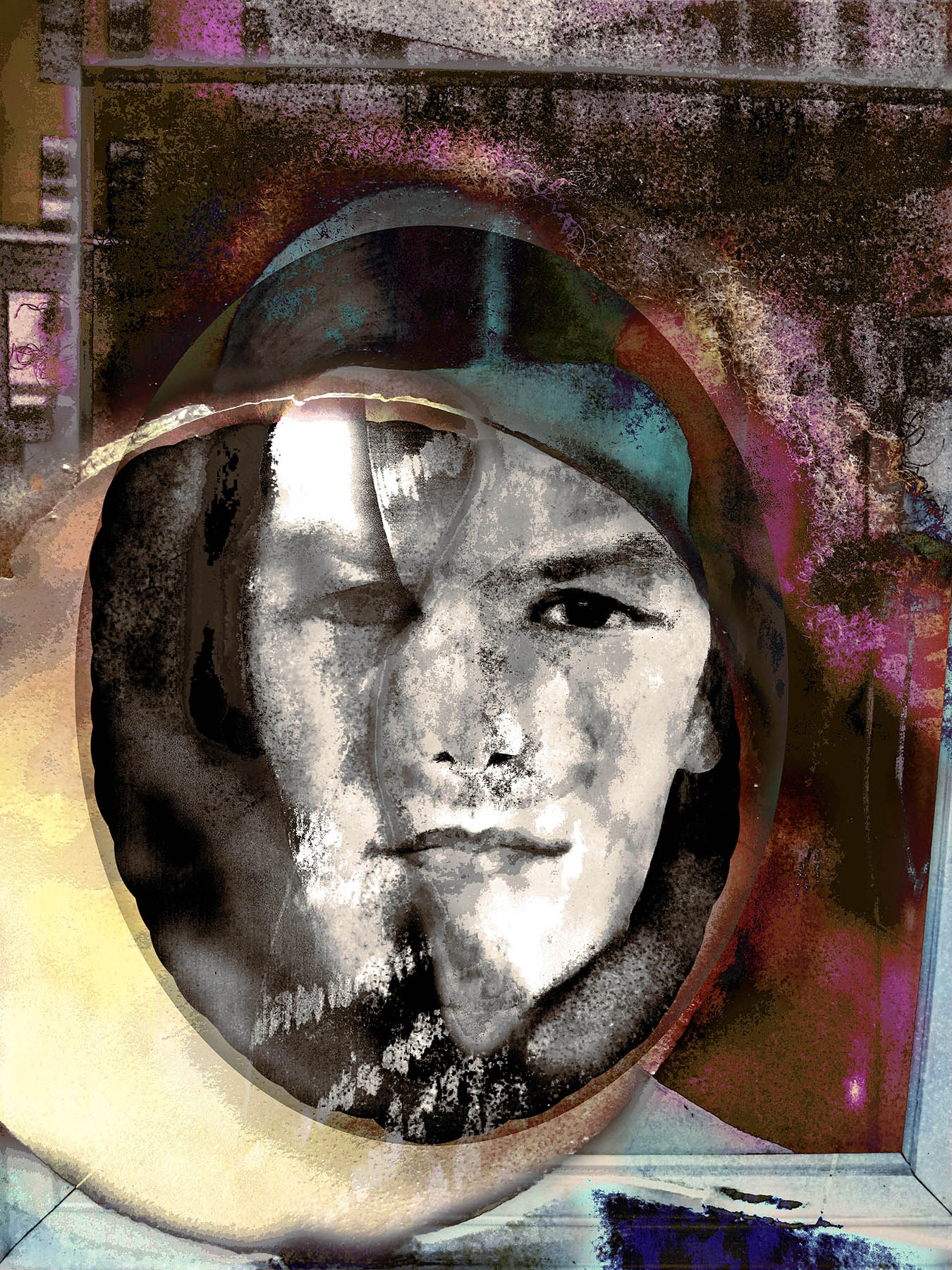
Friderike Heuer Moonlight (2020)

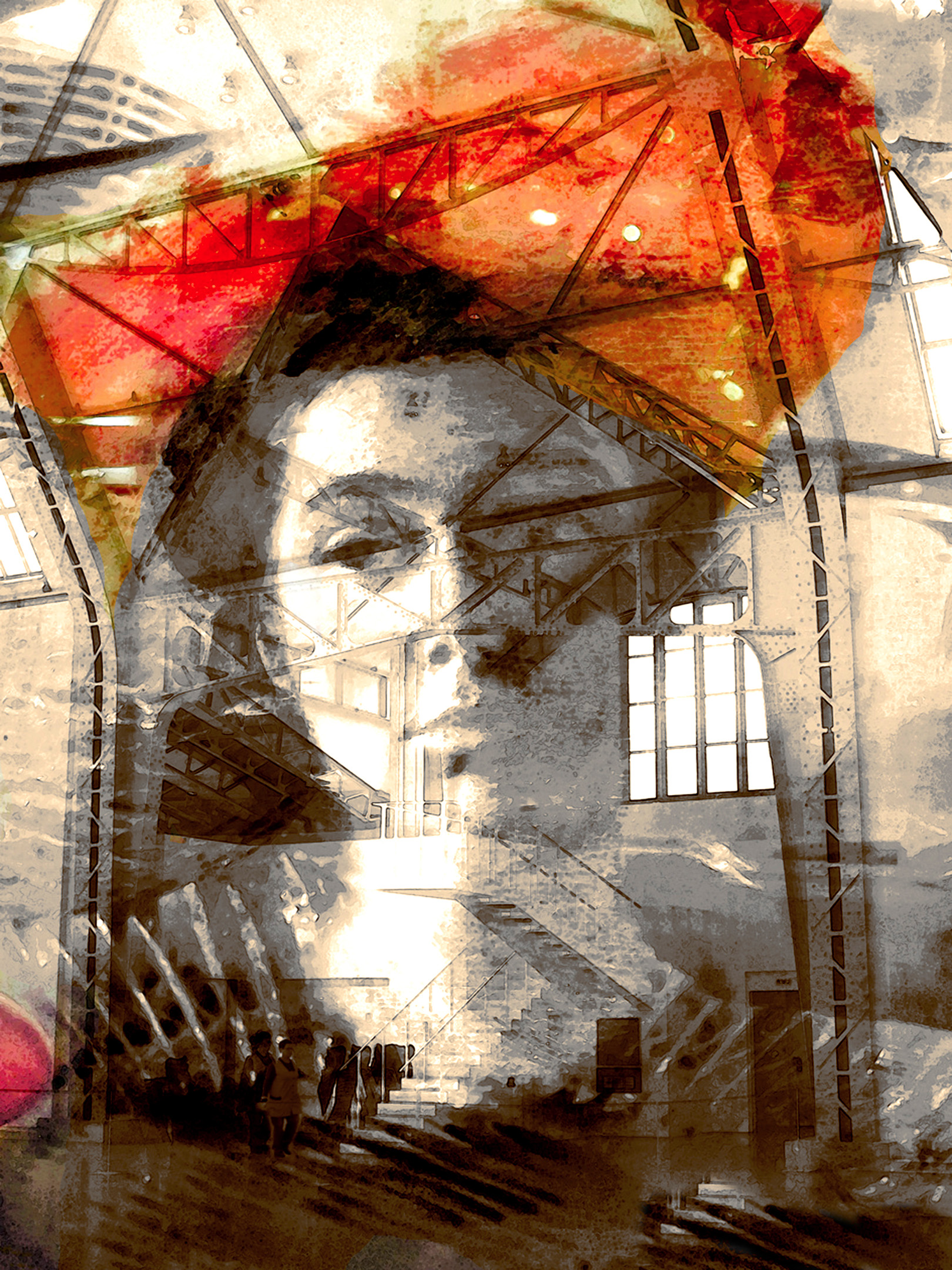
My artist talk for my new montage series, now on exhibition at the Newport Visual Arts Center until April 25, was shut down because of sensible enforcement of social distancing in our coronavirus world. I figured I’ll write about the work instead (in more depth than a 10 minute presentation) and want to give credit to a brilliant short essay I read some years back that influenced my thinking. The author, philosopher James Nguyen, explained in ways even we lesser mortals can understand – he ain’t one of us, just check his education and employment history, we will hear more from this young man – how we can get a grip on complex, complicated issues by finding models that explain them in simpler ways. “All” it takes is a bit of creativity in coming up with the right model and play with it.

Friderike Heuer On the Town (2020)

As an example he used the complex issue of figuring out how fake news spread in our societies and applied a model derived from epidemiology (a full three years, by the way, before we all tuned into that field in our desire to understand the spread of the coronavirus.) You can think of the dispersion of fake news as a virus that is infecting the population and apply to it medical models that track how diseases spread, for example the susceptible, infected, recovered (SIR) model, to reinterpret it. The people who buy into fake news are infected, the ones who now ignore it are immune (recovered) and then there are the masses who are susceptible to it. The SIR model predicts that we can modulate the spread by lowering the proportion of people who are susceptible, slowing down the rate or speed with which the news/virus is dispersed, and increase the rate at which those who started to believe the news/got sick now recover. The right proportion of these three factors (low, low, high) will lead to herd immunity, helping us to tackle an epidemic.

Nguyen points out that just as this scientific approach aims to represent a target, artists attempt to represent a subject. Reasoning about and constructing representations helps us to grasp new perspectives and to learn about the world. “In this sense art and science share a common core; the human ability to construct and interact with representations in order to learn about what it is that they represent.”

Friderike Heuer The Cranes (2020)

*

Fast forward to last summer when I visited the New Bedford Whaling Museum in Massachusetts for the first time. It is a terrific institution, providing tons of sensory experience (walk through the replica of a whale’s heart; board a whaling ship built to scale with every last detail), lots of education about the economics, politics and environmental issues historically associated with the whaling trade, and enticing exhibits of scrimshaw and macramé crafts, tools and weapons used during the expeditions. The museum offers replicas of the living quarters of those who benefitted from the the craze for oil derived from the blubber of whales, oil that burnt bright and without scent or smoke, and the craze for whale bones used in corsets confining women to their breathless, suffocating place. There is also plenty of information about the cruel fate of those doing the actual labor, and dying in the pursuit of profit for their masters. (I wrote about my first visit here.)

The visual art gallery in the museum exhibited some 20 or so paintings, titled The Wind is OpClimate, Culture and Innovation in Dutch Maritime Paintings, by Dutch and Flemish Old Masters from their impressive collection. The maritime paintings and drawings from the 1500s to the 19th century differed in quality, from masterworks to “school of so and so… ” They shared, though, a clear expression of pride and admiration for the explorers, sailors and skill of the seafarers in their midst. The paintings celebrate the heroic and are in awe of maritime prowess and domination of the beasts. 

Friderike Heuer Arctic Still Life (2020)

They also provided testimony for the effects of climate change then: The ‘Little Ice Age’ between 1500 and 1600 greatly affected the character of Dutch whaling in the seventeenth century. The harsh cold that froze rivers and canals changed ocean currents, which impacted trade routes to Asia and America. It also stranded many a sperm whale on Dutch beaches, caught by shallow water, providing increased fascination with the giants for the population. The Dutch were particularly innovative in coping with these climate challenges. They built differently shaped ships adapted to arctic waters, learned to hunt from the shores and found ways to process the blubber either on ships or on shore for efficient transport in barrels sailing towards the Dutch ports.

It struck me then and there that for centuries people were not realizing what the unconstrained killing of whales would do to the species. They were aware that hunting grounds emptied out and they had to venture farther afield, but they possibly ascribed it to the experienced change in temperatures. The scientific knowledge of the possibility of extinction of a species due to overfishing (and the subsequent trickle-down effects) was not available.

Friderike Heuer Hamburg Harbor (2020)

WE, on the other hand, DO know what harms our oceans, and what needs to be done to protect those ecosystems. After all, when 2 million whales were killed in the 20thcentury in the Southern oceans alone, many countries came together to sign the International Convention for the Regulation of Whaling and establish a global body to manage whaling, the International Whaling Commission (IWC.) Its role has grown to tackle conservation issues including bycatch and entanglement, sustainable whale watching, ocean noise, pollution and debris, collisions between whales and ships as climate change impacts migration routes and global warming affects available food sources. 

Friderike Heuer Plastics (2020)

Yet several countries have recently left the organization to take up whaling again, with potentially dire consequences. On a larger scale, all of us, as consumers of plastics and other pollutants that end up in the waters, endanger existing whale populations. In our relentless addiction to the amenities provided by fossil fuel consumption, furthermore, we do little to mitigate climate change that affects maritime biological systems, with feedback loops into weather systems, with feedback loops, for that matter, into how disease spreads and creates pandemics.

Friderike Heuer The Heron (2020)

Clearly we are not heeding the warnings coming from the experts, just like the people of Nineveh, in biblical times, did not open their arms to a – reluctant to begin with – prophet named Jonah, the very one supposed to have been swallowed by a whale. Postcards from Nineveh, then, is the title of my exhibit, riffing on what my work is trying to represent as a reminder of a complex problem – sometimes naive, sometimes willful ignorance affecting environmental protection.

*

So how do you represent the dangers of inaction? For one, you can point to a subject where practically everyone knows how horribly things can go and have gone wrong: people are aware of what has happened to whales. Limitless pursuit of fishing for profit brought several whale species to the brink of extinction across the centuries. Some are still fighting for their survival, like the North Atlantic right whale, others, like the grey whale, are now recovering due to organized intervention. This purpose was served by using excerpts from all the New Bedford whaling art that I photographed, mostly taking snippets with my iPhone. Here is a better example from the museum’s website.

Parts of this painting were used in the montage The Cranes above and Stranded (1) below.

Secondly, you have to represent what is at risk. For me nothing spells that out better than looking at the beauty of nature as we know it, with the implication how it can and will be lost if we don’t change course. The landscapes and seascapes from my photographs originate predominantly in the Pacific Northwest, along the Washington side of the Columbia river and the Oregon coast. There are also nature images from New Mexico, and Germany. Weaving the two elements together, what we know of the past (whaling disaster) and know as the present (the gift that is our landscape, still mostly intact) represents the intersection of human behavior, driven by either lack of knowledge or unwillingness to convert what we know into action.

Friderike Heuer Stranded (2) (2020)

Thirdly, who will be our prophet given the tendency to minimize scientific input either through absence of science education or willful dissing and curtailing of the discipline? Art has to step in and alert us to the issues, and perhaps help persuade us to engage. This aspect is represented by my photographs of art institutions and art, taken across the last decade, from the art museum in my hometown of Hamburg, Germany, Kunsthaus Wien, Museum Hundertwasser, the Barnes Foundation in Philadelphia, the Tacoma Glass Museum, the Philharmonic Concert hall in Los Angeles, the National Museum in Kraków, to the exhibition halls of the Rhode Island School of Design (RISDY) and Montreal’s Arsenal Gallery which resides in a converted shipyard and TOHU, the circus arts organization.

Friderike Heuer Hamburger Kunsthalle (2020)

Friderike Heuer Waiting (2020) (Barnes Foundation)
Friderike Heuer The Starlings (2020) (Tacoma Museum of Glass, Bridge Sculpture)

Friderike Heuer Pacific Sights (2020) (LA Philharmonic Hall)
Friderike Heuer The Mirror (2020) (RISDY, the slats reminded me of the corsets)
Friderike Heuer Still Life with Sea Shell (2020) (Arsenal Gallery Montreal)

*

Good photographers introduce us to their vision of what is in front of our eyes. The way they represent something is by means of selecting a specific perspective, capturing a certain mood, structuring their composition – in the end, though, they depict. Photographs show a world that exists, however subjectively perceived.

Photomontages, on the other hand, convey something that is constructed, giving the artist the leeway to represent possibilities, anomalies, products of imagination, just like painters do. By combining, manipulating, and altering photographs they create something that cannot be found in reality and yet conveys a sense of alternate reality, of imagined recourse. The way they come about in my own case is not me sitting with a checklist of the aspects of the model discussed above in front of my computer program that helps me create these works. I am loosely guided by the original thoughts about representation, and use only things I photographed myself, but the rest unfolds organically and often in ways that surprise myself.

Take, for example, this image, Reminiscence, an invitation to look at the past.

Friderike Heuer, Reminiscence (2020)

The Dutch landscape, painted centuries ago, is one I saw every summer as a child. I lived in Holland for a year as a young child, and then for a decade at the German side of the border with Holland, and our summers were spent at the North Sea, with boats like the old ones depicted still occasionally appearing in the seascape of the 1950s. The figure is a self portrait of a Finnish photographer I greatly admire, Eliana Brotherus. I photographed her work in Vienna, 2 years ago. She herself linked to the past in her portrait series by appropriating the landscape, stance and coat of Caspar David Friedrich, a German painter of the romantic period, and she reminded me of pictures of myself when still young. I intended to make the figure transparent to represent how the past seeps through into the present, guiding us forwards or holding us back, who knows. When I looked at the image, though, all it reminded me of was how thin skinned I am – both porous for the onslaught of information that I seek every day, visually and otherwise, but also for absorbing the emotional currents around me, strained and otherwise, often forcing me to withdraw. It bubbled up into the montage, unintended.

Or, as a different example, several of the montages ended up representing some aspects of colonial invasion of this continent, not necessarily tied to whaling but to maritime prowess that led to the endangering or extinction related to our own species, the humans, ways of life and languages of First Nations.

Friderike Heuer Confluence (2020) (Columbia River Channel)
Friderike Heuer Stranded (1) (2020) (New Mexico at Kasha-Katuwe National Monument)

One thing I was certain about, though, was that I did not want to lecture with a sledgehammer. I picked a rather small format for the montages, so they don’t overwhelm, but beckon for intimate interaction, inviting the viewer to come close to see the details. I wanted to give the Dutch and Flemish painters of yore a platform to celebrate their artistic achievements and importance to our understanding of history. And I wanted my own work to be beautiful to reach people’s minds, more so than disquieting, although I seem to be unable to avoid the latter completely regardless of what topic I tackle.

Friderike Heuer The Wish (2020)

Now all we need is someone to review the work to see if it actually accomplishes what I set out to do: to remind us that we cannot simply interfere with nature without consequences, or keep up our behavior blind to what is required to protect what we love. Send me a postcard!

PS: True gratitude to my fellow photographers and friends Ken Hochfeld, who printed and framed and critiqued everything you see here, and Dale Schreiner who helped me to sequence the series – his habitual role in all of my exhibitions. A thank you also to Tom Webb who runs the VAC in Newport and invited me to show and hung it in the upstairs gallery. And a shoutout to Steve and Barbara Blair who photographed the work during a visit this weekend – I still have not seen it in real life in the gallery!

Breaking: Talk Canceled

Folks, disappointing but justified news: the City of Newport canceled all nonessential public events – artist talk tomorrow 3/14/20 at the Newport Visual Arts Center is not going to take place. I will blog about the rationale for the series on Monday instead in case you are interested…. stranded, for now.

Deal with It!

I started the week with stealing a title and I’ll end it the same way.

Deal with It is the title of a podcast that features interviews with Lee Krasner (1908 – 1984), one in a group of podcasts that I am sending your way today. It is, of course, a fitting exhortation in these uncertain times, one I find myself muttering frequently, even though I am clueless about how to accomplish the command.

Deal with It

Maybe podcasts will help. I figured you might need some truly interesting presentations during long hours of self-isolating, or fighting yet another cold, or simply needing to hear something empowering during these challenging times.

The whole series, Radical Women, is a wonder. Here is the introduction, all sources and photographs courtesy of the Getty Research Institute:

What was it like to be a woman making art during the feminist and civil rights movements? In this season of Recording Artists, host Helen Molesworth delves into the lives and careers of six women artists spanning several generations. Hear them describe, in their own words, their work, relationships, and feelings about the ongoing march of feminism. Contemporary artists and art historians join the conversation, offering their own perspectives on the recordings and exploring what it meant—and still means—to be a woman and an artist. This podcast is based on interviews from the 1960s and ’70s by Cindy Nemser and Barbara Rose, drawn from the archives of the Getty Research Institute.

Take your pick: Alice Neel (1900–1984).

Viva La Mujer

Betye Saar (b. 1926)

Working my Mojo

Helen Frankenthaler (1928–2011) Hah!

Let ‘er Rip

Yoko Ono (b. 1933)

A Kind of Meeting Point

Eva Hesse (1936–1970)

Oh, More Absurdity

So there we have it: in this week devoted to women’s history we started with composers, went on to activists, pilots, then scientists and now artists as a cross section of role models, all resurrected from forgetting. If that isn’t motivating to fight the blues, what could possibly be?

Maybe this? A list of the ten National Parks that would not exist without the championship of women?

Or simply singing the Blues?

Dividing Passages

So far this week I have compared cubist, expressionist and abstract paintings to images I photographed in nature. Today I want to venture a bit further and talk about a subject matter that is frequently found in visual art and also a regular motif for the traveling photographer. Doors, in other words.

Doors as the substrate of a painting as well as its subject can be found as early as the fifteenth century. Dutch painters used triptychs: a format that consists of three panels that are hinged together and can be closed like a door. They functioned as a prayer aid, trying to help the observer to enter a meditative state with access to the divine world, but clearly setting up a boundary between every day life and the sacred through the focus on passageways. Doors were prominently painted within the triptychs as well, driving the point home of separation but also access to the divine. Different painters addressed different audiences: Robert Campin (1375-1444, usually identified with the Master of Flemalle) painted the annunciation within a domestic setting in the Merode Altarpiece to encourage private devotion in the home. Rogier van der Weyden organized the Miraflores Altarpiece in a series of archways to aid monks in completing the rosary. And Hugo van Der Goes created in the Portinari Altarpiece a Nativity scene to encourage hospital employees, and comfort sick patients with the notion of salvation. The use of doors was clearly linked to religious contemplation and communication with a higher power, but solidly set in environments familiar to the viewer.

*

That is somewhat different when we reach the romantic era, where religion is changing, with people turning to more secular forms of comfort, leaving a weakening church behind and, for pragmatic reasons, separate what used to be church functions from their origins. Take cemeteries, for example. They used to be on church grounds, but are now, with the growth of populations in the 19th century, their own separate entities often at a distance from the city gates.

Caspar David Friedrich, Abtei im Eichwald, (Abbey in the Oak Forest), 1809/10
Cemetery New Mexico
Cemetery South Carolina

One of the most famous paintings of the era is Caspar David Friedrich’s depiction of a funeral at the abby in an oak forest. It is a dreamlike landscape, the church in ruins, the portal open to be taken on by nature, which also looks, frankly, decrepit. Some lonely monks try to bury what is presumed to be the painter (who by the way was involved as designer for all the modern secular cemeteries around Dresden.) The door between life and death, between the past (with its comforts of structured religion now decaying) and the presence (where nature is not exactly up to task to provide divine comfort) – how more symbolic can it get? (I learned all this here, in a fascinating essay on Friedrich’s burial paintings.)

*

Moving forward in time, we find more reductive representations: Matisse’s french door that seems to frame a void. Original the central space contained a balcony and a landscape, but he blackened them out, at some point relating that “I’ve been forty years discovering that the queen of all colors is black.” What are we supposed to experience? A sense of night, beckoning? Something reduced to framing of uncertain passage? Is it me, or does it give you goosebumps as well? (If you live close to Baltimore or visit, don’t miss the Baltimore Museum, housing the largest Matisse collection in the world and opening a new center next year.)

Henri Matisse, French Window at Collioure, 1914

*

Artist with a sense of humor to the rescue: Just look at Marcel Duchamp’s door that he installed in his French apartment in 1927.

Marcel Duchamp, Door: II, rue Larrey, 1927

It served two doorways (between the studio and the bedroom, and the studio and the bathroom). The door could be both open and closed at the same time, thus providing Duchamp with a household paradox as well as a practical space-saving device. The “practical space-saving device” belongs more to a set for a bedroom farce. Duchamp’s rooms-whether filled with string, prank doors, or readymades provoking pratfalls-all confound the logic of work and efficiency. Instead, when Duchamp altered the purposes of both rooms and objects, to provoke play rather than work, laughter becomes their new “function.” A detailed, clever description of Duchamp’s life-long, successful attempts to avoid work (or point to it as a factor in alienation if used within the industrial context) and introduce play (helped by the fact that he was “kept” by numerous rich benefactors all of his life) can be found here.

*

Might as well turn to the surrealists and who better to serve us with passageways into another realm than Rene Magritte? I would not mind having these two doors, painted 23 years apart, in my life. That little cloud, which sails into (or out of) proximity to the sea, obligingly using the passageway instead of ignoring it and flying high, looks like it is curious, but also might be squashed in an instant if someone bangs the door… reminding me that I better pick my own path instead of following the beckoning of open doors. So who is victorious here?

Rene Magritte, La Victoire, 1939

And what was improved here? Some shade provided? A time-travel capsule if you dare step through that door? Many happy little clouds giving that sky a jubilant feel? Your guess is as good as mine, but these are doors that invite rather than forbid.

René MagritteThe improvement (L’embellie), 1962

And finally here is a door that appeals to me visually, but I would never ever follow an invitation to pass through it from its painter, Willem de Kooning. If you have it in you to read a review of his work, dripping in psychoanalytic jargon misplaced in an art review, but truly perceptive once you get to the core issues, you’ll understand my reluctance.

Willem de Kooning, Door to the River, 1960

Luckily, there are many other doors to chose from.

Closing the door on today’s musings is music by a contemporary of Friedrich: Felix Mendelssohn.

Shared Fields

Do you know that feeling when you have completely conflicting reactions to a person or an event? When a lot strikes you as admirable or interesting or unusual, but other things bug you, and you can’t quite find a resolution to that emotional tension? So it is with me and Helen Frankenthaler (1928 – 2011), today’s painter of choice, since large blocks of landscape colors reminded me of her color fields.

Helen Frankenthaler (American, 1928–2011). Hint from Bassano, 1973. 

She was born into an upper-class, wealthy and cultured New York family and early on given a sense of superiority by her father, New York state supreme court judge Alfred Frankenthaler. Her life was defined by remaining within that class and its perks, with multiple residences, staff, the works. Her education was privileged from the beginning, from ultra-conservative prep-schools to progressive institutions like Bennington College. Affairs and then marriage to arrived art critics and artists opened the door to the intensely creative world of the 1950s, including exposure to Jackson Pollock who stimulated her thinking about painting method. A short stint of being mentored by Hans Hofman, one of my own favorites (I wrote about him here) set her on her path, never looking back after that.

Helen Frankenthaler, Provincetown Window, 1963-64.

Yet she paved her own way, and despite all her socially somewhat conservative inclinations she was nothing less than revolutionary when it came to her art. And she came to it on her own – after a bitter break-up after 5 years with Clement Greenberg, the art critic du jour, and before her 1958 marriage to Robert Motherwell, another unusually wealthy artist, she managed to achieve recognition as one of the few women in the mid-century art world by pushing away from expressionism into true abstraction. (The marriage ended in 1971, she later wed an investment banker.)

Helen Frankenthaler, Untitled (Cover of a book, not dated.)

She was 23 years old when she started to paint in ways that would be known as the color field movement, influencing other artists later associated with that school. Pouring thinned oil paint on unprepared canvasses which absorbed it while flat on the ground (rather than using a brush), she created luminous, evanescent paintings that hinted at landscape but were as ambiguous as only good abstract art can be. British art critic Nigel Gosling reviewed her in 1964: “If any artist can give us aid and comfort,” he wrote, “Helen Frankenthaler can with her great splashes of soft colour on huge square canvases. They are big but not bold, abstract but not empty or clinical, free but orderly, lively but intensely relaxed and peaceful … They are vaguely feminine in the way water is feminine – dissolving and instinctive, and on an enveloping scale.”

Helen Frankenthaler, For E.M, 1982

I have always thought that she had the courage to create beauty (for women in general a treacherous undertaking, in my view,) but sometimes it was almost too beautiful. I was gratified when I found this review by Deborah Solomon which expresses my reservations in better ways than I could. Written in 1989 for the New York Times, she teases apart the contradictions between the artist’s bourgeois, anti-feminist, controlling nature and her lyrical work that depends to a large extent on accidents and improvisation.

Helen Frankenthaler, Tantric, 1977

It was, above all, beauty she was after, managing to translate ephemeral watercolor-like paintings onto a truly large scale. In later years sponges, squeegees and mops were added to the mix, now spreading diluted acrylics onto raw canvas, but the style pretty much remained the same, yet nowhere seeming boring. She did not seem to mind that the art world had moved on and the younger set deemed her caught in the past – that I admire too: to stick to your ways of expression independent of vogue.

Helen Frankenthaler, Canal, 1963

In her own words:”What concerns me when I work is not whether the picture is a landscape, or whether it’s pastoral, or whether somebody will see a sunset in it. What concerns me is – did I make a beautiful picture?”

Below are two videos describing her life and recording her musings during a visit here at Portland State University some 50 years ago.

And here is a local artist, recently discussed, who continues a tradition of luminosity.

And here is music that reminds me of Frankenthaler’s soothing effects on my mind – an unapologetic melodic approach with hints of romanticism.

Shared Colors

Here are some skies. The painted ones reflect the landscape of Northern Germany, up at the North Sea. The photographed ones were all taken while looking at the Pacific, a century later. I loved the painter, Emil Nolde (1867 – 1956), for much of my early life, being drawn to the color work, his expressionism, an unmatched intensity in his paintings – and the myth that he was the courageously resisting victim of Nazi terror, re-told in a famous novel by Siegfried Lenz, The German Lesson.

Emil Nolde, Meer (hoher Himmel, dunkel-grünes Wasser, qualmender Dampfer)
  1946–1947

I am still fascinated by the evocativeness of his colorization, the way it makes me ask is this really how the maritime sky looks? Indeed, it does! But everything else has collapsed, the beliefs that were so carefully instilled in post-war Germany, and the admiration that had been based on false premises.

Emil Nolde, Dampfer unter rot gelbem Himmel, circa 1935

Nolde was a man who was energetically and successfully building legends around his status as an artist, from day one. He was the misunderstood genius, the martyr at the hands (depending on the era in question) of the Jewish cabal dominating the art market who would not allow a true, pure nordic German to be successful, or at the hands of the Nazis who suppressed his art.

Emil Nolde, Dampfer unter gelbem Himmel, circa 1946

As it turns out, he was an ardent National Socialist himself (as was his wife Ada), a virulent anti-Semite, who even after the war did not change autobiographical writings depicting his loathing for Jews, and who stopped painting religious motifs because he could no longer stand painting “Jews.” Letters from him to Goering and Hitler contained suggestions as to how to rid Germany of “that race.” His subject matter shifted over to painting Vikings and other nordic mythology in the belief he could this way participate in forming the national-socialist art canon.

Emil Nolde, Rote Wolke, circa 1930

In 1933 he admired the writings of fascist Julius Langbehn (Rembrandt as Educator) who claimed that “a pure German art was needed to counteract modernist malaise. He deplored internationalism, mass culture, big city life, argued against specialization, knowledge, a culture of enlightenment, and called for a return to an education of the heart, based on character and individualism, the root of all German art.” Nolde loved this image of a national redeemer, the artist as a German quasi-religious idol. His unmet craving for recognition morphed into a sense of mission that he saw matched by the Führer’s plans. Alas, the admiration was not mutual. Hitler was rejecting the modernism exhibited by Nolde and assigned some of his work to the degenerate art exhibitions (soon to be removed from them by some high-up Nolde admirers in the 3rd Reich administration.) He was, however, sanctioned not with a prohibition to paint (as his later legend has it) but by restrictions on his possibility to freely seek and/or exhibit his art.

Emil Nolde, Herbsthimmel am Meer circa 1940

After the war Nolde carefully crafted the story of himself as a secret resister, having painted 1000s of small works (the unpainted pictures) while being checked on by the Gestapo (a lie.) The paintings date back to almost a decade before he was told to desist sales, and include topics that expressed alliance to the Nazi cause. Here is the interesting thing: much of German society was all too eager to join into this myth building, desperately needing a collective moral saga that matched each person’s need to absolve themselves from accusations of conformity if not collaboration, showing a way out: they had all gone into some kind of inner emigration. The Foundation archiving his work refused all access to incriminating written materials, benefitting from the myth making themselves. Nolde became a figure of cultural identification in post-war Germany, where clean heroes were desperately needed to regain a sense of identity and self-esteem. He was deemed the modern martyr who relentlessly served his art, regardless of defamation and persecution, helping people to redefine their own roles during the 3rd Reich.

Emil Nolde, Landschaft mit hohem Himmel und roten Wolken
circa 1930-1935

Last year saw the first comprehensive revision of the legend around this painter at a retrospective exhibition in Berlin, with a catalogue exploring the true history. The Nolde foundation is now under new leadership and fully participant in the research efforts.

Here is a fabulous review that offers more detail.

Music today from another Northern-born German, Johannes Brahms. No conflict between self presentation and content here, or between his art and his identity. Sigh of relief.

Shared Forms

Last year the Centre Pompidou did a retrospective of Victor Vasarely’s life works, titled Le Partage Des Formes, Shared Forms. I only read about it, but the title stuck in my head. It probably referred to the repetitive, grouped forms in his paintings. I, on the other hand, often see forms in nature which remind me of abstract art, and I always wonder what unconscious influence is extended by having been exposed to these patterns across a life time. Art offering its share of nature.

As a little exercise, then, I tried to come up with photographs I took on my walks and match them up with art works that they reminded me of. I’ve added a short description of the painter’s life, keeping us as far away from discussion of politics as possible. I think it helps to look at something beautiful, just to keep our spirits up.

Georges Braque, Still Life with Metronome, 1909

Vasarely’s work might, in individual instances, fit the bill for today’s nature photographs, but overall his op-art paintings are just too regular and bent towards creating visual illusions. Someone else, however, hits the jack pot: Georges Braque.

Georges Braque, Bottle and Fishes, 1910-1912

Born in 1882 in France, he was a trained as a house painter, but interested enough in fine art that he pursued an education. Originally influenced by Fauvism, he soon struck up a friendship with Picasso. (In his own words, they were tied together for some time like mountain climbers on a rope.) The two revolutionized painting by developing Cubism in parallel. The first, Analytical phase of Cubism was dominated by slab volumes, somber colouring, and warped perspective.

 “The colours are brown, gray, and green, the pictorial space is almost flat, viewpoints and light sources are multiplied, contours are broken, volumes are often transparent, and facets are turned into apparently illogical simultaneous views.”

Exactly the kind of view of sandstone and basalt cliffs when you inspect them closely.

Georges Braque, Piano and Mandolin, 1909

Braque became famous and well-to-do during his life time. He served in WW I with distinction, incurring a serious head wound that required multiple surgeries and months of recuperation. He had but one wife, and eventually separated from Picasso who chose a very different path. He died in 1963, with the last years of his life devoted to more figurative painting and subjects of Greek mythology.

Georges Braque, Le Sacre Coeur, 1910

Of particular interest to me is his development of collage work; he was one of the first to add paper and other substances to his paintings in his later career. He wrote much about the fact that paintings should no just be the representation of an anecdote, but an independent object. That is the inherent joy for me, of course, when I make montages: creating something that is in itself new and non-existent in reality from something as reality-based as possible: photographs. A representational illusion.

Here, however, is the representation of the real thing!

And here is the website of contemporary Oregon artist Lee Musgrave, who has a penchant for echoing nature in his abstract art or find abstraction in nature, depending on where and when the muse strikes him.

Music today is a 1917 ballet with cubist influence, Parade, composed by Eric Satie for a one-act scenario by Jean Cocteau, original costume design by Picasso. For the overlapping fragments, Satie uses jazz elements, a whistle, siren, and typewriter in his score.

For something a little bit more melodious: Here are the piano works.

Silence, golden?

So here is a dilemma: do I listen to the advice of my Beloved who insists that art shouldn’t come with an instruction manual? Or do I listen to the urging of friends to provide extensive explanations for my, admittedly, often complex photomontages? Do I tease with titles? Rely on short introductory artist statements? Write up lengthy descriptions of individual works?

Montages today from an old series (S)Elective Affinities Here: Water Rats

It is not just a theoretical question. I have two exhibitions coming up, with two very different series, and quite a body of work. (Details attached below.) With no introduction whatsoever you can have the most personal encounter with an image possible, defined by your own visual pleasure or your own thoughts evoked by the piece. Will you miss something? Perhaps. Will you understand what I was trying to accomplish? Maybe. Will your reaction be influenced by some extraneous manipulations? Definitely not.

On the other hand, does it help to understand the context of the larger body of work to decipher this or that meaning? You bet. Do textual references enable you to understand the framework and relations to art-historical elements? I’d say. Can I smuggle concepts and ideas into your head that guide your perception? Count on it.

La Couturière

It is all about manipulating attention.

I’ll save the truly fascinating, larger topic of attention research for some other day and focus on the basics today relevant to the questions above.

In the simplest of terms, attention is a mechanism that relies on multiple control mechanism. The exogenous control of attention comes from stimuli in the environment that trigger your attention automatically – the streaking movement perceived from the corner of your eye that has you look to where it came from. The piercing noise that alerts you whether your like it or not. A sudden burst of color that grabs you. A design of a page that draws your eye to a certain position. Something is literally grabbing your attention, hard, if not impossible, to resist.

Parallel to that we can control much of our attention endogenously, choosing where to look and what to process on the basis of what holds meaning for us, what we are trying to find, or what we expect to see or when to see it. (This, by the way, is what makes experts so good at perceiving in their field of expertise: they know where to attend at what point in time, which is crucial for events unfolding in time – think referees at a sports competition or mothers catching the kid at the moment where it falls off the play-structure.

The Analysis

Back to art: If I put a concept into your head, by alluding to something, or simply asking a question, or showing you hints that trigger stereotypes, you will attend to the work in front of you trying to integrate what you see with what you ponder. Here is the classic demonstration (Yarbus, 1967) by a Russian psychologist who used one of the very first eye trackers to check where people attended when moving their eyes to various locations on a given stimulus.

He asked subjects to look at a reproduction of a Russion oil painting An Unexpected Visitor painted by Ilya Repin in 1884, with different questions in mind, provided by the experimenter. The conditions included [1] examine the painting freely. [2] estimate the material circumstances of the family. [3] assess the ages of the characters [4] determine the activities of the family prior to the visitor’s arrival. [5] remember the characters’ clothes. And [6] surmise how long the visitor had been away from the family.

As you can see the patterns of eye movements (the black lines going back and forth) to explore the painting was dramatically different from condition to condition, with your “set” or assumptions about the potential discovery guiding your attention.

Here is an overlay of 2 question conditions and the recorded eye movements onto the actual color reproduction, making the differences even clearer (work by Sasha Archibald) (free examination at center, question about material circumstances of the family to the right.)

And here is of course the trick: only those things you attend to will get fully processed in your visual system, and potentially put into your memory stores. Unattended input might linger on some low levels of the processing hierarchy but will soon end up in the dustbin with all the other junk our brains discard. Details that might have significance will be simply overlooked if we were not conceptually driven to check them out. That might be of crucial importance if you are called as an eyewitness. But it also might affect how you embrace or understand a work of art, particularly if it is detailed and representational.

The Director

Then again, you might share the opinion of one half of our current household: I either like it or not!

Exhibit 1: Tied to the Moon

Stevens-Crawford Heritage House Museum
603 6th St, Oregon City
March – June 2020
Open: Friday – Saturday, 11:00am – 4:00pm
Admission: $5

Artist Reception on March 21st – 11:00 am – 1:00 pm

http://clackamashistory.org

This 2019 photomontage series describes some of the common experiences of women across centuries. Just like our physiologies are tied to the phases of the moon so are we tied through shared life events and states connected to our lives. A lot has changed for women; not enough has changed for women. Giving birth, raising children, aging, being loved or abandoned, being controlled or forging our own path has always been basic to the female experience. Finding solace among sisters or competing for scraps as rivals was often part of our existence. Curiosity, skepticism, learning and rebelling had to be fought for. Longing, dreaming and hope were part of the way.

Exhibit 2: Postcards from Nineveh

Oregon Coast Council for the Arts

Newport Visual Arts Center – 777 NW Beach Drive, Newport, OR 97365

March 7 – April 25, 2020

Artist Reception March 14, 1:00 – 5:00 pm, talk at 4:00 pm

On display is a new (2020) series of works that combine photographed snippets of 17th-century Dutch paintings of whaling expeditions along with contemporary environments.  It calls for attention to environmental stewardship at a time where nature is under threat. The title is a play on Jonah (the one swallowed by a whale) who was a reluctant prophet, ignored by the people of Nineveh. We, on the other hand, should listen to clarion calls about the need to protect our oceans and fish populations.”

Here is a piece of music by Arvo Pärt where silence commands everything around it. (For more examples of composers using silence, go here.)

Portland Art and Learning Studio: Ebullience

There is an Outside spread Without & an outside spread Within
Beyond the Outline of Identity both ways, which meet in One:
An orbed Void of doubt, despair, hunger & thirst & sorrow.

William BlakeJerusalem (1818).

Let me not mince words: I despise the term outsider art. Yes, I know the definition is loose – it can refer to anything, from art by those not trained as artists, or not affected by a particular culture, or living on the margins of society, or living with a disability or mental illness – often in any possible combination of all of these. And yes, I know we are stuck with the term, since it has taken on a life of its own ever since people started collecting this art. It is part of a commodity market always on the look-out for something new, something striking, something that money can be invested in.

Marker work by Lindsay Scheu

Lindsay Scheu

The very fact that you call some artists “outsiders,” (including those living with disabilities, who are our family, our neighbors, our clients and, yes, our friends,) perpetuates a tendency toward segregation rather than integration, to the loss of all involved. All, that is, but cutting edge curators and collectors who boost their bottom line, staging art fairs and exhibitions of the few among the legions of creative “outsiders” who somehow make it to the top of the art market.

Shannon Anderson

One might argue – and people do – that the invitation to show and sell outsider art removes some of the stigma that is associated with being different from societal norms, and alleviates the poverty that is often correlated with the struggle to make it as a person living with disability. Well, if the art is good enough to break through, why add to it a diagnostic label, triggering stereotypes of illness which we know to be still so pervasive? A bit of frisson? A bit of a kick that you are now leaving the comfort zone? Why invite the demarcation painfully experienced in real life at the boundaries between norm and not-norm into the language, perpetuating it?

*

In the 19th century they called people like William Blake, one of the first and finest protagonists of this art genre, “madmen,” or eccentrics, not outsiders. They still used those words in the 20th century when psychiatrists started to write about the art produced by their patients in asylums. Walter Morgenthaler’s A Mental Patient as Artist (1921) and Hans Prinzhorn’s Bildnerei der Geisteskranken. Ein Beitrag zur Psychologie und Psychopatologie der Gestaltung (Artistry of the mentally ill: a contribution to the psychology and psychopathology of configuration) (1922) made a splash in their time, leading to some cross fertilization with the emerging art movement of Surrealism.

Ceramic Studio – Mask by Mathew Spencer

Painters Jean Dubuffet and André Breton coined the term Art Brut, Raw Art, collecting innovative and sui generis works of art of those outside the mainstream. (A more detailed definition and a treasure-trove of art can be found at the Collection de l’Art Brut at Lausanne, CH.) It was not until the 1970s that the term Outsider Art was introduced, in a pathbreaking book with same title by Roger Cardinal. These days, variations abound. Marginal Art, or Art Singulier, are terms applied to anyone who is not fully included and shows novelty of expression or culture-independent vision. Closer to home we often find self-taught as a term being used to describe art produced by the above populations. In a society that values educational achievement as much as our’s, this seems to replace one stigma with another, but perhaps weaker one.

Caitlin Pruett

*

Luckily, there are places of art being made and displayed, where terminology is of no interest, and where the creative experience of singular human beings rules the day. It was one of the most pleasurable moments in recent weeks when I discovered just one such place close by: The Portland Art and Learning Studio (PALS) in NE Portland. PALS is a program of Albertina Kerr—a local nonprofit that empowers people experiencing intellectual or developmental disabilities, mental health challenges, and other social barriers to lead self-determined lives and reach their full potential. The program is made possible by gifts and grants of the community. Check it out here: PortlandArtAndLearningStudio.com.

PALS Building on MLK

The building alone is inviting, and the staff, from a genuinely friendly receptionist, multiple instructors and interns, to the intensely engaged and perceptive Ass. Director Chandra Glaeseman, serves some 90 clients with visible dedication. Both Chandra and instructor Malcolm Hecht took time out to introduce me to the program and the participants and show me around the space.

Instructor Malcom Hecht

A large, industrial hall is divided into multiple work stations that offer about any creative activity you can think of. Ceramics, painting, fabric arts, digital art, music, writing, beading, you name it. Tables provide spaces to interact, have lunch or snacks, and be creative. Some corners allow for more uninterrupted time to make books, or paint. A 1:4 or 5 ratio of staff to clients allows for individualized attention. A loudspeaker system helps to remind people that their transportation has arrived and they independently move about.

Brian Moran in conversation with Quinn Gansedo
Ed Case, Terrie Bush and Ed Papst enjoying lunch

The place is open to the public who can come and visit a brightly lit gallery that displays art both of local participants and traveling exhibits from allied organizations, like the Land Gallery in New York City, Creative Growth in Oakland, CA and Creativity Explored in Richmond, CA. Visitors can also peruse the works at the different artists stations and purchase them directly from the artist or craftsperson.

Gallery Space in the Building

*

PALS was opened some 19 months ago and still has capacity to accept more clients. Glaeseman is an engaged, hands-on leader of the program. Educated at the Maine College of Arts, she went on to receive her MFA from the Rhodes Island School of Design in 2008, including a Sculpture Magazine Outstanding Student award and RISDY’s Award of Excellence, juried by Ian Berry of the Tang Museum. During stints as adjunct faculty at PNCA, Lewis&Clark College and Willamette University she added teaching experience to her artistic practice. I am glad she did not waste resources to pursue additional achievements in social work or clinical psych, since from everything I observed, interacting with people in a genuinely caring and simultaneously pragmatic eye-to-eye fashion comes natural to her.

Director Chandra Glaeseman

Chandra (a truly apt name, I thought, when I learned it means bright star in the sky) has multiple goals for the growth of the organization, goals that are actively supported by management, in particular CEO Jeff Carr at Albertina Kerr. Her vision, for one, is to help clients increase their autonomy, and to provide tools via any kind of creative practice, not just visual art, to achieve more independence. In her experience making art provides a skill set that is transferable to everyday problem solving, however non-lineal the process might be.

Jeanette Mill, concentrating
James Enos

Secondly, she also promotes an attitude towards risk taking which signals that failure is acceptable, even welcome. Providing a safe space to fail, a space free from judgmental criticism, secures learning. Best case scenario, it also increases self confidence and the tools to take on real jobs in the community that recognizes the ability levels achieved at PALS.

Ginger Matthews

Last but not least, the hope is to connect PALS’ artists to the outside world, participating, for example, at the Outsider Artfair in NYC, where progressive studios have national representation and organizations can network to support each others’ work in the field.

David Hunt Waterfalls
Nick Shchepin Weaving

Heather Kreager, Fabric Art
Ed Papst Quilting

*

“Museums are managers of consciousness. They give us an interpretation of history, of how to view the world and locate ourselves in it. They are, if you want to put it in positive terms, great educational institutions. If you want to put it in negative terms, they are propaganda machines.” – NYC-based German artist Hans Haacke, (2019)

Who needs NYC when we have Gallery 114 in Portland, OR, not a museum but an artist collective that was founded in 1990. Haacke’s views of the role of art institutions, and his artistic focus on the social, political, and economic structures in which art is produced, exhibited and purchased, seem to be a good reminder what progressive galleries can and should do: educate.

Ebullience – Getting ready for opening night at Gallery 114
Gallery member and curator Diane Kendall
Gallery members and curators Joanie Krug and David Slader in back

Gallery 114’s dedication to inclusion of less-represented populations is remarkable – whether they open their space to poetry readings by Street Roots vendors, or hang exhibitions like the one this month on display. The current show, Ebullience, presents the diverse creative outpouring from PALS’ artists. The title couldn’t be more fitting – the work on display lights up the gallery’s rooms that are tucked in the Souterrain.

Judy Nuding, Brian Beckham, Alister Bond, Jamond Williams, Steven Jean-Marie. Acrylic, Oil-pastel, and Paper Collage on Canvas. Detail below.

Sculpture, weaving, drawing and painting all hold their own, thoughtfully curated in cooperation with PALS staff, by artists Diane Kendall, David Slader and Joanie Krug (who as a volunteer at PALS saw the potential and made the connection.)

Endale Abraham, A Palace fit for a King, Acrylic and Graphite on Canvas
Lindsay Scheu Untitled Marker on Matte Board
Ricky Bearghost, Untitled, woven Plastic, Wooden and hand-made Ceramic Beads, Leaves, AcrylicPaint. and Pom-Poms. Detail below,

The work might open new perspectives on how to view the world, a world not necessarily familiar. Viewing this world might shift the rigid boundaries between “us” and “them,” locating all of us on a continuum, rather than in disparate regions, inside for some, outside for others.

David Hunt Untitled (Waterfalls) Watercolor and Markers on Paper
PALS Collaboration with EATCHO, Acrylic on Canvas
Jamond Williams Untitled, Watercolor, Graphite and Markers on Paper

Make time for a visit, in the gallery or at PALS’ studio space, it will brighten your day. There is an effervescent mood at both places right now that gives rise to hope: hope for more empathy, more understanding, for unbridled joy in making art and, importantly, for inclusion.

Gallery 114Ebullience

1100 NW Glisan Street 
Portland, OR. 97209
503-243-3356

Thu, Feb 6, 2020 to Sat, Feb 28, 2020

Hours: Thursday – Sunday, 12pm – 6pm

——————————-

Portland Art and Learning Studios
Mon.-Fri., 9 a.m.-2 p.m.
4852 NE Martin Luther King, Jr. Blvd.
Portland, OR 97211
503-528-0744

Southern Rites

What do I want? Why do I want it? And how do I get it?” – Stacey Abrams, in a TED talk shortly after she lost in the 2018 midterm elections.

AS SHOULD BE OBVIOUS by now, I rarely review exhibitions that I don’t like. The world doesn’t need more negativity and I don’t need the emotional aggravation. It is therefore with some trepidation when I accept invitations to review something I have not yet had a chance to see. I will only do so if I am deeply committed to an institution and usually trust their choices, as is the case with the Oregon Jewish Museum and Center for Holocaust Education (OJMCHE.)

Felicia after the Black Prom, Vidalia, Georgia, 2009. Photographed by Gillian Laub.

No need to fret: OJMCHE’s newest exhibition, Southern Rites, is one of their strongest yet, a moving and thought-provoking tour de force about race relations and racism in contemporary America. Organized by the International Center for Photography and judiciously curated by Maya Benton, the exhibition of photographs by Gillian Laub is visual activism at its best: perceptive, engaged, critical photography of human beings in a context that defines them. Did I mention beautiful? Beautiful!

Artist Talk at OJMCHE before the official opening of the exhibition

It is not the beauty that matters here, though. It is the package of three elements that make this not just an artful, but an important exhibition: a longitudinal project executed with skill and courage in the light of tremendous obstacles, for one. Secondly, a slew of smart curatorial decisions how to present that project, equally important for creating a narrative. And finally, the flexibility of a Jewish museum bent on going beyond the traditional role of keeper of memory, whether Holocaust-related or preserving the history of the local community.

Museum Director Judy Margles welcomes the artist.
Bruce Guenther, frequent guest curator at OJMCHE, attends the opening

OJMCHE’s invitation to have difficult conversations about racism and relations between African Americans and Whites — at a time when this city is, again, in the midst of a murder trial for someone accused of hate crimes and where the weekend brings marches by the KKK and their allies in close vicinity of the museum — provides the very model of inclusivity that is a prerequisite for change. To hark back to Stacey Abram’s questions (and potential answers): if it is change that we want, and if it is justice that demands it, then to get there we are helped by the kind of art Gillian Laub creates and museums like OJMCHE that channel it.

Qu’an and Brooke, Mt. Vernon, Georgia, 2012. Photographed by Gillian Laub..

*

“I am an invisible man…I am a man of substance, of flesh and bone, fiber and liquids—and I might even be said to possess a mind. I am invisible, understand, simply because people refuse to see me.” –Ralph Ellison (1952)

GILLIAN LAUB IS A STORY TELLER. I cannot tell whether the New York-based photographer and film maker intuitively grasps the effectiveness of a human interest narrative, or if her projects are the results of intellectual decisions to employ a certain method – probably both, but in the end it doesn’t matter. Her work delivers a comprehensive view into the lives of other human beings, the way that they are shaped by their environments. Her interactions with her subjects elicit an openness and willingness to communicate that are rare for documentary photographers. The fact that she graduated from the University of Wisconsin-Madison with a degree in comparative literature before studying photography at the International Center of Photography, clearly exerts an influence. At her best she makes the invisible visible.

Gillian Laub, photographer and film maker

The images that you encounter at the museum depict the African-American and White High School seniors of small towns in Montgomery County, Georgia. The towns had segregated Proms way into the 21st Century. Laub visited, on assignment for he NYT, after a high-schooler had sent a cry for help to Spin Magazine in the early 2000s. Not only was she escorted out of the White Prom, chased out of town, car tires slashed, but repeatedly so, across several years that she returned, even when the Prom was now officially integrated some time later.

Yearbook of Segregated Prom

The topic of Prom politics – and the eventual accumulation of Prom photographs – was soon superseded by a tragic death in the community: in 2011 one of the young men associated with all the teens she had been photographing, was murdered by the father of a girl who had invited Justin Patterson and friends to come at night to her house. He shot at several of them several times. Originally charged with seven offenses, among them murder and false imprisonment the man was offered a plea deal and spent a year in a State detention center and some years probation. The victim’s parents’ claim that the shooting was racially motivated, went unheard. In later interviews, once freed, the shooter showed no remorse. In addition to portraits of the involved people, the exhibition shows a tape of the 911 call that is hair raising in its lack of humanity.

Curator Maya Benton in front of a photograph of the shooter and audio tape of the 911 call

A detailed HBO documentary of the Patterson killing, filmed by Laub, can be seen at the museum every Wednesday at 2:00 pm and on demand on the weekend.

Documentation of the Town’s Coping

The third part of the show consists of a large number of B-roll footage, glimpses of workers in the onion fields of Georgia, the town, the churches, and, fascinatingly, the many church signs and billboards that display evangelical messages. Most of the churches are still segregated by choice. Yet you cannot tell by eyeballing which constituency posted the religious slogans. A shared appeal to fear of Divine punishment for your aberrations, however, does not translate into anything much else that’s shared, it seems.

Noted.

*

MAYA BENTON, EDUCATED AT BROWN, Har­vard Uni­ver­si­ty and the Cour­tauld Insti­tute of Art in London, was faced with a tough choice for this exhibition. Many of the questions and subject matters raised by the extensive body of images and their implications had to be sifted through to cull a manageable display. More importantly, how do you tell a story that is not entirely your own? How do you document reality without appropriating someone else’s history? I have previously asked these questions here for other visual artists.

Maya Benton, Curator, Lecturer and Writer

In the current exhibition the decision was made – successfully – to let the subjects of the portraits speak for themselves, with transcriptions next to the images. It is then equally important to look at the photographs AND read the accompanying texts, particularly in instances where Laub had repeated contact with individual students across time, allowing us to be witness to changes in perspective caused by concurrent events. Believe me, it does not feel like the usual chore of digesting endless artist statements. These are living testimonials of voices that we rarely get to hear, and help to do both for us: to acknowledge stereotypes and perhaps to combat them.

A substantial amount of general information about the history and politics of segregation in our public school systems is displayed in additional showcases. Getting a refresher about the path from Plessy v, Ferguson to Brown v. Board of Education doesn’t hurt. What does hurt is reading the evidence of communal complicity in maintaining segregative practices even during the years of the Obama Administration: teachers’ comments on students’ essays bemoaning the divided Proms, classmates notes decrying calls for change as in the face of Southern tradition and so on. The displays are superbly assembled.

Note from classmate

*

“One wants to break free of the past: rightly, because nothing at all can live in its shadow, and because there will be no end to the terror as long as guilt and violence are repaid with guilt and violence; wrongly, because the past that one would like to evade is still very much alive.” –Theodor W. Adorno, (1959)

WHEN ADORNO WROTE in 1959 about the (refusal of) working through the past, he had fascism and in particular the guilty German people foremost in mind. OJMCHE is on target when the museum allows us to see how some of this can be translated to the memory culture of slavery and racism in this country as well, I believe. What is striking though, and that is what this exhibition certainly has made me think about, is how much those who used to enjoy the advantages of segregation and relative power in society, want return to the past, rather than forget it, never mind come to terms with it.

Public Shaming, Vidalia, Georgia, 2013. This Country. This Century. Photographed by Gillian Laub.

For large groups of Whites, power is perceived to be a birthright, and resentment surges when one sees one’s own displacement or descent as directly caused by the ascent of specific others – women who work, migrants who come into the country, African-Americans who take over the Prom. Unfortunately, these emotions are often stirred by easily manipulated beliefs rather than facts: if your job is gone, it is easier to blame the women who you see working all around you for displacing you, than questioning an economic system that relies on automation and outsourcing to continue to reap profits. If you believe that South American migrants will deprive you of your share of limited resources you don’t even look at the facts that show this to be untrue.

Those emotions mobilize: You see yourself attacked as a class, no longer as a failing individual, and that unites you with the many who share your view. Rather than apportioning blame to yourself as not being competitive, you can blame a shared out-group enemy – making for these dangerous movements that are now sprouting across the US, movements that are willing to consider even violence to defend what they believe is ripped from them.

Scientific studies have shown this to be true nowhere more so than in the American South. In their book Deep Roots: How Slavery Still Shapes Southern Politics Avidit Acharya, a political scientist at Stanford, Matt Blackwell, a professor of government at Harvard and Maya Sen, a professor of public policy at the John F. Kennedy School of Government at Harvard, link current conservative attitudes towards gun rights, death penalty and racial resentment in parts of the South directly to a slave holding history.

In a nutshell: Southern Cotton and tobacco industries thrived on chattel slavery, since those crops were extremely labor intense. After the Civil War, those regions’ economic survival depended on finding ways to continue to exploit Black labor. Anti-Black laws and practices, from Jim Crow to the undermining of education and participation in the political sphere, served that purpose. But there is another important mechanism at work, called behavioral path dependence by the authors: Generation after generation passes down and reinforces beliefs about racial inequality and the need to impede progress of those deemed inferior. Children learn from their parents and teach their own children, all the while being backed up by local institutions that echoe the value judgments and create spaces for segregation. After slavery was abolished and with it Ante Bellum Laws, the subjugation of Blacks now relies increasingly on cultural mechanisms.

“…things like racialized rhetoric from the top down can have really, really damaging and long-term impacts. So things like talking about people in dehumanizing language, institutionalizing policies that treat people as less than human. Those things can really create attitudes that then persist for a long time.

.. to be able to kind of preserve the same structure, economic structure that we had  with slavery it required a lot more kind of local vigilance to kind of enact these policies. So you had a kind of creation of a culture, a maintenance of a culture that required things like extrajudicial violence, it required basically training and indoctrinating young children into thinking about the world in certain ways.

Shelby on her grandmother’s car. Mount Vernon, Georgia, 2008

And this culture is incredibly resistant to change, proceeding at a glacial pace. In other words, federal interventions, like the Civil Rights Act or the Voting Rights Act (or what’s left of it) can address behavioral discrimination, but they do nothing with regard to attitudes. Children who are indoctrinated from an early age will carry their parents’ attitudes to the next generation.

For change to happen, we must pursue the one public cultural mechanism at our own disposal: education. This is what Southern Rites does on so many levels and so successfully.

Gillian Laub, artist, Maya Benton, curator.

In the true tradition of concerned photography, the early documentary approach to describing the injustice of the world, it educates through imagery, through text, through augmenting materials. It does so effectively because it taps into something beyond our thoughts. Show me one person who is not going to leave that exhibition emotionally riled, to varying degrees. It elicits empathy, pure and simple, an opening to relating in new ways. I just hope every high schooler in town has a chance to visit!

Southern Rites
From the International Center of Photography 
Photographs by Gillian Laub

Oregon Jewish Museum and Center for Holocaust Education

724 NW Davis St, Portland, OR 97209 

February 5 – May 24