Yesterday I spent a lot of hours in a meeting at the Patricia Reser Center for the Arts. In between conversations and checking out the lay-out of the building for a planned exhibition, I caught some glimpses of the art currently on display.
I said glimpses and I mean glimpses. This is not a review, just what my camera was drawn to for quick snaps when walking the halls. Or my iPhone, as the case may be.
Upstair is devoted to The Nest Project, work by Debbie Baxter, in the context of the current show at the Reser: Hope is beyond Words. The multi-partner art exhibition focuses on survivors of domestic and sexual violence in Oregon. It was created in collaboration with the City of Beaverton Police Department and City of Beaverton, Family Peace Center of Washington County, and Patricia Reser Center for the Arts. (Run time April 3 – May 17, 2026)
A huge actual nest filled with down is an attention magnet, and photographs line the walls depicting various instantiations of Baxter’s idea of having people strip to their newborn status and find shelter in often fetal positions in the handmade nests created on each occasion. (David Slader at ArtsWatch described the project at length last year.)
Image by Debbie Baxter from her website.
The main gallery downstairs featuresa collection of works by people who experienced abuse. Here is the gallery blurb:
Uplifting voices and holding a safe space for self-expression, Hope is Beyond Words showcases creative works drawn from survivors’ experiences. Serving as a catalyst to prompt conversations about collective responsibility and eliminating violence in our communities, individuals come together to help other survivors realize they are not alone that behind the faceless statistics, trauma affects real people in our lives. Demonstrating the human spirit through visual art and written word, individuals from Beaverton and Washington County share insights into the complexities, struggles, realities, and resilience of experiencing trauma, recognizing that everyone deserves to be physically and emotionally safe in our community.
The cocoon can be entered. Fashioned by multiple artists, from what looked like paper machee and coffee grinds.
Two things stood out for me – the variety of ways to express loss and resilience, and the range of ability to elicit curiosity as well as empathy. As I said, this was not an occasion for me to linger with the work, or take it all in. But I WAS taken in by something that could have easily been trite, and has become such a fashionable mechanism to elicit viewer interaction: the opportunity to write down a few words related to the focus of the exhibition, in this case survivors.
Seeing them strung up on the walls, the words spoke to me, and actually gave me a lift. Some earnest about self acceptance, some brutally honest, some just witty. All meant to boost without sneering, and that, truly, hit the spot.
The strangest juxtaposition to a short (6 minute) clip I had watched that very morning, sent by a friend. “The Employment” is clever, handpainted animated work from 2008, by Santiago “Bou” Grasso an Argentinian artist, describing the alienation in a capitalist world, where people are treated as and become objects. Not so at the Reser: people communicating with people, creating bonds through shared experiences or just empathy, and giving comfort. And advice: If life gives you lemons, become a used-car salesman…
“I see my buildings as pieces of cities, and in my designs, I try to make them into responsible and contributing citizens.” – César Pelli, Argentine-American architect (1926–2019).
About a century ago, a young man with a vision started buying parcels of land on Portland’s East side. His plan for a large commercial hub away from downtown was realized some 40 years later, when he had become a loaded southern Californian oil company executive with the means to hire the best architects of the day. Ralph B. Lloyd (1875–1953) did not live to see the opening of the mall that bears his name, in August 1960. By that time it was touted the largest mall in the U.S., designed by John Graham Jr, architect of Seattle’s famed Space Needle, as one of the first in a string of commercial centers his firm became known for.
Lloyd Center, with its open air plan, anchor stores and various attractions, including a famous ice rink, soon became a landmark of the city. Lloyd and his architects understood the lure of free and ample parking. Enough spots for 800 cars materialized. So did the customers. In the 1990s the mall was enclosed and provided with a food court. Even though that separated the complex from the previously open connection to the neighborhood, it remained more than just a place to shop. The entire complex served as a “contributing citizen” reminiscent of Pelli’s formulation. Walking groups of all ages used the space in rainy season. People found shelter from summer heat in the air-conditioned passages. Kids experienced their first taste of freedom when dropped off at the movies or the game rooms. Students hung out, and the ice rink provided endless opportunities to marvel or just people watch. Importantly, it was a community space that reflected economic and racial diversity, so sorely missed by many of us in other parts of the city.
Between the advent of E-commerce, the Covid epidemic, and changes in the overall economy, things went into a downward spiral eventually. Anchor stores left, gang-related crime and the number of houseless congregating around the neighborhood rose, and we are now at a point where the mall will be closed for good by the beginning of August.
The current owners of the center, Urban Renaissance Group and KKR Real Estate Finance Trust Inc., plan to demolish all of it and divide the 29.3 acres into 14 parcels to be sold for mixed-use redevelopment. ZGF architects offered an urban renewal proposal, and a Master plan was approved by city’s Design Commission on March 5th, 2026. Strong opposition by neighborhood groups, including the Save Lloyd Ice Coalition, and the Save Lloyd Campaign in partnership with the Northeast Coalition of Neighborhoods, ignored by the Design Commission, have now led to appeals of this decision. The City Council is scheduled to hear arguments against efforts to replace the mall on Wednesday, June 24 at 9:45 a.m., deciding on approval, modification, or opposition to the proposal entirely.
***
Impending loss of the familiar spurs melancholy for some, curiosity for others. The increasingly abandoned Lloyd Center drew photographer and public art and installation artist Horatio Hung-Yan Law for repeat visits. They turned into a months-long project of poignant documentation of a communal space under the threat of an uncertain fate. The photographic voyage is currently on exhibit at PLACE in NW Portland. Run, don’t walk, to catch this show before it closes on May 1,2026.
Tomes have been written about the lure of ruins and abandoned or decaying industrial and commercial space for photographers. Lucky for us, Law does not yield to the temptation to accentuate morbid aspects of decline. Instead, he provides a portrait of a place that still occasionally vibrates, still has moments of beauty, still conveys a sense of the original optimism of builders trying to integrate structural elegance and airiness into dens of commerce. Add to that choice of positive depiction a clever way to display his photographic harvest: the images on the wall are sequenced in various fashions that echo the feelings of walking through a Mall. There is no unifying style, color and black&white happily co-reside, sizes are all over the map, prints refuse to be rigidly aligned. Some walls are dedicated to architectural themes, others hint at subjective moments that roused emotions in the photographer. Busy views are counterbalanced by quiet glimpses. Law’s capture of the space mirrors both aspects that were emphasized by the original designs (as well as the plans for redevelopment), namely activation AND lingering.
The artist is surely familiar to ArtsWatch readers for his Urban Studies series, portraits of Portland’s neighborhoods taken with his iPhone on daily walks. These images are picked up by chance and a discerning eye, linked only by the fact that they were spotted during ambulation. Almost always interesting takes by our flaneur-in-residence. I had also reported on his curatorial prowess with works by contemporary Asian-American artists at the Portland China Town Museum, where he served as Artist Residency Director. (He will soon again curate a community assemblage, Portland as seen by photographers over age 65. The line-up of 40 participants is a veritable who’s who of the photographic community’s éminences grises, in this case more referring to hair color than actual hidden powers, I presume. Running for 6 weeks again at PLACE which generously donates its space, it promises to be a gang buster event starting at the beginning of May.)
This was the first time I saw an entire body of work exhibited by the artist, again with terrific moxie to break the rules. Simply pinned to walls, repeat motifs with slight, but important modulations. If he can continue to stay safely away from the cliff edge of vaulting into technicolor overdrive, the work could be meaningfully gathered into a book that many of us, I believe, would cherish as a memento of times coming to a close.
***
“At the heart of capitalism is creative destruction.” – Harvard economist Joseph Schumpeter.
You’ve probably walked by this sculpture near Lloyd Center a hundred times. Larry Kirkland’s 1991 stack of money on an ionic column in a fountain is titled Capitalism. If you ever read the inscriptions on some 25 of those coins, you likely agree that their outstanding feature is a competition for triteness. Samples:”Business without profit, is not business anymore than a pickle is a candy.” “Never invest in anything that eats or needs repairing.””That money talks, I’ll not deny, I heard it once. It said: “Goodbye”. I rest my case.
An alternative would have been to include some of Schumpeter’s wisdoms, his theory of creative destruction. It describes the process where new innovations replace outdated systems. Whatever you think about capitalism, insights on business cycles, entrepreneurship, and capitalist development need to be considered for modern economics. Or city planning, for that matter, if you want keep your foot in the world as is, rather than what we wished it to be.
I understand the nostalgia, the love for places that served a meaningful role in the community. I also believe we must look forwards, with the contemporary needs for affordable housing and more green spaces overwhelming. Infill of central spaces, linked to public transportation, is paramount in my opinion, IF we can guarantee that the needs of the populace are filled, and not neglected at its expense. Building housing and parks on former parking lots and store fronts sounds like the right move to me. The question is, of course, if the manifold promises and allusions to neighborhood improvement found in the development plan (downloadable here) approved by the Design Committee, are nothing but.
Are there fixed requirements of x units of this or that? Did I miss them, perusing the documents in front of City Council? Are there development laws I am not familiar with? In the plan outlines on policy for Housing Diversity (Policy 2.LD-4), at least, we read: “Encourage development of new housing, especially in Central Lloyd and on the Irvington and Sullivan’s Gulch edges to foster a sense of community and support efficient provision of residential amenities and services.” (My bolding.) A discussion of required features of any redevelopment of Lloyd Center should be paramount during the appeal process in front of Portland City Council.
Then again, we are not facing the erection of a data processing center, or a warehouse to be used as concentration camp on these 29 acres. I guess there’s always something that could be worse.
Or something to be grateful for: in this case that we have Horatio Law’s splendid documentation of a Portland landmark that can serve as a memento to mid-century architectural citizenship.
“Although I am enthusiastic about Venice, and though I’ve started a few canvases, I’m afraid I will only bring back beginnings that will be nothing else but souvenirs for me”.
In the early 1980s you could sneak into a Forbes exhibition of Fabergé eggs in New York City for free. I went there during my lunch breaks at the New School, across the street on 5th Ave, entering windowless, dark rooms with glass vitrines lit by invisible sources. Inside, the ornate concoctions nestled in dark blue or black velvet, each prettier than the next, gold and pastel colors. As long as you didn’t think about the way the Russian peasantry’s blood and toil enabled the Tsar to acquire such luxury items, you could revel in their beauty.
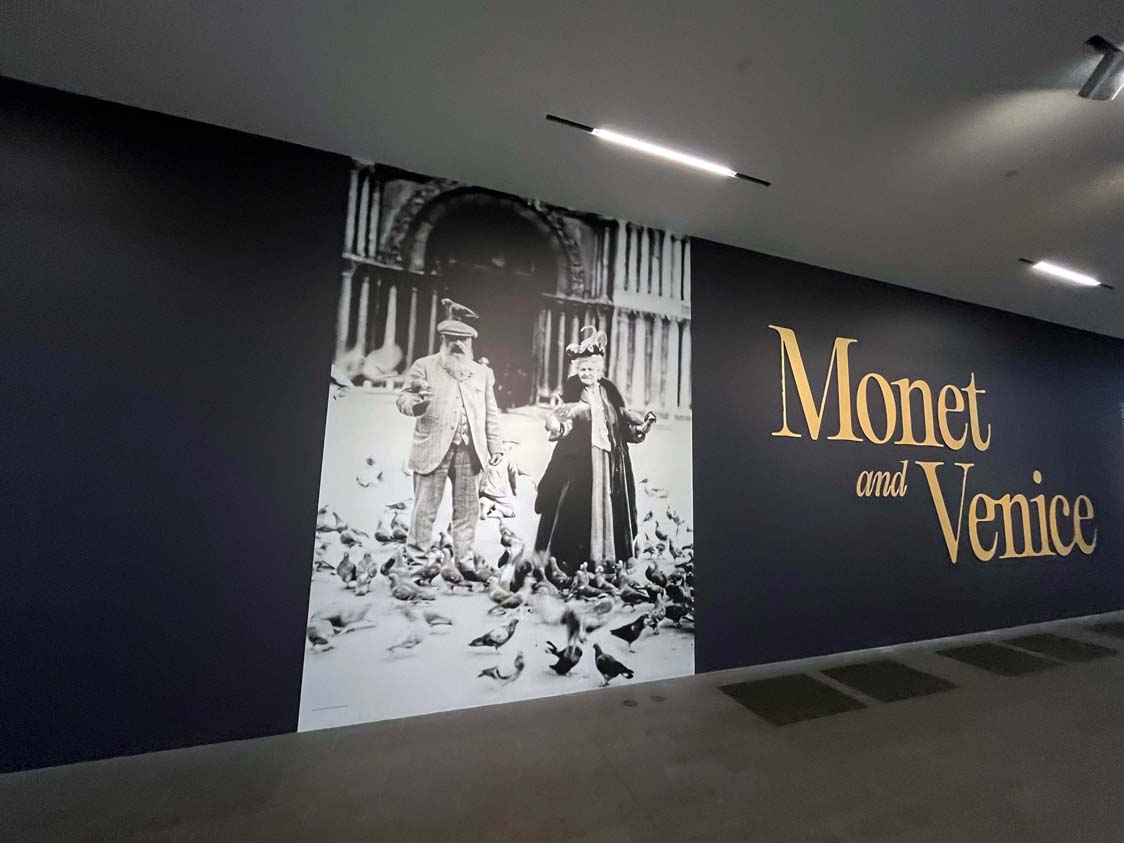
These associations popped up when I visited the de Young museum’s current exhibition, Monet and Venice, in San Francisco. Dark, windowless rooms, painted in velvety blue, contain numerous gold-framed, jewel-toned showpieces, each as pleasant and precious as a Fabergé egg, albeit rectangular. Fetching, exquisitely crafted, decorative. First impressions, of course, for someone who has never been much of a fan of Monet, and is wary of the through-line of decorative focus expressed by much of his work.
Claude Monet Palazzo Ducale (1908)
Second impression was admiration for how the entire exhibition was set up. The stellar collection of some 30 plus Venice paintings from the artist’s 10 week visit in 1908 (many executed from sketches, likely photographs, and surely memory in the ensuing 4 years back at home) is smartly framed by additional materials. Visitors get exposed to historic photographs of the city, as well as of the Monet couple visiting, and are provided with lots of quotations from the artist about his approach to art, process and subject. First shown at the Brooklyn Museum last fall, the exhibition was co-curated by Lisa Small, senior curator of European art at the Brooklyn Museum, and Melissa Buron, director of collections and chief curator of the Victoria and Albert Museum. A truly successful collaboration.
Carlo Ponti Piazza San Marco ca 1860-1870
Importantly, some works of other artist fascinated by Venice, among them Turner, Sargent and Canaletto, are interspersed with Monet’s cityscapes. (By all reports, he was hesitant to visit the city in the first place because so many admired colleagues had painted it, and the trip was planned by his wife Alice as a recuperative sojourn only, for the aging and cataract-plagued painter. But paint he did, barely arrived.)
Giovanni Canaletto Venice, the Grand Canal looking East, with Santa Maria della Salute, (1749-1750)
Michele Giovanni Marieschi Views of Venice (1741)
John Ruskin The South Side of the Basilica de San Marco, from the Loggia of the Palazzo Ducale, ca 1850.
Give me a Turner, any time.
J.M.W. Turner The Campanile and Piazza of San Marco, Venice (1840)
J.M.W. Turner Boats at the Entrance to the Canale della Giudecca, Venice, off Santa Maria della Salute and the Dogana (maybe 1840)
That said, the shimmering Adriatic light of the Venice lagoon was spectacularly captured in Monet’s paintings on display, but it (or any other bright light) was sorely missing from the surround. The contrast between the dark walls and the relatively small, bright canvasses made the latter into somewhat confined objects, constrained instead of unfolding into their surround.
Claude Monet San Giorgio Maggiore at Dusk (1908)
The only thing viscerally reminiscent of Venice were the crowds – here as there, amorphous units wafted from painting to painting, location to location, nowhere more dense that in the final room where large water lily paintings hung. The lure of the familiar, I guess. (This, by the way, despite timed entry slots for the exhibition. Lucky I was double masked.) The contrast could not have been more pronounced: the small cityscapes felt like glorified postcards compared to the immersion effect provided by the large pond canvasses, any given visual angle across the room still enveloping the viewer into the depictions.
Claude Monet Water Lilies (1914-1917)
The works themselves were pleasing in the impressionistic way, but for me became interesting at second glance, if and when I had a chance to break through the cordon of visitors bulging in front of each painting. They are, in some sense, studies of a given subject – this or that Palazzo – from slightly different perspectives (often just a minimally extended surround included) and under different lighting conditions that change the hue of the pastel tones applied. But they are also often horizontally bifurcated – with the top half devoted to depiction, however impressionistic, of a given architectural structure, and the bottom half a laboratory of ever more abstract painting of water.
Claude Monet The Grand Canal, Venice (1908)
The proportions of water to shore (large over small) seemed different from my memory of the canals (narrower in relation). I first thought that maybe we were seeing the psychological effect of boundary extension. This concept refers to remembering a previously viewed scene as containing a larger extent of the background than was actually present, and information that was likely present just outside the boundaries of that view is often incorporated into the representation of that scene. But here we are confronted with the reverse: it is the foreground, the water, that is larger (and also emptier, rid of most of the water traffic surely present in 1908 as well,) than the likely objective perspective. Lots of canvas space to develop abstraction rather than depicting optical impressions, uninhibited by the need to represent anything, perhaps. Have to give Monet that – always exploring, even towards the end of his by then illustrious career, at the height of his renown.
Claude Monet The Church of San Giorgio Maggiore (1908)
Some sentence I picked up at the Marmottan in Paris at a previous visit had stuck with me: “The artist invites universal thoughts of peaceful contemplation.” I wondered how this could come from a man, who was, in his own ways, politically engaged. He was a friend of Emile Zola’s and joined him and other liberals in their belief that Dreyfus was innocent, during the times of the Dreyfus Affair. He was drawn to Courbet, a radical leftist at the time. Prime minister Clemenceau was his friend, and during WW I Monet saw it as his patriotic duty to support the war effort with a victory garden and donations of his paintings to raise funds for victims and the wounded. I scoffed at the notion of art => peaceful contemplation, thinking of it as placating, rather than depicting the world as it is, moving us to remedy what’s wrong.
Goes to show that I am as thoughtless as the next person, if biased about a source. The same invitation to slow down, contemplate and introspect from a different corner – the curator of this year’s Venice Biennale – seemed like just the ticket. Then again, maybe it is not the act of contemplation, but the subject that irked me: Monet hoped for the restorative effect of contemplating the aesthetics of fleetingness in nature, the light, the atmospherics, major keys beauty. Which brings me to Venice 2026, more precisely the 61st Biennale which is about to open in early May. Here we are asked to focus on the “minor keys, the overlooked, disguised, fervently guarded spaces reserved for human dignity.”
(And yes, to all of you who frown, “What’s wrong with restorative beauty?” Nothing at all. It, as any consoling work of art, certainly has a prominent role for anguished souls. I just feel that time is running through our – my – hands like sand, urging a use of art to focus on the most important issues of our world to save what can be saved. Art as the canary in the coal mine. To put it bluntly, the beauty of water lilies or Venice will be a mute topic, once the ponds are dried out, the city drowned.)
Claude Monet Water Lilies (1907)
***
In refusing the spectacle of horror, the time has come to listen to the minor keys, to tune in sotto voce to the whispers, to the lower frequencies; to find the oases, the islands, where the dignity of all living beings is safeguarded.
—Curatorial statement by Koyo Kouoh, “In Minor Keys,”2025
***
The 61st International Art Exhibition of La Biennale di Venezia, In Minor Keys, will run from Saturday 9 May to Sunday 22 November 2026. It has seen its share of tragedy and upheaval long before it started. Curator Koyo Kouoh, highly respected in the art world, died suddenly late last year, leaving her team scrambling to consolidate and materialize her vision for this year’s exhibition. Another death struck, with Henrike Naumann, who was to represent the German pavilion, succumbing to cancer at age 41.
Then South Africa canceled its pavilion. The South African minister of culture had taken political issue with the work of Gabrielle Goliath, who had been unanimously selected by committee. “Elegy” was a decade-long project, a performance and video series that honors women, gay, and trans people who have been victims of violent killings. The new iteration at Venice was to include a tribute to Hiba Abu Nada, a Palestinian poet killed in an Israeli airstrike, as well as the tens of thousands of women and children who have died in Gaza since October 2023. Government and artist tied up in law suits over this perceived censorship move, until the state declared final refusal to be represented this year in Venice at all in February.
The U.S. was not far behind. We will have a Pavilion, but the final choice of representative is highly controversial. For the first time ever, the State Department took on the selection process, sidelining the NEA with budget cuts. Applicants had to pass the “Trump test” that proposals must not “operate any programs promoting diversity, equity and inclusion.” Apparently, the almost unknown artist Robert Lazzarini had initially been selected before being nixed by the State Department, to be dropped for “bureaucratic rather than ideological reasons,” as later reported. Other artists came on with proposals, among them Andres Serrano and Curtis Yarvin.
Who was finally picked? An American born sculptor, living in Mexico, who never applied to show at the Biennale in the first place. Alma Allen has only once been included in a major exhibition in the States, the 2014 Whitney Biennial. Last year some of his sculptures could be seen adjacent to NYC’s Park Avenue. Compare that to the standing of his Biennale predecessors: including Robert Rauschenberg, Ed Ruscha, Jenny Holzer, Jasper Johns, Martin Puryear, Simone Leigh and Jeffrey Gibson, among others. He is currently not represented by any gallery. This was his commentary in the NYT: his galleries, Mendes Wood and Olney Gleason, asked him not to accept the Venice Biennale commission and dropped him when he did. Both galleries confirmed that they were no longer working with him, but declined to explain why, making the entire nomination and the obscure process behind it even more controversial.
I learned that “organizing the pavilion this year is commissioner Jenni Parido, founder of a pet food company and now executive director of the mysterious American Arts Conservancy (AAC), a new Florida-based nonprofit established this September with a mission to advance American visual art through diplomacy, education and cultural legacy. As its website states, it was “founded on the belief that art is a foundational element of a thriving democracy.” (Ref.) All in line, one presumes, with what curator Jeffrey Uslip highlights as “Allen’s alchemical transformation of matter explore the concept of ‘elevation,’ both as a physical manifestation of form and as a symbol of collective optimism and self-realization, furthering the Trump Administration’s focus on showcasing American excellence.”
***
Pavilions unfilled, pavilions filled with murky selection processes, and now pavilions demanded to be removed: many artists sent out an urgent call to ban outright or relocate national representation of countries engaged in warfare or genocidal action, including Russia, Israel, and the United States. There are precedents: the Russian and South African pavilions had been previously excluded, and there was political reaction to Pinochet’s takeover in Chile in 1974, with all national pavilions closed.
Not exactly minor keys, but a loud cacophony of conflict preceding the opening of this important touchstone in our contemporary art world. More Shostakovich’s 7th in C major than a Schumann concerto in A minor. I will report later how it all unfolds after the opening.
In the meantime, pay the De Young a visit if you are in San Francisco. It is a treat to see the accumulated art works in the current exhibition.
I look at a typical day right now (see below) and am not surprised that I am at times overwhelmed. As you likely are. So I will take a little time off from regular posting, go visit my kids down South, and along the way gather some renewed energy.
Morning: I read poetry, made for the moment, by Lebanese-Armenian poet Perla Kantarjian. Beirut is in flames as I write this. Under the cover of another war next door. If I had the energy I would write about the long-term environmental consequences of all the burning oil, in addition to the human suffering right now, but I don’t.
So I cry.
***
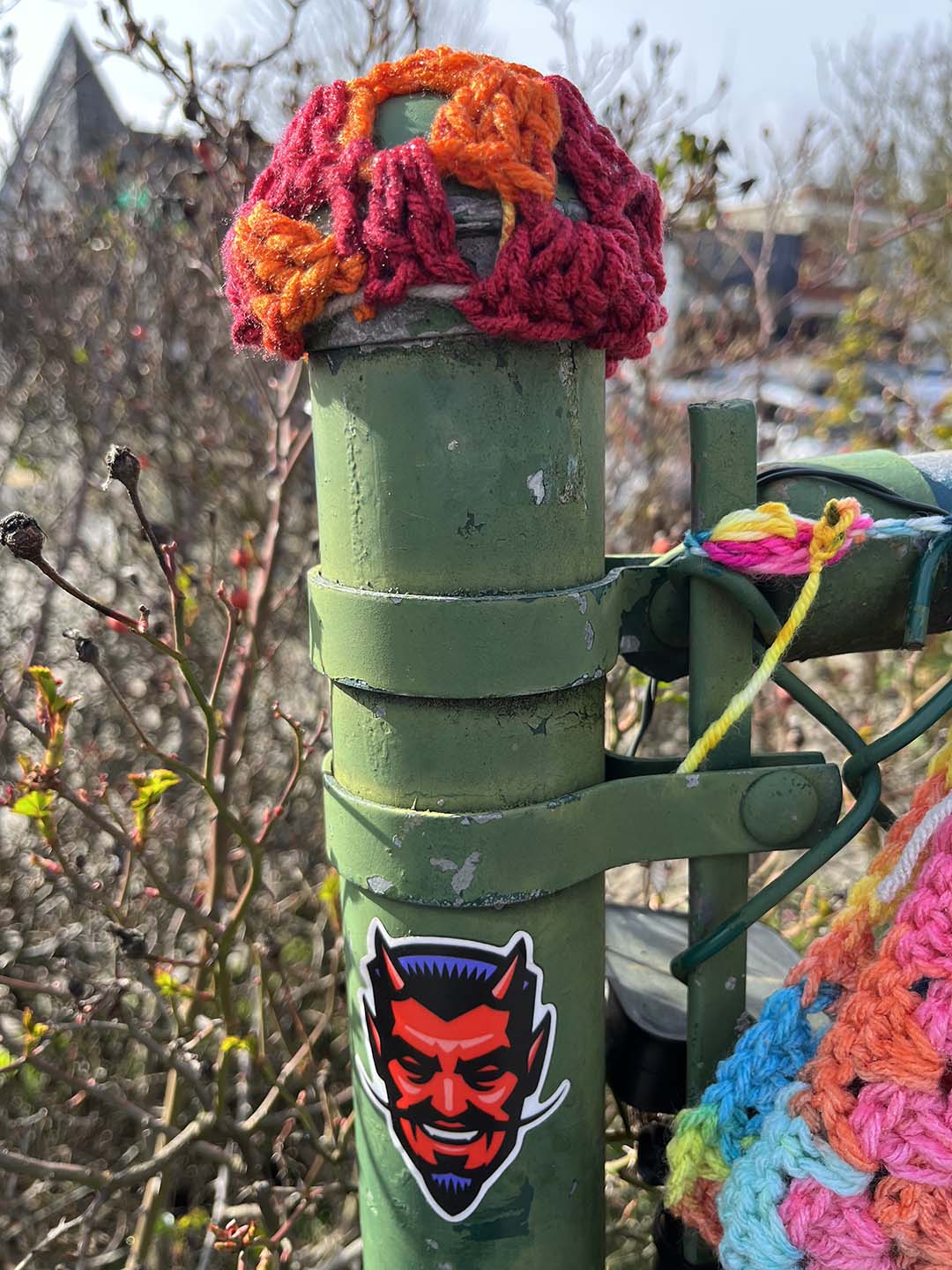
Then I go for my neighborhood walk, and find a fence made beautiful with eye candy – a group of crafters probably decorated together during the recent yarn crawl. This is an annual Portland experience, an event for fiber enthusiasts — knitters, crocheters, spinners, weavers, and felters — who spread through the city on a particular day to explore and support the many independent shops in and around Portland, Oregon, rather than buy on-line. Such a spot of upbeat color.
So I rejoice.
***
In the evening, I think through what art I saw that lingered from this day. Without competition, it was a project filmed in 2002 near Lima, Peru. A Belgian and a Mexican artist mobilized some 800 people to shovel sand to shift the top of a dune. You are rolling your eyes? Francis Alÿs is a multidisciplinary artist who focuses on shared cultural histories, urban engagement, and the human impact on the environment. I saw his work years back at the Tate Modern, and continue to follow what he is doing. Here is an older project particularly apt for our current situation: It was called Cuando la fe mueve montañas (When Faith Moves Mountains) – and really: isn’t that what we need right now? Even if change is imperceptible, going slow, needing a lot of organizing and solidarity, something IS happening? Watch the video and see how students define their understanding of art, its social context and implications, the consequences of communal action.
So I feel hope.
I also feel whiplash, with all those intense emotions shifting constantly. Time to take a break! I’ll be in touch sporadically.
Sometimes, when you look back, you can point to a time when your world shifts and heads in another direction. In lace reading this is called the “still point.”
The words above come from a recent novel where a particular make of lace plays a key role in the plot. (Historical murder and mayhem, inter-generational strife, an imaginative, fun, and occasionally overwrought romp.)
The first part of the quote felt timely in describing a turning point in the world, this March of 2026. The second part referred to something that sprung from the author’s imagination: descendants of the Salem witches divining the future from lace. So not a real thing – lace reading – that I naively assumed did exist. After all, people read tea leaves, crystal balls or cowry shells, why not lace? A “still point” seemed such an intuitive concept.
Our world is shifting and heading in another direction, though, isn’t it? So why do I turn to the topic of lace today, and not to other alternatives? I could think through how we should deal psychologically with our worries and fears, or how to seek community as to not face a crumbling world alone?
As you will see, lace, as introduced today, will speak to all of it.
Burratto Lace Grapevine Motif Italy 17th C
Lace is going to be at the center of this summer’s exhibition and activities at the Columbia Gorge museum. Executive Director Lou Palermo builds on the ideas and successes of previous projects for which she was instrumental during her time at Maryhill Museum. As I reported then, the Exquisite Gorge I and II programs collected the works of PNW printmakers and fabric artists, respectively. All of them celebrated aspects of the Columbia Gorge associated with a particular region. They were eventually displayed on the museum grounds in installations that preserved the geography of the river and its surrounds.
One of the most exciting part of these enterprises were the ways community was involved – community partners were called, and answered with extreme generosity, creativity, in-kind and financial support for all that was happening. Workshops involved library and schools, field trips allowed other artists to learn during master classes, people donated materials, opened their studios. From kids to grown-ups, participation was key – from learning to make prints, to how to weave, or do silk screenings; from studying natural dyes collected from native plants, bee keeping, to learning about Native-American symbols and history associated with the Columbia Gorge.
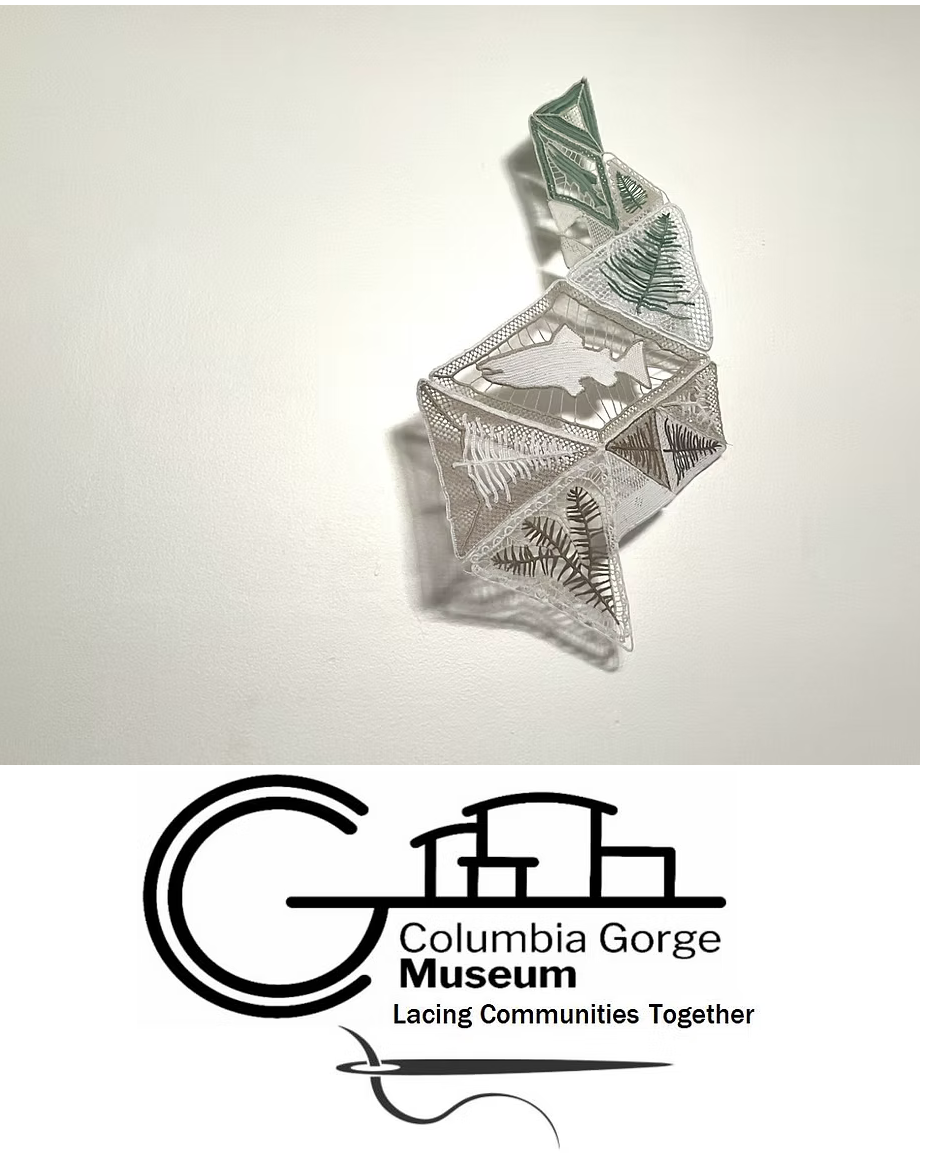
It was this aspect that Palermo and her great team at the Columbia Gorge Museum wanted to make central in this year’s adventure: lacing communities together. They are encouraging engagement with a heritage art form that will create samplers devoted to core aspects of the region, the trees and the salmon. Under the guidance of a remarkable contemporary lace artist, Maggie Hensel-Brown, everyone who is interested can learn and contribute, not just select artists. By the end of August, the museum will have collected regionally, nationally and internationally stitched lace samplers that will be arranged into beautiful installations reminding us of the value and beauty of the landscape surrounding us.
Czech Lace Emilie Palickova (Detail) mid-1900
Multiple organizations have already pledged their collaboration. From Skamania Lodge, multiple library districts, the History Museum of Hood River County, to several lace and fiber arts-oriented organizations, like the Columbia Fiber Guild, Portland Lace Society, Lacemakers of Puget Sound and not least, the Arts in Education of the Gorge, all will help this project along. Local libraries will even hand out kits with all the necessary materials for making a small lace triangle to contribute to the installation to those interested.
Flanders Lace (Detail) 1700 – 1750
Are you among the many currently grieving the dissolution of the social fabric? That will be counterbalanced by fabric, holes and all, that was produced by a diverse community united in the hope they could deliver a thing of beauty, or at least an attempt to get there – you should see my first needle stitches. Not to worry, Hensel-Brown absolutely encourages imperfection, as long as you have fun trying. Huge relief, if you ask me.
She also provides step-by-step instructions for those new to the art form, both on video and as PDFs. She explains how you can gather the simple materials needed, and what to be on the lookout for, or practice with care. Her instructions are easy to follow, which does not mean that the first steps into needle lacing are a breeze. The needle work requires serious attention. I consider that one of the best ways to distract yourself from other thoughts, mind you. I am grateful for any half hour these days when I am not thinking about what is going on in the world, and strict attention protects my thoughts from straying.
I also found that the repetitive motions, once you have learned the one simple stitch involved in it all, can be extremely meditative. The kind of meditation that stills you and silences the worries for a while in this world that has shifted to yet another war. Check it out – you might find yourself as a part of a community that is learning and connecting while celebrating nature. Just what so many of us currently need.
Here are all the instructions helping with the Community Lace-Along.
Lace has had a complex history, influenced by diverse cultural backgrounds, and dependent on how it was created. Needle lace was started in the 15th century, made by women in Europe, popularized for the next 200 years. That lace is made entirely with a needle using a single thread on a temporary backing, wich is later removed. I love its name: Punto in Aria, stitches in the air. Angry at the world? Stab the air… a peaceful and productive way of letting off steam.
Lace can also be made with bobbins, a technique derived from braiding, developed pretty much in parallel to needle lace, using multiple threads. You can also create lace patterns with crocheting or knitting, but none as fine as the traditional techniques.
The art form and geographically refined patterns spread from Italy to Spain, France, Flanders and England. Lace makers fleeing religious conflicts often settled in other lace producing regions, interchanging patterns and techniques. Lace was a time-consuming art form, much prized as a status symbol for aristocrats or rich merchants. It certainly drew the attention of European painters of the Golden Age who left us with detailed examples of what their patrons wore. In fact, when I hear the word “lace,” it is these paintings that come to mind, long before thinking of fancy underwear, or bridal veils, or prayer mantillas, all commonly associated with the fabric.
Thomas Gainsborough Portrait of Mary Countess Howe (1760) Detail.
Eventually machines took over the jobs. The manual production knowledge might as well have died out with the professional lace makers after the industrial revolution, had it not been for artists who picked up on lace, and designers who saw its potential. Since the 1970s, there has been an explosion of interest in contemporary lace making, with societies founded to celebrate and educate about lace, museums established to preserve the history, and exhibitions devoted to many aspects of lace production, not least last year’s DesignBiennial in Venice.
How things are depicted changed with ever improved or altered techniques. What it is that was expressed in lace changed as well. Earlier simple geometric designs gave way to representations of nature. (The many gorgeous examples of trees shown on lace were of particular interest to Palermo, given the intended celebration of nature found in the Gorge.) Depictions of nature gave way to whole narratives, with human figures in cultural or political contexts, entire stories implied on small lace tableaus.
***
Here are just two striking examples of contemporary perspectives – Maggie Hensel-Brown‘s work and that of Agnes Herczeg which I find equally thought-provoking.
Some three years ago, Hensel-Brown gathered community to create an incredibly beautiful accumulation of leaves that were then conjoined. Over 400 participants, some 700 leaves, instilling a sense of fragility and resilience at the same time.
The artist’s individual work is characterized by story telling. She takes everyday scenes and infuses them with magic, via a pattern defined by negative space, all with a needle and a single thread. The portraits capture emotions, anchoring those universals in the specifics of our Covid- or Internet-driven times. Details abound, asking us to explore deeper and deeper into the fray.
Maggie Hensel-Brown Quarantine Self Portrait I (2020) (all images from her website)
Maggie Hensel-Brown Sheets (2022)
Maggie Hensel-Brown Not useful, not beautiful (2023)
Maggie Hensel-Brown January 24th (2024)
I cannot wait to see her work in person.
***
Herczeg is a Hungarian artist who combines lace creations with branches and sticks she finds along the local beaches of the river Danube.
The juxtaposition of the airiness of the lace and the hardness of the wood creates a sculptural effect, with each medium competing for attention, yet emerging as an organic whole. I am particularly drawn to her hand coloring of the lace once the needle work is done. It provides additional depth to the configurations, further strengthening the sense of sculpture.
Agnes Herczeg: The resting place, 2019, 5 cm high, Needle lace with silk thread and thin wire contour combined with poplar branch, hand-painted
Agnes Herczeg: The tree, 2019, 9 cm high, Needle lace with silk and juta thread with thin wire contour, combined with beech bark, hand-painted. (Source)
We’ve come along way since the 14hundreds. It is glorious to think that the heritage is preserved and continues to be handed down to each next generation, with ever new twists and turns, not only of needles. Much to look forward to this summer, when the Columbia Gorge Museum will display lace variations and a renowned artist available on location.
I am skirting the issue. I should be writing about the politics of war, but my head would explode. Let’s turn to the interesting people department instead. Given that it is Women’s History month, I’ll start with a 19th century poet and union leader attuned to skirts.
The Skirt Machinist
I am making great big skirts For great big women— Amazons who’ve fed and slept Themselves inhuman. Such long skirts, not less than two And forty inches. Thirty round the waist for fear The webbing pinches. There must be tremendous tucks On those round bellies. Underneath the limbs will shake Like wine-soft jellies. I am making such big skirts And all so heavy, I can see their wearers at A lord-mayor’s levee. I, who am so small and weak I have hardly grown, Wish the skirts I’m making less Unlike my own.
Lesbia Harford was an Australian poet, lawyer and labor activist. Her father abandoned the family after bankruptcy, her mother toiling to get the 4 young siblings fed and educated. Harford was one of the first women to get a law degree at Melbourne University in 1915, where she became interested in the politics of class relations as well as feminism. She decided to work in the garment factories to understand truly the conditions of working class life, particularly among women. Despite having congenitally defective heart valves which made physical labor difficult, she went on to become a leader of the Industrial Workers of the World (IWW) around 1916.
She was openly bisexual, often in polyamorous relationships, and radically honest in her poetry around feminine issues that would not be discussed in public. She died from tuberculosis at age 36, her last years of life tortured by illness and dependency.
The poem struck me as both anguished and angry. Here is this small person, overwhelmed by the weight of the production task, metaphorically as well as literally. Stunted, she sews for women who are clearly of a different class, unrestrained in their consumption, free to eat and rest. Yet even these Amazon-sized women are burdened by the weight of heavy skirts, jelly-like limbs prohibiting escape.
Heaviness even when the contraptions of previous eras – the crinolines, the farthingales, the petticoats – were long abandoned. Skirt length and materials varied across time, of course, not least affected by the economics of any given era. If you look at shapes and lengths in relation to war vs. peace times, for example, you find straight correlations, with skimped materials when times are hard. Length also, eventually, became a means of protest and liberation – the mini skirts of the 1960s the most famous example.
***
Skirts were on my mind for a number of reasons. I had read about a woman who collected woolen skirts for decades from Midwestern thrift stores, up until she was 89. For the next 10 years – Audrey Huset lived until her 99th birthday – the collection of over 1000 vintage skirts was stashed in cartons in a garage. Her granddaughter, artist Mae Colburn, started to archive them in 2022, with the help of her parents, professors of costume design and photography, respectively. They sorted them according to a range of colors, plaids, and silhouettes – here is the link to the digital archive where you can be amazed at the collection.
I try to wrap my head around the motivation: how can you accumulate so much stuff, without even using the garments? Then again, I can just see the joy of the hunt, the glory of a find of an unusual specimen, the hope that these will make some warm recycled rugs in the future, the physical pleasure of touching woven wool of that period (much denser and of higher quality than what we see today.) A passion that gets you out of the house and in contact with people into your high eighties…still. Collectors are a mystery to me.
***
Then another skirt appeared on my screen. An expert knitter, designer and dancer had shared the instructions for a voluminous, long skirt she called the Paris skirt, and asked her 35.000 subscribers on Instagram (or anyone else) to knit along. There was a huge resonance, an exploding array of pictures posted of the variations generated by knitters across the globe. A new community instantly created, although I have asked myself how people who have not been knitting for ages, could afford to participate.
The pattern is not difficult. The materials required, on the other hand, are prohibitively expensive, if you do not already own a stash of remnant wool accumulated across many former projects. The mohair wool, for example, costs an average of $30 or so for 50 grams, which give you some 500 yards (the project requires over 2700 yards for larger sizes, and that does not account for knitting with double or triple strands that give the skirt some heft and bounces on the bottom.) Five different sizes of circular knitting needles required: the largest alone, US 13 mm, costs easily $27. If you had to start from scratch you could spend $300 or more, for a homemade skirt!
But again, the use of leftover materials is a sustainable practice, and the making of your own clothes a political act. Add a community that derives a sense of connectedness from the shared experience, and you have truly accomplished something. The designer herself considers knitting a form of resistance.
***
Then a book appeared in the mail, a gift from a friend who rightly anticipated my pleasure of receiving it. Loosely bound in recycled (and strangely fragrant) jeans material, it is titled Fav Pieces of, followed by some 50 names of people from across the globe. Let’s ignore the fact that the choice of font, an illegible page of contents, and an occasionally tortured introduction trying to provide intellectual heft, all scream for attention. It is, after all, published by Thaddaeus RopacPublisher of Modern Art. (I did not yet see the book on their publications website.)
Let’s focus instead on the fabulous idea of editors Frauke von Jaruntowski and Gerhard Andraschko Sorgo, to collect essays from people with various backgrounds about their favorite piece of clothing or other adornments. And admire the range of images provided with the design, including portraits of items, owners, or both, and some contextual pictures that are meaningful, ranging from laypersons’ snapshots to serious photography.
The essays make us think about our relationship to clothes and, in turn, the ways beauty norms, body image, experienced gaze, memory, class conformity, politics, moods as well as our yearnings, influence our consumerism – or our rejection of it.
It is a fascinating read, if only for the comparison between explanatory attempts. Some people reveal intensely private information, others block with superficial description. Multiple owners describe how the item makes them feel internally for its own relevance, history or associations. Several emphasize how a given piece allows them to create a persona projected outwards. A few discuss the relevance of fashion in their lives, yet others the need for comfort, rather than public effect. Some are eloquently descriptive of beauty, others refer but to function.
Oversharing, reticence, courage to expose vulnerability, vanity, strategic self positioning, thoughtful introspection, or simple autobiographical anecdotes – all can be found between two covers.
Only two skirts made the list. One is from an exchange between designers, a hand-stitched, non-traditional patchwork quilt in return for hand painted plates. The essay informs about the history of Scottish tartans, symbol for traditional Clans. It then turns to lovely interpretation of the possible meaning of patch-worked remnants, creating a style that belongs to all. A Mix-and-Match Clan for a rootless citizenry, a remix overcoming divisions, and an important reminder that we can create something new from old. The reader truly understands why that is a favorite piece in this context.
The other skirt appears to have been protectively underused, in contrast to its oft worn twin in more muted colors, both purchased at KENZO in 1980’s London, simultaneously. The beloved bright one was a match for the buyer’s brilliant mood at the time, the darker one more likely acceptable in the owner’s day-to-day existence. A short comment on personal history that brought the good mood in the 80s in stark relief, and a cryptic snippet on how she regrets not having worn the favored piece enough, are the parentheses for the half-page long musings.
***
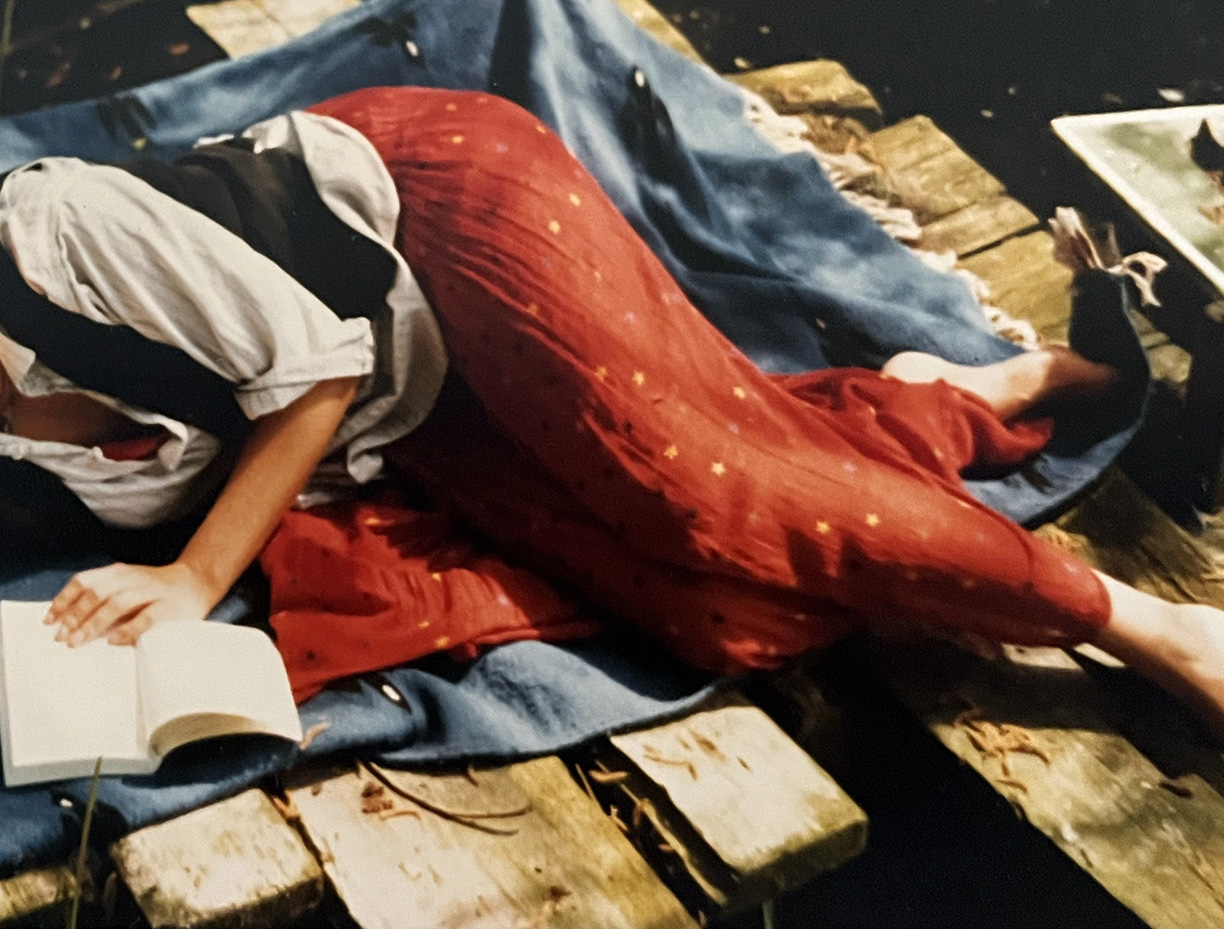
I used to wear skirts all the time. These days, not so much. I live in the functional, no need to think, can get dirty, ready to hike, comfortable uniform of pants and sweaters. But my favorite item in my closet is indeed a skirt, and it has accompanied me through good times and bad ones, for probably 20 years or longer. It replaced an old, red, star-sprinkled favorite that somehow got lost during emigration. I wear it when I travel, when I give lectures, or when I need a boost to my sense of who I am, during tricky encounters.
I picked it for my double portrait sessions with Henk Pander when he was still alive, a project, Eye to Eye, where he painted the photographer, I photographed the artist, across weeks of sittings. The skirt felt like the appropriate feminine counterweight to the absence of feminine symbols, eradicated by mastectomies for cancer. It’s most important attribute, other than a cheerful patchwork of patterns, is that it is light and wide enough to run in. No heavy skirts, no constricting pencil shapes ever again!
The skirt is also associated with something I am occasionally proud of: resisting overconsumption, for the most part, sticking to the tried and true. (I previously reviewed fiber artists, Ophir El-Boher, who embodies that concept in her art.) Of course that, too, comes from privilege. When you have permanent space to store things forever, when you have enough clothing that any one item is not worn to threads, when you have the funds to buy good quality that lasts, it is easy to do the right thing and not yield to compulsive purchases. In that way, then, the skirt reminds me to be grateful for all the choices I have.
Music today leads us back to the top – the fate of seamstresses in an exploitative economy. A Yiddish Ballad about the 1911 Triangle Shirtwaist Factory fire.
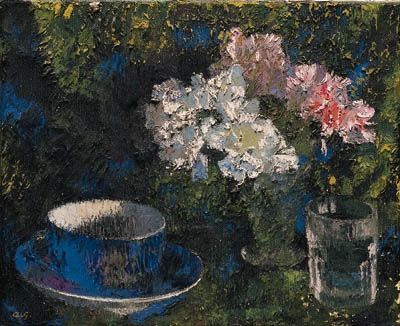
Here you see me, with my morning coffee cup, thinking what I should do for the next blog. I was working on a longer piece, but would not finish in time. My focus was drawn to the cup because I had recently encountered a series of paintings containing cups, presented by the inimitable French gallerist Yoyo Maeght.
So I thought, let’s offer some of those and some additional ones, celebrating the joys of hot coffee during cold days. Or any day, come to think of it. After all, new Harvard research shows that 2 to 3 cups a day are tied to significantly lower dementia risk, and slower cognitive decline. (Not the decaffeinated kind, though – the more caffeinated, the better, it looks like.)
Paul Cézanne, Woman with a Coffeepot (1890–1895)
Just then, a friend sent me the essay below, which I decided to post in full. It is something I rarely do, but the writing resonated on so many levels and the shared love for birds is obvious. The observations and emotions expressed feel familiar in almost uncanny ways. At the same time I decidedly disagree with some of the sentiments. A piece to make me think, then, so very welcome. The author is Chloe Hope who has been writing about death and birds with sensitivity and wit for quite some time now. Here is her substack link, so you can see for yourself.
You get the somewhat haphazard combination, in other words, of a borrowed text and a borrowed visual idea, the former defiant, the latter comforting. I guess as good a combination as any to start our week with.
Félix Vallotton Nature morte avec des fleurs (1925).
in accordance
one eye on the sky…
By Chloe Hope
Someone in the village has been feeding the Kites. There’s an unusual number, wheeling above the valley—David counted forty, the other day, spinning a languid gyre. I’ve a cricked neck from holding my face parallel to the sky, and at times they hover so low I can see the whites of their glassy eyes. Their constant spectre is as intimidating as it is hypnotic, and they drift overhead like a half-remembered dream, while we press on below. One eye on the sky. I find myself envious of their honeyed glide. The grace with which they seem to meet the day. I have, of late, become increasingly irritated by my seeming inability to feel a sense of ease. The news cycle exhausts and demoralises. What was a creeping sense of disquiet has become a steady march of dread, and the crumbling of systems which long presented themselves as trustworthy continues unabated—each passing week seeing the circle of complicity widen, and the nature of what was being protected grow ever darker. The news is magnetic interference and my mind a compass needle that cannot find true north. I am exquisitely disoriented by this moment in time. My defensive go-to, since childhood, in the face of confusion and unrest, is to sense-make. The tumult that infused my youngest years saw understanding become sword and shield—and confusion my mortal enemy. Those grasping arms served me well; until, of course, they didn’t. Until wielding tools of rationale became as insane as the thing I was fighting. Some things will not yield to understanding. Certain darknesses have no angle from which they begin to resolve, and to keep searching for one eventually becomes its own kind of madness.
Henri Matisse Laurette with Coffee Cup (1917)
Over the years, I have had the extraordinary good fortune of being involved in the early weeks of many a young Bird’s life. As with any newborn being, there are exciting points of progression which way-mark their developing birdness: eyes opening, pin feathers forming, perching. A particular favourite of mine to witness, however, is the first wing stretch. Any wing stretch is a joy to see, but there’s something about the first one that feels seismic—as though the wings themselves are making a declaration of intent to the sky—“Soon, vaulted blue. Soon.” Each time the sight lands sharp in my chest, the strange sting of something so perfect it makes me nervous. Each time I am made to question what I will declare to the sky. A wing is a refusal of gravity; a rebuttal, made of bone. The architecture so ancient it renders us a footnote. Feathers extend in graduated tiers, the whole apparatus light but not frail—hollow bones latticed within, muscles knitted along the keel. When a Bird lifts its wings, it is shaping pressure. Curving and carving air. Whether Robin or Raptor, they sense the invisible and answer in accordance.
Francisco de ZurbaranStill Life with Chocolate Breakfast Undated
Flight is a holy intimacy with the world, one clearly reserved for those who know how to belong to it. And few belong to it more completely than the Andean Condor. These spectacular Birds have a wingspan of over 10 feet, stand more than a meter tall and, weighing 15kg, are among the largest flying Birds in the world. At the turn of the decade, a study of these Condors revealed that, while airborne, they flap their wings less than 1% of the time. One of the Birds monitored flew for over five hours, travelling more than 100 miles, without beating their wings once. These magnificent beings take to the skies, and surrender to the currents they find there. They do not fight the air they’re met by, nor wish for better winds. They sense what is, and answer in accordance—and the world, thus met, holds them aloft. Their surrender is not capitulation, but an active and intelligent response to the world exactly as it is. And their radical trust ignites my own.
Henri Fontain LaTour Vase de fleurs avec une tasse de cafe (1865)
Surrender is exquisitely difficult—for me, at least—and it seems that no matter how many times I manage it, it never becomes something that I know how to do. I’ll mither and loop, all while knowing there is an alternative, but it somehow feels out of reach. I wonder whether the act of letting go, of yielding to the very is-ness of things, tends toward rocky terrain because some part of us knows that a day exists, suspended in the geography of the future, where the final task to be asked of us will be that very thing. Each time I open my arms and tilt my head to the sky, and meet the world on its own terms in a posture of vulnerability, I am preparing for—and speaking to—my ultimate surrender.
It’s windy here, today. There’s a horizontal line of chimney smoke scoring across the garden. The Kites are undeterred—in fact I think they’re playing in it. May we each meet the day with the grace of these Red Kites, and may we each meet Death with the grace of a soaring Condor.
Jean Etienne Liotard Lavergne Family Breakfast (1754)
“Suspended in the geography of the future” – I just love that phrase; it applies not just to eventualities we meet in our own lives, but also in the unfolding of art history. Just look at the Liotard version of breakfast and then take in Juan Gris – a mere 160 years apart.
Juan Gris Breakfast (1914).
What sticks with me, though, from the essay, is the distinction between capitulation and surrender, and the sense that an unwillingness or inability to surrender might be problematic. That we have to practice surrender for the day when it is inevitable. I disagree. I think we have to practice NOT to surrender, particularly as women in this world, or as people dealing with illness. Why worry about attitude, when death might sneak up on us unexpectedly, or soothe us into a non-conscious state before departure, or simply declare the time is now. You don’t expect an emotional stance from a baby being birthed, it simply has no choice in the matter. Why then from the person who is equally forcefully dragged into the reverse process?
The implication is somehow that an approach of a certain kind can and will ease things at the end. Yet I have seen during hospice work that all 4×4 combinations – letting go, fighting against, good death, bad death – regularly occur. Why use energy now to shape yourself into something you hope matters, when that energy could be used to pursue what you love now, what feels comfortable now, what strengthens you in daily struggle now? There are dangers to surrendering in advance – in politics as much as on the sick bed.
I’ll place myself happily among the group of defiant young women and their cups below, by one of Sweden’s foremost contemporary painters. Just dare me to let go!
Karin Mamma Andersson About a Girl (2005.)
It is claimed that Johann Sebastian Bach insisted on his morning cuppa. “Without my morning coffee, I’m just like a dried up piece of roast goat.” Here is his Coffee Cantata.
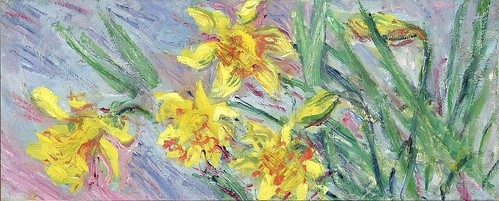
This is how I look today: red nose, running like a faucet, teary eyes, head cold stuffing my brain. So we’ll keep it short and take joy from daffodils, signs of better times to come. I don’t even have it in me to pair them with my photographs of these yellow wonders. In German they are called Easterbells, but here they already sprout early February.
Just take in the brilliant color. Spring will emerge.
John Dobbs Daffodils 2023
Helen Firth Daffodils in Long Grass (late 20th C)
Lily Yorke Still Life of Daffodils in a Blue and White Vase (1890)
A. van Haddenham Daffodils and other flowers in a hamper (19th century)
Berthe Morisot Daffodils (1885)
Gustav Klimt The Dancer circa 1916–18 – Daffodils central among all the rest….
Mat Grogran Still Life with Daffodils
Wayne Thiebaud Daffodil (Etching)
Maria Sibylla Merian Daffodil, Scorpion grasses and Butterflies, ca 1657–1659
And just as a reminder, this very flower from the genus Narcissus was claimed to have sprung from the site of Narcissus’ death, after he glared too long into his watery mirror image, fell in and drowned.
Hoping for renewal after narcissists’ demise. May there be millions of these flowers around!
By Else Lasker-Schüler, translated by Eavan Boland.
***
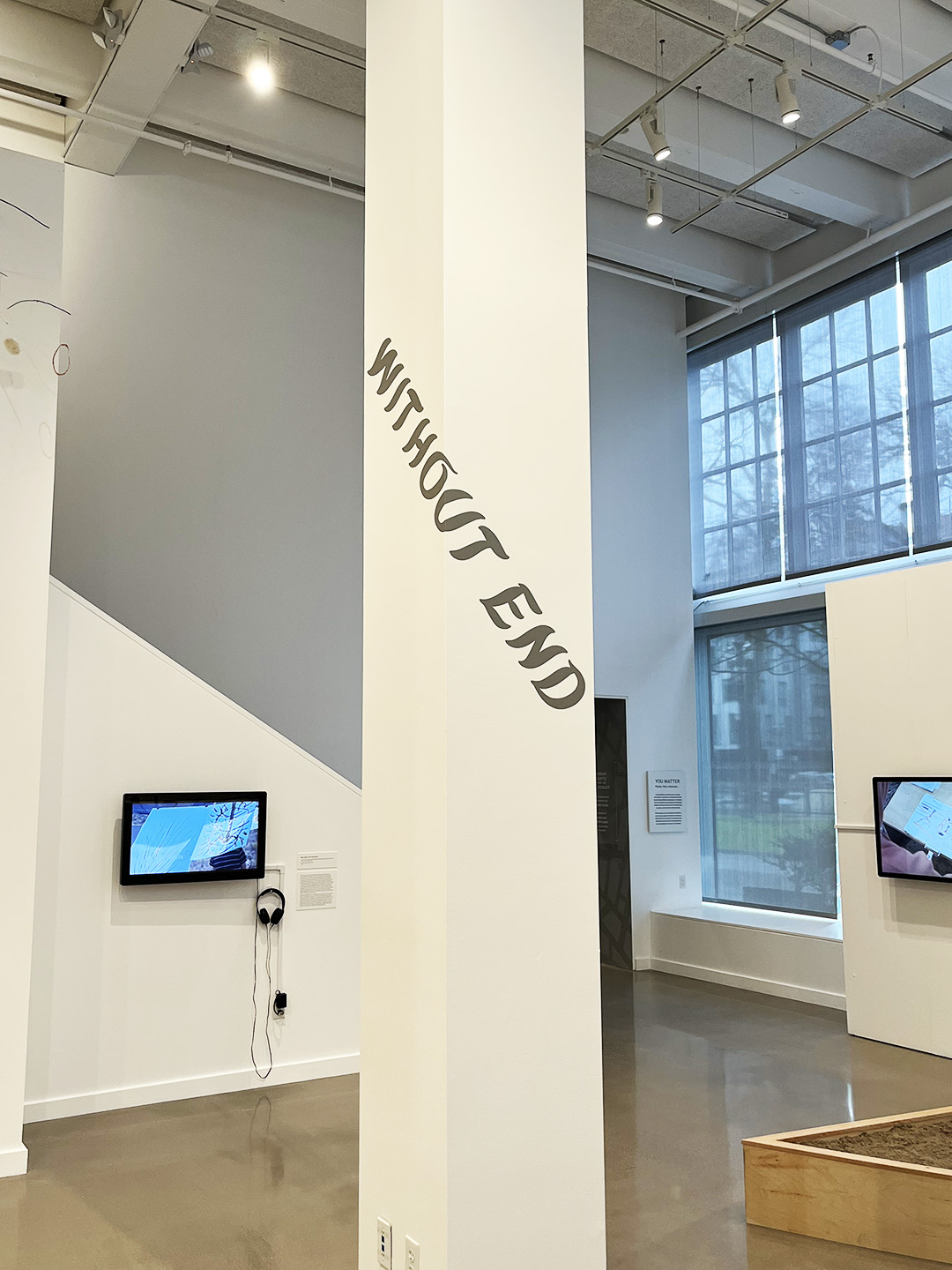
It was pure coincidence that I visited Cara Levine‘s exhibition Without Endat the Oregon Jewish Museum and Holocaust Education Center during the same week that my kids arrived in town. They are permanently relocating as survivors of the Altadena /Eaton Fire that destroyed their house, their neighborhood, their newly planted gardens and every memento they owned from more than three generations. Not a coincidence, then, that Levine’s current work, concerned with grief elicited by climate-related natural disasters and originating in exactly those same (Palisade) fire-induced losses, intensely resonated on a personal level.
Levine’s work has focused on loss, grief and pain of all kinds across the years of her practice since she earned a BFA from the University of Michigan in Ann Arbor, MI (2007) and an MFA from California College of the Arts in San Francisco, CA (2012). More importantly, though, it has offered perspectives on both, the causes of losses and communal ways in which healing can be implemented. Put differently, the work is not exclusively focused on individual experience, but on unveiling the collective circumstances that are producing loss, as well as offering tools to overcome trauma.
Before I get into the specifics, let me emphasize what I consider the strongest aspect of her work before us.
Real grief strikes down to the bone. There are no layers, no occlusions, no obscurations that it does not penetrate – they all become irrelevant. Levine’s sculptures and installations have that same directness: what you see is what you get. In our world where art often takes pride in obscurity, the need for deciphering, the veiled references, the analyses left to those in the know, her work will have none of that. Language is explicit, forms are defined, function leaves no room for interpretation. The art directly communicates shared human experience, and the artist is on an equal level with the viewer, no hierarchical distancing allowed. This, of course, is the basic element of communal experience, a focus of Levine’s makings, just as much as the individual’s grief.
***
I first came across Levine’s projects in 2022, when I was writing about the waves of eco-anxiety and post traumatic stress disorder of climate catastrophe survivors seen by clinical psychologists. Therapists face both increasing number and intensifying depth of anxiety disorders related to climate change. Data from the general population confirmed the trend. “A 2020 poll by the American Psychiatric Association showed that “more than two-thirds of Americans (67%) are somewhat or extremely anxious about the impact of climate change on the planet, and more than half (55%*) are somewhat or extremely anxious about the impact of climate change on their own mental health.”
What could be done before you need to find a therapist? Some political moves might help activists. Science is contributing tools to fight collective helplessness. And then there is art: Levine and other contributing artists invited people to participate in physically digging a hole to throw in their grief. For seven days, echoing our Jewish custom of sitting Shiva after a death – a time when community meets and supports the mourner – a large hole was dug in Malibu. The project happened on the grounds of the Shalom Institute campus which was devastated by the Woolsey Fire of 2018, an early taste of the fiery destruction to come. It struck me at the time that digging that hole might be one of the ways in which we could dig ourselves out of one: forming alliances (the contributors ranges from Chumash tribal leaders to cantors from local Synagogues) would provide an exit to suffering grief in isolation. Alerting community to the causes of wild fires might also lead to collective action to tackle climate change denials.
A video of the project can be watched at the current exhibition. So can a subset of exhibits from Levine’s project alerting us to the number and types of deadly shooting of unarmed civilians.
***
This is not a Gun (TINAG) was triggeredby an article in 2016 Harper’s Magazine that depicted objects held by unarmed victim of police shootings. The artist carved replicas of these innocuous objects, and workshop participants created ceramic models while discussing topics of racism and police brutality often associated with these kinds of shootings.
One of the most famous of these cases happened in New York City in 1999, when unarmed 23-year-old Guinean student named Amadou Diallo was struck with 19 of 41 rounds fired by four New York City Police Department plainclothes officers. They were charged with second-degree murder and subsequently acquitted at trial in Albany, New York on the grounds that they had a reasonable expectation to be endangered and drew a gun first in self defense.
Since then, long-term data collection revealed the fact that these shootings disproportionally victimize Blacks and other people of color. But there is also research evidence that Blacks and Whites both misperceive something innocent to be a weapon more often, if the object is held by a Black rather than a White person. In other words, all of us are likely to exhibit modern racism or implicit racism – automatic, unconscious, unintentional – still being tied to a culture that routinely links the idea of Blacks with the idea of deviant behavior, or a set of ideas, mostly bad, that concern violent crime, poverty, hyper sexuality or moral corruptness.
You might not act on those beliefs, you might deny them, but the associations are carried by most of us through permanent exposure to the linkage of Black to negative or threatening concepts, whether we are aware of it or not, whether we have the best of intentions and the most egalitarian politics. (For a more detailed discussion see my review here.) Projects like Levine’s draw attention to the stereotypes (and for that matter the historical burden of racism) with the hope of motivating people to intercept their own mental associations.
Acknowledging the existence of racism, explicitly or implicitly expressed, and the hold it has on our society is the necessary antecedent to fight it. I can scarcely imagine a more timely reminder given what is unfolding in our communities at this very point in time, regardless of the color of unarmed victims of state violence.
***
The new work in this exhibition centers around containers of sand, intended to be deposits of what we release into them – drawing our sorrows, by hand or dowel. For those dealing with climate-related losses a lasting memento is offered – “silver linings” made of pewter filling in the contours of a sand drawing (by appointment, see the OJMCHE website)
They will be given to the participants and a replica stored in the artist’s collection. Examples from prior studio work are on display.
Sands shift, patterns will disappear, but the act of thinking what to depict and the physical act of drawing might very well form a containment that holds the grief momentarily outside of ourselves. Only to return.
Without end. As the aptly chosen exhibition title suggests.
Maybe the healing comes not from the unrealistic termination of the pain, but the insight that we walk on shared ground, sand before us containing multitudes, a communal experience. Certainly in the case of our own family’s post-fire trajectory, community sustenance made all the difference. The help – emotional, physical, financial, spiritual – being extended from the farthest corners was medicine. Solidarity as a first hand experience.
But maybe it is also a time to put the aspect of healing on a slow burner, and instead increase the heat of resistance against forces that create avoidable losses in the first place. Climate change denial is just one of the aspects of hostility towards science that we are currently experiencing, but one that has huge implications for the planet at large. Our time is running out to implement the necessary changes that can prevent the worst suffering for millions of people killed or ravaged by loss through climate catastrophes.
An installation of imprinted birchwood panels on some sort of infinity loop names types of loss, predominantly private causes, but also some of the general political challenges we face, from the legality of immigrants, the divisiveness in our society, to the lack of protecting our earth. I found myself longing for stronger words, in visually more prominent positions. The TINAG project was so courageous and openly political. Why not here? We live in an age of multiple mass extinctions around the world, at a time when authoritarian or even fascist history repeats itself in a variety of disguises across nations. This is a time of pandemics, starvation and withholding of medical or economic aid that dooms hundreds of thousands of people. Horror without end.
How do you draw a representation of genocide in a sand installation? The birchwood would have held the word.
***
What held grief was a dream catcher high up, pretty easy to miss, commemorating the untimely death of artist Peter Simensky, chair of the Graduate Fine Arts MFA program at California College of the Arts, Levine’s friend and mentor, to whom this exhibition was dedicated. For those unfamiliar with this unusually creative, political and perceptive artist, here is a link to an exhibition booklet from a previous memorial exhibition at Reed College’s Cooley Gallery and here is a link to his website.
I could not discern if one element of the dream catcher was indeed made out of pyrite, a kind of rock central to Simensky’s last artistic endeavors, Pyrite Radio works. Doesn’t matter. Whatever form his signal takes, I believe it will contain pride and joy at what is on display in the gallery below, the courage not to walk away from grief included.
My heart is heavy today, after a German friend and mentor died peacefully two days ago, surrounded by his family. I am grateful that we were able to say Good Bye on the phone last week. I learned that he was fully ready to walk on, with cancer having wrecked his body. His biggest complaint to me concerned the fact that he was no longer able to paint, having intense double vision in addition to balancing problems. Passionate about his craft to the last, the artist in a nutshell.
In retrospect, one of his strongest series of obscured faces seemed to anticipate the inability to see. More likely, it expressed one of the greatest fear of any visual artist: loosing their eyesight. Those paintings, some of which I photographed in his studio, also encapsulate another truth. It was hard to see the subject behind the paint, hard to really know the painter behind his ever voluble quipping, joking, story telling. Endless colorful anecdotes obscured a number of significant losses across a lifetime, rarely discussed.
Michel was born in 1938 in Halberstadt, a small city in the state of Saxony-Anhalt, in the Harz mountain range of Eastern Germany. A military base since WW I, the city became the center for Junker aircraft production during WW II, housing an SS forced-labor camp, not far away from the Langenstein-Zwieberge concentration camp. The Luftwaffe airbase was target of Allied bombing campaigns in 1944; during the last days of the war, after the Nazi town administration refused to surrender, 218 Flying Fortresses of the 8th Air Force, accompanied by 239 escort fighters, dropped 595 tons of bombs on the center of Halberstadt, killing about 2,500 people. The left-over 1.5 million cubic meters of rubble were handed over to the Soviet Red Army forces in June 1945. Imagine experiencing this as a 7 year old. I don’t even know if he lost family or neighbors, and I have known him since 1969.
At that point he had been in then West Germany for 8 years. By chance, Michel was abroad in 1961 when East Germany erected the wall, keeping its own population from leaving the country. He decided to stay in the West, another rupture, given the future inability to visit with folks at home. He had been trained as an optometrist, then enrolled in the Academy of Fine Arts in Dresden. He now transferred to the Staatliche Kunst Akademie in Düsseldorf, studying painting under Ferdinand Macketanz (as did Gerhard Richter, same class, same year) and under the far more interesting Gerhard Hoehme, a close ally of Jean Dubuffet’s ArtInformel movement. Despite being a Meisterschüler, a kind of post-doc for graduates with distinction, Michel had to leave the lively artistic and intellectual environment of the city. Married to a young writer and poet, penniless with a child, soon two, on the way, he took a position as a high school arts teacher in the provinces, guaranteeing a steady income – and isolation.
This is where I met him, in the school’s art studio where I hung out, when the rest of my class, all boys, no girls, had sports or religious instructions (I was not part of that entirely catholic environment.) I had transferred to that public school from a despised private all girl boarding school after months and months of hospitalization, to be closer to home. Spent the summer in daily tutoring in a stuffed study of an ancient, smelly prof to pick up two years of Latin in 6 weeks – not exactly a great time in the life of a 16-year old. Michel’s first action proved he was a real Mensch: I was overcome with unanticipated menstrual pain to the point of fainting, embarrassed beyond description in that all male environment, and he just picked me and my bike up and drove me home, in the middle of the school day.
The artist and his wife eventually bought and remodeled an old vicarage in one of the small villages of the Selfkant region where I grew up. It was a bastion of colorful decorations and lights, a wild garden, progressive politics and conversations about art and literature through the nights, all amidst an environment that was deeply conservative, religious and narrow minded. I learned a lot about the courage to be different during later visits, after I had long moved to the big city to go to law school. I also got sternly scolded by Ingrid, and affectionately distracted by Michel, when I appeared again and again after yet another fling gone south, heart broken, driving 100s of kilometer through the night to seek sanctuary. “You need to find a sturdy farm boy, with intellectual potential!” was the recurring instruction. Well, I happily ended up with the intellectual potential, if not the farm boy….
We stayed in touch, by letters, phone and visits, during the tough times of Ingrid’s tragically early death from breast cancer; during the years I had moved to the U.S.; during the times Michel was more upset than I had ever seen him before, when his second wife was gravely ill, followed by a miraculous recovery. He rarely talked about his feelings, but proudly reported on his two children and grand children, who live in New Zealand and Holland, respectively, and were luckily able to be with him during his last days.
He claimed he was not surprised that I eventually began to make art, not just write about it, and was one of the first substantive and engaged critics. These phone and email conversations were essential for someone like me who had never had any formal art education; they were also influenced by the fact that he was always open to new ways of seeing and depicting the world, open to new mediums like my photomontages.
I have written a bit about Michel’s approach to art here before. What strikes me today, during the type of retrospective one is drawn to by permanent loss, is his willingness to risk change. There were so many oscillations between abstract and figurative approaches, exploring sculpture in addition to two dimensional work, systematic experimenting with closed vs. open perspectives, shifting from whimsey to deadly serious depictions.
I am also thinking about the role of chance. So often, in the art world as everywhere else, your success depends on external variables beyond your control, and not necessarily on the depth of your talent, or your ability to strike new territory. What would life have been like, if East Germany had not become an authoritarian state? What would have been possible, if a monthly state stipend or other sponsorship had made an independent artistic career possible, without being encumbered with a “day job”? Would it have made a difference if his studio had been in an urban environment rather than the rural landscape of the western provinces? Would his regional recognition be supplanted by a national or international one?
We will never know. What I do know is that his family lost a man who loved them deeply. I lost a relationship that was special for its transformation from a student-teacher status, where a 16 years age difference was huge, to an egalitarian friendship between adults, signified by shared knowledge of loved ones we had lost – my parents, his first wife. The world lost yet one more gifted, interesting artist who worked, relentlessly, in the margins of the art world, overshadowed by the few of his generation who made it big, and yet had not necessarily more to offer. It did not matter much to him – all he cared about was being able to bring his vision onto the canvas.
In our ultimate phone call he was still clear enough to tease me. Fritzi, he called me one last time, even though he knew full well I despise the nick name and always protested.
Well, Michel, Fritzi mourns you.
May your memory be a blessing.
Sketch he did of me as a 17 year-old. The portrait never got finished, with a baby and a toddler in his house.
















.jpg&f=1&nofb=1&ipt=3863a7c1a46a8257efe60993d26cae9a03642a5aa010da553079d2c354ea3b4e)


.jpg%3Fmode%3Dmax&f=1&nofb=1&ipt=05f3674c7ffa9a1ac8dbe36461134ff965e8a820ccac0dc55192edd3c79265f3)