Browsing Category

Art

Exquisite Gorge II: Ariadne’s Thread

“A labyrinth is a symbolic journey . . . but it is a map we can really walk on, blurring the difference between map and world.” – Rebecca Solnit, Wanderlust: A History of Walking

Remember Ariadne? The labyrinth? The Minotaur, half man, half bull? Vague memories of vengeful Cretan king, Athenian hero, lovestruck princess and a ball of yarn? I could not help but thinking of the myth during my first artist visit for this year’s Exquisite Gorge II project, offered by Maryhill Museum of Art. Thirteen fabric artists, in collaboration with community partners, will portray an assigned section of the Columbia river in three dimensional form on frames. The sections will be linked in the end, forming an “Exquisite Corpse” during a public outdoor celebration at the museum in August. I hope to introduce all of them and their work with individual portraits during the next few months.

———————–

THE EXQUISITE GORGE PROJECT II

“…a collaborative fiber arts project featuring 13 artists working with communities along a 220-mile stretch of the Columbia River from the Willamette River confluence to the Snake River confluence. The project, again initiated by Maryhill Museum of Art and following the original one by printmakers in 2019, takes inspiration from the Surrealist art practice known as exquisite corpse. In the most well-known exquisite corpse drawing game, participants took turns creating sections of a body on a piece of paper folded to hide each successive contribution. When unfolded, the whole body is revealed. In the case of The Exquisite Gorge Project II, the Columbia River will become the ‘body’ that unifies the collaboration between artists and communities, revealing a flowing 66-foot work that tells 10 conceptual stories of the Columbia River and its people.”

———————–


So much to take in at Kristy Kún‘s studio in Ashland, OR. So many associations to the Ariadne myth.

A short refresher: Vengeful Cretan king subdues Athenians in war, extracts human sacrifice ever so often, feeding the youth to his hungry Minotaur, a monster conceived by the queen and an angry God because the king betrayed him with a cheap sacrifice. Half bull, half man, the creature is conveniently stashed out of sight in a labyrinth built by clever engineer Daedalus. Athenian hero Theseus vows to slay the beast. Clever daughter of the king, Ariadne, helps Theseus by providing a spun, woolen thread that allows him to navigate the steps through the maze for his return after the bloody deed is done. He takes her, as promised, away on his ship as his bride, but then dumps her on the Island of Naxos, as instructed by Goddess Athena in a dream. Marries Ariadne’s sister, no less. Depending on who you read (or listen to, lots of opera material!) and in which century, Ariadne either hangs herself out of despondence, or marries a God, Dionysus. Oh, no one lives happily after. Just saying.

Rising Sand 2018 46″ x 26” x 4″ Details below

There were labyrinthine works hanging on Kún’s studio walls or spread on surfaces, pathways ebbing and flowing with no discernible entry or exit.

There were threads pulled from materials, threads criss-crossing layers to be felted, threads waiting in skeins of wool to be pummeled.

There was instance after instance of the application of Ariadne’s thread, a problem solving method – by definition, a logical method that traces steps or takes point by point a series of found truths in a contingent, ordered search that reaches an end position. You solve a problem by multiple means, keeping a record so you can see where you dead-ended or progressed.

It might sound strange to introduce artistic work with a focus on problem solving, but the work at hand requires so many steps, so many intricate levels of processing, so much, indeed, engineering, that a logical, even mathematical mind is required.

The result, flowing, extravagant, holistic beauty belies the tight construction that goes into the creations.

Kún works with felt. Makes felt. Shapes felt. Compiles and arranges felt, with a brain trained as an engineer and the eye of a visual artist.

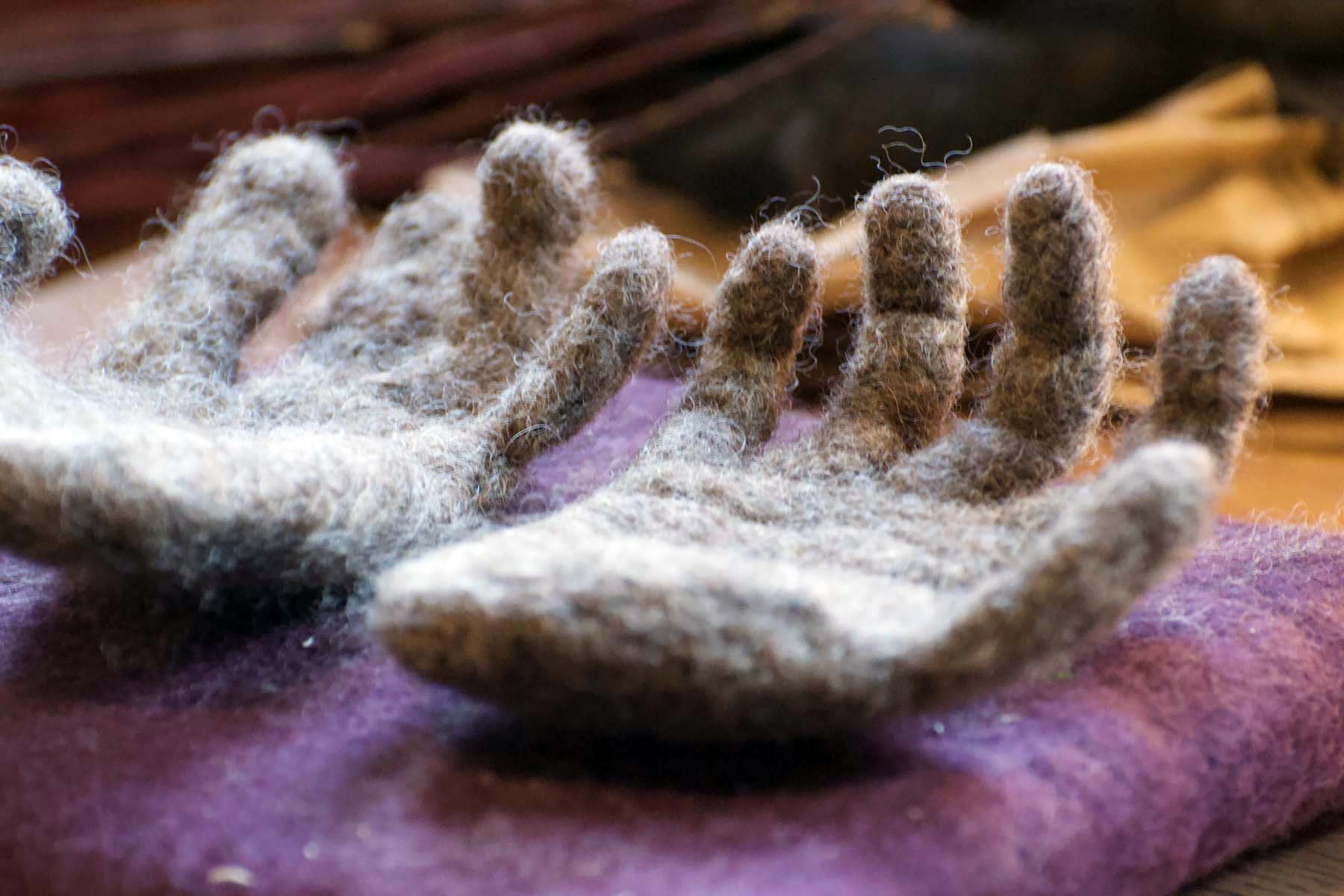
The matted fabric we call felt is created by binding protein fibers (wool from animals like sheep, goat, yak or alpaca) to each other in a process that involves the physical tangling of the fibers by means of special needles, or by using water and agitation that pummels the raw materials. Ever accidentally shrunk your favorite sweater by 2 sizes in the washer/dryer? That is wet felting…. the hair in the wool consists of shafts that are covered by protein scales. The water and detergents open up the scales and the agitation in the rotating drum, or rolling and rubbing and tossing, binds them together, shrinking them up to 40%.

Dry felting involves barbed needles that you stick into the raw material over and over, weaving the fiber strands together. It can be done by hand or by machine, when large projects are involved.

Felting has been around since at least the 6th century B.C., predating spinning and weaving. It likely originated with nomadic peoples in Asia, and remnants were discovered in burial places all across Siberia and Northern Europe. It was essential for shelter (think Mongolian yurts!) warmth and durability in clothing and boots, and protection from saddle burn for animals carrying loads. Ornamental uses have found their way into beautiful blankets and carpets, now extending to 2-D or 3-D sculpture.

The fabrication of today’s materials has come a long way from being coarse, wet wool stomped by camels, or pummeled by the hoofs of horses. Kún, for example, varies the kinds of fibers going into the felt. The selection involves the density of wool – wool is measured in microns, which describe the diameter of a wool fiber, the smaller the micron the finer the wool.

Micron 23

The artist also uses materials like silk that get entangled into the pressed fibers, dying the silks herself to achieve desired color gradations.

Layered wool and silk get run through the needling machine up to 6 times, then cut into strips, or fins, by a power cutter, wet felt aligned with cheese cloth, worked on surfaces that allow to pool the water.

Eventually the materials get shaped. That includes insane detail work of pulling threads out of the sides by hand to achieve a chenille-like effect that adds to the beauty.

Individual elements are stitched on, wet felt fibers shaved or torched to achieve the desired smoothness.

And then it’s time to finish the design, long planned and recorded to the tiniest detail. Some of the pieces are huge.

Photograph by Kristy Kún.

———————–

The artist with the clear face, beautiful eyes half hidden behind her glasses, is the descendent of Hungarian immigrants who settled in the Mid-West, establishing Presbyterian churches in and around Ely, Iowa, working hard to feed large families. She certainly has inherited that incessant, laser-focussed work ethic, a red thread like Ariadne’s throughout the many changes along her professional path. Trained as a construction engineer at the University of Nebraska, Omaha, she found her first real calling in wood working and furniture making. She settled in Northern California, interned and worked and learned the craft. A marriage to a fellow craftsman dissolved swiftly, leaving her as a single mother to a young daughter, trying to eke out a living in a male-dominated domain.

A side line of supplying crafts materials to her daughter’s Waldorf School led to an import business of Italian wool, selling it to spinners and felters. She got increasingly drawn into the fiber arts world, attending bi-annual workshops and camps for craft artists, the Frogwood Collective among them. Inspired by artists like Janice Arnold and Jenne Giles, Kún turned to felting in a serious way in the last decade, shifting from roles as supplier to that of artist.

It did not make her economic existence less precarious. Now located in Portland, OR, she was trying to support her family, while struggling with the illness of her new partner, who she lost to cancer in a painful battle to the end. Two years ago she moved to Ashland, leaving the familiarity and friendship network of PDX behind, to start a new life with a new love and a new studio, all during pandemic woes.

Life has felted Kristy Kún – my take, expressed with admiration. The various analogues of pummeling and stabbing, prodding and stomping have produced a tough, resistant core combined with (intellectual and emotional) flexibility like the fabric counterpart. Loose threads of flickering temper and intense empathy stick out here and there. Like the matted material absorbs water, she absorbs ideas and visions, turning amorphous input into shaped Gestalt. In addition to her raw talent, her persistence and technical skill have registered with the art world. Her work will be shown at this year’s Smithsonian Craft Show, Future Focus, and large commissions from collectors and designers across the world are regularly received.

—————————

While Kún and Lou Palermo, Maryhill Museum’s Director of Education, brainstormed over technical details of construction and placement of the frames – now stashed in her show room – within the Exquisite Corpse design, my thoughts wandered back to the tale of Ariadne, Theseus and the Minotaur. The myth has inspired countless works of art, from tellings by Catullus 64 and Ovid’s Heroides 10 in the first century B.C., to paintings spanning over 1000 years (here is a link that provides 73 of them!), to musical compositions, Monteverdi in the Baroque period, and Richard Strauss in 1916. And let’s not forget the modern version of myth telling – most recently seen in Dark, the German sci-fi thriller available on Netflix, that makes heavy use of Ariadne’s story and symbolism. A smart review of Dark in the NYT pointed out the particular theme’s relevance to contemporary history.

One of the reasons for its ongoing popularity, I believe, is that one can apply so many different perspectives to any one of the characters or actions involved. Across time you can see how interpretations of Ariadne focussed first on her passivity, her abandonment by yet another fickle male, then on her possible emancipation, her cunning in helping her lover, her ruthlessness in sacrificing a half-brother to a hero she saw as her ticket off the island – you name it. All links to shifting perceptions of gender roles.

Theseus has had his share of fans and critics too, understood as a self-sacrificing hero, or simply power-hungry. His wandering in the labyrinth has been appropriated by psychodynamic approaches in psychology, an archetypal representation of the psyche and a path to individuation, the authenticity you reach when you’ve made your way through the convoluted maze of feelings.

Comparisons to creativity have been offered as well. Serpentine windings to a goal without knowing the way, many a dead end, unclear what fates await – you get the idea. It looks to me that Kún’s creativity has not at all been impeded by labyrinthine obstacles. If anything, her work has blossomed from tightly constructed, somewhat rigid, representational beginnings to more freely flowing abstractions of natural forms that are willing to stand on their own. To link back to Rebecca Solnit’s quote at the beginning: Kún has created a bridge between map and world, walking along in its folds.

This leaves us with one final contemplation, how shifts in perspective define the Minotaur. The creature could either be seen as a bloodthirsty monster, depraved and deserving of slaughter, or as someone who in his deformity had to be hidden away as to not offend the sensibilities of the viewer(s.) Is he an enemy to the outside world? Or is his confinement an act of brutality against him? Do we project our fears of power, aggression, rage, disability and death onto this misshapen creature? Avoid the Other? Classic takes rejoiced forever in his slaying.

There were a few compassionate voices, Polish poet Zbigniew Herbert’s among them, expressed in a post-humosly published volume of essays, Labyrinth on the Sea, which described his visit to Crete in 1964. Elaborated in a later prose poem, The history of the Minotaur (1974), he sees the misshapen prince as a victim of those who insist on political, social and religious norms as defining who does and does not belong. Which – and yes, we were getting there eventually! – also applies to women and textile art.

I will talk about the history and politics of textile arts in depth at a later point in this series of essays. Let me just say here the very basics: not only were the arts and crafts divided into domains, with gender roles assigned, for centuries. Different arts were also linked to different values – male painters and sculptors scored higher than their female counterparts, the latter for the most part chained to their textile universe behind the embroidery frame. Hidden away in a maze, for all intents and purposes, forever invisible and unnamed even if they created stunning woks of art – just think Bayeux tapestries. Only in the last 40 years has textile art been given a platform, previously reserved for the male dominated, traditional fine arts field. With the help of some pioneers in the early 1920s who opened the flood gates, women have emerged to show the world how true art is independent of medium and how neglected media add novelty to the traditional canon in ways that are intensely beautiful.

Kristy Kún has to be counted among them.

It was a cold night in Ashland, sky shimmering with stars. I would not have found the Corona Borealis even if it had been present (I looked it up, it appears in July) – I barely can locate the Big Dipper. The small constellation of stars is said to represent the crown (corona) that Dionysos gave to Ariadne after she had been abandoned. It comforted me to think that, even if connected to a consolation prize, a woman with a thread is visibly remembered.

Here’s an alternative outcome!

Holes Being Dug

Almost out of the door, I grabbed the small point&shoot camera despite knowing better. It had been a bad week of painful lymphedema in chest and arm around the incisions, and I really should not lift my arm too much. Oh well. Was I ever glad I had at least this camera with me when doing the familiar round at Oaks Bottom. Come join me!

They were out, my cherished crows, in masses, hanging in the trees squawking, strutting through the meadow. Which should be much less straw colored in February, reminding me that we’ve now had four years in a row where rainfall was way below average.

Entering the wooded path, the beauty – Japanese print-like – of the duckweed on reflecting water was inspiring, even with the knowledge that it is found growing in water associated with cropping and fertilizer washout, or down stream from human activities, particularly from sewage works, housed animal production systems and to some extent industrial plants.

Given the color, I was not sure if it was common duckweed or more likely azolla, red water fern. The ducks didn’t care, and neither should we. Both are fascinating plants, providing nutrients and helping ecosystems.

Gadwalls, I learn. They live in the Great Plains but migrate through here.

The herons were unperturbed, out for lunch, ignoring me walking but a few meters away from them. I guess the loudly singing tree frogs at the pond’s rim were on the menu.

Beaver activity was visible everywhere,

but I think this fellow was a muskrat.

I can never tell. A kilometer further down I spotted this guy, and given his lunch, a fish, the likelihood was otter. As I said, cheap camera, not the resolution one would have wished for with this sight. I mean how often do you see an otter eating fish 15 minutes downtown from city center?

When I got to the viewpoint, the extent of the drought became more visible. This should be a lake, folks, not a dry hole in the ground.

If you are like me, it gives you the creeps. If you are like many of our compatriots, it instills fear, sometimes to the point of a condition that the the American Psychological Association (APA) defined as eco-anxiety, ”a chronic fear of environmental doom.” It is not listed in the Diagnostic and Statistical Manual of Mental Disorders (DSM-5,) but clinicians all over report attempts to treat it.

Not sure if this was the doe or one of her fawns that I regularly saw last summer

Last April, an article in the Scientific American described in depth what therapists are facing and how they have to make decisions about how to treat the massively increased numbers of patients who present fear if not panic in the face of climate catastrophe. A 2020 poll by the American Psychiatric Association showed that “more than two-thirds of Americans (67%) are somewhat or extremely anxious about the impact of climate change on the planet, and more than half (55%*) are somewhat or extremely anxious about the impact of climate change on their own mental health.” 

Red-tailed hawk

The NYT joined the topic with an article last week, describing the treatment approach by one of the earliest proponents of a necessary treatment approach to eco-anxiety.

Here is the dilemma: there is a tension between eco-anxiety’s role as a rational response to an existing threat, on the one hand, but also a potentially debilitating response, on the other hand.

There’s no clear, standard definition as to when eco-anxiety is unhealthy. It is rational to be fearful in view of a threat, and the threat is real. It is, however, unhealthy if it paralyzes your daily function, as it now does for scores of people. There is also the question of therapists’ own (political) beliefs. If they think your analysis of the threat is exaggerated or delusional (they don’t believe in climate change or its imminence) they will pathologize your response, which will have an impact on your therapeutic relationship.

Scrub Jay

Therapists themselves also feel unable to cope with their own feelings about environmental destruction. “When a therapist hasn’t begun to come to terms with their own emotions around climate change, it can add to the emotional turmoil of clients coping with overwhelming grief and anxiety, said Tree Staunton, a climate psychotherapist in Bath, England. For example, a therapist’s own grief, anxiety or guilt might come off as defensiveness or withdrawal. (Ref.)

Then there are the cases of people, in particular children, who have been personally impacted by traumatic events like fires, flood and tornados or hurricanes caused or aggravated by climate change, who are living with actual PTSD that needs to be treated while the threat of these events is ongoing.

Willamette River bank bordering Oaks Bottom on the Westside

The trolls were out, en masse, in the comment section for the NYT article. But so were thoughtful letters to the editor (2 examples below,) that highlighted important facts found both in and beyond the article.

“… the corporate construct that cleverly shifts the responsibility of a carbon footprint onto each individual. This is similar to the way the petrochemical and plastics industries have shifted all responsibility for recycling, particularly of the packaging they create, onto the individual, although the responsibility for recycling plastics should lie with the manufacturers.” (Mary Englert,
Portland, Ore. The writer is a retired licensed professional counselor.)

youth distress is directly related to the experience of governmental dismissal of and inaction on climate change. Young people are essentially reporting that their governments are gaslighting them by dismissing and devaluing their concerns, and by falsely stating that they are taking necessary action. This has significant political implications. Multiple reviews of the mental health effects of climate change (this is not a new topic in academia) all predict civil unrest and conflict as the long-term outcome. Politicians have a chance to correct course, honor their young constituents’ fears and act decisively. While therapy matters, preventing climate catastrophe matters more.” Mary G. Burke,
San Francisco. The writer is a professor in the department of psychiatry at the University of California, San Francisco and a member of the university’s Climate Change and Mental Health Task Force.

Baldies

It is easy to feel helpless and anxious when thinking what we can do about the destruction of our world, when really a few large corporations—and complicit politicians—call the shots. But there ARE things one can do, and in the doing alleviate some of the anxiety.

There are some political moves that can help activists. Science is contributing tools to fight collective helplessness.

There is important information that you can read, outlining possible next steps. Earthtrack, for example, offers tons of information about governmental subsidies that harm the environment. Environmentally harmful subsidies (EHS) are government actions that by design or effect accelerate the production or consumption of natural resources or undermine broader ecosystems supporting planetary health. The data show at least $1.9 Trillion a year (2% of global GDP) being dished out to Energy, Mining(non-energy), Fisheries, Forestry, Water, Construction, and Transportation industries. The organization informs about both the beneficiaries of such subsidies, worldwide, and reports on possible actions against them.

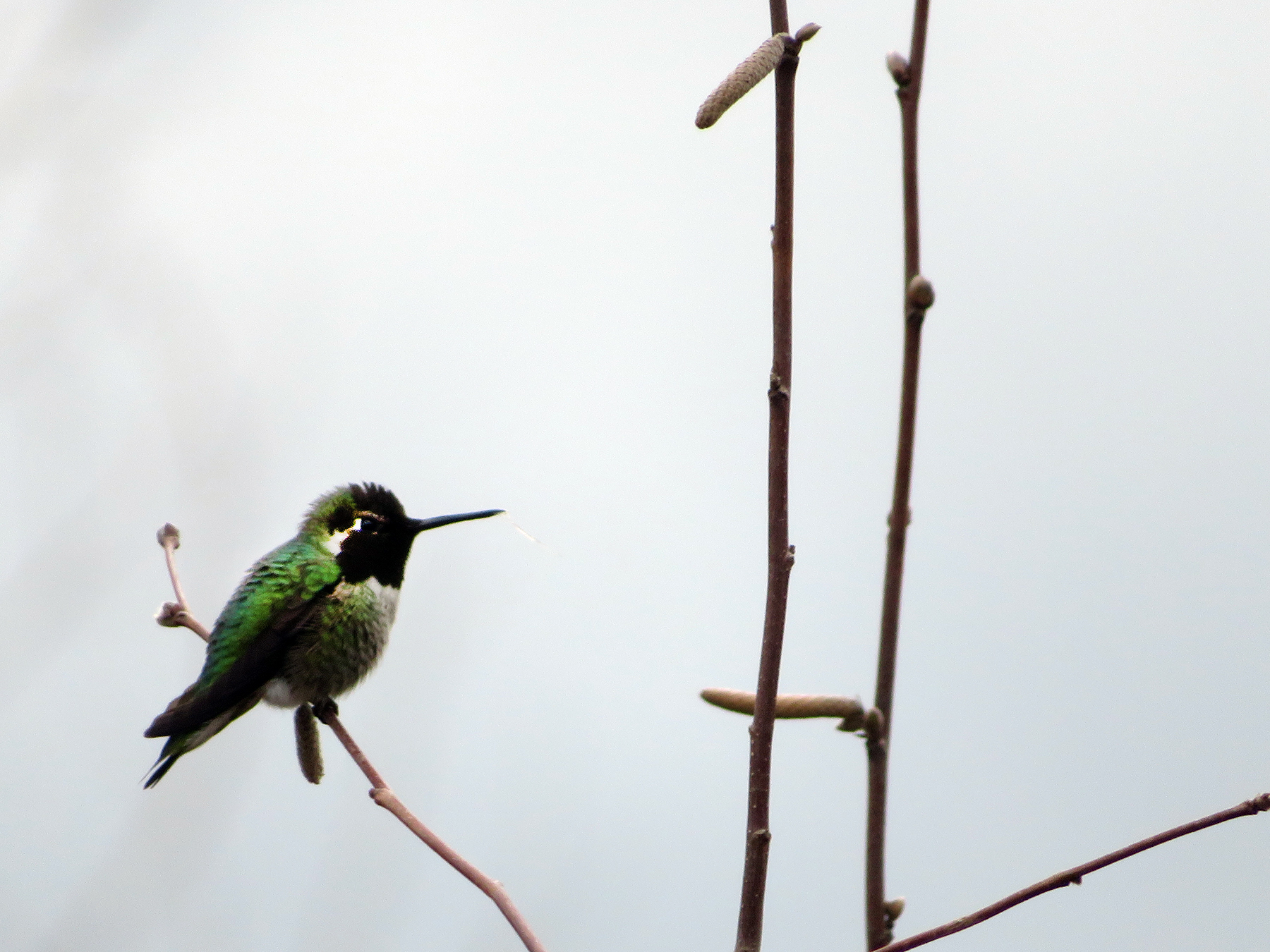
Anna’s Hummingbird

And then there is art. The hole in the ground where the Oaks Bottom Lake should be reminded me of this project from L.A. last year.

Cara Levine and associated artists provided their week-long participatory event as a communal reaction to and lifting of grief over the losses incurred during the pandemic – including the land, where the dig took place, of The Shalom Institute campus – which was devastated by the Woolsey Fire of 2018. Might as well throw our eco – fear into the mix, or the hole as the case may be, being strengthened by knowing we are not alone.

Or we could be digging ourselves OUT of a hole by collective action. You know where you find me doing just that.

Scrub Jay

Music today is one of my picks when I try to deal with surges of anxiety.

Breathing the High-Altitude Ether of Discovery

“Art-making embodies our private struggles with the meaning of life, the relationship between humanity and nature. In a time when our ability to comprehend reality is becoming more and more blurred by our inability to abstract meaning, the visionary abstractionist of natural phenomena represents a way of making art that is inherent and primordial…Through use of organic shapes and a chaotic vocabulary, it is possible to awaken the viewer’s own private demons.”Frank Kowing (2011)

It all began with a cold call to Linfield University. The family of Native American artist Frank Kowing, one of the first graduates of Linfield’s budding art department in 1966, wondered if they could get help with a treasure trove of work left in a storage unit. Framed, encaustic oil paintings, endless loose canvasses of acrylic abstracts, sculptures made of sticks and found objects, drawings and notebooks were all looking for a home.

Partial Linfield Gallery View

Brian Winkenweder, chair of the art department, was hesitant given the fact that the university is not set up to store collections, but upon seeing it all, was hooked. The quality of the work, the link to the institution and the region all deserved an exhibition, with hopes to connect collectors and art lovers to the work for further distribution.

Partial Linfield Gallery View

Thea Gahr, artist and curator of the Linfield Gallery, had her hands – and her head – full. Selection is always difficult with a plethora of materials, particularly when works range across domains, span decades, and differ wildly in style.

Thea Gahr inspecting one of the many canvases that could not be hung

In her favor, though, were the facts that she excels in taking risks, as I have now seen across several of her curations, had sufficient run-up time to think things through, and commands a space that captures a light seemingly made for or reflected in Kowing’s paintings of Pacific Northwest mountain scapes.

Frank Kowing Mt Hood 2010
Frank Kowing North Cascades 2010

***

—————————————————————————————-

Frank Kowing: Breathing the High-Altitude Ether of Discovery

Exhibition dates: Feb. 9 – Mar. 18, 2022

Opening reception: Wednesday, Feb. 16, 5:30 – 7 p.m.

Experience the paintings, sculptures, and sketchbooks of Frank Kowing Jr. b. April 1,1944 – September 24, 2016.

900 SE Baker Street
McMinnville, Oregon 97128
503-883-2200

—————————————————————————————-

I don’t follow any system. All the laws you can lay down are only so many props to be cast aside when the hour of creation arrives. – Raoul Dufy.

I had entered the empty gallery in the morning, wary of inside visits but determined to get to know what the Linfield folks were raving about and had almost an hour to myself, camera in hand, before meeting with the curator.

Some of the work was truly beautiful, much of it disquieting and all of it forcing you to read beyond seeing, the artist himself disambiguating the visual impressions by including text on practically each and every painted abstract or representation. Or, was the intention to make the work rather more ambiguous? Hard to tell.

Frank Kowing Thought Thing 2009 with excerpts

I did notice an intense push-pull exerted on me. The perception of wholes, of representative forms, of the rhythm and flow of the abstract visual input were constantly battling with the compulsion to decipher what the artist had written for you to read, or included in terms of photographs. The focus narrowed on his written communications, as if he intended to protect the beauty – or the meaning – of his painted visions and landscapes from too close an inspection, any possible intrusion. I couldn’t help thinking that the old adage by the 18th century French philosopher Marmontel, “the arts require witnesses,” had to be extended here to the request that the artist’s life, his struggles, demanded witnessing.

Un-numbered acrylic. “Closed into myself as if in mental state, saying please, how soon will this end.”

***

Frank Kowing, a member and Elder of the Confederate Tribes of Grand Ronde, was born in McMinville in 1944. (I am grateful to the Kowing family to have made excerpts of an upcoming biography available to me, which allowed me a glimpse of the artist’s life.) He served in the Navy during the Vietnam War, traveling extensively across Asia during his R&R breaks, travel an early passion that would hold true for the rest of his life. Europe was next after his tour ended, where he settled in Amsterdam. He attended the Gerrit Rietveld Academy, an art school that heavily focussed on graphics and design, but probably also provided exposure to the burgeoning neo-expressionist movement that took Europe and then the U.S. by storm during the 70s and 80s, the Austrian Georg Baselitz and Americans Philip Guston and Jeffrey Koons among them.

When funds ran out – a constant struggle throughout a lifetime devoted to making art and forced to making money, in exhausting day jobs as a contractor – Kowing returned to the States, living and working at multiple East Coast locations. He received an MFA from Penn State in the early 70s, joined various art collectives in New York, Pensylvania, D.C. and later Maryland, starting to sell work but never enough to be economically secure, like so many artists. After brief stints in California and a respite year in his beloved Oregon, he joined the Peace Corps in 1985 and spent 2 years teaching children living with developmental disabilities in Tunesia, followed by 6 years as a curator at Meridian House International, a multiservice not-for-profit conference center and museum in D.C.

The frequent shifts in location and occupations where partly the result of structural factors, economic hardship, the opportunities to be part of collectives, a conflicted relationship with established art galleries, the personal anchors of love and friendship found or abandoned.

I also think they were part of an internal restlessness, one driven by an overarching theme in the artist’s life: intense and frequent losses.

He was estranged from his parents, as well as from a son from an early relationship. He lost two beloved wives to death from diseases. He lost his health to a series of grave accidents and subsequent surgeries, the ravages of undiagnosed Lyme disease and increased pain management by self-medicating with alcohol. The zest for life, the passion for nature – mountain climbing in particular, again and again all over the world – the longing for the freedom of high altitudes of any kind, was in increasing tension with the paralysis induced by physical pain and emotional depression.

***

I am writing about this because the work itself draws one into a conversation with the artist’s expressed feelings. When he notates states-of-mind and emotions he communicates with the potential viewer. It is tempting to label him as a confessional painter, just like Sylvia Plath was stereotyped as a confessional writer, given the naked honesty and vulnerable pain and self-reflection associated with her poetry. That would be a mistake, though, in both cases, since the work embodies strategies of communications that are very well aware of the perceiver, and not just centered on self-disclosure, with Kowing implicating the viewer directly in his artist statements.

Frank Kowing – Tree of Life – 2011 with excerpted side-view showing the three dimensional materiality of the work.

Art is a language, an instrument of knowledge, an instrument of communication.” –  Jean Dubuffet

Among the standard models of intentional communication in my own field, psychology, are the so called Gricean assumptions. Grice proposed that we all want to convey meaning, something best achieved if we stick to truthfulness (maxim of Quality) which would be reflected in an artist’s sincerity to communicate or their skill and the selection of an appropriate style and medium in artistic communication. We should also choose the right level of complexity, (maxim of Quantity,) in painting that would be the appropriate levels of visual complexity. Our communication should be non-random (maxim of Relevance,) expressed in the painting’s subject that might included links to our culture, or to personally relevant issues, or historic symbols. Finally, there is the issue of how obscure an expression is, or structurally sound in terms of a painting’s composition (maxim of Manner.) Forget the science speak. Simply put: if you want to get a message across, to be understood, choose your topic wisely and in context, express it without distraction or excess details, and do so in a manner that does not obscure the meaning. Could have said that in the first place, I know.

Frank Kowing self portrait Journal series (Tyger Tyg, Burning Bright) 2011 with excerpts

Kowing basically breaks all of these rules and has us nonetheless completely fascinated with deciphering the meaning he might or might not convey. That is what true art can do!

Here are just some random examples that speak to that point. I had mentioned before that the layout of the representational paintings, the mountain scenes in particular, draw the viewers on the one hand to the beauty of nature, the pristine peaks, yet bind them to the base of the mountains, chained to deciphering the text, loosing the forest for the trees, so to speak. The mountains come in full view only if you stand far away, but the texts draw you close so you can read.

What is the subject and why is it overlaid by riddles?

It is puzzling, but the work soon conjures some strong emotion in the viewer – in my case memories of years spent in a suffocating, cloistered boarding school in the South West of Germany, looking through my classroom windows into the hazy blue of the Odenwald mountains and the Koenigsstuhl, a longing for being out there, away from it all, so intense it almost hurt. It might be different memories for others, but we probably all share that sense of wanting something, someone or somewhere and not having easy access, if any at all.

Frank Kowing Cascades 2004

The level of complexity of Kowing’s work goes overboard, particularly in the abstract expressionist acrylics that are dotted with snippets of text like his beloved Mt. Hood meadows with wildflowers. The words in the oil paintings are also in ambiguous relation to the complex spatial planes depicted in the painting; the photographs and typed pieces of paper are neither clearly foreground nor background, they remind the viewer that the painting is literally a flat surface, immediately contradicted by the three dimensional parts of the paintings created by layers of paint and wax – tactile mementos of ripped open scars or glorious mountain ridges, take your pick.

Frank Kowing Tree of Life 2011 excerpt

He has taken the inclusion of signs and text from the legacy of his forbears, collagists like George Braques, to new heights, leaving the viewer at times to struggle.

Un-numbered acrylic

Frank Kowing Acrylic # 84 Date not available

And chaos rules, obscurity is writ large. At least in my head, trying to figure out if Kowing meant the accumulation of fortune cookie predictions or other banal proscriptions scattered across his acrylics seriously, or as a tease, ridiculing our desperate need for unambiguous meaning by serving cultural platitudes cold.

A wonderfully humorous trickster, then, in addition to the deeply serious communicator.

That sense of trickster is reinforced when looking at the possibly invented communication with Edward Kienholz in one of the largest works in the exhibition. Kienholz, famous for his elaborate found-object assemblages which convey a harsh scrutiny of American society, was known to pull major pranks himself, in pursuit of chaos many times over.

Frank Kowing The Sea of Kienholz – excerpts – date unknown

I prefer the emotion that corrects the rule. – Juan Gris

I think Kowing would have liked the photograph below that dimly reflects me in the gallery glass door in front of the exhibition announcement. A faint witness to his art, his wit, his struggles. Moved by learning about this work, his life. And wondering what it is with art that allows communication between an artist and an audience even if they are separated by time, sometimes centuries, by cultural back-ground – Native American Oregonian meet German immigrant – by color or class, with some having the unearned privilege of inclusion in mainstream society, while others don’t.

The true artist knows how to convey basic emotions, cross-culturally shared, I suppose, the woes of longing/not belonging, the irreparable hurts of a past than cannot be healed, or the joy of being a small part of a majestic natural environment, that lets us feel free for small slivers of time.

Kowing knew how to tell stories, fully aware that they were likely shared in some, even many details at levels that transcend our roles in life.

The very last painting Kowing painted has an alpine sky-blue rectangle in the center, an empty space devoid of text, mementos, sorrow.

I try to tell myself that when he walked on in 2016, he stepped through that window into the azure light, breathing the high-altitude ether of not discovery, but release.

If you are interested in seeing work of other contemporary Native American artists, here are just a few options from around the state:

Seeds and Such

A young German historian, Annika Brockschmidt, recently published a book about America’s Holy Warriors (so far available in German only as Amerikas Gotteskrieger,) detailing the evolution of Trumpism, the general turn to an authoritarian, evangelical, cult-like movement within the GOP and the resulting danger to democracy. It met with acclaim, moved up the ranks in bestseller lists, until last week a sudden shitstorm unfolded, led by Politico’s chief Europe correspondent and echoed by representatives from the right-wing German press. She had not visited America! She had not interviewed Republicans in person! She was just echoing propaganda from leftwing US sources! Independent of the fact that the pandemic made travel impossible, the criticism conveniently overlooked that the contents were not claims by an investigative journalist (although she sure has an incredible breadth of source information as well as journalistic experience) but source analyses by a trained historian. The book, by the way, is smart, concise and perfectly reflective of what we here in the U.S. are experiencing.

I am bringing this up partly because I have been wrestling with the fact that my current reviews of visual artists are confined to a virtual experience of their art, or reading about their art. I am forced to look at their work on-line, if that is even possible. I can describe none of the emotional reactions that come with a real-life encounter, in situ, or thoughts that are spontaneously elicited when you meet face to face with something extraordinary. Maybe that is why universally available poetry has taken over so much of the recent musings. Does that mean I cannot, for now, review visual art? No. Just like it was for Brockschmidt, I still have access to the ideas, the concepts and insights that drive visual artists to their creations and can describe how those affect me or what they imply for the likely standing of the work.

Today, then, I want to introduce the ideas of a gifted young Palestinian artist, Jumana Manna, a film maker and sculptor, who was born in the U.S., grew up in Israel, and now spends her time between Berlin and Jerusalem. She recently received one of Germany’s more coveted awards for up and coming young artists, the bi-annual Max Pechstein Prize. It is the latest in a string of accomplishments that include stints at the 2017 Venice Biennale, and solo shows in major European and American institutions.

Let me trace the evolution of Manna’s ideas that have clearly marked her thinking for much of her career. As always, I am impressed when someone is able to have a continuous body of work that pursues different aspects of a general question.

Or questions. Who gets to decide what gets preserved when power hierarchies determine access and interpretation in situations defined by conflict? Who gets to determine how memories are shaped and transmitted? Who gets to choose what artifacts or living organisms get preserved or extinguished? Who gets to fix a value hierarchy that often serves indirectly political purposes? Manna looks at these question in the domains of botanical and agricultural preservation and opens the door to new ways of thinking about everything from the way religious botanists shaped the description and preservation of a region’s flora, to the insidious side effects of the Green Revolution in Middle Eastern countries torn by war, to Israeli laws and punishments imposed on foragers for traditional Palestinian foods.

An early body of work, Post Herbarium, looked at the American missionary, botanist and surgeon George E. Post (1838–1909) who in the late 19th century traveled to the Levant to collect botanical specimens. He believed they would be a key to understanding Christian theology. A depiction of the inherent tension between biblical beliefs and assumed scientific rationality was focal to Manna’s installations that used information gathered at the Post Herbarium at the American University of Beirut, where the specimens collected in Syria, Palestine and Sinai are archived.

Next came the film Wild Relatives (2017). (The link to Manna’s website includes a short trailer. The whole thing can be watched on True Story, but needs subscription.) The film is a marvel. It follows the journey of seeds between Syria, Lebanon and Norway, seeds collected and crossbred by scientists at local seed banks, then lost due to war, recouped from the Global Seed Deposit in Svalbarg and eventually sent back there again. (I had introduced that Seed Bank in the blog in 2017, when melting permafrost frost threatened it with flooding. Here is a more recent description of their work. )

I cannot begin to describe how the dry and often horrifying facts are told in lyrical fashion and with a sensitivity to human suffering that makes you cling to the story while absorbing scientific detail. I can, however, describe what we learn from the film. The International Center for Agricultural Research in the Dry Areas, known as ICARDA, a center that focuses on seed collection, cultivation and research, was moved from Lebanon (during that war) to Syria, back to Lebanon (during this war.) Scientists were lucky to escape Aleppo and much of their stock was lost. They requested their original seeds back from the Svalbard Seed Bank which had housed earlier deposits. Refugees from Syria are now working the fields in Lebanon to continue the local seed collection, cultivation and cross breeding with wild relatives of the species, and, once established, packages of these seeds are returned to Svalbard for further safe keeping. The film follows the journey and the humans involved in both Lebanon and Norway, their dreams and their nightmares shaped by both science and religion.

A detailed description of ICARDA’s work and struggle can be found here. What the film offers, though, is a question of the impact of Western agricultural practices and developments on the lives of small holding farmers in poor countries. What we know about the Green Revolution, the production of more food due to genetic manipulations that increased yields, is that it was a double edged sword. With increased food security (good), you also had increased use of pesticides, increased agricultural water consumption, increased areas of land needed for efficient farming, driving small holders out of the business (all bad.) Monocultures depleted the soil, and indigenous varieties of crops got extinct (really bad.)

The loss in biodiversity is real – and a problem. In the U.S. alone, 95 percent of cabbage, 91 percent of corn, 94 percent of pea, and 81 percent of tomato varieties were lost between the nineteenth and twentieth centuries. More importantly, in countries that are more exposed to current assault from climate change, like Middle Eastern countries are regarding droughts, the industry-produced seeds have not adapted to the shift and thus deplete water resources ever more. Seed preservation in vaults, theoretically a good thing, stores genetic material from times past, just like you keep animals in a zoo. The genes, however, do not adapt if they are not exposed to changing environmental conditions, yet it is exactly those adaptations that are needed to feed a world that grows drier and hotter. And hungrier.

The film makes clear that on the one hand questions of scale – who has the means, economically and scientifically, to run preservation projects for humanity’s safe keeping – favor organized institutions. But those who have the means also make the choices about genetic varieties in breeding and are able to monopolize world markets. Small breeders and preservationists who have still access to wild varieties of plant species contribute an enormously valuable part in fighting declining agrobiodiveristy, but they are an endangered species themselves. What will be preserved, what will be developed all rests on who is in power to make decisions that affect much of the world.

Here are some additional considerations how the interaction of climate crisis, monopolized agricultural decision making and urbanization contributed to the revolution turned war in Syria.

Fast forward to 2022 for Manna’s most recent video installation. Here at the West Coast we can currently see her newest work, Foragers, at the University of California, Berkeley Art Museum and Pacific Film Archive (BAMPFA.) The video installation was co-commissioned by BAMPFA, BAK Utrecht, and the Toronto Biennial of Art and filmed primarily in occupied Golan Heights, the Galilee and Jerusalem. (Full disclosure: I have not seen Foragers yet, but have been deeply moved by Manna’s essay on the issues exposed by the film – highly recommended reading, an insightful contemplation of many interrelated historical and political topics as well as an autobiographical testament: Where nature ends and settlements begin, translated into German by Fabian Wolff.) The text about the genesis of this work and her own personal experiences is a powerful reminder of what it means to live in occupied territories. Culture and tradition can be drawn into the struggle between opposing forces, and that extends even to what is allowed to be picked and eaten as per centuries-old customs.

In this specific case wild thyme and wild thistle, central to the Palestinian cuisine, known respectively as za’atar and ‘akkoub, were put on a protected species list by the Israelis, even though harvesting actually encourages the growth of these plants year after year. Individuals caught by the Nature Authority are put on trial with significant punishments, all the while many more of these plants are destroyed when the ground is prepared for the construction of new Israeli settlements. Here is a detailed description of the video installation.

If you remember, I have recently written about foraging here in the U.S. and its relationship to slavery and the impact of historical change on the African-American traditions. Traditions and knowledge were cut off with the hardships and legal (or customary) exclusion from nature following emancipation. Proprietary rights of White landowners were harshly enforced, once they had no gain from people’s survival through foraging, a survival that depended on supplementing the meager scraps of food they received on plantations. I have also discussed the effects of the Bonneville Power Act on the destruction of traditional food sources for Pacific Northwest tribes, by destroying fishing sites and generally endangering the salmon runs in order to regulate and increase water needed for aluminum production.

The interplay between nature, its products, competition for resources and power hierarchies are not an isolated phenomenon, but something found throughout history. An artist’s rendering of these complex and often rather dry topics (Seed propagation? Genetic engineering?) can open a space for us to think through the issues. Work done that reflects not just some distant past but the actual situation of growing food, lacking food, monopolizing food seems incredibly timely, given that we can expect food production to suffer in a world hit by pandemics, changing weather patterns and armed conflict. To do all this without wagging fingers, but with grace and inclusivity as Manna’s work does, is quite an achievement.

And I haven’t even talked about her work as a sculptor yet which happened in parallel to her video explorations.

Music today from a live performance in Amsterdam: Trio Joubran.

Wanderlust

Essential Meaning of Wanderlusta strong desire to travel.

Full Definition of Wanderlust: strong longing for or impulse toward wandering. – Merriam Webster

If you check the definition for wandering on Merriam Webster you’ll notice that it includes “meandering, not keeping a rational or sensible course, or movement away from the proper, normal, or usual course or place.” Anything but hiking which the original German term “wandern” refers to.

Wanderlust was at its root about hiking, a desire to get back into nature, explore the natural world during the period of German romanticism. Artists from the 18th century on tried to find new inspiration beyond the cities and experience or express their feelings rather than simply depict scenes. That was true for visual artist as much as composers and authors. The fear of nature, as represented by forbidding mountains or cliffs or the vagaries of the seas transformed into fascination, even awe.

Thomas Cole A View of 2 Lakes and Mountain House, Catskill Mountains, Morning. (1844)

Later, and perhaps connected to the European system of artisan apprenticeships and journeymen, Wanderlust took on the meaning, probably more familiar to us, of the urge to roam anywhere but home, the longing for seeing the world at large and confronting unforeseen challenges.

Albert Bierstadt Giant Redwood Trees of California (1874)

It was all about the hero in nature, made small by awe (just look at these tiny figures in their immense surroundings), or seen big as conquering the obstacles encountered. It was about deceleration and a certain longing for glorified older times. It was also about the larger story of finding meaning in life, or allegories of a life’s progression, or expressing one’s relative take or standing in the natural order of things, a rise in individualism. And often it was linked to nationalism and pride of the beauty of one’s country.

Gustave Castan Landscape with Hiker (1870s)
Gustave Castan Gewitterstimmung im Rosenlauital (date unknown)

The quotes convey it well: “The things one experiences alone with oneself are very much stronger and purer.” (Eugene Delacroix.) “Amid those scenes of solitude… the mind is cast into the contemplation of eternal things.” (Thomas Cole.) “I must stay alone and know that I am alone to contemplate and feel nature in full. I hav to surrender myself to what encircles me, I have to merge with my clouds and rocks in order to be what I am.” (Caspar David Friedrich.)

Karl Eduard Biermann Das Wetterhorn (1830)

A few years back Berlin’s Alte National Gallerie had an exhibition of paintings ranging from romanticism to expressionism that focused on landscape and the wanderers within. Some of today’s paintings are from that show, some are personal picks from other encounters, and they leave out the more familiar ones. They do show a trajectory, though from the early romantic leanings to more expressionist offerings that de-emphasize the human/landscape interaction. This was the first painting you saw when you entered – and the only woman of the bunch…

Jens Ferdinand Willumsen Die Bergsteigerin (1912)

However you frame it, I was bit by the Wanderlust bug since early childhood, and felt suffocatingly stifled when first Covid made travel impossible in 2020, and then health issues put a curb on hiking as well in 2021.

Vincent Van Gogh Man with Backpack (1888)

I am therefor thrilled to report that on the very first day of 2022 I managed part of a hike, in snow no less, that reprised my last one in 2020 before things fell apart. I had reported on it here.

Emil Nolde Der alte Wanderer (1936)

Today’s images are a comparison between July and January conditions of the very same sights on the trail up to Mirror Lake, OR (I did not do the full hike up to the top of the Tom Dick and Harry mountain on New Year’s Day.) Or I would have looked like this.

Ferdinand Hodler Der Lebensmüde (1887)

It is hard to explain why hiking feels so empowering – beyond the stress relief of physical exertion and the pride to pull it off (even in slo-mo and across much diminished distances.) I have no spiritual inklings when out in nature (have I ever?) but an endless appreciation for the beauty around me and the sensory input that reaches from smell to sound to visual reflections of light and shadow. I cherish the resilience of the landscape that surrounds me and, I guess, take it as a model. I like to observe change, when revisiting familiar sights over and over again, as long as that change is natural and not imposed by human interference. Drives me up a wall, when parks are closed for remodel…. no matter how much environmentally sensitive reconstructions are warranted – I feel deprived! And, I admit it, I like the “hunt” with my camera for wildlife of all sorts, the sudden gift of sightings, hoped for, but never guaranteed. I hiked long before I took up photography, though, so that’s just a bonus. Maybe it is the freedom that Hardy (below) describes, to move away from daily anchoring by duty.

So grateful that at least day hikes are back on the menu!

——————————-

———————————

——————————————

———————————-

——————————————

—————————————–

Freedom 

Give me the long, straight road before me, 

A clear, cold day with a nipping air, 

Tall, bare trees to run on beside me, 

A heart that is light and free from care. 

Then let me go! – I care not whither 

My feet may lead, for my spirit shall be 

Free as the brook that flows to the river, 

Free as the river that flows to the sea. 

by Thomas Hardy (1840 – 1928)

I’ll hike to that! While singing Schubert’s ” Der Wanderer.

One should not forget, though that there are serious alternatives to hiking, in case you are housebound – read this fascinating piece and consider!

This Season’s Gift

In true appreciation of your continued reading, encouragement and critical interaction my gift to you for the holidays is:

No politics today.

No social justice issues today.

Nothing complicated or sad today.

A poem about how to be hopeful with the help of nature.

Here’s a collection of images from a hike up Wahkeena Falls last week, into the mist with a sprinkling of snow. There was beauty and the reminder that there are always more chances. If you had told me in the hospital at the beginning of the year that I would hike some miles up the steep hills of the Gorge by the end of it, I would have declared you insane.

Mist

It amazes me when mist 
chloroforms the fields 
and wipes out whatever world  exists 


and walkers wade through coma 
                              shouting 
and close to but curtained from each other 


sometimes there’s a second river 
lying asleep along the river 
where the sun rises 
               sunk in thought 


and my soul gets caught in it 
               hung by the heels 
               in water 


it amazes me when mist 
                             weeps as it lifts 

 
                 and a crow 
calls down to me in its treetop voice 
       that there are webs and drips 
and actualities up there 


and in my fog-self shocked and grey 
               it startles me to see the sky

by Alice Oswald (elected as the first female professor of poetry at the University of Oxford in 2019)

Here is to crows, blue skies and actualities. I will see you in the – happy – new year.

———————————

And in case you still need more support to get through these next weeks, I urge you to try the following relaxation exercises. If Bruno Pontiroli’s models can do it, so can you! Possibilities abound!

That’ll be me!

Since all the animals reminded me of Camille Saint-Saëns’ Carnival, here is his Christmas Oratorio, equally enchanting. Merry Christmas.

Feathers to the Rescue.

Today is all about counterbalancing my reading recommendations (heavy, in every meaning of the word) with something visually enchanting (light, in every meaning of the word.)

The essays can be found in The Atlantic, here and here. They are asking us to imagine the unimaginable and allowing us glimpses into a world that seems surreal even though it surrounds us, the active work of many to destroy our democracy and passive bystanders paving the way, again. I completely understand if it is all too much to face (although that is some of the problem that the essays tackle,) and offer the sculptural art below as an anti-dote to heavy hearts.

Here is someone who champions feathers. Chris Maynard, with backgrounds in ecology and biology, uses his skills with magnifying glass, forceps and eye surgery tools to create carvings into feathers that evoke fragile, intricate scenes.

Here is a short clip where he explains his work.

Maynard is a member of Artists for Conservation (AFC,) a Canadian based international non-profit that represents approximately 500 artists from 30 countries,in the nature/wildlife art genre who are committed to conservation. One really cool thing about them: they list art on their website linked to categories of beneficiaries, so if you know someone who cares about whales, or owls, or a particular national park and are desperately looking for a meaningful present: voilà!

***

Kate MccGwire also works with feathers, in her case in bulk, creating ingenious sculptures that remind more of water than air in the way they capture movement. The British artist’s websites says she collects, sorts and cleans her material – where do you find that many feathers??? Maybe collecting refers to finding sources that provide. Must be.

“Speaking on her use of feather as a metaphor for what she terms ‘the duplicity of nature’, Kate MccGwire has said, ‘My work is inspired by the water forming incredible patterns that are there one second and gone the next. Everything is fleeting on the water, it is beautiful but there is danger and treachery underneath the surface. I’m intrigued by that dichotomy.”

Just look at the flow.

SASSE/SLUICE, 2018
Mixed media with pigeon feathers
60 x 450 x 200 cm

Or the bulk!

And then, there are feathers au naturel. The way I find them on my walks.

May the feathers lift us up. If not, we should crawl underneath and hide. At least it’ll be dry and warm.

Music by Poppy Ackroyd today.

The Bellwether

bell·weth·er

/ˈbelˌweT͟Hər / noun

the leading sheep of a flock, with a bell on its neck.

  • an indicator or predictor of something.

Oxford English Dictionary

Two years ago I had the opportunity of portraying numerous artists of a project called Exquisite Gorge, offered by the Maryhill Museum of Art. 11 print makers, in collaboration with community partners, carved an original artwork each for an assigned section of the Columbia River, all of which were ultimately connected in a two-dimensional, 66 ft long representation on the grounds of the museum. Each artwork portrayed a section of the river itself and linked to the next section, forming an “Exquisite Corpse.”

We are now entering the second iteration of this artistic adventure, Exquisite Gorge II, which will exhibit the skills and creativity of 13 fiber artists whose works will align the very same sections of the Columbia River as last time. I will follow the creation of these three – dimensional art works closely and also portray the community partners involved in multiple aspects of the project, including opportunities to inspire and educate about fiber arts. The culminating event will be on Saturday, August 6, 2022 at Maryhill Museum of Art, where each free-standing “exquisite corpse” section will be brought together to reveal the continuous sculpture formed by upright three-dimensional frames.

In some ways, this first essay is the bellwether then, an indicator of what’s going to be happening across the next many months. The title, however, was mostly chosen because it relates to sheep (wethers are castrated rams, to be precise, who were leading the flock while fitted with bells to allow shepherds locate the sheep across a distance.) The phrase also points to those who establish a trend, and we will discuss that as well. How’s all this related to art? Well, the fiber for many fiber art projects has to come from somewhere, and in some cases the source is, you guessed it, sheep.

_________________________________________________________________________________________________

THE EXQUISITE GORGE PROJECT II

“…a collaborative fiber arts project featuring 13 artists working with communities along a 220-mile stretch of the Columbia River from the Willamette River confluence to the Snake River confluence. The project, again initiated by Maryhill Museum of Art and following the original one by printmakers in 2019, takes inspiration from the Surrealist art practice known as exquisite corpse. In the most well-known exquisite corpse drawing game, participants took turns creating sections of a body on a piece of paper folded to hide each successive contribution. When unfolded, the whole body is revealed. In the case of The Exquisite Gorge Project II, the Columbia River will become the ‘body’ that unifies the collaboration between artists and communities, revealing a flowing 66-foot work that tells 10 conceptual stories of the Columbia River and its people.”

Artists and Community Partners:

Section One: Oregon Society of Artists–Artist: Lynn Deal
Section Two: Lewis and Clark University–Artist: Amanda Triplett
Section Three: Columbia Center for the Arts, The History Museum of Hood River County and Arts in Education of the Gorge–Artist: Chloë Hight
Section Four: White Salmon Arts Council and Fort Vancouver Regional Library–Artist: Xavier Griffith
Section Five: The Dalles Arts Center and The Dalles-Wasco County Library–Artists: Francisco and Laura Bautista
Section Six: The Fort Vancouver Regional Library at Goldendale Community Library–Artist: Carolyn Hazel Drake
Section Seven: The American-Romanian Cultural Society and Maryhill Museum of Art–Artist: Magda Nica
Section Eight: Desert Fiber Arts–Artist: Ophir El-Boher
Section Nine: The Confederated Tribes of the Umatilla Indian Reservation–Artist: Jessica Lavadour
Section Ten: ArtWalla–Artist: Kristy Kún
Frontispiece: Tammy Jo Wilson and Owen Premore

_________________________________________________________________________________________________

_________________________________________________________

To mortal men the gods allot woes which cannot be foreseen.” 
― Apollonius of Rhodes, Jason and the Golden Fleece (The Argonautica)

_________________________________________________________

I loved the 3000 year-old Greek tale of Jason and the Golden Fleece as a child. I mean, heroes, adventure, boat trips, flying sheep, dragons, magic, revenge, what’s not to love? Jason’s first wife Medea, I guess; who’d love a woman who kills her own children? But then again, she was betrayed by him after she had helped him acquire the golden fleece that secured him a throne. I would also likely not have loved the fact that the story described, certainly by the time Apollonius composed it in the 3rd century BC, the Hellenistic colonization of the lands around the Black sea. I had, of course, no clue about such things in the late 1950s.

The pre-history of the myth, by the way, is much older. Excavations of the 1920s and 30s, in central Turkey, uncovered Indo-European tablets from a Hittite civilisation dating to the 14th century BC. One of these has an account on it of a story similar to that of Jason and Medea. Fleece played a considerable role as symbols of prosperity; Hittite clans from the Bronze Age hung them to renew royal power. For the ancient Etruscans a gold colored fleece was a prophecy of future prosperity for the clan. (Ref.)

My son sent this when he saw the portrait above…. must have done something right in my child rearing.

Sheep have claimed symbolic roles beyond their fleece, of course. Egyptian deities were depicted with rams’ heads. Christian symbolism had a field day with innocent lambs led to slaughter, shepherds guarding their flocks, sheep being the most cited animals in the Bible with over 500 mentions. Composers like Bach, Händel, Britten, to name just a few, integrated biblical verses about them into their music. Poets would pick up the symbolism, most memorably in William Blake’s Lamb. Novelists would hone in on the image of the Black Sheep, one of the earliest in 1842 by Honoré de Balzac. The tale of two brothers competing for inheritance, of power and cruelty of life has certainly parallels to the old Greek myths. (It turns out, by the way, that wool that has black strands in it can only be sold for a fraction of the price of white wool, because it makes even dye lots much more difficult to achieve.)

And who could forget the invisible sheep in a box in The Little Prince, Antoine de Saint-Exupéry’s novella that pointed to the sheep’s possible role in uprooting the horrible seeds of fascism, represented by Baobab trees? Or one of the funniest science fiction novels of all time, Connie Willis’ The Bellwether, which perfectly captures both the way fads are generated and science progresses by stumbling into lucky breaks?

Let’s look at the real thing, though, not just the symbolic use.

The gods certainly allot a share of unpredictable woes to sheep farming, a complex enterprise. The animals provide meat (lamb and mutton,) wool and pelts for textiles (here’s where the art project comes in!,) and milk from the emerging dairy sheep industry. It has been an industry in steady decline in this country, from a record high of 56 million heads in 1942 to 5.17 million heads as of January 1, 2021, according to USDA statistics.

There are multiple reasons for this downward slope: higher feed and energy costs, land disputes and fencing, losses to predators and/or disease, a consolidation of the sheep packing industry and competition with cheaper products imported from other nations. Add to that the fact that conservationists are often in conflict with sheep farmers for areas critical to each group, and that wool in clothing has been replaced to a large extent by synthetic fibers. Meat consumption has declined as well, from an average per person consumption of 4.5 pounds annually in the 1960s to just 1.17 pounds in 2020. Climate change is also having a potential effect on sheep farming with the epic drought showing effects. Range sheep operations rely on grazing on native pasture lands, some of which are increasingly regulated and permit-dependent due to endangered species protection. Clearly, it is an uphill battle. One, it turns out, that some young people, reconnecting to the land, are willing to fight.

Meet Merrit and Pierre Monnat who started a sheep farm in 2014 near Goldendale, WA.

M+P Ranches has grown from fewer than 10 coarse wooled sheep to almost 300 fine wooled Targhee and Rambouillet ewes and grown in size to about 320 acres. The sheep move from pasture to pasture, grazing on dry sagebrush country, perennial grassland and alfalfa fields throughout Klickitat County during the warmer months. In winter they are grazing further East and are fed hay provided locally, to ensure that the ewes produce enough milk for the lambs that start to be birthed in February.

Originally from Texas, Merrit moved to the PNW for internships on farms, and ended up working on Vashon Island, WA, where she met her husband. Pierre, growing up in Seattle, spent many childhood summers on a relative’s farm in Wisconsin. Later he got involved in vegetable farming in Washington, and was ready for farming on his own when they got together. They built the business, quite literally, by hand: the barns, the service buildings, the fences.

The Monnats live in a farmhouse that is over 100 years old, reached by dirt road. Their products – meat and wool – are distributed locally through farming co-ops, and in direct sales from their website. In addition, they have horses, and have built a greenhouse that adds produce to their list of products, appreciated by restaurants that insist on farm-to-table quality.

It is a work-intense and relatively isolated life, with little time for anything else. It took multiple years to find a foothold in the community, although by now the couple feels integrated and appreciates the advice handed down from older farmers. The farm work is augmented by shearing services that Pierre offers with a mobile trailer, a labor that requires intense skill, focus and concentration to avoid harming the live stock. If you hire yourself out to do this you are also dependent on the owners doing the right thing – not feeding the sheep on the day of the procedure and keeping distractions like dogs etc away from the live stock. It can be nerve wracking. It will be fascinating to watch him do a shearing demonstration in front of a live audience at Maryhill Museum during the exhibit opening in August.

In a state that mirrors the national trends, Washington sheep farming has seen a reckoning since the 1950s. By 2019 most of the state’s farm flocks consisted of 24 or fewer sheep being raised at diversified, family-owned farms, with only one last big range operation still featuring a flock of about 5000 heads. (A terrific historical overview of the issues can be found here.) The aging of farmers and their retirement without successors is a serious problem. Primary producers over 65 now outnumber farmers under 35 by more than 6 to 1.

But perhaps ranchers like the Monnats are the bellwethers for a younger generation of people willing to explore something new without the traditional ways of easing into an established family business. Young farmers pursuing the fleece – white, not golden. Not exactly Jason and Medea, but defying the gods nonetheless, with intense work, passion and determination, not the dark arts.

They are part of a movement that contributes to the growth of the local food movement and could preserve mid-sized farms in the country. They are more likely than the general farming population to grow organically, limit pesticide and fertilizer use, diversify their crops or animals, and be deeply involved in their local food systems via community supported agriculture (CSA) programs and farmers markets. (Ref.) And in our case, they connect to local individuals and organizations focussed on art, whether they are providing wool for artisanal processing or education for projects like the Exquisite Gorge II. Let them be bellwethers, by all means!

Rams are kept in the barn for the winter.

And in the building next to the barn the new renters arrived, Margo Cilker and her husband who is a cowboy. Cilker has her first album out to rave reviews, including one on Oregon Arts Watch. Here is one of her songs, That River from the album Pohorylle.

If Life Gives You Shards…

Broken strategies. Broken systems. Broken hearts. Lots of wreckage after the results of this week’s election, and lots of gratuitous commentary by all those who seem to know what should have been done differently. If in doubt accuse progressives, never mind that we have a centrist president, centrist senators who are holding up any substantive legislation and a moderate candidate in VA who lost a substantial point advantage after remarks that triggered parents grappling with increased diversity in their children’s schools. Never mind a progressive candidate for Mayor of Buffalo who won the primaries fair and square being ousted by a write-in campaign supported by her own party’s establishment in alliance with republican donors.

Let’s focus on something positive instead. I am encouraged by art that points the way to something more constructive: take the shards, the remnants, what’s discarded and make it into something beautiful that functions as a reminder of what came before but also points the way to what can emerge.

All photographs of jewelry are from Julie Decubber’s website linked below.

Julie Decubber is a jewelry artist currently working in the South of France. She forges connections between things with a history and new creations, with an exquisite eye towards what compliments or what does not distract from the visual beauty of the material itself.

I was first drawn to her work with old porcelain shards. I have always loved patterned porcelain. In my childhood our plates that so often held food I did not like or was not interested in came from a pattern called Burgenland (Castleland.) It spurred the imagination of the (even then) travel-hungry child. It is no longer produced just like my own 50 year-old china which floats phoenixes (birds, of course!) and ideas of renewal, and which will be proudly used into perpetuity with chips, cracks, and dulled glaze.

Here are some samples found on Decubber’s website that show her work with porcelain shards.

Buttons!

Her newest project, however, is what really interests me. She visited, interviewed and formed impressions of a number of contemporary ceramic artists, all women. They entrusted her with discarded shards from their projects which she then turned into jewelry.

I always admire collaborative projects because they require heightened sensitivity to diverse approaches, but also widen the repertoire of ideas that are collected cumulatively. Before you look at what she came up with it might be fun to check out the work of the ceramicists, linked below.


The ceramists:

Anne Verdier , Julia Morlot , Émilie Pedron , Julia Huteau , Héloïse Bariol , Enrica Casentini , Agnès DebizetUlrike Weiss , Francine Triboulet , Kaori Kurihara , Nani Champy-Schott , Léa Van Impe , Linda Ouhbi , Fanny Richard , Alice Toumit .

Here is some of what Decubber created. The whole collection was shown in an exhibition at the Musée des Arts Décoratifs in Paris which closed last month.

Here is a glimpse backstage, a mosaic from her workshop, beautifully laid out by some clever website designer.

Decubber describes her pieces as history that can be worn, as documentation of the history behind their origins, from porcelain manufacturers of old to the eclectic output of contemporary ceramicists. This history also includes nods to cultural influences rooted in geography, from subsaharan styles to asian forms, stressing the importance of art to break nativist boundaries.

It is perhaps no coincidence that this work caught my eye during a time when the denial of history partially drives election outcomes. “Let’s not make our innocent White children feel bad when they hear in school that humans were treated as animals by their ancestors! Let’s not delve into the racist structures of our nation lest we ourselves would have to admit that we are on the side of evil, if only via complacency. Let’s not even face the fact that maybe, after all, we ourselves don’t think of ranking skin color, religion, class as wrong. As just one example, almost 50% of Republicans assert that only Christians can be true Americans.

seen on Twitter on yesterday

In Virginia it was not just the straw man of Critical Race Theory. A lot of uproar was caused by a 2019 third party – audit report that described public schools as “hostile learning environment” for students of color and that staff often failed to address racist incidents. Multiple students, the local NAACP, and even the commonwealth’s attorney general have called for the public school system to correct systemic racial discrimination.” This led to a 2021 equity plan calling for implicit bias training, enhanced protocols for handling racist behavior, and improved reporting systems for students. Parents erupted, suing the system over the plan, and the Fox news universe took over during a time of parental frustration with school closures due to Covid that had reached the boiling point. (Ref.) Preliminary statistics of voter choice indicate that Republicans gained the most strength in districts that had recently seen increased diversity in their student population.

Nationally we see the same trend emerging, just looking at school board meeting disruptions. It really is a perfect platform. Boards are accessible, they are filled with or represent parents driven to the brink by worries about their children and the burden of homeschooling during the Covid lockdowns. Aspiring candidates are easily financed with organized dark money (like the Tea Party of yore, by the same sources.) And hostile environments and even violent threats drive a lot of parents who were perfectly happy to be members of school boards or other educational settings into retirement.

Let’s face it: we are not seeing a simple misunderstanding about the dog whistle Critical Race Theory being or not being taught in public schools. We are seeing a veiled but deeply ingrained aversion of many parents to a change in racial relations, to a reckoning with racial history in general, a willingness to hold on to their own prejudices. “Yes, slavery was bad, so we ended it hundreds of years ago. Let’s move on, nothing to see here. And if we have to ban Toni Morrison books, so be it.” We see a centeredness on White kids when CBSNews asks “How young is too young to teach kids about race?” while Black kids as young as three years of age feel the implications of their race. For them obliviousness to race is not optional. Why should it be for White kids?

How do you make that an issue as a democratic campaigner, calling out voters‘ explicit or implicit racism, without shooting yourself in the foot? Or, to stay in line with today’s visuals, walking barefoot over broken shards?

Here are shards of light turned to music.

Raise a Voice – Art as Social Praxis

Sooooo – long piece today which was written as a review for OregonArtsWatch over the weekend. You can read it on their site or the usual way below. The latter will, of course, give you the bonus of music, as per usual (the favorite musician of the artist who I interviewed.) This was the first time I venture out in over a year to actually review an exhibition, and I felt grateful that it turned out to be a splendid occasion. See for yourself.

*******************************************************************************

 …the ordinary becomes beautiful as a trace of the true. And thordinary becomes a trace of the true if it is torn from its obviousness in order to become a hieroglyph, a mythological or phantasmagoric figure.” 

– Jaques RancièreThe Politics of Aesthetics – The Distribution of the Sensible.

Theodore A. Harris, Artist

Ownership. It’s a difficult concept to define, given that it can be applied to relations between a person and an object like a painting or a piece of land, or relations to legal entities like a business, a domain or a copyright. Ownership is usually protected by law, although the details of this protection vary according to cultures, economic systems, and other customs. In each case, the details specify who has which rights to what they own, and also who is allowed the use or enjoyment of others’ possessions only with the owners’ consent.

There are often ethical questions around ownership that we have trouble resolving, despite all the laws. Should we appoint scientific ownership to cells taken from an individual without consent? (Think Henrietta Lacks.) The privilege in that case was assigned to the scientific community and the pharmacology industry (which, of course, benefitted heavily from this ownership).

Should we grant ownership of discovered skeletal remains to the anthropology community or to Native American tribes demanding that the remains be returned under the federal Native American Graves Protection and Repatriation Act ? In the case of Kennewick Man, it took a 9-year legal battle, advances in DNA testing, and a 2016 legislative change that finally allowed the ancient bones to come home to a coalition of Columbia Basin tribes for reburial according to their traditions.

Who is the owner of objects that were illegally obtained? Jewish families whose art was stolen or expropriated under the reign of National Socialism have been granted restitution by the courts. African American plaintiffs in a case arguing that daguerreotypes of their enslaved ancestors belong to them and not Harvard University, have been denied by the courts. The argument that the photographs were taken under conditions of slavery and with the explicit intent to demonstrate the “truth” of White superiority by depicting the slaves in full frontal nudity, and thus constitute crimes against humanity, held no sway with the judges.

Theodore A. Harris. Postcard from Conquest (Collage and Conflict series), 2008, triptych, 85″ x 42′ in each panel, collage printed on paper , mixed media collage on panel.

There is a different kind of ownership, no less beset by ethical concerns. This kind lies in the role of the gate keeper who owns the power to control access to a given domain, and, equally important, the power to frame the criteria that define the domain and the rules of participation.

The ethics of gate keeping – in the realm of art as well as politics – are addressed by Linfield University’s new exhibition: 

Theodore A. Harris: Art as Social Praxis – Dedicated to Art Historian David Craven

October 11- November 20, 2021

Opening Reception/Artist Talk: Thursday, Oct 14 – 6 pm – Linfield Gallery, Linfield University, McMinnville, OR 

Theodore A. Harris, Artist

Harris, collage artist, writer and founding director of the Institute of Advanced Studies in Black Aesthetics, is based in Philadelphia. He is a warm, approachable man, whose thoughtful explanations are often punctuated by bursts of enthusiasm, quite infectious. As a writer, Harris is co-author of books with Amiri Baraka: Our Flesh of Flames (Anvil Arts Press) and Malcolm X as Ideology (LeBow Books); with Fred Moten: i ran from it and was still in it (Cusp Books); as well as TRIPTYCH: Text by Amiri Baraka and Jack Hirschman (Caza de Poesía). His visual art can be found in public and private collections, including the Pennsylvania Academy of the Fine Arts, the Center for Africana Studies, the W.E.B. DuBois College House, and Penn Libraries, University of Pennsylvania; Saint Louis University Museum of Art; and Lincoln University. Since 1985 he has taught at the renowned Anti-Graffiti Network/Philadelphia Mural Arts Program, which he co-founded.

The artist has created work that is historically pertinent and initiates political thought – two benchmarks that are essential for art to be significant, in the eyes of eminent art historian David Craven (1951 – 2012) to whom the exhibition is dedicated, and whose analytic insights have clearly informed the art before us. (A helpful introduction to Craven’s life and work by Brian Winkenweder, professor of Art History and chair of the art department at Linfield, who organized the exhibition and invited the artist, can be found here.) Winkenweder has a track record of placing his students in first-rate MFA programs, not least by using exposure to the various complex exhibits in the beautiful Linfield gallery as a “learning laboratory.” The university fully supports his endeavors, not something you hear often across art departments in this country, testimony to an institution that understands the value of an art education and the critical thinking that it instills.

Brian Winkenwerder, Professor of Art History, Linfield University

Harris’ work on display is, as it turns out, prescient in some ways, eerily transposable from one era to another. 

Take the collage murals now affixed to the walls opposite the Linfield Gallery. One depicts a young, masked boy – looking at us perhaps cautiously, perhaps accusingly – next to an inverted image of the Capitol building. Created in 1995, the context then was the Rwandan Genocide, the boy witness to the massacres against displaced persons, masked to combat the stench from the scores of killed Tutsis, the ethnic minority that fled Hutu persecution. The U.S. did nothing to intervene in the systematic slaughter of hundreds of thousand of people, missing an opportunity to mitigate a crime at best, actively pursuing its own geo-political interests at worst. 

When looking at this collage in 2021, the mask can come to denote another kind of symbolism – the fate of a world exposed to a pandemic and “responses” that again range from missed opportunities or misplaced optimism at best, to the pursuit of political and economic goals while sacrificing lives at worst. The inverted capitol building brings to mind the attacks of January 6th, an attempt to turn the democratic process upside down and put structural agreements enshrined in the constitution on their head.

Theodore A Harris Vetoed Dreams (1995)

The second mural invites the viewer to a mix of visual depictions of armed conflict and text, including a written justification of the Iraq invasion by Condoleeza Rice. The triptych from 2008 is titled “Don’t Shoot the Caregivers.” At the time it invoked the controversy over the true reason for the war, whether the U.S. had to protect the world from weapons of mass destruction or whether an un-satiable appetite for fossil resources motivated the invasion. Independent of reason, the fact remained that the victims of war were those indigenous to the land, its caretakers. Fast forward to 2021 where native populations spear-head the protest against resource extraction and dangerous transport through tribal lands on our own continent. The fight against the construction of various pipelines exposes the caretakers to violence, at times deadly, now on our own soil. Alternatively, 2021 also provides scenarios where the polarization around the vaccination debate has led to violent attacks on caregivers who are trying to heal and protect those afflicted with Covid-19.

Theodore A. Harris. Don’t shoot the Caregivers” (2008)

*

The concern about ownership is forced on us by those who ask: 

Is it art? “Oh no,” would the gate keepers of yore respond while clutching, if not pearls, then their tie pins. Belonging to a guild of self-referencing art critics and art historians, learned, territorial critics like Clement Greenberg or Hilton Kramer seek to legislate who counts as an artist and also to frame what constitutes art, in particular establishing formal rules and focusing on the purity of medium and style (no language allowed!) 

Is it art? “The essential kind given its content,” would perhaps be Craven’s answer, “the notion of aesthetic quality has to be expanded!”

This contrast of opinions between progressive art historians and those considered establishment is brilliantly skewered in Harris’ body of work ThesentürConscientious Objector to Formalism, with many examples displayed as large prints in the current exhibition. 

Riffing on Martin Luther’s then revolutionary theses pinned to the church door in Wittenberg, the title points us to the urgency of reform, of change needed when it comes to whose voice is allowed at the table. The various exhibits contain snippets of quotations of and references to the luminaries in the art world, some more accessible than others to the uninitiated. They are anchored by a repeated image of a group of men familiar from Rembrandt van Rijn’s painting “The Syndics” (1666.) These were the men from Amsterdam’s Drapers Guild, appointed to exercise quality control of dyed cloth, assigning prices and marketability during a time of intensifying import/export business and slave trade with the expansion of the East Indian Trade Company, a de facto colonial ruler since 1602. The excerpted image was found by Harris on a Dutch Masters Cigar box. Gate keepers in their own right.

Theodore A. Harris. Exhibits from Thesentür :Conscientious Objector to Formalism series, 2020, 
     46” x 29” in, digital image printed on paper. 
Theodore A. Harris. After David Craven 4 (Thesentür Conscientious Objector to Formalism series), 2020, 
46” x 29” in, digital image printed on paper.

*

Voice. The question of who is allowed to speak has been debated since Aristoteles. The decision of who has a voice reflects power hierarchies, then and now, with the Greek philosopher among the first to marginalize certain populations who he deemed not to have logos, the power of speech needed to participate in the political arena. Whether we look at medieval guilds claiming their territories, to the contemporary exclusionary mechanisms reserving access to education to certain classes, or to which nations are allowed to join global alliances, a seat at the table was something that was never guaranteed. The most glaring example in our own country is the institution of slavery, followed (as an obviously related issue) by the question of who has the right and the access to vote. In these and other domains, marginalized populations, including, of course, people of color and women, have had to fight to make their voices heard.

Which voices are admitted will also influence the framing of issues, and this can have major consequences. Is affirmative action a necessity that compensates for past injustice or is it yet another entitlement in a society that (some claim) has reached (or, in the view of the Supreme Court, needs to reach) a state of color blindness? Are vaccine mandates depriving us of guaranteed freedoms, or are they protective measures needed to ensure freedom? Is housing a human right, or is it to be treated as a financial asset only? These are not just theoretical questions – consider, for example, that different framing of crime leads to different political outcomes. If you ask people how to combat crime that “invades the city like a virus,” they are twice as likely to vote in favor of social reform (rather than adding police forces),compared to people who are asked how to combat “crime that preys like a beast on the city.” (Ref.)

Theodore A. Harris. End This War…after Shirley Chisholm (Collage and Conflict series). 2008, triptych. 9” x 11″ in each panel, mixed media collage on board.

*

Jean Baudrillard (1929–2007) once said that art is no longer able to perform a vital function in our culture. I strongly disagree. Art like Harris’ work lends its power to social movements that add new and different voices to the chorus, voices that help address social inequality. Those previously unheard not only want to have a voice, but they want to use that voice to challenge the framing that favors existing power relations, and encourage transformation instead. No longer content to be silenced, this art provides a template for those gathering the courage to speak up.

The exhibition lifts up excluded voices. It is beautifully curated by Thea Gahr who has been teaching art at Linfield for almost a decade and is a notable print maker in her own right.

Thea Gahr, Linfield Gallery Curator
Teaching students in the print studio

Importantly, it provides a welcome signal at a fitting time and place. Tenured Linfield professor Daniel Pollack-Pelzner who had spoken out against university leaders about allegations of sexual misconduct as well as antisemitism and the mishandling of racist graffiti on campus, was abruptly terminated not half a year ago. The move created outrage in the national and international community of educators and scholars, aghast over the silencing of a Jewish voice, and those of the students he encouraged to come forward, by a Baptist-affiliated organization. A since-filed lawsuit by Pollack-Pelzner interprets the firing as retaliation against a whistleblower – a discriminatory business practice with no due process. (Subsequent events seem to vindicate the whistleblower: One of the people accused has now resigned from the Board and has since been indicted on multiple counts of sexual abuse. Another Trustee and long-term donor to the university immediately resigned from the Board in protest of the firing, another Board member stepped down several weeks ago.) Whose voices are heard? 

*

The ordinary becomes beautiful as a trace of the trueAnd thordinary becomes a trace of the true if it is torn from its obviousness in order to become a hieroglyph, a mythological or phantasmagoric figure.”  Harris’ work reminded me of Rancière’s insight, since it develops familiar images and quotations into a truth that can only be discerned by ripping them out of their context. By turning things upside down, the artist encourages us to look and listen in different, new ways, appropriate to moments of crisis. It is enormously empowering in its suggestion that the gate keepers can’t keep out all of us. The potential for transformation is there, repair an option if we use our voice.

Plan a field trip to McMinnville. Talk to the artist who is in residence until 10/14 and the folks who make it all happen. Much to contemplate. 

Theodore A. Harris: Art as Social Praxis – Dedicated to Art Historian David Craven

October 11- November 20, 2021

Opening Reception/Artist Talk: Thursday, Oct 14 – 6 pm – Linfield Gallery, Linfield University, McMinnville, OR