1. Yesterday’s published version of the blog somehow dropped the attribution of the poem to its author. It was written by former Oregon Poet Laureate Paulann Petersen. I apologize.
2. I will be back in hospital for the rest of this week for more surgery. Savor the dark blues of today’s musing until I’ll reach out again.
—————————————————————–
One of the things I find truly inspiring are reports of people who have excelled in their fields and yet are suddenly trying something new and different, unafraid of failure or ridicule. So many aspects involved in that process, all of which I cherish individually: curiosity, flexibility, courage, plain old guts.
Take Brooklyn-based artist Lorna Simpson, for example, an accomplished conceptual photographer now in her early 60s, often included in the context of Carrie Mae Weems‘ and Kara Walker‘s work when it comes to conversations about strikingly innovative and successful Black women artist. Her body of work, making collages with found photographs, staged settings, script, and sometimes video elements, was defined by the way she juxtaposed language with image, opening entirely different modes of interpretation. And now she has turned to painting.
A description of her new approach and her thoughts around it can be found in an interesting Vogue Interview. The huge paintings (some are 9 feet in the largest dimension) consists of layers of screen-printed materials, still in collage mode, applied to some substrate canvas like gessoed wood or fiberglass, which she then paints with ink. The work was in progress before we were confronted with Covid-19, but after the true colors of the Republican administration started to reveal themselves, environmental consequences and all.
The underlying photo materials, found in old magazines and blown up to these extra large dimensions, are all about historical expeditions into parts of the Arctic. There are still elements of language (although undecipherable when you do not have access to the real thing and rely on photographs in art reviews,) but they recede against the background of magnificent landscape.
A sense of terra nova and seemingly glacial silence, combined with the dark ink shrouding the landscape, evokes an ominous tone fit for our times and, alas, planet. I associate Arctic expeditions with people willingly or forced to push physical limits, with a longing to experience the most alien terrain on earth compared to our usual habitat, and with territorial power grabs to exploit yet more of earth’s limited resources.
The paintings mirror the sense that darkness descends and eternal ice is no longer eternal. They remind us that extreme winter storms become frequent experiences, and vulnerabilities previously reserved for those living at the extreme boundaries of human civilization are now engulfing the rest of us. They strike me less as objects of desire for the adventurous, or seekers of solitude, but more like clarion calls to be alert to the ruthlessness of environmental degradation. The fluidity of the ink also triggers a sense that nature is lowering a billowing curtain, a curtain call next, signaling the end of a performance before the house empties for good. From Brooklyn to the Behring Sea – we are warned to batten the hatches.
And, sounding like a broken record, what is my next sentence? Yup, how I wish I could see that work in person!
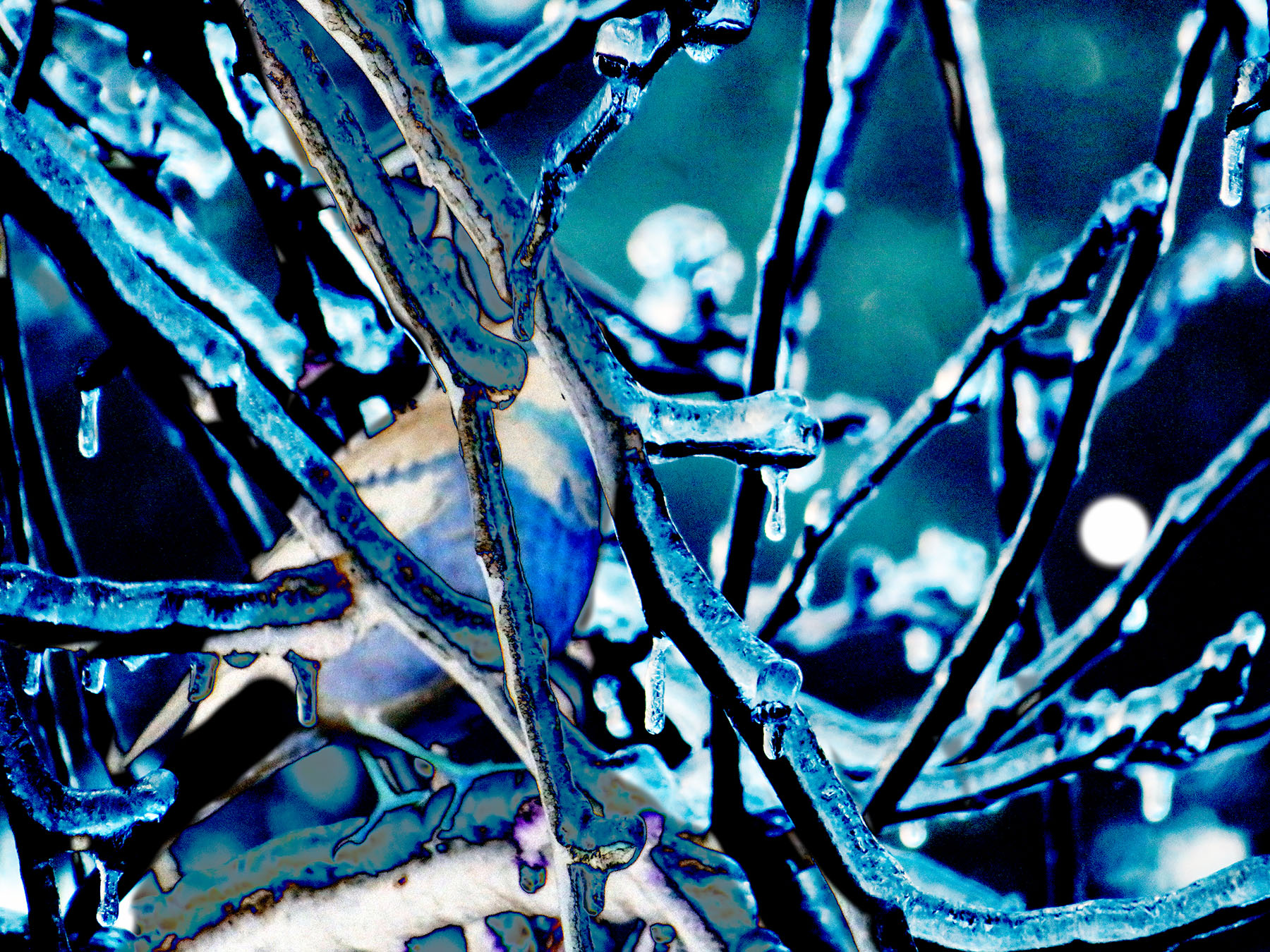
Photographs today are miniature blue ice abstractions found on my tomato cages during the recent storm, photographed through a window.
Music is not my cup of tea, but the video was worth it. Check it out, to see how one pulls off a piano performance on an arctic ice floe.
Here is a better piece to combat all that darkness: Angel of Light. (We recently listed to Rautavaara’s Cantus Arcticus, remember?)
So why would I write about an artist whose work I don’t particularly like and whose politics I found a mixed bag at best, and pretty upsetting in some aspects? An artist who died about 2 week ago, forcing me to keep my snark at a minimum?
I tell you why. Arik Brauer (1929-2021) had a trait that I singularly admire: he did what he wanted in his pursuit of art as well as in life, in full defiance of the demands, criticisms or attacks by his contemporaries.
An Austrian Jew, he survived the Holocaust, in contrast to many of his family. He eventually settled in Vienna again after detours of living in Paris and Israel, where he met his wife. He was a singer, an architect, a painter, who engaged in the good fight for environmental protection and the odious fight against muslim immigration into Austria. His views of Islam as an evil force, however shaped by his experience as a Jew, even let him devote paintings late in life depicting what he understood to be the oppression of Muslim women.
During a time where abstractionism was believed to be the future of painting, he engaged in Fantastic Realism, drawing from myth and fairy tales, religious themes and the healing power of nature. As I said, not my cup of tea, but an unperturbed pursuit of what he saw as his best tool for expression. A mix of realism, surrealism and art nouveau, saturated colors and not a scintilla of fear to cross over the border of kitsch, it seems. Below is a short clip that shows a retrospective, no need to understand the German.
I think it is hard to begin with to know what we want to express and how we want to express it. It is harder in societies like ours that proscribe such structured trajectories from childhood, leaving little room to explore who you are in the constant competition for achievement. It is even harder when you are surrounded by people and movements who label you old fashioned or any number of derogatory terms. To pursue your own path without hesitation is something I envy.
Not that he didn’t have his fans, though. Among them was a couple, the Leopolds, who deserve their own little report one of these days, two ophthalmologists who collected work by Klimt, Schiele and any number of emerging artists in the 1920s, including Brauer.
The Cube in the Center above is Museum Leopold
Eventually their treasure found its home in the Leopold Museum – here, too, a light and a dark side closely connected. On the one hand they understood the artistic power of many of the Austrian painters they collected; on the other hand they used any means to get their hands on looted Nazi art, at least according to some pending law suits (and one that settled for $19 million, keeping a stolen painting in the museum.)
The Leopold Museum is part of Vienna’s Museum Quarter, depicted in todays photographs. It is an important museum, testament to collectors who also knew what they wanted – Zeitgeist be damned.
Music is by Brauer himself and one of his daughters, Timna Brauer, who is a renowned singer in her own right.
Do you know that feeling when you are spontaneously attracted to something or someone, without being able to put a finger on to the reason why? An inexplicable, intense pull towards something with no clear rational basis?
Sidney Cain Tricksters in Pools (2020)
This happened to me last week when I chanced onto the work of Sydney Cain, a San Francisco based, young emerging artist, who has shown work at Betti Ono Gallery, Ashara Ekundayo Gallery, Rena Bransten Gallery, SOMArts, San Francisco Arts Commission, and the African American Arts and Culture Complex. I only saw it on the web, so wish I could have stood in front of the real thing.
Cain’s work is deeply spiritual – I am not. Her work is steeped in the myth and history of her people of African descent. I am a White woman with no connection to that continent other than a longing to travel there again. Her focus is on multiple aspects of genealogy and her ancestors in the Jim Crow South. As a German, I’d rather not engage in genealogy for fear of what one might find.
Sidney Cain Refutations, pt. 1 (2019)
Her images touch something in my heart and my brain, nonetheless. The large figures, often located behind an obstruction, like a wire or a fence (typical of the wrought-iron fences surrounding the graves found in Southern cemeteries,) seem to exist in some liminal space. They are not quite defined persons, but also not simply ghosts. They seem to be going about their business, rather than waiting to be called back from the past, yet they are not quite present.
They remind me of some of Käthe Kollwitz’s work in her print cycles around the Peasants Wars, her political focus on the evil of oppression, and paean to the masses demanding justice. Her preoccupation with death across history was matched by her connection to populations who suffered, bringing the dead back to life, ignoring existing class and cultural divides or historical chasms.
A canny ability to used smudged imagery to bring something else into sharpened focus.
Sidney Cain At the Corners I Miss #1(2019)
Cain moves dust of graphite, chalk and cobalt with her hands across the paper to reveal these ancestral representations. The choice of these media is deliberate:
“Graphite, as the element carbon, represents the possibilities of forming into new allotropes. Chalk and carbon based material, commonly formed from the shells of ancient deep marine organisms acts as a medium of spiral time theories.”
These media are somewhat ephemeral (compared to an oil painting,) which confronts us, in her words, with the ideas of impermanence and transformation, on the bedrock of her belief that the ancestors can be reborn as narrators in our own reality.
Sidney Cain Where Guardians Meet(2020)
Maybe that was the pull of the work, linking to the preoccupation of many of us right now with impermanence and transformation given our plague-riddled world – virus and racism alike. Although I should phrase that more carefully: I really have shifted from thinking about impermanence to thinking about transformation instead.
Sidney Cain Abiku (2020)
Impermanence for me links to a state of loss, often grieved, something that existed in the past and is now gone. Transformation, on the other hand, is not a state but a process, one that is oriented toward the new, the future. We might not control the transition or even know what that future looks like, but it is movement, like life itself, rather than stasis shrouded in nostalgia (or for some, dread.) That framing – a forward movement – feels, if not empowering, at least like a guide accompanying us into the unknown. It is comparable to the drinking gourd songs of Cain’s ancestor, purportedly leading them, with the help of the Big Dipper, from bondage into new worlds.
ONWARDS.
Follow the drinkin’ gourd Follow the drinkin’ gourd For the old man is comin’ just to carry you to freedom Follow the drinkin’ gourd
Inauguration – today we rejoice! Tomorrow we remind ourselves that the mascot is gone but the team remains intact.
It is surely no coincidence that I have been thinking about South Africa’s long history of colonial racism, eventually codified in laws imposed by the Apartheid regime. Racist practices had begun with the arrival of the Dutch East India Company in the 17th century, were later fortified by the British colonizers in the 19th century, but then legally structured (and then some) by the Nationalist Party which ruled South Africa between 1948 and 1994.
Despite the vanquishing of the racist German National Socialistic regime in 1945, South Africa decidedly went for its own version of White supremacy just three years later. Laws prohibited marriage and sex between the races, required registration of your race, enacted a prohibition for Blacks to vote and assigned them to certain areas or homelands through The Group Areas Act (1950.) This law partitioned the country into different areas, allocated to different racial groups. It represented the very heart of apartheid because it was the basis upon which political and social separation was to be constructed.
Gone are the Sacrificial Lambs (2011) (Series: Affirmation&Negation)
There were laws segregating universities, and those banning opposition parties. Laws drew divisions between the homeland areas themselves to prevent solidarity or joint action among different groups of Blacks. There were laws to formalize discriminations in employment, laws that controlled migration in and out of areas and protected forced and violent expropriation of property and relocations of Blacks to poor areas. As late as 1970 the Black Homeland Citizenship Act (1970) changed the status of the inhabitants of the ‘homelands’ so that they were no longer citizens of South Africa. The aim was to ensure Whites became the demographic majority within ‘white’ South Africa.
La Couturière (2010) (Series: (S)Elective Affinities)
By the mid to late 1980s opposition had become strong and vocal in a Defiance Campaign, and the regime reacted with violent oppression and police power. One of the ways the protest movements mobilized people and signaled meanings was through the use of color. Orange, white and blue, associated with the Nationalist Party, the colors of the first flag of the Republic of South Africa, were shunned. Visual graphics in posters and leaflets used black, green and gold instead, which stood for the color of the People, the green of the land and the gold for the wealth of the land. They had been chosen by the African National Congress, the main opposition party, since its inception in 1912. Those colors went underground in 1960 with the banning of the ANC, since people found by the regime to be in possession of items bearing these colours (no additional writing or image necessary) ran the risk of being beaten up, arrested or even killed.
But then came purple:
“On 2 September (1989,) police turned a powerful water cannon on thousands of protesters attempting to march to parliament. The water contained a strong purple dye, the intention being to mark all those who were protesting so they could face arrest at a later time, even if they managed to run away. Hundreds were arrested and for days it seemed a large part of the Cape Town population had become various shades of purple. This flew in the face of racial segregation laws and became a standing joke. People filled out ‘purple’ on the section of the arrest forms that demanded information about race and the defiance campaign slogan was changed temporarily to ‘the purple shall govern’. Ironically, the event contributed successfully to the Defiance Campaign in that people with different skin colour looked more alike. ‘Purple people’ signified the ultimate embodiment of the mode of colour as a political statement, more than the media of clothes mentioned earlier.” (Ref.)
The Moor (2010) (Series: (S)Elective Affinities)
A year later, the color red was added to the protest vocabulary.
Joe Slovo, General Secretary of the Communist Party of South Africa, on returning home for the first time in 1990 after 25 years in exile, sent a message to his supporters anticipating his arrival. ‘Wear red socks’, he said and thousands did. No written explanations, images or verbal slogans were needed. When people put on their red socks for Slovo, they were acknowledging their own history of concurring with the senti-ments, politics and strategies of the South African Communist Party, and joining these thoughts with the quirky humour of the leadership. The choice of media, namely socks, was deliberate because socks are not immediately and overtly discernible and can be shown or hidden at will. (Ref.)
I’m going on about this at length for two reasons. For one, it is timely to remind ourselves of how racism has governed historical developments not even 100 years ago and how a mass movement could break some of the spell. Secondly, the mind-blowing sculptures by South African sculptor and photographer Mary Sibande, who I want to introduce today, can only be appreciated if we understand the historical significance of both color and costume.
Sibande casts life-sized sculptures of her face and body molded in fiber glass, creating an alter ego, Sophie. She then dresses these sculptures in gowns filled with enough symbolic references that it compares to decoding a renaissance portrait. Sophie is the silent narrator of the history of South African Black women, often in servitude or barely paid domestic workers, who are allowed to express their fantasies of what the world should look like if they weren’t indentured.
Silent Symphony (2010)
Blue was the chosen color in her early work, the blue of the traditional maid’s uniform; the shapes of the gowns are of Victorian splendor, and the activities enacted are undermining the racial and class hierarchy. (Below Sophie, with eyes closed as always, is repairing a superman cape.)
More recently the artist has added the color purple and now even red to her repertoire and the alternate versions of Sophie are juxtaposed as those representing her maternal past and those standing for the future of the progressive movement with an allusion to the events of 1989 described above.
A Reversed Retrogress: Scene 1 (The Purple Shall Govern). (2013)
“Sophie” straddles time, pre-, during and post-Apartheid, as well as roles. There is the specific inheritance of stories and dreams of the women in the artist’s family, four generations who were maids or other kinds of domestic workers. There is Mary as Sophie, now, drawing on the repository of African myths, beliefs and wisdom.
There is also, it seems, a general representation of the struggle of Black women in the system, their marginalization in a post-colonial world as well. In each configuration she is confident, alive, a subject that tells the story, her story, rather than someone subjugated.
The sculptures really strike me as a celebration of strength.
Detail from the series “In the Midst of Chaos There is Also Opportunity” (2017)
I assume anyone not familiar with the politics of South Africa would still be moved and made to think by this emotive work. If you are able to fill in the necessary facts around the use of color, or other symbolism of note in the fight against Apartheid, the full power of these sculptures unfolds. Oh, when can we travel again to see all this in a museum in the country where it come from? Or at least in a gallery in our own nation?
Music today is interspersed with talk – I learned a lot. Music mobilizing protest.
Photomontages are from 2010 and 2011, chosen for the colors blue, purple and red and the fact that they, too, focused on narrative.
So it goes. You learn some interesting things from a book you received for Hanukkah, and then you get caught up in much more fascinating questions about the book’s author. Let me report on both, today and tomorrow, respectively.
The book, Photography and Society, by German-French photographer Gisèle Freund, is a seminal study of the relationship between photography and society, including its political implications.
Freund had to flee Germany in 1933 where she was involved in political resistance against the rise of the Nazis. Finding shelter in Paris, she studied at the Sorbonne and began to photograph an ever widening circle of cultural icons and famous literary types, later published in Paris-Match, and Life Magazine, among others.
The book is an assessment of photography’s role up to the late 1970s, when the book was first written (published in translation in 1980). Freund could not have been more visionary in what was yet to come in the next half century than she was on those pages.
What could I, a photographer who is often thinking about politics, find more fascinating? I’ll get to that in tomorrow’s installment.
Here’s the Heuer’s Digest review:
Freund, using the dissertation she wrote at the Sorbonne in the 1930s, first lays out photography’s history, including how it was invented and how it displaced the many artists who had come to serve the demands of a growing and ever wealthier bourgeoisie for portraits: painters, engravers, lithographers. Originally hailed as an advancement to serve science, it soon dominated in the social realm as a token of status or a means of remembrance. The early phases of artistically creative photography were soon superseded by adjusting to the mediocre tastes of those who paid for the pictures. Eventually professional photographers, a trade that had grown like wildfire due to demand, were sent packing when do-it-yourself photography took over.
The second part of the book relegates the big question Is photography art?, to the dust bin where it belongs. Of course, it can be. Why not ask the much more relevant question instead, What is photography for?
For one, as a means of reproduction, it has been a wonderful tool to disseminate art (painting and sculpture included) – just think postcards in museum stores, or books that open the minds of generations to visual art otherwise confined to museums.
Secondly, there are many types of photography that impact society in other ways. There is “concern” photography, the documentation of suffering in poverty and war and general social justice issues, photography as personal artistic expression, photography as photojournalism, as a propaganda tool, and last but not least, its commercial aspects in the advertising industry. And, of course, always, always self-representation – although the term Selfie did not yet exist when she wrote.
Freund provides memorable examples of how the “objectivity” of photography is laughable, given how what you select can shape an impression, how captions under a given image can completely change its meaning, or how juxtaposition of two photographs can manipulate opinion. For example: take a photograph of a Russian tank sent to squash the Hungarian uprising. Consider caption 1 vs. caption 2:
1. In contempt of the people’s right to self determination, the Soviet government has sent armored divisions to Budapest to suppress the uprising.
2, The Hungarian people have asked the Soviets for help. Russian tanks have been sent to protect the workers and restore order.
Freund concludes her book with thoughts roughly summarized below: What began as a means of self representation has become a powerful tool that penetrates all aspects of society. Yet finding photographs that go beyond representation, some that are truly art, is rare. The tool has democratized mankind’s knowledge and built bridges between people by providing a common language in civilization, but has also “played a dangerous role as an instrument of manipulation used to create needs, to sell goods and to mold minds.”
How was Freund’s life and photography influenced by these insights? Stay tuned.
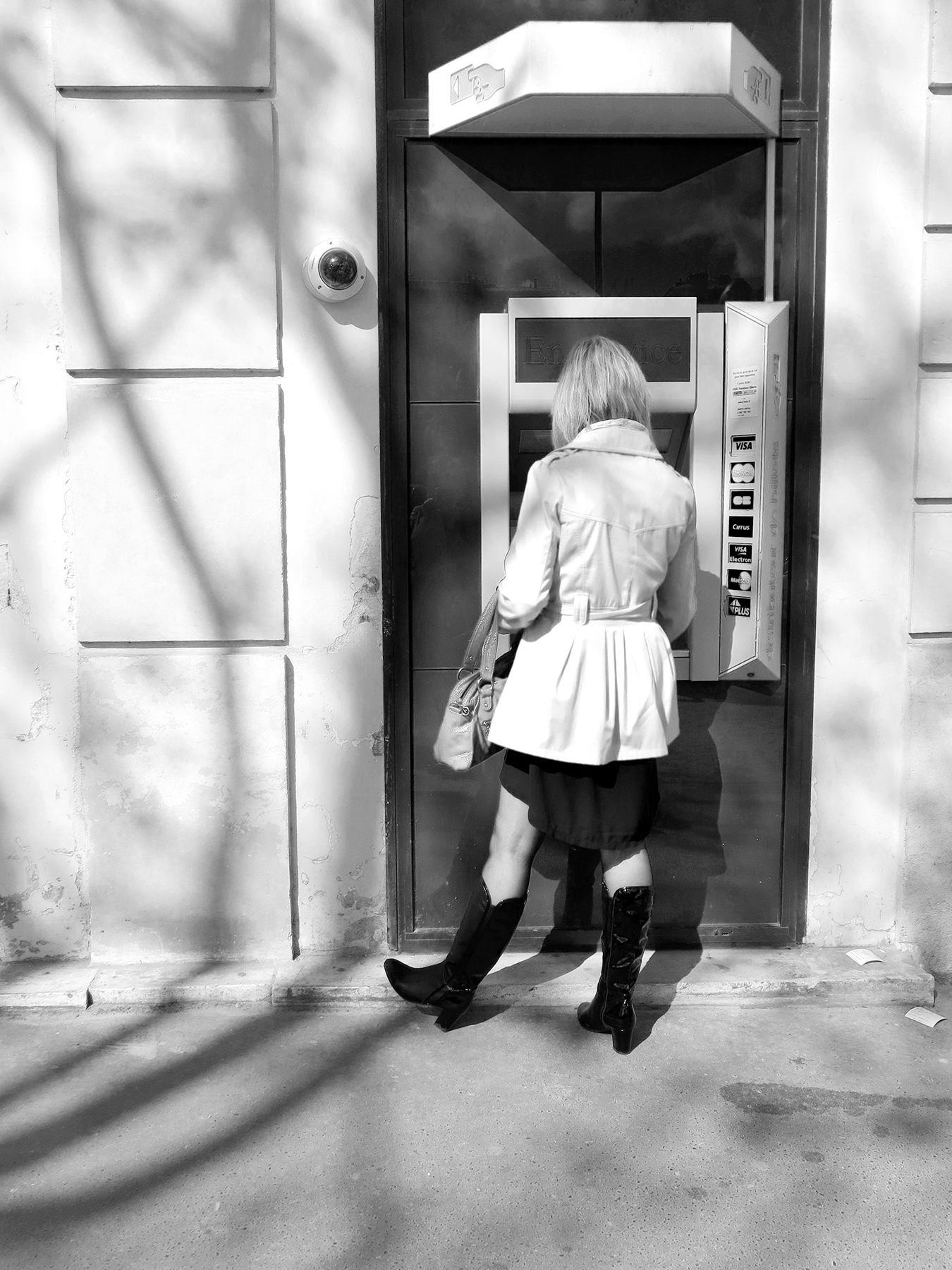
Photographs today are street photography from my 2014 visit to Paris, Freund’s chosen home.
Music is mainly interesting for the vintage film clips of Paris in the background.
Hanukkah begins tonight, a minor Jewish Holiday morphed into a major one in cultures competing with the magnetism of Christmas for children’s souls – or for consumers’ wallets. A story of a light lasting beyond its life span, a miracle celebrated, and one of civil war, conveniently ignored.
Before we settle on sarcastic, let’s celebrate what these holidays during dark times – both by calendar and by historical era – have in common. They do bring light and its cousin, hope, to our lives. Hope for what could be, if enough energy, faith and grace can be mustered or bestowed. Survival, peace, redemption, all on the list.
I thought it would be appropriate to look at light, then, to brighten our day. Much to chose from. Here is an installation that I like watching because it has historical roots in the history of the whaling community of New Bedford, the city of light given that its port harbored the whaling ships that provided the blubber for America’s lamps for centuries. Hope for survival is surely invoked by the art work, given the fate faced daily of the seamen (many escaped Southern slaves among them.)
Here is a light installation that in some ways expressed for me the hope for peace. Peace AMONG us, in mutual aide and recognition, an effort to build community.
Marinella Senatore’s neon colored installation at Florence’s Palazzo Strozzi’s open-air courtyard provides uplifting pointers. We Rise by Lifting Others, draws on the popular southern Italian luminaria or ‘artist’s lighting’ tradition. Comprising hundreds of LED lights, the ten-metre-high installation becomes the monumental heart of the palazzo’s Renaissance courtyard. The words she chose remind us of community and participation: ‘The world community feels good’, ‘Breathe you are enough’ and ‘We rise by lifting others’.The installation will be up until 7 February 2021.
And in case you already heaved a sigh of relief – no politics today! – fooled you. Here is the video of a light installation that speaks to the truth, and the lies, of our times. The work was erected, in timely fashion, on election day.
Stefan Brüggemann‘s project’s detailed evolution and commentary on its goals can be found here.
The artist insists that ‘the intention is not for the work to offer a conclusion, but to open up a question and place a doubt.’ Still, given the choice of location and the extent to which immigration has been politicised in the US, it is difficult not to read this as an indictment of the Trump Administration. One can only hope that, by the time the installation is taken down – shortly after Inauguration Day in the US – our society will have begun to move on from the gaslighting that Brüggemann has so succinctly decried. (Ref.)
One can only hope…
Hope for redemption, I tell you, has to start with our very own acknowledgement that it will not come from above. We have to earn and fashion it ourselves.
Happy Hanukkah!
Photographs today of my favorite source of light. Music by Max Richter on the nature of day light.
When I think back to my time in Venice during the Biennale in 2015, snugly lodged in the attic of some decrepit Palazzo, exploring exhibit after exhibit during the days, I feel nothing but gratitude. Such visual riches, such food for thought. Such freedom to explore at my own pace, such amusement at the gradient from Kitsch to Kunst, as they say in German.
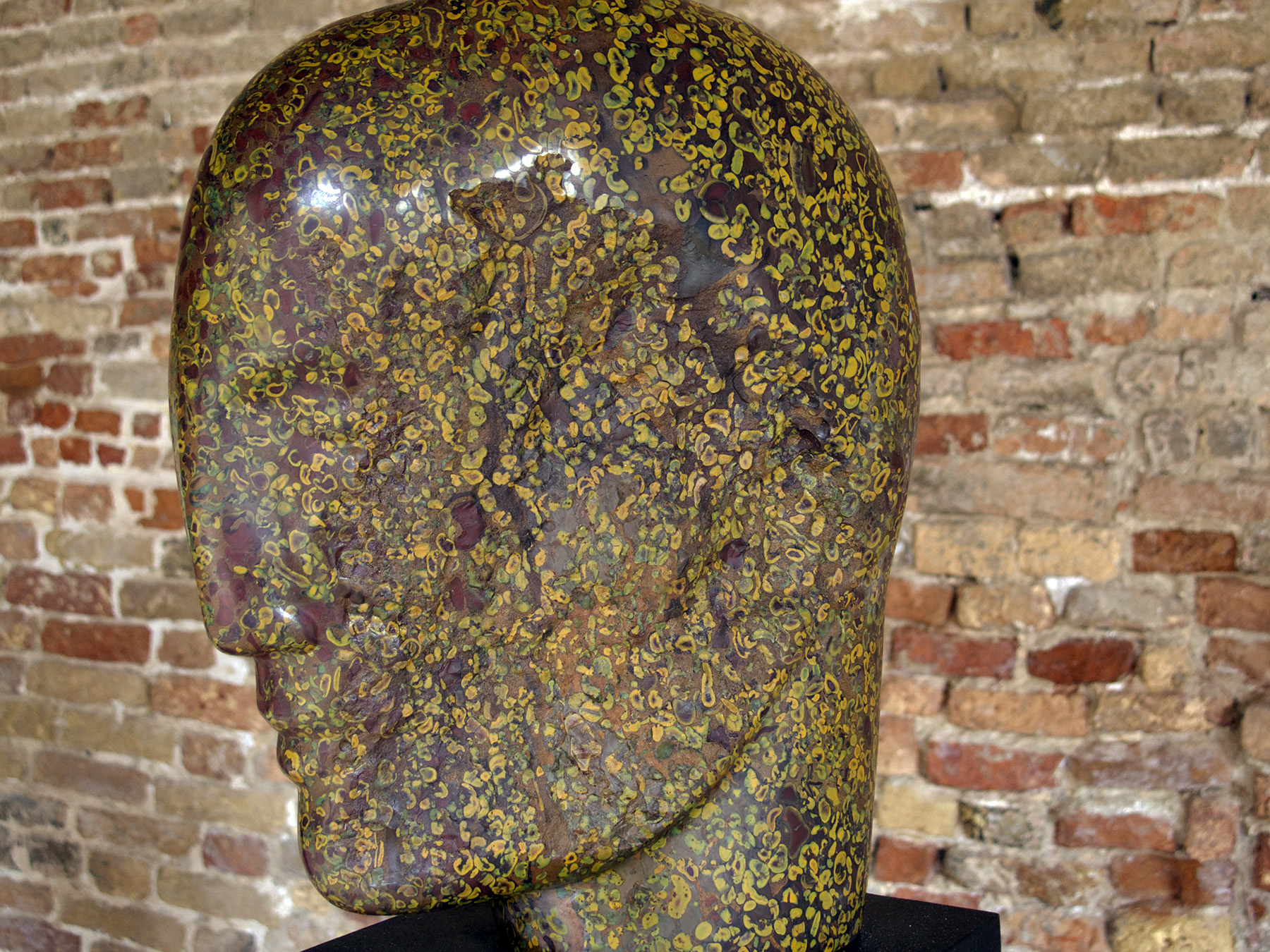
For me the most memorable and admired exhibit was shown at the cloisters of the Madonna dell’Orto church: Emily Young’sCall and Response.Here is a description of the work of who is called Great Britain’s greatest living sculptor:
Using rock from quarries near her studio in the Etruscan hills, Young’s work fuses the age-old principles of stone carving with a progressive, widely informed approach to form and composition. The contemporary and ancient are united in these sculptures, creating a rare and poetic presence that is amplified by the atmosphere of the tranquil Venetian cloister, which is part of the Madonna Dell’Orto church favoured by the Italian painter Tintoretto. Monumental yet strongly individualised, static yet expressive, these sculptures encourage the deep contemplation on mankind’s relationship with stone and its source of origin; the Earth.
In the artist’s own words:
“Every moment of every day and every night humankind is called to by the Earth, and we respond to her, our mother planet, our creator. She is our maker, and we her dependents… These are things I think about when carving these stones which the local volcano has thrown out in some eruption, or the wind and rain has exposed over thousands of years, or a river has rolled and smoothed around, for me to find and work into a semblance of me, a conscious human. Throughout our human history we’ve acknowledged nature’s great powers in this way.
When I carve the stones I wait to see what the stone and I arrive at together. I think: these stones can easily carry my call back to the Earth, of sorrow and the knowledge of tragedies unfolding, along with gratitude and delight in the beauty of unpolluted night skies. I add my voice to the stone’s, one made in Earth’s history, in violence and stillness and endurance, born of their ascent out of and descent back to dusty origins. They can last at least as long again as they already have done, millions upon millions of years.”
The work is ravishingly beautiful. As is the sentiment.
It also inspired playfulness in me upon my return to the States, a tongue-in-cheek exercise trying to add something to this arc from antiquity to the present. Taking snippets of paintings ranging from 17th century to 19th century works that I had photographed during my various travels, I provided some relief for eyes sore from all the incoming brilliance. The title of the project was Augentrost (the German name for the plant Euphrasia which was used in the middle ages to treat eye ailments.)
It feels like an eternity ago. Which, wouldn’t you know it, is another subject taken up by Emily Young and many an artist preceding her. If I could travel now this would be my sprint to take in before it closes this month:
Riddle me that: Switzerland is supposed to have the largest number of satirical publications per capita. There’s a stereotype-defying fact that will evaporate from my brain as fast as you can say yodel (defined as practicing a form of singing or calling marked by rapid alternation between the normal voice and falsetto.)
One of these publications, the oldest in fact, is Der Nebelspalter (The Fogsplitter) which in 1920, exactly 100 years ago and still under shock of the carnage produced by the Spanish Flu, published a poem that could be written for all of us, today. Looks like what goes around comes around – true both for pandemics and also the way people react to them.
I have translated the bitingly sharp verses, but of course had to do without rhyming since I am not a good enough translator for that. It was hard enough as is, since the German was quite old-fashioned. I thought, however, the gist would suffice to have us all feel like someone just put a century-old mirror up to our faces, with nary an occluding patina softening our recognition.
The Flu and the People
A slayer traveled through the land
with drums and with a scythe
with gruesome drumrolls from the band
shrouded in black, the flu arrived.

She entered each and every house
and reaped the sheafs in full -
many pink cheeked maidens died
and strapping young men were culled.

The people in their anguish called
loudly for the public authorities:
What are you waiting for? Protect us from death -
Whatever shall become of us?

You have the power, the duty too,
show us what you can do -
We'll warn you, don't dodge it now,
what else are you good for?

It's a scandal, the way it's handled,
where are the prohibitions -
there's singing, dancing, partying and bars,
haven't enough people died already?

The governors had puzzled thoughts
traversing through their brains,
how to combat this adversity
their brows were deeply furrowed.

Hark, their efforts found reward,
their thoughts were indeed blessed;
Soon prohibitions, harsh and unfamiliar,
rained down onto the land.

The flu ducked deep and timidly
and was about to disappear,
when the people newly clamored
in a chorus of a hundred thousand voices:

"Government, hey!  What are you, nuts?
What's this supposed to mean?
What is all this stuff that oppresses us,
you wisest of the wise?

Are we only here to pay taxes?
Why do you deprive us of all joy?
Particularly now with MardiGras upon us - ha!
The masses bellowed and blustered.

You can prohibit church and all,
the singing and the praying.
But regarding the rest,
we refuse to be shackled!

That was not really what we wanted,
allow us dancing and boozing,
otherwise the people  - listen to their grumbling -
will march on the city in hostile mobs.

The flu, already on its last leg,
squinted quietly,
and said, " Finally -  after all!"
And laughed maliciously.

"Well, well, it never learns
that old humanity!"
She unfurls, grows, is pale
and sharpens the scythe anew.
Sounds familiar?
I have a lot of positive associations with Switzerland. I learned how to ski there, something I loved if only because I scared everyone around me with my speed, inappropriate for a wobbly beginner.
I improved my French there, when farmed out to a family in Neuchatel for months on end, being left to my own devices which included hours on end spent in movie houses watching Brigitte Bardot in her prime.
I met an old lady in Lausanne who had spent her youth at the Russian Tsar’s Court before the revolution and had sketchbooks, shown to me at length, that documented every outfit she ever wore to any occasion at the palace, in watercolor no less. Since I was exactly in-between being starstruck with royalty (age 13 – 15 ) and devoting my life to being a revolutionary (age 16 to 16. 5) I drifted on a cloud of deliciously ambivalent reaction.
Add to that now the admiration for a satirical poem that describes ageless human behavior, when confronted with a pandemic, to perfection.
The viral form anticipated???
Re-emergence is, of course, not just reserved for viruses and human behavior, but exists in art as well. Case in point is captured in today’s photographs, chosen for their fit with the topic (and also, truth be told, because I have no photographs of Switzerland.)
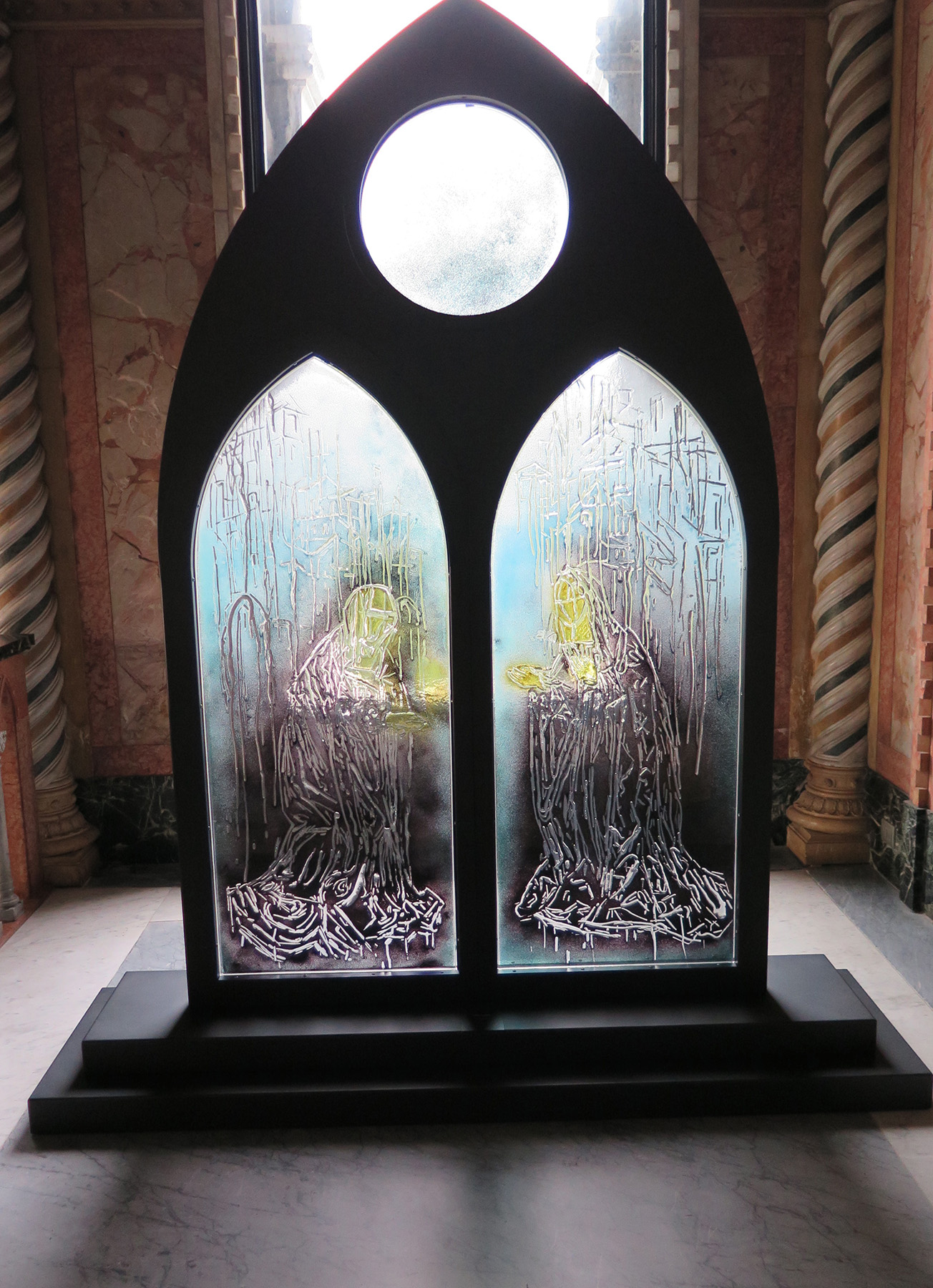
The intricate glass objects were part of Glasstress 2015,an exhibition in conjunction with the Venice Biennale, titled Gotica. Curated by he State Hermitage Museum of St. Petersburg and Venetian glass blowing studios like Berengo, it explored how “medieval ideas and communication methods have imperceptibly crept into our modern conscience despite our technological advances and how the Gothic concept influences contemporary art.” Fittingly, it was on display in the neo-gothic Palazzo Franchetti, which in late September I had practically all to myself.
Venice itself is of course a city deeply imprinted with gothic and neolithic architecture. But its artists, or so the exhibition notes state, are also reclaiming medieval themes and styles, if not processes. Some of the works took themselves too seriously, some were witty, all were superbly crafted and some linger with meaning, even now, years later. My kind of show.
The artists used the vernacular, referred to exorcism, eschatology, death and resurrection, alchemy and the search for the Holy Grail. They asked, and I quote, the Gothic question: Are we about to enter the new Middle Ages?
Are we any closer to an answer now, five years hence?
Music today from the time of plague and courtly love…
This week I went to the Visual Arts Center in Newport, OR to pick up my work that had been there since March, the exhibition promptly available for view on their website only due to Covid-19 closures. Art institutions – for all the arts – are truly hard hit, particularly when they cannot fall back on large endowments, and need income from art sales or attendance sales. Hard to wrap your head around how many individual lives are affected, from artists to staff.
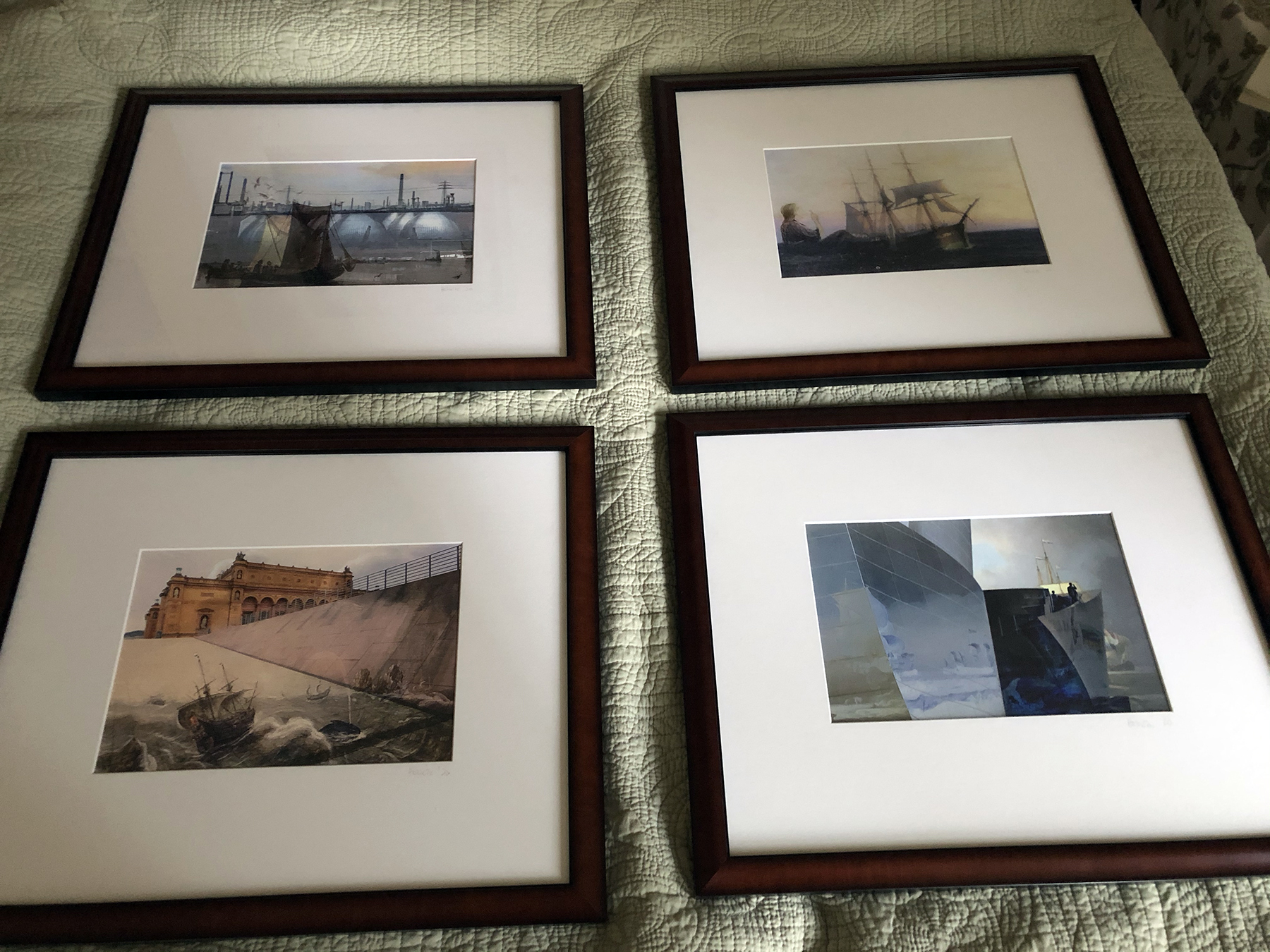
My series Postcards from Nineveh had used a mix of contemporary landscape photographs and old Dutch paintings of whaling and war ships to speak to issues of environmental degradation and protection. I looked at my montages with fresh eyes after this long hiatus, and also with a new thought picked up while reading up on today’s artist of interest, painter Alfred Wallis.
Now where do you put all that stuff? Some gets hung in the gallery aka my living room
Wallis painted mostly ships that could not have been more different from the ships painted by Dutch maritime artists of the earlier centuries. The latter exhibit dominance, power, brinkmanship, while Wallis’ boats look more like streamlined, abstracted toys, mercilessly exposed to the power of the elements, escaping wrath by sheer luck.
Shipwreck 1, the wreck of the Alba, 1940
I wondered if these differences have to do with the ideological role maritime commerce, exploration, colonialism and war readiness played for a small nation entirely dependent on it, as the Dutch were. Or if it had to do with the fact that Wallis, unlike many of the Dutch artists, spent a large hunk of his childhood and adulthood as a common sailor, risking his life sailing from Cornwall to South America and back many times over, fully aware of the existential danger of the trade.
Voyage to Labrador, 1936
Wallis’ life story (1855-1942) certainly reads like something out of a novel, a Dickensian one at that, except with no happy end. Orphaned as a young child he started working as a cabin boy on a schooner at the tender age of nine. Eventually he advanced to full seaman, teaching himself how to read, never having set foot into a school.
When on land, he was taken in by Susan, the mother of his only friend and lived with the family. 23 years his senior, Susan nonetheless agreed to marry him in 1875, when he was 20. She had until then given birth to 17 children of whom five survived, a fate not granted to the two babies she had with Wallis. By 1890 he moved the family to St. Ives, and gave up seafaring for a scrap metal collection business instead, accruing the nickname of Old Iron. That business ended with the declineof the Cornish fishing market due to rapid industrialization and capital acquisition by larger companies.
Bark with a Man at the Wheel on a Stormy Sea, 1938
He and his beloved wife tried to scrape by, with various trade adventures, including making and selling ice cream on the streets of the small town that had become an artist colony, all amounting to nothing. When she died in 1922, her children purportedly stole their small savings, and abject poverty set in. To deal with his loneliness, Wallis took up painting at age 70 or so around 1925, using scraps of cardboard and wood and a very small palette of only 5 colors, most of them quite muted.
Five Ships, Mount’s Bay, 1928
With no prior training he set to it quite productively, drawing and painting what was familiar, the ships, harbor, landscape and houses of St. Ives. He refused to join the ever growing colony of artists around him, and made a point of using only paints that were meant to paint ships and machinery, not artists’ oils or watercolors. Two notable artists,Ben Nicholson and Christopher Wood, claimed to have found another “Cézanne,” when they happened to pass by his cottage, and they started to buy some of his work and send others to people in the art world.
Small Boat in a Rough Sea, 1936
His growing success developed parallel to increasing signs of mental illness. Wallis isolated himself more and more, became paranoid, feeling persecuted, and had visions of the Devil invading his house. He was so debilitated that he could not keep up an independent life, squalor and disease taking over, and was eventually committed to a poorhouse – his largest fear in life – where he died. More details can be found here.
His work is as original as anything can be when done at your kitchen table, with no education or training, focussed on the things you know or that are meaningful to you. Others can talk about the stylistic inventions, his creativity in assigning spatial relations, his willingness to bend reality even when reality was what he cared about. Not clear to me if he tore up the rule book when he never knew what the rules were.
But I want to point out how much these small paintings speak to emotions, how the world that was closing in on him, existentially, mentally, physically is reflected in the feelings these art works evoke. There is something foreboding or dangerous that seems to hide behind the sails or the next corner, or in proportionally huge fish, at the same time that there is an energy that seems pushy and determined.
Nothing playful here, certainly nothing referential to art history, nothing trying to prove to an art world that you belong. All his very own vision, derived from 70 years of looking at the world, with no need for approval so important for the young, no thoughts of selling (he was shocked when the first sales occurred and ask the buyers to set the price – obviously not enough to prevent his trajectory towards the poorhouse.)
Land, Fish and Motor Vessels, 1937
Starting late, blooming in your own four walls while in the process of disconnecting from society, putting personal expression it its purest form onto a surface seems both miraculous and also enviable. I assume there are millions of Wallises around the planet, almost none of them ever discovered, leaving a visual testimony of how they saw the world, while the world dims around them. Nothing naive about them, even when they get classified this way, and not much of Outsiderism either, given how they might be among us in multitudes. Art wills out, even when it gets late.