There are days when serendipity reigns. They are rare. They are welcome. And, as it so happens, one of them was yesterday. Early that morning I read an essay by a young acquaintance whose writing I have posted here repeatedly for its depth and perceptiveness. Mattathias Schwartz reported on the Trouble with Scale, offering devastating evidence why we need to change our approach to the rapid adoption of products across the world. Unchecked growth is not always good – an urgent example being the effect of internet proliferation on the genocide against the Rohingya in Myanmar. Among other outlets, including the NYT and the New Yorker, Matt writes for a relatively new nonprofit journalism organization, Rest of World, which so far has delivered nothing but interesting articles – I urge you to check them out if you are at all interested in international topics that won’t appear on our regular radar.
Mid-morning I received an email from a friend who sent me a link to a short film made by friends of her’s, Donata and Wim Wenders. The film is part of a project by public broadcasting in Berlin to create multiple shorts from various artists and intellectuals highlighting aspects of our current world-wide situation.
I am attaching my translation of the spoken/written word in the 2 minute clip so my US readers can appreciate the expressed yearning for change as well. Filmed in his apartment the short follows Wim Wenders editing his typewritten manuscript of reactions to the challenges facing us. You will spot immediately how it is connected to the essay recommended in the beginning of today’s musings.
Many people think about this right now and it is the most pressing question. What will happen after this brutal emergency brake that was applied to our world? What would I wish for? Change.
Can we only imagine change when it seems necessary to us?
When and how are we humans willing to accept change?
Only through extreme situations like wars or global crises? The majority of us have never experienced those. Wars are always somewhere else and the second world war was too long ago…. And the climate catastrophe?
It is only existentially experienced by those who will suffer its consequences, the children, the youth, the poorest of the poor, for most of us “there’s still time….”
But don’t we all experience NOW, ALL TOGETHER, for the first time, on the whole planet, something that threatens us all? And does that not force us to rediscover the COMMON GOOD, the way we are dependent on one another, responsible for each other?
Our new experience of isolation, of being separated, left to fend for oneself, the huge longing for …. connection. How will all that change how we value community or society?
———one sentence I didn’t get————-
Surely it has to be based on a new sense of togetherness, a rediscovery of equality, brotherhood or solidarity… ) (all concepts that have fallen out of favor)
Do we have the strength to redirect out thinking in this direction?
Are we able to learn the lesson?
Will supermarket cashiers, medical personell and delivery truck drivers remain HEROES even “afterwards?”
Not, if all we want is to return to “business as usual.”
“Growth” per se simply cannot remain the holy grail of politics.
Central to the new order has to be socially minded thinking concerning humanity and climate conscious action concerning the planet.
“Afterwards”, nothing will be more important than change. (Renewal? Transformation?)
*
You know Wenders likely from movies like Paris, Texas, or Wings of Desire, but I highly recommend that you check out a recent documentary, probably one of the best films they made, available on multiple outlets here, about Pope Francis. The visual skill of the film making is stellar, but it was the message that moved me, delivered without pathos, didacticism or condescension: to mend our ways is the only way we can and will survive the forces currently destroying the fabric of our world, quite literally. Religion can – perhaps – play a significant role, if religious representatives remain honorable.
Finally, at the end of the afternoon, I had made my way through multiple days of listening to Igor Levit playing Beethoven, alerted by a friend who pointed to his brilliance.
I found just the piece to end with today: a concert of the Waldstein Sonata he gave this April at Schloss Bellevue in Berlin, introduced by the German President, Walter Steinmeier, who pleaded with us to support the arts in these difficult times (what a difference a president makes…) The pianist reminded us, that it is a piece about togetherness empowering us all. I guess serendipity had lost patience with me, because the video of the performance refused to transfer to the blog. So here are the first and last movement from one of his CDs, I could not find a full version outside of Spotify….
Here is the link to the Bellevue concert, maybe if you copy it directly into youTube, it might work – worth looking at his hands. https://www.youtube.com/watch?v=lC8DBTfJI90
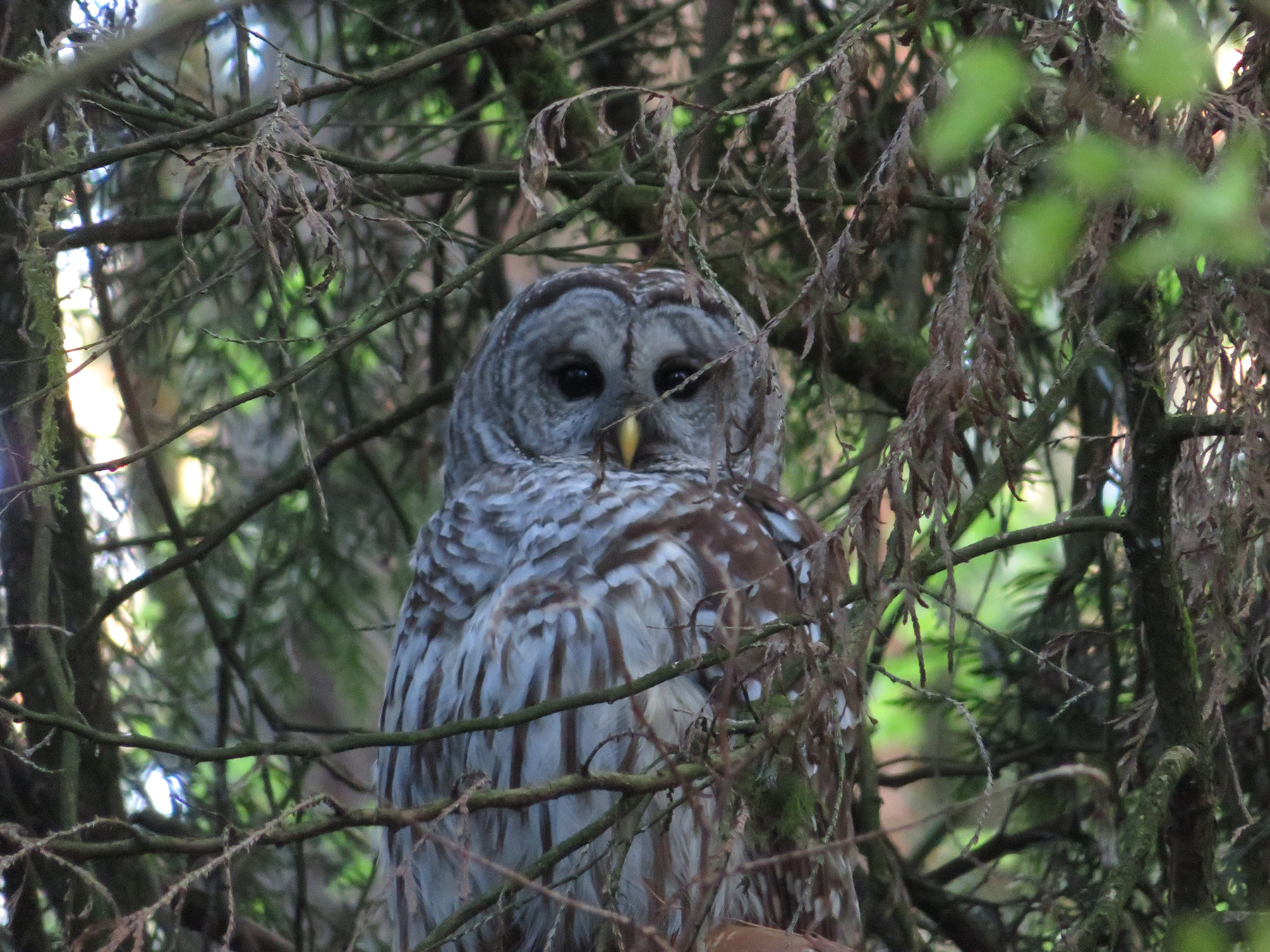
Photographs today are in honor of Wim Wender’s devotion to Francis of Assisi, Patron Saint of the birds, and my own devotion to owls. All of these photos – with the exception of the horned owl I found in New Mexico last year – are from the last weeks, when a barred owl made an appearance in my garden while we were sitting on our deck, and in the forest nearby during multiple hikes. Talk about serendipity….
That’s what the top of the website said when I searched for images of Jon Foreman’s land art. The suggested psychological benefit of signing up for a daily newsletter or some such seemed as surreal as the idea that anyone might buy into such a claim. But then again, we know that of all the claims people buy into these days, a link between advertisement and happiness probably is among the least outrageous….
2019 works with stone and leaves, John Foreman
In any case, here is the history: I get several minutes of pleasure on my daily walks in the neighborhood when finding little art projects that are left behind to cheer us all up. They spurred me to look at other artists who put something in the landscape on a greater scale, with snazzier means, often closer to design than art, but so be it. I vaguely remembered having seen something about Foreman and sand-rakings, but then found the site that had me roll my eyes for five seconds rather than experiencing happiness. Eventually there was a successful search result for this video showing the artist raking his neighborhood in Wales. Using sand and stones – available to all of us to some degree – maybe we could come up with something a little bit more unconstrained, or witty? My neighbors are certainly on up there.
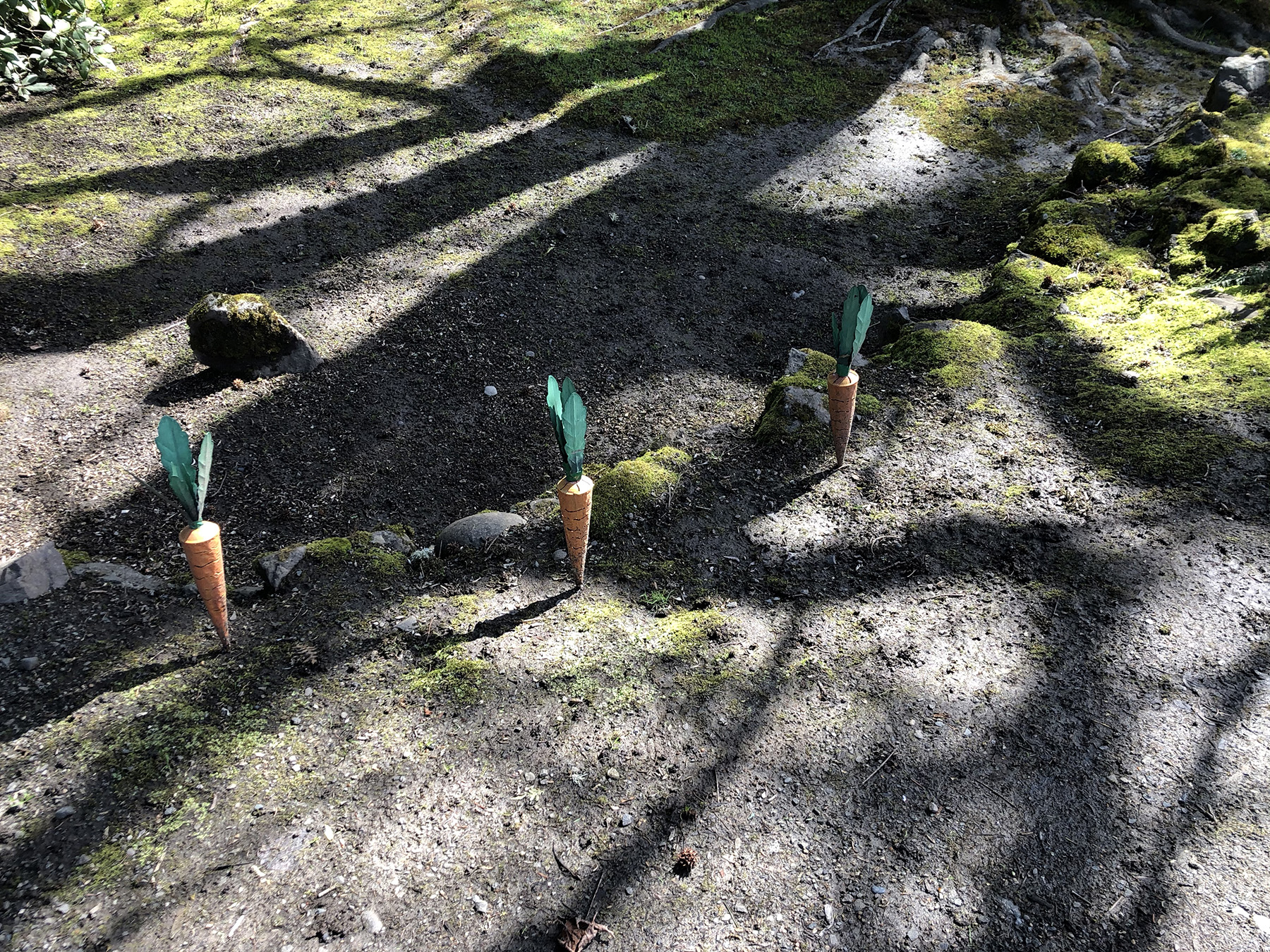
Found at Marshall Park
Land painting on a larger scale is something you can currently find in Switzerland. The site surely beckons, although the landscape painting is probably long grown out or washed over when travel becomes available once again, 100 years from now. Think of a canvas 3000 square meters wide to be filled with imagery of hope, employing tromp l’oeil at its best. The 3-D manipulation is remarkable!
Saype, born in 1989, has been visible on the art scene since about 2013, increasingly known for his large grass paintings that use biodegradable paints that he produces himself. They get absorbed into the landscape once the grass grows over it. Last year he won a Forbes 30/under/30 award, that declared the 30 personalities under 30 who are the most influential in the contemporary Art & Culture world.
Painted stones are left in nests of moss all over the park by the short set
I, of course, like his work with political impetus the best, although he is very careful to position himself as a humanist, rather than an affiliate with any political movement. Here is a beautiful clip about his work in honor of the SOS Mediterranee, an organization that saves refugees from drowning. The artist is not exactly witty, as I had hoped. He is, however, very good at what he does, and he also likes clothes that carry his brand name. Hm.
Carved doors appear again (we had a neighborhood tension over those of us who loved them (the many of them) and those who removed them daily when they appeared….)
Saype’s most recent project is called Beyond Walls – “it shows interlaced hands, reaching out, shaking and united in a common effort beyond all walls separating humans and enclosing them in mental or geographical spaces. Thus, the walls erected in mentalities become fictive partitions, wiped out by artistic imagination. It merely opens a breach in the real walls, the ones built by humanity within and against itself. ” Here are the sites that already have been painted, Andorra, Berlin and Paris among them.
It’s big, it’s pretty literal, it’s a notch too obvious. But it is clearly done with good intentions.
Back to my neighborhood artists, then, who are also reaching out, lending a hand, giving all indications that they understand mutual aid and solidarity, and for whom small scale is just enough.
Flower and leaf still life at the edge of the path
Now that makes me happy.
Music today from a Swiss composer, Arthur Honegger, who provides us with a sufficiently chipper entry into this new week and something fresh assuming that you as much as I are not too familiar with this composer…
Since we are all over the map this week anyhow, I might as well think out loud about one of my current preoccupations in the art department.
As those of you familiar with my montage work know, I often appropriate partial images from other artists into my art. I am not alone in that venture: artists more famous or talented than I have long pursued all forms of appropriation, sometimes even direct copying. A more detailed discussion in the art world can be found here.
Air France (Fluchtgedanken, 2020)
My rule has always been that I only use snippets that I photographed myself, and that the ultimate outcome – the montage – produces significant change to the parts appropriated, and provides a completely new creative context.
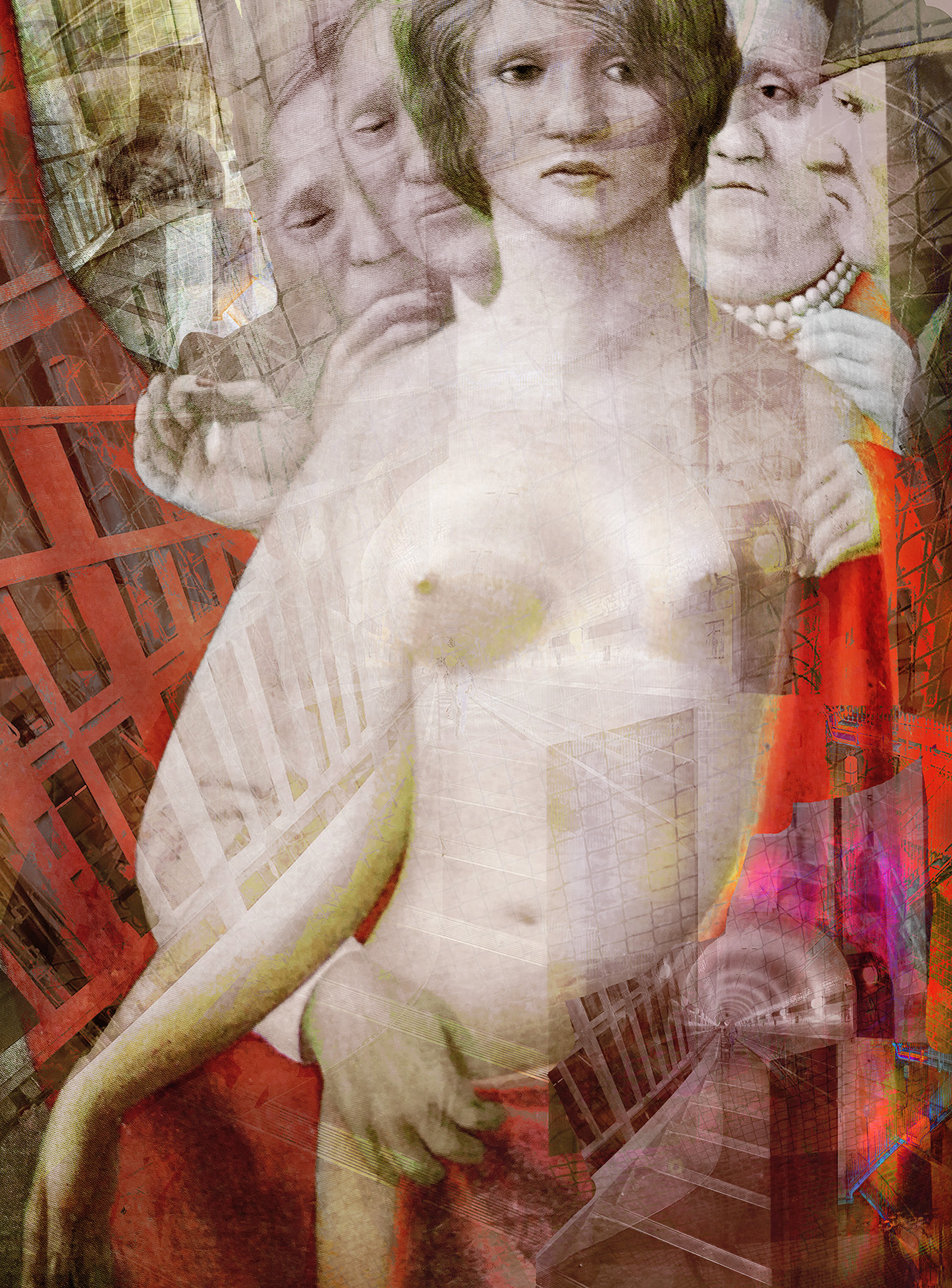
That said, I find myself in a novel situation with the series I am presenting to you today. It uses not just one partial painting by a single painter, but incorporates multiple works by that painter. The series is one way of my dealing with the emotions and thoughts generated by the current situation, less so about the social isolation and more about the way we as a society are distributing risk, often unfairly, and in some recent whispered discussion within the framework of accepting eugenic principles. Took us what, only 75 years to get around to it again? What are expandable lives? The old? The diseased? The incarcerated? The poor?
The Tunnel (Fluchtgedanken, 2020)Virus Whispers (Fluchtgedanken, 2020)
All the painted portraits I manipulated in the new series Fluchtgedanken – Thoughts of Escape are from an interesting guy, George Tooker; I found an old art magazine in a pile in my basement that my husband for some incomprehensible reason saved from his grandfather. It had a spread of Tooker paintings printed on grainy cheap paper, painted in the 1950s and 60s, that I photographed. Tooker was openly gay, first living in Manhattan, then somewhere rural up North, totally engaged in civil rights movement, including the march on Selma, and preoccupied with the fate of the working class. Had quite a bit of success with egg tempera paintings in the Social Realism style in the 1960s. I had honestly never before heard of the guy or seen his work.
At the Soup Kitchen (Fluchtgedanken, 2020)Grand Central Station (Fluchtgedanken, 2020)Plexiglass (Fluchtgedanken, 2020)
The people in the paintings all had such a gripping zombie look, such empty eyes, that they seemed the perfect representations for those being pushed or having no choice but to attend the Covid-19 frontlines. The essential workers, the nurses, the unemployed, the hungry, the people in lock – down, the ones hiding from racism – all there! Well, with a bit of imagination they fit into the roles – and with even more imagination I linked them to themes of escape, hinting at modes of getting away.
Filing for Unemployment (Fluchtgedanken, 2020)Waiting for the Bus (Fluchtgedanken, 2020)
I embedded them in montages that include a lot of linear abstractions to counterbalance the figurative work and used my older, existing work that focussed on means of transportation, planes, ships, bikes, trains etc. connecting them to the figures in our constrained environment. I figured Tooker would not be offended by my recycling of some of his portraits given the shared politics and impetus to force people to think about the realities of our world through art. Then again, who knows. He’s dead. I couldn’t ask.
The Harbor (Fluchtgedanken, 2020)Quarantine (Fluchtgedanken, 2020)
Would very much appreciate feedback on what you see here today – if and how it speaks to you, ore more basically whether the points come across….
At the Airport (Fluchtgedanken 2020)
and for May Day, tomorrow, I’ll honor the striking workers (and recommend this from The Intercept for your perusal about the labor relations at major US companies under current dangerous conditions.)
The Strikers (Fluchtgedanken, 2020)
Music is a mix of the traditional kind sung during May 1 demonstrations in the class struggle and the kind Tooker would have heard while he painted…one of my favorite albums of all time, I used to scream in sync with it…
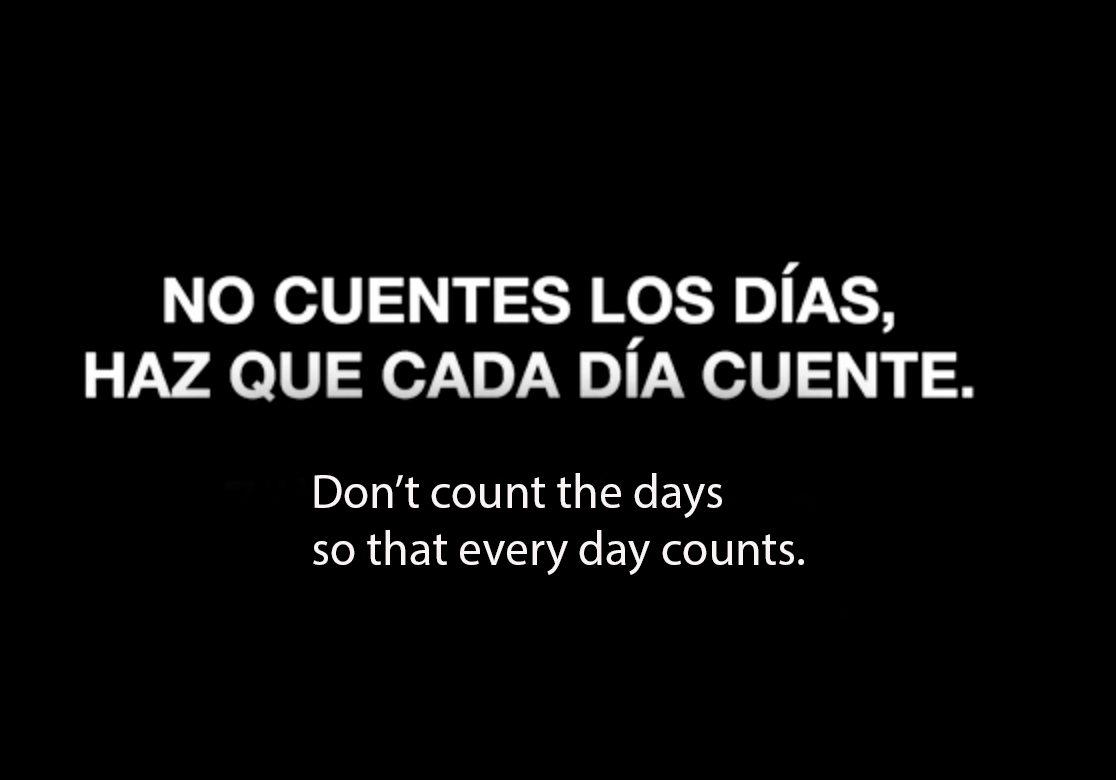
I know I am repeating myself but where would I be without my friends who are sending me all this cool stuff? Today’s offering came from Germany although it is originally a Spanish video creation (Quarantine with Art,)by some fashion organization, attached all the way at the end. I have added english translations to the images. Hey, no mention of the virus, just a description of our daily lives, for future historians…..
No body-contact
«La creació d’Adam» de Michelangelo Buonarotti (1511)
or kisses,
«Los amantes» de René Magritte (1928)
6 feet distance
«Annunciazione de Cestello»Sandro Botticelli (1489–1490)
Cosmetologists are closed
«Autorretrato (1974)» Frida Kahlo
Balcony conversations
«Mujeres en la ventana» Bartolomé Esteban Murillo (1655–1660)
City Center
«Piazza d’Italia» de Giorgio de Chirico (1913)
Long morning hours
«After Breakfast» Elin Danielson-Gambogi (1890)
Week 1
«Retrato de Helena Kay» Winslow Homer (c 1872)
Week 2
“Mujer leyendo en un sofá”William Worchester Churchill (1920)
Week 3
«Joven decadente (después del baile)»Ramón Casas (1899)
Coughing into your elbow
«La Caída de Faeton» Jan Carel van Eyck (1636-1638)
The way we’ll all look this summer
” Pareja” Fernando Botero (1932)
When you HAVE to go outside
Detalle de obra, perro (?)
Shopping for 2 weeks
«Cristo en la casa de Maria y Martha» Vincenzo Campi (c 1580)
Video Conferencing
“Retratos”Amedeo Modigliani (1915-1920)
And when everything is over
“ El abrazo del Demiurgo” Luis Key (2019)
the reunion!
“ Bal du Moulin de la Galette” August Renoir (1876).
Here is the video.
Music today matches the beauty of the paintings, from Spain in honor of the video’s creator.
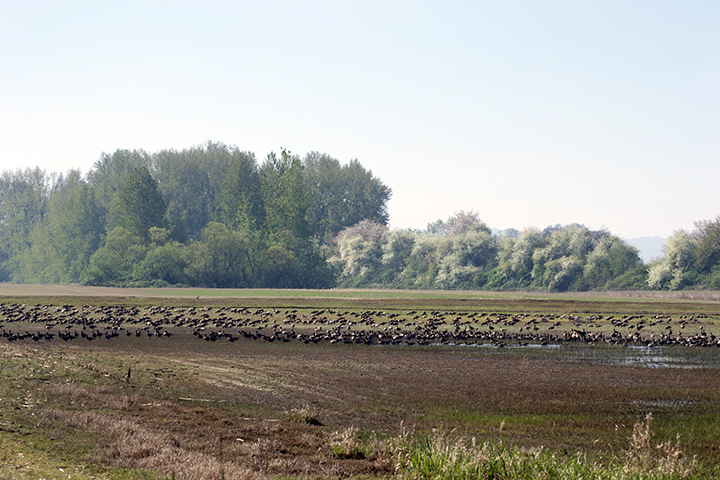
There they were in the fields, this Monday. Hundreds and hundreds of them. So much for social distancing….
Usually at this time of year Canada Geese would gather for the migration back North. Many of them now stay here, having found both food sources and breeding grounds that suit them. They are really amazing in what they pull off, once in flight. They can fly up to 1000 km a day, which means they could fly around the world in 48 days, if they’d wish to. But they wish to stay.
Looking at them reminded me of Inuit art that has depicted them for ages.
Traditional stencil,
Lukta Qiatsuk, Canada Geese Nesting Ground, 1959
modern stone cut and stencil,
Killiktte Killiktee, Canada Geese, 2016
Litographs,
Kananginak Pootoogook, Canada Geese Mating, 1976
Carvings,
Johnnysa Mathewsie Canada Goose, 2018
Acrylic and ink on paper,
Benjamin Chee Chee Goose in Flight 1977
And these artworks, in turn, reminded me of a small, riveting exhibit at the Portland Art Museum that I had a chance to explore earlier this year before everything shut down. Akunnittinni: A Kinngait Family Portrait exhibited the works of three Inuk women, grandmother, mother and daughter, Pitseolak Ashoona, Napachie Pootoogook, and Annie Pootoogook respectively. Their work was intimate, direct, jarring. They described the world as seen and experienced by them, providing autobiographical narratives as much as a glimpse of historical and cultural episodes that taught me much about Inuit culture and the resilience of women in a violent world, violence to which the youngest artist succumbed in 2016, and which was born by the older ones, during a time where husbands would rent out their wives by the hour to traveling sailors.
Trading Women for Supplies by Napachie Pootoogook, Ink,(1997/98).
It was fascinating to see three generations describe their lives, and display an astute summary of the mundane, the quotidian, the cultural influences of later years on the first nation lives. PAM’s Center for Contemporary Native Art picked a winner (the exhibition was curated by Andrea R. Hanley (Navajo.) I will be eager to go back to the smaller galleries, once the museum is open again, and let me be surprised at what I find.
Oh, to be a bird, and just leave it all behind, hide in that big gaggle in the safety of numbers, wander through the fields with less of a sense of past or future and just living in the moment of grazing. There is some continuity for them as well, though – they mate for life! And geese, believe it or not, often live for up to 24 years.
Today’s title is not referring to the kind of activity intended to make you buy clothes. Instead I want to talk about representations trying to make you understand and/or buy into complex concepts. Think this is going to be boring? Think again! It provides a glimpse of science and will all relate to art. It will also be long. And personal. Consider it your reward, dear brave and zany readers, or punishment. Your pick.
Friderike Heuer Moonlight (2020)
My artist talk for my new montage series, now on exhibition at the Newport Visual Arts Center until April 25, was shut down because of sensible enforcement of social distancing in our coronavirus world. I figured I’ll write about the work instead (in more depth than a 10 minute presentation) and want to give credit to a brilliant short essay I read some years back that influenced my thinking. The author, philosopher James Nguyen, explained in ways even we lesser mortals can understand – he ain’t one of us, just check his education and employment history, we will hear more from this young man – how we can get a grip on complex, complicated issues by finding models that explain them in simpler ways. “All” it takes is a bit of creativity in coming up with the right model and play with it.
Friderike Heuer On the Town (2020)
As an example he used the complex issue of figuring out how fake news spread in our societies and applied a model derived from epidemiology (a full three years, by the way, before we all tuned into that field in our desire to understand the spread of the coronavirus.) You can think of the dispersion of fake news as a virus that is infecting the population and apply to it medical models that track how diseases spread, for example the susceptible, infected, recovered (SIR) model, to reinterpret it. The people who buy into fake news are infected, the ones who now ignore it are immune (recovered) and then there are the masses who are susceptible to it. The SIR model predicts that we can modulate the spread by lowering the proportion of people who are susceptible, slowing down the rate or speed with which the news/virus is dispersed, and increase the rate at which those who started to believe the news/got sick now recover. The right proportion of these three factors (low, low, high) will lead to herd immunity, helping us to tackle an epidemic.
Nguyen points out that just as this scientific approach aims to represent a target, artists attempt to represent a subject. Reasoning about and constructing representations helps us to grasp new perspectives and to learn about the world. “In this sense art and science share a common core; the human ability to construct and interact with representations in order to learn about what it is that they represent.”
Friderike Heuer The Cranes (2020)
*
Fast forward to last summer when I visited the New Bedford Whaling Museum in Massachusetts for the first time. It is a terrific institution, providing tons of sensory experience (walk through the replica of a whale’s heart; board a whaling ship built to scale with every last detail), lots of education about the economics, politics and environmental issues historically associated with the whaling trade, and enticing exhibits of scrimshaw and macramé crafts, tools and weapons used during the expeditions. The museum offers replicas of the living quarters of those who benefitted from the the craze for oil derived from the blubber of whales, oil that burnt bright and without scent or smoke, and the craze for whale bones used in corsets confining women to their breathless, suffocating place. There is also plenty of information about the cruel fate of those doing the actual labor, and dying in the pursuit of profit for their masters. (I wrote about my first visit here.)
The visual art gallery in the museum exhibited some 20 or so paintings, titled The Wind is Op – Climate, Culture and Innovation in Dutch Maritime Paintings, by Dutch and Flemish Old Masters from their impressive collection. The maritime paintings and drawings from the 1500s to the 19th century differed in quality, from masterworks to “school of so and so… ” They shared, though, a clear expression of pride and admiration for the explorers, sailors and skill of the seafarers in their midst. The paintings celebrate the heroic and are in awe of maritime prowess and domination of the beasts.
Friderike Heuer Arctic Still Life (2020)
They also provided testimony for the effects of climate change then: The ‘Little Ice Age’ between 1500 and 1600 greatly affected the character of Dutch whaling in the seventeenth century. The harsh cold that froze rivers and canals changed ocean currents, which impacted trade routes to Asia and America. It also stranded many a sperm whale on Dutch beaches, caught by shallow water, providing increased fascination with the giants for the population. The Dutch were particularly innovative in coping with these climate challenges. They built differently shaped ships adapted to arctic waters, learned to hunt from the shores and found ways to process the blubber either on ships or on shore for efficient transport in barrels sailing towards the Dutch ports.
It struck me then and there that for centuries people were not realizing what the unconstrained killing of whales would do to the species. They were aware that hunting grounds emptied out and they had to venture farther afield, but they possibly ascribed it to the experienced change in temperatures. The scientific knowledge of the possibility of extinction of a species due to overfishing (and the subsequent trickle-down effects) was not available.
Friderike Heuer Hamburg Harbor (2020)
WE, on the other hand, DO know what harms our oceans, and what needs to be done to protect those ecosystems. After all, when 2 million whales were killed in the 20thcentury in the Southern oceans alone, many countries came together to sign the International Convention for the Regulation of Whaling and establish a global body to manage whaling, the International Whaling Commission (IWC.) Its role has grown to tackle conservation issues including bycatch and entanglement, sustainable whale watching, ocean noise, pollution and debris, collisions between whales and ships as climate change impacts migration routes and global warming affects available food sources.
Friderike Heuer Plastics (2020)
Yet several countries have recently left the organization to take up whaling again, with potentially dire consequences. On a larger scale, all of us, as consumers of plastics and other pollutants that end up in the waters, endanger existing whale populations. In our relentless addiction to the amenities provided by fossil fuel consumption, furthermore, we do little to mitigate climate change that affects maritime biological systems, with feedback loops into weather systems, with feedback loops, for that matter, into how disease spreads and creates pandemics.
Friderike Heuer The Heron (2020)
Clearly we are not heeding the warnings coming from the experts, just like the people of Nineveh, in biblical times, did not open their arms to a – reluctant to begin with – prophet named Jonah, the very one supposed to have been swallowed by a whale. Postcards from Nineveh, then, is the title of my exhibit, riffing on what my work is trying to represent as a reminder of a complex problem – sometimes naive, sometimes willful ignorance affecting environmental protection.
*
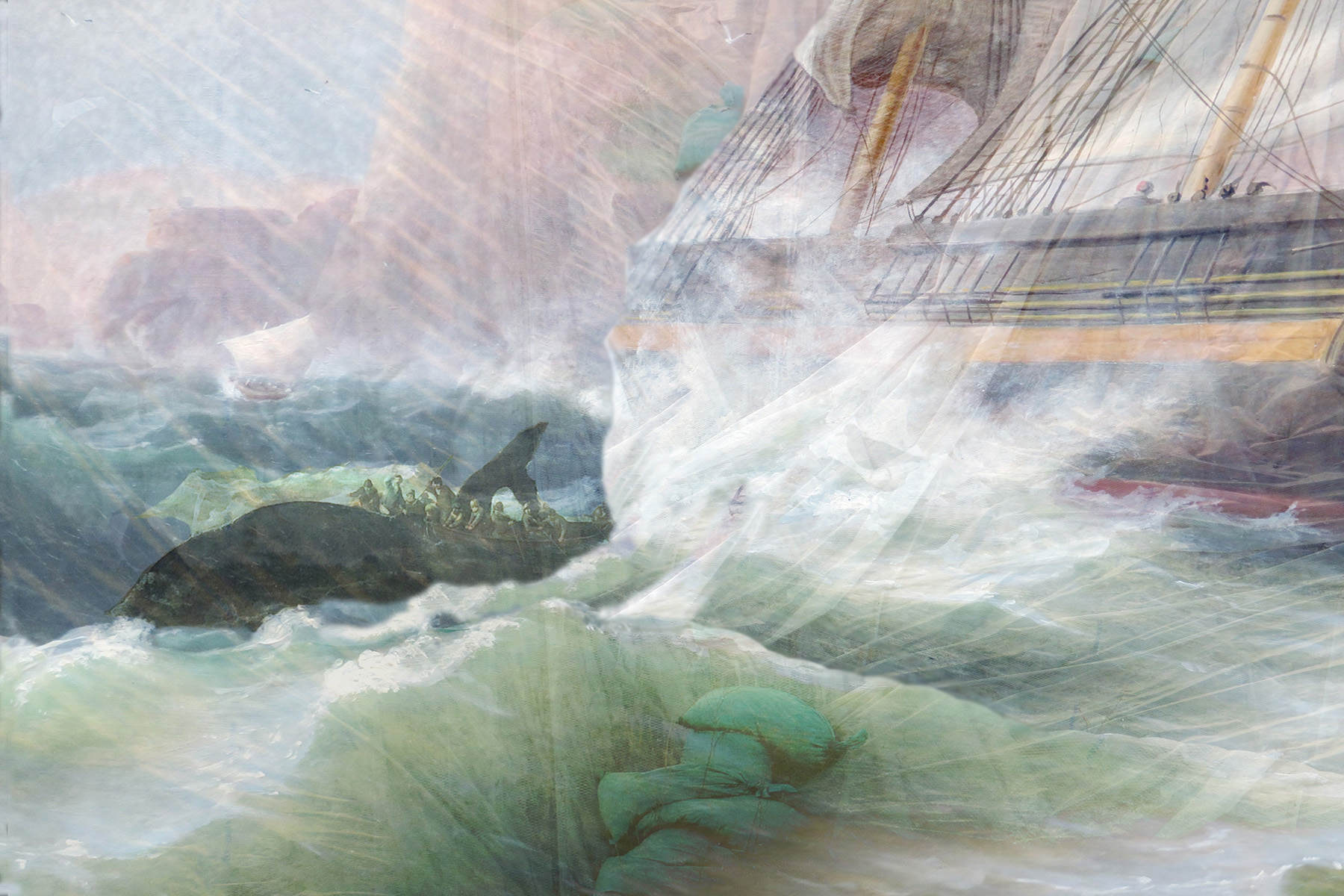
So how do you represent the dangers of inaction? For one, you can point to a subject where practically everyone knows how horribly things can go and have gone wrong: people are aware of what has happened to whales. Limitless pursuit of fishing for profit brought several whale species to the brink of extinction across the centuries. Some are still fighting for their survival, like the North Atlantic right whale, others, like the grey whale, are now recovering due to organized intervention. This purpose was served by using excerpts from all the New Bedford whaling art that I photographed, mostly taking snippets with my iPhone. Here is a better example from the museum’s website.
Parts of this painting were used in the montage The Cranes above and Stranded (1) below.
Secondly, you have to represent what is at risk. For me nothing spells that out better than looking at the beauty of nature as we know it, with the implication how it can and will be lost if we don’t change course. The landscapes and seascapes from my photographs originate predominantly in the Pacific Northwest, along the Washington side of the Columbia river and the Oregon coast. There are also nature images from New Mexico, and Germany. Weaving the two elements together, what we know of the past (whaling disaster) and know as the present (the gift that is our landscape, still mostly intact) represents the intersection of human behavior, driven by either lack of knowledge or unwillingness to convert what we know into action.
Friderike Heuer Stranded (2) (2020)
Thirdly, who will be our prophet given the tendency to minimize scientific input either through absence of science education or willful dissing and curtailing of the discipline? Art has to step in and alert us to the issues, and perhaps help persuade us to engage. This aspect is represented by my photographs of art institutions and art, taken across the last decade, from the art museum in my hometown of Hamburg, Germany, Kunsthaus Wien, Museum Hundertwasser, the Barnes Foundation in Philadelphia, the Tacoma Glass Museum, the Philharmonic Concert hall in Los Angeles, the National Museum in Kraków, to the exhibition halls of the Rhode Island School of Design (RISDY) and Montreal’s Arsenal Gallery which resides in a converted shipyard and TOHU, the circus arts organization.
Friderike Heuer Hamburger Kunsthalle (2020)Friderike Heuer Waiting (2020) (Barnes Foundation)Friderike Heuer The Starlings (2020) (Tacoma Museum of Glass, Bridge Sculpture)Friderike Heuer Pacific Sights (2020) (LA Philharmonic Hall)Friderike Heuer The Mirror (2020) (RISDY, the slats reminded me of the corsets)Friderike Heuer Still Life with Sea Shell (2020) (Arsenal Gallery Montreal)
*
Good photographers introduce us to their vision of what is in front of our eyes. The way they represent something is by means of selecting a specific perspective, capturing a certain mood, structuring their composition – in the end, though, they depict. Photographs show a world that exists, however subjectively perceived.
Photomontages, on the other hand, convey something that is constructed, giving the artist the leeway to represent possibilities, anomalies, products of imagination, just like painters do. By combining, manipulating, and altering photographs they create something that cannot be found in reality and yet conveys a sense of alternate reality, of imagined recourse. The way they come about in my own case is not me sitting with a checklist of the aspects of the model discussed above in front of my computer program that helps me create these works. I am loosely guided by the original thoughts about representation, and use only things I photographed myself, but the rest unfolds organically and often in ways that surprise myself.
Take, for example, this image, Reminiscence, an invitation to look at the past.
Friderike Heuer, Reminiscence (2020)
The Dutch landscape, painted centuries ago, is one I saw every summer as a child. I lived in Holland for a year as a young child, and then for a decade at the German side of the border with Holland, and our summers were spent at the North Sea, with boats like the old ones depicted still occasionally appearing in the seascape of the 1950s. The figure is a self portrait of a Finnish photographer I greatly admire, Eliana Brotherus. I photographed her work in Vienna, 2 years ago. She herself linked to the past in her portrait series by appropriating the landscape, stance and coat of Caspar David Friedrich, a German painter of the romantic period, and she reminded me of pictures of myself when still young. I intended to make the figure transparent to represent how the past seeps through into the present, guiding us forwards or holding us back, who knows. When I looked at the image, though, all it reminded me of was how thin skinned I am – both porous for the onslaught of information that I seek every day, visually and otherwise, but also for absorbing the emotional currents around me, strained and otherwise, often forcing me to withdraw. It bubbled up into the montage, unintended.
Or, as a different example, several of the montages ended up representing some aspects of colonial invasion of this continent, not necessarily tied to whaling but to maritime prowess that led to the endangering or extinction related to our own species, the humans, ways of life and languages of First Nations.
Friderike Heuer Confluence (2020) (Columbia River Channel)Friderike Heuer Stranded (1) (2020) (New Mexico at Kasha-Katuwe National Monument)
One thing I was certain about, though, was that I did not want to lecture with a sledgehammer. I picked a rather small format for the montages, so they don’t overwhelm, but beckon for intimate interaction, inviting the viewer to come close to see the details. I wanted to give the Dutch and Flemish painters of yore a platform to celebrate their artistic achievements and importance to our understanding of history. And I wanted my own work to be beautiful to reach people’s minds, more so than disquieting, although I seem to be unable to avoid the latter completely regardless of what topic I tackle.
Friderike Heuer The Wish (2020)
Now all we need is someone to review the work to see if it actually accomplishes what I set out to do: to remind us that we cannot simply interfere with nature without consequences, or keep up our behavior blind to what is required to protect what we love. Send me a postcard!
PS: True gratitude to my fellow photographers and friends Ken Hochfeld, who printed and framed and critiqued everything you see here, and Dale Schreiner who helped me to sequence the series – his habitual role in all of my exhibitions. A thank you also to Tom Webb who runs the VAC in Newport and invited me to show and hung it in the upstairs gallery. And a shoutout to Steve and Barbara Blair who photographed the work during a visit this weekend – I still have not seen it in real life in the gallery!
Folks, disappointing but justified news: the City of Newport canceled all nonessential public events – artist talk tomorrow 3/14/20 at the Newport Visual Arts Center is not going to take place. I will blog about the rationale for the series on Monday instead in case you are interested…. stranded, for now.
I started the week with stealing a title and I’ll end it the same way.
Deal with It is the titleof a podcast that features interviews with Lee Krasner (1908 – 1984), one in a group of podcasts that I am sending your way today. It is, of course, a fitting exhortation in these uncertain times, one I find myself muttering frequently, even though I am clueless about how to accomplish the command.
Deal with It
Maybe podcasts will help. I figured you might need some truly interesting presentations during long hours of self-isolating, or fighting yet another cold, or simply needing to hear something empowering during these challenging times.
The whole series, Radical Women, is a wonder. Here is the introduction, all sources and photographs courtesy of the Getty Research Institute:
What was it like to be a woman making art during the feminist and civil rights movements? In this season of Recording Artists, host Helen Molesworth delves into the lives and careers of six women artists spanning several generations. Hear them describe, in their own words, their work, relationships, and feelings about the ongoing march of feminism. Contemporary artists and art historians join the conversation, offering their own perspectives on the recordings and exploring what it meant—and still means—to be a woman and an artist. This podcast is based on interviews from the 1960s and ’70s by Cindy Nemser and Barbara Rose, drawn from the archives of the Getty Research Institute.
So there we have it: in this week devoted to women’s history we started with composers, went on to activists, pilots, then scientists and now artists as a cross section of role models, all resurrected from forgetting. If that isn’t motivating to fight the blues, what could possibly be?
Maybe this? A list of the ten National Parks that would not exist without the championship of women?
So far this week I have compared cubist, expressionist and abstract paintings to images I photographed in nature. Today I want to venture a bit further and talk about a subject matter that is frequently found in visual art and also a regular motif for the traveling photographer. Doors, in other words.
Doors as the substrate of a painting as well as its subject can be found as early as the fifteenth century. Dutch painters used triptychs: a format that consists of three panels that are hinged together and can be closed like a door. They functioned as a prayer aid, trying to help the observer to enter a meditative state with access to the divine world, but clearly setting up a boundary between every day life and the sacred through the focus on passageways. Doors were prominently painted within the triptychs as well, driving the point home of separation but also access to the divine. Different painters addressed different audiences: Robert Campin (1375-1444, usually identified with the Master of Flemalle) painted the annunciation within a domestic setting in the Merode Altarpiece to encourage private devotion in the home. Rogier van der Weyden organized the Miraflores Altarpiecein a series of archways to aid monks in completing the rosary. And Hugo van Der Goes created in the Portinari Altarpiece a Nativity scene to encourage hospital employees, and comfort sick patients with the notion of salvation. The use of doors was clearly linked to religious contemplation and communication with a higher power, but solidly set in environments familiar to the viewer.
*
That is somewhat different when we reach the romantic era, where religion is changing, with people turning to more secular forms of comfort, leaving a weakening church behind and, for pragmatic reasons, separate what used to be church functions from their origins. Take cemeteries, for example. They used to be on church grounds, but are now, with the growth of populations in the 19th century, their own separate entities often at a distance from the city gates.
Caspar David Friedrich, Abtei im Eichwald, (Abbey in the Oak Forest), 1809/10Cemetery New Mexico Cemetery South Carolina
One of the most famous paintings of the era is Caspar David Friedrich’s depiction of a funeral at the abby in an oak forest. It is a dreamlike landscape, the church in ruins, the portal open to be taken on by nature, which also looks, frankly, decrepit. Some lonely monks try to bury what is presumed to be the painter (who by the way was involved as designer for all the modern secular cemeteries around Dresden.) The door between life and death, between the past (with its comforts of structured religion now decaying) and the presence (where nature is not exactly up to task to provide divine comfort) – how more symbolic can it get? (I learned all this here, in a fascinating essay on Friedrich’s burial paintings.)
*
Moving forward in time, we find more reductive representations: Matisse’s french door that seems to frame a void. Original the central space contained a balcony and a landscape, but he blackened them out, at some point relating that “I’ve been forty years discovering that the queen of all colors is black.” What are we supposed to experience? A sense of night, beckoning? Something reduced to framing of uncertain passage? Is it me, or does it give you goosebumps as well? (If you live close to Baltimore or visit, don’t miss the Baltimore Museum, housing the largest Matisse collection in the world and opening a new center next year.)
Henri Matisse, French Window at Collioure, 1914
*
Artist with a sense of humor to the rescue: Just look at Marcel Duchamp’s door that he installed in his French apartment in 1927.
Marcel Duchamp, Door: II, rue Larrey, 1927
It served two doorways (between the studio and the bedroom, and the studio and the bathroom). The door could be both open and closed at the same time, thus providing Duchamp with a household paradox as well as a practical space-saving device. The “practical space-saving device” belongs more to a set for a bedroom farce. Duchamp’s rooms-whether filled with string, prank doors, or readymades provoking pratfalls-all confound the logic of work and efficiency. Instead, when Duchamp altered the purposes of both rooms and objects, to provoke play rather than work, laughter becomes their new “function.” A detailed, clever description of Duchamp’s life-long, successful attempts to avoid work (or point to it as a factor in alienation if used within the industrial context) and introduce play (helped by the fact that he was “kept” by numerous rich benefactors all of his life) can be found here.
*
Might as well turn to the surrealists and who better to serve us with passageways into another realm than Rene Magritte? I would not mind having these two doors, painted 23 years apart, in my life. That little cloud, which sails into (or out of) proximity to the sea, obligingly using the passageway instead of ignoring it and flying high, looks like it is curious, but also might be squashed in an instant if someone bangs the door… reminding me that I better pick my own path instead of following the beckoning of open doors. So who is victorious here?
Rene Magritte, La Victoire, 1939
And what was improved here? Some shade provided? A time-travel capsule if you dare step through that door? Many happy little clouds giving that sky a jubilant feel? Your guess is as good as mine, but these are doors that invite rather than forbid.
René Magritte, The improvement (L’embellie), 1962
And finally here is a door that appeals to me visually, but I would never ever follow an invitation to pass through it from its painter, Willem de Kooning. If you have it in you to read a review of his work, dripping in psychoanalytic jargon misplaced in an art review, but truly perceptive once you get to the core issues, you’ll understand my reluctance.
Willem de Kooning, Door to the River, 1960
Luckily, there are many other doors to chose from.
Closing the door on today’s musings is music by a contemporary of Friedrich: Felix Mendelssohn.
Do you know that feeling when you have completely conflicting reactions to a person or an event? When a lot strikes you as admirable or interesting or unusual, but other things bug you, and you can’t quite find a resolution to that emotional tension? So it is with me and Helen Frankenthaler (1928 – 2011), today’s painter of choice, since large blocks of landscape colors reminded me of her color fields.
Helen Frankenthaler (American, 1928–2011). Hint from Bassano, 1973.
She was born into an upper-class, wealthy and cultured New York family and early on given a sense of superiority by her father, New York state supreme court judge Alfred Frankenthaler. Her life was defined by remaining within that class and its perks, with multiple residences, staff, the works. Her education was privileged from the beginning, from ultra-conservative prep-schools to progressive institutions like Bennington College. Affairs and then marriage to arrived art critics and artists opened the door to the intensely creative world of the 1950s, including exposure to Jackson Pollock who stimulated her thinking about painting method. A short stint of being mentored by Hans Hofman, one of my own favorites (I wrote about him here) set her on her path, never looking back after that.
Helen Frankenthaler, Provincetown Window, 1963-64.
Yet she paved her own way, and despite all her socially somewhat conservative inclinations she was nothing less than revolutionary when it came to her art. And she came to it on her own – after a bitter break-up after 5 years with Clement Greenberg, the art critic du jour, and before her 1958 marriage to Robert Motherwell, another unusually wealthy artist, she managed to achieve recognition as one of the few women in the mid-century art world by pushing away from expressionism into true abstraction. (The marriage ended in 1971, she later wed an investment banker.)
Helen Frankenthaler, Untitled (Cover of a book, not dated.)
She was 23 years old when she started to paint in ways that would be known as the color field movement, influencing other artists later associated with that school. Pouring thinned oil paint on unprepared canvasses which absorbed it while flat on the ground (rather than using a brush), she created luminous, evanescent paintings that hinted at landscape but were as ambiguous as only good abstract art can be. British art critic Nigel Gosling reviewed her in 1964: “If any artist can give us aid and comfort,” he wrote, “Helen Frankenthaler can with her great splashes of soft colour on huge square canvases. They are big but not bold, abstract but not empty or clinical, free but orderly, lively but intensely relaxed and peaceful … They are vaguely feminine in the way water is feminine – dissolving and instinctive, and on an enveloping scale.”
Helen Frankenthaler, For E.M, 1982
I have always thought that she had the courage to create beauty (for women in general a treacherous undertaking, in my view,) but sometimes it was almost too beautiful. I was gratified when I found this review by Deborah Solomon which expresses my reservations in better ways than I could. Written in 1989 for the New York Times, she teases apart the contradictions between the artist’s bourgeois, anti-feminist, controlling nature and her lyrical work that depends to a large extent on accidents and improvisation.
Helen Frankenthaler, Tantric, 1977
It was, above all, beauty she was after, managing to translate ephemeral watercolor-like paintings onto a truly large scale. In later years sponges, squeegees and mops were added to the mix, now spreading diluted acrylics onto raw canvas, but the style pretty much remained the same, yet nowhere seeming boring. She did not seem to mind that the art world had moved on and the younger set deemed her caught in the past – that I admire too: to stick to your ways of expression independent of vogue.
Helen Frankenthaler, Canal, 1963
In her own words:”What concerns me when I work is not whether the picture is a landscape, or whether it’s pastoral, or whether somebody will see a sunset in it. What concerns me is – did I make a beautiful picture?”
Below are two videos describing her life and recording her musings during a visit here at Portland State University some 50 years ago.
And here is a local artist, recently discussed, who continues a tradition of luminosity.
And here is music that reminds me of Frankenthaler’s soothing effects on my mind – an unapologetic melodic approach with hints of romanticism.