Browsing Tag

Wislawa Szymborska

Possibilities

Walk with me. Today the universe sent a graffiti message to find the birds, so we shall.

It will be the last stroll of 2025, a year full of challenges and sorrows, but also joy from unanticipated quarters.

Rather than listing the highs and lows of 2025 as do so many other retrospectives, I want to focus on one thing: let us continue to fight indifference in 2026. I know I have harped on this all year long, but it is important enough to reiterate in this last YDP of the year.

Wood Duck

*

There are many meanings of being indifferent. Here are some gleaned from the Thesaurus:

  • not mattering one way or another (what others think is altogether indifferent to them.)
  • of no importance or value one way or another ( they talked about indifferent things.)
  • being neither excessive or inadequate (hills of indifferent size.)
  • being neither good or bad (in the sense of mediocre work.)
  • marked by no special like or dislike (indifferent about the task they were given.)
  • marked by lack of interest or concern (indifferent to suffering or injustice.)

It is, as you likely anticipated, the last option I am after, the ongoing struggle with apathy.

Kestrel

*

I do not want to be unconcerned, incurious, aloof, detached, disinterested or all the other synonyms that come to mind (or appear on the Thesaurus page, as the case may be.)

I don’t want ANYONE to be that way, because we are in this TOGETHER, in need of the strength of collective action.

What is “This” I am referring to, you ask? I am thinking of a world that is coming apart at the seams, in need of accelerated stitching to prevent dissolution, moral as much as physical.

A world where some not only hold on to existing inequality, but think it is a G-d-given right, with a biblically defined hierarchy of White over all darker shades, male over female, rich over poor. A world that desires inequality to continue or even be expanded.

A world where climate change, spread of disease and death are hastened by anti-science policies, removal of aid, eugenics, greed and war.

A world where the tools of promoting differentiated thinking – education, a free press, mechanisms to increase differences of opinion, including free speech – are systematically removed and broken.

A world where diversity is despised instead of celebrated.

Indifference will make it possible for this world to exist, something we should oppose at all cost. It might be an uphill struggle, but, as Miles Davis reminds us in today’s music, “So What?”

Crow eating mouse….

***

Grateful that a friend sent out the poem below. As so often with Szymborska, she uses the first person singular approach to establish a direct connection to the reader. (I had posted another of her poems like that here.) SHE has all those preferences, what about yours? SHE questions established truths and mainstream narratives, what about you? SHE made choices, isn’t it your turn?

Not only does she invite us into a mindset that alternates between the small and the large, interior and exterior worlds, the philosophical and the mundane. She reminds us that we have agency – we can make up our minds about what we believe and care about, instead of being indifferent. We have options, even if the powers that be try to convince us that we have run out of them (or our state of overwhelmed fatigue insinuates the same). There are possibilities, if we only think a little harder, accept being governed by reason, avoid being stymied by borrowing trouble.

Meadow Lark. A rare find at this time of year.

What this poem provides for me is the permission to contain sometimes contradictory multitudes, as long as I care and make choices, all of which is in my power. More importantly, it makes me aware of the need for action to follow from belief, given that she lists numerous morally consequential preferences that don’t exist in a void, but require positioning.

Let us remind each other of this in 2026.

Possibilities

I prefer movies.
I prefer cats.
I prefer the oaks along the Warta.
I prefer Dickens to Dostoyevsky.
I prefer myself liking people
to myself loving mankind.
I prefer keeping a needle and thread on hand, just in case.
I prefer the color green.
I prefer not to maintain
that reason is to blame for everything.
I prefer exceptions.
I prefer to leave early.
I prefer talking to doctors about something else.
I prefer the old fine-lined illustrations.
I prefer the absurdity of writing poems
to the absurdity of not writing poems.
I prefer, where love’s concerned, nonspecific anniversaries
that can be celebrated every day.
I prefer moralists
who promise me nothing.
I prefer cunning kindness to the over-trustful kind.
I prefer the earth in civvies.
I prefer conquered to conquering countries.
I prefer having some reservations.
I prefer the hell of chaos to the hell of order.
I prefer Grimms’ fairy tales to the newspapers’ front pages.
I prefer leaves without flowers to flowers without leaves.
I prefer dogs with uncropped tails.
I prefer light eyes, since mine are dark.
I prefer desk drawers.
I prefer many things that I haven’t mentioned here
to many things I’ve also left unsaid.
I prefer zeroes on the loose
to those lined up behind a cipher.
I prefer the time of insects to the time of stars.
I prefer to knock on wood.
I prefer not to ask how much longer and when.
I prefer keeping in mind even the possibility
that existence has its own reason for being.

By Wislawa Szymborska

Translated by Stanislaw Baranczak and Clare Cavanagh

Happy New Year. Much gratitude that you all have come along for the ride so far.

Downy Woodpecker

“Did Women Ruin Men Blaming Women For Ruining Things?”

I borrowed that title from writer Celeste Ng who posted it in response to the inane opinion piece by Ross Douthat in the NYT, wondering if women ruined the work place (I will not even link to it – they later shifted the titled to liberal feminism instead of “women.”)

Low energy on my end this week, so you get to look at some portraits I took of strong women, and a collection of publications (I found ready-made) that blamed women for ruining – well, everything.

It would all be laughable, if the bigotry wasn’t so scary.

\

Portrait of a Woman

She must be a variety.
Change so that nothing will change.
It’s easy, impossible, tough going, worth a shot.
Her eyes are, as required, deep, blue, gray,
dark merry, full of pointless tears.
She sleeps with him as if she’s first in line or the only one on earth.
She’ll bear him four children, no children, one.
Naive, but gives the best advice.
Weak, but takes on anything.
A screw loose and tough as nails.
Curls up with Jasper or Ladies’Home Journal.
Can’t figure out this bolt and builds a bridge.
Young, young as ever, still looking young.
Holds in her hand a baby sparrow with a broken wing,
her own money for some trip far away,
a meat cleaver, a compress, a glass of vodka.
Where’s she running, isn’t she exhausted.
Not a bit, a little, to death, it doesn’t matter.
She must love him, or she’s just plain stubborn.
For better, for worse, for heaven’s sake.
      

by Wislawa Szymborska translated by Stanislaw Baranczak and Clare Cavanagh.

A short piece for music today, introduced as: “Being a woman writing music in the early 20th century was an act of feminism in itself. In the 1920s, a critic at one performances remarked with surprise that Ruth Crawford Seeger could “sling dissonances like a man”—because, you know, what could a woman possibly know about discord?”

Or music. Or anything…..

A World not of this World.

· River Stories - New work by Kristie Strasen. ·

“I like maps, because they lie.
Because they give no access to the vicious truth.
Because great-heartedly, good-naturedly
they spread before me a world
not of this world.” – Wisława Szymborska

This stanza from Szymborska’s poem Map, the last one she wrote before she died, loomed large in my head when I drove home after a conversation with a local artist who had invited me for a studio visit to explore the project she is currently working on.

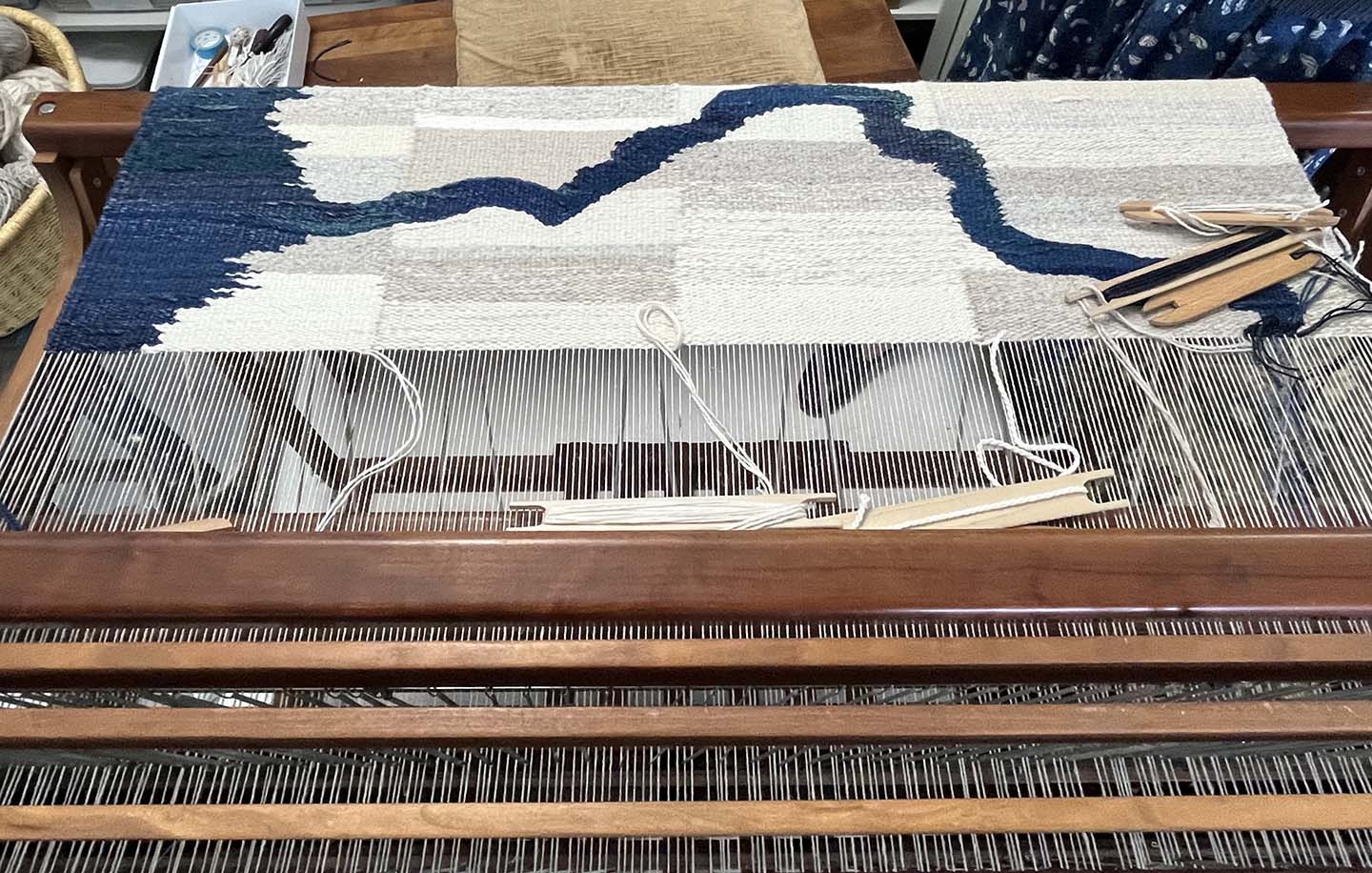
Kristie Strasen is a renowned colorist and textile designer, with numerous awards under her belt, and, more importantly, decades of experience in creating pattern and color schemes for high end textiles where execution matches her original visualization. In the decade or so since she relocated from New York City to the Columbia Gorge, she has infused her creativity, her skill set(s) and her curiosity about the history of her new home into ever more ambitious projects at the loom.

Her current endeavor can be described as a work of cartography, in the widest sense. The weavings model reality in the most abstract ways, combining scientific inquiry, aesthetics and technique, as all map making does that tries to capture reality in spatial form.

River Stories will depict the entire course of the Columbia River from the Canadian headwaters to the mouth where it enters the Pacific Ocean, some of the tributaries, like the Klickitat and the White Salmon river, and several sections of the Columbia Gorge Scenic Area.

It is technically a complex endeavor. Strasen enlarged maps that show the geographic features of the river course, bends and all, partitioned the sections into grids and then traced the river course, eventually with dots under the warp of her loom.

With free hand weaving she delineated an exact depiction of how the river runs, through six sections, with background colors reflecting the tone of the respective landscapes, the forests, the cliffs, and the eventual softness at the confluence. The color choices required more than just her perfect eye – because the wool in the requisite colors was of different weight, the straight edges, pride of accomplished weavers like Strasen, had a tendency to be less than perfectly straight, once off the loom. Probably only detectable for experts, but something the weaver had to grapple with given her high standards.

All I can say: The tapestries are a beautiful, but I equally marvel at the way Strasen transforms her curiosity about the world into a specific work of art that shares some of her insights with the viewer.

Curiosity about the world: in addition to a longstanding fascination with maps, the artist devoured the literature about the history of the Gorge, the consequences of Western expansionism, and the effects of human intervention on nature, once she had arrived in White Salmon, WA and made it her home. She felt called to draw our attention to both, the consequences of our meddling with nature, as well as the preservation of it, the latter largely due to early efforts of individuals like Nancy Neighbor Russell, who was instrumental in rescuing the Columbia River Gorge in Oregon and Washington, threatened by commercial interests. Russell founded Friends of the Columbia Gorge in 1980, working to protect the Gorge from development and secure it for federal protection, th Columbia River Gorge National Scenic Area Act, passed by the U.S. Congress in 1986.

***

Maps express particular viewpoints in support of specific interests. They can shape our view of the world and our place in it by selectively presenting information. This can be bad when the purpose of persuasion is manipulation. I had written about this some years ago in the context of another map making and art project:

“The goal of suggestive mapping was to achieve political objectives (while avoiding lies, which could be easily exposed) by appealing to emotions and rigorously excluding anything that didn’t support the desired message. Its maps were intended specifically to engage support from the general population, and they were often “shamelessly explicit. Cornell University has a wonderful introduction and collection of maps all sharing the purpose of persuasion. The topics range from religion, imperial geopolitics (think colonialism), slavery, British international politics, social and protest movements to, of course, war. The goal was made explicit in the 1920s (and later taken on in force by the Nazis) when in reaction to the shameful defeat in WW I German cartographers decided to go for the “Suggestive Map,” cartographic propaganda which they thought had given the British a strategic advantage.”

But the way information is presented can also have the positive impact of a warning or an invitation to think things through critically. A selective tool used by Strasen is the color she chose to mark the various dams blocking the natural flow of the river. In my interpretation, bright red bars signify the danger, the concept of halting, the possibility of destruction and the ongoing heat of the discussion around the justification (or absence thereof) of dam removal. These visual magnets emphasize obstructions that we now know had ongoing disastrous consequences for fish populations, never mind the trauma of displacement for the Native American tribes affected by the dam construction. They remind us how much the lifeblood of the Pacific Northwest, this river and all who it serves, are endangered by efforts towards relentless extraction, a view shared with the Columbia River Keepers who are passionately engaged in its protection.

***

Maps in art have been around for some time (for a short history of this intersection, go here.)

Art, like maps, can be a tool of persuasion, doubling the force of that intention when utilizing maps’ suggestive power, which can be done in a number of ways.

Mona Hatoum, born in Lebanon to Palestinian parents and living in England, for example, took copies of the flight route maps you find in airplanes, and added hand-drawn designs in ink and gouache. Rather than focussing on geographic borders, she delineated the movement across the globe, leaving to us the decision if that movement was voluntary or not. She herself describes the paths she drew to be “routes for the rootless.”

Mona Hatoum Routes II (2002) Photo Credit: MOMA

Later work employs sculpture, with red neon outlining the continents, representing a globe riddled by hot spots, places of military or civil unrest, a world aflame.


Mona Hatoum Hot Spot III (2009) Photo Credit Agostino Osio.

Closer to home, artist Mark Bradford has made his mark with his large-scale mixed-media works that combine representations of geography and the ruinous fate of residents of depicted areas. The artist models the streets and buildings of specific neighborhoods with string or caulk, layering scavenged paper on top and cutting and peeling away layers to both conceal and expose the geography. Some of his map paintings refer to areas in L.A. shaken by violence in the 1992 riots. Others refer to scorched earth, referencing the Tulsa Race Massacres of 1921 which wiped out Oklahoma’s Black Wall Street.

Mark Bradford Black Venus (2005)

Mark Bradford, Black Wall Street, 2006

Mark Bradford Black Wall Street (2006)

Mark Bradford Scorched Earth (2006)

 
Not all art is, of course, explicitly political. Some, like Juan Downey‘s Map of America, draws swirls of color to stimulate the imagination.

Juan Downey Map of America (1975)

Then there is Maya Lin’s Pin River project – sculptures depicting river courses with pins or marbles, up to 20.000 in this rendering of the Hudson river watershed. She also uses installations created from more than 200 bamboo reeds in the form of a 3D drawing of the Hudson River basin,

<p><em>Folding the Hudson</em>, 2018. Glass marbles, adhesive. Courtesy the artist. Photo: Kris Graves.</p>

Maya Lin Folding the Hudson (2018)

Maya Lin Pin River—Hudson Watershed (2018) detail.

Maya Lin Map of Memory, Hudson River (2018)

All of these works, in their own way, demonstrate that maps can be used for more than an efficient way to communicate spatial information.

This is also the case for Strasen’s tapestries, which are surely more than a tool to help us think about our physical surroundings. Her unapologetically reductive maps offer less context and more of a sense of wonder for a particular place, a particular beauty and history. A world not of this world, and yet.

The blue band of the river, set against an immense backdrop of diffuse landscape coded only in color, gives us a figure/ground constellation that tells a story emphasized by this degree of abstraction: the centrality of a river shaped by forces larger than us, defining a region, essential to its – and our own – survival.

The work will be completed in June when it will be inaugurated during a solo show at the Columbia Gorge Museum.

I cannot wait to see it hung!

Columbia Gorge Museum E.D. Lou Palermo, inspecting a finished section of the tapestry.

Thoughts triggered by Geese.

Returning Birds.

This spring the birds came back again too early.
Rejoice, O reason: instinct can err, too.
It gathers wool, it dozes off — and down they fall
into the snow, into a foolish fate, a death
that doesn’t suit their well-wrought throats and splendid claws,
their honest cartilage and conscientious webbing,
the heart’s sensible sluice, the entrails’ maze,
the nave of ribs, the vertebrae in stunning enfilades,
feathers deserving their own wing in any crafts museum,
the Benedictine patience of the beak.

This is not a dirge — no, it’s only indignation.
An angel made of earthbound protein,
a living kite with glands straight from the Song of Songs,
singular in air, without number in the hand,
its tissues tied into a common knot
of place and time, as in an Aristotelian drama
unfolding to the wings’ applause,
falls down and lies beside a stone,
which in its own archaic, simpleminded way
sees life as a chain of failed attempts.

by Wislawa Szymborska

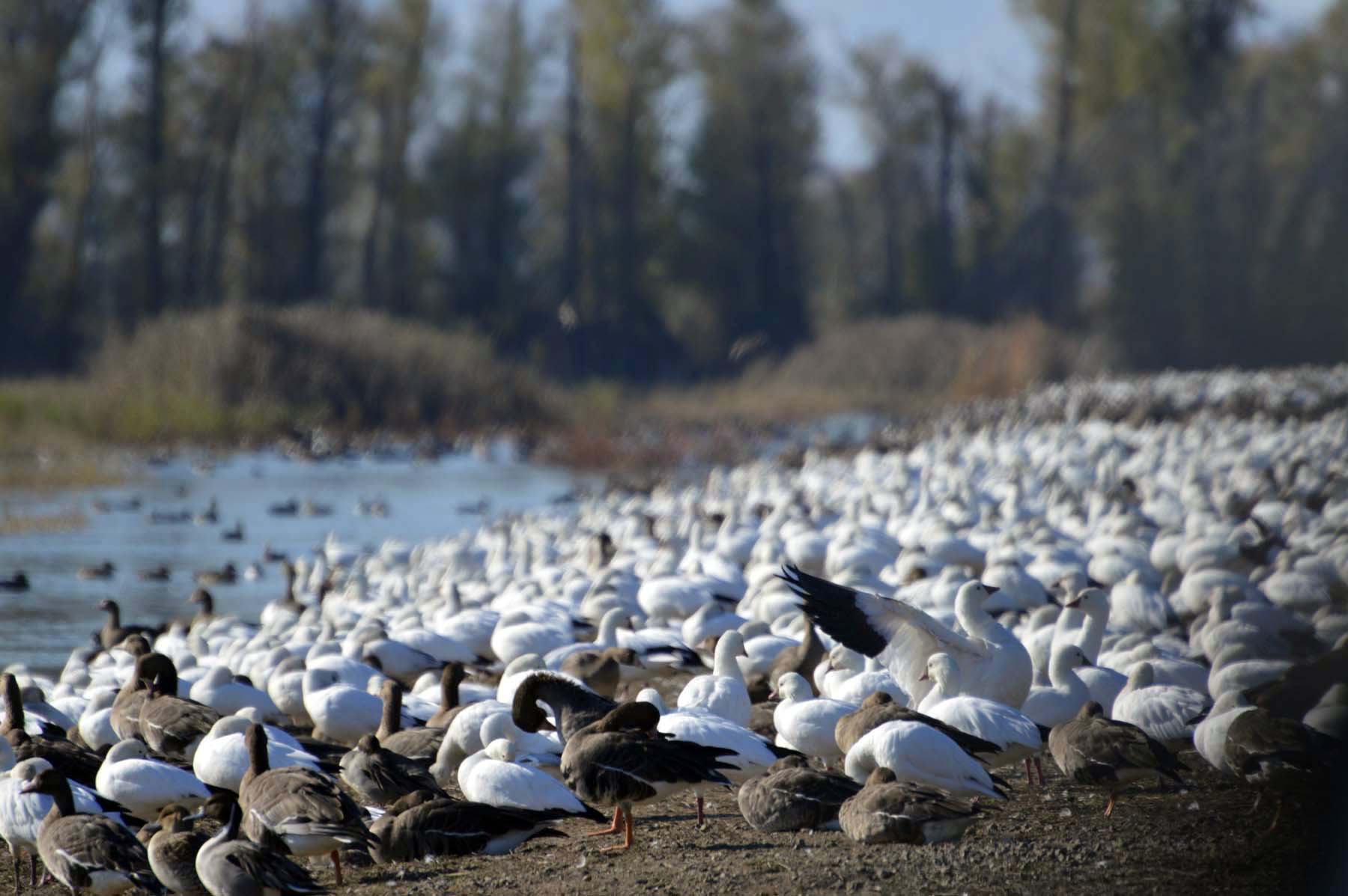
Still awed by all the snow geese I recently encountered. And it was tempting to post Mary Oliver’s Snow Geese poem for its gratitude for unexpected beauty, or Wendell Berry’s Wild Geese with its admonition to recognize the here and now, but you know me. Szymborska hits the spot, every single time. Particularly since she depicts the death of a few unlucky birds, while I try not to think about the deaths of millions of them, saving the dispiriting topic of the bird flu (and its catastrophic implications) for another blog. We’ve had our fill of horrors already earlier this week.

I adore the poet’s sly juxtaposition of instinct and reason, both known to fail. I admire the way she describes the biological features of the birds in all their beauty, linking them to positive traits like patience, honesty and conscientiousness, but also works of art, sculptural finesse worthy of museums.

This is not a dirge — no, it’s only indignation.”

That is the feistiness I want to take into my day, my life, when contemplating mortality or dealing with the “foolish fate” of witnessing erosion of achievements, justice and equality among them, that so many generations fought for. Maybe each single life is a chain of failed attempts, indeed, but lives accumulating across centuries were clearly able to improve the world.

What was this thing about the arc of the moral universe? It’s long, but bends towards justice? If a murdered man could cling to this belief, so can we. We could even muster some sort of hope that the danger of a snowy death upon too early a return is now gone with the arrival of climate change and rising temperatures. Oh well, another “failed attempt” – at gallows humor.

Then again, we could just stick with the poet’s resigned realism. It served her well, all the way to the Nobel Prize.

No, indignation it shall be, not sorrow, indignation hatching action.

In any case. The geese were luminous and loud and basking in the California sun, grey and white geese alike. The light still radiates inside of me, providing needed warmth.

Music today is about another white bird….

Salvia and Szymborska to the Rescue.

One of those weeks. Between the heat and a body with its own intentions I had to cancel all planned outings, miffed and distraught. As luck would have it, a friend sent out a poem that shut me up and set me right. It converts disappointment into the insight that all moments matter. They all contain their very own history, asking us to value what is, not what has been or might come along. We are embedded in a timeline, each moment of its own importance.

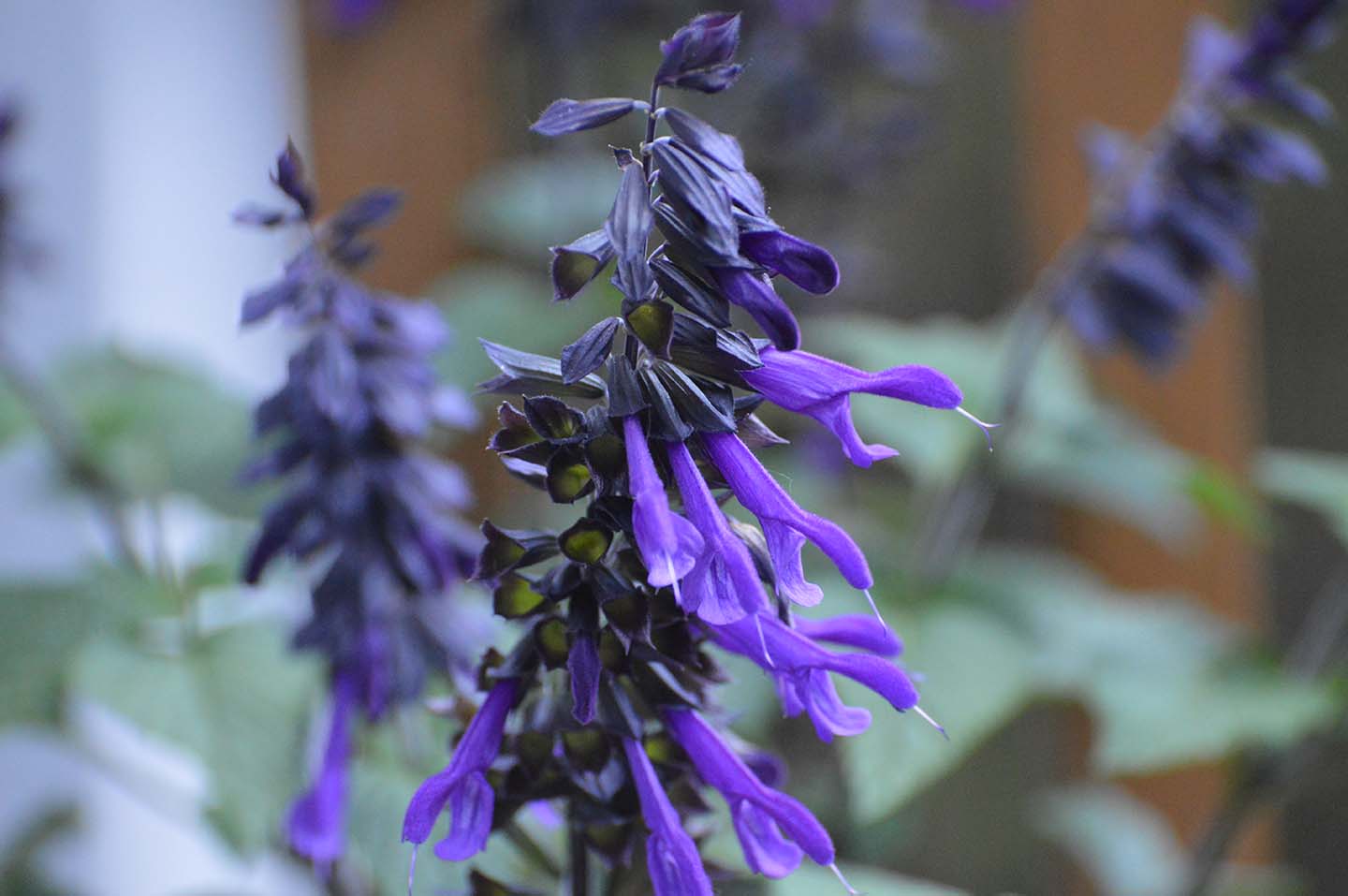
“So it happens that I am and look.” Which is what I did. At a single plant on my balcony, a blue salvia visited by the occasional humming bird, the bees preferring its neighboring lavender and the yellow zinnias (this year’s color scheme in solidarity with Ukraine. Much good it will do, other than reminding me to be a witness. But I digress.)

No Title Required

 It has come to this: I’m sitting under a tree
beside a river
on a sunny morning.
It’s an insignificant event
and won’t go down in history.
It’s not battles and pacts,
where motives are scrutinized,
or noteworthy tyrannicides.
 
And yet I’m sitting by this river, that’s a fact.
And since I’m here
I must have come from somewhere,
and before that
I must have turned up in many other places,
exactly like the conquerors of nations
before setting sail.


Even a passing moment has its fertile past,
its Friday before Saturday,
its May before June.
Its horizons are no less real
than those that a marshal’s field glasses might scan.
 
This tree is a poplar that’s been rooted here for years.
The river is the Raba; it didn’t spring up yesterday.
The path leading through the bushes
wasn’t beaten last week.
The wind had to blow the clouds here
before it could blow them away.
 
And though nothing much is going on nearby,
the world is no poorer in details for that.
It’s just as grounded, just as definite
as when migrating races held it captive.


Conspiracies aren’t the only things shrouded in silence.
Retinues of reasons don’t trail coronations alone.
Anniversaries of revolutions may roll around,
but so do oval pebbles encircling the bay.
 
The tapestry of circumstance is intricate and dense.
Ants stitching in the grass.
The grass sewn into the ground.
The pattern of a wave being needled by a twig.
 
So it happens that I am and look.
Above me a white butterfly is fluttering through the air
on wings that are its alone,
and a shadow skims through my hands
that is none other than itself, no one else’s but its own.
 
When I see such things, I’m no longer sure
that what’s important
is more important than what’s not.

By Wislawa Szymborska
 
From Poems New and Collected 1957-1997

Here is music about a summer garden.

In(ter)dependence

Lots of thoughts about dependency lately. Triggered by general sorrow about the ongoing wars, or specific preoccupation with weather-related problems, never mind an aging body necessitating caution. We are so intensely dependent on the actions and solidarity of others, their help and support, their wisdom, skills, presence and availability in our lives. “Nothing wrong with solidarity, support, wisdom, presence,” you say? I agree – but to depend on it also means to suffer if it isn’t available, and I experience a degree of helplessness just thinking about that scenario which bugs the hell out of me.

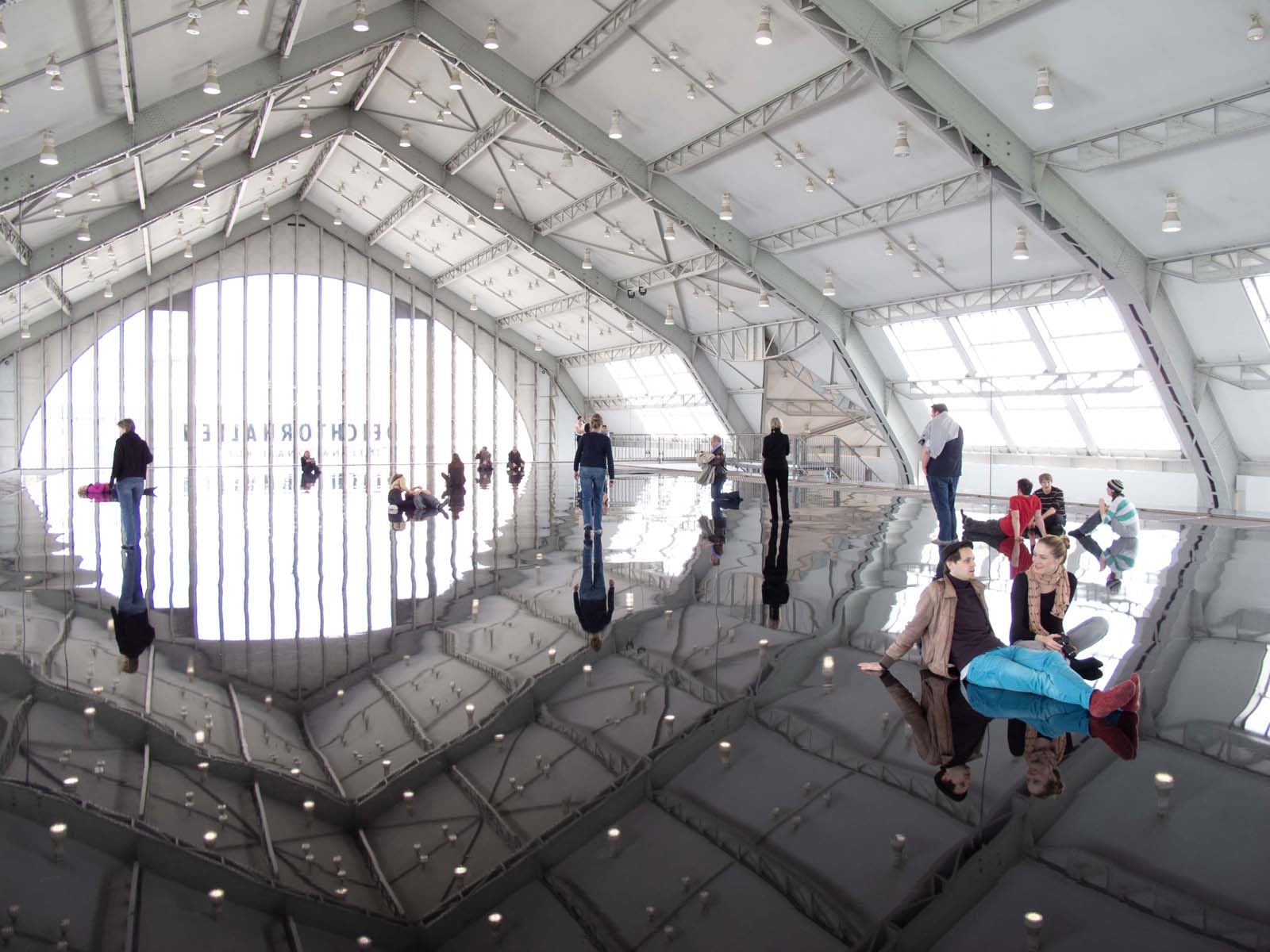
Antony Gormley – Horizon Field Hamburg, 2012, steel, wood, 25 m x 50 m, 60t (thereof 40t steel), 7.40m above hall floor, Deichtorhallen, Hamburg, 2012

Autonomy is shrinking in a world that closes in around you, with threats to your physical safety, most pronounced in war zones, but similarly present with a climate that wrecks havoc on your immediate surround, or age that insists on limitations. I find it most upsetting in regards to freedom of movement – or absence thereof – again in the life and death scenario of incoming bombs preventing relocation, or floods and fires forcing relocation, or a simple ice storm keeping you stuck inside without your daily refueling in nature because you can’t afford to break a bone or two.

Probably not a coincidence that I was drawn back to a poem by one of my favorite poets of all times, a poem that celebrates the independence of the soul (relative even to us, its bodily container), and also of quotidian objects like mirrors that exist and work regardless of anyone’s attention. It drives home several points: independence is desirable and we simply have to accept that we can’t always call the shots – even our own soul might or might not attend to us, depending on its own whims and wishes. But the poem also comforts with the suggestion that there are nonetheless states where gifts – and closeness – are still available. Its speculation of likely interdependence, made in the last lines, somehow softens the burden of dependence.

My favorite stanza, though, is this:

We can count on it
when we’re sure of nothing
and curious about everything.

Since this is my perpetual state, frankly, I cling to Szymborska’s suggestion that soul will be regularly on hand.

A Few Words on the Soul

We have a soul at times.
No one’s got it non-stop,
for keeps.

Day after day,
year after year
may pass without it.

Sometimes
it will settle for awhile
only in childhood’s fears and raptures.
Sometimes only in astonishment
that we are old.

It rarely lends a hand
in uphill tasks,
like moving furniture,
or lifting luggage,
or going miles in shoes that pinch.

It usually steps out
whenever meat needs chopping
or forms have to be filled.

For every thousand conversations
it participates in one,
if even that,
since it prefers silence.

Just when our body goes from ache to pain,
it slips off-duty.

It’s picky:
it doesn’t like seeing us in crowds,
our hustling for a dubious advantage
and creaky machinations make it sick.

Joy and sorrow
aren’t two different feelings for it.
It attends us
only when the two are joined.

We can count on it
when we’re sure of nothing
and curious about everything.

Among the material objects
it favors clocks with pendulums
and mirrors, which keep on working
even when no one is looking.

It won’t say where it comes from
or when it’s taking off again,
though it’s clearly expecting such questions.

We need it
but apparently
it needs us
for some reason too.

by Wislawa Szymborska

­ —Translated by Clare Cavanagh and Stanisław Baranczak

If the soul is an independent agent leaving us soulless for years at a time, it is interesting that we are nonetheless so committed to pave the way for its escape – think of the customs so prevalent in many cultures to shroud mirrors in the house after a death occurred, for fear the soul might be trapped in one. Souls and mirrors have a long history of connection in mythology and literature (as does death and mirrors, come to think of it. Break a mirror: 7 years of misfortune, likely leading to death! Make a mirror: death guaranteed at a young age, as it turns out. Fabrication of this luxury item involved the use of noxious substances, quicksilver included, until very recently, establishing an average life expectancy of but 30 years for the members of the guilds in Italy and France that produced mirrors as well as glass ware.)

The largest mirror I ever saw was an installation in a huge former market hall in my hometown of Hamburg, Germany, as part of the Documenta in 2012. Called Horizon Field, it was one of sculptor Antony Gormley‘s ongoing explorations of the interdependence of humans and their environments, both regarding their spontaneous interactions, or their effects on each other.

Imagine 3800 square meters of empty hall with a platform suspended from the ceiling, about 25 feet above you in the air. Made of 40 tons of steel, it took a full month to install.

The whole thing was 82 feet wide and 164 feet long, dark as night from below, and coated with a silver mirror on top, reflecting the flood of light coming in from the arched glass windows. A single person walking across it (you had to stash your shoes at the bottom of the stair case, guards making sure of it) could make the thing vibrate.

It was fascinating to watch how visitors were preoccupied with their own mirror images laid out underneath them, rather than exploring the strange doubling of architectural features of an industrial building that had played historically a huge role in the enrichment of the Hanseatic economy. Built between 1911 and 1914, the hall is one of the few surviving examples of industrial architecture from the transitional period between Art Nouveau and 20th century design.

It was also a perplexing sight to see a large proportion of the visitors now in their socks, slipping and sliding with child-like amusement, centered on their proprioceptive senses once done with visual self-admiration. It was somewhat challenging to photograph it all given the swinging of the platform, and a slight queasiness induced by the oscillations. But staying underneath, in relative darkness, was not the best option either, wondering, with the mind of a skeptic, if and when that thing would come crashing down. Too many associations with the impending doom signaled by breaking mirrors….

Well, I was free to move, then, and walked off to wander the streets still familiar to me. No bombs or ice storms keeping me from it – unclear, however, if in company of soul.

Music today is by Arvo Pärt, his 1977 Tabula Rasa (and not Spiegel im Spiegel as one might have predicted.) I just love those meditations, and they fit the travels of the soul as well.

This Sleepy Backwater

Housekeeping first: I am taking part of next week off from the blog, need to spend some time photographing, something that has gotten short shrift over all the writing.

***

I had to laugh at this headline found yesterday in an article in VOX:

“Especially the “if true” part” – UFOs, dead alien pilots, reverse engineering, secret government programs… the rumor mill is at it again, this time through a whistle blower, a former government official named David Grusch, who has worked in the National Geospatial-Intelligence Agency and the National Reconnaissance Office, who gave public testimony before a House of Representatives committee Wednesday.

No evidence provided, just more talk of hear-say. But what I find interesting is this eternal preoccupation with a world “out there,” instead of saving the one we’re currently wrecking, or at least loving it for what it is. I have written about the psychological function of alien narratives previously. Today I will just turn to the tried and true, a poet with whose views I agree more often than not, and whose remarkable ways of getting a point across with seeming ease belying masterful construction always puts me in awe.

She is content enough with our sleepy backwater…

The Ball

As long as nothing can be known for sure
(no signals have been picked up yet),
as long as Earth is still unlike
the nearer and more distant planets,

as long as there’s neither hide nor hair
of other grasses graced by other winds,
of other treetops bearing other crowns,
other animals as well-grounded as our own,

as long as only the local echo
has been known to speak in syllables,

as long as we still haven’t heard word
of better or worse mozarts,
platos, edisons somewhere,

as long as our inhuman crimes
are still committed only between humans,

as long as our kindness
is still incomparable,
peerless even in its imperfection,

as long as our heads packed with illusions
still pass for the only heads so packed,

as long as the roofs of our mouths alone
still raise voices to high heavens —

let’s act like very special guests of honor
at the district-firemen’s ball
dance to the beat of the local oompah band,
and pretend that it’s the ball
to end all balls.

I can’t speak for others —
for me this is
misery and happiness enough:

just this sleepy backwater
where even the stars have time to burn
while winking at us
unintentionally.

by Wislawa Szymborska

translated by S. Baranczak and C. Cavanagh

from View with a Grain of Sand: Selected Poems, by Wislawa Szymborska

Photographs today are of some of the more alien looking flora I’ve come across this year in this sleepy backwater. Wish it would stay sleepy and not burn up….

Here is a track – Of Beauty – from Gustav Mahler’s Das Lied von der Erde (THE SONG OF THE EARTH). Beautiful music about a beautiful world.


What are the Chances?

“What are the chances…” was the beginning of a sentence that cropped up with astonishing frequency this week.

What are the chances, seriously, that more people voted for Walker than the Rev. Warnock?” was me fretting half-way through the evening when election statistics had the former ahead of the latter for a short amount of time. Still in disbelief after all these years in this country that it could even come close. The good guy won, eventually, but the margins were too close for comfort.

***

What are the chances that Sinema leaves the Democratic Party before Manchin?” High, it turns out. Her voting behavior cost us higher minimum wage, extended child tax credits, and voting rights protections. Seems there is little variability in her moral compass – it’s stuck on amoral.

***

What are the chances, that I would find myself in any way connected to one of the right wing extremists arrested in Germany during a nationwide raid this week?” Low, really an outlier. 25 people (with more assumed to be associated) are accused of plotting a coup to overthrow the state with armed attacks, former members of congress and military and ex-military para-trooper members among them. Many are now in pre-trial detention, suspected of forming a terrorist organization. The defendants are closely linked with the Reichsbürger movement, who believe that the 1871 borders of the German empire are still in effect, tend to be far-right extremist, do not accept the legality of the Federal Republic of Germany, and, according to the prosecutor, “followed a conglomerate of conspiracy myths consisting of narratives of the so-called ‘Reichsbürger’ as well as QAnon ideology.”

New “head of state” was supposed to be Heinrich VIII Prince Reuss, a 71 year-old of aristocratic lineage, and one of the purported ring leaders. Here’s where six degrees of separation makes an appearance, however: as an 18-year old I was invited to visit a branch of the Reuss family for Easter. For the life of me, I can’t remember why I scored the invitation or why I accepted it (certainly no romantic involvement) from Heinrich IX Prince Reuss (must have been a cousin), they all get the same name, just numbered in succession…

We drove south in a car from Hamburg to his parents’ castle (literally) near Frankfurt. Arriving too late for dinner, we were led to our rooms. I appeared, starving, the next morning, Good Friday, in the breakfast hall. The horror! I was not dressed head-to-toe in black, mourning garb required for this Holy Day, apparently, in arch-conservative households. Back to your room, have the maid rummage for a fitting outfit! Well, it was off to a train station for me.

***

What are the chances“, I thought, when following the complicated Supreme Court hearings about the Independent State Legislative (ISL) theory on Wednesday, “that I’ll be able to write about that in ways that get the legal details and importance of the Moore vs Harper case across?” Slim, as it turns out, even with the example of an iceberg….

In a nutshell, the case is about extreme gerrymandering, the possibilities (or not) of stopping excesses, and, more generally, the power of state courts and/or legislative bodies to shape aspects of federal elections. SCOTUS heard plaintiffs’ arguments that under the Elections Clause of the U.S. Constitution, state legislatures retain exclusive power over federal redistricting and election rules, while state constitutions, state courts, governors, or voter-approved ballot measures have no power to check, balance or even review those laws. Yup. -. It is, as legal observer and author Elie Mystal pointed out, all about trying to take power away from non-partisan state actors and putting it solely into the hands of partisan state actors.

That’s as far as I can go – the rest of the arguments, delivered in detail, clarity and with focus on the implications to what remains of our democracy, can be found in VOX, the Atlantic, Mother Jones, the NYT, and the National Review. Take your pick – any one but the last helped my understanding of the matter.

And since we’ve landed on the topic of relative probabilities, we might as well end the week with my favorite poem about Statistics. Chances are, you’ll like it, on average.

A Word on Statistics

Out of every hundred people, those who always know better: fifty-two.

Unsure of every step: almost all the rest.

Ready to help,
if it doesn’t take long: forty-nine.

Always good,
because they cannot be otherwise: four — well, maybe five.

Able to admire without envy: eighteen.

Led to error
by youth (which passes): sixty, plus or minus.

Those not to be messed with: four-and-forty.

Living in constant fear
of someone or something: seventy-seven.

Capable of happiness: twenty-some-odd at most.

Harmless alone,
turning savage in crowds: more than half, for sure.

Cruel
when forced by circumstances: it’s better not to know,
not even approximately.

Wise in hindsight: not many more
than wise in foresight.

Getting nothing out of life except things: thirty
(though I would like to be wrong).

Balled up in pain
and without a flashlight in the dark: eighty-three, sooner or later.

Those who are just: quite a few, thirty-five.

But if it takes effort to understand: three.

Worthy of empathy: ninety-nine.

Mortal:
one hundred out of one hundred — a figure that has never varied yet.

BY WISŁAWA SZYMBORSKA  from Miracle Fair. Translated by Joanna Trzeciak.

***

Photos today from Frankfurt and environs, in honor of another weird episode in the life of Heuer, filed under Frequency Distribution.

Statistics? No Problem. (Sorry for the annoying ads interrupting today’s music, could not find an alternative.)

Chances that this photograph relates to today’s text? Nil. I just love it, the matching colors, the symmetry and patterns of vertical lines, the contrast of work boots and fur jacket, this stranger’s strutting towards the center of the gate posts in completely empty space. It happened to be shot near Frankfurt.

Discovery

Discovery

I believe in the great discovery.
I believe in the man who will make the discovery.
I believe in the fear of the man who will make the
…. discovery.

I believe in his face going white,
his queasiness, his upper lip drenched in cold sweat.

I believe in the burning of his notes,
burning them into ashes,
burning them to the last scrap.

I believe in the scattering of numbers,
scattering them without regret.

I believe in the man’s haste,
in the precision of his movements,
in his free will.

I believe in the shattering of tablets,
the pouring out of liquids,
the extinguishing of rays.

I am convinced this will end well,
that it will not be too late,
that it will take place without witnesses.

I’m sure no one will find out what happened,
not the wife, not the wall,
not even the bird that might squeal in its song.

I believe in the refusal to take part.
I believe in the ruined career.
I believe in the wasted years of work.
I believe in the secret taken to the grave.

These words soar for me beyond all rules
without seeking support from actual examples.
My faith is strong, blind, and without foundation.

by Wistlawa Szymborska
from 
View With a Grain of Sand
Harcourt Brace 1993

translation: Stanislaw Baranczak and Clare Cavanagh

I wonder if this poem seeded the idea of a book, a remarkable book that looks at the consequences – intended and unintended- of scientific discoveries. Benjamin Labatut’s When We Cease To Understand The World is a small volume describing mathematical and scientific research, ruminating about the psychological states of those engaged in the work, and weaving fact and fiction in ways that meander between horror story and lyric poetry.

The last time I felt like this when reading a novel grounded in history, was decades ago when I couldn’t put Pat Barker’s Regeneration trilogy down, never mind babies screaming for attention, house wanting to be cleaned, lectures needing to be written and exams to be graded. Both authors share the skill of sending readers on two parallel paths, leaving it to us to drop and pick up the strands where truth ends and imagination begins, where facts are overshadowed by psychological analysis or feelings discarded in the light of facts. Both also excel in alternations of intensity and subtlety, in itself a weird combination.

Barker succeeds in sustaining our attention to history, social structures, identity (before that became a political concept) across three complex volumes, never letting up tangential brilliant confabulation,. She thinly veils her portraits of historical people behind pseudonyms and graphically imparting on us the horrors of World War I and what they did to the soul of artists.

Labatut, in contrast, keeps it short – perhaps aware of contemporary attention spans. His subjects are famous scientists, although the pages are sprinkled with some names less familiar, and some characters are completely made up. He has a knack to impart scientific facts in ways that do not frighten even the math- or physics-phobic reader, partly because the narrative swings endlessly back to the human interest story at the heart of the tales – how do you accept the fact that your discovery brings suffering and ruin to the world? Do you continue to proceed?

Both authors do not shy away from delving into details of horrors, yet the texts themselves have a certain serenity as if we are watching our own history unfold from the safe location of a distant star. That in itself is, of course, a trick, since it indirectly suggests that our own responsibilities need not be considered when focused on those who wreaked the actual havoc, or do they? The wishful thinking of Szymborska’s lines (admitted to be without justification in fact,) should it not be headed by us, in the ways we should be willing to obstruct, to risk, to endanger our standing by unpopular but necessary actions?

Szymborska’s “I believe in the refusal to take part” is less wish than command. One that is faintly echoed in the last chapter of Labatut’s work which introduces us to a night gardener, a former mathematician who has given up on the world, too clear-eyed about the catastrophes awaiting us, in a society that uses the principles of quantum mechanics without ever truly understanding them. The very last parable of the book describes the final demise of lemon trees cut down by their own excess riches. It somehow all came together, and I felt humbled by it.

Szymborska, again, sarcastically:

“I am convinced this will end well,
that it will not be too late,”

How many more reminders do we need by brilliant writers that clinging to this belief simply won’t do?

On a more upbeat note, here is a fun compilation of unintended, positive consequences of scientific discoveries.

Music today by Bartok who was enchanted with mathematical principles and symmetry, particularly the Golden Mean. The ratio appears in this piece. Give it a chance, it grows on you.

Hunger

When I was young and impressionable I had to read a book titled Hunger by Knut Hamsun. Why they would serve us literary fare by a Norwegian Nazi remains a mystery. Maybe my German high school teacher was as enamored by the Nobel Prize author as were many others, more famous people: Maxim Gorky, Thomas Mann, and Isaac Bashevis Singer. The book explores the psychological decline of a pretty asocial character who is driven almost mad by hunger, but as a consequence of refusing available food, fully in line with Hamsun’s celebration of individualism and freedom to choose. In the end the protagonist escapes his woes by hiring on to a ship and sail the seas, being fed, presumably, three meals a day. It felt odd, even to a 15-year old, that hunger was not presented as an inescapable scourge for the many who lack access to food, but as a choice. Some of my thoughts on the issue of food insecurity you’ve read in earlier blogs.

Decades later, I came across this:

Hunger Camp at Jaslo

by Wislawa Szymborska

Write it. Write. In ordinary ink 
on ordinary paper: they were given no food, 
they all died of hunger. “All. How many? 
It’s a big meadow. How much grass 
for each one?” Write: I don’t know. 
History counts its skeletons in round numbers. 
A thousand and one remains a thousand, 
as though the one had never existed: 
an imaginary embryo, an empty cradle, 
an ABC never read, 
air that laughs, cries, grows, 
emptiness running down steps toward the garden, 
nobody’s place in the line. 

We stand in the meadow where it became flesh, 
and the meadow is silent as a false witness. 
Sunny. Green. Nearby, a forest 
with wood for chewing and water under the bark- 
every day a full ration of the view 
until you go blind. Overhead, a bird- 
the shadow of its life-giving wings 
brushed their lips. Their jaws opened. 
Teeth clacked against teeth. 
At night, the sickle moon shone in the sky 
and reaped wheat for their bread. 
Hands came floating from blackened icons, 
empty cups in their fingers. 
On a spit of barbed wire, 
a man was turning. 
They sang with their mouths full of earth. 
“A lovely song of how war strikes straight 
at the heart.” Write: how silent. 
“Yes.” 

Translated by Grazyna Drabik and Austin Flint 

I know, it’s the week of Christmas. Visions of food associated with the occasion, pungent smells permeating houses, meals shared with loved ones, unusual things like goose or carp (if you are German,) gingerbread and Stollen (a baked Marzipani concoction of about a million calories per slice,) all mouthwatering and sweet. Now why do I have to ruin that by reminding us of hunger as a weapon, an instrument of torture, a tool of extermination? Yes, a whole region of Jews were killed by being driven into a corral near the town of Jaslo and refused food and water. Can’t we let the past rest, at least during this week of celebration?

I would, if it were only the past. Just as Szymborska exhorts us to keep the memory alive – Write it. Write. – I cannot but say it, say: we are faced with hunger by design, here and now, in our American Prison system. There a few who bear witness. Last week this singular report was published by the ACLU of Southern California in cooperation with various other organizations. It “combines testimonies from people who were incarcerated in the Orange County jails during the pandemic with public records. Nutrition facts, menu items, and budget information gathered from the Orange County Sheriff’s Department through Public Records Act request.”

For almost two years now the thousands of inmates in this system have not had a hot meal. The three meals they get are mostly inedible sack lunches that contain moldy bread, spoiled slices of meat, and an occasional apple or orange. It is not enough food, particularly if you cannot eat it if it’s rotting, and it is so unhealthy that food-related illnesses have skyrocketed. Food poisoning from the spoiled food is one thing; the high sodium and carbohydrate contents have increased heart disease, diabetes-related problems, and circulatory system illness.

The situation has gotten so bad, that even the Board of State and Community Corrections asked the jails to add hot meals after their inspection revealed the horror of the situation. What happened? Hot cereal was added to breakfast, but soon after refused again. Soup was added to dinner (high-sodium broth with floating onion and tomatoes to be found with a magnifying glass.) However, the soup was put on the floor in front of the cells, often only accessible after an hour when it had become cold and by now detected by bugs that live in the shadows of the prison hallways, equally desperate to improve their food intake.

Kitchen closures where justified with Covid-19. The closures saved a good amount of money to the prison system, none of which has been re-invested into better nutrition for the inmates. In addition, the system has made a significant amount of revenue on items that incarcerated people can purchase through commissary (some $10.000.000 a year.) That kind of food might be more edible than bug-infested soup, but it is also not healthy, like most items that come out of dispenser. Medical and religious diets have been denied due to Covid restrictions, or so it is claimed.

“If a budget recipient spends less than its predicted budget, the surplus rolls over or goes towards other department expenses. That means that when OCSD receives a budget for food services and ultimately spends less than was budgeted, the remainder rolls over and can be used for other expenses like staff salaries. That is what happened when OCSD shut down the hot kitchens.”

These are the numbers that show the development during the Covid years, all on the backs of the inmates.

I”n 2018, OCSD rolled over just $72,000 from the food budget to use on other OCSD expenses; in 2019, OCSD rolled over $90,000. In 2020, after OCSD stopped serving hot food, they rolled over $963,013. In 2021, OCSD is on track to rollover $656,472.”

You can find all the details and art work and experiential testimony by the inmates in the report. Images today were created by the prisoners.

I do not know if the situation is any different in Oregon. But I do feel that we are ignorant of all of it unless we happen to have our noses pushed into it. Without knowing, of course, there will be no memory, no transmission of the horrors of one’s times to future generations as a warning. And poets will have to dig up a past that we failed to change in our present. Spread the word, if you can. The link to the report, again, is here.
Music by Bob Marley.