“Art must be an integral part of the struggle. It can’t simply mirror what’s taking place. It must adapt itself to human needs. It must ally itself with the forces of liberation. The fact is, artists have always been propagandists. I have no use for artists who try to divorce themselves from the struggle.”
–Charles White in Jeffrey Elliot, “Charles White: Portrait of an Artist,” Negro History Bulletin 41, no. 3
Part of this quote greets you when you visit MoMa’s artist page for Charles White. I had tried to figure out which visual artists managed to do the impossible: find ways to depict how to pursue change, as a society, as a nation, as individuals, rather than reminding us of the existing woes. Painting historical events is an indirect way of doing so. Those works show us the injustice, or the suffering, or the might of those who rule, potentially appealing to our conscience or raising our consciousness, or both. Important and valuable. But how do you show the way forwards? White seemed an appropriate starting point. One of his early lithographs suggested to us that hope is possible, and a motivating factor, some 20 years before the Civil Rights Movement brought some change. (And some 60 years before that change is on its way to be reversed…)
Charles White Hope for the Future 1945
If I look at the image, Hope is not the first thing that comes to mind. A dead tree with a noose hung from it, a baby in medium distress, walls closing in with wooden isolation. Yet there are those huge maternal hands, offering strength and protection. They are also notably angular, square. Squarely: in a direct and uncompromising manner; without equivocation, tells me the Oxford Dictionary. These hands are placing blame squarely on racism.
What about the face, though. Do you see hope there? Maybe the shape of the waning moon on her forehead, signaling a hope for he decline of racism? The expression itself struck me as, frankly, angry. And since I still haven’t figured out the answer to my question of how art should depict progressive utopias or the ways to get there, let’s turn to the depiction of anger in women instead. (You know me, thoughts jump around.) Female anger is not exactly a ubiquitous topic in centuries of painting, but one that at least spoke of disruption of rules, since the display of anger was historically considered unfeminine. Verboten, really.
Anger is a somewhat under-researched topic in my field. We define it as an emotion characterized by antagonism toward someone or something you feel has deliberately done you wrong. Psychologists are more concerned with aggression or other hurtful behaviors, which is separate from anger, although the latter can lead to the former. Just ask yourself, how often are you angry without aggressive behavior? But also, has anger ever morphed into a somewhat violent act? My guess is the former happens often, the latter rarely for most of us, though it does on occasion. If it happens all the time, then you have a problem.
Giotto L’Ira 1306 (Fresco)
Excessive anger has physiological consequences that harm you, including increased blood pressure that damages the heart, and it interferes with decision making, often leading to long lasting consequences. And of course violent outbursts can and will harm others.
On the positive side, non-violent anger can be an extremely motivating factor to find solutions to the perceived problems and initiate change. It also influences the way you approach or evaluate something or someone. If you are unwittingly cued by angry faces in association with something, you value that something, any given object, more. When you show pictures of angry men, rather than sad ones, they elicit more support. Men who display anger rather than sadness in negotiations are more successful in their demands – people yield to someone perceived to be dominant. (Ref.)
All of this is not true for women, even though they are cross-culturally shown to experience equivalent amounts of anger, both in frequency and intensity, compared to men, clearly a biologically built-in emotion. Anger conforms to display rules – the norms of a given culture what can or should be publicly shown – and women, in almost all cultures, do not act on their anger as men do. Importantly, they also are not perceived more positively when displaying their anger, in fact the opposite is true. Most modern psychologists subscribe to a bio-sociocultural interactive model to explain this fact. There might be biological gender differences that allow women to curb their angry outbursts to begin with – the orbital frontal cortex, which is involved in controlling aggressive impulses, is much larger in women. Good thing, too, given that women would easily be harmed by the physiologically stronger males, if they attack them. All kinds of evolutionary explanations have been offered. (For details on biological differences, here is an in-depth review.)
It is always hazardous to indulge in evolutionary story telling, though. For example, it seems entirely plausible, that, over evolutionary time, mothers who were particularly nurturing might have had greater reproductive process; therefor nurturing, not anger, would be favored by evolution. But it is equally plausible, that, over the years of evolution, mothers who were particularly ferocious in protecting their young would have had an evolutionary advantage. This contrasts highlights why many scientists, with a nod to Rudyard Kipling, refer to these evolutionary notions as “Just so stories.”
And speaking of angry mothers: one is Medea, about to murder her children out of rage over her unfaithful husband… note, how we are not even allowed to see her face frontally, and the presumably glaring eyes in particular are even further recessed into shade.
200 years earlier we see a raging Judith, slaying Holofernes, the general of Nebuchadnezzar’s army threatening Judith’s people. Two versions, one by a man, one by a woman painter, see for yourself who is actually expressly raging, spurting blood on her chest. These are of course depictions of a biblical story, so viewers can be amenable to be reminded of the tale.
Caravaggio Judith Beheading Holofernes c. 1598–1599 or 1602
A different approach is to serve culturally-based display demands by orienting the viewer to the (invisible) victim of a woman’s anger: the poor man.
Carl Dornbecher Poor man, 1919
Just a few years earlier, the intensely weird, academicist painting below was meant as a commentary on the new medium of photography, seen by the painter as a positive development: “It has opened our eyes and forced us to see that which previously we have not seen.” Riffing off Democritus’s aphorism: “Of truth we know nothing, for truth is in a well,” this fury appears with a whip instead of the usual mirror in her hand, revealing the “naked” truth all right. (I fear I’ll never be able to photograph that, even if I was inclined to capture aphorisms…)
Jean Léon Gérôme, Truth Coming Out of Her Well to Shame Mankind, 1896
One last, contemporary offering from the sparse menu of angry women in art: Pipilotti Rist’s still from a video of a woman unhesitatingly smashing car windows, extremely feminine in her red pumps, fluttery summer dress and make-up.
Pipilotti Rist Ever is Over All (still), 1997
Here is the video where she is actually smiling and bouncing along. A total disconnect between displayed emotion and enacted behavior, as if even during the outburst you still have to keep that grin on your face. The best part: a police woman walks by, smiles back and salutes her. Worth a few minutes of your time, if only for the sound track!
Of course we all know, if this had been the black child from Charles White’s litho in the beginning, the story would have a different ending. Hope for the future? You tell me where to go from here.
Angry, but beautiful music by Bartok today. In addition to Bela Bartok there is a bonus Schnittke…
Walk with me, in the wetlands around the Tualatin River, during almost 90 degrees at 10 am on a quiet Sunday morning. That was before we had 104 degrees. Wetlands? Dry lands, with a bit of water now shared by creatures in close proximity.
Some still have the energy to show off in front of a mate.
Much of the water is covered by a carpet of duck grits, or algae, enough to reflect the shadows of adjacent vegetation, greeting you with the most saturated chartreuse imaginable.
A lot of plant life is dry, on verge of crumbling, leaves, grasses, a wistful beauty.
Birds still out to find that morsel, before the full heat of the day. A Cedar waxwing, a brown creeper, perfectly camouflaged and an osprey showing off above me, flying from his perch directly to the space above me, so I get some footage even with the small camera, since I couldn’t schlepp the large lens in the heat.
Yet the views I was most enthusiastic about were the thistles. At this time of year you have all stages visible at once, still some blossoms, some flowers, and then all going to seed. The ground is carpeted with the fluff. It flies in the air, like little ghosts swarming the fields. It shimmers silvery, I believe gossamer is the word, something delicately spun, not by spiders, but by the plants that use air currents and weightlessness to propel their offspring to new worlds where they can settle and sprout. The next cycle begins.
In German I would say: “sie begeistern mich,” a word indicating an enthusiastic approach to something or someone. Literally translated it means, they fill me with ghost(s), but it is used in the sense of something touching your soul, or activating joy. Incidentally, you could also say “ich schwärme four see,” I adore them. The term literally means to swarm, like bees forming a swarm or swarming out – just like these seed fluffs do. The medieval usage turned from the verb associated with insects to one describing the ways of religious sects, deviating from the pre-determined church requirements to think along traditional paths and becoming free thinkers instead, around the 16th century. In the literary developments of the 18th century, the term became a commonplace for all kinds of wild enthusiasm and phantasmic thinking.
Why do I bore you with the etymology of German words? For one, because it is quite similar for English, when you look at the roots for the word enthusiasm. The original meaning had to do with religion, transferred from the Greek enthousiasmós, from enthousiázein “to be inspired or possessed by a god,” around the 17th century. Secondly, because I have been wondering what it means to be strongly, enthusiastically preoccupied with, in my case secular, matters all the time and expressing those feelings with abandon. Since childhood, really, I was easily excited about so many things, adored them, absorbing them as well as treating them with enthusiasm. Does that make you less critical? Impede judgment? Is it going to be interpreted differently by others, because I am a woman, seen as overly emotional rather than in possession of a trait that has components of both, affect and cognition?
As it turns out enthusiasm predicts satisfaction in life and positive relationships. If you’re up for it, here is an extensive but well written review of what we know about the cumulative effects of experience, interpretation, and regulation of positive stimuli and emotions that ultimately lead to the experience of happiness, life satisfaction, and wellbeing. The paper gives an overview of how wellbeing and happiness were defined across the centuries and how contemporary psychology is now looking at the underlying physiological processes that are at work – or that are missing. “Experiencing positive emotions (likeenthusiasm) benefits psychological and physical wellbeing in numerous, intersecting ways, including modulating neurophysiological correlates within the central and peripheral nervous systems.”
So there. I enthusiastically photograph thistles, marveling at their beauty. I also enthusiastically welcome the latest news out of a courthouse in Georgia. I enthusiastically watch the video clips of a grandchild learning to crawl. I enthusiastically count the hours until the thermometer lands on something under 90 degrees. (Luckily I can count that high. Turns out, enthusiasm is also a prime motivator for learning, so having had that in my tool kit for various forays into schooling was not a bad thing.)
Then again, I unenthusiastically read what Merriam-Webster had as an example for the use of the word enthusiasm on their website:
The criminal charges appear to have done little to dampen Republican voters’ enthusiasm for Trump, who remains the leading candidate for his party’s 2024 nomination for president.—The Salt Lake Tribune, 8 Aug. 2023
Let’s enthusiastically hope that on this August 16th things have changed! (Fat chance.)
And here is a passionate piece of music. Hard to believe it was composed during WW I, in 1916.
Housekeeping first: I am taking part of next week off from the blog, need to spend some time photographing, something that has gotten short shrift over all the writing.
***
I had to laugh at this headline found yesterday in an article in VOX:
“Especially the “if true” part” – UFOs, dead alien pilots, reverse engineering, secret government programs… the rumor mill is at it again, this time through a whistle blower, a former government official named David Grusch, who has worked in the National Geospatial-Intelligence Agency and the National Reconnaissance Office, who gave public testimony before a House of Representatives committee Wednesday.
No evidence provided, just more talk of hear-say. But what I find interesting is this eternal preoccupation with a world “out there,” instead of saving the one we’re currently wrecking, or at least loving it for what it is. I have written about the psychological function of alien narratives previously. Today I will just turn to the tried and true, a poet with whose views I agree more often than not, and whose remarkable ways of getting a point across with seeming ease belying masterful construction always puts me in awe.
She is content enough with our sleepy backwater…
The Ball
As long as nothing can be known for sure (no signals have been picked up yet), as long as Earth is still unlike the nearer and more distant planets,
as long as there’s neither hide nor hair of other grasses graced by other winds, of other treetops bearing other crowns, other animals as well-grounded as our own,
as long as only the local echo has been known to speak in syllables,
as long as we still haven’t heard word of better or worse mozarts, platos, edisons somewhere,
as long as our inhuman crimes are still committed only between humans,
as long as our kindness is still incomparable, peerless even in its imperfection,
as long as our heads packed with illusions still pass for the only heads so packed,
as long as the roofs of our mouths alone still raise voices to high heavens —
let’s act like very special guests of honor at the district-firemen’s ball dance to the beat of the local oompah band, and pretend that it’s the ball to end all balls.
I can’t speak for others — for me this is misery and happiness enough:
just this sleepy backwater where even the stars have time to burn while winking at us unintentionally.
Photographs today are of some of the more alien looking flora I’ve come across this year in this sleepy backwater. Wish it would stay sleepy and not burn up….
Here is a track – Of Beauty – from Gustav Mahler’s Das Lied von der Erde (THE SONG OF THE EARTH). Beautiful music about a beautiful world.
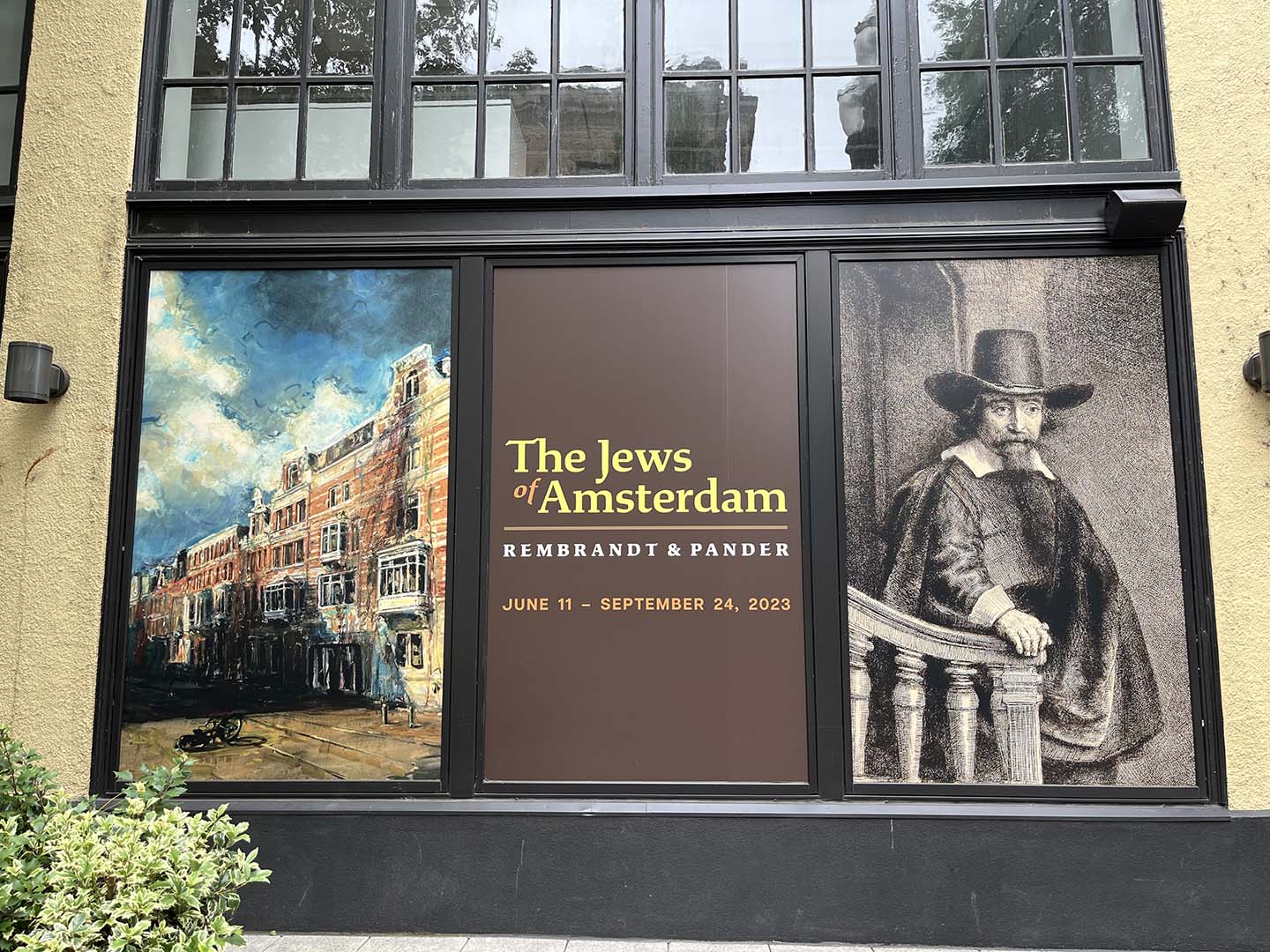
IT SEEMS TO BE the rule these days: every time I visit a new exhibition at the Oregon Jewish Museum and Center for Holocaust Education (OJMCHE,) my brain picks up speed and my heart gets either heavier or lighter, depending on what’s on display. The most recent visit changed my mind as well. Last month I had declined to review the opening exhibitions in celebration of OMCHE’s expansion and addition of a new permanent gallery dedicated to Human Rights after the Holocaust. I did not want to mingle with crowds, which I very much hoped would be there to honor the museum’s continuing growth. I was spoon-fed on Rembrandt as a child and was not sure I needed to see yet another etching of biblical lore in my life time. And, most importantly, the recent loss of Henk Pander, a close friend, still felt raw. I had written an in-depth review of his penultimate exhibition, The Ordeal, while he was still with us and was not sure if I had anything more to add.
Well, here I am, reviewing after all. The exhibitions were just too interesting and raised important questions while I walked through a thoughtfully curated show during an afternoon when the galleries were empty, trying to put a lid on my unease. Taking in The Jews of Amsterdam, Rembrandt and Pander, as well as But a Dream, Salvador Dalí, turned out to be a challenge on multiple levels, if a rewarding one. That’s what good museums do, right? Make you think and feel and learn, even when some of the topics are difficult to deal with, as has been the case for the majority of the exhibitions I have reviewed for OJMCHE over the last years.
Want to stick with me then, while I’m thinking out loud? (Alternatively, here is a detailed OR ArtsWatch review of the museum re-opening, including Bob Hick’s conversations with museum director Judy Margles explaining some of the choices made, and Bruce Guenther who brought his perceptive touch once again to the selection and arrangement of exhibits.)
Let’s start with the Dalí. It was a bit surreal to enter an exhibition of 25 works, “Aliyah, the Rebirth of Israel,” commissioned by Shorewood Publishers in 1966 for the 20th anniversary of the founding of the State of Israel and mounted in observance of the state’s 75th birthday, when I had read just hours earlier a statement by former Israeli Prime Minister and decorated military officer Ehud Barak in Haaretz: “The moment of truth is upon us. This is the most severe crisis in the history of the state. … with the upcoming vote… we are hours away from a dictatorship.”
Aliyah literally means ascent, but has been the term used for the return of Jewish people to a land they claim their own. Seeing the internal divisions, violent protests, an increasingly desperate fight for democracy and a country accused by B’Tselem, Human Rights Watch and Amnesty International, among others, of practicing apartheid against Palestinians, one can’t but think of descent rather than ascent. Isaac Herzog, the President of Israel, warned of civil war as Netanyahu rejects compromise. Organizers estimated 365,000 people have come out in cities around the country on one day alone to protest the government’s attempted judicial overhaul.
All the more a reason, one could argue, to present a vision of Israel that helps us understand its history, depicts its travails, and confers hope and admiration about the resilience of a people. And how better to accomplish this than with photolitographs based on masterfully executed mixed media paintings, grouped around relevant Zionist history and elucidated by biblical citations at times? (The paintings were displayed at the Huntington Hartford Museum in New York City originally, and then sold; the current whereabouts of many of them are unknown.)
There is just one problem: the artist, Salvador Dalí, was an abominable human being, and his expressed admiration for figures like Hitler and Generalissimo Franco at least indirectly suggest racist and authoritarian preoccupations. Whether he actually was an antisemite is a matter of debate, one the museum, to its credit, does not entirely shy away from. David Blumenthal who, together with his wife, lent the current exhibits to the museum, engaged in serious scholarship around the question of Dalí‘s relationship to Jewish themes, laid out in an essay here. He went through a number of speculations to reject most of them in favor of the conclusion below, with a lingering doubt about motives nonetheless:
So, what was Dali’s commitment to “Aliyah, The Rebirth of Israel”?
It seems to me that it was not an obsession with moneymaking or a desire to develop the “Jewish market.” Nor was it a need to rectify his reputation as an antisemite that brought Dali to use Jewish themes. It seems to me, too, that it was also not a quirk of his or Gala’s ancestry, or sympathy with Jews, Jewish culture and history, or the Jewish State. Rather, as I see it, this was a commission and Dali executed it seriously. Shoreham had commissioned this. Dali had Jewish friends in New York who helped him with the material, though we do not know who these friends were …This, it seems to me, is the most reasonable explanation for Dali’s work on “Aliyah, the Rebirth of Israel” – that this was a serious execution of a serious commission, authentic even if not experimental — though the argument of crass exploitation cannot be ruled out.
***
SHOULD WE SEPARATE the art from the artist? Can we?
On the one hand, we have decisions like Israel’s to deny public performance of Wagner’s music, a composer associated with expressed anti-Semitism and admiration of totalitarian rulers, who adored him in turn. On the other hand, if you look closely, antisemitism was such a run-of-the-mill sentiment across continental Europe that we would have to throw out half of all famous writers and composers, just thinking of Bach, Beethoven, Robert Schumann and Clara Schumann, Chopin, Tchaikovsky and Carl Orff. In literature we couldn’t read Shakespeare’s “The Merchant of Venice”, Dostoyevsky, the poetry of Ezra Pound and T.S. Eliot, to name just some who come to mind readily and all of whom are performed in Israel or read in Hebrew translation. It is, of course, not just a question specific to antisemitism, but one that extends to any repulsive behavior. Do we patronize the movies of a Roman Polanski or Woody Allen, or watch Bill Cosby or Johnny Depp? Do we listen to music by people who have been convicted of various forms of abuse? Do we buy our grandchildren books authored by newly rabid transphobes, even if the literature enchanted entire generations of our own kids?
In some ways, we have to do our homework to decide if a given artist held odious attitudes, or whether there was a deeper, darker impulse at work that really could be tied to evil that manifested in expressed cruelty, both verbally and behaviorally. (Read George Orwell for the details.) For Dalí, some still re-interpret his glorification of fascism, whether Hitler or Franco, as a defiant provocation of his surrealist peers with whom he competed (it did lead them to exclude him from their group, clearly seen as more than just big talk.) But if we look at the witness reports on his violent beatings and sexual assaults of women, torture of animals, necrophilic longings and, expressed admiration (“Hitler turns me on to the highest, Franco is the greatest hero of Spain”) in his book The Unspeakable Confessions of Salvador Dalí, there seems to be enough to decide that he was not just trolling, and thus we do not want to give him and his work more exposure. In fact, read his previously unpublished letter to Andrew Breton, and I bet you will never look at this artist with the same eyes again.
So why do we give the artist a platform? And I don’t just mean the museum folks who make decisions about what would fit into a particular exhibition series embracing art with a Jewish theme, or celebrating Israel’s birthday, or attracting visitors with the lure of famous names, visitors who then learn about Judaism, or truly intending to open the debate about art vs. artist. I also think of the rest of us, who flock to see the famous artist’s work. The simple answer might be: we are interested in the art, admire it, so who cares about the artist, live with it! There are more complicated answers, though. One potential reason could be that our own attraction to spectacle, our hidden desire to make excuses for wanting to witness violence or narcissism in action, can be satisfied if we have something that “justifies” the behavior we observe or unconsciously lust after (think crowds at lynchings, for example.) This something, in the case of artists, can be the belief that “genius” excuses a lot. In a new book, Monsters. A Fan’s Dilemma. author Claire Dederer argues that “genius” is a construct that implies that the artist channels a force larger than him/herself. We give them a pass because that force, the artistic impulse, is so overwhelmingly positive that it makes up for the rest of the sorry picture. This presumed force larger than someone can, of course, be attributed to multiple origins, like when you believe that certain powerful people (and I won’t mention any names) are sent by a deity or fulfill biblical prophecies, and thus have carte blanche to overstep moral boundaries for that very reason.
Another possibility arises from brand new research findings from psychologists at the Humboldt-Universität zu Berlin, Germany. The research team tried to explore empirically how people’s knowledge of abusive behavior by an artist would influence their aesthetic judgement of a piece of art as well as their electrophysiological brain responses. The shortest summary of a very complex and smart experimental design I can offer in our context: receiving negative-social biographical information about an artist will make you like their art less. Yet at the same time the work is physiologically more arousing to you, particularly if the art itself contains a reference to the negative behavior, when you look at our brains’ first spontaneous reactions. Reverberations of disgust? Or the kick of a voyeur?
Independently, we also have to differentiate between those who suffered from an artists’ immorality, Holocaust survivors who had to play Wagner in camp orchestras, or domestic violence survivors who watch a movie star strutting with impunity, compared to those of us for whom this is more of an intellectual enterprise. I have no answers. I know some of the art I love most or that has formed me in my understanding of art was created by people I dislike or even abhor. Dalí‘s art does not belong to the former, but Dalí the person surely resides amongst the latter. I would not ever go to see an exhibition solely presenting his work, being firmly convinced of his embrace of fascism among the rest of his abominations. I was in luck, then, that the remainder of the afternoon provided a much brighter picture, with The Jews of Amsterdam, Rembrandt and Pander.
***
“A new and astonishing poetic secret arose from the idea of juxtaposing related, as opposed to unrelated, things.” René Magritte, 1932
***
WHEN I ENTERED the gallery showing Rembrandt (1606 – 1669) and Henk Pander (1937 – 2023) – neither one of them a Jew, so the title needs a bit of stretching – I couldn’t help but think of Magritte’s 1932 painting Les Affinités électives (Elective Affinities). What triggered the memory was the spatial feel of Rembrandt’s etchings contained in a small, compact space, with little room to breathe, surrounded by the proverbial as well as literal walls of Pander’s paintings lining the perimeter, just like the egg in the cage.
But the combination of the two artistic oeuvres also fit perfectly with Magritte’s musings above, by all reports offered when he had finished this painting after having woken from a dream in a room with a caged bird. The typical surrealist approach of combining unexpected and unconnected subjects to surprise effects had been replaced by a play on relevant relations. The notion of elective affinitieswas originally coined in a novel by Goethe (Die Wahlverwandschaften), but more likely read by Magritte, sympathetic to the communist party for most of his life, in Max Weber’s 1905 book The Protestant Work Ethic and Capitalism. The term was loosely understood as a process through which two cultural forms – religious, intellectual, political or economical – who have certain analogies, intimate kinships or meaning affinities, enter in a relationship of reciprocal attraction and influence, mutual selection, active convergence and mutual reinforcement.
Henk Pander Intersection in Amsterdam East (Set back in time) 2022
There you have it: The painters’ works do relate, converge and reinforce each other, no matter how far apart in style, historical content, execution. Central to both is, in my opinion, a shared focus on what Robert Frank so famously called “the humanity of the moment.” (For him this was a requirement for a good photograph, and he went further: “This kind of photography is realism. But realism is not enough – there has to be vision, and the two together can make a good photograph.”)
Beyond the shared location of Amsterdam, both artists’ output is undisputedly visionary, creating imagery that stands for key moments in the exploration of humanity’s history, whether guided by the episodes derived from the belief system of the (mostly) Old Testament (Rembrandt,) or the photographs taken of his Dutch surround and rendered into historical narratives that represented the desolation of a town under Nazi occupation (Pander.) The humanity of the moment is captured by Pander most vividly in the absence of same, not a person in sight, just left-over detritus hinting at deported burghers, violent actions and hasty departures, (and conveniently setting scale, so that the already ominously lit buildings, some seemingly on fire, take on an imposing height that intensifies the sinister mood. (I am adding a contemporary photograph from some tourist website that shows how small the houses actually are.)
Henk Pander Rembrandthuis, Amsterdam (2022)
The humanity in the moment that is not directly accessible in the pictures because it belongs to the artist more than the subject, is Pander’s homesickness while he painted the streets he once roamed, (a homesickness that one has to assume was shared by the deported Jews who survived the Holocaust.) Henk suffered recurring waves of Heimwee, the Dutch word translated as the aching for home, better capturing a real sense of almost physical pain, rather than a general malaise. It was not nostalgia, after all his childhood had been harsh under German threat and occupation, hungry and consumed with fear. It was not Verlangen, longing for an imaginary golden past that never existed. It was the loss of a sense of place and familiarity with that place, familiarity with a culture, language and certainly the spot in a family tree of many generations of painters descending from the old Masters. He was proud of having come into his own as a mature artist with his very own ways of expression, but also felt like a stranger in a strange land, no matter how much recognition he received or how truely in love he fell with the American landscape of the West.
I vividly remember an occasion where I tried to come up with an interpretation of one of his large oil paintings (not in the current set.) After repeated failures he said, with that impish grin of his’, “it’s just a painting, Friderike!,” which it was and yet wasn’t. They all were, in the sense that often some visual exploration, purely guided by aesthetics, started to take over, intermingling with or even overshadowing the original concept. But there was always a concept, a thought, a communication of something that deserved our attention. A day later I sent him a postcard of Pieter Brueghel the Elder’s painting The Dutch Proverbs as a tease, a painting capturing some 120 concepts all in visual guise, conceptualization on steroids. We explored it together, during one of the long waits in the clinic where I drove him for early cancer treatments long before the pandemic ensued, and were able to identify many of the proverbs which are very similar in German and Dutch. Heimwee descended on both of us, knowing that no-one in our immediate vicinity would know even a few of the proverbs, which were such cornerstones of our childhood.
May his memory be a blessing.
Pieter Brueghel the Elder The Dutch Proverbs (1559) Oil on Oak Panel, Staatliche Museen zu Berlin
***
Voor de wind is het goed zeilen – it’s easy to sail ahead of the wind – If conditions are favorable it is not difficult to achieve your goal.
The little boat in the upper right corner of Brueghel’s compendium embodies this proverb, and it applied to Rembrandt van Rijn’s life and career for many years. Until the winds shifted, when he ended up losing his patrons due to changes in public taste, losing his house and belongings in bankruptcy, and after some more artistically productive years was eventually buried in a pauper’s grave near Amsterdam’s Westerkerk in 1666. As is so often the case, the decline was overdetermined, with multiple factors at work, including financial miscalculations of not having paid debts and overspending for his compulsory collecting of art and antiquities.
Much has been written about the artist, with unlimited admiration or sanctimonious scorn. A genius outsider, for some, making his way from humble origins to the embrace of a wealthy merchant class, a misogynistic exploiter of women, for others, who confined his aging lover who had raised his orphaned son to a prison-like asylum when she started making demands while he was already bedding a 23 year old replacement. Myths about him having secretly adopted Judaism abounded. Hitler and his charges tried to make him into an Aryan hero (and looted his art during the war), to the point where they appointed the horrid propaganda film maker Hans Steinhoff (Hitlerjunge Quex)to make a movie about him in Amsterdam in 1941 with a script appointing three “evil Jews” as the cause for his downfall, with Propaganda Minister Goebbels covering all the cost. (The Dutch Resistance Museum in Amsterdam had a fascinating exhibition about Nazis’ attempt to incorporate the Rembrandt into fascist ideology in 2006.)
Ephraim Bonus, Jewish Physician (1647)
The best introduction I can think of, one successfully arguing that the artist was simply a man of his times, acting within an era-specific and location-determined set of conditions, is historian’s Simon Schama’s book Rembrandt’s Eyes. (For those of us with a shorter attention span, here is a link to a talk he gave that really sums up a lot of information. It is open source and you can download the whole thing.) Schama stresses the general attitude toward Jews in the Amsterdam of the 17th century as one of “benign pluralism.” Of the 200.000 inhabitants in 1672, only 7500 were Jews, with the minority of very wealthy Sephardic Jews (Marranos, forced converts to Catholicism) who had fled the Southern Inquisition at the beginning of the century concentrated in one area, and 5000 much poorer Ashkenazis who by 1620 fled the programs in central and Eastern Europe, speaking Yiddish and keeping to themselves.
The Jewish Quarter, where Rembrandt lived for some twenty successful years had a 40/60 % mix of Gentiles to Jews, with the Sephardic Jews enjoying social equality (although not intermarriage) while enormously contributing to the country’s economy. It was, early on, an exceptionally tolerant age and society, of which Rembrandt was no exception. Again, it is somewhat surreal that I write this while the Dutch government has collapsed over issues of asylum seekers and immigration policies, with a fragile 4-party coalition under Prime Minister Mark Rutte, lasting, in this round, less than 18 months. An extreme right wing party, the Party for Freedom under Geert Wilders, and a populist Farmer-Citizen movement, headed by Caroline van der Plas, are eagerly waiting in the wings for the potential November election. Tolerance for immigrants is at an all time low, making the 17th century look ultra-liberal in comparison.
Rembrandt used some of his Jewish neighbors as models, although it is debated how often, and was often interacting, perhaps even close friends, with Rabbi Manasseh ben Israel, an emphatic proponent of reconciliation between Jews and Christians who commissioned multiple works from the artist, some displayed in the current exhibition. Some might have simply been observations outside his window. It is now claimed that the setting of the artist’s 1648 etching, Jews in the Synagogue (1648) – is not a synagogue but, rather, a street scene in the Jewish Quarter of Amsterdam. It shows only nine Jews, one less than the requisite minyan, but it also centers an isolated figure, potentially remarking on the separation between the established Sephardic Jews, and the Ashkenazi newcomers.
Jews in the Synagogue (Pharisees in the Temple (1648)
Rembrandt’s tolerance or even desire for inclusion extends beyond the Jews to people even lower in the social hierarchy of the times: Blacks. I think this is important to acknowledge, since it describes the artist’s willingness and need to depict the world as it was, forever searching for veracity and empathizing with the human condition.
He created at least twelve paintings, eight etchings, and six drawings in which Black people play roles as spectators or participants in biblical scenes, models likely taken from the street or the household of his Jewish neighbors. (Ref.) As it turns out, the Creole were former slaves on the plantations of the wealthy Marranos, brought back as household help and now just servants since slavery was prohibited in the Dutch provinces. The rich Portuguese Jews were quite involved in the sugar trade, colonial exploits pursued by the Dutch West India Company (WIC) that by 1630 fully engaged in human trafficking to ensure there were laborers for the mills and plantations in the colonies. (Quick aside, I know it’s getting long: acknowledging the specter of colonialism and slavery, museums and art historians have ceased to talk about the era as the “Golden Age.”) Rembrandt must have known this, particularly since he had portrait commissions of some of the most influential Marranos who owned plantations in Brazil. But the fact remained, he depicted his Black subjects without disdain or mockery and gave them central roles in biblical narratives that might have emphasized the possibility of conversion (proselytizing then often used as a justification of slavery.)
If you look at the intimate, small depictions of biblical scenes, or Jewish citizens engaged in religious practice, one thing is clear: not only are people naturalistically depicted, truly as they looked, but they are always caught in a narrative moment that draws the viewer completely in with its drama and impending resolution – the humanity of the moment. That moment is one where things turn, either for good or for bad, the moment before the sacrifice of a son,
Abraham and Isaac (1645(
the moment of receiving forgiveness,
The Return of the Prodigal Son (1636)
the moment of the take-off of the angel, barefoot, no less, and with a gravity-proof robe
The Angel departing from the family of Tobias (1641)
the moment a dangerous seduction might or might not happen.
Joseph and Potiphar’s Wife (1634)
Rembrandt and his compatriots focused in this work on the fragility of our existence, caught in the very moment where something irreversibly changes, never to be the same again, often raging at the claimed inevitability of it all. As I wrote previously while reviewing Henk’s work, the Dutch have a name for that circumstantial reversal, staetveranderinge, a term derived from the Greek word peripeteia, and a concept embraced in Dutch paintings since the 1600s. The change could be in any direction – from anguish to praise, like in Rembrandt’s versions of The Angel appearing to Hagar, but most often captured when circumstances shifted irrevocably to disaster, like Jan Steen’s Esther, Haman, and Ahasuerus from 1668, below.
The preoccupation with “state change” corresponded with the rise of Calvinism, a religion that dominated the Dutch provinces and led to long religious wars against Catholic nations but also to boundless prosperity, shaping the evolution of commerce and empire. Henk Pander certainly inherited and made good use of this narrative concept across his life time, but Rembrandt knew to convey it to perfection. This is how he captures our rapt attention, since we know and fear these situations and are curious to see how they will be resolved, unless we know the biblical stories or re-tellings of mythology by heart, which have, at least in some instances, a good ending, something that hooks us as well.
Selection of illustrations for Menasseh ben Israel’s “Piedra Gloriosa” (1655)
Story tellers, the both of them, across time and historical settings, working magic with light, shadow or color, willing us to be a participant in the solving of the narrative. Simon Schama’s assessment that Rembrandt managed to engage us by upping the intensity of the story through combining the ordinary with the extraordinary holds for Henk Pander as well.
See for yourself. The exhibition will last until September 24, 2023.
***
OREGON JEWISH MUSEUM AND CENTER FOR HOLOCAUST EDUCATION
724 N.W. Davis St., Portland
Hours: 11 a.m.-4 p.m. Wednesdays-Sundays
Lefty’s Cafe museum deli hours: 11 a.m.-3 p.m. Wednesdays-Sundays
Admission: Adults $8, students & seniors $5, members and children under five free
Last week I came across a short interview with some notable writers all focused on the climate crisis. Rebecca Solnit, Thelma Young Lutunatabua, James Miller and Jay Griffiths were asked multiple questions concerning their own relationship to the crisis, their levels of engagement, their hopes and fears. When asked about the efficacy of the written word for a fight against the climate crisis, their responses ranged from hope and enthusiasm to doubt. One answer lingered with me: “I embrace all forms of storytelling, and I think all are necessary in this struggle. We have to tap into people’s imaginations and show them that another world is possible.”
That is of course one of the many functions of art, showing possible worlds, next to creating beauty, communicating ideas, raising consciousness, being the canary in the coal mine. I want to focus today on how photography can serve as a window into a different, private world that allows us to see people who are perhaps different from ourselves and yet utterly familiar in their mundane settings, poses, and demeanors. With that it creates the possibility of empathy if not bonding, in a way that writing about the subject never would (at least not immediately), words relying on facts and persuasion, rather than the direct emotional involvement created by the narrative of imagery.
The photographs, a century apart, depict queer folk, and I want to stress that today’s musings are not about the issue of transgender origins, medical procedures for transitioning, or transphobia, although all warrant close examination in an era that has made the topic into a tribal rallying cry for exclusion and worse. The intensity of the debate echos other preoccupations with the “order” of things, the retention of existing hierarchies or the need for simple binary truths in this world, an either/or thinking that avoids engagement with choice and uncertainties. (And of course a backlash against the enormous progress made in the area of sexual orientation, including the right to marry a same-sex partner.)
That said, here are the biological facts. Biological categories do exist – have some objective reality in the sense that if, for example, your genetics have an xy pattern, it is enormously likely that you have an anatomy associated with males and a biochemistry associated with males, and if you are biologically xx, the same applies for women. But that reality sits alongside of the undeniable fact that there is a substantial number of people who don’t fit this pattern. Biologically some have traits that are strongly associated with male and female. And in still other cases they have biological traits that are neither typically male nor typically female, and so for example their genetic pattern is entirely different, having xo or xxy chromosomes. One more step: if this is undeniably true at the level of biology, it would be astonishing if it wasn’t reflected in people’s psychology, with one example of many, some people feeling they were born into the wrong body, and often having these feelings from a very young age.
But again, what I am after today, is how photography, in the depiction of something or someone who is different, can create a sense of familiarity nonetheless, and can convey a shared humanity. It does so by offering a narrative that invites the viewer into daily routine, anything other than the exotic fantasies contained in the stereotypes held by those feeling disgusted, alienated or threatened by queerness.
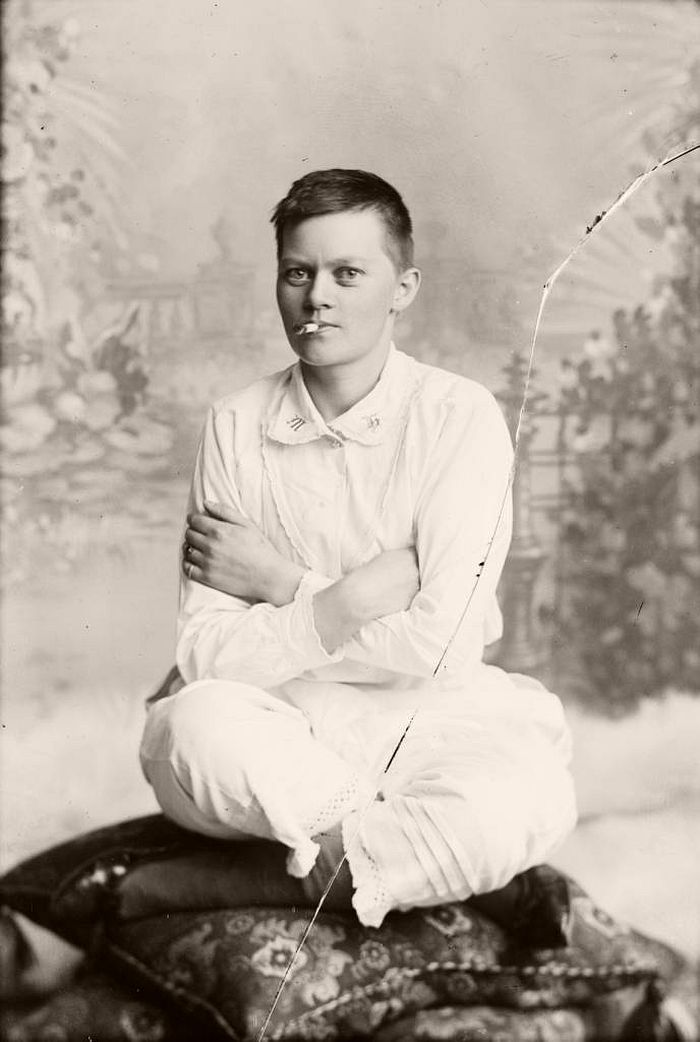
The first selection is the work of two Scandinavian women photographers, Marie Høeg (1866 – 1949) and Bolette Berg (1872 -1944), who met in Finland and lived in Norway, as business partners and as a couple. They were suffragettes and quite engaged in feminist politics on the local level, while making a living by conventional photography, studio portraits and the like. Høeg founded the Horten Branch of the National Association for Women’s Suffrage, the Horten Women’s Council and the Horten Tuberculosis Association. Berg worked more behind the camera. The photographs were part of some 400 glass plates found in a barn of their farm decades after they had died. Marked “private,” they contained images that played with gender roles, cross dressing, mimicking behavior reserved for men (arctic explorers in fur coats,) showing the androgynous protagonist as well as a number of their friends joyously defying gender norms.
The work has a home at Norway’s national photography museum, the Preus Museum in Horten. It is currently shown at the ongoing Festival of Photography and Visual Arts, PHotoEspaña, in Madrid until September.
As you can see, the couple poses like a traditional heterosexual couple at home, going out in the boat (or sitting for a photographer in these studio props that were known to anyone at the time,) interacting with their pet, and having fun at drinking, smoking and playing cards with friends (behavior reserved for men at the time) independent of gender.
A few of the photographs show a male friend not averse to cross-dressing.
Fast forward to 120 years later, and a different part of the world. Camila Falcão has been photographing Brazilian trans women (women born into male bodies), encouraging them to pose as they wish, in their own environments. (All photographs are from her website.) Brazil’s 2019 law that considers transphobia a crime has done nothing to lower the murder rate of Brazilian queer people: it is the highest in the world, for the 13th consecutive year, with a 30% rate of 4000 killings in that span of time.
The title of Falcão’s series, “Abaixa que é tiro” refers to the reactions of the portrayed and their friends, who started commenting ‘Abaixa que é tiro!’, celebrating being shown to the world. “The expression is used widely among the Brazilian LGBT community to address that something really awesome/fabulous is about to hit you. More in general, however, it could be said that “Abaixa que é tiro” signals a paradoxical relationship between fear and empowerment.” (Ref.)
Again, notice how an attachment to pets immediately confers familiarity.
Women are tired, women break arms, women have friends.
Women are barely out of childhood,
could be on a winning gymnastics team,
a first grade teacher,
or the smart, uncompromising sister who sets you right.
Work like this can help to deconstruct stereotypes, although it will be a long road until increased visibility leads to a decrease in violence against this population. The photography world is noticing. We have now venerable institutions calling for work to show what unites us in times of division, like, for example, the British Journal of Photography, having judged exhibitions of Portraits of Humanity. Every single image that manages to shift our consciousness and beliefs is worth it, even if not all of us can have Falcão’s talent, access or courage as an ally to a demonized minority.
Music today is sung in Portuguese by Joao de Sousa, but created by a Polish collective, Bastarda, that has the most amazing modern Jewish music in their repertoire. Check them out. I have been listening to Fado non stop for weeks.
Last night I watched a movie, Tár, Todd Field’s 2022 film starring Cate Blanchett (fabulous performance) as a famous female conductor whose life unravels, seemingly, when her past actions catch up with her. Honestly, I cannot describe what I saw with anything amounting to a rational interpretation. It is a labyrinth, proud of its plethora of cues and hints dropped all over that allow for multiple readings of what the whole thing is about.
A story about the evils of cancel culture? A story about the need for calling out perpetrators who then deserve a fitting fate, or an exploration of how rumors and innuendo destroy a life? Is it a ghost story, or a horror story or a warning tale of what happens when you pop too many pills that were not meant for you in the first place? A psychological profile about addiction to pills that might induce hallucinations, or lead to physical falls that in turn might give you concussive brain damage leading to hallucinations? Is it a tale about how lies, ambition, greed and taking no hostages along the way eventually lead to someone’s downfall, greek mythology for the modern consumer in a Me-Too era? Perhaps.
Reviews ranged from drooling (in the NYT,) to scathing (in The New Yorker,) to at least helpful (in Slate) with every single one I read, including the adoring ones from the British media, written by a man. The protagonist, Lydia Tár, originally Linda Tarnowsky, who grew up in a working-class, immigrant household that she has long obscured, is a woman of major talent and equally large appetites, for the good life and young flesh, respectively. There is clear evidence of some seductions of proteges, and more that are insinuated. Conveniently she is depicted as a lesbian, in a relationship with another woman who served her originally to get to her goal to conduct a major symphony orchestra in Berlin, and whose medications (for heart problems or anxiety, unclear) she hoards for herself. Her role as “father” in that couple’s family is enough of a male attribute to allow the viewer to buy into the me-too scenario that unfolds, as if being a cis woman would not suffice to make accusations swallowable.
We see her genuinely passionate about music, interpreting composers, getting the best performance out of her players. We also see her as being transactional in every relationship on the scene, and full of contempt, coldness or scathing for those who stand in her way or won’t do her bidding.
One of her former proteges and lovers who she actively undermined in the professional music field, commits suicide. Weird events start to intrude into Tár’s days that might or might not be auditory and visual hallucinations, or skillfully placed signs by revenging entities that slowly drive her into some form of madness.
Eventually, the chickens come home to roost; not only is she rejected by her newest paramour, but there seems to be an organized movement by many of the victims, competitors or offended people that lead to her down fall. She loses everything, her child, her marriage, her professional standing.
In the last part of the movie she is en route to the only new job she could find, in some unnamed place in Asia. She travels down a river, which might as well be the river Styx, in a tourist boat, and crouches, submerged, in a cave behind a waterfall, cut off from humanity, in what might as well be the entrance to Hades.
In the final scene we see her conducting a mediocre orchestra in front of an audience of fans dressed up and masked in the bizarre costumes of Manga conventions, with a movie about to be screened that seems to be a super-hero or science fiction tale. Whether it is all a dream or the reality remains unclear, but the unraveling is clearly linked in time to when she took a bad fall while fleeing a seeming monster, imaginary or not.
Death is Scandalous. Philosophizing at the Cemetery. (Lecture announcement.)
Is she a monster? Is she a victim? Both? Are there ghosts lurking out there bringing about revenge? Can you tell that I have been thinking out loud, trying to grasp something when I didn’t? Any suggestions are welcome, as is your opinion whether a director of Field’s caliber (and gender) should have devoted his first film in 16 years to exposing a woman in a me-too scenario, without ever committing to a clear differentiation between perpetrators and victims. I don’t know what to make of that.
What I do know is that there went a lot of care into the visuals, with admirable success in creating a gothic, grey, white and black ambience that colored everything in the upper strata of social life: from white private jets to dark-grey tailor-made suits; dark lecture halls for interviews, or restaurants that might have served the mafia dons or members of the House of Lords; cold concrete wall of Brutalist architecture in a cold marital home.
And finally white pants of those who’ll rise as avengers of the oppressed and abused, white blouses for a betrayed spouse.
Red comes in sparingly, and always associated with outrageous action. The hair of the suicidal protege, glimpsed like a ghost from behind, or with her face covered up by Tár’s body, is red.
The luxury bag of one of Tár’s admirers, coveted and snatched as a prize by Tár for a one-night-stand with the groupie, is red. The jacket of a child bullying Tár’s daughter, a child she accosts with unimaginable cruelty and threat, is red. A forgotten toy that leads to the accident at the turning point of Tár’s life, is brownish red. And the number 5, which plays a crucial part in the narrative of Tár’s ascent to stardom in her ruthless pursuit of conducting Mahler’s Fifth as her masterpiece, appears in red late in the film, leading her to be violently, physically ill.
Fiasco
Not a bad choice for a film that scatters clues in countless other ways. After all, red is the color in the visible spectrum that scatters least due to its long wave length (620-750 nm). Scattering refers to light getting deviated from its straight path upon striking an obstacle, such as dust, gas molecules or water vapor. The light is redirected in different directions (said scattering) after hitting the particles present in the medium. Red, then, makes for a good choice when you want a signal that catches attention even when visibility is compromised by obstacles, like fog or smoke (I guess literally as much as metaphorically.) In real life, of course, it serves as a warning signal: think brake lights, traffic lights, red warning flags, flags in bull fights or the ones of old that were wave at the commence of action on the battle field.
Red might also elicit emotions like anger or fear, given that it is often associated with dangerous stimuli, like fire, poisonous snakes, insects or berries, wounds and blood. “Seeing red” is a term that in fact correlates with an individual’s personal traits: people who rate high in hostility see far more red in ambiguous stimuli (colors that are faded and could be either red or blue) and also prefer the color red ( which might bias them towards the interpretation above.) They also engage in more interpersonal hostility, if they prefer the color red over blue. And of course, their anger raises the blood to their face, looking red. (Ref.)
I guess Field (who grew up in Portland, by the way,) has done his homework in the psychological literature or was just intuitively spot on, when he designed his color markers for the film. Alas, despite all visual signals, the meaning still feels scattered. Maybe I simply don’t run on the same wave length….
Music today is another composition that plays a major role in the film: Elgar’s Cello Concerto, here performed by a very young Jaqueline du Pré. It is a sad, contemplative work written directly after WW I, in 1919, echoing a world full of anguish. Elgar was ill, depressed and disillusioned. Fits entirely well with the unfolding of Tár’s drama.
On days when I cannot control the chaos in my brain, I sometimes turn to my desk drawer and tend to the chaos in there instead. Nothing like a bit of sorting and discarding to make yourself believe there can be order in the world, if only for two seconds.
This time I straightened out an accumulation of calendars; as regular readers know, I create one each year as a fundraiser for Streetroots, a PDX organization that produces a weekly paper, working with the houseless, and I also use them as gifts for the many people in my life who deserve one. Well, that sounds abominably condescending. Scratch it. Calendars make for good gifts, how’s that?
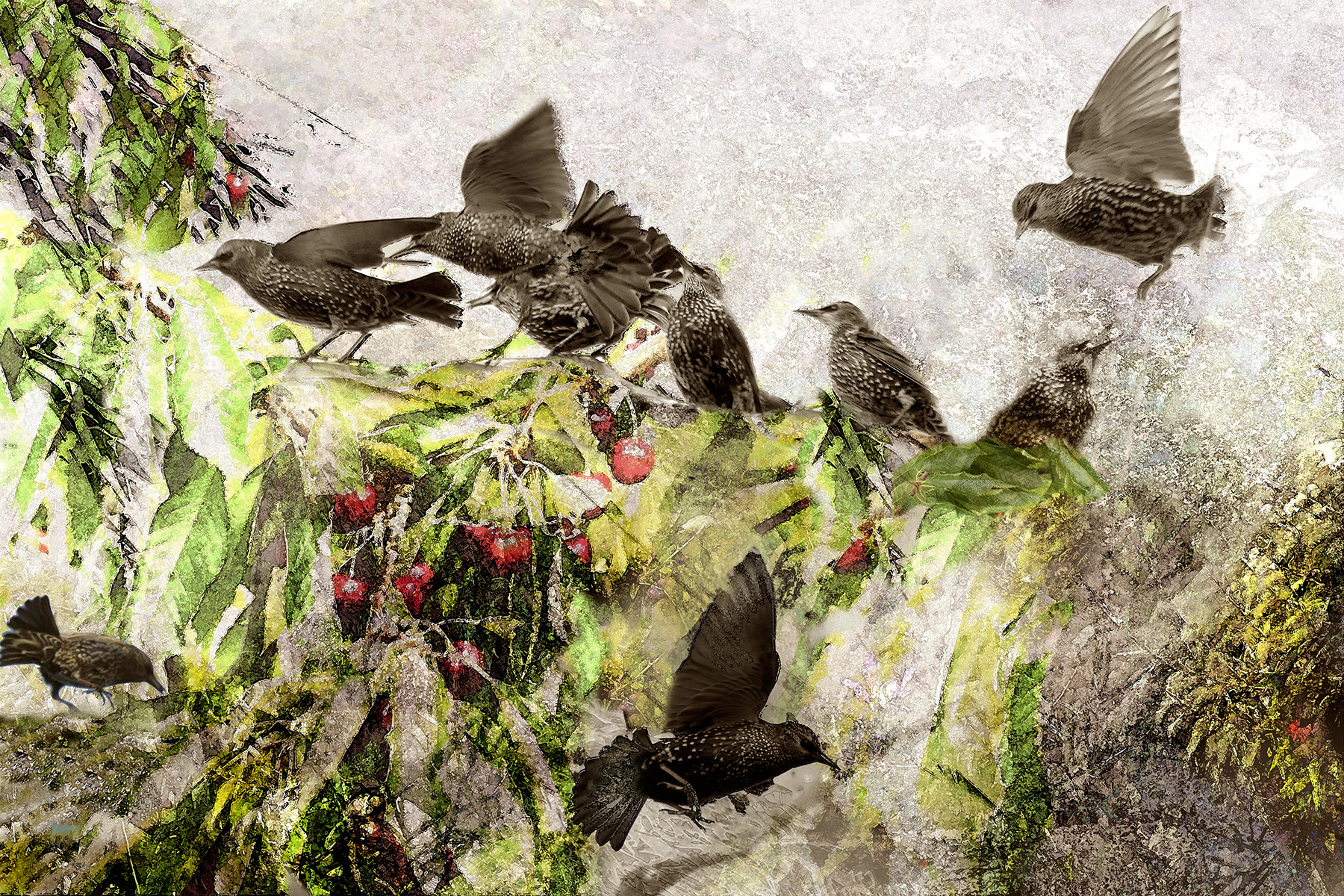
Last year’s calendar, Fusion, was all about showcasing some lovely birds I had photographed over time, putting them playfully into settings where they did not belong, still lives for the most part. Note the word playfully. It has taken me a long time to feel confident enough to work with birds without some intellectual excuse, given that the Portland slogan “put a bird on it” resonates with its sneer.
I had done two series with birds before, both concerned with the impact of environmental damage on avian populations, a serious enough concern to warrant working with birds. There was Dreaming, while snared, of Murmuration which displayed starlings symbolically netted.
And there was Denizens of Climate Change, which I had actually exhibited.
So, Fusion seemed like progress, psychologically, incorporating just something that I found beautiful and not in need of justification.
Well, that was short lived. I am working with birds again, this time for a more complex project where they are no longer the main actors, but part of a larger assembly of concepts that will tell a story. And wouldn’t you know it, the unease of being a woman artist who creates beauty with something that could be seen as cute, or pretty, lovable or simply chirpy, has returned in full force.
Pelicans (2023)
Of course, some multimedia artists seem to have no such qualms. Jamaican artist Ebony G. Patterson‘s powerful new show at the New York Botanical Garden is a case in point. (NYC friends, go see it!) Glitter-crusted wakes of vultures roam the flower beds, more than 400, as it turns out, and there’s a strange peacock to be found.
…things come to thrive…in the shedding…in the molting… points to the transitory nature of things, the uncanny intertwined with the undisputed beauty of the flora. There is no hesitation to use birds as messengers. Then again, the ones on display are quite symbolic birds, and not your garden variety starling and finches, golden or not.
***
Female artists often have to contend with a kind of scrutiny that goes beyond what male artists experience. Their work is also still valued less than their male counterparts’, if you look at the rate of both exposure and compensation. (Ref.) Just look at the titles of what you find in the literature exploring this phenomenon. This is what randomly pops up at a first search about double standards.
Male artists dominate galleries. Is it because ‘women don’t paint very well,’ or just discrimination? (Ref.)
The staggering lack of female artists in America’s museums (Ref.)
Race- and gender-based under-representation of creative contributors: art, fashion, film, and music (Ref.)
The Dam (2023)
I’m happy to report, though, that we have a chance to look at the work of female artists across some part of our region, all in one place, likely to defy the gender stereotypes. If you have no other plans, make sure you go to the opening reception of Women Artists of the Gorge this Saturday, June 17th, at the Columbia River Gorge Interpretive Center Museum in Stevenson, WA. It’s a short and easy drive from Portland and the acres surrounding the museum offer beautiful vistas as well.
I will write about this show next week, when the crowds have dispersed. It is a gorgeous place out there, perfect for visiting, and, I happen to know, for photographing birds.
Music today is about Mozart’s starling. Explanation here.
“If the doors of perception were cleansed every thing would appear to man as it is: infinite./For man has closed himself up, till he sees all things thro’ narrow chinks of his cavern” ― William Blake, The Marriage of Heaven and Hell.
LIKE ANY other segment of the population, artists have not been immune to cancer. The recent loss of one of our own to this disease, Henk Pander, is a painful reminder, grief still rippling through the community. We know of numerous famous painters, including Artemisia Gentileschi, Rembrandt van Rijn, Gustav Klimt, Marc Chagall and David Hockney, who were afflicted. Photographers not far behind, Dorothea Lange among them as well as Ester Bubley, Arthur Rothstein, Ralph Steiner and Gordon Parks, to name just a few. (Here is a more comprehensive selection from a recent art exhibition at the Hillstrom Museum of Art, MN.)
Medical research indicates that, compared to other professional groups, the mortality patterns among male painters shows an increased risk of dying of cancer, manifesting as bladder, colon and brain cancer, and also leukemia. For women painters, it is breast and lung cancer that is found at elevated rates compared to the non-artist population. The causal mechanisms have not been established, but there are likely links to hazardous substances present in the paints and finishes painters use (Ref.) Then again, it could be the immense stress levels from a precarious existence, shared by many artists, that affect the immune system negatively. Substantially increased cancer mortality rates for photographers are clearly associated with chemicals applied in darkrooms while processing film (Ref.)
Cancer was historically something people did not talk about, an abysmal affliction associated with shame, superstition and mortal dread. You find a few portraits in renaissance art that show women who are likely dealing with breast cancer, but none of the type of work that has begun to emerge, finally, since the last century: visual artists dealing with their own illness, processing their experience through their creativity or using their experience as a means of questioning the stereotypes that surround illness and death. From attempts at personal healing to attacking the metaphors associated with the disease – “it’s a fight, a battle, a crusade” – to simply conveying insights so that others can be prepared or warned, you find a variety of artworks that embody our era’s willingness and courage to expose oneself and/or make the personal political. A late, but welcome attempt to heed Blake’s appeal to “cleanse the doors of perception,” revealing underlying truths rather than keeping them out of our field of vision.
The incomparably courageous and smart artist Hannah Wilke documented her experience with Lymphoma in fascinating and brutally honest staged photographs that were evidence for her unsurpassed talent for gesture. May her memory be a blessing.
Hannah Wilke Intra-Venus Triptych 1992-93
Artists do not just expose their diseased bodies, of course. Some prefer narrative paintings that indirectly alert to what is lost, often for entire generations. I very much relate to the painting below that depicts imagined inter-generational connection when the person is no longer there to talk. If you have cancer when your children are young, one of the bottomless fears concerns what will happen to them, accompanied by an overarching sorrow that they will never really get to know you (or you them) on a more equal footing.
Ofer Katz“Things I wanted to tell you – Mark and Aliza Ainis at The Dead Sea” 2021
(This painting, by the way, is part of a project that has been of enormous help to cancer patients trying to overcome isolation. A national organization, Twist Out Cancer, offers a program called Brushes with Cancer.
“… it strategically matches artists with those touched by cancer to create unique pieces of artwork reflective of their journey. Over a period of 4 months, pairs will connect virtually and their relationships are guided and supported by Twist Out Cancer mentors with the intention of creating a support system for both the artist and inspiration. The program finishes on a high note with our signature celebratory art exhibition, gala and auction.”)
Then there is Prune Nourry’s public art signaling healing, to which I am admittedly partial, even though her Catharsisseries skirts the edges of metaphors that I abhor. Amazons are of course warriors, implying an ongoing war with the disease. I continue to be floored by Nourry’s ideas and instantiation of mammoth projects (I wrote about her work I saw in Paris some years back here.) The battle metaphors so lend themselves to focus on winners and losers, victors and victims, survivors and fallen, all of which imply an either/or categorization and a hint of fortitude (or lack thereof) in dealing with the illness. As any cancer patient will tell you, the implications that one isn’t tough enough, fighting enough, optimistic enough, radical enough, tend to add insult to injury.
Here are some images of Nourry’s work processing breast cancer and an explanation from her website.
“Catharsis was born in 2018 with The Amazon, a monumental four-meter concrete sculpture with glass eyes, inspired by an ancient marble statue at the Metropolitan Museum of Art representing an injured amazon. Prune Nourry created the sculpture as a cathartic act in her fight against cancer. Inspired by ex-voto traditions, particularly the Japanese mizuko kuyo, the piece is entirely covered in thousands of incense sticks. During a public performance in the heart of Manhattan, the incense went up in smoke to symbolize healing.”
Breast cancer seems to be the dominant topic for artists processing cancer – perhaps because it is so prevalent, has been suppressed as a subject for so long or, importantly, because patients more often than not live to tell the tale. Gallery shows focus on the resilience of survivors, and museums draw attention to the topic, like this ingenious stunt at the Thyssen-Bornemisza National Museum of Art in Madrid in October last year. They featured an exhibition titled “From the skin to the canvas: another take on breast cancer,” displaying digital copies of works by Francisco de Goya, Peter Paul Rubens and Hans Baldung Grien which had been altered to make it look like the nude subjects have undergone mastectomies. (Unsurprisingly, most of the media reports did block out the images – I really had to hunt to find one….)
Thoughts about breast cancer seem to be manageable, compared to, say, lung cancer which has a far worse prognosis and less visible damage, as well as being associated with un/spoken assumptions that it is your own fault because of bad habits (I wrote about this recently here.) Breast cancer survivors’ day-to-day functioning is not as affected by missing breasts (non-withstanding the emotional losses tied to female beauty ideals, or those of sexual pleasure) once you’ve left the cancer behind you, compared to living with the aftermath of lung cancer. The absence of breasts becomes an integrated norm, with all other physical functions intact, allowing you for long stretches to forget the ordeal. That is not the case with a lung removed which affects every step you take, every breath, really. The knowledge that this dreadful beast tends to spread surreptitiously much more frequently makes ignoring your state near impossible. Seen in that light, the prevalence of breast cancer-related art becomes understandable.
In fact, to my knowledge there seems to be no art by established visual artists engaging with lung cancer, although a few rather depressing novels and autobiographies by afflicted authors exist: “The Quarry” by Iain Banks, “In gratitude” by Jenny Diski “When breath becomes air” by Paul Kalanithi , and “Stadium IV” (Stage IV) by Sander Kollaard. Two authors who died of lung cancer wrote poems about their ordeal: Raymond Carver (“What the doctor said” and John Updike (“Needle biopsy”). Illness perception – in this case one of doom and resignation – has consequences, for coping as a patient as much as for the obviously lacking desire or energy to create an artistic representation of the trauma.
***
“A successful work of art is not one which resolves objective contradictions in a spurious harmony, but one which expresses the idea of harmony negatively by embodying the contradictions, pure and un-compromised, in its innermost structure.” ― Theodor W. Adorno, Essays on Music
PROCESSING the illness experience can have enormous benefits, for artist and beholder alike, regardless what disease gave rise to the art. That point was driven home for me last week when shown the new work by artist and cancer survivor Ruth Ross. I had written about Ross’ thrilling exhibition Red Scare last fall, embroidered fabric and photographic collages about growing up in the shadow of the Rosenberg trials during the McCarthy era, and was curious where she would go next. Once again, her projects fuse the personal with the political, this time embodying contradictions that belie the surface harmony of the portraits.
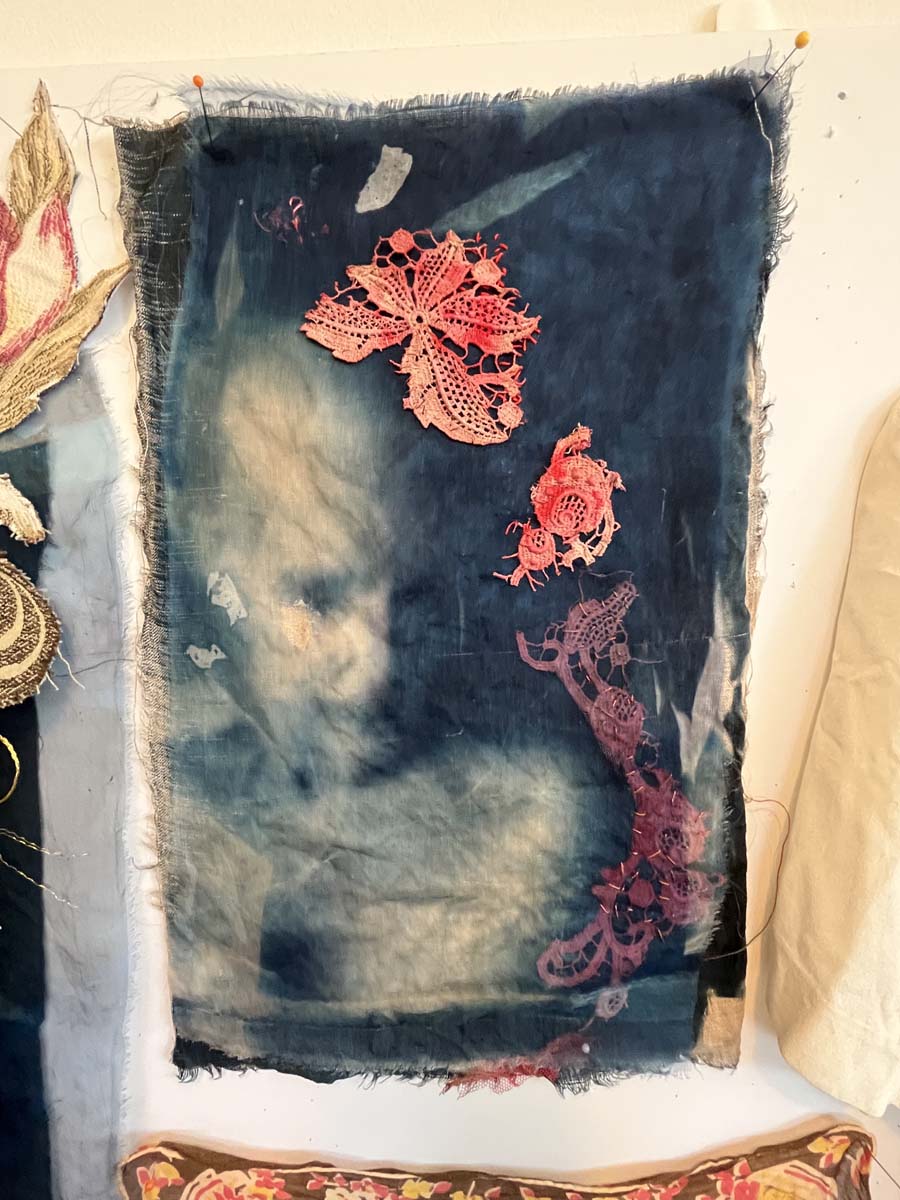
Photographs of the artist taken during her chemotherapy and transformed into cyanotype prints are embroidered with fanciful, phantasmagorical hats that are often quite beautiful, sometimes resembling overbearingly heavy crowns.
In Ross’s own words:
Marking 11 years out from chemotherapy for breast cancer, I came across a series of stark photos I had asked my husband to take when I was at my weakest and most debilitated. Seeing from those photos how frail I seemed, I created a series of cyanotype prints to silk organdy, a delicate and nearly transparent textile that would reflect my vulnerability.
What if I were to revisit that troubling time with a more tender view? Could layers, image, and stitching, endow that self with what I thought I had lost? Or perhaps with what I never even had? An elaborate hat made of flowers from a far-off paradise. A fanciful silver bird grasping some golden threads. With this work I revisit a difficult time. I can now express joy, self-indulgence. Ignore my judgmental self and invest it with wit, frivolity, and forgiveness.
For me, the work elicited a less personalized interpretation. It embodies contradictions that are structural, not just based in private experience. Hats during chemotherapy are meant to hide the stark nakedness of the head, the ugliness of a skull bereft of one of culture’s (or myth’s, literature’s, religion’s) greatest symbols: hair.
Hair is a powerful signifier of individual identity (lustrous locks signal fertility and health, for example,) as well as gender and group identity – think of hair styles reserved for elites, shorn hair for skin heads but also nuns, indicating celibacy in the latter case, long hair for politically active males in the western 1960s and so on. Women were constrained to certain hair styles before, during or after marriage entering widowhood, cross-culturally so, as anthropologists exploring initiation-, marriage- and mourning rites can attest. And of course, women in multiple religions are not allowed to reveal their hair at all to people outside the family. Hair has a place in witchcraft rituals, and it surely plays a role in the economy: The global hair care market size reached US $82.3 BILLION in 2022. That is a lot of gels, rinses, oils, tonics, serums, masks, dressings, shampoos, conditioners, and sprays, to treat hair to be shiny and voluminous, much to the envy of those of us born with something more resembling chives…
Black hair in this country was also a subject of policies driven by structural racism: only now have we done away with prohibitions of natural hairstyles, like afros, braids, bantu knots, and locs, policies used to justify the removal of Black children from classrooms, and Black adults from their employment. The Crown Act, (Creating a Respectful and Open World for Natural Hair) passed in March 2022, banning hair-related discrimination.
Hair, then, is public, not just private. Drug-induced loss of hair is to be hidden from the public, however, to spare others the reminders of mortality, and to not call attention to what is perceived as our own decimation in (assumed) attractiveness value. In that sense, chemo-caused hair loss is both a public and private representation of the illness. It can cause individual distress as well as societal stigma (honestly, how do you even separate these two variables?) National Institute of Health data reveal as recently as 2 years ago that up to 14% of women refuse life saving chemo treatment because of their fear of hair loss. Risking death because of internalized beauty ideals imposed by a society that judges women by this standard, and easily dismisses those who no longer conform to it, imagine!
Hats, in this context, serve as a means of hiding visible signs of cancer treatment to protect societal denial of illness, and help avoiding dreaded negative attention. Ross’ hats, of course, do the opposite. All attention goes to these flights of fancy, then extending to the transparent emanations of suffering beneath, forced to confront the ravages and all they imply. The contradictions of joy and pain are inextricably linked.
The assumption of one being in the present, the other in the past, however, is an illusion, just like the possibility that these hats could ever not slip off the bald skull unless artificially glued or pricked by pin needles. You might be cancer free at this moment, but you will never be free of the thoughts that it might raise its ugly tentacles again. All you can do is cherish the here and now that is the potential ante-room – and Ross does that with luminous defiance. The choice of materials that simultaneous imply decay and lusciousness in itself is ingenious, with tropical splendor growing out of the ripped fabric of our lives.
The sobering realization that the exuberant blossoming of the flora echos the relentless proliferation of cancer cells is, alas, inevitably not far behind.
The artist’s expressed intention to create these pieces as a way of ending a hard chapter on a high note are a welcome reminder of healing. But there is an implicit way of forcing us to look at the consequences of cancer treatment for women that is radical in her art: part of the suffering during this affliction has to do with stigmatization, and desperate attempts to escape it and the isolation it imposes are often futile.
No hat, however beautiful (or unobtrusive) can make that fact disappear. Might as well bring it to the forefront, then, as Ross does, with gusto. Her work opens our perception to experiences during illness that go beyond the physical affliction or the psychological realm of dread induced by cancer. We are driven to hide our deterioration from the eyes of a world that has made beauty a commodity and reminders of mortality a taboo.
One of Ross’ collages is part of the group exhibition: Not Just: A World Collage Day.
I came across Oliver’s poem yesterday, and it spoke to me.
I was privileged in the sense that I was early on instructed by my mother to attend to the less obvious specimens in the floral world around us – just like the poet points to the weeds or small stones, anything but the showstoppers.
Blue Flax – the plant linen is made from.
So much beauty to be found in the borders of the garden, rather than the central beds. (Well, at least in this magical garden created by a true master gardener who is always willing to experiment. Today’s blog is dedicated to you, R.C.!) So many more opportunities for pollinators, too. And that’s before we even get to the wild flowers…
Baby Blue Eyes
Lobelia
Dame’s Rocket
Even the shade of blues in spring is softer, lighter, and there is purple with a hint of pink at times. Summer, of course, gives way to the heavy saturated blues of delphiniums and salvias, but we’ll get to that in time.
Allium
Scabious (Knautia)
Wild Geranium
I have always thought of prayers that give thanks as psychological tools to focus attention( even before I read the poem,) be it to a situation or a feeling, a means of making aware, reminding oneself of the grace that surrounds us at a particular moment.
Desert Bluebell
Not that I expect (or hope for) another voice to make itself known. Acknowledging the beauty or kindness of the world around me is enough. It restores balance for all the fear I’m usually tuned into. It also points to the importance to help the world stay that way, to protect fragility. Acknowledgement, then, paving the path to action.
Borage
The climbers opt for more substantial flower heads, like the wisteria below, about to unfold,
and the clematis.
These photographs, with one exception, were taken on a single day last week. Wherever you look: reason to give thanks for evolutionary pressures to create what we consider beauty. Awareness that there is not just misery in the world. Reminders that we have to act to keep it that way, before the world becomes a hothouse. You might be partial to orchids. But the delicate, porcelain blues I cherish wouldn’t survive that.
Music today is Mozart’s ode to the violet… (below, strictly, are violas.)
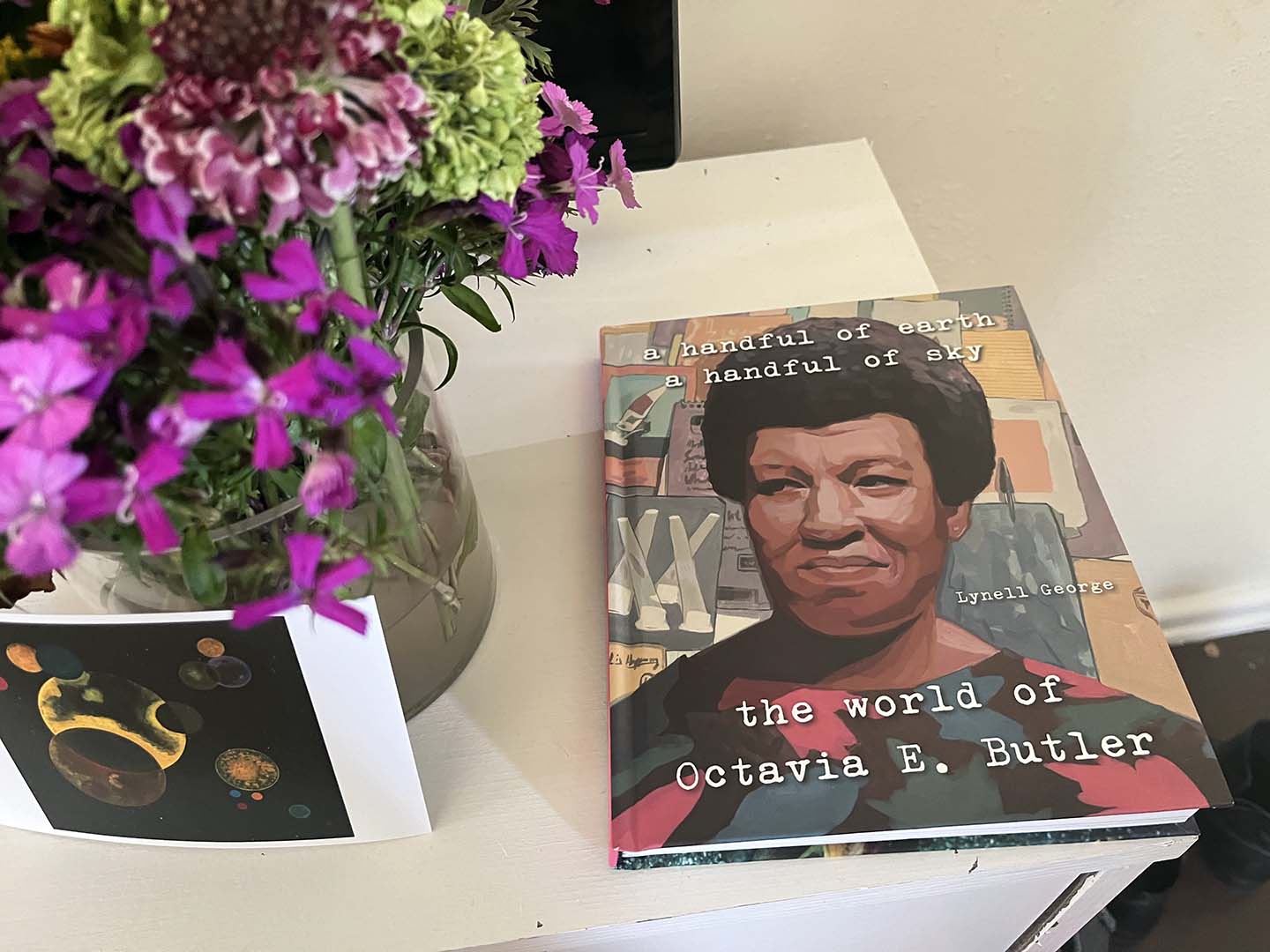
Today’s musings will be all over the map, geographically, emotionally and with regards to content that has preoccupied my brain for a while. It all leads back to Octavia E. Butler, a writer who I admire for her exquisite, creative world building, her focus on in/justice, and her ability to transcend genres. I am even more grateful for all of her modeling of what it means to have courage and persistence, to stick to goals defying racist, patriarchal, professionally closed systems, while skirting existential poverty and loneliness during formative years.
Mural at the Octavia E. Butler Magnet School in Altadena, CA.
All over the map: Let’s start with Trieste, Italy. Why Trieste? I was somewhat condescendingly amused during my 2018 visit there to see flocks of fans follow the footsteps of their hero, James Joyce, who lived and wrote major works in Trieste for years. Selfies with his statue, tour lines in front of his lodgings, photographs of the multiple plaques conveniently placed by the Bureau of Tourism: Joyce walked over this bridge here! More than once!
Well, I was wrong, I’ve joined the multitudes and never should have sneered. Not pursuing Joyce, nor taking selfies, but I am now trying to walk along the paths of someone I wish I’d understand, taking in the neighborhoods and buildings that were part of her daily life, reading about her struggle, and visiting places that keep her memory alive.
Pasadena, CA, then, is next. No plaques here, but a helpful map laying out routes frequently taken by Butler, prepared by people at the Huntington Library which holds the author’s archives. An even more helpful book by journalist Lynell George, A Handful of Earth, a Handful of Sky – the World of Octavia E. Butler, which introduces the canvas on which Butler drew both herself and the worlds she constructed from the insights captured by her daily struggles, the physical environment in which she labored, and the mental landscapes that she traveled while growing into the writer some of us now devour. George describes the author with exceptional sensitivity and intuition, during the years before Butler would go on to become a MacArthur (Genius) Fellow and win a Pen Lifetime Achievement Award, as well as Hugo and Nebula Awards for her trailblazing work in science fiction—the first Black woman to win both awards.
Butler was born in 1947 in Pasadena, CA, to a mother who worked as a maid and a father who was a shoe shiner and died when she was very young. She was dyslexic, isolated in school and not particularly supported by the majority of her teachers. Later she turned to menial jobs, often physical labor, that did not require much thought so she was free to do her own thinking, and could use the rest of her time to walk or visit libraries, some involving hours on the bus.
Historic center Pasadena, including the post office where checks, manuscripts acceptance or rejection letters might have arrived in her P.O.Box.
Lynell George’s account of these early years is, among other things, based on archival items that Butler saved over the years: lists. And lists. And lists. On scrap paper, or any other expandable surface she could write on, perhaps compulsively constructed to organize and likely ward off a flood of fears that might otherwise prove overwhelming. Shopping lists. To-do lists. Lists to evaluate what could be pawned to head off starvation. Lists of goals. Lists of dreams. Lists of exhortations or promises to Self, or incantations about how the world should be and how to make it so.
An eternally slow start to find her way into publishing, with 2 small manuscripts sold in 5 years, interminable stretches of professional drought, and yet this author went on to write and publish over a dozen books, with artists, play-writes, musicians and film makers increasingly inspired by the work since her death from injuries sustained in a fall at the age of 58 in 2006. Her novels are taught at colleges and universities around the country (well, where there are not yet banned, I should hasten to add…) and you can now watch adaptions of her books on TV. (Coincidentally, this weekend’s NYT listed an introduction to some of the essential works, so you can see for yourself how much ground was covered or where to start.)
***
Many of Butler’s books can be found in a small book store on North Hill Avenue in Pasadena, Octavia’s Bookshelf. It opened about a month ago and offers a range of works by BIPOC writers, and a welcome space to sit down and explore.
Here I meet Nikki High, owner of the store, who is helpful in recommending books when I approach her to pick her brain and perfectly happy to spend some of her valuable time chatting with this stranger. Which brings us to the Republic of Ghana, the west-African country where sociologist and Pan-Africanist civil rights activist W.E.B. Du Bois resided during the last years of his life and is buried. He died on the eve of the civil-rights march in Washington,D.C., where Dr. Martin Luther King Jr. gave his “I Have a Dream”speech and where Roy Wilkins of the NAACP announced Du Bois’s death from the podium. I mention to Nikki that I am currently reading a thought provoking, beautiful novel by Honorée Fanonne Jeffers, The Lovesongs of W.E.B. Du Bois, and she tells me about her recent travels to Ghana to visit Du Bois’ grave and the house he lived in, visibly moved by the reliving of that memory.
Jeffer’s novel revolves around the concept of Double Consciousnessthat Du Bois introduced in his seminal book The Souls of Black Folk (1903.) So does Kindred, (2003) Butler’s historical fiction/fantasy novel introducing a heroine who time travels between the 19th and 20th century, between the slave plantation where her ancestors suffered and her interracial marriage in 1976 L.A.. The novel has become a cornerstone of Black American literature.
Du Bois argued that living as an African American within a system of White racism leads to a kind of fragmented identity. The double consciousness refers to “the sense of always looking at one’s self through the eyes of others.”
“It is a socio-cultural construct rather than a baldly bio-racial given, attributed specifically to people of African descent in America. The “two-ness” of which it is a consciousness thus is not inherent, accidental, nor benign: the condition is presented here as both imposed and fraught with psychic danger.” (Ref.)
The socio-cultural existence is defined by a racial hierarchy that includes hostility and suspicion, subtle or outright exclusion, a life lived in uncertainty and guardedness. The individual’s identity, both novels argue, is also affected by the historical fact that harm extended beyond the individual to whole family structures and networks of kin. Only when you understand the legacy of historical trauma and merge it into your own sense of self will it cease to afflict you. Past and present need to be integrated to mend a disjointed self.
***
As luck would have it, the Octavia E. Butler Magnet School‘s library celebrates an OEB science fiction festival the next day. Previously Washington Middle School, the institution’s new name (since Fall 2022) honors its famous alumna. Since I have to avoid crowded indoor settings during the pandemic (it is NOT over, folks!), I cannot join the activities, but manage to get a few photos in a ventilated hallway. New generations are introduced to a role model that leaves you in awe for the obstacles overcome.
On to Mountain View Cemetery in Altadena, CA, where Butler is buried. It is a peaceful place with beautiful old tree growth, als long as you ignore the coyotes that they warn you about, patrolling in packs, by some reports.
Butler’s grave marker is unobtrusive, not easy to find. The inscription is one of her most frequently cited insights, from the book The Parabel of the Sower (1993), where she turned her attention to climate catastrophe and the subsequent militarization of state and rapidly shrinking chances of survival. Set in 2024, it seems utterly prescient in retrospect, its descriptions outlining the contours of our lived or soon to be lived reality.
Allow me one short digression, and some speculation, you’ll see why in a minute. Butler’s last resting place sports numerous strange grave stones, if you can call it that, artificial tree stumps carved with the emblems of a maul, wedge, axe and dove, as well as markers inscribed with repeat phrases, the Latin motto “Dum Tacet Clamet” which translates to “though silent, he speaks.” A bit of research brought me to Omaha, Nebraska, where one Joseph Cullen Root founded The Woodmen of the World (WOW) in the early 1890s. It was essentially a mutual aid society, a beneficiary order that provided death benefits and grave stones to its members by essentially passing around a hat.
That turned out not to work exactly, and so shifted thirty years later to become a regular life insurance company. By 1901 it was the largest fraternal organization in Oregon with 140 camps and a membership of 15,000. Membership conditions: you had to prove yourself in various ways, be older than 16 and – White. A subdivision, Women of Woodcraft, is captured in this photograph.
Women of Woodcraft (likely a drill team), ca. 1910. Object ID: 2011.033.001; Copyright Royal Gorge Regional Museum & History Center
Would Butler be turning in her grave, surrounded by valkyries like these? Likely not. She would point to the importance of the idea of mutual aid, and to change: if you look at the website of the WoodmenLife Insurance Company that grew out of WOW, you find images of Black, Asian, Brown and other faces among the White beneficiaries, carefully assembled to stress diversity. It might only be on the surface, who can tell, but change nonetheless. And in any case – she might stay silent, but her work speaks to millions, in contrast to the wood people of the world….
***
This brings me to the reason why I, an old White European woman who can take privilege seemingly for granted, am so preoccupied with a Black writer who envisioned change and imbued her heroines with strength and refusal to give up, forever pursuing humanistic goals. She instills hope.
I feel like living in an era where, here as well as internationally, change is pursued or co-opted to move us backwards. The powers that be (or wannabe) want to affirm or re-install structures – and I mean STRUCTURES – that go beyond individual racist impulses or acts, to dominate on top of a hierarchy and use that dominance to extract riches and suffering. These forces are insisting that “differences”exists, be they racial, religious, gender, sexuality or simply cultural. Don’t ever believe in equality! Put a value label to these differing categories, with some “better,” others “worse,” with the dominant category, of course, being the superior one. This valuation is extended to an entire group, depreciating not just single humans, but a whole category. “Negative valuation imposed upon that group becomes the legitimization and justification for hostility and aggression. The inner purpose of this process is social benefit, self-valorization, and the creation of a sense of identity for the one through the denigration of the other. And as is evident, the generation and expression of hierarchy run through it from beginning to end.” (Ref.)
Whether you look at the Nazi play book, present-day Hungary, Russia, India or other authoritarian movements, these principles are at work every single time, with the content attached to the “difference” changing according to local need du jour and historical hierarchies, including colonialism. In addition, progressive movements so often weaken themselves by intra-group strife instead of collaborative fighting against a common enemy. I can think of no better explanation of those principles than in Arundhati Roy’s speech last week at the Swedish Academy.
It is so easy to lose hope, to withdraw by feeling overwhelmed, helpless, powerless to achieve true equality. And yet there was a person who faced obstacles beyond description, who believed in hope and the power of community.
Here is someone who put it in words better than I ever could, Jesmyn Ward, a formidable writer in her own right:
“This is how Butler finds her way in a world that perpetually demoralizes, confounds, and browbeats: she writes her way to hope. This is how she confronts darkness and persists in the face of her own despair. This is the real gift of her work… in inviting her readers to engage with darker realities, to immerse themselves in worlds more disturbing and complex than our own, she asks readers to acknowledge the costs of our collective inaction, our collective bowing to depravity, to tribalism, to easy ignorance and violence. Her primary characters refuse all of that. Her primary characters refuse to deny the better aspects of their humanity. They insist on embracing tenderness and empathy, and in doing so, they invite readers to realize that we might do so as well. Butler makes hope possible.”
Against the backdrop of a legacy of trauma she provided us with a legacy of optimism, that the lessons of successful collective action and resistance in the past will guide us to the right kind of change in the future, with the help of courageous and resourceful Black women.