Browsing Category

Culture

The Red Shimmer of Remembering – Celilo Recalled at The Reser

“…Make sure the spirits of these lands are respected and treated with goodwill.
The land is a being who remembers everything.
You will have to answer to your children, and their children, and theirs—
The red shimmer of remembering will compel you up the night to walk the perimeter of truth for understanding
….” – Joy Harjo – Excerpt from Conflict Resolution for Holy Beings (2015)

Analee Fuentes (Mexican-American) Sockeye Salmon, Spawning Oil on Canvas

Joy Harjo, a Musckogee Creek Nation member and 23rd Poet Laureate of the U.S., urged us in a recent collection of poems, Conflict Resolution for Holy Beings, to assess our place in the world, to mind our obligations derived from history, and to fulfill our duty to “speak in the language of justice.”

Celilo, Never Silenced, the remarkable inaugural art exhibition at the newly opened Patricia Reser Center for the Arts in Beaverton, provides memory aides that will help us to “walk the perimeter of truth,” as Harjo phrases it, perhaps the first step in the direction of justice.

What was Celilo? Who were the people displaced by a U.S. governmental decision to dam up a river that provided existential, spiritual and cultural essentials at Celilo falls where salmon fishing and concomitant trade meetings for the Pacific Northwest tribes happened since time immemorial? As I wrote before in OregonArtsWatch, the fates of salmon and the Northwest tribes were intertwined and received an immeasurable blow when the Dalles dam was constructed in 1957. The dam inundated the upstream Celilo Falls and Celilo village, the largest trading center for salmon, with scant compensation for the loss. Subpar housing was built only for a few permanent residents of the village who were displaced, ignoring all those tribal members who lived on reservations but regularly came to Celilo to fish and trade. It took until 2005 to start building the promised structures and no serious reparations have been paid for the immense loss of livelihoods that depend on salmon fishing.

Sara Siestreem (Hanis Coos / Confederated Tribes of Coos / Lower Umpqua / Siuslaw) Disasters of Man Acrylic, Graphite, China Marker, Color Pencil on BFK

I honestly have no idea how many people in Oregon, if approached on the street, would know this history or be aware of its implications. I wager that for most of us there will be few associations, negative or positive. For Pacific Northwest tribes, on the other hand, it was a rupture, endangering fish and river health alike, increasing conflict over ever scarcer resources, and ignoring the spiritual importance of salmon to tribal culture as much as the fact that food security was endangered with less protein available.

Richard Rowland (Hawaiian) Ahikaaroa Firebox Vase Anagama Wood-fired Vase

The Reser exhibition provides an educational starting point for a conversation about Native American losses and the conflict surrounding broken promises, undermined treaties, and the consequences for tribal members in the present and not just some hazy past. That said, the show is also a marvel in the way it collects and displays a wide range of artworks across diverse media, thoughtfully curated by gallery coordinator Karen De Benedetti, showcasing the resilience and power of contemporary tribal artists.

Gail Tremblay (Onondaga and Mi’kmaq) Stone Giants sleeping under the Bear Star Acrylic on Canvas 

De Benedetti knows to give the work room to breathe instead of overstuffing the walls, has a keen eye, and is willing to take risks with selections that vary across styles and accessibility – and all that in a part-time position, which makes the results all the more impressive. Trained as an artist and with a wide repertoire of experiences across educational and exhibitory settings, including positions at two previous art centers started from scratch, she knows the ropes. She managed to compile a set of works that introduce us to a significant number and variety of current Native American artists, one more interesting than the next.

Don Bailey (Hupa tribal member, raised on the Hoopa Valley Reservation in California) Once upon a time on the Columbia Oil on Canvas

Bailey is new to me. I was completely taken with the interplay of ambiguous planes in the painting, as well as the double use of paddle/pestle in the lower right corner, the landscape shifting in and out of configurations belonging to either nature or man.

Fused and blown glass, ceramics, painting, linocut prints, sculpture, photography, archival footage, poetry – smartly arranged, all telling a story, from different perspectives, about a river, a place, a sacred fishing ground and displaced nations – rising in resilience with memory intact and now translated into art. The “perimeter of truth” of which Harjo speaks was really laid out across these walls.

Amply represented is is Lillian Pitt’s intricate work. A member of the Confederated Tribes of Warm Springs/ Wasco/ Yakama, she and Rick Bartow, who was an enrolled member of the Mad River Band of Wiyot Indians, and whose work is also included, probably have the highest name recognition.

Lillian Pitt River Stick Indian Cast Crystal, Steel and Granite

Lillian Pitt Ancestors Fused Glass

Lillian Pitt River Guardian Cast Crystal, Steele and Granite

Another familiar name is Joe Feddersen, a member of the Confederated Tribes of the Colville Reservation (Okanagan and Arrow Lakes.) His sculptures exhibit an almost clinical serenity I so often associate with good blown glass, letting us perceive light through reflection and cast shadow, belying the insane skill required to produce such quiet elegance.

Joe Feddersen Fishtrap Blown Glass

Joe Feddersen Fishtrap V Blown Glass

There is archival photography capturing the history and contemporary photography by Joe Cantrell, Cherokee, raised in Cherokee County, Oklahoma who also contributed a driftwood sculpture.

Joe Cantrell Totem Enduring Resilience Driftwood

Joe Cantrell Walking Together Digital photograph on aluminum

***

When you exit the gallery towards the main entrance hall, you step into a large space marked by wood, glass, steel and concrete with a motion-sensitive public sculpture of a dandelion shedding its seeds. Brian Libby, my colleague at OregonArtsWatch, wrote about the history, architecture and philanthropy of Patricia Reser regarding the building here.

Jacqueline Metz and Nancy Chew Puff Rearview Mirror Ball

The Reser Center has at its core a state-of-the-art theatre that has multi-purpose use and, come June, will be presenting Portland Chamber Orchestra’s production of a large-scale work by Nancy Ives, Celilo Falls: We were there. The chamber-music piece will be accompanied by text and storytelling by Ed Edmo (Shoshone-Bannock) and projected photographic images by Joe Cantrell (Cherokee) which explores the geologic and human history of Celilo Falls.

It never ceases to amaze me how a single individual with a vision, means and generosity, can set great things in motion.

Pah-Tu Pitt (Confederated Tribes of Warm Springs / Wasco / Yakama / Pitt River (Wintu)) Salish Protector Mask Carved Yellow Cedar – Sean Gallagher (Asuruk, Inupiaq) Arctic Goose Transcendence Acrylic on Canvas

When you walk upstairs you enter a space with a small gallery for emerging artists, which is as light-filled, with giant windows, as the first-floor space that abuts the street. On all levels, the outside is invited in, an openness towards and desire to merge with the community – which is by all reports what the new arts center is all about. Chris Ayzoukian, the Reser’s director, wants to celebrate the different cultures in the community and provide a platform that gives diverse artists a voice with this performing arts center. The building, which makes the inside visible wherever possible, reflects that goal. At the same time, the neighborhood is reflected in the glass of several of the gallery works, including one by Jonnel Covault, also new to me.

Jonnel Covault Undamned Linocut Print

Rick Bartow (Mad River Band of Wiyot Indians,) Fall Hawk I Monotype

Covault’s linocuts capture the landscape in precise and elegant ways, walking a shifting line between abstract patterns and the occasional hyper-representation, often discovered only when you look closely.

Jonnel Covault The Powers that Be Linocut Print

Jonnel Covault Over the Fall Linocut Print

***

Walking around the Reser, art gallery and building alike, I was thinking back to my last visit to The Whitney for the Biennial in 2019. If you imagine a portion of the NYC’s museum for contemporary art, condensed to an elongated miniature block and plopped down in Beaverton, you might find some similarities.

Whitney Museum of Contemporary Art upper left; the rest is The Reser.

Yes, a different world, a different league, but comparable in a shared thematic focus on inclusion of diverse constituencies. Both institutions are partly trying to use art to help us understand, in light of a sometimes violent history, who we and who others are and who we want to be. All of which includes an acknowledgement that there is often a separation between co-existing cultures, driven on one side by anything from racism to ignorance to fleeting guilt-tinged hesitancy to engage in conversation, met potentially by historically justified distrust and desire for inward protection on the other side.

I had written about the Whitney’s approach in 2019 here.

And this is where the power of the exhibition kicks in: demonstrating the brutal division between those of us who are clueless about what many of the artworks imply, and those who get it in the blink of an eye, being familiar with the expressed contents via the reality of one’s daily existence. We might share the same space, in world and museum alike, but we surely do not share a language or the experiences eventually captured by that language when it relates to race, gender, disability, and access.

I tried to explore a possible bridging between worlds by photographing NYC street-art found in Harlem and Bushwick, the East Village and Williamsburg, communal expressions of the issues at the center of the museum pieces, a call and response between cultures.

This year’s Biennial at the Whitney, opening in April, is titled Quiet as it’s kept, addressing our desire to look away from the harm we cause or have experienced, keep it secret and silent, no matter how much trauma ensued. The current Reser exhibition proudly defies keeping it quiet. Like all good art and education, it raises questions, sometimes uncomfortably so, and provides a toolbox so that we ourselves can explore potential answers. In this context it is helpful that there is support through organizations that have a history of engaging in dialogue.

One of those partners is the Confluence Project. The community-based non-profit presents indigenous voices to connect to the ecology, history and culture of the Columbia River System. Besides educational programs – here and here are some about Celilo – there are art landscapes that link present and past, open to be explored by all. One of my favorites is easily reached in the Sandy River Delta. Maya Lin’s bird blind, located at 1000 Acres park, was constructed with black locust, an invasive species to the Northwest. Its use after removal from the landscape underlines the commitment to sustainability. The wooden slats tell the names and current status of 134 species Lewis and Clark noted on their westward journey. As Harjo suggests, the land might be a being that remembers everything. This land art helps us to remember as well.

Make your way to the Reser first, though. Parking is easy with an adjacent structure, (butterfly-adorned, no less, with threatened Fender’s Blues.)

Will Schlough Gather Painted Aluminum

The Max station is a stone’s throw away, and outside seating is available around the arts center to take a break and enjoy spring temperatures, public art,

Jason Klimoski and Lesley Chang, StudioKCA Ribbon Concrete, steel, LED

and a bit of reclaimed duck pond. The Westside is lucky to have a new, important destination. Really, we all are.

Artists talks are coming up. More inclusive exhibitions are being planned. Go check it out!

Saturday, April 30th | 2:00 pm – Artist talk with Joe Cantrell, Ed Edmo & Nancy Ives

Saturday, May 14th / Artist talk with Analeee Fuentes & Richard Rowland

Saturday May 22nd / Artist talk with Lillian Pitt, Sara Siestreem, Greg Archuletta and Greg Robinson More details to come:www.thereser.org


Gallery exhibit from March 1 – June 5, 2022. Gallery hours are Wednesday-Saturday 10 am-6 pm.

Patricia Reser Center for the Arts, 12625 SW Crescent St, Beaverton, OR 97005
Bird brain

The good news about being old and decrepit is that you are eligible for a second Covid booster shot.

The bad news is that your brain is mush for about 24 hours, and so can only marvel at the strange tidbits picked up from the daily Twitter deluge.

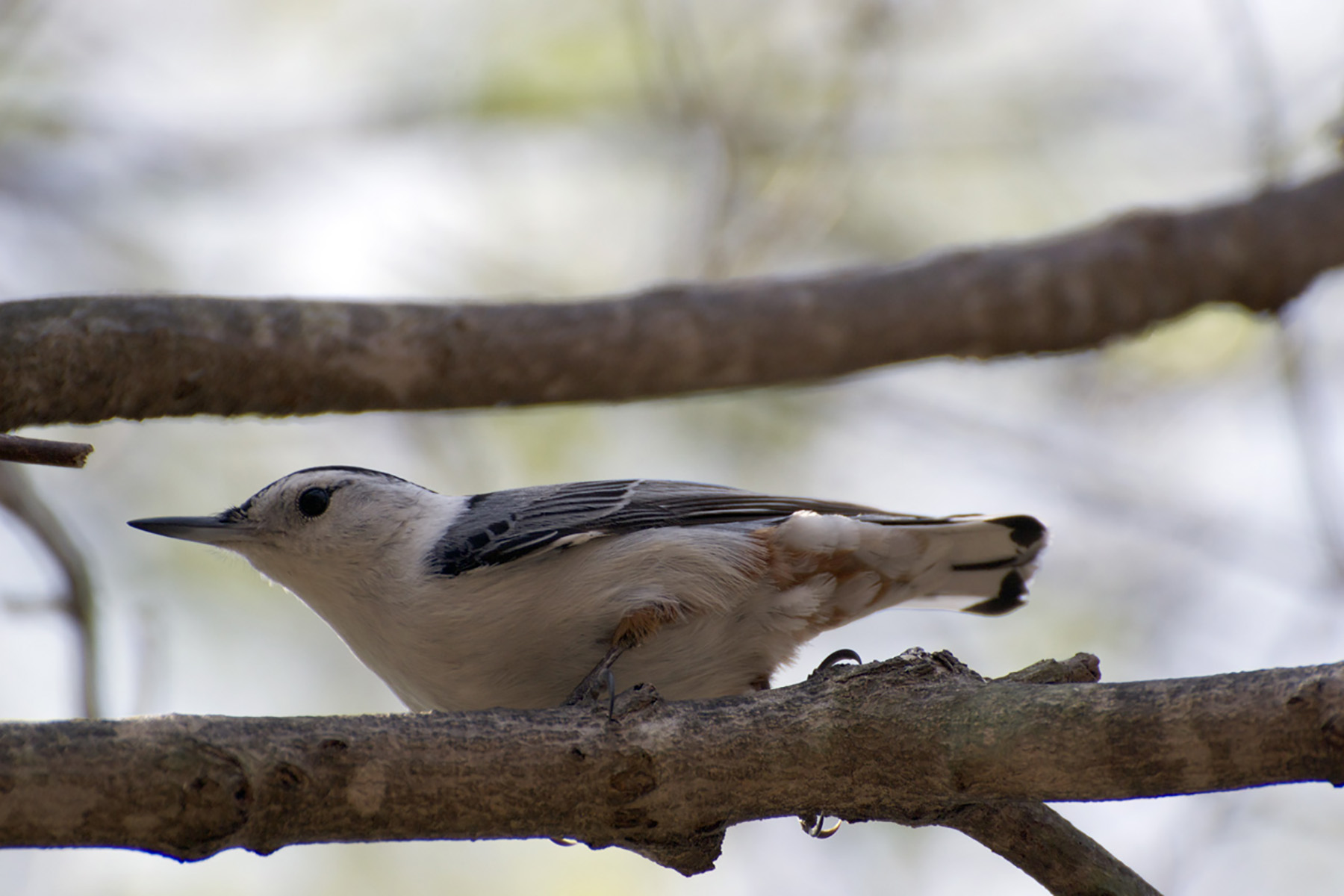
Good news: if you don’t want to look at my bird brain’s gleanings, look at the bird art instead which I photographed while waiting at the clinic after the booster, so the nurse could be sure I didn’t keel over…

Artist plaque said: Susan Freedman, Beaverton, OR. Here is the website I found. I figured I’d compliment the encaustics with photographs of the real thing, or whatever I assumed the birds to be.

Other news? Here are the things I encounter when doing my morning survey of incoming oddities. You can see why my brain is starting to accelerate towards entropy. Evidence: I thought some of these pretty useless facts were amusing.

  • German word of the day is Wohlstandsverwahrlosung, a state of decay that results from having it too easy for too long, leading you to selfishly compare your own petty grievances &mediocre accomplishments to the pain &struggle of people who know the meaning of real problems.
  • An example of what celebrities can do for Ukraine: Today David Beckham handed over his Instagram account with 71 million followers to Iryna, a Ukrainian doctor from Kharkiv who is caring for Ukrainian civilians under Russian attack.
  • Tell me a simple fact that simply blows your mind. For example, every ‘c’ in Pacific Ocean is pronounced differently. Your turn.

  • The English language makes no sense. You can understand it through tough thorough thought though.
  • Samurai were officially abolished in 1867. The first ever fax machine was invented in 1843 and Abraham Lincoln was assassinated in 1865. Which means there was a 22 year window in which a Samurai could have sent a fax to Abraham Lincoln.
  • Cleopatra lived closer to the launch of the iPhone than she did to the building of the pyramids at Giza.
  • Joe Biden was born closer to Lincoln’s presidency than his own. 1865 Lincoln’s presidency ends…1942 President Biden is born…and President Biden is now 79. Yes indeed, it’s true.

And finally after yesterday’s Hearings, that would have been disgusting even with an intact brain:

And that is what the News reports “captured” in the everlasting desire to “both-sides…”

I guess mine is not the only birdbrain this week….. so what. (Title of today’s music as well…)

Just twittering along.

Snapshots

Preface: I debated long and hard if it was frivolous to post today’s musings, written at the beginning of the week, given the grim news out of Ukraine as Putin’s forces have fully invaded the country and appear intent on regime change. But I do believe we need to take care of our mental health by not exclusively thinking about terrifying things, and so thought this would be 10 minutes of your day to focus on something else. I will, however, add at the end some sources that support Ukrainians from a variety of perspectives.

————————————————————–

A lot of people I know are happy to buy old photographs they find at flea markets or antique stores. Not the artistic kind, mind you, but snapshots of people who they never met, who have probably walked on long ago, and whose families had no interest in keepsakes. I have always felt that it was intrusive, somehow crossing a border into someone’s privacy, not quite kosher.

Nonetheless, I very much enjoy it when collectors actually come up with some interesting aggregate that tells us something about similarities and differences across time, or capture a Zeitgeist, or point to some inexplicable curiosity. I know, I’m not consistent, but then who is….

One of those accumulations of discarded photographs was published in 2015 by a Frenchman, Jean-Marie Donat, who had searched for and found photographs of people posing with others, costumed as polar bears, in Germany from the 1920s to the 1960s. The book’s limited edition, a collection of over 200 found photographs weirdly titled TeddyBears, is sold out. Thus I cannot tell if the mystery of such a strange prop was ever revealed.

There is speculation, though, that the hype started with 2 beloved polar bears in the Berlin Zoo in the early 1920s, and costumed employees taking pictures with themselves and visitors to increase zoo attendance. From there it spread.

I can personally vouch for the presence of such creatures in Berlin with this 1928 picture of my then 4-year old mother, posing to the left of the bear. How the album survived war and flight, I don’t know. If that picture had landed at a flea market, perhaps I’d be glad for an interested collector who would keep that smile around.

Another edition of snapshots – this time of women in trees – was recently showcased in The Marginalian (formerly Brainpickings.) Described as “Sweet and Subversive Vintage Photographs of Defiant Delight,” Popova offers both some of the photographs and her, as always, thoughtful commentary on the nature of tree climbing and taking photographs of unusual activities or circumstances.

The collector Joachim Raiss eventually jumped on the polar bear train as well, it looks like. Irresistible flea market finds, I guess. The views of women in trees appealed to me, someone known to have climbed a tree or two in better times, as a display of discarding of norms and exuberant recklessness, even if Sunday finery was involved.

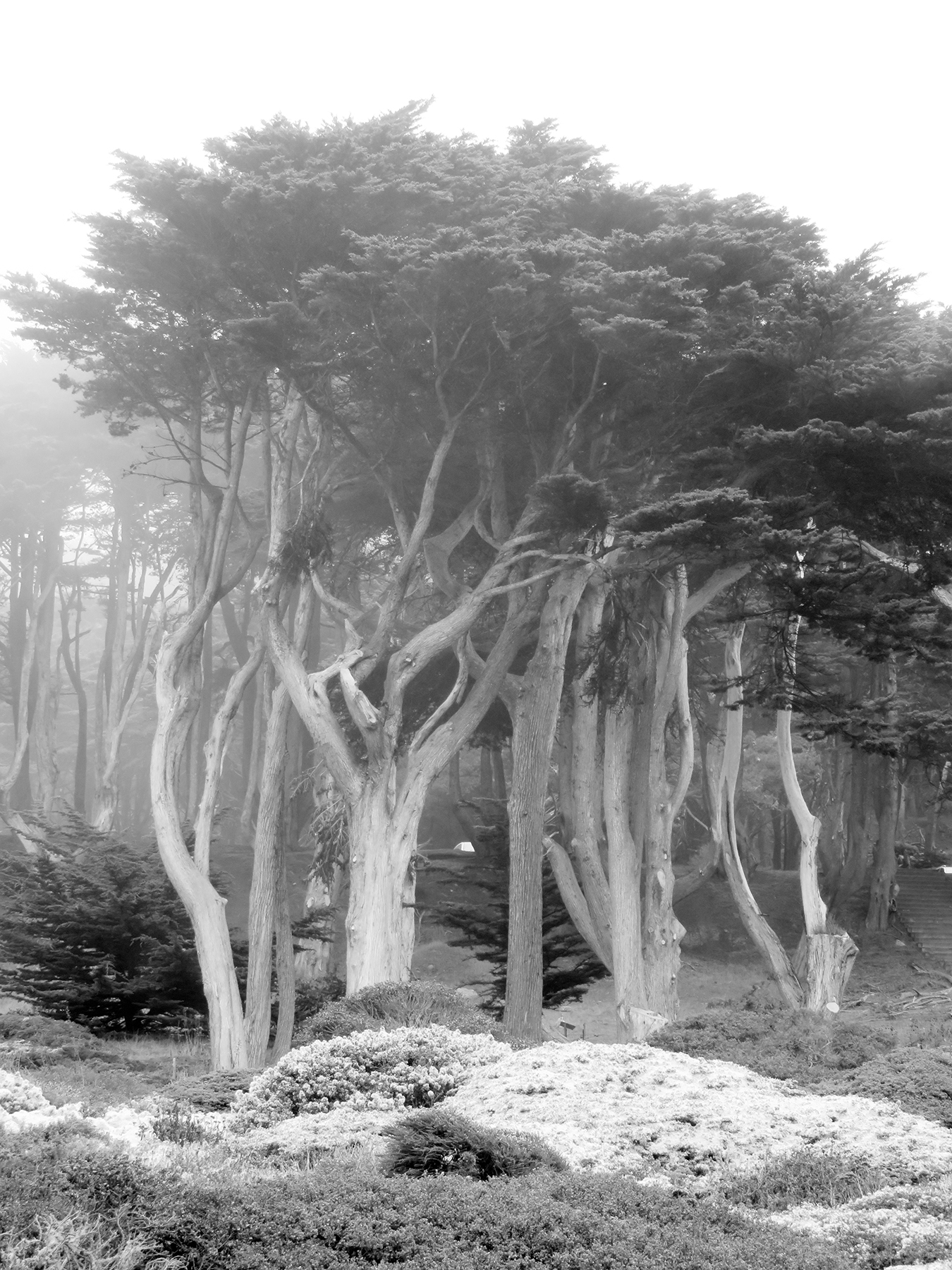
(My photographs today are of unclimbed but admired trees, pines and eucalyptus, in San Francisco’s Golden Gate Park and along the Pacific coast.)

Speaking of reckless and tree climbing: How does this bit of science journalism sound to you?

Climbing a tree or balancing on a beam can dramatically improve cognitive skills, according to a study recently conducted by researchers in the Department of Psychology at the University of North Florida. Working memory capacity increase of 50 percent found in research.” (Ref.)

These assertions refer to a study that looked at a group of adults who were given training exercises that focussed on proprioception, the awareness of body orientation and positioning. They engaged in activities that required both attention to body position and physical exertion – lifting, running, balancing, crawling, specific new sequences of movements. Their working memory (how you process and remember facts currently in your view) was tested before and after the training and it improved! Control groups either listened, while seated, to a lecture, or did a gentle form of Hatha Yoga, Kripula Yoga, which focusses on body posture and awareness, contraction of muscles and breathing, and neither control group showed a gain in working memory capacity.

Shall we rejoice – hey, all we need is the right exercise and our decrepit memory picks up… or shall we give the study a closer look?

For one, no mention of tree climbing in the methods section – where did that come from? Secondly, the groups were extremely small, just 18 participants in the experimental condition of movement training, larger control groups, but still underpowered and in any case not the same number of participants.

Groups also varied along so many dimensions that any comparison is very hard to link back to a causal factor. The age composition was different, the gender composition was almost reversed between training group and one control group.

The duration of the experiment was much longer for the training group (2 and 2.5 hrs respectively for training, while only one session for one hour at yoga.) The training exercises were new, the yoga control, however, was intermediate, in other words familiar with the moves. (It is also inexplicable why this study did not find a beneficial effect of Yoga on working memory, when many other studies of Hatha Yoga have…).

And last but not least, the task they used to assess memory improvement is not one of the better ones, we’ve had more precise tools in our tool box for the last 20 years.

I am summarizing these things not only so you don’t have to slog through a methods section. More importantly, I don’t just want to point out that there is weak research out there and data interpretations that cannot be trusted – I assume we all agree on that.

I am trying to stress the issue of reckless science reporting, that papers over ambiguous results or introduces bad data, and will soon be contradicted when the next result is out that points in a different direction. The public, in general, is mostly not aware of what constitutes reliable science and what should never have made it through the review process. Seeing conflicting results, ever changing tacks on this or that claim, will undermine trust in science, at a time when that trust is already at a low point, politically expedient for some, no doubt.

Shouting not from the rooftops, but the tops of trees: check the science before jumping to conclusions and writing it up for cheap effects in the news. Scientist in tree insists!

Music today is from Berlin in the 1920s where many of the snapshots were taken, Kurt Weill’s Dreigroschen Oper original version.

And here is another Weill song, covered by David Bowie who lived in Berlin and performed live there.

And no, I did not really climb that tree! I climb heights with photoshop these days…. But I did photograph the tree.

—————————————————————————-

NGO that arranges life-saving equipment for Ukrainian soldiers: https://savelife.in.ua/en/donate

Hospitallers working at the frontline: https://www.facebook.com/hospitallers/posts/2953630548255167

Ukrainian Women’s Veteran Movement:  https://www.uwvm.org.ua/?page_id=3437&lang=en

NGO that assists internal refugeeshttps://unitedhelpukraine.org/

NGO that assists internal refugees, especially from Crimea: https://www.peaceinsight.org/en/organisations/crimea-sos/?location=ukraine&theme

NGO that aids traumatised childrenhttps://voices.org.ua/en/

Foundation that assists healthcare and education in eastern Ukraine: https://razomforukraine.org/projects/zhadan/

They were sent out by Timothy Snyder, a historian of the region.

Honor the Past, Respect the Present.

How do you persist as an individual, a group, a people, when insult is added to injury in a never ending stream of violations, ignorance – willful ignorance -, appropriations or plain, colonial hostility? What are the sources for resilience, when you face scarcity, displacement, disrespect and racism in continuity?

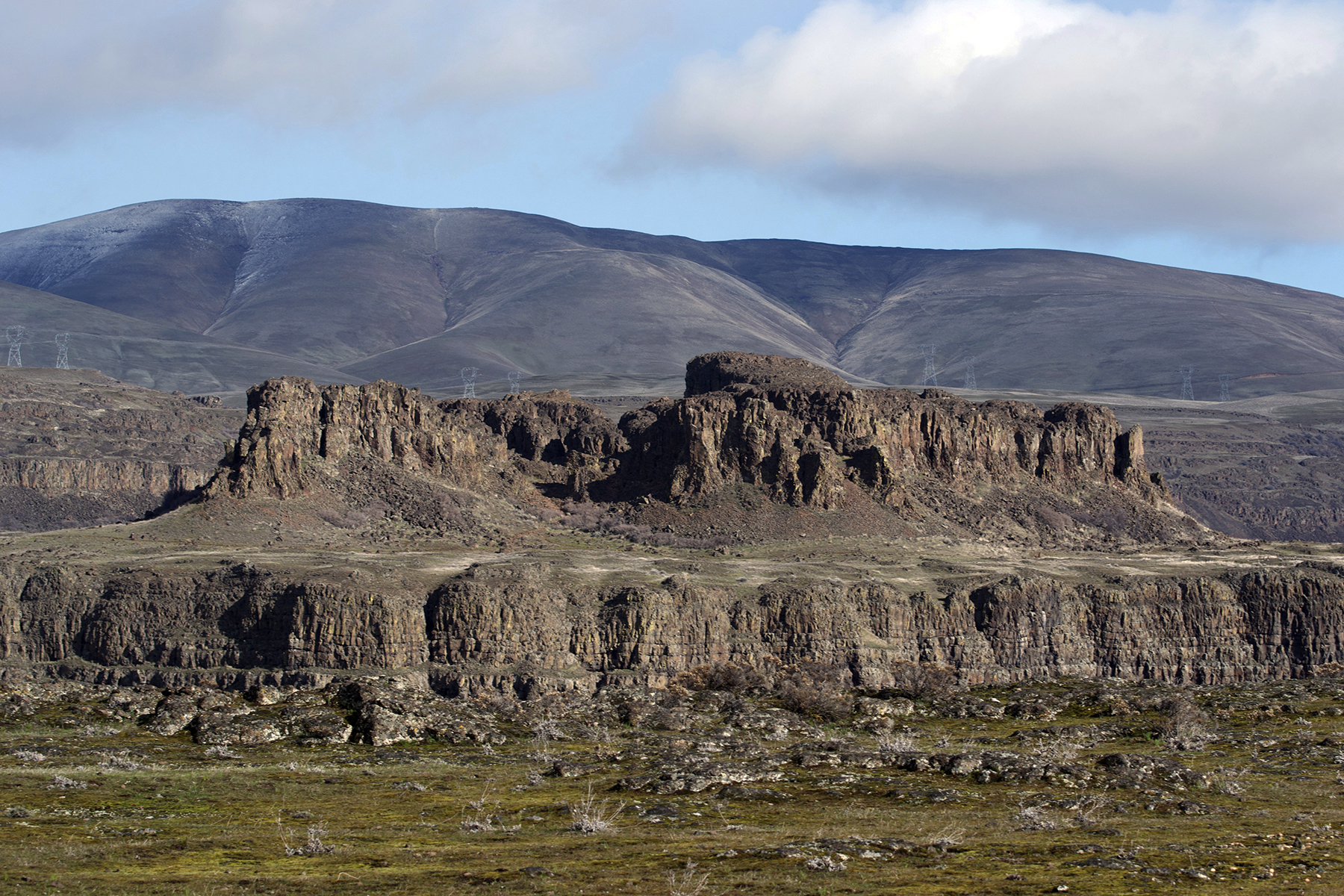
These thoughts went through my mind while standing in a sun-lit, silent landscape on the Washington side of the Columbia river near Horsethief Butte, the quietude only occasionally interrupted by the calls of birds of prey.

I was looking across the Temani Pesh-Wa Trail, lined by pictographs (rock paintings) and petroglyphs (rock carvings) that were created by the First People who lived in the Gorge and the surrounding uplands. The introductory panel read: Honor the Past, Respect the Present.

The story of these particular stones is one of sorrow and resilience, with little honor or respect from most of us non-indigenous folks when it comes to their fate in the last century, until they were placed at Columbia Hills a few years ago.

Nobody knows how many of these images existed along the shores of the Columbia. It is estimated there were about 90 or so sites between Pasco and The Dalles. The rocks before you were about to be submerged when the floodwaters rose from yet another dam, the inundation of the John Day Reservoir. The U.S.Army Corps of Engineers cut out just a few of them in time and they were relocated under the guidance of Chief Gus George, (Rock Creek Indian) in the small town of Roosevelt, Wa. Stored there, in a small, unprotected park, they were subject to vandalism and decay, given that the community simply did not have the means to protect them from visitors who came to do rubbings, or worse. Several disappeared, taken as souvenirs or stolen by collectors, who knows. (I found much of the information for today here and here.)

Relocated again in 2003, they spent an interim decade in Horsethief park until they found a final home at the Temani Pesh-Wa Trail in 2012 with the help of the Wanapa Koot Koot working group that consisted of representatives of the Confederated Tribes and Bands of the Yakama Nation, the Confederated Tribes of the Umatilla Reservation, the Confederated Tribes of the Warm Springs Reservation of Oregon, the Nez Perce Tribe and government administrators. Tribal elders and cultural specialists engaged to present tribal values and respect for the original creation of their ancestors. The site is open 7 months of the year and some of the paths only accessible with a guided tour, leading to the cliff face that depicts Tsagaglalal, or “She who watches” in the Wasco-Wishram language.

Vandalism and theft is a physical attack on heritage objects. Another is appropriation of imagery that does not belong on t-shirts, mugs or any other tourist trap merchandise. But there is also an issue with the use of language and interpretation of something that is rooted in a different culture. As early as 1719 Cotton Mather (on the East Coast) described “writing on stone.” Across the centuries the images caught the interest of archeologists, anthropologist, plain old explorers and people interested in the history of their region. Guesses about origins and interpretive or value judgements proliferated.

Source for archival images here

Eventually people settled on calling them rock art. Stop that!, argues eminent Native American artist Lillian Pitt carefully and Jon Shellenberger (Yakama), who holds a BS in Anthropology and MA in Cultural Resource Management, passionately.

Petroglyphs/pictographs are not art.  They are sacred images that represent significant cultural themes, messages, beliefs to a Tribe.  They were not created for aesthetic purposes.  They were created to teach, warn, or record those not yet born.  Even though we may think that they are pretty, beautiful, pleasant to look at, those are not the values inherent in the images you see.  those are the values that you as the viewer are placing on the image. Please stop calling them rock art. “

There is a lot of meaning conveyed through petroglyphs/pictographs.  Some of that meaning is known and some of it is only known by certain individuals within certain families. Many tribes didn’t have a written language and depended on oral tradition to perpetuate their culture.  These images are a manifestation of the culture as it relates to the environment.  They demarcate sacred sites, warn people to beware, indicate the presence of animals or plants, and are at times prophetic.  Elders are still learning about the meaning of specific petroglyphs and its only in certain stages of life that they are able to understand their meaning.” 

Contrast that with an interpretive sign at another petroglyphs site at Death Valley National Park:

Indian rock carvings are found throughout the western hemisphere. Indians living today deny any knowledge of their meaning. Are they family symbols, doodlings, orceremonial markings? Your guess is as good as any. Do not deface – they cannot be replaced. (bolded by me, source here.)

Licence is given to impose our (non-native) interpretations and stereotypes on objects as if we have the same amount of knowledge or insights as the living descendants of those who created the images, or tribal archeologists and anthropologists. Our fantasies of renewal and closeness to nature, of a long lost authenticity that we associate with Indian tribes, are superimposed on the carvings, when we have no clue what they really meant in the context where they were created.

The stakes in the interpretation of rock art are substantial. Interpretations of(pre)historic rock art’s original meanings and functions, especially when passed on to the public through guide books, museum displays, and interpretive materials at rock art sites, have the potential to shape perceptions of Native Americans, challenging or reinforcing dominant perceptions of indigenous cultures and histories.” (Ref.)

Native Americans, like Lillian Pitt, explain the nature of these carvings as part of religious ceremonies, hunting rituals, or for the purpose of communicating important messages. Some were private, done by young people on vision quests, others public. Pictographs were painted with pigments derived from coal, iron oxide deposits (hematite and limonite,) clay and copper oxide. Ground into powder and added to a binder of fat, bolded, eggs, urine, saliva or plant juices, they were applied with fingers. Petroglyphs were achieved through carving into the rock, pecking, scratching or scraping with a harder hammer stone.(Ref.)

They all have in common a spiritual nature which requires that the sanctity of the place where we encounter them (even if they have been moved 4 times in 50 years… ) needs to be respected. Not my place of origin, not my culture, not my knowledge base – but a sense of linked humanity, a desire to communicate shared across the millennia.

It was easy to feel awe and reverence, on that bright morning, myself a tiny speck in a large landscape,

surrounded by ground squirrels and bald eagles,

and goose tracks,

facing a small tree that symbolized resilience, defying a barren location.

Nez Perce songs today for music. If you are interested in seeing work of contemporary Native American artists, visit Maryhill Museum, which opens again March 15th!

Of Fish and Men

When humans were created, the Creator asked all the animals what they could do to help humans survive, as they didn’t know how to feed themselves. According to the legend, the salmon volunteered to help. Salmon was the first animal to stand up. It said, “I offer my body for sustenance for these new people,’ I’ll go to far-off places and I’ll bring back gifts to the people. My requests are that they allow me to return to the place that I was born, and also, as I do these things for the people, I’ll lose my voice. Their role is to speak up for me in the times that I can’t speak for myself.

– Traditional story from the treaty tribes of the Columbia, related by Zach Penney, the fishery science department manager at the Columbia Inter-Tribal Fish Commission (CRITFC.)

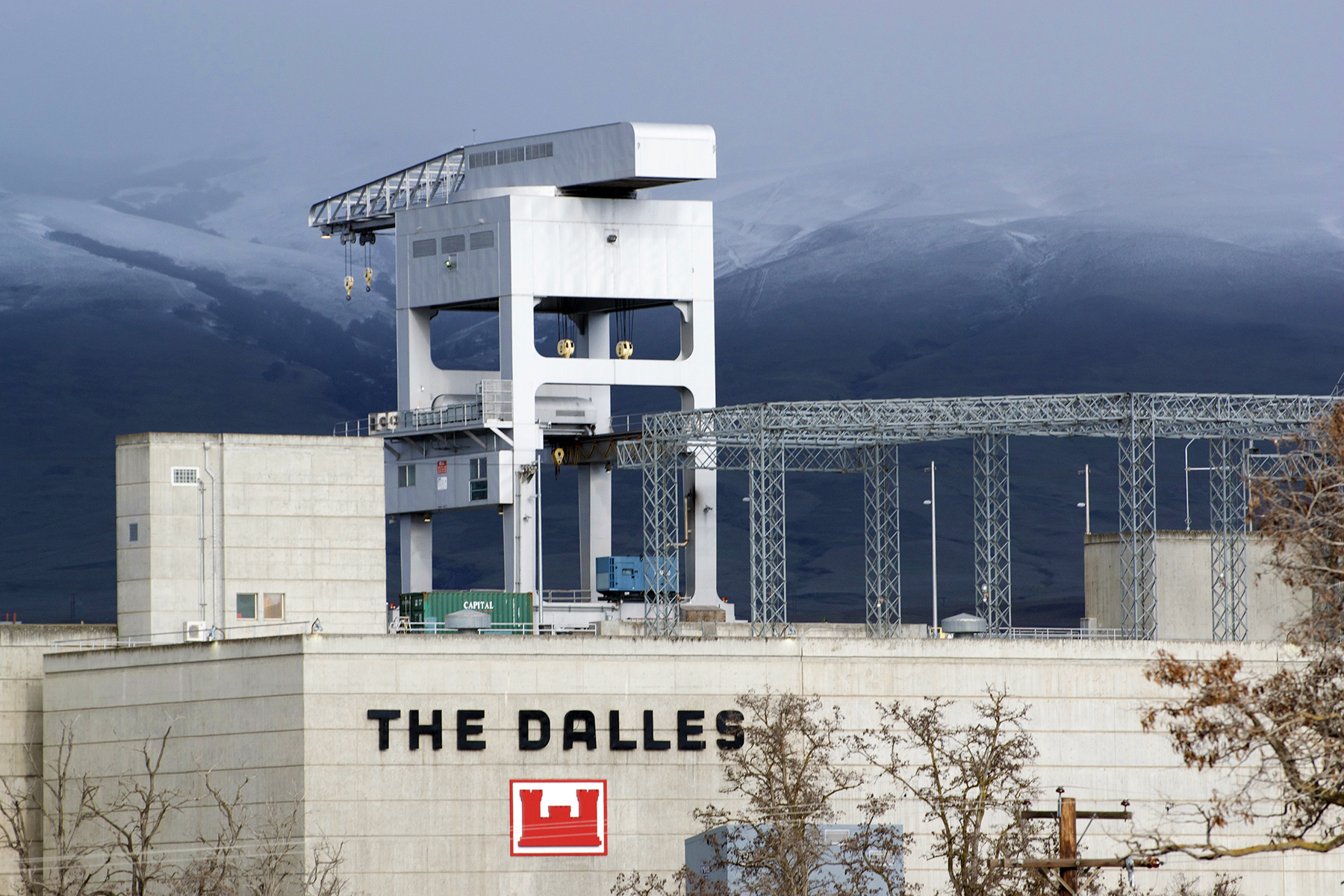
I had driven to The Dalles to get a glimpse of the bald eagles that were supposedly congregating in high numbers around the dam. No such luck, wouldn’t you know it.

One lonely bird….
A second one if you use a magnifying glass….

Instead there were plenty of other interesting sights, from the snow-capped hills that looked like they were sprinkled with powdered sugar,

to numerous traditional fishing scaffolds perched over the Columbia river.

A perfect occasion, then, for a reminder of what we know about salmon fishing given its central role in the physical and spiritual lives of indigenous people who have pursued it in this region for at least 10.000 years. Salmon are iconic to Northwest indigenous culture and identity, but also the main source of protein across these millennia. The fates of salmon and the Northwest tribes are intertwined and received an immeasurable blow when the Dalles dam was constructed in 1957. The dam inundated the upstream Celilo Falls and Celilo village, the largest trading center for salmon since times immemorial. There was scant compensation for the loss, subpar housing built only for a few permanent residents of the village who were displaced, ignoring all those tribal members who lived on reservations but regularly came to Celilo to fish and trade. It took until 2005 to start building the promised structures and no serious reparations have been paid for the immense loss of livelihoods that depend on salmon fishing. (Ref.)

The runs consist of five species of salmon, Chinook (king), sockeye (red), coho (silver), chum (dog), and pink (humpback) and steelhead, a migratory form of trout. All of them, shown below, existed in abundance, not least because native fishing practices controlled for overfishing. (I got most of my material for today here and here. The second source includes a detailed and fascinating description of the life cycle of the salmon, much more complex than they taught you in 5th grade! More on the history of the tribes that have fished here for millennia can be found at the Museum at Warm Springs – well worth a visit for their photographic collection alone. It was just featured in OR Arts Watch.)

From John N. Cobb, “Pacific Salmon Fisheries.” (Washington, DC: Government Printing Office), 1921, Courtesy of Smithsonian Institution Libraries

The bad news first: salmon runs have been in further decline, harmed by dams, overfishing, and, by environmental degradations caused by farming run offs, construction and land fragmentation, local logging and mining and now the universal water-heating effects of climate change.

The good news next: organizations like CRITFC play a central role in trying to manage, restore and improve the situation, representing the four regional tribes, Nez Perce, the Confederated Tribes of the Umatilla Indian Reservation, the Confederated Tribes of the Warm Springs Reservation of Oregon, and the Confederated Tribes and Bands of the Yakama Nation. With over 100 employees across multiple departments, they offer biological research, fisheries management, hydrology, and other science to support the protection and restoration of Columbia River Basin salmon, lamprey, and sturgeon. Equally importantly, they continue to ensure that tribal treaty rights are protected, with the help of their lawyers, policy analysts, and fisheries enforcement officers.

Fish ladders and hatcheries help support salmon, but the runs continue to struggle. Just a fraction of the fish successfully journey from ocean to spawning areas each year as revealed by tagging salmon and collecting DNA samples and other data by the fishery scientists. Hatcheries can increase the harvest, but they also have downsides. They are believed to have contributed to the more than 90% reduction in spawning densities of wild coho salmon in the lower Columbia River over the past 30 years. Why? When domesticated fish breed with wild salmon the genetic fitness of the offspring can be diminished. When hatchery fish are released, they compete for food in the wild and often eat the smaller wild fish. They bring diseases, caused by their hatchery crowding, into the wild fish populations. It is not a solution.

Historically the environmental knowledge of tribal members and their willingness to fight to protect the fish have been one of the few things to ward off complete disaster. The taboo to take spawning fish, waiting periods at the beginning of the upstream runs and limited fishing periods overall all ensured, for tens of thousands of years, that fish would return. And then the Europeans arrived.

The requirements for healthy salmon runs:

“A natural river meanders and sometimes floods, creating quiet side channels that salmon require. The fish also need their eggs, buried in gravel, not to be suffocated in dirt nor swept away. They need them to be nourished by oxygen-rich cool water flowing through the egg pockets. They need enough water in the stream — a dewatered streambed is a salmon graveyard. They need access downstream to the ocean and upstream to their spawning grounds. They need unpolluted water.”

All was affected by the newcomers. Land for farming, cleared down to the water, deprived the rivers of shade for cool water temperatures. Clear-cut riverbanks created silt that suffocated the spawning beds. Irrigating the crops emptied the streams. Dams without fish ladders, needed for flour – and woolen mills, irrigation and later electricity and even recreational purposes (lakes for powerboats…) interrupted up-stream fish travel.

As of 2020, in Washington State alone they counted 1,226 regulated dams (many do not cross streams but contain irrigation ponds, manure lagoons, and the like.)

Logging of old growth trees increased fires, destabilizing the riparian woods, again increasing silt. Loggers also built splash dams to facilitate the log floats down river – first backing up water then releasing it in a flash, disastrous for salmon fry. Mining booms created town constructions which in turn excavated river beds for gravel, sand, and limestone. Hydraulic mining required extensive ditch systems and dams. Detritus and chemicals washed into the creeks, destroying spawning beds. And all that even before extensive overfishing continued with no regard to the consequences.

In 1854 a treaty was signed at Medicine Creek which granted the tribes “The right of taking fish, at all usual and accustomed grounds and stations…” – words fully ignored. Many governmental restrictions were aimed at tribal fishermen, while licenses were granted to commercial fishermen and then sport fishermen, increasing the maximally allowed harvest even when it was already common knowledge that the runs were endangered.

“In 1935, the first year Washington kept records, the tribal catch was 2 percent of the catch whereas “the powerboat fleet hauled in 90 percent. According to state records, the entire Indian catch for Puget Sound from 1935 to 1950 accounted for less salmon than taken by the commercial fishing fleet in one typical year” (Ref.)

Eventually tribal representatives tried to fight for their rights in court, which upheld the treaties only to be ignored again by state governments. Tribal activists like Billy Frank Jr. and Bob Satiacum and their supporters staged now legendary fish-ins in the 1970s to protest limited fishing seasons, only to be arrested. This led to the United States Department of Justice filing a case against the state of Washington (US v. Washington, 384 Fed Supp). Judge George Boldt (1903-1984) issued a historic ruling (upheld in appeals) which affirmed the tribes’ original right to fish, which they had retained in the treaties, and which they had extended to settlers. It allocated 50 percent of the annual catch to treaty tribes, changing the ground game for fishing (and making a lot of non-tribal folks intensely angry.)

Restoration efforts are joined, though, by multiple constituencies.

Landowners including farmers, tribal governments, state agencies, conservation organizations, and individual volunteers from all walks of life are replanting riverine forestland, removing invasive species, placing woody debris, installing engineered snags, and reconnecting floodplains to their rivers. (Ref.)

We’ll see if the efforts can outrun the averse effect of population growth, stream bank development and loss of forest cover to fires. Removal of dams continues to be a key issue.

In the meantime here is a clip of traditional salmon fishing and the wise instruction of Brigette McConville, salmon trader and vice chair of the Warm Springs Tribal Council and a member of Warm Springs, Wasco and Northern Paiute tribes: “Whoever works with fish, it’s important to be happy. The old saying, ‘don’t cook when you’re mad,’ that’s true in every culture.”

Here is a poem by Luhui Whitebear, an enrolled member of the Coastal Band of the Chumash Nation and the Assistant Director of the Oregon State University Native American Longhouse Eena Haws.

The Year of the Tiger

Two billion people across the world celebrate the Chinese Lunar New Year tomorrow, 2/1/2022, the Year of the Tiger. Last week I went down to Lan Su, Portland’s Chinese Garden, on a cold, sunny day to marvel at the decorations as I do every year. If you expect me to write exclusively about tigers, though, you should know better by now!

It has to be about hippopotamuses as well. I could stretch to find a connection, hippos being fierce (like the Chinese Zodiac sign of the tiger,) or semi-aquatic, linking to the fact that 2022 is a Water year for the Chinese Zodiac.

But in truth, even the hippos are just a part of today’s topic: how science approaches the (re)introduction of species to places from which they have vanished, or never lived before.

I was alerted to the issues when hearing about the hippos who were left to fend for themselves when Drug Lord and all-around-evil-guy Pablo Escobar was killed by Columbian police in 1993. He had a private zoo next to his mansion that hosted 4 hippos which escaped into the wild when the estate was left to itself. Here we are now, 30 years later, with an estimated 80-100 hippos congregating along the neighboring Magdalena River. That number might swell to another 800-5000 hippos in the next 30 years, depending on who is doing the estimating (Ref.) Hippos have no natural predators in Columbia, nor are their numbers culled by droughts as they would be in their native countries in Africa. They happily procreate.

Well, not much longer. Since it is legally forbidden to kill them, after a public outcry when the first of these escaped beasts was shot, the Regional Autonomous Corporation of the Negro and Nare River Basins (CORNARE) is now culling the herd by sterilizing the animals. They deliver doses of a contraceptive vaccine to the hippos which works on both males and females, via dart guns. The reason for a comprehensive sterilization program lies with multiple threats to the environment if the hippo numbers increase unchecked. Their grazing for food is intense and prevents other herbivores to get to the nourishment they need (a single adult hippo consumes about 88 pounds (40 kg) of grass per day.) The amount of poop deposited in the river is a threat to some aquatic plant and fish populations. And hippos can be quite aggressive if too close to human contact, with inevitable violent encounters in shared space with the fishermen.

It is easy to visualize how a foreign species hurts the balance of an ecosystem. Or what re-introduced species do to environments that have changed so much over the millennia as to not be recognizable given the landscape fragmentation. But scientists have started to look not just for the negative aspects of rewilding or new (if unintended) introductions, but to catalogue the positive trends associated with animals in new places. It looks like they just might serve some ecological functions that were earlier offered by now extinct species. New folks picking up the slack!

Here are the principles that the International Union for the Conservation of Nature (IUCN) established:

Take the hippos. Their daytime grazing habits are similar to those of now extinct giant llamas that lived in Columbia in the Pleistocene. Their defecations bring nutrients to rivers that extinct semi-aquatic creatures of yore provided. But the numbers need to be monitored and if necessary, constrained.

Northern Australia lost its giant marsupials. They are in some ways replaced by grazing water buffalos, the largest herbivores since the extinction, whose feeding habits reduce the frequency and severity of wildfires, mitigating the effects of climate change.

Feral hogs, whose rooting in soil increases tree growth and attracts bird flocks, are replacing ecological work done by extinct giant peccaries in North America. The original American horses, which died out about 12,000 years ago, are now replaced by feral mustangs and burros in the American West who engage in well-digging behavior like their forbears, protecting water resources.

These are just a few examples. More details can be found here.

And guess who is rewilded in China? Yup, South China tigers. They are taken from Chinese zoos, the only place where they exist now, and reintroduced to open terrain in wild life preserves in South Africa. Once they have learned to live outside of captivity they will be released back in China. May the Year of the Tiger see an improved coexistence of humans and nature!

Here is some traditional Chinese pipa music. Happy New Year to those who celebrate!

New Year’s Resolutions.

2022. Welcome to a glut of grim as NYT editorialist Frank Bruni put it so aptly a few days ago.

Let’s ignore it and focus on New Year’s resolutions instead.

Which happen to be the same as the Old Year resolutions…. well, mine anyway.

What have we got?

A deep urge to bear witness, even if it hurts so often, since it is about the only thing I can do these days with times of active protesting gone the same way as has my unwrinkled skin, my youthful energy (hah), my casual risk taking.

Bearing witness can come in a number of ways – one is not to look away when confronted with the misery or injustices of the world, the plight of the houseless and incarcerated, for example. Another is to seek out facts that truly inform us, when those facts are often conveniently stashed out of sight.

Which brings me to the second resolution: staying grounded in observation and reason, not believing with “blind faith” or falling for “alternative truths.” Two plus two equals four. Wishing otherwise doesn’t make it so. Neither does claiming so. In a world where fear and unpredictability have given rise to unprecedented amounts of conspiracy theories, let’s focus on scientific expertise.

Add to that a third resolution: let’s practice courage. Courage to live, to resist, to speak up, to goof off on tangents because they bring pleasure. Courage to chronicle, knowing full well that we are witnesses in the shadow of death around us. Courage to turn to both: the historians and the poets. Historians because they tell us about those in power and what they do with it, crimes and lies included. Poets because they often convey the essence of history from the perspective of the victims – suffering and humiliation.

And no poet did this better than Zbigniew Herbert. I want to start 2022 with the poem I have offered here before – it just remains one of my favorites of all time, and encapsulates all I have listed above. His words infuse me with courage, remind me of the power of faith (in whatever you happen to believe) and point to our moral obligations even when the going gets rough. It sings a quiet defiance to historical facts of oppression and manipulation.

The Envoy of Mr Cogito 
                   by Zbigniew Herbert

                   Go where those others went to the dark boundary 
                   for the golden fleece of nothingness your last prize

                   go upright among those who are on their knees 
                   among those with their backs turned and those toppled in the dust

                   you were saved not in order to live 
                   you have little time you must give testimony

                   be courageous when the mind deceives you be courageous 
                   in the final account only this is important

                   and let your helpless Anger be like the sea 
                   whenever your hear the voice of the insulted and beaten

                   let you sister Scorn not leave you 
                   for the informers executioners cowards – they will win 
                   they will go to your funeral with relief will throw a lump of earth 
                   the woodborer will write your smoothed-over biography

                   and do not forgive truly it is not in your power 
                   to forgive in the name of those betrayed at dawn

                   beware however of unnecessary pride 
                   keep looking at your clown’s face in the mirror 
                   repeat: I was called – weren’t there better ones than I

                   beware of dryness of heart love the morning spring 
                   the bird with an unknown name the winter oak 
                   light on a wall the splendour of the sky 
                   they don’t need your warm breath 
                   they are there to say: no one will console you

                   be vigilant – when the light on the mountains gives the sign- arise and 
                   go 
                   as long as blood turns in the breast your dark star

                   repeat old incantations of humanity fables and legends 
                   because this is how you will attain the good you will not attain 
                   repeat great words repeat them stubbornly 
                   like those crossing the desert who perished in the sand

                   and they will reward you with what they have at hand 
                   with the whip of laughter with murder on a garbage heap

                   go because only in this way you will be admitted to the company of cold 
                   skulls 
                   to the company of your ancestors: Gilgamesh Hector Roland 
                   the defenders of the kingdom without limit and the city of ashes

                   Be faithful Go

  
                                                               translated by John Carpenter & Bogdana Carpenter 

Counterbalancing the gravity of the resolutions and the darkness of the season I offer you colorful brooms – someone reminded me that tradition forbids to sweep and clean on the first day of the New Year. Now where did that myth come from? Found that and other New Year’s old wives’ tales on Maids.com, no less.

Or brooms used for flying, another myth, I’m told. One first mentioned in 1451. Here is a fascinating account of the history associated with witches and brooms. Told you, I’d dig out the fact! Even the facts of the origins of myths…

OK, let’s just remember what sunlight does to color – and that it will surround us again, eventually, sweeping clean the last cobwebs of superstition.

Music today is a reference to the energy which I hope fills the new year and gives you an idea of my kind of house cleaning….

Moving along

I skimmed two unusual books across the last weeks. Skimmed because I could not read 700 pages for one and who knows how many for the other before giving them as Hanukah presents to the kids. But I read enough (plus the reviews) to form an opinion that I can recommend them if you are willing to have your mind blown by one, and learn surprising facts in the other. Long slog today, so you are allowed to skim as well. But another wet weekend might give you enough time to read…

I am talking about The Dawn of Everything by David Graeber and David Wengrow (which I will definitely finish in full when my library loan comes through,) and Move by Parag Khanna.

The Dawn of Everything is a strange, mesmerizing window into the authors’ minds, who are willing to speculate about everything that has been accepted theory about 40.000 years of human history. The anthropology and archeology duo tackle the question if durable hierarchies in the form of nation states are inevitable. Nation states are usually assumed to be the outcome of a natural process due to the development of agriculture, accumulation of property that requires protection and increased population sizes amassed in cities, all leading to leadership hierarchies, domination exerted by state power and bureaucracies. The duo claims that nation states, and in particular undemocratically governed nation states are not at all inevitable, contrary to popular opinion. They point to alternative ways of humans organizing themselves and their lives across history from the very start.

The book is a tour de force of speculation, offering (elsewhere disputed) facts that help question the accepted wisdom of historians. The authors provide example after example of early human societies that avoided states, or subverted them, or decided to accept hierarchies during some times of the year and not during others. The authors certainly make the point that early societies were not in a natural state (innocents in the Enlightenment’s view, or brutes in Hobbes’) until agriculture inevitably changed the picture from an egalitarian to a hierarchical society. Instead they show that hunters and gatherers built their societies intentionally, with consensus. Some showed all signs of democratic approaches, others had inequality already built in. There were endless configurative possibilities and people made choices among them.

So why are we now stuck with nation states? Without providing an answer, the book challenges us to think through if there is STILL a possibility for alternatives, something the authors strongly believe. The classic reasons for statist views of history lie potentially with the fact that people can no longer easily move somewhere else if they dislike a given country, and the fact that bureaucracies have grown to impenetrable proportions. But Graeber and Wengrow show that many early cities thrived for centuries with no sign of hierarchy, contradicting scholars who assume that authoritarian rule appears naturally whenever large populations gather.

I found the book empowering not because it answers questions (it often doesn’t) or simply defies common assumptions (it always does.) It provides a model of a fresh approach when you question things differently. If you no longer think that there has to be an overarching pattern or law that inevitably governs the progression of human development then you can start to think through what alternatives could look like and how to bring them about. You can look at evidence for alternatives or interpret data in a new light. And once you acknowledge the possibility for human intervention, you can alter mind sets and explore ways how to change the status quo of domination of some over others.

The authors worked on this book for 10 years, planning more volumes to come. Graeber died suddenly of an infection at a young age shortly after completion. Here is a written portrait of this unusual, gifted man.

*******************************************************

So why would I read Move when the author is dissed like this from a New Republic review for a previous book:

Khanna’s contempt for democracy and human rights aside, he is simply an intellectual impostor, emitting such lethal doses of banalities, inanities, and generalizations that his books ought to carry advisory notices. Take this precious piece of advice from his previous book—the modestly titled How to Run the World—which is quite representative of his work: “The world needs very few if any new global organizations. What it needs is far more fresh combinations of existing actors who coordinate better with one another.” How this A-list networking would stop climate change, cyber-crime, or trade in exotic animals is never specified. Khanna does not really care about the details of policy. He is a manufacturer of abstract, meaningless slogans. He is, indeed, the most talented bullshit artist of his generation. And this confers upon him a certain anthropological interest.

Okaaaayyyyy. In German you would say this reviewer “had a louse crawling across his liver.” Same origin as the phrase “he’s an offended liverwurst” – since antiquity the liver was assumed to be the seat of emotions, and even as small a trigger as a louse could torpedo one’s mood. Never mind a bullshit artist. But I digress.

Let’s just say, I occasionally try and read widely and consciously from people I don’t necessarily agree with. And you know what? There were some interesting things to be learned from this book and it spoke to the issues of mobility and migration which played also such a role in the volume discussed above. Khanna makes an argument for opening up international borders, given the inevitable future mass migrations due to climate and political factors combined. He proclaims mobility across borders as a human right. He sees realignments likely to be regional (the millions of displaced Asian people will move into Kazakhstan, displaced Chinese will move into Russia, and Central Americans into Canada – all of which have tons of empty space that can be settled with the change in temperatures and according agricultural possibilities.)

The author argues that we need to move people to resources and technologies to people, something that will not happen if we cling to nativist notions of sovereignty. The question is how can you preserve geographic nation states that people feel culturally rooted in and move beyond sovereignty at the same time, into shared administration and stewardship of crucial geographies and resources?

He uses the examples of Canada and, surprisingly, Japan, as nations that have a futuristic outlook towards opening their borders to migrants. Khanna speculates that Europe will attract masses of Asian youth talent, while the nativist US stays behind. He also shows that migration needs to be done sustainably, so that newly opening eco systems are not trampled and then have to be deserted again and gives claimed catch-all phrases like “cosmopolitan utilitarianism” at face value, (the notion of holding all people equal and maximizing their happiness or welfare seems a bit of lip service in his rendering), we should debate how we can move towards open borders and mass wealth redistribution. Here is a summary article where the author explains his position.

In the context of pandemics and the emergence of newer, scarier variants, I believe one might indeed think through how more globally organized administrative powers would protect humanity as a whole. We can close borders all we want to, viruses and other invisible agents will always have a way to escape across them. If we do not coordinate research, prevention and treatment it is only a matter of time until things get worse, and no riches and fortified national castles will protect us. Decisions to give priority to pharmaceutical companies’ investments over radical, global distribution of available vaccines has been rather short sighted.

In any case, both books help move our thinking along, particularly when we don’t agree with some or much of what the authors offer. Just the right thing for late December when the holiday hectic calms down and you need an excuse not to leave the house or the couch on yet another rain soaked day or are forced into lockdown, and can tackle something more than the next mystery novel.

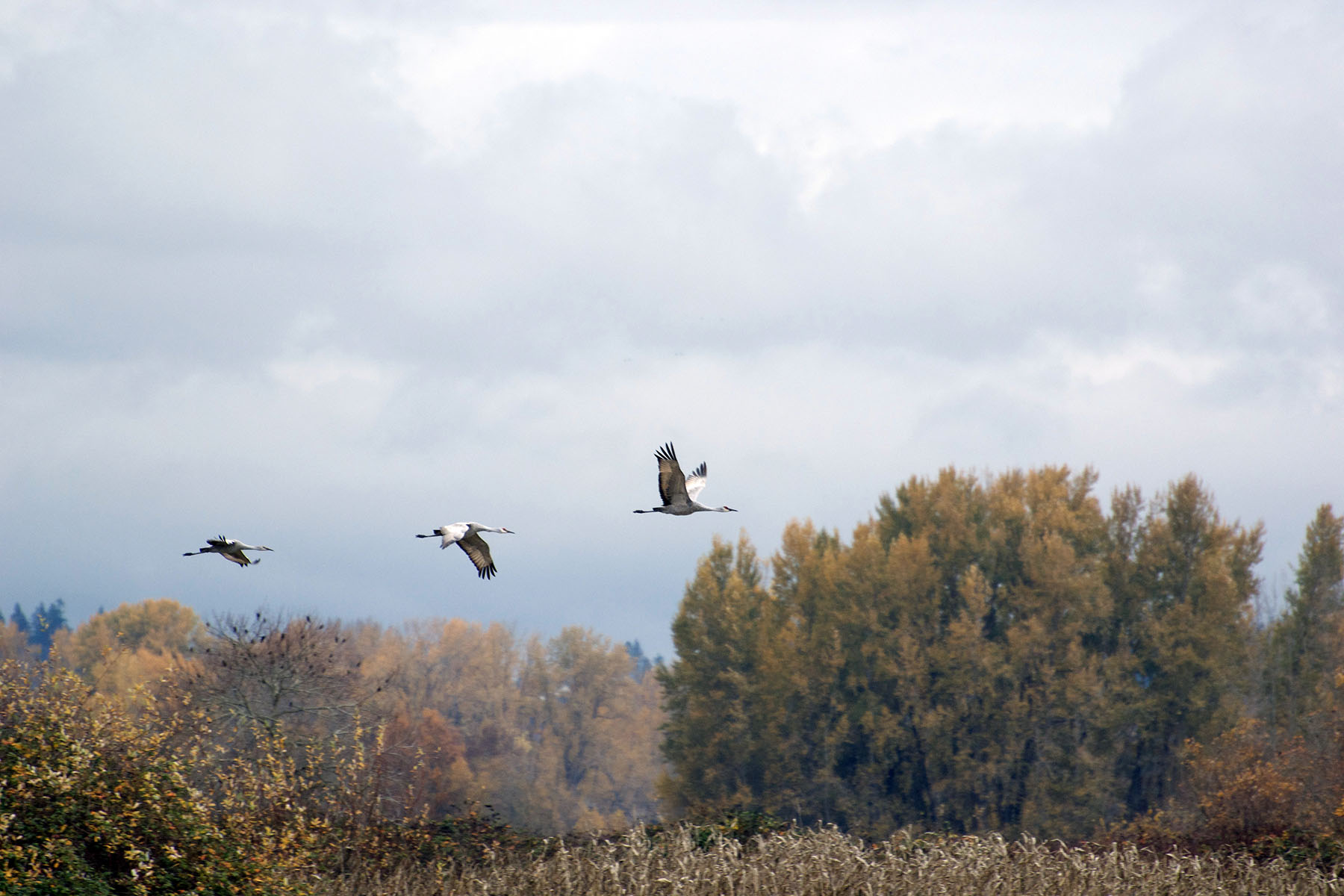
Photos today of birds last week on Sauvie Island, all of whom ignore borders.

Music today can be ambient listening, sustaining dreams of a better future, if reading becomes too cumbersome.

The Wishing Tree

I wish, I wish, I wish – oh, so many wishes.

Some are tinged with ire.

I wish judges like this didn’t exist, much less be allowed to practice law.

Some of my wishes are colored by regret: I wish we had more information about what our actions actually engender. Case in point: Ordering stuff on-line with the full expectation that we can send it back if it doesn’t work out and it will be restocked.

I actually never ever ordered things on-line pre-pandemic, other than getting bed linens from L.L.Bean or some such. I still rarely do it, but felt horrible when I chanced on information that explained the environmental cost of ordering on line right after sending back pants that were too big. And no, we are not just talking cost of transport, the trucks and trailers and planes and container ships wasting fuel and polluting in order to deal with the return of things that did not fit or did not please.

Here is a detailed description of what all these returns amount to: they are thrown into the garbage. Inspection cost (were items worn or damaged,) repacking and restocking cost are so high for the manufacturers that they simply forgo those options for the returned merchandise valued more than $ 100 billion, last year alone. Some items might be stripped for valuable parts, but a lot of it goes directly into the landfill. That is particularly true for clothing.

Why don’t companies donate the returned items to charity, so at least they get a tax write off? Brand dilution! If paying folks see their brand names displayed by the homeless they will no longer buy that brand…many companies now tell you even to keep the unwanted merchandise and they refund you nonetheless, hoping to save the cost, time, and labor to deal with it and leave it to you to dispose of it, pretending that they are generous. In the meantime, people who are not aware of the damage, order in multiple colors and sizes, keeping only the perfect fit and send the rest back.

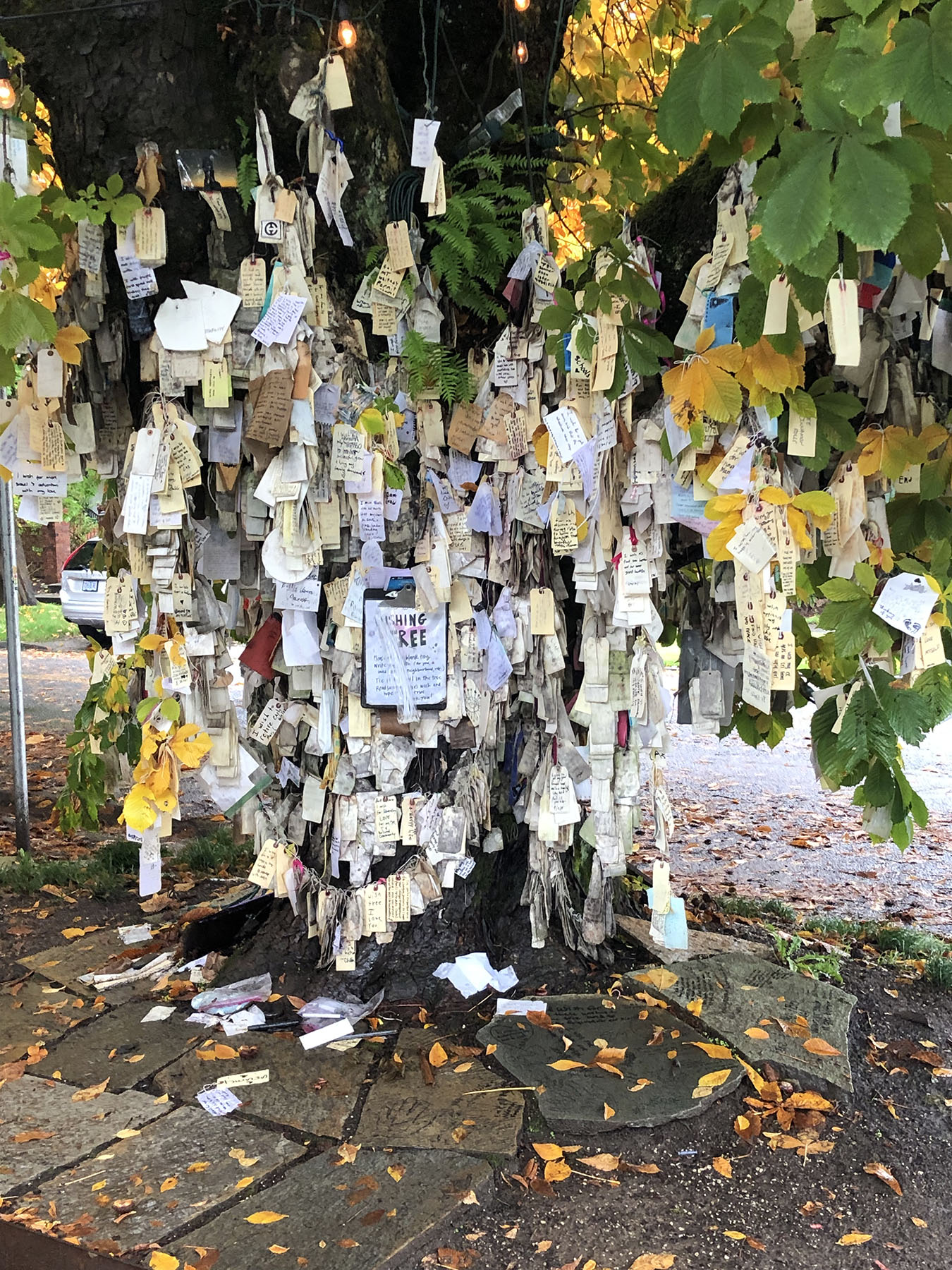
I wish I had known, I wish more of us knew these things. But these are unlikely thoughts to be found on the scraps of paper hanging from wishing trees, like the ancient horse chestnut tree on the corner of 7th and NE Morris St. Established by property owner Nicole Helprin in 2013, this tree has seen so many wishes and dreams added over the years. Rumor has it that the occasional paper blown away into the streets represents a wish fulfilled.

Wishing trees have been around for a long time, across diverse cultures, many concerned with issues of love, fertility, safety, and some with peace. People deposit expressed words, or pieces of cloth, or coins, depending on custom.

Wishing tree from Alaçati, Turkey (source on web)
Tanabata Festival wishing tree in Japan (source on web)
Wishing tree spiked with coins in Scotland ( source on web)
Wishing tree hung with Nazar in Anatolia

Why trees? Association with powerful forces (of nature) or home to otherworldly powers that could make wishes come true? In their height closer to the heavens, home to benevolent grantors? Antennas?

For me psychologically more interesting is the fact that people like to externalize what could be a private prayer or wish – the very act of making it public, saying it out loud, seems to have some meaning. Maybe the act of sharing makes you feel less alone, or heard, even if the next reader is not the powerful entity that could fulfill your wish. Maybe the act of voicing it defines a problem that you want to be collectively remembered and then collectively tackled (certainly for the wishes for peace or end of poverty.) Maybe putting it in words clarifies, through the very act of verbalizing, the hierarchy of your own needs and provides access to thoughts about action.

I wish I knew.

If you don’t have handy access to a wishing tree you can easily send your wishes to a project dedicated to putting up wishes, or, as the case may be, filling a well with them. Yoko Ono started an interactive art work in 1996 asking people to write down their wishes, hang them on trees displayed around museums and civic spaces. Over a million of them are preserved and stored in the wishing well, adjacent to a light sculpture called the Imagine Peace Tower in Island, a beam that is lit up at certain times of the year. Here is the link to send your’s in if that would make a difference.

Mine, in the meantime:

Looks like my adventure is cut short….

And here is Roger waters of Pink Floyd fame with Three Wishes.

Unacknowledged

Newspeak. Doublethink. Thoughtcrime. Big Brother. What’s the first thing that comes to mind when reading these words? George Orwell, 1984? I had planned to write about how the author, frequently misquoted no less, is claimed by the extreme Right these days. They are raging about all things “Orwellian,” cancel culture and authoritarian moves by a democratic administration.

While I pursued that topic I chanced on a biography of Orwell’s first wife which turned out to be much more interesting, revealing snippets rarely found in the hagiographic descriptions of the famous author. It also provided general food for thought about what happens – and I guess it happens frequently enough – when women subordinate their own interests, careers, needs to those of their (to be made) famous spouses. Mercedes Barcha Pardo, wife of Gabriel Garcia Marquez, comes to mind, or Sophia Tolstoy, Zelda Fitzgerald, Elias Canetti’s wife Veza or, in the realm of science, of course Albert Einstein’s wife, Mileva Marić. We see no or little corresponding acknowledgment of their contributions, even if they heavily impacted the intellectual output of the spouse in question, and not just served towards his comforts.

Eileen O’Shaughnessy, one of the first women to graduate from Oxford with a degree in English, met George Orwell (born Eric Arthur Blair) while she was pursuing a degree in child psychology. Apparently rocky from the start, their relationship was not made easier by the fact that she moved in with him into a damp, moldy little farmhouse in rural England. Their cottage at Wallington – “The Stores” – was supposed to enable them to live a self-sufficient life, with animals and vegetable gardens, crops sold in their store a well. The bulk of the hard physical labor fell to her, even if he chipped in occasionally, and then there was the typing and editing she did for his manuscripts. (Photographs today of what she might have planted, weeded, and harvested.)

Their marriage was supposed to be open, although it seems that he took advantage to have numerous affairs, while she mainly devoted her time to help him flourish as a writer. And not just her time – she introduced him, who had never finished a higher education, to modern English writers and all she had learned for her degree at Oxford. Several ideas or even whole phrasings and passages from her own writing made it into his later work. She followed him to Spain, nursed his wounds incurred in the Civil War, and helped him escape back to safety when his political leanings endangered him.

She took on jobs to supplement his meager income, long before he became famous for his major novels, something she did no live to see. She agreed to adopt a child – their shared desire for a family likely scuttled by his infertility. He was unwilling to get tested due too his abhorrence of masturbation (needed for the testing procedure.) His additional squeamishness regarding female sexual organs led her to keep a secret of her diagnosis of uterine cancer, (also played down so it would not interfere with the adoption of their son Richard.) Here she was, settled with an infant, riddled with tumors, living in London which depressed her to no end, and Orwell took off on assignment for reporting from Europe. Only a week before her hysterectomy – she died on the operating table at age 39 – did she write and inform him of her condition, worried that he might also balk at the monetary cost.

Here is a biography that delivers the details. The author, Sylvia Topp, argues that O’Shaugnassy could have had a successful academic or clinical career. Enrolled as a postgraduate student in educational psychology at University College, London, she was a protege of Sir Cyril Burt. Burt was ahead of his times, having demonstrated, against the contemporary consensus, that girls were intellectually equal to boys, and who had, in addition, argued that all children, male and female, should have equal access to education. Eileen could no longer pursue the degree when her time, energies and focus were absorbed by the needs of her husband – whose talent she clearly recognized and supported, though she did not live to see his fame.

Beyond the sacrifice, though, she was deeply unhappy in the relationship, with the two of them violently fighting more often than not. What keeps women from pursuing their own fates? It is not necessarily a circumstance influenced by any given historical era. We see it often enough in modern times as well. At the time, perhaps the stigma or divorce or living in separation might have been too large to bear, although much of it was spent during the war years where society was much more in flux with so many men absent.

And if anyone was aware of female capability, it was Eileen who had been raised in a household unusually devoted to giving both sexes equal educational opportunities, and who was the one who financed the couple with her work. I am stumped why the pattern persists, just looking at the unevenly distributed numbers of hours spent with domestic work nowadays, even among couples where no-one is particularly gifted.

Here is a poem she wrote, long before the two of them met. Engulfed by news of the growing horrors of governments led by Hitler, Mussolini, and Stalin, she feared that the world of scholarship and cultural life that meant so much to her, was being destroyed. Orwell took part of its title, after her death, for his most famous novel – and certainly you can find some of the seeds of the novel’s concepts and dystopian visions in the poem as well.

End of the Century, 1984

Death

Synthetic winds have blown away

Material dust, but this one room

Rebukes the constant violet ray

And dustless sheds a dusty doom.

Wrecked on the outmoded past

Lie North and Hillard, Virgil, Horace,

Shakespeare’s bones are quiet at last.

Dead as Yeats or William Morris.

Have not the inmates earned their rest?

A hundred circles traversed they

Complaining of the classic quest

And, each inevitable day,

Illogically trying to place

A ball within an empty space.

Birth

Every loss is now a gain

For every chance must follow reason.

A crystal palace meets the rain

That falls at its appointed season.

No book disturbs the lucid line

For sun-bronzed scholars tune their thought

To Telepathic Station 9

From which they know just what they ought:

The useful sciences; the arts

Of telesalesmanship and Spanish

As registered in Western parts;

Mental cremation that shall banish

Relics, philosophies and colds –

Mañana-minded ten-year-olds.

The Phoenix

Worlds have died that they may live,

May plume again their fairest feathers

And in their clearest songs may give

Welcome to all spontaneous weathers.

Bacon’s colleague is called Einstein,

Huxley shares Platonic food,

Violet rays are only sunshine

Christened in the modern mood.

In this house if in no other

Past and future may agree,

Each herself, but each the other

In a curious harmony,

Finding both a proper place

In the silken gown’s embrace.

Music today by Stevie Wonder from the album Talking Book, which is a favorite. One of the tracks, Big Brother, is in reference to 1984.