Here is music for love played by musicians I love. Sending same to my readers – I so appreciate feeling connected through the exchange of thoughts and commentary!
Here is music for love played by musicians I love. Sending same to my readers – I so appreciate feeling connected through the exchange of thoughts and commentary!
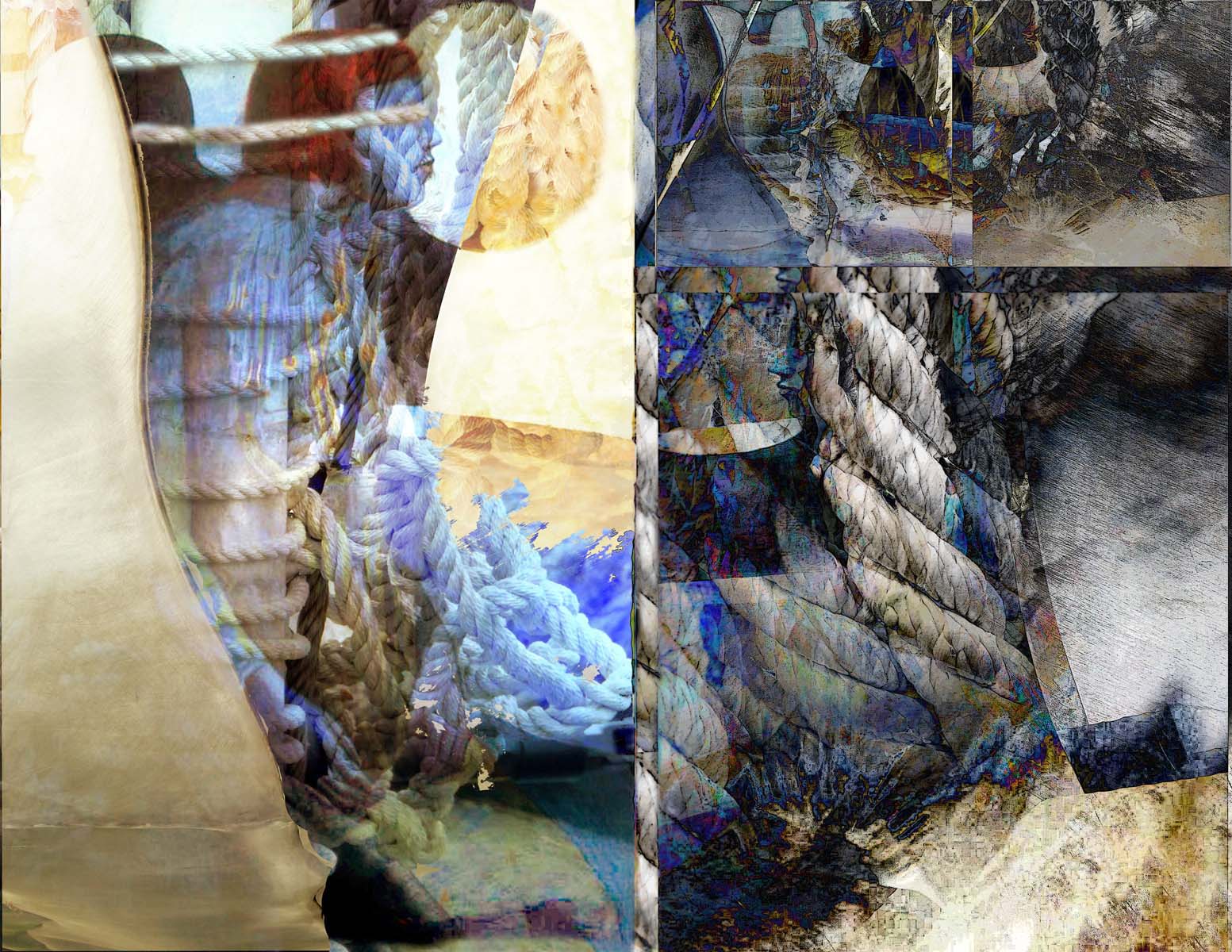
What would you say are the most important tools harnessed by early mankind? Fire? The Wheel? Agriculture? Does string even come to mind?
It did not, for me, until I embarked on a bit of reading about the history of string after I was stupefied by an archeological find that dates some 35.000 years back, a tool that allowed a small group of people working together to produce meters and meters of strong rope in about 10 minutes.

Single threads are not particularly useful. Twist them into yarn, though, or make yarn into strands, or strands into string and then ropes, and you have something that powerfully affects your interactions with the world. Our idioms tell the tale: learn the ropes, spin a yarn, hang by a thread, tie the knot, thread the needle, string along, cut the cord, moral fibre, loose the thread – where was I?

“A string can cut, choke, and trip; it can also link, bandage, and reel. String makes it possible to sew, to shoot an arrow, to strum a chord. It’s difficult to think of an aspect of human culture that is not laced through with some form of string or rope; it has helped us develop shelter, clothing, agriculture, weaponry, art, mathematics, and oral hygiene. Without string, our ancestors could not have domesticated horses and cattle or efficiently plowed the earth to grow crops. If not for rope, the great stone monuments of the world—Stonehenge, the Pyramids at Giza, the moai of Easter Island—would still be recumbent. In a fiberless world, the age of naval exploration would never have happened; early light bulbs would have lacked suitable filaments; the pendulum would never have inspired advances in physics and timekeeping.” (Ref.)

We lace our shoes with string, we get sewn up on the operating table with string, our clothes are woven from twisted fibers, and much of what is tied in knots depends on cordage. Hunting or camping involves plenty of ropes. String has been used as a form of mathematical expression by indigenous people in South America thousands of years ago. A system of knots and tassels hanging from a central strand would record census data and tax information. The language of modern technology refers to strings and threads as well – string theory, web-sites, links, Threads (e.g. the replacement site harboring all of us fleeing from formerly known as Twitter.)

One of the biggest and most consequential uses of string were, of course, the ropes and woven sails that enabled naval exploration: centuries of warfare, colonialism, but also economic trade and scientific exploration depended on cordage that made those boats functional. It was not just the rigging of sails. You also need rope to tow ships, and, to this day, tie even modern ships in harbor. You need hoist cables for cranes, winches, and dumbwaiters as well as woven fenders.


The history books tied rope making to early inventions and practices in Egypt, between 2000 and 1750 BCE. But archeologists knew of much earlier use by indigenous people of ready-made threads, like grasses, vines and pliable roots. Eventually people discovered that you can twist the fibers extracted from plants and animals into ropes, with pliable plants like agave, coconut, cotton, willow, and pond reeds producing strong fibers.
Here is the finding that blew my mind: archeologists unearthed tools made in the Paleolithic, some 35.000 – 40.000 years ago, that were used to manufacture rope. Excavated from a cave in southwest Germany, these are ivory batons, about 8 inches long, that have four holes containing 6 precisely carved, sharp spiral grooves.

The scientists experimented with replicas of the tools (called a Lochstab in German) to see what could possibly be processed with them.
“Individual holes of the Lochstab did not prove effective for pretreating sinew, flax, nettles, and hemp, but we achieved positive results for cattail, linden, and willow. Cattail was particularly applicable because the Lochstab could help to remove the starch for consumption by crushing the outer harder surface of the stems while separating the fibers for cordage. The use of cattail for making rope is well documented ethnographically, and archaeological accounts exist, in particular for later periods. Cattail is highly useful for food, cordage, and basketry.


The tool’s relevance lies in making thicker, stronger rope consisting of two to four strands. We twisted and fed bundles of cattail leaves through the holes. The holes help to maintain a regular thickness of the strands and facilitate the addition of new material necessary for making long stretches of rope. The grooves help to break down the leaves and orient the fibers while maintaining the torsion needed for rope making. The four-holed tool is then pulled with regular speed over the strands . Behind the tool, the strands combine automatically into a rope as a result of their twisting tension. The number of holes used determines the thickness of the rope. Because one person is needed to twist and maintain tension on each of the strands and one to operate the Lochstab, three to five people would be needed to use a four-holed Lochstab for rope making. Our experiments using cattail and four or five participants typically produced 5 m of strong and supple rope in 10 min.”


What fascinates me is not just that they figured out this tool per se. Using it also required social cooperation, communication and shared goals, bonding the people to each other and thus gaining an advantage over groups that had less developed technology and reciprocal labor. Shared labor led to in-group cohesion, augmenting survival. 35.000 years ago!

Here are some musical references to skipping rope – a childhood activity I preferred much over tug-of-war, wouldn’t you know it. There is Ukrainian composer Viktor Kosenko‘s 24 Children pieces that include jumping rope, Khatchaturian‘s Skipping rope, there is the Children’s Suite Op. 9 by Ding-Shande, really a sweet piece also referring to jumprope, and a piece for harp by Carlos Salzedo that includes Skipping Rope.

As an antidote to my habitually bleak news these days, I thought I’d collect and present what brought me fun, knowledge and/or encouragement across the last week.
HOPE:
In Germany literally millions of people marched against the far right now for two consecutive weeks, with demonstrations particularly strong on Holocaust remembrance day. “Germany’s constitutional court stripped a neo-Nazi party of the right to public financing and the tax advantages normally extended to political organizations, a decision that could have implications for countering the Alternative for Germany, a far-right party whose growing popularity has caused concerns among parts of the population.”
Below is what demonstrators got to see on a high-rise in Düsseldorf.
“The difference between 1933 and 2024? You!”

EDUCATION:

And also this…..

I did not know that.
RELIEF:
The International Court of Justice in The Hague walked a fine line in their ruling on the genocide case against Israel brought by South Africa; here is a compilation of short, informative expert opinions on the implications, offered by the Atlantic Council (not exactly a hotbed of progressivism). Here are the take-aways from The Guardian, slightly more to the left. And here the ruling is declared a historic victory for the Palestinians by The Intercept. Then again, Israeli Minister of National Security Itamar Ben-Gvir declares it: Hague Shmague. Fact is, the case is taken up, will stretch out for years, but importantly for now, the court ordered Israel to “take all measures” to avoid acts of genocide in Gaza, a ruling that is, however, unenforceable.
FUN:
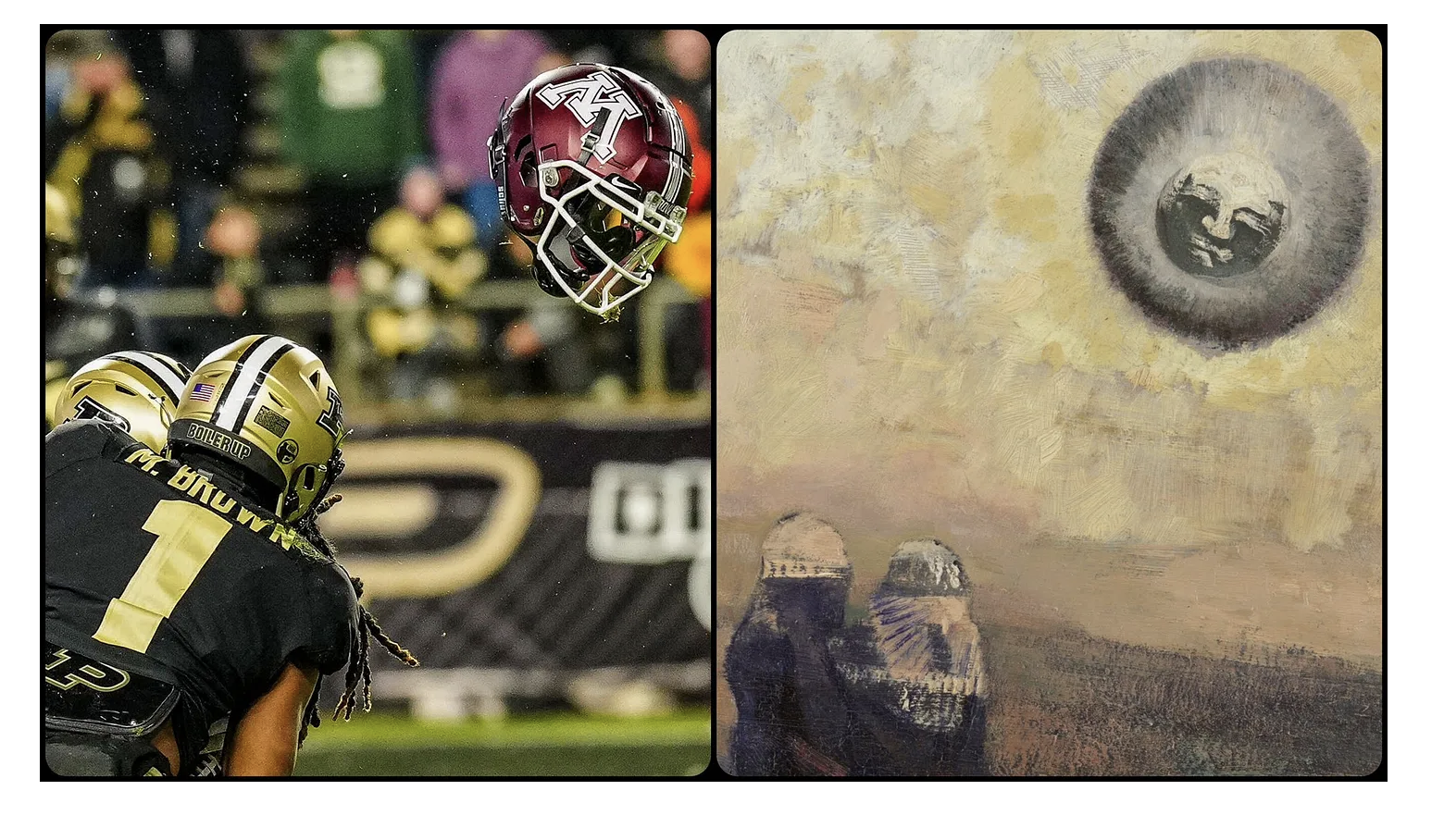
I discovered a site, Artbutmakeitsports, that manages to combine knowledge of art and sports in ways that had even me, the least sportive person in the world, laugh with delight.

Autumn, by Mikhail Larionov, 1912


The Harvesters, by Pieter Bruegel the Elder, 1565.
Last, but not least,
CONTENTMENT:
I finally managed to bring some of my affairs in order, figuring out what to do in the case of eventual demise. Unlike those whose adherence to religion faiths proscribes what to do, I had to make difficult decisions myself. I’ve never wanted to imagine myself cooped up in a coffin. I did not like the idea of cremation due to its horrid environmental impact. They now offer an alternative, where your remains get literally composted and then, except what urns relatives might claim, gets used to fertilize reforesting projects in the PNW forests. “Mami Mulch!” as my beloved declared. And now I don’t have to think about it ever again…
When I am Among the Trees
When I am among the trees,
especially the willows and the honey locust,
equally the beech, the oaks and the pines,
they give off such hints of gladness.
I would almost say that they save me, and daily.
I am so distant from the hope of myself,
in which I have goodness, and discernment,
and never hurry through the world
but walk slowly, and bow often.
Around me the trees stir in their leaves
and call out, “Stay awhile.”
The light flows from their branches.
And they call again, “It’s simple,” they say,
“and you too have come
into the world to do this, to go easy, to be filled
with light, and to shine.”
By Mary Oliver
I might not shine in this world, but I can sure make it grow!
And here is sunlight and a breeze flittering through the tree canopy – Liszt‘s music at its best.

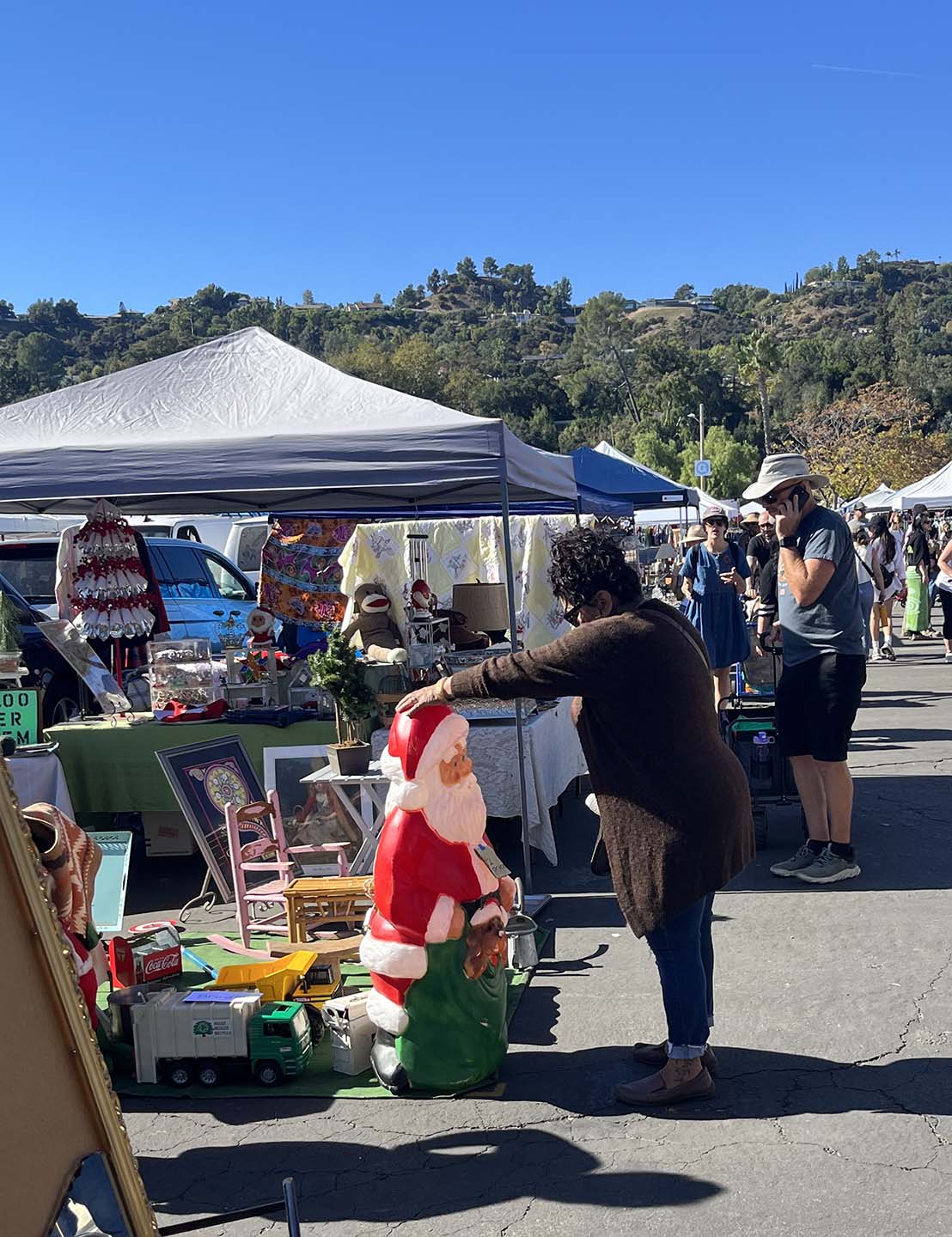
He might prefer the sunny climes of Southern California (where I photographed him and his brethren in November.)

Or he might want us to contemplate where all the stuff ends up that he annually delivers – the flea market.

Or he is simply an old man with a beard, no longer able to keep up with these times, sweat on his brow.

(Then again, there were other old men with beards who were ahead of their times – the treetop angel is reading one of their books…)

Or maybe Santa got delayed by doing what he does best: providing some joy for the younger set, ignorant of consumer culture.

And if he doesn’t show, there will be other visitors, in a few days’ span.

Here is some rarely played Christmas music bei Liszt. More contemplative than merry, but that seems appropriate right now.
“How is the ordinary man to know that the most violent element in society is ignorance? Someone has said that it requires less mental effort to condemn than to think. The widespread mental indolence, so prevalent in society, proves this to be only too true. Rather than to go to the bottom of any given idea, to examine into its origin and meaning, most people will either condemn it altogether, or rely on some superficial or prejudicial definition of non-essentials.” – Emma Goldman Anarchism (1910)
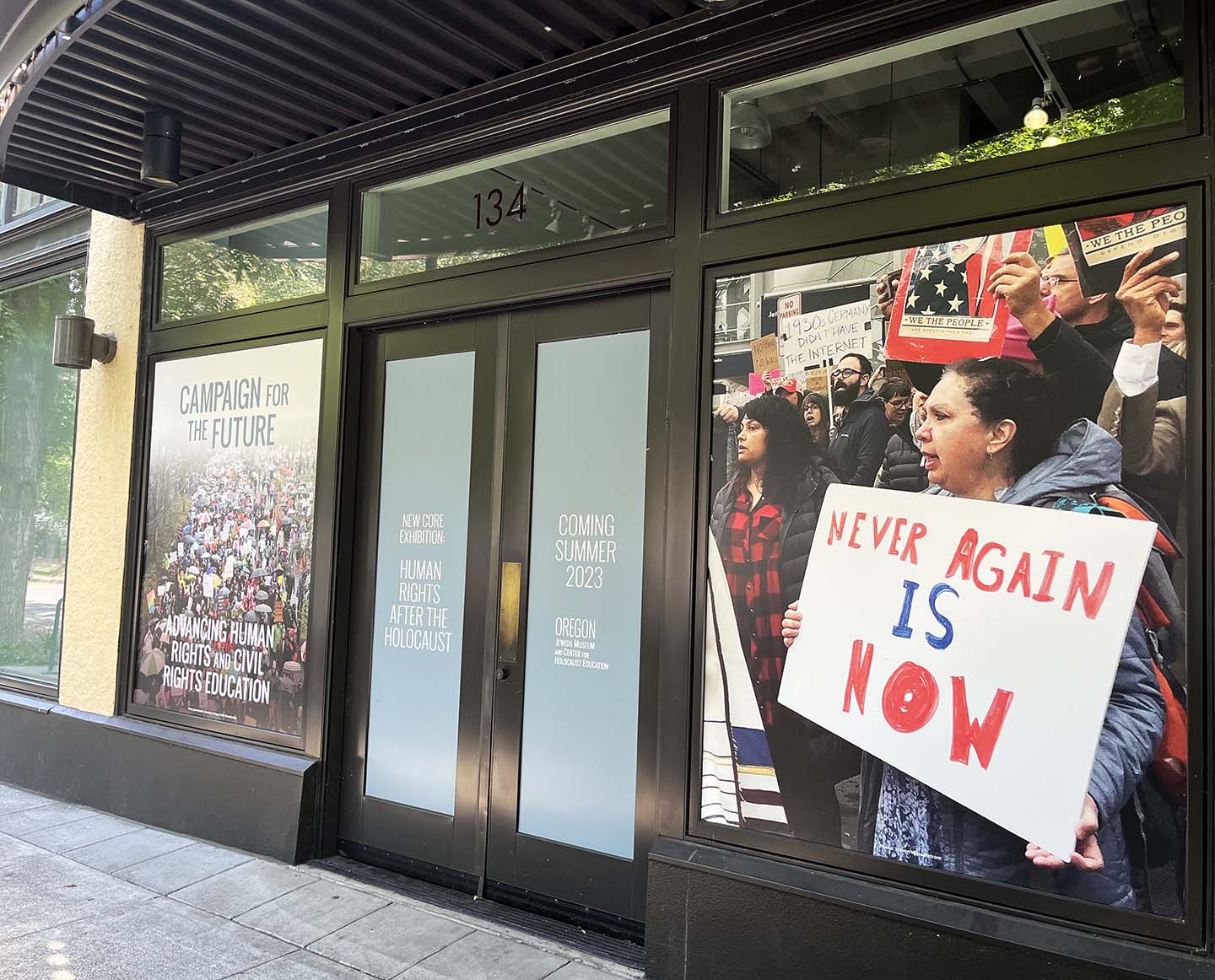
If revolutionary Emma Goldman (1869 – 1940) and OMJCHE executive director Judy Margles miraculously connected across time, they would likely discover many commonalities. Both of Jewish descent, both allergic to hypocrisy, both with a strong belief that a better world can be achieved if we act on it, and, importantly, both committed to the idea that education is one of the most important tools to affect change towards a more just world.
Determined women, visionaries even.

Of course, one of them, prone to destruction, ended up in prison and exile, while the other is an ultimate builder, leaving Portland with a legacy that is beyond valuable, for Jews and non-Jews alike – which is why it is so hard to see Margles depart, no matter how much she deserves retirement after years of incessant work at the museum.
No “mental indolence” for the director, who received a B.A. from the University of Toronto in her native Canada, and her M.A. in History and Museum Studies from New York University. If ideas catch her attention, they will be tracked, examined and turned into action. Her life’s work includes a quarter-century’s engagement in establishing a museum that will preserve the history of Oregon Jewry, inform about the Holocaust, and expand its mission to a pluralistic embrace of education about human rights and their potential violation.
Margles blazed a path – if not always in a straight line – from idea to institution, one that has made its mark on Portland’s cultural landscape, and is increasingly recognized within the national domain of Jewish museums as well. What began as a “museum without walls” based on discussions with prominent local Rabbi Joshua Stampfer and his wife Goldie in the late 1990s, soon morphed into small quarters that provided room for archived materials, including recorded oral histories, and modest exhibitions of art or photographic collections that depicted the everyday life and historical presence of Jews in Oregon. Many in the community stepped forward to help, offering practical, organizational and/or financial support, with active Boards and a small, dedicated staff shepherding the museum towards growth. But it was Margles’ leadership and relentless push that propelled the organization through various brick-and-mortar rentals to the building in the North Park blocks that is now owned by and houses OJMCHE.
Today’s various exhibition halls, conference rooms, archives, giftshop and cafe are a far cry from the early beginnings, rental rooms in Montgomery Park, followed later by a mostly windowless hole-in-the wall also on Davis St., and until 2016 a larger space on NW Kearny St. that was occupied together with the Holocaust Resource Center.
Ongoing changes extended to the museum’s mission as well, which expanded from preservation of local Jewish history to include more focused education about the Holocaust, particularly after the official 2014 merger between the Holocaust Resource Center and the museum. Teaching about the Holocaust and honoring the memory of those who perished under Nazi persecution took on new urgency, given the continual rise in anti-Semitism and the parallel loss of actual witnesses to the atrocities, with the few remaining survivors now in their 80s and 90s. Keeping the memory alive and transmitting the lessons learned to prevent future catastrophes became an important task for the museum, with a special focus on reaching schoolchildren both inside and outside of the museum walls.
Female leadership has been, interestingly enough, a hallmark of Jewish museums and also the cultural centers aligned with them. Jewish women established the earliest “identity” museums — trying to connect to culturally specific history and opening the avenues that subsequently led to other such museums, including the National Museum of the American Indian, and the National Museum of African American History in Washington, D.C.
In the U.S., it was the National Federation of Temple Sisterhoods that founded the very first Jewish museum at Hebrew Union College in Cincinnati in 1913 (now the Skirball Museum in Los Angeles, after reorganization in 1972.) In the late 1990s some 80% of Jewish Museum directors were women. The Council of American Jewish Museums (CAJM,) an association of some 70 American Jewish institutions devoted to Jewish culture and promotion of its richness and educational value, has been headed by a woman for the last many decades. This is not just an American pattern. The large Jewish museums in Berlin, Frankfurt and Vienna are all lead by a woman.
Makes me curious, of course. Historically, this pattern of widespread female leadership might have been the result of the limited options for women hoping to serve public roles in societies where gender separation was still part of a cultural and religious system. Leaving the arts or the tending to local history, so connected to families and networks, to women might have been a way to give them – or have demanded by them – some limited empowerment.
Apparently, though, women brought something special to these roles; how else are we to explain the continuation of this history, given that it is the exception to the rule of male dominance of leadership roles across many sectors of western societies, the arts included? The challenges Margles faced, and her success in dealing with them, provide a plausible explanation.
What are the challenges? Just like for other organizations, leadership of a culturally specific museum requires an enormous amount of multi-tasking, given the diverse set of task demands. Yet it also requires social intelligence, given that it operates within a relatively small set of, in our case, Jewish-identified people, many known to each other and having a stake in their history as a community.
As the museum’s leader, you have to decide on the exact terms of your mission, you have to procure funds, both from private donors and publicly available sources, until grant proposals invade your dreams, more likely nightmares. You have to initiate or think through potential mergers with other organizations, which will be enormously valuable but also add to the list of obligations. You have to predict what size staff will be allowed by your funding and you have to manage the staff, taking on various jobs yourself if you can’t afford enough people to divide the labor. In the meantime you’re fighting a tendency to micro-manage, born out of a sense of responsibility more than a need for control. You have to find space – oh, do you have to fight for space that is affordable, accessible, safe. Never mind parking.
You are also responsible for programming, gambling on what a given budget can provide, and making educated guesses about what type of exhibition would be most effective in promoting your mission, all the while attracting visitors who might become involved with the museum and/or potential supporters. You need to devise curricula for educational programs, that are age appropriate and portable to be brought to schools and other educational settings. You need to train volunteers as exhibit guides, you need to appease committees where different ideas over annual Galas or other festivities clash, find board members that bring complementary skill sets to their role and are committed. You need to create effective PR, and oversee digitalization to keep with contemporary practices. You need to make choices among job applicants once you’ve reached a financial standing that allows you to hire specialists, you need to stay up on the literature conveying modern museum standards and practice, and you need to travel to conferences and meetings to keep up the networking efforts. Occasionally you need to mop up the water spilled by leaks in the roof on a Sunday when no janitorial staff can be reached. I am sure I have forgotten half of the jobs that are potentially on leadership plates.
That is not enough, though. For Jewish museum leadership it has always been important to recognize the changing social or religious needs of their community and to navigate the fact that this community is not monolithic and will confront at times with conflicting demands. A sensitive ear, and an ability to compromise, then, need to be added to the skill set.
Add to that the requirement to straddle a thin line that is particularly treacherous: finding the right answer to the question tackled by contemporary Jewish museums around the world. Who do they serve? Is their role determined by the Jewish community or the non-Jews around it? Is their mission to preserve and educate about the specifics of Jewish history, or are they allowed to address the general politics of their times in the context of Jewish experience – and then whose Jewish experience, given the fractious nature of contemporary Jewish identity, starting with those who live in Israel and those who live in the diaspora, those who promote Zionism and those who make an emphatic distinction between being Jewish and being a Zionist, those who are religiously affiliated and those who define themselves culturally, to name just a few divisions?
These are not just theoretical considerations. The newly appointed director to the Jewish Museum of Vienna, Barbara Staudinger, landed in hot water with her inaugural exhibition last year, 100 Misunderstandings About and Among Jews. Curatorial decisions had to be reversed when large parts of the Jewish community were in uproar over some textual items and a video presented relevant to Israel and the Holocaust.
Likewise, three years earlier, the director of the Jewish Museum in Berlin had to resign after the Israeli government and the main organizations representing Jews in Germany complained that JMB’s exhibitions were overly political and, worse in their view, friendly to Palestinians and explicitly anti-Israel (long before the atrocities of October 7, 2023 and all those that followed). The museum was accused of having become too political, beyond the boundaries of its mission. The voices of international scholars and museum professionals who lauded JMB for its willingness to serve as a place for dialogue on issues of identity in an age of growing anti-Semitism across Europe, were drowned out by the critics.
One of the Berlin exhibitions that drew ire, and contributed to job loss, was “The Whole Truth, everything you wanted to know about Jews,” a 2013 show intended to resolve misconceptions about what it means to be Jewish or how Jewish life unfolds. People could peruse answers to frequently asked questions and also ask a Jewish person him or herself, who was placed for two hours at a time, into a glass box. “Jew in a box,” as it became known, was judged despicably degrading by some (the parallel to Eichman in his glass witness box in Israel during his trial for implementing the Final Solution, among others,) wonderfully provocative by others, making people think about the ongoing divisions between Jews and non-Jews in Germany, and the lack of knowledge or (worse) conspiratorially tinged assumptions still held by many who approached the sitter to ask their questions.
My questions to Margles, when I interviewed her for this article, were simpler. What was the high point of her 24 years’ tenure at the museum? The spontaneous answer referred to the opening date of the museum in its current location, the fruit of the labor of so many years finding the right container to hold all the history, objects and ideas alike and move forward with larger exhibitions. That date, however, also denoted one of the lowest point as well, she added; it was just days after the fatal TriMet stabbings occurred, a racially motivated hate crime, reminding everyone of the vulnerability of minorities. Another low point hit 3 years later, when the museum had to close its doors under lockdown requirements during the first year of the pandemic. It was unclear how the museum would survive, with PPP loans not yet available; happily, though, the museum was rescued by a terrifically supportive Board.
What was her favorite exhibition across all those years? That’s All, Folks: The Mel Blanc Story was the immediate answer. The tribute to this local comedian and voice artist who made it big in Hollywood movies and TV after years in Vaudeville and radio, was one that made you laugh, and laugh loud. I can just see how this counterbalances the darkness of so many of the topics associated with the collective memory carried by the museum and its educational focus on the Holocaust that was Margles’ daily concern for so many years.
I, on the other hand, would vote hands down for OMJCHE’s new core exhibition, Human Rights after the Holocaust. For me it is the epitome of forward thinking at a time where teaching the history of minorities is ignored at best and actively suppressed at worst in a country that grapples with human rights violations every single day. This emphasis, Margles notes, does not in any way diminish the uniqueness of the Holocaust, at the same time that it draws attention to trauma and injustice more broadly. Importantly, the call has to be to explore the underlying mechanisms that can lead to prejudice, discrimination and persecution, so that we empower new generations to be prepared to fight for what is just, regardless of racial, cultural or religious origin.
This, for me, is leadership, the pursuit of a vision that grows to be inclusive over time, a pluralistic view of the world that will serve the museum for decades to come and one that ultimately believes in the power of education. Farewell, Judy Margles. We owe you.
“The time is out of joint; O cursed spite!/That ever I was born to set it right!” [I.V.211-2])” Shakespeare’s Hamlet after being visited by a ghost.
In the small rural village where I grew up, Martinmas was a big occasion. Celebrating the altruism of a religious figure, a knight who shared his bread and cut his velvet cape in half to help a freezing beggar, the catholic regions across Europe put up a big parade every mid-November. Dressed in our warmest clothes, we were allowed to line the streets to cheer on a fake St. Martin riding on a horse in the evening, a subsequent bonfire at the village’s edge with dramatic reenactment and dispersement of yeast dough baked into little bread men with dried currants for eyes and a clay pipe in their mouths. Have no idea why, but it is a detail stuck in memory.

It was exciting as well as eerie. Quite a few small kids were scared to death, between darkness and fire reflected in his silver helmet and a huge horse getting restless, neighing and bucking. It was also a time when the geese were butchered and prepared for a feast.


I was reminded of those occasions when listening to a song Geträumt hab ich vom Martinszug (I dreamt of the St. Martin’s Parade,) music by Katie Rich and Christian Schoppik, a pair of contemporary surrealist folklore musicians in Germany. Lately they have teamed up with another artist, Johannes Scholar, who is more known for his electroacoustic, ambient music, that combines electronic aesthetic and nostalgia for a lost future.


The trio performs as Freundliche Kreisel (Affable Spinning Tops, album in the link), mixing experimental and acoustic sounds with lyrics that could come from German Romanticism, fairy tales, mythology and plain folk song. Lots of ghosts, sinister scenarios and temporal disjunctions, on another compilation album, Specter Land, as well.

Obviously more accessible to German language speakers, but the feeling of the disquieting undertones, directly and indirectly hinted at in the words, are certainly conveyed when you listen to the music only. The female vocalist (intentionally?) sings like a child, projecting a halting naiveté and vulnerability, before she switches to urgent warnings. Wouldn’t exactly call it riveting music, but with repeat listening its unease gets under your skin, settling like an ear worm – the German word for a melody colonizing your brain – or like the talking ferret alluded to in the lyrics, that lives in the walls and becomes a haunting menace, perhaps a specter. Of interest.


In his 1993 book Specters of Marx, Jaques Derrida coined the term Hauntology in reference to Marx’ and Engels’ claim that “a specter is haunting Europe – the specter of communism.” Derrida’s concept embraced the idea of a return or persistence of elements from the social or cultural past, like a ghost, suggesting that Marxism haunted the Western world from beyond the grave. Hauntology has been applied to music as well, our culture’s affinity for a retro aesthetic and an emphasis on cultural memory found particularly in folk music.

For the musicians of Freundliche Kreisel it manifests, among others, in reverence to Friedrich Hölderlin (1770 – 1843) and Friedrich Alfred Schmid Noerr (1877 – 1969). Hölderlin was one of our finest lyrical poets who subsumed the form of classical Greek verse into the German language and tried to embrace a “spiritual renewal,” integrating Christian faith with the pantheon of Greek gods and all that implied. (He lived and died stricken with mental illness, no causality suggested, just a tragic figure.) Schmid Noerr also elevated the cultural contents of different systems, in particular Christianity’s effects on the Teutonic world. A philosopher and writer, he wove tales that bound historical figures to legend, the past forcibly infusing the present.


Despite his fervor for all things occult, mythical and Germanic, something he shared with the Nazi leadership of his time, he was active in the resistance and published, as late as 1939 and 1940 some radically anti-Nazi pamphlets and a draft of a new German constitution.


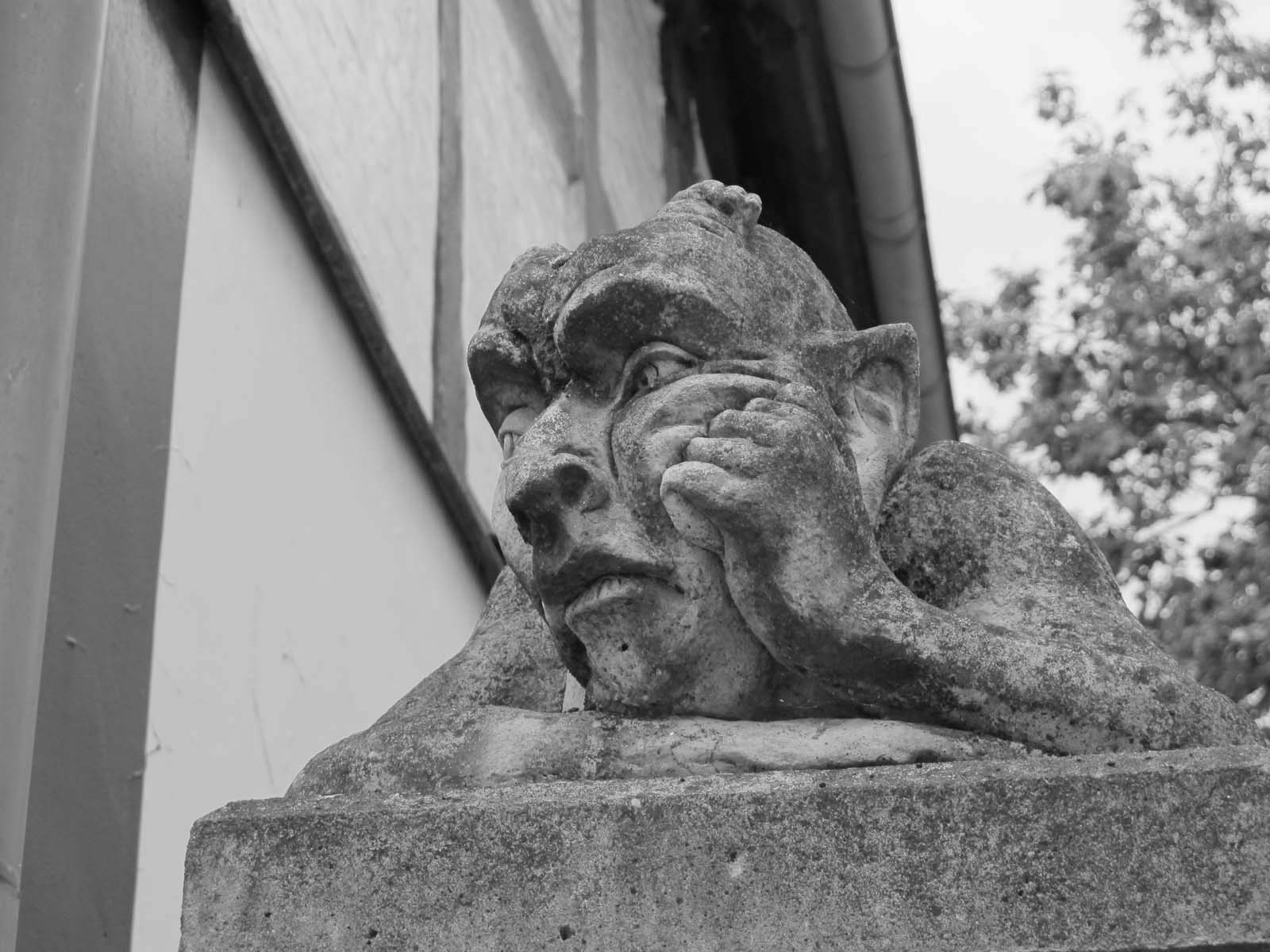
Which finally brings me to the specter I meant to write about from the get-go today, with your eyes presumably already glazing over: the return of social and cultural elements of the fascist past, a set of philosophical beliefs and linguistic usage that is reemerging into contemporary American and European discourse. A haunting presence.

Consider the historical situation in early 20th century Germany (I am summarizing a more detailed description from here, Eric Kurlander’s excellent book Hitler’s Monsters): modernity challenged traditional religious practices, with science and secularism progressing at a steady pace. The discarded spiritual worldview created a vacuum that was filled by new esoteric (and often science-hating) belief systems. Nazi leadership grafted onto these ideas of the supernatural, the occult, esoteric sciences and pagan religions. It allowed them to attract followers whose disenchantment in the wake of the industrialization of their world gave powerful incentive to cling to irrational ideas.


The content of these supernatural allusions were often racially tinged. Slavs were vampires, Jews were vermin, both trying to undermine the purity of German blood.
“The supernatural imaginary, which mixed science and occultism, history and mythology, also allowed Nazis to pick and choose the characteristics they would like to ascribe them to their enemy, comparing them to vampires, zombies, devils, and demons.”
Green light for dehumanization of those conveniently selected as out-groups that helped foster in-group cohesion among the electorate.


The rise of non-White races impelled people to adhere to a system of racial hierarchies, that assigned supremacy to White men and the history of Aryan or Nordic nations. Conspiracy theories to make sense of an increasingly complex world sprouted everywhere and were used by Nazi rhetoric for their emotional appeal.
“Firstly, the supernatural imaginary influenced Nazi geopolitical views, which manipulated archeology, folklore, and mythology for foreign policy purposes. Himmler and Rosenberg developed these arguments, based largely on folklore, mythology, and border science that for thousand of years the Nordic people were the dominant civilization in Europe and they had a right to reclaim that. Bad archeology, selective use of biology and anthropology, and mythology fueled a lot of ideas about the Eastern Europe and why Germans had a right, like the medieval Teutonic knights, to (re)conquer the East.” (Bolded by me.)
The steadfastly held belief that one group of people was elected to rule over others, biologically, historically and racially superior, helped set the ultimate catastrophe of fascism in motion. And that was before the advent of social media…here is a piece that lays out the implications of algorithms in shaping our understanding of realty.

I am including trees here because German oaks, birches, beeches and willows, as well as forests in general play such a major role in our mythology and fairy tales.


I don’t have to spell out, I presume, how this applies to our current situation. Am I seeing ghosts, drawing the devil on the wall? (The German idiom expresses that someone is being overly pessimistic or only focused on a worst-case scenario.)
You tell me. I certainly don’t seem to be the only one.

Photographs today of typical rural sights in Germany, from Lower Saxony, Saxony Anhalt, Schleswig Holstein and Hesse, with crumbling half-timbered houses offering refuge to all kinds of specters, ghosts and Poltergeists.

40 years ago on this day my mother died suddenly and unexpectedly. I was a continent away and had to scramble to get home for the funeral. I thought I’d never get over the grief. I did, though. Whatever deep-seated sadness remains is certainly more than balanced by the gratitude to have known unconditional love and been given gifts galore: an interest in all of what the world has to offer among them. She was an intrepid traveler, and nothing escaped her eyes, no matter how mundane. Her moods could swing from amused to serious to fearful to exuberant in the shortest amounts of time and I see myself in that as well.


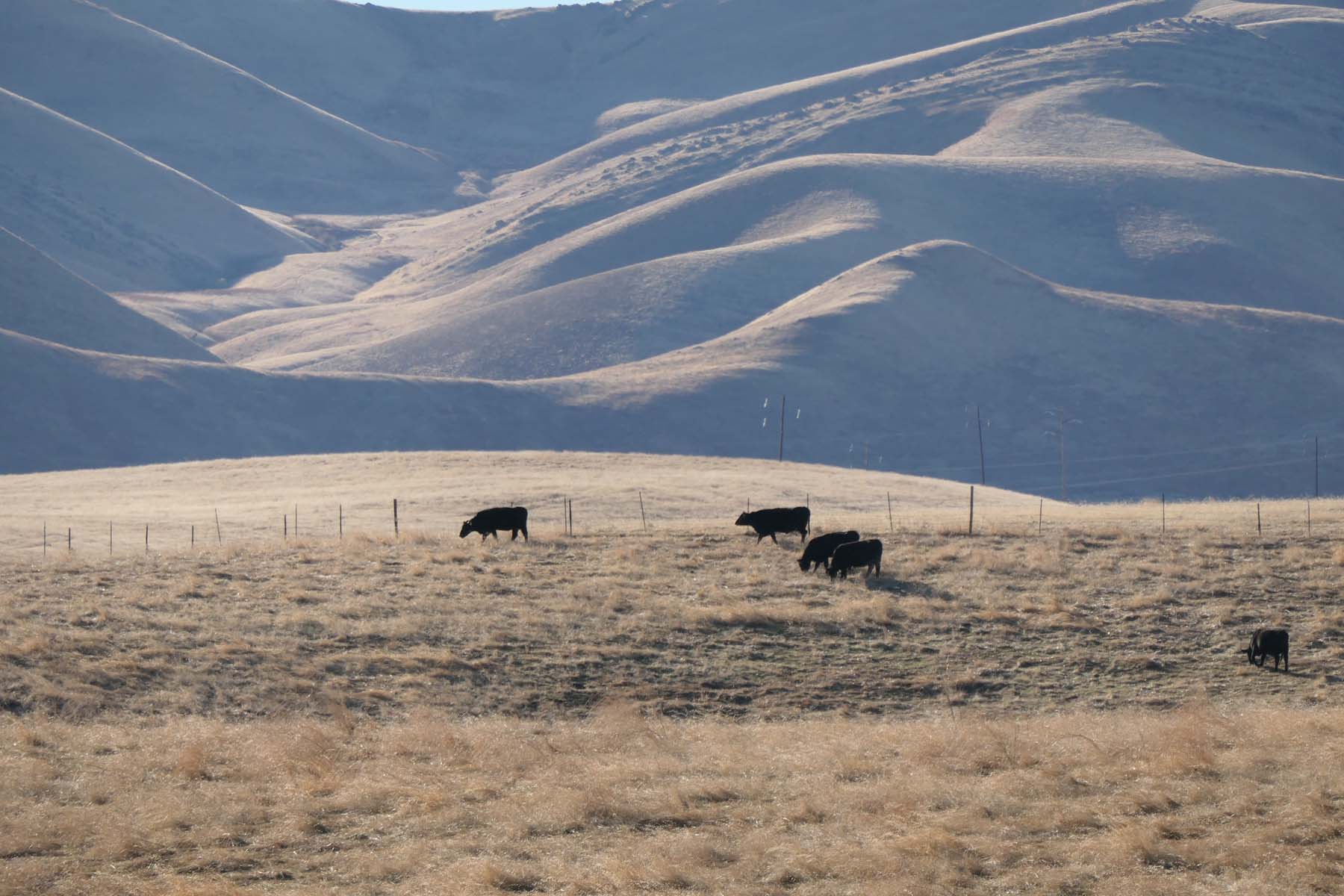
Mt. Shasta with no and very little snow 6 weeks apart. New crops planted now that rain has started.

Fall colors have arrived.


And frost once you crossed back into southern Oregon.

She would have enjoyed the roadtrip that brought me to L.A. and back, all 3.400 kilometers in a small car, with frequent stops to take in roadside attractions. She loved to drive, as do I, which is a blessing since I can no longer fly. She would have exulted in meeting the newest generation, named Lina in her honor, who will perhaps – hopefully – see the world with the same wonder as her predecessors.


Same view from a slightly different angle 6 weeks apart – beginning of October, end of November, pains now flooded.
Today’s photographs are selected to describe the range from amusement to awe. Here is the absurdity of a Potemkin village mimicking a Western town, a playground for children adjacent to a diner off of I 5 near Kettleman City, with Bravo Farms proudly displaying their collection of old signs, surely ignored by the kiddos who are overly excited to be released from the confines of their carseats. (Be warned: inside the restaurant, it is a zoo, with shooting arcades and proud display of gun imagery, overpriced and greasy pulled pork sandwiches, and noise levels that aim to deafen your remaining hearing capacity.)


Maybe they should reconsider their choice of beverage?
The second set was taken at the Sacramento National Wildlife Refuge. On my way South the first white chested geese had arrived.


On the way North, 1000s of Ross geese had reached their destination, ready to stay in California for the winter. Seeing this abundance of beauty is one thing, hearing it is another – the sounds are indescribably moving.


I picked today’s music accordingly – migrating swans and other birds can be heard in the background.


Mud hens congregate in front of the geese
And since that was the only serious piece I could find on migration, there is another Swansong , Schubert’s Ständchen transcribed and transformed for piano by Liszt – one that was played by my mother at bedtime, right below my room. Love is nigh.


Walk with me. A slow amble under a hot November sun through strangely empty streets in central L.A. on a Saturday morning, with visual input galore.

Where are all the people? This was around 11.am.


Frequent stops for photographing – not enough, as it turned out, or not always focused enough.

As is my wont, I went into a neighborhood without having read up on it, always hoping to have a fresh eye. More educated now, I wish I’d had added stops for this or that landmark, oh well. Still captured the essence, I think.

A lonely tagger.
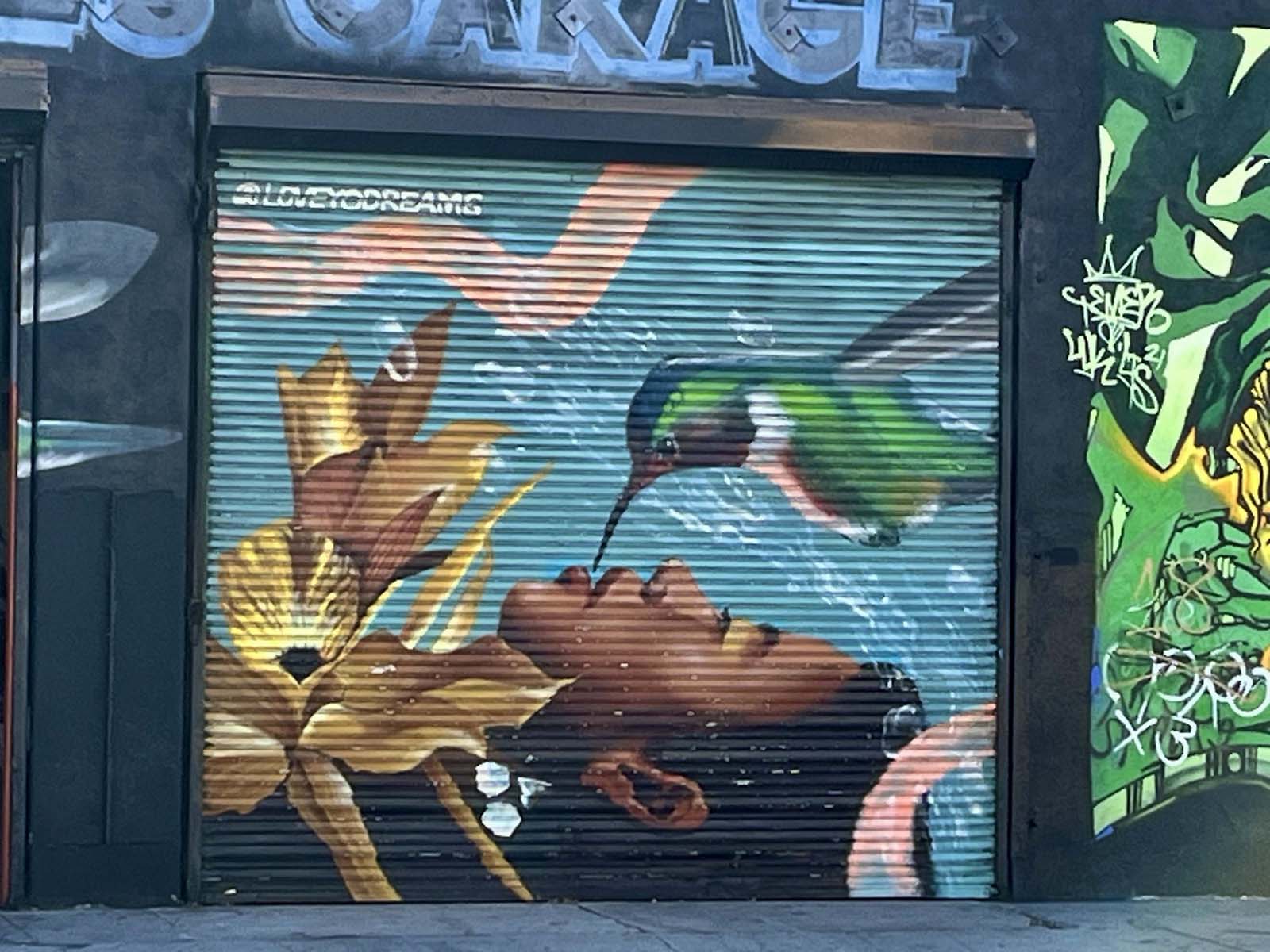
I had chosen L.A.’s art district for my outing because it is generally advertised as a haven for graffiti, and it did not disappoint. Its history, now that I have read up on it, is generally more interesting than most of the murals, however. More distressing as well. Much of the graffiti is simply tame.


The area was actually the center of California’s wine industry in the 19th century, L.A. then known as the City of Vines. Not only were the vineyards located on land taken from the indigenous Chumash, Tongva, and Tataviam tribes, but tribal labor was used to build the business in systems not unlike slavery. When native Americans came to the mission and were lured in baptism it brought with it a bidding contract that they could not leave. They were forced into indentured labor, including winemaking, and lived in subpar conditions that introduced and spread European diseases. When the mission systems were secularized, their land was given to white settlers instead.


The Earth Crew mural, a community mural from the 1980s, renovated 5 years ago.
Displaced, they roamed the area and many of them turned to alcohol to drown their sorrows, which led to horrid consequences.

(Ref.)


Eventually the vineyards gave way to the citrus industry, which was later destroyed by treatment-resistant parasites. During its heyday, it needed a shipping network, provided by the railroad that arrived in 1876. First Southern Pacific, then the Atchison, Topeka, Santa Fe Railroad and finally the Union Pacific. By 1905, Los Angeles had become the western terminus for three major transcontinental railroads. All three railroads built depots, transportation buildings, warehouses, and rail yards in and around the Arts District. Many cheap hotels providing single rooms for the workers followed. Some of the photographed buildings capture the old architectural structure.


By WW II the rail system was replaced by the trucking industry, with the industrial nature of the area permanently ensconced until the 1960s or 70s, when artists moved into many warehouse now vacant, because smaller businesses had been absorbed or displaced. The alleys had also become too small for ever increasing truck sizes. By all reports the urban environment was decaying and dingy, but increasingly dedicated to art- making and -living spaces, once the City of Los Angeles passed the Artist in Residence ordinance in 1981, which allowed artists to legally live and work in industrial areas of downtown Los Angeles.

Looked to me like the little scooters were longingly staring at the mega truck…


Some 50 years later, gentrification rules the neighborhood. There is enormous loss of inexpensive lofts to developers who have converted some former loft and studio buildings into condos.


New high-rises change the character of the neighborhood.
The district is still one of the most filmed locations ever, with as many as 800 filming days a year. The movie industry knows a good thing when it sees it. Chic bars and restaurants around many corners. Weed dispensaries everywhere.

Privately run and decorated dog parks as well – probably a good thing, for dogs and neighborhood alike.


Some landmarks remain, but are also undergoing changes, something that was true through the centuries for the American Hotel. That building and its occupants alone is a living testament to the changing times – a fascinating, detailed summary (with a link to a documentary movie) can be found here. It was the first hotel that was legally open to Black people, with a bar that was shut down in 1914, when it became obvious that Whites and Blacks mingled and partied together.

Ownership changed hands, and was Japanese, as were most of the guests, until they were brought into the camps after Pearl Harbor. A Mexican immigrant bought and operated hotel, bar and market in the mid 80s, and the artists moved in, using the exterior for murals as well. Here are the current ones:

“La Abuelita/Má’sání” (2015)(Portrait of a Navajo weaver by El Mac. The geometric pattern above Abuelita was painted by Augustine Kofie and the lower left portion was painted by Joseph Montalvo AKA Nuke One of the UTI Crew.
White paws below on the other side of the building.


A pioneering social activist, Joel Bloom, opened a General store on the ground level in 1995 and fought for years against the forces of gentrification before he died in 2007. It looks like 16 years later that battle is still ongoing.

Lots of buildings are shuttered and For Lease signs everywhere – prices waiting for investors, I suppose.


Part of the attraction of the Art District is/was the music, always at the cutting edge before commercial appropriation. The only music related mural I found, though, commemorated murdered rap artist Nipsey Hussle, shot in front of his store in 2019 in a gang dispute. He was a rising musical talent and also revered as someone giving back to his community and trying to revitalize the neighborhood.

Mural by Mister Alex, Biganti26, Hufr – Hussle and Motivate (title of a track)
And memorialization of Kobe and his daughter is found here as well, as so frequently across this city that still mourns the loss, the sun providing a kind of halo.

Not much political art that I came across, maybe that needs to be explored in different neighborhoods.

But there was plenty of reference to comics and a certain affinity for portraits.


My eye, of course, was over and over caught by the saturation of the colors, even those in the pastel range. The light here is so different from up north, and it affects everything.


.
Yup, a lot of visual load. Don’t say I didn’t warn you!

Music today is by L.A. music ensemble Wild Up, playing a rousing piece by Julius Eastman.
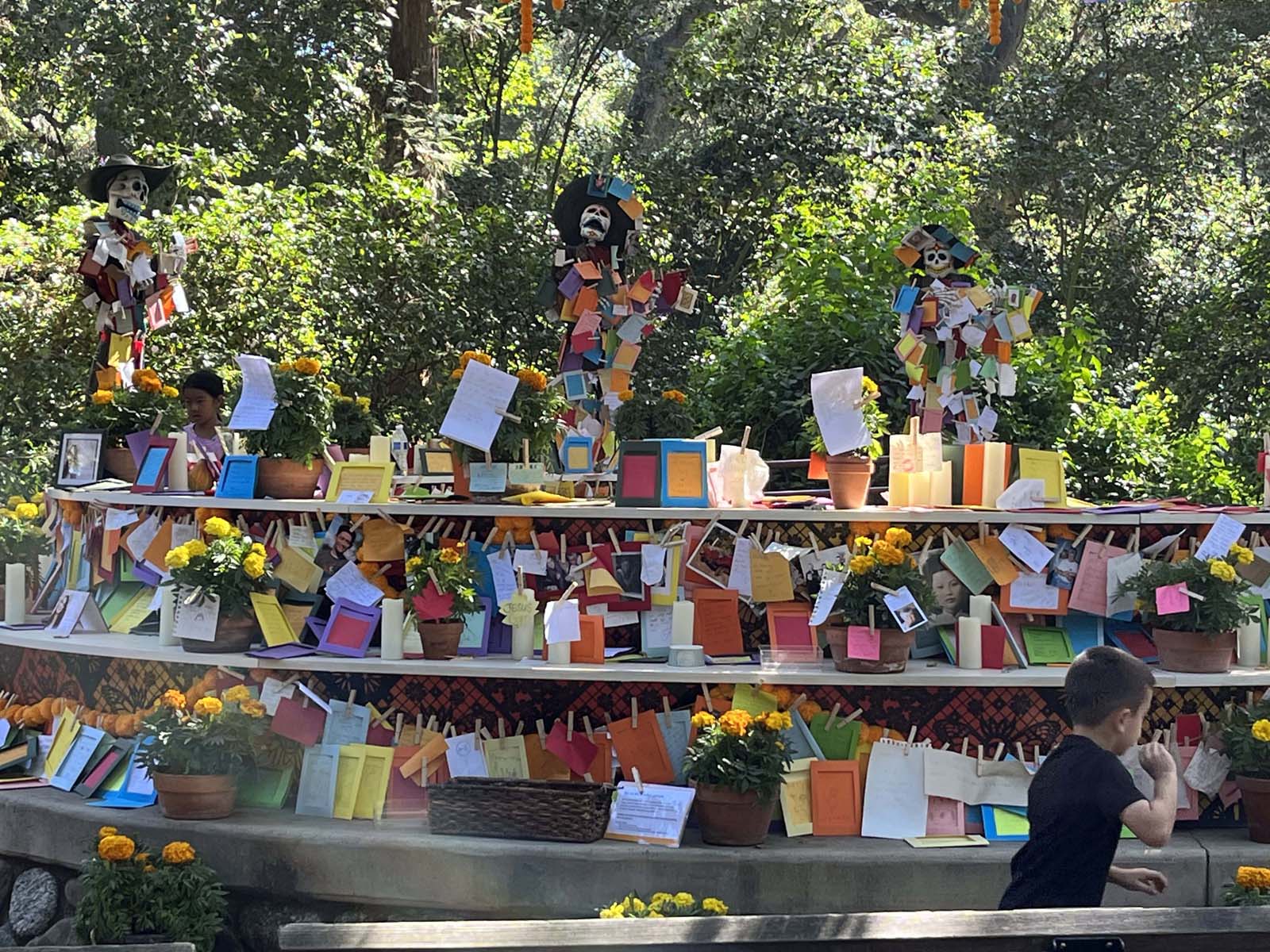
Between October 28 and November 3, Mexicans and other people with Hispanic heritage celebrate the Day of the Dead. It is believed that those who have departed can return during this period, visiting from the underworld, Mictlán in Aztec mythology.
Traditionally, families provide some support for the reunion with altars that contain symbolic items to make the spirits comfortable and show them that they are remembered. These gateways between two worlds are called ofrendas.

Some are small to fit into one’s house, others are large community affairs, combining individual remembrance with establishing communal bonds by upholding the tradition. I’ve come across several of them during my L.A. explorations.


I was told that they traditionally make reference to earth, water, wind (papel picado) and fire (candles) as elements that have meaning for the visit, representing the terrestrial plane that the loved ones are about to reenter.
There are items that symbolize purification and protection for the visitors, like the burning of copal or incense.
There are photos of the visitors themselves, an important part of remembrance, and usually chosen to display them while doing something they loved.


Other items focus on decoration to show that we celebrate their return, in particular Papel Picado, intricate paper cut-outs that also symbolize wind.

Marigolds are a big part of the celebration, seen everywhere with the flower vendors and on the ofrendas. Cempasúchil, a flower of Nahuatl origin and called flower of twenty flowers” is believed to represent the sun and the light emitted to illuminated the travelers’ path.

Then there is bread, that points to the cycle of life and death. It is specially made for this annual occasion, with orange, anise and topped with sugar. The shape varies apparently from region to region, symbolizing parts of the physical body with an elevated center that refers to the head or the heart.

And there are the calaveras/calaveritas, sugar skulls that also refer to the sweetness of life and death as belonging to each other. Sometimes they are made from more durable materials, paper maché, clay or wood so that they can be reused every year.
Often, alcoholic drinks and even cigarettes are included to invite the traveler to enjoy themselves once again and think back to the good times in life, as are fruits that represent sweetness.


The ofrada strikes me as a wonderful way to keep memory going, introducing younger generations to both their forbears as well as the traditions of one’s culture. The focus on comfort, sweetness, nourishment and protection are a counterbalance to the pain that loss and grieving instills. The brightness of the colors, the marigolds that illuminate every corner is so incredibly life-affirming.
Some versions are more modern, but expressing the same sentiments:

A book of memories and tokens for the loved ones.

Yellow and orange can, of course, be found all around during halloween times. Here is an abundance of pumpkins that were displayed at Descanso garden right next to a communal ofrada.


Now, if you tasked me with decorating, you’d probably get this….

Sunday afternoon, I happened to be at Sycamore Grove Park, a little neighborhood park, and an Aztec dance group, Xipe Totec, performed for Dia de Muertos. I’m just floating on the sounds and sights…


Here is a traditional folk song for the occasion La Llorona
Classical Music by Gabriela Ortiz is titled ofrenda..

“At its outset in the mid-1960s, the historic preservation movement contributed to the racial splintering of the nation’s urban fabric. It denied the freeway’s entry into communities deemed historic while granting its passage through communities judged differently. It empowered some communities in their fight against the freeway while putting others at a disadvantage. In the disproportionate number of black communities that bore the brunt of urban highway construction, the preservation strategy had no chance, leaving displaced residents with a meager set of resources to recuperate their connection to the past. This is why we need to pay attention to murals, festivals, autobiographies, oral histories, and archival efforts. In the high-stakes struggles over the fate of the American city, these were the “weapons of the weak,” the tools invented by displaced communities to fight the forced erasures of their past.”
― Eric Avila, The Folklore of the Freeway: Race and Revolt in the Modernist City
WHEN YOU ARE NEW to a city, like I am to Los Angeles, one way of exploration is to hit the history books. I had described my early mapping of the city onto Mike Davis’ City of Quartz: Excavating the Future in Los Angeles in April here, while reviewing an exhibition from the LACMA archives, Pressing Politics: Revolutionary Graphics from Mexico and Germany.
This time, I brought Weimar on the Pacific: German Exile Culture in Los Angeles and the Crisis of Modernism by Ehrhard Bahr, thinking I might follow in the footsteps of my exiled Landsmen during the 1940s, artists and intellectuals fleeing Nazi persecution. The book’s introduction contains the following description: “Los Angeles has occupied a space in the American imagination between innocence and corruption, unspoiled nature and ruthless real-estate development, naïveté and hucksterism, enthusiasm and shameless exploitation.”
I don’t know about the American imagination, but those of us who devoured Berthold Brecht’s California poetry 20 years later as German teenagers obsessed with America were undoubtedly influenced by his assessment:
Contemplating Hell
Contemplating Hell, as I once heard it,
My brother Shelley found it to be a place
Much like the city of London. I,
Who do not live in London, but in Los Angeles,
Find, contemplating Hell, that it
Must be even more like Los Angeles.
Also in Hell,
I do not doubt it, there exist these opulent gardens
With flowers as large as trees, wilting, of course,
Very quickly, if they are not watered with very expensive water. And fruit markets
With great leaps of fruit, which nonetheless
Possess neither scent nor taste. And endless trains of autos,
Lighter than their own shadows, swifter than
Foolish thoughts, shimmering vehicles, in which
Rosy people, coming from nowhere, go nowhere.
And houses, designed for happiness, standing empty,
Even when inhabited.
Even the houses in Hell are not all ugly.
But concern about being thrown into the street
Consumes the inhabitants of the villas no less
Than the inhabitants of the barracks.
Bertolt Brecht Nachdenkend über die Hölle, 1941, translated by Henry Erik Butler


Mural and Paintings by Devin Reynolds on the walls of the Hammer lobby. Contains references to John Milton’s Paradise Lost, displacement from a beautiful home acting as a red thread through the histories of many Angelenos.
Many decades later I wholeheartedly disagree with Brecht’s description – I find L.A. vibrant and fascinating – though not his political analysis. He knew class divisions and precarity when he saw it. By all reports, he clung to negative emotions as a motor driving his writing. But his ability to pick up on what makes this city thriving, underneath capitalistic excess or popular culture driven by interests to keep racial segregation intact, might have been curbed by what was then and still is not easily visible to the outsider. At least that is my speculation after chancing on Eric Avila’s The Folklore of the Freeway: Race and Revolt in the Modernist City, from which I cited at the very start of these contemplations.
Knowing the history of a place is essential to understanding its character. Who rose to the top and who was pushed to the bottom will define the nature of both the lay-out, the (d)evolution of neighborhoods and the way power hierarchies are distributed. My hometown of Hamburg, Germany, for example, needs to be read in the context of its merchant marine and membership in the Hanseatic League, its intermittent warfare with Scandinavian neighbors, and its destruction under Allied firebombing during World War II.


Left: Marcel Alcalá Right: Emmanuel Louisnord Desir
There are ways of learning about the past of a city and her people that are not found simply by looking in all the traditional places. Clearly, mainstream historians have little incentive to document attempts towards self-empowerment or organized resistance by those not among the ruling classes. Facts about the past are instead often woven into the fabric of experienced daily life, painted on neighborhood walls (I had written about Pacoima, for example, here,) told during story time in corner libraries, experienced during Saturday’s soccer matches at the local park, found during celebrations of special days for different nationalities. Not just the past, I’d add, but the present, as it resurrects what was to be extinguished. Not exactly easily accessible to a foreigner like Brecht, struggling with the language, not particularly mobile, traumatized by persecution and exile, and facing the fact that there are 88 cities, approximately 140 unincorporated areas, and communities within the City of Los Angeles.

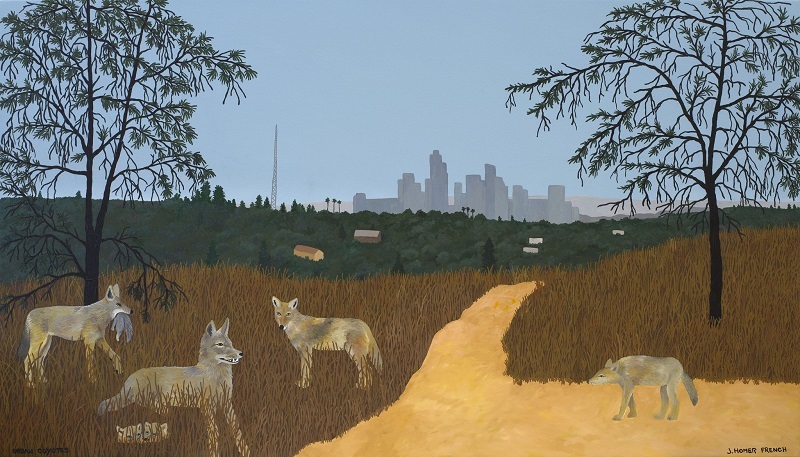
Jibz Cameron Cops, Coyotes, Cars, Crows (2023) Watercolor, Correction Fluid and Graphite on Paper
We, on the other hand, are lucky enough to find quite a bit of it all in one place, a weave that is compact as well as sprawling, screaming as well as whispering, consciously representing or intuitively describing, like L.A. itself. It’s made possible by curators who brought a cross section of yet undiscovered stories into an exhibition that in many aspect mirrors the city it drew from.


At least that is how I experienced the Hammer’s current exhibition Made in L.A. 2023: The Act of Living, an iteration of its biennial attempt to showcase new talent, unknown or underrepresented artists, providing access to what is likely hidden to most of us from different cultural enclaves. Guest curator Diana Nawi and Pablo José Ramírez, who joined the Hammer museum full-time in June, and Ashton Cooper, Luce Curatorial Fellow, have assembled some 250 works of 39 locally based artists, challenging us to confront our stereotypes and navigate an abundance of thought-provoking art. I come back to what I had written about our own Portland’s current art extravaganza, Converge 45: perceptive curation is a mystery to me, like herding cats, but when it succeeds it is a gift to the community (never mind an intellectual feat.)
Their guiding principles can be found in their statement above.
***
AT RISK OF FALLING for surface rather than structural characteristics, here is an analogy I can’t resist: as L.A.’s neighborhoods differ along multiple dimensions, so does the chosen art in this show. By size, by spacing, by density, by degrees of familiarity. Just as I like some neighborhoods more than others, some leaving me cold, some moving me to the core, some eluding my comprehension, some dull, some riveting, some evoking scorn, and others longing or admiration, so it is for much of the work on display. What registered most deeply was the fact that many of the exhibits taught me something I would not have otherwise known, and how much, sometimes viscerally, texture ran as a common theme through the galleries. Texture, indifferent to past, present or future, is, of course, a stand-out characteristic of Southern California’s nature for this Northerner, with its unusual mix of desert and tropical plants, all ridges, grains, thorns, spines and spikes, peeling bark, twisted fronds, and leathery surfaces.

Kinetic sculpture by Maria Maea “Lē Gata Fa’avavau (Infinity Forever)” (2023) including parts of palm trees, car parts and feathers.


Really, I think there are few materials known to man not included in this biennial. Natural materials like wood, bones, wool, cotton, pearls, wax, mica, graphite, dirt, salt, limestone, copper, leather, feathers, palm fronds, sea shells, corn, corn or other plant based substances. Fabricated materials like acrylic, plastics, paper, forged metal, glass, lead alloys – you name it, it was affixed or served as a constituent even in the context of more traditional forms of painting. Some assemblages consisted of more material detail than you could possibly take in at a single visit. Videos were (blissfully) few and far in-between, although demonstrations of octogenarian Pippa Garner triggered some giddiness.


What follows are some photographs to relate the overall variety of art on display, not necessarily work that I liked, but work that speaks to the range of cultural production, the focus on texture, as well as entryways into histories new to me. I will then turn to my absolute favorites, both artists I had never heard of. In one case, apparently, the same was true for the curators, who only met the young painter upon recommendations of other studios.

Beautiful weavings by Melissa Cody, Scaling the Caverns (2023) at center, detail below

Sensuous configurations of leather, painting- or quilt-like, by Esteban Ramón Pérez,

Esteban Ramón Pérez Cloud Serpent Tierra del Fuego) (2023) Leather, rooster-tail feathers, urethane, acrylic, nylon, jute wood.
Disquieting collages by King Seung Lee,

Kang Seung Lee Untitled (Chairs) (2023) Graphite, antique 24-k gold thread, same, pearls, 24-k gold leaf, sealing wax, brass nails on goat skin parchment, walnut frame.
(Aside: what it is with chairs that can so easily register as ominous? Look at Tadashi Kawamata‘s currently exhibited at Liaigre’s building in Paris: Nest at Liagre. Or is it just me?)

Photo creditL Sylvie Becquet
From the younger set:

Michael Alvarez 2 Foos and a Double Rainbow (2019) Oil, Spray Paint, Graphite and Collage on Panel
A reminder for those of us who vicariously experienced the AIDs epidemic as young adults when living in NYC, with friends dying:

Joey Terrill works, the selection depicting formative memories and daily experience in queer communities.
The Munch-inspired scream on steroids below attracted a lot of attention, justified, in my opinion, only if you looked more closely on the backside of the sculpture that provided a narrative worth the attention grabbing. The sculpture was co-created by numerous Native Americans.


Ishi Glinsky Inertia – Warn the Animals (2023)
Runner-up to the works below that inspired me most, was this assemblage using a silk parachute. Talk about texture!


Erica Mahinay Lunar Tryst (2023) and Details. Acrylic, raw pigment and aluminum leaf on half-silk parachute, lead, ostrich feathers.
And here are Kyle Kilty’s paintings, as vibrant, patterned, and hibiscus-colored as L.A. itself, capturing the imagination with abstractions that turn representational upon closer inspection – just about the same process the traveler experiences when getting to know and learning to navigate this moloch of a city.
For some reason I was reminded of Paul Klee, had he lived in another century, under the California sun and caved to demands for size. (The Phillips had an informative exhibition on Klee’s lasting influence on other American painters, some years ago.)


Kyle Kilty It could be, Frankly (2022) Acrylic, mica flake and oil on canvas.

Kyle Kilty It Could Get the Railroad (2022) Acrylic, oil, and graphite on canvas


Kyle Kilty Arranging (2019) Acrylic, oil, and gold leaf on canvas
And here, finally, is the essence of story telling about the facets of this city here and now, its hidden treasures and traditions, the diasporic nature of its people due to displacement from their home countries and/or the grid of highways, literally embedded in the substance of L.A. county itself: the soil collected from its various neighborhoods, mixed with salt, rain, limestone and masa. Jackie Amézquita’s 144 slabs are testament to the unwritten history of the many unseen people who constitute the lifeblood of L.A., the embedded drawings representing typical sights during quotidian encounters.


Jackie Amézquita El suelo que nos alimenta (2023) Soil, masa (corn dough), salt, rain, limestone, and copper
Here you can see her at work and hear her explanations of the artwork. It is terrific on so many levels.
***
THERE IS CHANGE AFOOT at the Hammer. This week we learned of the planned retirement of long-time director Ann Philbin, with a search for a replacement underway. It will be difficult to fill those shoes. Hopefully, the core of her focus will endure, a commitment to contemporary art with a focus on emerging artists and social justice. The 2023 biennial certainly can serve as a model: reconsidering the past in the sense that it paves the way for grasping a more equitable future, but then moving on, creating our own utopias.
Started today with an incisive German voice. Might as well end with another one. If you replace the words “(social) revolutions” with “art,” and “19th” with “21st” century, the museum might eventually follow this model:
“The social revolution of the nineteenth century cannot take its poetry from the past but only from the future. It cannot begin with itself before it has stripped away all superstition about the past. The former revolutions required recollections of past world history in order to smother their own content. The revolution of the nineteenth century must let the dead bury their dead in order to arrive at its own content.”
Karl Marx The Eighteenth Brumaire of Louis Bonaparte. 1852

Mirrored in installation by Guadalupe Rosales.
———————————————
Made in L.A. 2023: Acts of Living
OCT 1 – DEC 31, 2023
HAMMER MUSEUM
Free for good
10899 Wilshire Blvd.
Los Angeles, CA
90024