Browsing Category

Politics

The Bright Sun was extinguish’d.

Forgive me if my mind wanders even more than usual these days. I used to think of my habit of forming strange and far-reaching connections as an asset; these days associations come unbidden, feeling more intrusive than clever or surprising. Be that as it may, here is the most recent chain of thought, originally triggered by a day of darkness.

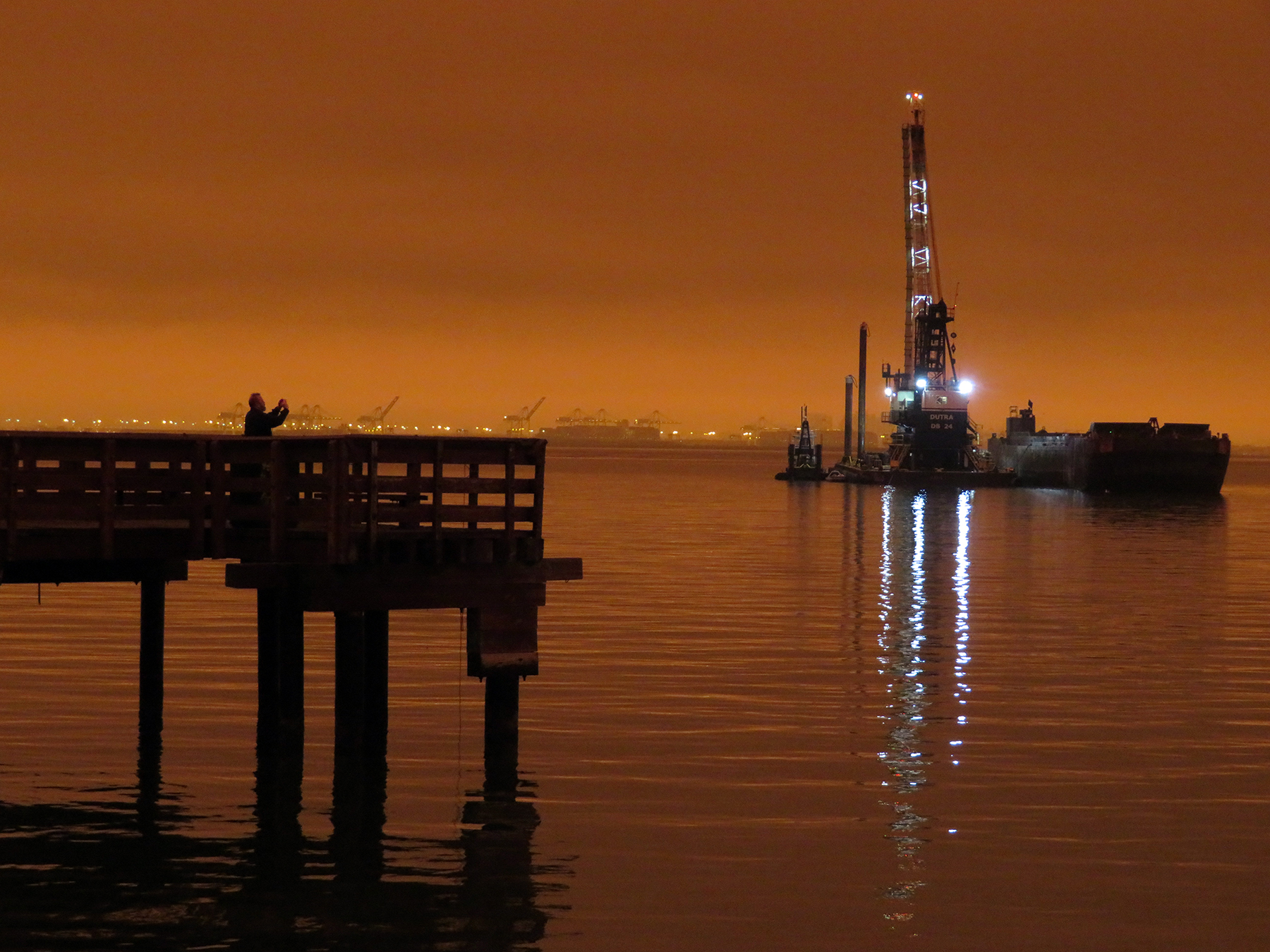
Literal darkness, that is, as you can discern yourself when realizing today’s photographs were taken at noon, overlooking San Francisco Bay, some days ago. A darkness likely to have enshrouded the Oregon landscape as well, a consequence of the devastating fires.

It brought to mind Lord Byron’s poem, Darkness, attached below. It was written in the summer of 1816 after the explosion of the Indonesian volcano Mount Tambora in 1815. The eruption killed more than 10,000 people, while an additional 30,000 across the world perished from the crop failures, famine, and disease that resulted from extreme weather triggered by the explosion. Volcanic ash blotted out much of the sun for more than a year, having people believe that the sun was dying. The average global temperature dropped by a whole degree. The poem reads like a prescient description of both climate change and/or the more figurative darkness that surrounds us in these days of the demise of our democracy.

Darkness

BY LORD BYRON (GEORGE GORDON)

I had a dream, which was not all a dream. 
The bright sun was extinguish’d, and the stars 
Did wander darkling in the eternal space, 
Rayless, and pathless, and the icy earth 
Swung blind and blackening in the moonless air; 
Morn came and went—and came, and brought no day, 
And men forgot their passions in the dread 
Of this their desolation; and all hearts 
Were chill’d into a selfish prayer for light: 
And they did live by watchfires—and the thrones, 
The palaces of crowned kings—the huts, 
The habitations of all things which dwell, 
Were burnt for beacons; cities were consum’d, 
And men were gather’d round their blazing homes 
To look once more into each other’s face; 
Happy were those who dwelt within the eye 
Of the volcanos, and their mountain-torch: 
A fearful hope was all the world contain’d; 
Forests were set on fire—but hour by hour 
They fell and faded—and the crackling trunks 
Extinguish’d with a crash—and all was black. 
The brows of men by the despairing light 
Wore an unearthly aspect, as by fits 
The flashes fell upon them; some lay down 
And hid their eyes and wept; and some did rest 
Their chins upon their clenched hands, and smil’d; 
And others hurried to and fro, and fed 
Their funeral piles with fuel, and look’d up 
With mad disquietude on the dull sky, 
The pall of a past world; and then again 
With curses cast them down upon the dust, 
And gnash’d their teeth and howl’d: the wild birds shriek’d 
And, terrified, did flutter on the ground, 
And flap their useless wings; the wildest brutes 
Came tame and tremulous; and vipers crawl’d 
And twin’d themselves among the multitude, 
Hissing, but stingless—they were slain for food. 
And War, which for a moment was no more, 
Did glut himself again: a meal was bought 
With blood, and each sate sullenly apart 
Gorging himself in gloom: no love was left; 
All earth was but one thought—and that was death 
Immediate and inglorious; and the pang 
Of famine fed upon all entrails—men 
Died, and their bones were tombless as their flesh; 
The meagre by the meagre were devour’d, 
Even dogs assail’d their masters, all save one, 
And he was faithful to a corse, and kept 
The birds and beasts and famish’d men at bay, 
Till hunger clung them, or the dropping dead 
Lur’d their lank jaws; himself sought out no food, 
But with a piteous and perpetual moan, 
And a quick desolate cry, licking the hand 
Which answer’d not with a caress—he died. 
The crowd was famish’d by degrees; but two 
Of an enormous city did survive, 
And they were enemies: they met beside 
The dying embers of an altar-place 
Where had been heap’d a mass of holy things 
For an unholy usage; they rak’d up, 
And shivering scrap’d with their cold skeleton hands 
The feeble ashes, and their feeble breath 
Blew for a little life, and made a flame 
Which was a mockery; then they lifted up 
Their eyes as it grew lighter, and beheld 
Each other’s aspects—saw, and shriek’d, and died— 
Even of their mutual hideousness they died, 
Unknowing who he was upon whose brow 
Famine had written Fiend. The world was void, 
The populous and the powerful was a lump, 
Seasonless, herbless, treeless, manless, lifeless— 
A lump of death—a chaos of hard clay. 
The rivers, lakes and ocean all stood still, 
And nothing stirr’d within their silent depths; 
Ships sailorless lay rotting on the sea, 
And their masts fell down piecemeal: as they dropp’d 
They slept on the abyss without a surge— 
The waves were dead; the tides were in their grave, 
The moon, their mistress, had expir’d before; 
The winds were wither’d in the stagnant air, 
And the clouds perish’d; Darkness had no need 
Of aid from them—She was the Universe.


________________________________________________________

The poem’s apocalyptic tone was not just caused by the strange, dark weather. Byron himself was at one of the lowest points in his life, his reputation shattered by revelations of his incestuous relationship with a half-sister, and public disclosure of his marital cruelty (he was sexually and emotionally abusive to his partners, men and women alike, throughout his life time.) He left England in disgrace at age 28, never to return again, wracked by debt and alcoholism. He died in exile from illness contracted through exposure to the elements. Notorious to the last, and yet he was a shining star in romantic poetry’s firmament, of bright intensity or intense brightness, your pick.

—————————————————————————————————————-

Notorious is also a term for me, for many of us, prominently associated with RBG. Supreme Court Justice Ruth Bader Ginsburg, may her memory be a blessing, died last week on the eve of Rosh Hashanah, a bright sun extinguish’d. For all she fought for, trailblazed, conquered, for a life lived with integrity at the opposite end of the spectrum from Byron, she, too was not granted a peaceful death. The very knowledge that her passing would be exploited for yet another power grab by those who care for nothing but, must have weighed heavily for someone ready to be freed from the ravages of cancer and yet clinging to life in hopes of gaining time towards the election. It was not to be.

We must mourn her, and then tend to her legacy by whatever means we have. I find it heartening to be reminded that this is not on individuals alone. If you reread the poem above, look at the lines that signal connectedness – “And men were gather’d round their blazing homes 
To look once more into each other’s face” – we are in this together. Or the lines that point to a future, even if shrouded by fear – “A fearful hope was all the world contain’d.”  And then various descriptions of how people, other than those giving up, acted on that hope.

The poem does not end happily, but rather in desolation. That is a choice, but one the poet himself did ultimately not give into. Byron dreamt of revolutionary changes for the world and actually fought for social justice in his few years in government service. So did Bader Ginsburg in her reckonings with the powers that be. Here are Byron’s words from Canto IV of Childe Harold:

But I have lived, and have not lived in vain:
My mind may lose its force, my blood its fire,
And my frame perish even in conquering pain,
But there is that within me which shall tire
Torture and Time, and breathe when I expire [.]

For the rest of us: let’s tire, if not torture or time, then at least the current President and Senate hellbent on filling a Supreme Court Seat that does not belong to them. Make them weary with an onslaught of action. Exhaust them, weaken them by all means in our repertory. Unless darkness becomes the universe.

Music today uses the words from another Byron poem, She walks in Beauty. Rest in power, RBG. You have not lived in vain.

Hope for the Future

In the dark times/Will there also be singing? Yesthere will also be singing/About the dark times. –Bertholt Brecht, Motto to Svendborg Poems, written in exile in Denmark, 1939.

Some people sing about the dark times with their camera, documenting state imposed cruelty as much as the defiance by those affected. One of those contemporary photographers is Ximena Natera, a Mexican reporter and documentary filmmaker who specializes in migration, human rights violations, peace processes and collective memory in the region. Her work with Pie de Pagina’s investigation unit – they support at risk reporters in conflict zones – has been recognized by Mexico’s National Journalism Award, Gabriel Garcia Márquez Foundation, and Pictures of the Year Latam.

Ximena Natera

She currently lives in Brooklyn, NY, while attending the documentary photography program at the International Center of Photography in New York on a Jan Mulder Scholarship prize.

Ximena Natera

I had known about her work given my interest in issues of migration, but was reminded of her when a recent issue of Mother Jones featured her brilliant portraits of young children who attended Black Lives Matter marches, gatherings and other communal functions.

The photos were taken in the beginning of June, 2020. At that point, no-one would have hesitated to take their children to marches and demonstrations against police brutality and racism, that would take place in city squares, in front of public buildings, the streets of various cities in this nation. They would have been able to sing about the dark times, gaining a collective memory of civic action, learning that each voice counts at a young age.

Ximena Natera

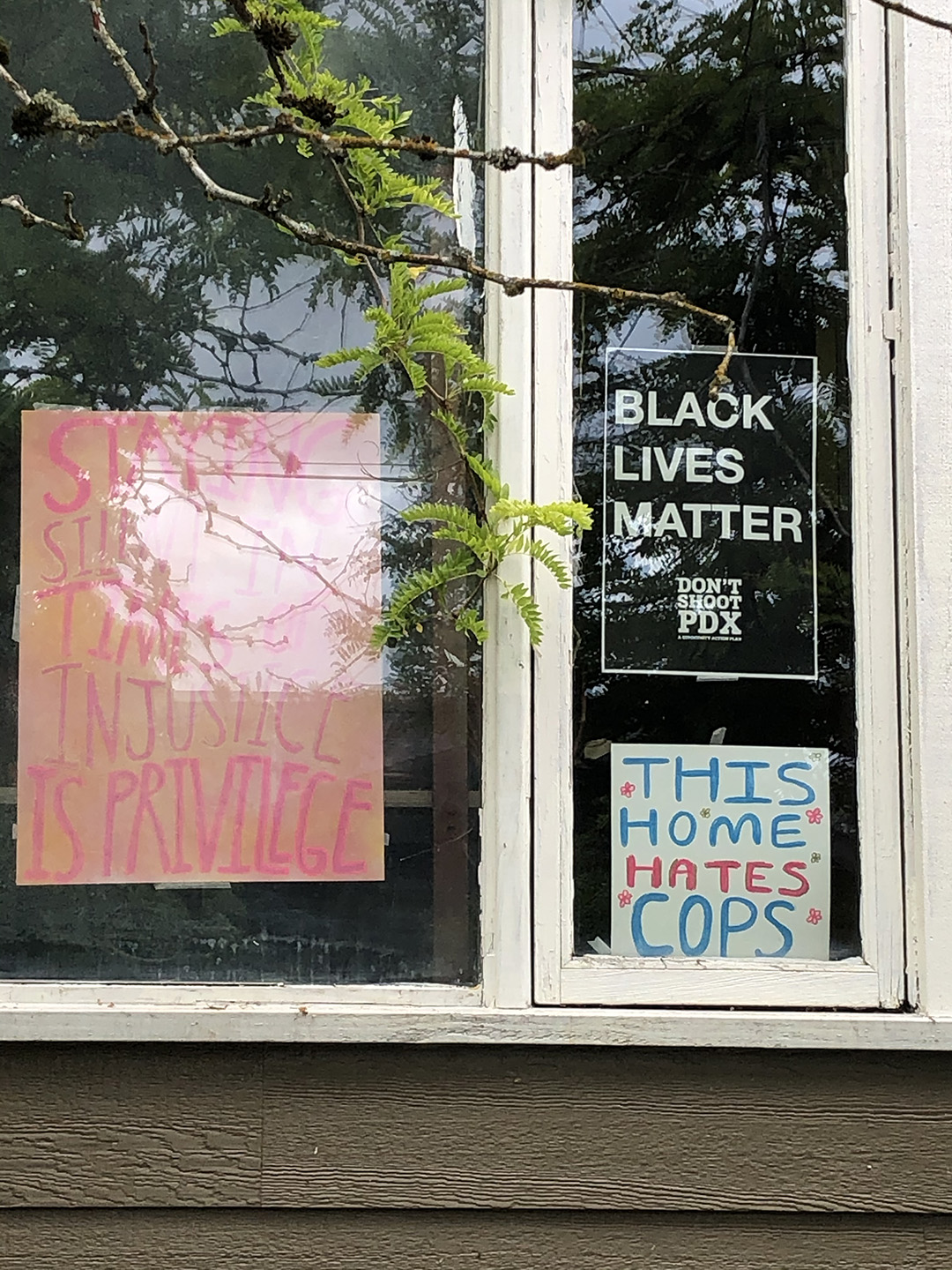
Can you imagine now, with teargas, toxins and other ammunition shot randomly into peacefully protesting crowds of mothers, dads, veterans and nurses, how a child could be traumatized, if not physically hurt? They have to stay home, or do their little neighborhood bike parades which are gratefully happening all over Portland, deprived of large communal experience that would guide them on their path to be engaged citizens. The political implications of the current PDX situation will be far reaching and long lasting. Dark times, indeed.

And yet, seeing the photographs of the NYC kids create pure hope. Hope for a better future.

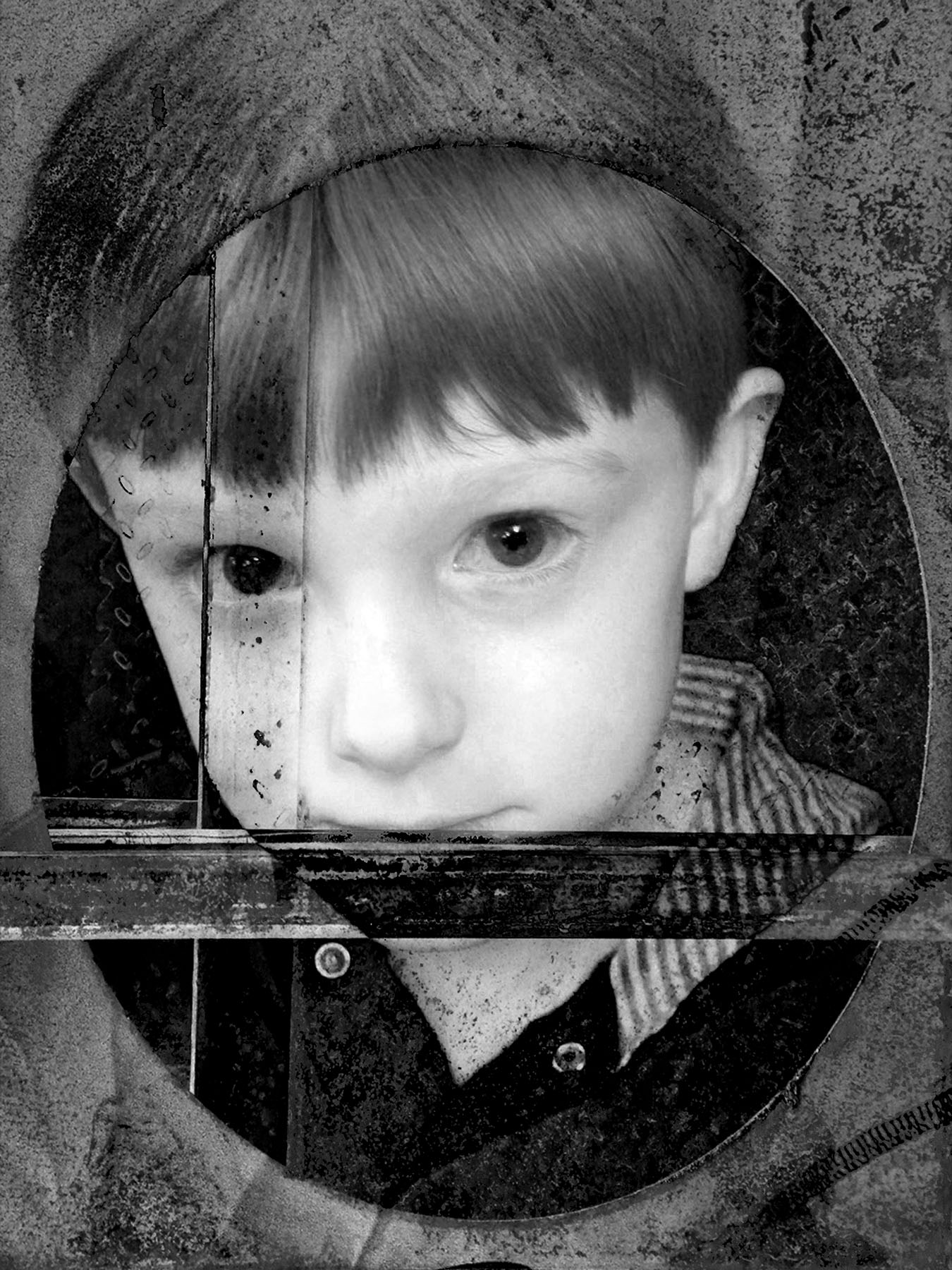
My own photomontages for today were the results of working at a peace camp with children of all religions some 7 years ago.

Music from the Resistance Revival Chorus singing about the dark times.

All Human Beings

Today the text is the music and the music is the text. The words of the 1948 UN Human Rights Declaration, in their demands for and implicit belief in humanity – the vision of a better and fairer world that is within our reach if we choose it – remind us that we still have a long way to relieve the trauma that millions of people undergo everyday, imposed by cruelty, greed and injustice.

Eleanor Roosevelt, credited with its inspiration, was the chair person of the UN Committee that drafted the document. She referred to the Declaration as the “international Magna Carta for all mankind,” and considered the 30 Articles of the Declaration as her greatest achievement. It was adopted by the United Nations on December 10, 1948. Here is Roosevelt reading the preamble.

Composer Max Richter put her words to music, incorporating her reading of the preamble into a piece called All Human Beings from his new album Voices, to be released by the end of July. He then crowdsourced hundreds of readers of all ages who repeated the words in various languages, interwoven with the music. They are the voices of the title.

Here is an interview with the composer about his approach to music as a conduit for political or philosophical thought and here is a play list of his works broadcast on NPR.

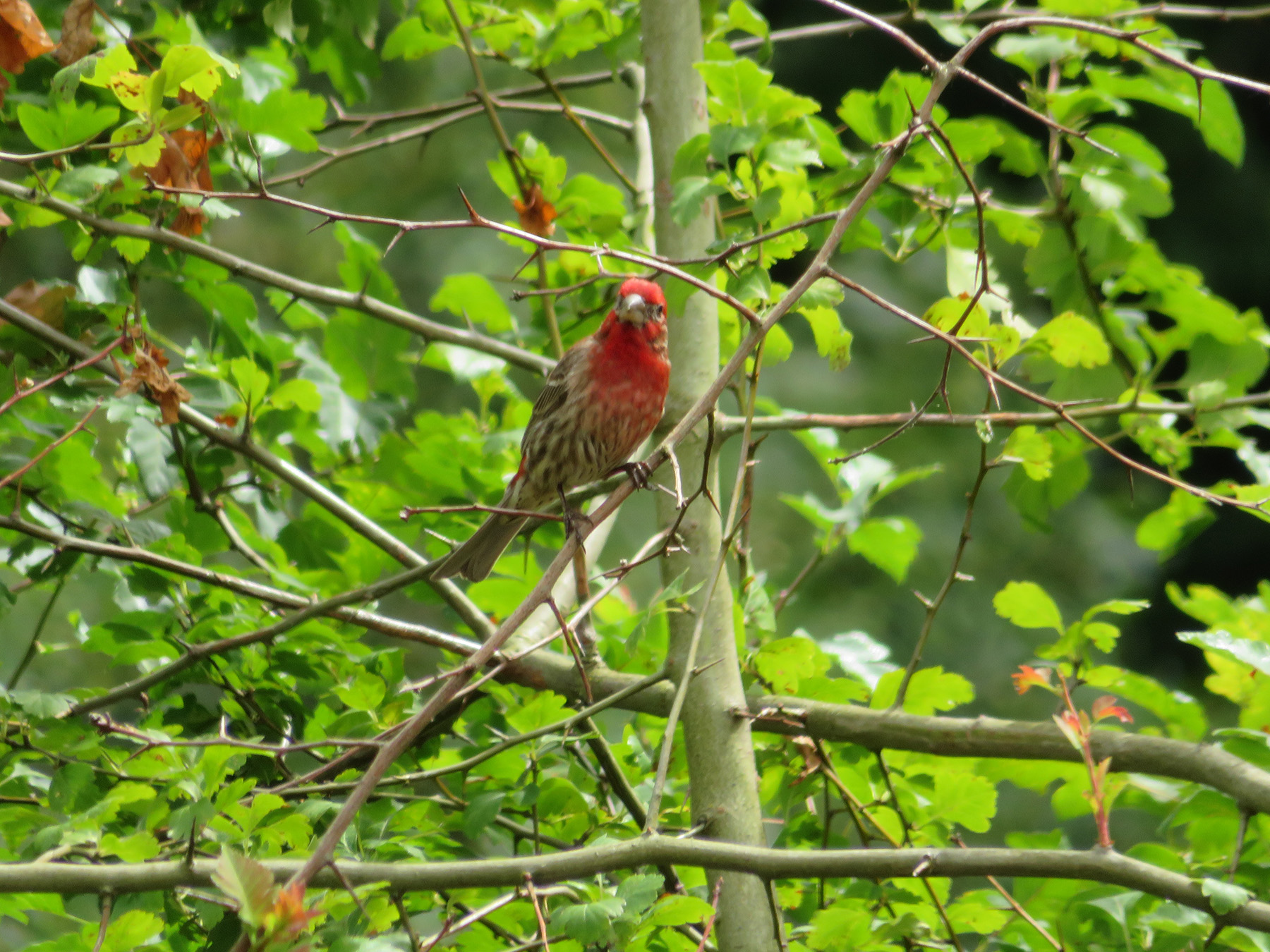
Photographs today are a variety of finches, gold finches, house finches – the male plumage still intense for mating, to produce a second clutch of eggs. Their color comes from pigments in the food they eat, and so varies depending on the quality of the food. The better quality food, the more intense color, the more likely to be chosen as a mate by Ms. Finch….

I chose finches because they range across the entire world – in tune with the United Nations mission. Bunting, canary, cardinal, chaffinch, crossbill, Galapagos finch, goldfinch, grass finch, grosbeak, and sparrow classify as finches.

The function(s) of silence

The dictionary Merriam-Webster gives us a few definitions of silence as a noun:

1: forbearance from speech or noise MUTENESS 

2: absence of sound or noise STILLNESS in the silence of the night

3: absence of mention:a: OBLIVIONOBSCURITY – b: SECRECY weapons research was conducted in silence

or as a verb:


1: 
to compel or reduce to silence STILL//silenced the crowd

2: SUPPRESS //silence dissent

3: to cause to cease hostile firing or criticism// silence the opposition

Silence, in other words, is not just a desirable state to enable contemplation or soothe our stretched nerves. It can also be used to achieve certain communicative goals: keeping a secret (which can be good or bad,) signaling who belongs to certain groups or serving as a means of exclusion, or as manipulation in the service of power. You can be silent because you have nothing to say, or you don’t want to say something or you are not allowed to say something.

There are controlled, calculating silences: The majority of Republican politicians, until yesterday, were silent on the wearing of masks even though all scientific evidence pointed to them as effective in slowing the pandemic. Being silent on the numbers of infected people seems to be a magical tool to make the disease disappear, whether we are talking the President’s proposals regarding testing, or the disappearance of hospital admittance statistics across red states.

Then there are resigned, powerless silences – children who are undergoing traumatic experiences often cease to speak. People who have never been listened to don’t want to waste energy by futilely raising their voices.

Silence is often socially and culturally regulated: who gets to speak first or who does not get to speak at all tells volumes about power hierarchies. There are not many languages who do not have proverbs that allude to the desire to silence chattering women folk, for example. And we can finally put a myth about gossiping women to silent rest: new research shows they don’t do any more of that than men.

Many terms in both German and English connote a critical or negative perspective rather than a positive one: “Shut Up!, wall of silence, I’m lost for words, under the cloak of silence, speechlessness, the silence treatment, shocked into silence, hushing something up. (The German translation for the last one, by the way, is literally “killing with silence,” totschweigen, wanting to make something disappear for good.)

Silence, then, can be political. Some years back, for example, a famous German author, Martin Walser, talked in his acceptance speech for the Peace Prize of the German Book Trade about the “instrumentalization of the Holocaust” and the Nazi concentration camp Auschwitz as a “moral bludgeon.” Let’s no longer talk about it, we feel bombarded! He recommended that Germans withdraw to their own conscience, to a place of “profound inward solitude” and engage in “the withdrawal into themselves.”

All hell broke loose. The solution to return to the individual conscience in order to avoid the public remembering, silencing it, in effect, was not something that sat easily with many people who had worked hard to educate about the Holocaust particularly in light of the rising neo-fascist tendencies in younger generations as well. The Jewish community was mortified, with its then-leader Ignaz Bubis decrying the re-establishment of a scenario which has nourished anti-Semitism for hundreds of years: the revengeful Jew, who doesn’t want to make peace and the poor Christian victim who seeks salvation through his quiet lonely suffering. (Ref.)

Closer to home we have a great many examples of silence in politics to choose from – beginning with Richard Nixon’s invocation of the silent majority in 1969. Or think of the current debate around the persistence of racism in all of its ugly forms. Pence, for example, has not allowed the words Black Lives Matter to cross his lips even if directly asked in interviews. Police departments around the country are silent on crimes committed against Black citizens, until public pressure boils over. The current failure of the Senate to pass pending legislation – The Emmett Till Anti-Lynching Bill – is another example of silence on the part of the American state. No federal law was EVER passed to criminalize the practice of lynching.

The moment of silence that is invoked like clockwork in our age of mass shootings is a tool as well: we do not wish to acknowledge that gun suicides claim more than 20,000 lives in the United States annually; that American women are 11 times more likely to be shot and killed than their counterparts in other high-income countries; that black men account for 6 percent of the U.S. population but half of its gun homicide victims. With its roots in religious practice the gesture seems to indicate that we are helpless to prevent something we’d like to think of as an act of G-d, rather than the outcome of profit motives for the weapons industry combined with structurally racist policies.

Back to the word itself: silence has its etymological root in the latin verb desinere: to cease, stop, desist, abandon. Silence across history has been responsible for abandoning those who needed a voice, their own being stopped. Silence, if you want to reverse the letters, gave license to the abuse of power. Let’s desist.

Photographs today found on a walk along NE 22nd and surrounds.

Music by Sir John Tavener, composed to capture his escape from a near-death experience.

Silence, in so many words.

I like silence, though I am not one of those people who crave it constantly. In fact, one of the pleasures of travel that takes me away from a place where the incessant screeching of crows is the dominant sound in an otherwise quiet environment, is the return to city noise. New York City in particular, a place where I spent many years, greets me with “Ah, this is the noise indeed,” (as well as “Oh, I remember these inescapable, foul smells,”) in ways that provide a bittersweet jolt of familiarity and reminiscence. Different, of course, if you visit, and don’t have to live any longer immersed in the constant barrage of sounds.

Silence is certainly the mode when I work, no background radio for me when writing or creating montage, despite my love for music. Silence was the biggest prize when moving out of shared housing, including boarding school dorms where you could not hear your own inner voice for constant vigilance of what the noises meant across the hall, the whispered ones most dangerous of all. Silence unimpeded by the neighbors in surrounding flats was a gift when finding our house.

Many have written about silence and its nemesis, the bombardment with noise in our culture. The linkage is smartly captured in a book by George Prochnik from a decade ago, In Pursuit of Silence. A comprehensive review can be found here.

But today I want to share descriptions of types of silence that I’ve come across, in hopes they’ll spark recognition and give you as much pleasure as they did for me.

“Not speaking and speaking are both human ways of being in the world, and there are kinds and grades of each. There is the dumb silence of slumber or apathy; the sober silence that goes with a solemn animal face; the fertile silence of awareness, pasturing the soul, whence emerge new thoughts; the alive silence of alert perception, ready to say, “This… this…”; the musical silence that accompanies absorbed activity; the silence of listening to another speak, catching the drift and helping him be clear; the noisy silence of resentment and self-recrimination, loud and subvocal speech but sullen to say it; baffled silence; the silence of peaceful accord with other persons or communion with the cosmos.”

It is somewhat ironic that they were written by a man eulogized in 1973 by journalist Nat Hentoff, his friend and colleague, as Citizen Va – r- ooooooom! The author in question, Paul Goodman, would be one of those people I’d choose to invite to the proverbial lonely island.

Born to a sephardic Jewish family in NYC, he led an intellectual life as rich as they come, and a practical life as poor as they can be endured. His openly lived bisexuality cost him educational status, jobs, group memberships in even the most progressive environments. His anarchist writings did nothing to improve that lot. Fame, or notoriety, you choose, that were accrued in the 1950s as a philosopher of the New Left, a social critic, as co-founder of the Gestalt Therapy movement and psychotherapist, as a novelist and activist, did not extend much beyond his early death from a heart attack.

And yet his writings are especially applicable to our current times. His World War II-era essays on the draft, resisting violence, moral law, and civic duty were re-purposed for youth grappling with the Vietnam War but can be applied to state violence in general. In Growing Up Absurd (1960), he addressed young protesters, really young Americans in general, whom he encouraged to reclaim Thomas Jefferson’s radical democracy as their birthright.  The book was not just about school reform to re-engage disaffected youth, but a reckoning with a political and economic system that used and discarded human beings as pawns. If alive today, he would be a welcome, loud voice indeed, not a proponent of silence.

More on the uses of silence tomorrow.

Photographs today from a place where you commune in silence – collected across cemeteries in Paris, another nicely noisy city.

“Silence is not acoustic. It is a change of mind, a turning around,” composer John Cage once remarked. He was drawn to it in his studies of Zen Buddhism. So it shall be his music for today, the Sonatas and Interludes in a prepared Piano, recently performed in Seattle. For those interested, here is an approachable introduction to the composer and the music. Open your week-end rested brain to the challenge!

Nothing is Easy

I get mail that tells me I make too much use of the bully pulpit and should seduce the reader on an easy slope into hard topics. Noted.

I get mail that urges me to be more straightforward and cut the superfluous trimmings from the message core. Under consideration.

I get mail that compares me to a mindreader, expressing word for word what is a fog of thoughts in someone’s brain. I don’t think so.

I get mail that simply says: Spot on! Makes my heart sing.

On some days, I am told by strangers that they love my work, so glad they stumbled on the blog. Makes my day.

Occasionally I get yelled at. So be it.

Yet all agree I have some quirky habits. One of them is to recommend books to read that I have not (yet) read myself, as you all well know. (There are other, quirkier habits. They include one that I have had since childhood. I leave the cores of apples, religiously consumed as one per day for the last 60-odd years, lying around wherever I drop them, much to the consternation of my mother who called me Appelschnut, a vernacular for “little apple mouth,” and my roommates, lovers, girlfriends, or my husband. Should I ever get lost in the Hänsel and Gretel woods, just follow the trail of pips….

Regarding that unseemly habit, I wouldn’t know the answer to the question: “Why?”

*

I do know the reason for the book recommendations, though: I simply do not have enough time to read everything in a timely fashion. When books crop up that tie into something that is of current interest or importance, and if they are recommended by a source I trust, I have no quarrel with putting them up and out there. Who knows, maybe I’ll get mail that tells me they were worth it?!

Case in point was a reminder in our current discussion about race relations and discriminatory treatment, that our educational institutions, as designed, have been at the forefront of keeping race and class in separate corners, perpetuating a division that prohibits young minds to snap out of historically and culturally ingrained patterns of group identity.

An article in yesterday’s Washington Post reported on the results of studies of White students’ attitudes after forced school segregation was ended in Charlotte, NC, in 2002. Students’ views became closer to those of their minority peers, and a significantly smaller proportion registered as Republicans later in life. Exposure to minorities in grade school also affected whether you doubted that they were structurally disadvantage in our society and influenced your choice of room mated during the college years.

The book Cutting SchoolThe Segrenomics of American Education by Noliwe Rooks who is the W.E.B. Du Bois professor of literature and the director of American studies at Cornell University, and was for ten years the associate director of African American studies at Princeton University, paints a larger picture. On the one hand, the book is a personal memoir of living in two very distinct educational environments simultaneous – she alternated between her divorced parents’ households in Florida, with an overwhelmingly white, integrated school, and San Francisco, where her peers were POC or all Black.

 “That experience, and my family history, led me to understand the tremendous influence of the segregated history of American education on our educational present.

In our current moment, the type of education, the quality of the school buildings, the experience of the teachers, and the ability to graduate are vastly different depending on the racial and economic makeup of one’s community. It is apartheid: a system that is, at its core, organized by physically separating racial groups and then privileging one racial group over another (a construct that cannot be disentangled from social class). 

On the other hand, it is a rigorous research study of the historical dynamics of race and class, and contemporary attempts to co-opt educational reform in favor of maintaining double standards and increasing further privatization (often as a means to blur the separation between church and state as well. Here is a verbatim quote ( I found somewhere else) by Betsy de Vos: “Our desire is to confront the culture in ways that will continue to advance God’s kingdom.”)

Rooks’ work came to my attention when I listened to a conversation between Amy Goodman and the author in a radio program about the effects of the pandemic on education. Rooks felt that our current circumstances in some ways shine a light on the inequalities that are already there, with those who are suffering the most tending to be Black and poor. Remote education – the fall-back option after city after city had to close the schools – works for some parts of the population, but not those for whom school meant so much more than just receiving lessons: a place to get fed, wash their clothes, have structure and social services, mental health stability.

In communities where you do not have access to stable, fast Internet, on-line learning is problematic. For many poor people, the internet is accessed through their phones, which means on-line sessions accrue more charges, money they don’t have. And in much on-line learning schools expect parents to hand out lesson plans and facilitate homework assignments beyond the twice-a week 40 minute lectures, which many poor parents are unlikely to be able to do. Home environments also do not facilitate concentration needed for remote learning, if they are cramped or noisy. (Harvard Law asked students worried about these issues to rent office space – no joke!.)

On the college level, the vast majority, well over 60%, of Black and Latinx kids who get BAs do so at community colleges or for-profit universities, not at four-year institutions. There has been little exploration about how these institutions are going to re-open, if at all. What works perhaps at truly wealthy institutions who have funds to spend for prevention and protection, is not going to work at the schools that serve the majority of the population. And we are not even having a national discussion about this.

Nothing is easy. Learning about the historical factors that created and perpetuate unequal education for groups of people in this country, however, might help figuring out what must be urgently re-structured and how we can go about it.

Should all this be thoroughly depressing, the photographs of yesterday’s walk might just be the balancing ticket – the beauty out there cannot be tempered even with the rain-filled skies.

Music today about schooling across several generations.

Filmed in Germany for some reason….

The Need To Learn

When I observe wildflowers, plants and the natural environment around me, I feel joy, a sense of place, being here and being now. When I look at larger vistas, particularly if clouds are involved, I feel longing, a desire to go to places far away, a yearning to be untethered.

(Wouldn’t you know it, my bird watching is in-between – which probably explains the constant avian barrage that you are exposed to in these pages.)

The opportunity to do both on last week’s hike, feeling grounded and dreaming of a world beyond, reminded me of the work of a brilliant young photographer from the Democratic Republic of Congo. (I was introduced to her by Maaza Mengiste, whose book “The Shadow King” I recommended earlier, and whose public postings continually provide new insights.)

Gosette Lubondo is a photographer from Kinshasa who has already found international acclaim in less than a decade of professional work since she received her degree in visual arts from the Academy of Fine Arts in Kinshasa. Lubondo’s most recent series, Tala Ngai, invites viewers to visit with contemporary Congolese women in their own homes, portrayed in the clothes they wear outside of the house, inside of it, and a glimpse of their personal surroundings. It is strikingly intimate, the triptychs almost defiantly capturing this very moment in time, with no explicit nod to the trauma that Congo (formerly Zaire) had to go through with the worst of wars after the yoke of brutal Belgian colonialism.

Books I’ve read about that country, from the horrible Joseph Conrad’s Heart of Darkness, to Barbara Kingsolver’s The Poisonwood Bible, which I liked, have educated me about the history. Tram 83 by Fiston Mwanza Mujila, a remarkable first novel and highly recommended, made an emotional impact. Here is my favorite sentence from a 2015 review:

“Evoking everyone from Brueghel to Henry Miller to Celine, Fiston — as he’s known — plunges us into a world so anarchic it would leave even Ted Cruz begging for more government.”

The photographic work, in contrast, has one overarching appeal: I made me long to get to know those women, creating a desire for connection that is so lacking in our post-colonial world.

*

Two of Lubondo’s previous series, created in 2016 and 2018, Imaginary Trip I and II, have more historical pointers and relate back to how I started today’s musing: rootedness versus journey. They combine not just the spatial dimension of travel, near and far, but also propel us into a dimension of time, then and now.

The combination is achieved by manipulating photographs of historical sites, associated with travel (disused train compartments in an old train depot,) or linked to place (an abandoned school building from Congo’s colonial past) from the past, with images of people as they are now or would have been in the respective times and locations. Truly clever.

The work has impressive layers. Independent of the striking visual aesthetics it makes you think about how experience is tied to place (the Belgian colonial oppression was surely one of the most violent in the entire world) and educates about Congolese specifics. On a whole different level, though, it appeals to how much the imagination is involved in travel, in the ability to pick up and go, to leave behind, to become less visible in the distance. She achieves this by often integrating transparent figures or objects into the depictions. And ultimately, the body of work has to be placed within the context of obstacles to migration that are put up against African people by many a nation in the world, regardless of the trauma they experience in countries that are wrecked by civil war, or the exploitation of multinational companies (just look at the Lithium extraction in Congo) that leads to ever increasing levels of deforestation, famine and poverty.

*

Knowing about the context – historical, cultural, geographical, political – is here, as so often, a key to understanding the depth of the expressed ideas. The artist’s work was displayed at schools in the DRC to increase students’ understanding of history. Not many of us do, myself included of course, when it comes to countries that are on other continents, outside of our regular information diet.

The same is often true, though, for what is happening right here and now in the US as well: a key to understanding where we are and where we need to move toward is a matter of having contextual insight. An understanding that includes the fact that all of us are affected, not just populations we have kept separate from ourselves. As Stacey Abram’s points out in her new book: “No assault on democracy will ever be limited to its targets.”


And who better to provide the context than Keeanga-Yamahtta Taylor in her most recent essay in the New Yorker, How to Change America. If you have time to read one thing today, make it this one.

We need to learn.

Music is from the DCR with a bit of political background. And here is Ferre Gola, a contemporary singer (sorry if ads interrupt…) .

The Will to Disobey

“Vorsicht, Kindchen, Vorsicht!” (Careful, kiddo, careful…) was a constant refrain in the household of my childhood, outnumbering even the “Straighten your back!” and “Darling, would you fetch me my cigarettes….”invocations.

Vorsicht – care, caution, precaution, restraint – built an invisible fence around a child’s desire and need to explore, to risk. For my war-traumatized parents, danger (understandably) lurked in shadows and around every imaginable corner. “Don’t jump off that swing, don’t race your bike, don’t hitchhike, don’t spend time to travel abroad instead of proceeding straight to your clerkship,” the variations were endless. Physical danger, psychological danger, danger to the vision of an unencumbered life in a straight line from school to university to career to marriage to happily ever after. Anticipatory fear was literally a cloud forming a cage.

Steep Creek Falls

Except that we escaped through the invisible bars, at every possible turn, skimmed knees, black&blues, twisted ankles, tropical diseases be damned. I never felt more alive than when climbing prohibited trees as a kid, when sleeping rough on the beaches of Morocco in the early 70s, or hunting for orchids in the temperate rainforests of Venezuela. In fact, lovingly imposed constraint continually incited the opposite: a yearning for risk taking, a struggle with conformity, a will to disobey.

Alaskan Bunch Berries
Anemones
Bead Lilies
Avalanche Lilies
AvalancheLilies
Wind Flowers
Bear Grass

All this is on my mind because in some miniature ways I still thrive on adventure, even when it is now limited to scrambling up and down a pile of rocks on an otherwise moderate, although insanely beautiful hike.

Luckily someone lend me gloves…
The top

No more solo hiking for me, like last year in New Mexico. Photographs today are from an outing last week where two kind souls invited me sight-unseen (regarding my physical condition) to explore with them a tiny slice of the Pacific Crest Trail (Rock Creek Pass). Am I ever grateful they took me with them – Charlie and Dennis, I owe you!

Wildflowers abounded, water rushed down the outcrops, lichen glowed in the diffuse light, snakes saw no reason to scurry away, rock wrens serenaded us and old growth forest calmed the soul along the way.

*

Risk taking, of course, also figures in the larger picture of deciding how to approach life while the country re-opens. We are no longer talking about thrill seeking, but a real and present danger to our lives, if we risk infection with Covid-19.

Any decision has to be based on an assessment of the probabilities of both the danger levels in situations we might seek out or avoid and our own specific vulnerabilities. Outside differs from inside, crowdedness differs from emptiness, duration of encounter with others is a huge factor, as is the presence or absence of masks. Your age and your health status has to be part of the equation.

Indian Paint Brush
Penstemon
Balsam Root (I think)

For me, there is also the question of why. It is not just going to be what am I doing, but why am I doing it? What are the reasons that justify for me to take risks? Do I go back to work, because I and my family could not survive otherwise? Am I truly needed for something, or am I too compliant to simply refuse? Am I staying away from the outside world because I let irrational fear rule me or because I legitimately cannot afford to risk infection? Is there such inherent meaning to be part of a community, or not being idle, that it justifies tolerating moderate risk at my work or the market place? Has fear become a mistress that we need to find the will to disobey?

Bleeding Hearts at the Bottum
Pioneer Violet
Arnika

The same is true for the larger question of risk and civic participation, when you decide the time has come to protest even in the face of radicalized police- and state action, perpetuation of historical injustice.

It is even a question when you contemplate actions often associated with protests, rioting and looting. Asking ourselves why people are doing that might provide surprising insights. One of the best explantations, both in content and rhetorical skill, that I have come across is in the attached short video. Note I have not linked to any other reading today, just so you have time to listen to a powerful voice. (Bonus: you will never play Monopoly again….)

And for music today one of the best choirs in the country with a familiar encouragement:We are not AFRAID today! Let that guide us, within reason.

Eau de Casselunettes

I rarely regret my habit of discarding mementos. No kids’ kindergarten drawings clog my drawers, no receipts for memorable journeys, few letters. Except on days like these, when I have to reconstruct what I was told, in a poem no less, by a lover half an eternity ago.

It had to do with cornflowers. My blue eyes? My toughness? (Not only did the plant invade the farmers’ fields taking up valuable nutrients, but it blunted the hand sickles with its tough stems – Thou blunt’st the very reaper’s sickle and so in life and death becom’st the farmer’s foe….) The intensity of blues, found in flower and my moods alike? Honestly, I forget. I do remember, however, that he left me for a violinist, and ended up, despite a brilliant dissertation on Trotsky in exile, teaching Spanish to 6th graders. She switched from concert hall to babies. I wonder what became of them.

Cornflowers are on my mind because of seeing too many images of people’s burnt and swollen eyes from tear gas or other noxious substances. Distilled in the right way, like the famous French concoction of the title, they can calm inflamed ophthalmic surfaces, work as anti-inflammatories and anti-irritant on lids, and as a decongestant for swollen mucous membranes. No use to put it on the officially permitted medic stations helping protesters with water and first aid, though, when even those get destroyed by police in sheer spite like yesterday in Ashville, NC.

I have always been partial to cornflowers (Centauria Cyanus). They grew wild, together with poppies and chamomile, in the fields around our village. We picked them, and they actually lasted in the vase for quite some time. I was fascinated by the story in my book of Greek Mythology in which Cyanos, the child poet, sang the praises of nature so well that the goddess Flora transformed him into cornflower so that we remember him every year anew. Well, these years we lack reminders: the industrial agricultural use of land with its systemic herbicide and pesticide application, has driven the plant pretty much out of our view, other than in ornamental gardens. No swaths of blue alongside and within fields of oats, wheat, barley and rye for us.

*

In ways, however, that remind me of the dilemma of how to approach art you love when you despise the artist who creates it, I have had mixed feelings when I look at cornflowers ever since I learned that is was a secret symbol for the Austrian Nazi part in the 1930s. Wouldn’t you know it that some of the contemporary German neo-Fascists took up the symbol used by the then-banned National Socialists in 1930s Austria before the Anschluss of 1938 brought the Nazis to power in the country?

By obvious chain of association, I have been unable to stop thinking about how political change can creep up on you when disbelief has kept you for the longest time in a state of denial. One of the things that matter and that I have certainly underestimated, is the degree of contemporary conformity – or complicity – despite all historical warnings, that allows the poisonous elements to gain power and solidify it. I hope you have the time to read a rather long, but perceptive case description of personalities who shared beginnings, but ended up in very different positions when it came to stand up against evil. Anne Applebaum’s essay on complicity and its consequences is informative in its detailed description of the process; I am not sure I learned enough to understand the causes that differentiate the psychological profiles of those who resist complicity and those who embrace it. But much food for thought in a week where I think we are so overloaded on emotional facts that counterbalancing it with thinking about underlying patterns is perhaps helpful. If only to distract us.

And if your eyes are strained from all that reading – there’s always Eau de Casselunettes! Or a bit of art to restore you.

Igor GrabarGroup Portrait with Cornflowers, 1914.
Vincent van GoghWheat Field with Cornflowers, 1890.
Isaac LevitanCornflowers, 1894.

Music today is Mahler’s first song cycle of the wayfarer – Lieder eines fahrenden Gesellen. The wayfarer would have seen cornflowers along the fields while traveling, thinking of the blue eyes of his beloved. She dumped him, too, provoking much baritonal despondency…

Consider the Lilies of the Field.

And why take ye thought for raiment? Consider the lilies of the field, how they grow; they toil not, neither do they spin: Matthew 6:28 (King James Version (KJV) of the New Testament.)

In a week where a bible was used as a prop and a dogwhistle, let us actually open one. You don’t have to be Christian to be familiar with these words from the Sermon on the Temple Mount; nor do you need to be religious to understand the meaning of the entreaty: there is a higher power that provides for you, do not spend your life in fear.

In general, I’m all in favor of being counseled not to fret. I do start to get suspicious, though, when it becomes an admonition for those worried about their existential conditions, asking for help only to be quieted by vague references to a God who will provide, rather than to be allowed to demand a share of the pie.

A God, in the case that I am trying to think through today, that is also known as the free market. Before you judge me blasphemous, I am just using the metaphor as a pointer to the economic concept of all-knowing, invisible forces that regulate our society for the good of all, rising tides carrying little ships, trailing freedom in their wake. Or so they say.

Funny thing is, while we all are told not to worry, there are others who systematically, sometimes clandestinely, work hard on being protected from anything that could make them worried. They do so by shifting risk to those who cannot easily defend themselves. I believe knowing some of the history of our economic system in this regard is essential to understand why we see such concentrated, pent-up rage (beyond the injustices of racism) of large parts of the population in the course of the pandemic.

My (by necessity simplified) summary today is derived, among others, from articles I read by Jacob Hacker, Professor of Political Science at Yale University, and Edward A. Purcell, Joseph Solomon Distinguished Professor at New York Law School, both not exactly hotbeds of anti-capitalist insurgency, last I checked. The worries, in other words, are described by people who are generally in favor of a market economy.

There have, at the ideological extremes, always been two views about capitalism. For some it produced freedom, opportunity, economic growth and ultimately led to prosperity, democracy, and international cooperation. It linked your risk taking to your reward. For others it created massive inequalities, political oppression, and international rivalries and ultimately led to fascism, imperialism, and war. It saw no reward for those who shouldered most of the risk. Yet all agree that our economic system has always bent towards methodical risk calculation. You could make money with it: think Life Insurance. Or bets on the stock exchange. Or risking a fortune to develop a medicine that in turn made you even richer. Yet in addition to calculating risk to create value, e.g. take risk as an entrepreneur or corporation, those who had the means have managed to shift anticipated risk to weaker parties.

“Releases” from workplace or consumer injuries, “independent contractor” agreements, anti-union policies, race- and gender-based wage discriminations, and the use of part-time employees and unpaid interns shifted operational costs onto the weak, uninformed, and vulnerable. On a more sophisticated level investment banks, brokerage firms, and credit agencies used risk analysis to design complicated financial instruments that generated huge fees and profits while shifting the risks of those instruments onto distant, ill-informed, and often misled investors.” (Ref.)

Some general form of risk shifting has forever dominated our system: we historically asked our government (the taxpayer, all off us) to shoulder the greatest risks for the benefit of private profiteers. The government was called to build and maintain massive infra- structure, invest in institutions that secured order, like “courts, postal services, and police and military protection to highways, canals, railroads, and facilities for air travel to the internet, cybernetics, digitalization, and nanotechnologies, government investment and leadership underwrote economic growth, spurred ever more efficient methods of transportation and communication, and generated stunning new technologies that entrepreneurs exploited to create new products and industries. “(Ref.)

Industries also exploit risk by selling you things to “reduce risk,” (AK-15s , anyone?) or lie about the danger of products to continue selling them (cigarettes, anyone?) Risk assessments are used to discriminate against certain groups of customers (higher interest rates or premiums) etc.

Importantly, businesses avoid risks of liability for the wrongs they cause by adopting legal devices that make it impossible to sue them. We are seeing a clear case of that now in what is discussed around Covid-19 related infections, industry liability laws and Trump’s Executive Order. If your unemployment benefits run out and you HAVE to go to work to put food on the table, into an environment that does not protect you from infection, you have no recourse if you get sick. Which also means employers will have ever less incentive to make the work place safe. We are worse off than before the 1920s, after which ultimately workers’ compensation programs were passed to help with death and disability. Even though these programs are still around, they only compensate for documented injuries incurred on the job – virus transmission on the job cannot be easily verified. It looks like organizations are succeeding in pushing us back into early industrial America, before (socialized) safety-nets were established.

In other words the original link between risk and reward, the historical justification for the way our economic system works, is broken. The increasing demand for ever less interference in “free market” regulations, calls for less taxation and fewer social welfare programs add to the destruction. We see the consequence of this anti-government sentiment clearly: tax-cuts brought huge deficits and reliance on foreign investment. Budget cuts led to decline in services and safety-net measures. Our infrastructure is crumbling. Public education is undermined. And wealth inequality is rising to proportions that were unthinkable during the early, enthusiastic days of capitalism. And now we have 40 million people without a job, and consequently without health insurance, with no end in sight. Economists predict that up to 40% of the lost jobs will never be reinstated and we are facing long-term unemployment worse than that of the Great Depression, all while awaiting the announcement of the first ever trillionaire.

We started with Matthew. Let’s end with Proverbs. 31:9, to be precise (KJV):

“Open thy mouth, judge righteously, and plead the cause of the poor and needy.”

Check.

Music today is mix of protest ballads. Here and in Germany.