“Human beings have always been on this path to extract what we can from the environment around us for financial gain, oftentimes without a mind to the kind of environmental costs that come along with that sort of industry.” — Naomi Slipp, chief curator, New Bedford Whaling Museum
One of my all-time favorite museums is the New Bedford Whaling Museum. It is a place where art, science and history intersect, where you can be caught in wonder and be educated at the same time.
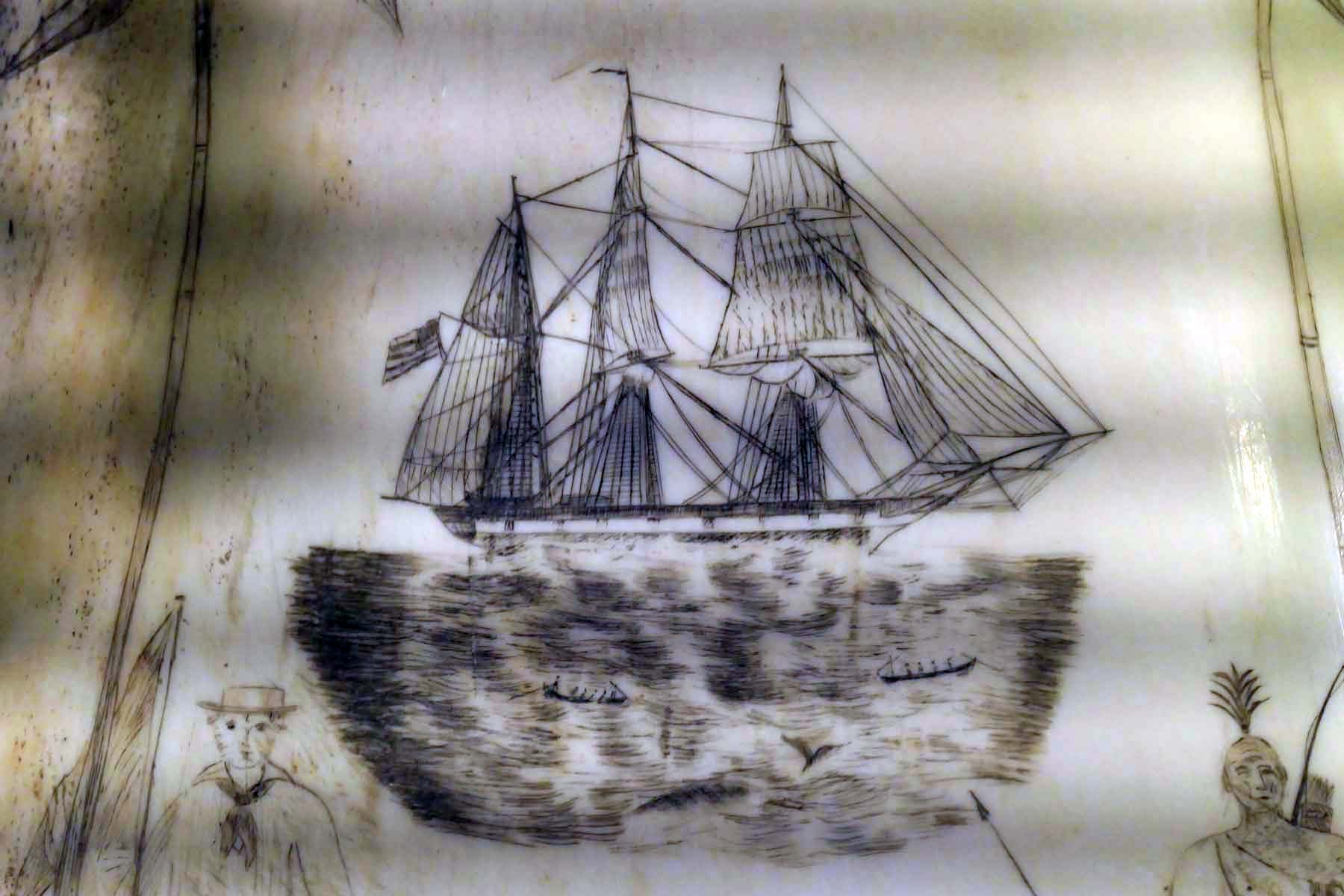
This summer they offer an exhibition that places Scrimshaw in a context larger than the whaling industry it was traditionally associated with. The Wider World & Scrimshaw juxtaposes objects from their own collection with other items representing the carved decorative arts and material culture made by Indigenous community members from across the Pacific and Arctic.
Scrimshaw is the incising, engraving, carving or fashioning of primarily ivory and bone (and sometimes other natural and man-made materials) into works of art or other decorative or useful articles. The origin of the word is debated, likely an English nautical slang expression meaning “to waste time.” Carving on ivory and bone had been done by indigenous cultures for centuries before it took off as a trend among sailors in the whale fishing industries. Being on trips that could last up to three years, these folks needed something to pass the time.
These days it is hard to come by the original materials, so there are a lot of “fakeshaws” appearing – yes, that is actually a term used by dealers in those art objects. Faux ivory is made from molded polymers or celluloid plastics, which yellows with age like real ivory. The fakes are often enhanced with added materials during the casting process to give them the color, grain, patina, and weight of ivory. (Ref.) Motifs are taken from the original scrimshaw craft and applied to these fake surfaces.
This is very different from what is also shown in the museum’s current exhibition: new work by Duke Riley who uses scrimshaw on plastic objects found during clean-up actions of beaches. His contemporary approach to depict environmental degradation fits perfectly with the museum’s mission to educate about the cost of industrial extraction and pollution, and he does not disguise the true nature of his canvases.
He paints the found objects, laundry detergent jugs and plastic bottles, flip-flops, cassette tapes, with colors that mimic ivory or whale bones, and then carves or inscribes motifs onto them that are done in the style of traditional scrimshaw engravings, but portray contemporary pollution and the industrial figures behind the environmental destruction.
Riley’s work is deadpan funny, yet instills horror for those of us interested in environmental protection at the same time. From oil barons to marine creatures, he spins a tale that connects the dots from the beginnings of the whaling industry to the polluted oceans we are navigating today. More details about his artistic approach and philosophy can be found here.
What registered with me was the fact that the artist alluded to his frequent visits to the Whaling Museum as a child as an inspiration to link traditional craft as exhibited there to present-day conceptual ideas. In some funny ways, the same thing happened to me – although I visited only once 5 years ago, I was prompted to mix what I had photographed there – paintings of whaling expeditions – with my own representation of the needs to protect our oceans. The visit gave rise to the series Postcards from Nineveh, with the photographs superimposed onto shots of current landscapes or cultural landmarks. My show’s opening at the Newport Visual Art Center coincided with the first Covid Lock-Down in 2020, so hung unseen for many months.
I have written about the specifics of my approach here. The upshot, though, (and I am recycling my thoughts here) is that as artists we represent a subject. “Reasoning about and constructing representations helps us to grasp new perspectives and to learn about the world. In this sense art and science share a common core; the human ability to construct and interact with representations in order to learn about what it is that they represent.”
In the case of environmental degradation, we have to figure out ways of representing what is or isn’t done to the environment, the costs of inaction, and somehow capture what is at risk if we don’t change course. Luckily, with photomontage, we can go beyond what exists in real life (as depicted by photography) and convey something that is constructed, giving the artist the leeway to represent possibilities, anomalies, products of imagination, just like painters do. By combining, manipulating, and altering photographs it creates something that cannot be found in reality and yet convey a sense of alternate reality, of imagined recourse. And all this because I saw all these whaling-related treasures at the New Bedford museum.
Here are some samples.
Music today is a tribute to sailors. Shanties and ballads.
I have to admit, it’s been ages since I visited the World Forestry Center. No more explaining to my (now grown) kids that the fake logger climbing a fake tree with a fake goose and owl calmly sitting on branches below him, are there for educational purposes, and maybe, just maybe, meant as a joke. Or to stimulate discussions how museum exhibits not necessarily reflect the real world. Don’t get me wrong, they and I loved the place during too many rainy days in Portland, Oregon, and some of the educational displays did promote meaningful conversations.
As it turns out, there are now more and better reasons to visit, than simply looking for bad weather diversions. The place is changing at a fast clip, with an ambitious plan to update and modernize this Portland treasure. Among the important improvements are a program of new art exhibitions that should attract a wide swath of visitors who are interested in both, information about the environmental conditions of our state as well as of international forests and how contemporary issues of changing nature is represented by serious artists.
Let’s face it: today’s cultural institutions have a near impossible burden to carry. Besides the particular content they are supposed to display in aesthetically appealing ways – here forestry in all its permutation and history – they have to engage in educational missions, social outreach, community involvement, and simultaneous financial juggling between higher cost and decreased funding. To fulfill all these imperatives you need innovative thinking, creative solutions, and a vision that extends beyond the safe, habitual offerings we’ve come to expect from specialty museums. Judging by the current exhibition, the Discovery Museum at the Center has found someone who fits the bill. Stephanie Stewart Bailey, the new experience developer (unfamiliar title to me, but makes sense when you look at the intersection of art, science and nature) has managed to mount a show that combines stellar international photography with an educational mission to help us understand better the central role and function of trees in numerous civilizations.
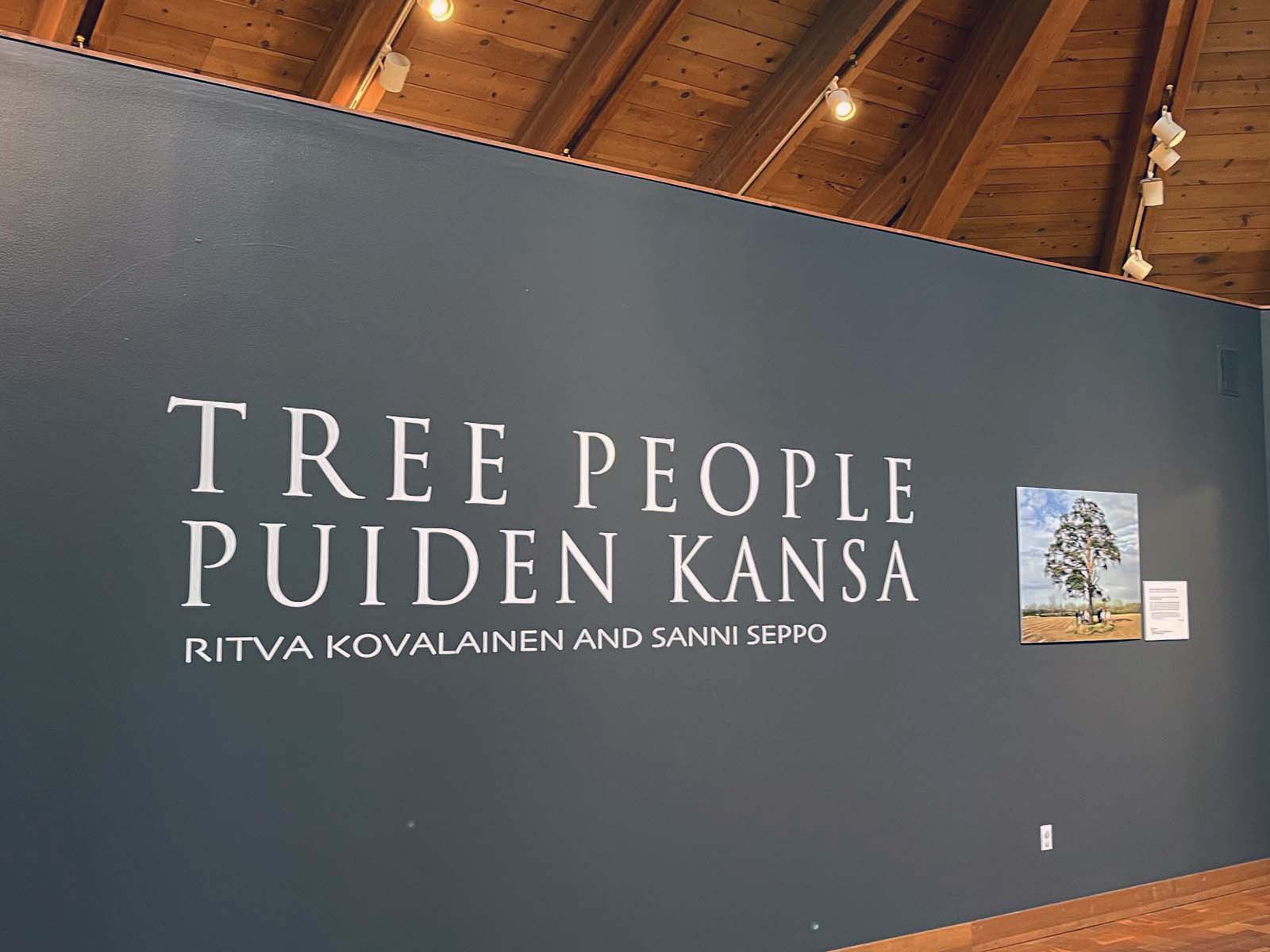
Tree People by Ritva Kovalainen and Sanni Seppo was the first installment of a three part artistic collaboration between these two prize-winning Finnish photographers interested in the interrelationship between nature and those that populate it. For over three decades the duo have explored the mythology associated with trees and forests, (Tree People, 1997) the way forest management and silviculture affect both land and people, (Silvicultural Operations, 2009) and now how primeval forest look (and act) differently from those that have been exposed to centuries of human commercialization (Forests of the North Wind , 2024).
The visual work is compelling (as is their environmental activism), but the deeper attraction to me lies in the artists’ rigorous research, amounting to an anthropological tour de force across these 30 years, including field interviews and archival exploration. Each of the three installments stands on their own. I found the choice of Tree People for the Discovery Museum timely because they speak to some issues that are currently of great cultural interest in the Pacific Northwest as well.
The exhibition is divided into topics, photography always accompanied and enhanced by written explanations of the historical context. One section explores the destruction of sacred spaces, groves believed to be hallowed, once Christian proselytizing started in earnest, cutting down worshipped trees and replacing them with churches. One of the most appealing aspects of the curation was a circle of fabric panels, printed with trees, that you could enter as if it was a grove. It was mounted by Stewart Bailey in a clever way, hanging from a braided wreath of twigs and branches, which stayed with the topic of trees, and were visually harmonious. More interestingly, they projected shadows onto the semi-permeable canvas, doubling the sense of being close to trees.
There is a part on forest spirits, and traditional fare around how to combat them and keep a boundary between human civilization and the forest.
There is an introduction to good luck/sacred trees that are associated with a particular homestead. One of the photographs depicts a houseless person who had made his home under a tree in a Finnish park. It was a comforting thought to one of the younger visitors feeling they would never be able to afford a piece of property where a legacy tree could serve multiple generations. Stewart Bailey told me, that the idea to choose a tree in one’s general environment was visibly uplifting. Must be the Zeitgeist (or more likely the housing market…): the Washington Post just last week had an article strongly encouraging us to select a favorite public tree and tie our own life events to frequent visitations.
Last but not least, there are two sections devoted to memorializing the departed, humans and animals alike. These provide a direct link to a big question raised in the contemporary Pacific Northwest where competing interests fight over the preservation of certain trees that were culturally modified.
***
Oregon, like Finland, has an important history linked to the ways we have handled forestry, claiming ourselves to be the state that timber built. The natural riches of fir trees, cedars and Ponderosa pines were there for the taking, and taken they were, generating winners and losers along the way. Depending on one’s perspective you could think of pioneers conquering the wilderness, or robber barons using illegal timber sales through the rail road contracts to make a fortune. Here, as well as in Europe, opposing interests fought over legislation that promoted their often contradictory goals.
Logging throughout the first half of the last century provided great pay, secure employment and boons to the infrastructure of many growing timber communities. When private timber reserves dwindled in the late 1950s, the Forest Service and Bureau of Federal Land Management were pushed to permit increased harvesting on public lands and allow clear cutting and use of chemical herbicides. Eventually environmentalists started to fight back, and during the 1990s the “timber wars” ensued – protection of endangered species like the spotted owl was weighed against the fate of the many communities that lost their livelihoods with stricter federal regulations on logging, or the earnings of the lumber industry, respectively. (The link brings you to a fabulous OPB series on the history of the law suits.) An early verdict prohibiting national forest timber sales in potential spotted owl habitat in May 1991, set off years of litigation over animals and plants that had been listed as endangered and severely curbed logging.
The attempt to change the rules and regulations governing timber harvest and protection of old growth forests is ongoing. The 1994 Northwest Forest Plan is in the process of being amended, partially due to fast changing environmental conditions. Catastrophic wildfires and tree-killing pests have done intense damage to all habitats. Barred owls are conquering spotted owls’ habitat, ever diminishing their numbers. A committee working under immense time pressure has made numerous recommendations, several of which were slashed by the Forest Service, deemed irrelevant to the amendment. There is also a planned amendment for all national 128 forest plans, a draft of which was release in June. In theory the public has 90 days to comment, and the timeline declares hopes for a decision and implementation by January 2025. Many of the parties involved in this joint effort to find compromises for forestry management have expressed worries that different national election outcomes would affect the planned amendments in various ways. (Ref.)
Most of us have probably an inkling of this history, although the extent to which it is related to violations of treaties with tribal groups who had to cede old growth forest in land swaps or were simply dispossessed, has rarely been stressed. New to me, and bringing us back to the context of the exhibition and its focus on the function of trees as keepers of memory, archivists of entire civilizations, is the call for protection of individual trees in the fight over the right to harvest large swaths of timber by the industry. What is at stake here is the fate of culturally modified trees (CMTs), living trees that have been visibly altered by indigenous cultural practices. They were related to food production (peeling the bark), cultural traditions (weaving, producing ceremonial regalia, building shelter or carving of paddles and canoes.) Trees were selected for memorial or mortuary poles as well, and many exhibit drill holes that tested the strength of the tree so that sustainable harvesting could be completed, not hurting future growth.
These trees are of cultural and spiritual significance, sacred memorials to tribal ancestors and living archeological sites that allow insight into historical practices. Equally important, they are of legal significance. When indigenous rights are challenged, carbon dated trees with indigenous modification can be testament to the occupancy and forest stewardship of tribes at a given point in time. For cultures that existed without much written record, whether the indigenous Samis for Finland, or the first nations, tribes and bands in the North American sphere, these trees are archives that can be precisely dated and are a rare historical source for archeologists, anthropologist and historians alike. The question is how they can be legally protected from clear cutting, before they die a natural death given their age in old growth forests. (Here is a great book for further information about the research and the political debate around CMTs.)
It would have been fascinating to link the photographs of the Finnish memorial trees with their arboglyphs, those carvings of dates and numbers, to the contemporaneous questions raised by the protection of modified trees in our own backyard. But I am sure those connections to place and universal issues will be made once the museum has found its stride with traveling as well as independently curated exhibitions.
As is, I cannot recommend a visit to see this work strongly enough. It is like falling into another time and place, yet eerily familiar. Then go home and (re)read Richard Power’s The Overstory. The winner of the 2019 Pulitzer Prize in Fiction is a paean to trees, nature and environmental activism, one of my favorite novels of all time. Or, alternatively, just hang out under a conifer it Forest Park. The trees will speak to you.
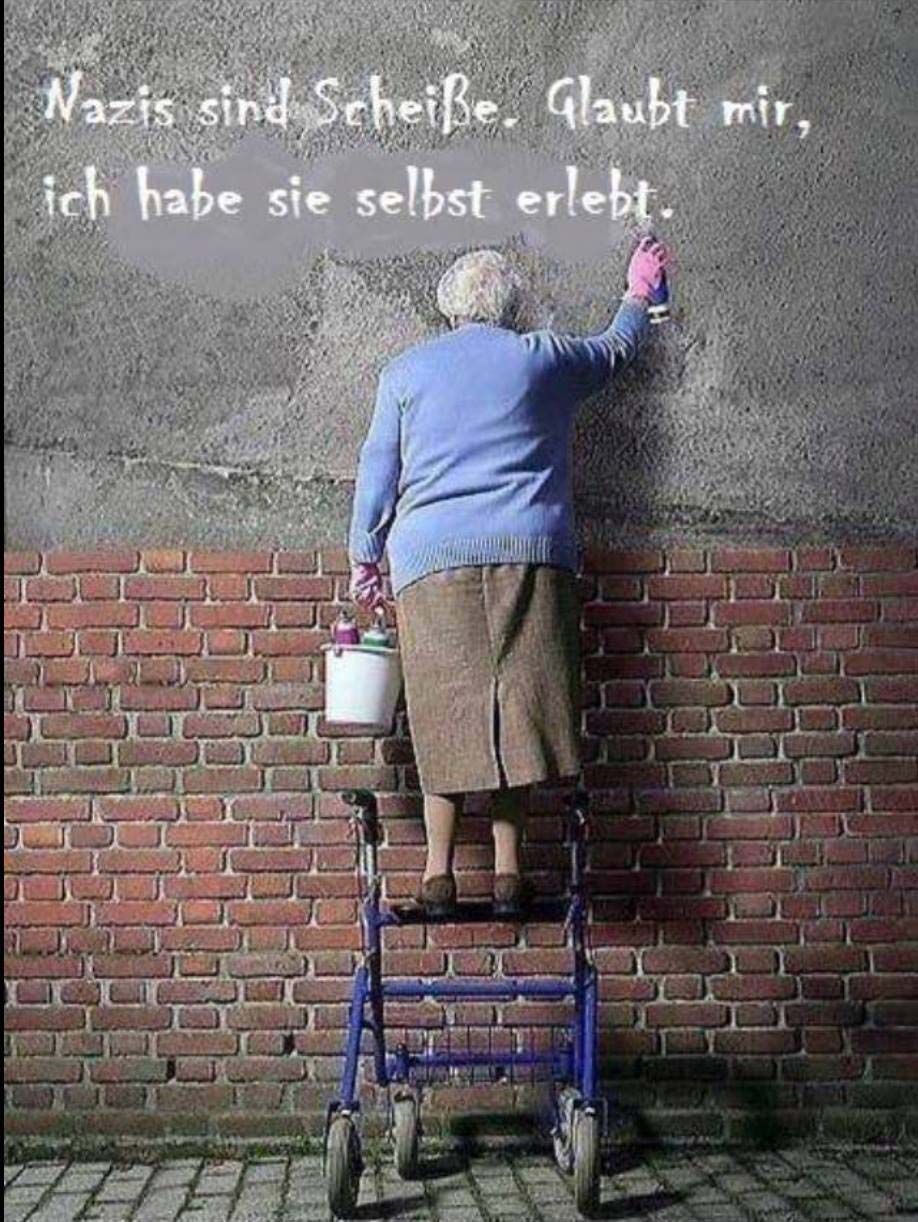
I found today’s title photo years and years ago on the net. The little old lady’s tagging says: “Nazis are garbage. Believe me, I have experienced them myself.”
It is somewhat ironic that I now AM that old woman and can report that the experiences are no longer just in the past. How dreadful is that. Luckily there are plenty of people resisting.
German cartoonist Tobias Vogel, known under the tag name @Krieg Und Freitag, is in the middle of a fundraising campaign to supportan organization that fights Nazis. (The name translates as War and Friday, and was coined when the artist looked for war and peace on his phone and mistyped Frieden – peace – as Friday.)
Vogel has created a signature collection of little stick people who comment on the travails of everyday life and politics online and with prints that can be purchased. He received multiple prizes, including the Grim Online Award, for his work across the last years.
Gallery exhibition of Tobias Vogel at Affenfaust
The current project raises money for a non-profit with the name of Kein Bock of Nazis(KBAN, No Desire for Nazis.) Since 2006 they support, network and inform adolescents and young adults on the topic of the extreme right, racism and the Neo-Nazi scene.
” In recent years, we have distributed hundreds of thousands of free youth magazines and more than one million information flyers. We organize concerts and protest actions, and we continuously provide initiatives, groups and individuals who are committed to fighting the right with information material, posters and stickers. Through our social media accounts, we help to mobilize protest actions. We finance our work exclusively through donations.”
Here is the idea: A little stick person appeared on social media with a sign: Stick-People Demonstration against Nazis – where are all the others?
For each $5 donation, one stick-person gets added to the group, and there will be a life session of the artist drawing all these “participants” across the span of several days in an art gallery, Affenfaust Gallery, in Hamburg. The drawings will be projected against the walls, and there is a live stream of the event at https://www.twitch.tv/affenfaustgalerie, starting on July 12, and the mural can be visited during the following week. (The name of the gallery is a pun: monkey’s fist refers to a nested knot used in merchant shipping to weigh down the sweatline during mooring of ships. They see themselves as knotting art and culture together creatively.)
Gallery at Paul Roosen Str.
So far, they have collected over 6000 “people” for the anti-Nazi demo, and I wonder if the artist will get severe tendonitis from drawing them all live. All proceeds go to the non-profit. I just marvel at the conceptual cleverness of having people create a visual mass, representing what it could look like if we all got our act together and ourselves out into the streets.
Music today: The Revolution will not be televised – perfect call for action, and perfect foil for the fact that the stick-people WILL be televised.
From my Hamburg Series (2018) Seeing Strange. Those containers are water recycling plants in the harbor, colloquially know as rotten eggs. Wish Nazis old be described as a few rotten eggs, but there are just too many and counting…
Update: Due to copyright issues to be resolved, I will remove the photographs I had taken of Carrington’s work at OJMCHE or found in a book about her paintings. Stay tuned.
“You’re trying to intellectualize something, desperately, and you’re wasting your time. That’s not a way of understanding, to make it into some kind of mini-logic. You’ll never understand by that road.” “What do you think we can understand by?” ” By your own feelings about things. It’ a visual world. You want to turn things into some kind of intellectual game. It’s not. ” – Leonora Carrington in a interview published in 2015, with Carrington’s cousin, journalist Joanna Moorhead, author of Surreal Spaces: The Life and Art of Leonora Carrington.
2024 marks the centennial of Surrealism, a movement born in 1924 with the publication of a Manifesto by André Breton. Oregon Jewish Museum and Center for Holocaust Education’s new exhibition The Magic World of Leonora Carringtonjoins the celebration, offering a small collection of prints by Leonora Carrington, one of the female pioneers of Surrealism and a life-long painter of mystifying imagery full of passion for an otherworldly realm.
It was Bruce Guenther’s suggestion to introduce Carrington’s work for this special occasion, and he also secured the loan of the prints from Mixografia. As the Adjunct Curator for Special Exhibitions, he made his mark on OJMCHE’s visual arts programming during the last seven years, and we were the richer for it. In addition to being connected to the art world and able to draw on a trove of curatorial experiences, he, more importantly, pursued two goals. For one, he wanted to widen the horizon of a local audience to the diversity and depth of contributions by Jewish artists, many of them unfamiliar, and secondly, intended to shoot for the moon, when it came to bringing work here that had previously seemed out of reach. Succeed he did!
He introduced us, among others, to Grisha Bruskin (Alefbet: The Alphabet of Memory) for OJMCHE’s inaugural exhibition in its current location, or a wide range of local Jewish artists’ work relating to identity and religion (I AM THIS: Art by Oregon Jewish Artists,) confronted us with the provocative, self-reflective art of Kitaj ( R.B. Kitaj: A Jew Etc., Etc.) or reminded us of the art-historical importance of feminist Judy Chicago (Turning Inward, JUDY CHICAGO). Continually, Guenther encouraged us to question, reevaluate and improve on our understanding of art in the context of Judaism. He pushed us, guided us, helped us. It is our loss that he is no longer going to surprise us with his choice of exceptional programming at OJMCHE.
***
A plethora of exhibitions here and in Europe are currently lined up to celebrate Surrealism’s centennial. Some are offering a general overview of this revolutionary art movement, others have a specific focus. Until mid-July you can visit The Royal Museums of Fine Arts of Belgium which inaugurated IMAGINE!, a touring exhibition of works of the most famous surrealists conceived in close collaboration with the Centre Pompidou (Paris). By September, Surrealism. L’exposition du centenaire (1924-1969) will open at the Centre Pompidou, then travel on to the German Hamburger Kunsthalle. On the wings of its recent blockbuster exhibition about Caspar David Friedrich and the reaches of Romanticism, Hamburg will focus on the affinities and differences between Romanticism and Surrealism in 2025. Then on to Madrid, and eventually we can visit closer to home, at the Philadelphia Museum of Art. This fall, the Lenbachhaus in Munich inaugurates a highly anticipated exhibition about Surrealism and anti-fascism, But live here? No thanks!, illuminating Surrealism as a political movement with an internationalist commitment in the fight against colonialism and fascism. The Henry Moore Institute in Leeds will display The Traumatic Surreal, concentrating on post-war surrealist women artists and their opposition to the patriarchy since 1960. And last but not least, a show entirely dedicated to Leonora Carrington will also open in October at the Palazzo Reale in Milan, Italy.
This – believe it or not – selective list of exhibitions points to the many facets of the surrealist movement and the fact that it has finally “arrived.” The shows will be accompanied by various intellectual explorations of the nature, origins and practical consequences of Surrealism, helping us to understand what the movement is about, its implications for our own time and where to place various artists within its margins. A movement that was dedicated to the deconstruction of rational language, to dissolving the contradiction between reality and the irrational, to resisting habitual modes of thought and perception, is celebrated by means of the traditional intellectual lens and rational analysis of art historians and/or sociologists. One wonders if the artists would have been pleased or annoyed.
I speculate, though, that Leonora Carrington (1917 – 2011) couldn’t have cared less. I think of her as a force of nature who marched to her own drummer all her life, pursuing her painting, her writing and her fervent political engagement for women’s liberation without a moment’s thought of the world’s reaction. Then again, she would likely be pleased that female artists within the movement have eventually gotten their dues, rescued from the assigned roles as muses or child-women, young and subservient, as the male founders of the movement liked to think of them and/or treat them. Across the last decades they have finally been recognized as brilliant artists in their own rights, most recently with a magnificent survey exhibition at The Schirn, Frankfurt a.M., Fantastic Women.
Born in England into a family of wealthy if staid manufacturers, sister to three younger brothers and raised by an Irish nanny fond of myths and fairy tales, Carrington rebelled from an early age. Thrown out of countless boarding schools, she enrolled in art programs and ended up in Paris at age 20, where she met and fell in love with a surrealist painter 26 years her elder, Max Ernst. He abandoned his second wife (having divorced his first, Luise Straus, who was later murdered in Auschwitz, marrying and divorcing two more during his lifetime) for Leonora with whom he settled in rural France when interpersonal drama threatened to take over their productivity in Paris. Carrington refused to be a “muse” from the very beginning and engaged in her own – and distinct – exploration of both the themes and the processes closely associated with the new movement.
Photographs removed
Leonora Carrington A Magnificent Bird Portrait of Max Ernst (1939) — Max Ernst Leonora in the Morning light (1940)The artists exchanged these portraits during a reunion in New York. Carrington, by her own desire, never saw Ernst again after that.
When Ernst was arrested by the Nazis and later escaped to New York, she fled to Spain, suffering a severe mental breakdown, made worse by inappropriate, possibly sadistic psychiatric care during inpatient treatment. She eventually left Europe on a visa provided by a marriage of convenience, and after some time settled in Mexico, finding love, committing to motherhood, and becoming extraordinary prolific in her various creative endeavors, as a painter and novelist processing her autobiographical experiences, including her psychotic break. In Mexico she was embedded in a group of close women friends who were also expatriate artists, Remedios Varo whose painted dream worlds incorporated mystical philosophy and surrealist techniques not unlike Carrington’s, and photojournalist and surrealist photographer Kati Horna. They shared various interests that, at a minimum, enlivened quotidian domesticity and, more importantly, provided substance for their creative output less chained to reality: interests in alchemy, witchcraft, mythology and more.
Some of Carrington’s prints on hand are products of her imagination, typical hybrid figures or grotesques that combine animal and human features. The bulk of the work, however, are paintings made in the early 1970s to dress characters of a play “The Dybbuk or Between two Worlds.“ The word Dybbuk originates from the Hebrew דָּבַק , dāḇaq, meaning ‘adhere‘ or ‘cling’ and refers to the soul of a dead person, always a man, now possessing the body of a living human being, most often a woman. Written by S. Ansky who was interested in Hassidic folklore that contained elements of the story since the 13th century, the play was originally performed in 1920, first in Russian, later in Yiddish. (דער דיבוק, אדער צווישן צוויי וועלטן; Der Dibuk, oder Tsvishn Tsvey Veltn. Here is a link to a magnificent Polish film made from the play in 1937, in Yiddish with English subtitles, a window into a world long gone.)
Alternatively, here is a short summary by a modern, feminist playwright, Lila Rose Kaplan.
“Once upon a time a woman named Leah was allowed to be in a story because she was getting married. Her father picked her a rich husband. Then her dead boyfriend possessed her, because if a woman’s gonna take up space in a story she must not be a woman. Then they learned that Leah had been promised to her dead boyfriend before she was born. She screamed why don’t I have any agency, but no one could hear her. So, they did an exorcism and got her unpossessed. Then she killed herself to be with her dead boyfriend or maybe she just wanted to be left alone.“
Photographs removed Leonora Carrington Leye returns transformed into the Dybbuk (1974)
Rachel Elior, the John and Golda Cohen Professor of Jewish Philosophy and Jewish Mystical Thought at Hebrew University, discusses the societal function served by the notion of possession by a spirit in her book DYBBUKS AND JEWISH WOMEN in Social History, Mysticism and Folklore. She argues that it could have been a means of escape for women who saw no other way out of the misery of oppression. Once “possessed,” women would no longer be held responsible for acting out or demanding agency of any kind, giving them a certain degree of freedom, including the refusal of arranged marriages. Of course there was a price to be paid, eventually, in the form of torturous exorcism.
Carrington was not Jewish – and she certainly did not lack agency! – but the appeal of this quintessentially Jewish story must have been strong, given that it contains so many elements that spoke to her interest in mysticism, soul transmigration, the role of women in male dominated societies, and ultimately resonated with some of her own biographical experiences.
Between two Worlds: Surrealist artists surely moved between worlds, that of reality and that within the recesses of the unconscious, a magical realm where irrationality was a prize, not a burden. As a female artist, Carrington had to fight to have her own voice heard, not being subsumed as a muse, possessed by a male, however smitten. Father figures in her own life, whether her actual father or a substitute, Ernst, had controlled her existence to some extent. But the memory of forced separation from her lover might have also been evoked by the elements of loss in Leah’s world. As one who had experienced “being possessed” during her psychotic episode, the painter could surely imagine herself into the psyche of Leah, to whom this male spirit adheres, using her as a vessel for his own unfinished life. Exorcism was not simply a technical term for someone who had been forced through fit-inducing medication at the asylum in Spain. And last but not least, emigration placed you between worlds, the old and the new, neither one fully your own.
Even though the characters themselves did not spring from her imagination, the way Carrington depicted them with her own aesthetic, strangely graceful, elongated figures, infused them with a life of their own. The lithographs offer, indeed, a visual world, one that generates feelings rather than lending itself to rational analysis (which will not stop me from speculation, as per usual…). The collection traveled through Mexico, exhibited early at the Salón de la Plástica Mexicana, after they were transferred to lithographs at the Taller de Gráfica Popular in 1974. (I wrote about the political role the print studio played in Mexico previously here.)
I consider her renderings remarkable in the sense that suffering, doubt, or bitterness are anything but central – somehow I find primarily resilience in the strong colors, the androgynous representations. And maybe there are traces of rage, in purple and red. Given that the artist was raised in a staunchly catholic household, these colors might also refer to the liturgical colors associated with the Celebrations of Martyrs (red) and Masses for the Dead (purple.) Then again, we have the red stockings of the women’s liberation movement and in England, her country of origin, the Suffragettes used purple that symbolized royalty, loyalty to the cause, and women’s quest for freedom.
Photographs removed Leonora Carrington Leye y Frade (1974)
The continual presence of protective females in the vicinity of Leah echoes one of the characteristics of the artist herself: she was acknowledged as a reliable supporter of the women around her, building strong connections to women all her life. It is as if Carrington’s own strength and endurance is gifted to the female protagonist, in defiance of the customary image of Leah as the victim. The fact that some Mexican graphic elements are included also signals the possibility that a soul has come home, can come home, no longer restlessly wandering. They might reference the surrealist artist’s own political beliefs captured by the movement statement found already in 1935 in the Bulletin International du Surréalisme: “The human soul is international.”
***
“Those who read or listen to our stories see everything as through a lens. This lens is the secret of narration, and it is ground anew in every story, ground between the temporal and the timeless. If we storytellers are Death’s Secretaries, we are so because, in our brief mortal lives, we are grinders of these lenses.” – John Berger inWhat Time Is It? (2019)
War, like the soul, is international as well, alas. It claimed and continues to claim victims regardless of their association with the warring parties – international observers, aid workers and photojournalist have paid that heavy price for trying to inform the world. David Seymour (Dawid Szymin, 1911- 1956,) known as Chim, was one of them – he was killed, three days after the armistice, no less, by Egyptian soldiers during the Suez Crisis when British–French–Israeli forces invaded Egypt in 1956 after Nasser nationalized the Suez Canal.
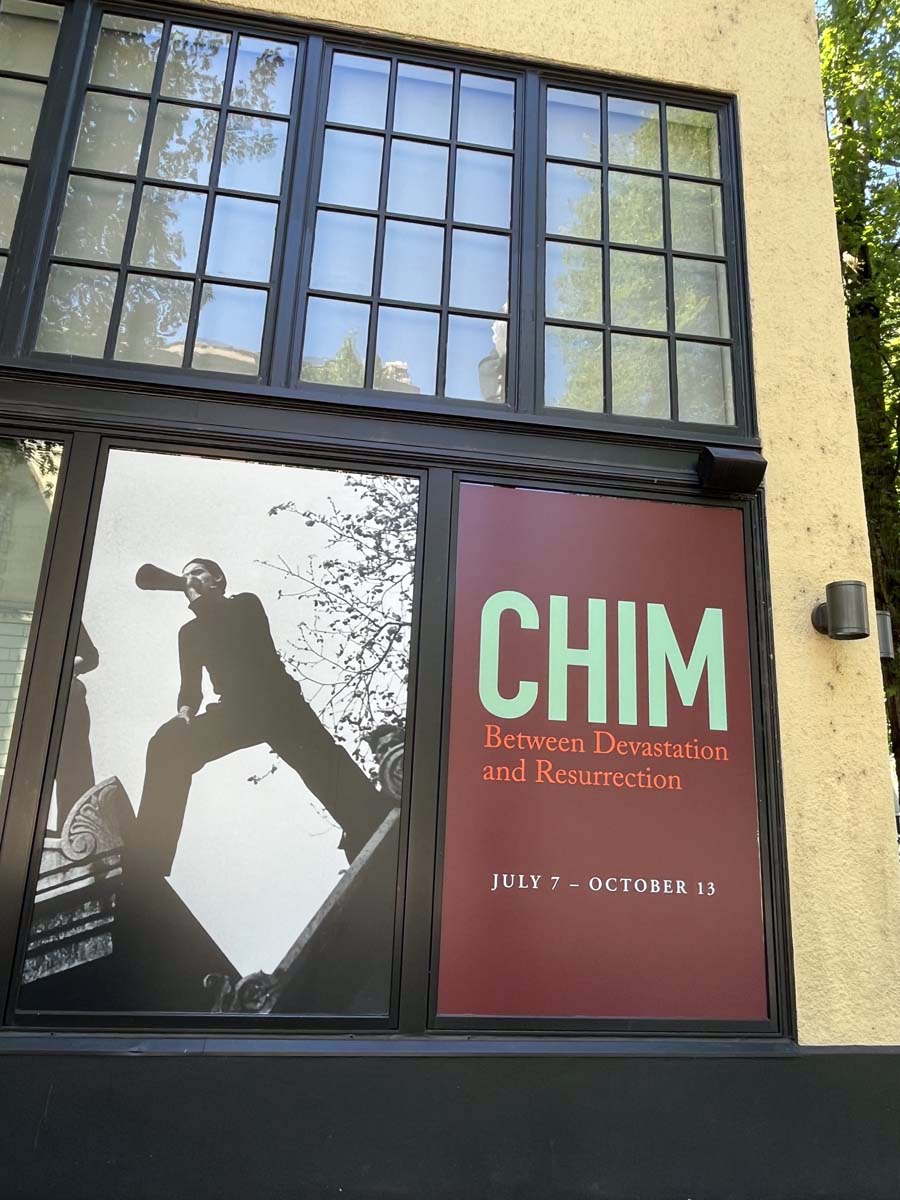
Chim: Between Devastation and Resurrection presentsphotographs that cut through to the reality of war, ignoring nationalistic or ideological fervor in favor of an empathetic response to the horrors wars impose on their victims. His lens told stories capturing both his times and the timelessness of suffering.
Born in Poland, Chim studied graphic arts at Leipzig’s prestigious Staatliche Akademie für Graphische Künste und Buchgewerbe in the early 1930s and then enrolled at the Sorbonne in Paris to study physics and chemistry. He started to take photographs for a variety of journals and magazines to make money for a living and soon got a reputation to be a talented social documentarian as well as war photographer when he documented the Spanish Civil War in 1936. Together with Henri Cartier-Bresson, Robert Capa, and George Rodger, Chim co-founded the Magnum photo agency after WW II ended and he had returned to Europe, having enlisted in the US Army during war times. In 1948, he was commissioned by UNICEF for a project he is now most known for, documenting the war’s effect on European children. “Children of Europe” was published by LIFE magazine and in book form eventually.
David Seymour (Chim) Girls playing in the ruins of a former orphanage, Monte Casino, Italy (1948)
***
OJMCHE’s photography exhibitions have been hit and miss. There have been brilliant shows (Southern Rites and Die Plage come to mind,) but also more pedestrian ones. One of the problems has to do with receiving previously curated package exhibitions that served well in their original purposes, but do not necessarily speak to contemporary questions. They also do not allow juxtapositions with work that one might choose if curating independently, to complement or off-set the photography on view.
The collection, on loan from the Illinois Holocaust Museum, and excerpted from an original show by the International Center for Photography, exhibits works that are solid, beautiful at times, and often moving. Chim was a master of the medium’s technical aspects, lighting and depth of field. He also often incorporated signs, banners, or posters into his images that functioned like internal captions, reminding us of the important legacy of Constructivism.
If a show had been independently curated, though, it could have raised a number of important issues. For one, just as the female artists within the surrealist movement have long stayed unacknowledged, much less feted, so has the legacy of female photographers in the realm of war photography. Chim has often been called “photography’s forgotten hero,” but there are a surprising number of Jewish women who documented war since WW I, continuing through the Spanish Civil War and on to WW II, and are completely ignored by the canon, no matter how remarkable.
There was Alice Schalek ((1874-1956) who lived in Vienna and is regarded to be the first woman who photographed Austrian soldiers at the frontlines during WW I. Gerda Taro (Gerta Pohorylle) was the first Jewish female photographer killed in the field, in Spain. A lifelong socialist and gifted photographer, she was the partner of Magnum-photographer Robert Capa, who, in contrast to her, has become legendary. Faigel Faye Schulman (1919 – 2021) was a Jewish partisan photographer, and the only such photographer to photograph their struggle in Eastern Europe during World War II. Honorable mention belongs to Margaret Bourke-White (1904-1971) who, although not Jewish, documented combat zones in WW II as the first woman war correspondent from the US., and, importantly, photographed Buchenwald when the concentration camp was liberated.
And then there was Kati Horna (1912 – 2000), one of Carrington’s closest friends in post-war Mexico. Born into a Jewish family in Hungary, a close childhood (and life-long) friend of Robert Capa, she studied Political Science in Berlin, and, after the rise of the Nazis, photography back in Budapest. She ended up in the early 1930s in Paris, working as a freelance photographer for a press picture agency, Agence Photo. Her work shares both a modernist aesthetic and a focus on narrative with Chim’s. During her documentation of the Spanish Civil War, she concentrated on the conditions of women and children through mainly portraiture, just as we see in Chim’s later work for the UNICEF project. She utilized bird’s eye views early, as we’ve come to associate with Chim.
Kati Horna Umbrellas, Meeting of the CNT, Spanish Civil War, Barcelona 1937
David Seymour (Chim), Child’s Funeral, Matera, Italy, 1948,
It would have been valuable to learn about the history of photographers working at the same time in the same places, with the same political beliefs and then wonder the women disappeared from view. Again.
***
Another question raised by exhibiting images of the effects of previous wars relates to war reporting in our contemporary society flooded with war imagery. LACMA’s exhibition ‘Imagined Fronts – The Great War and Global Media,’ closing after a long run just this week, reminded us of the role of photography in a war-torn world. Photography can be used as a tool of propaganda to generate both psychological and material support for the war effort. Likewise, it can be utilized to create empathy with its victims and oppose war actions. The borders between propaganda and information are porous, since war parties strive to claim that their efforts are just if not heroic, intending to legitimize their efforts, or dehumanize the opponent.
David Seymour (Chim) Boy in bombed building, Essen, Germany (1947)
(Essen was one of the most heavily bombed cities in Germany, with 90% of its urban structures destroyed. A seat of heavy industry in the Ruhr region, it housed over 350 forced labor camps during the war mining coal and producing weapons, working for Krupp and Siemens. Alfried Krupp was sentenced in the Nuremberg trials, but pardoned by the US in 1951. Some people reliably get away with anything.)
War photography during the World Wars and up until the Vietnam war was regulated and controlled by states and military, censorship included. Imagery of direct violence and death was traditionally avoided, replaced by clichés. In fact Richard Nixon attributed the loss of the Vietnam war to the media’s willingness to show violent images of the victims. I continually wonder how the availability of phone cameras in people’s hands and easy internet dispersal have changed the impact of photography, now depicting participant horrors beyond our imagination, the fate of the victims and the actual unfolding of violent acts in real time. Do we accept their veracity or are they manipulated? Do we avoid them for fear of drowning in helpless bystander feelings? Will they distance us from understanding war because they come from sources that we associate with the “enemy?” Can war documentation cut through hate, anger, resentment, violence and destruction, change minds? Could it in 1956, can it now?
In reviewing the LACMA exhibition, my thoughts were these:
I have no definitive answer. This exhibition’s imagery most meaningful to me, a pacifist, namely the depictions of suffering and the satirical stabs at those who financially gain from war, will likely not speak to those eager to go to war, just as racist propaganda posters embraced by them do nothing for me. Maybe our ideological or political divisions prevent us to think through art that does not confirm our preexisting beliefs. To that extent, art will not be able to produce change, given the strength of our biases.
It is certainly worth a further discussion, and I hope Chim’s images will provide a starting point for exploring these issues at OJMCHE. The last photo he took before he was killed two days later, encapsulates war’s human toll – two wounded civilians sharing a mattress with paltry enough to eat. Half a century later we still see the same pictures, multiplied by thousands. Stories told through a lens were intended as a wake-up call. It seems, to no avail.
David Seymour (Chim) Civilians, Port Said, 1956
OREGON JEWISH MUSEUM AND CENTER FOR HOLOCAUST EDUCATION 724 NW Davis Street Portland, OR 97209
Wednesday – Sunday: 11 – 4
Chim: Between Devastation and Resurrection
The Magic World of Leonora Carrington
July 7 – October 13,2020
Special events:
Opening Reception this Sunday July 7, 1:30 – 3:00 pm.
Goddess of Surrealism: A Lecture About Leonora Carrington with Dr. Abigail Susik
August 8 | Event starts at 6 – 7pm, Doors open at 5:15pm for reception
The Life and Work of David “Chim” Seymour, presented by Ben Shneiderman
July 21 | Event starts at 2pm – 3pm, Reception at 3pm – 4pm
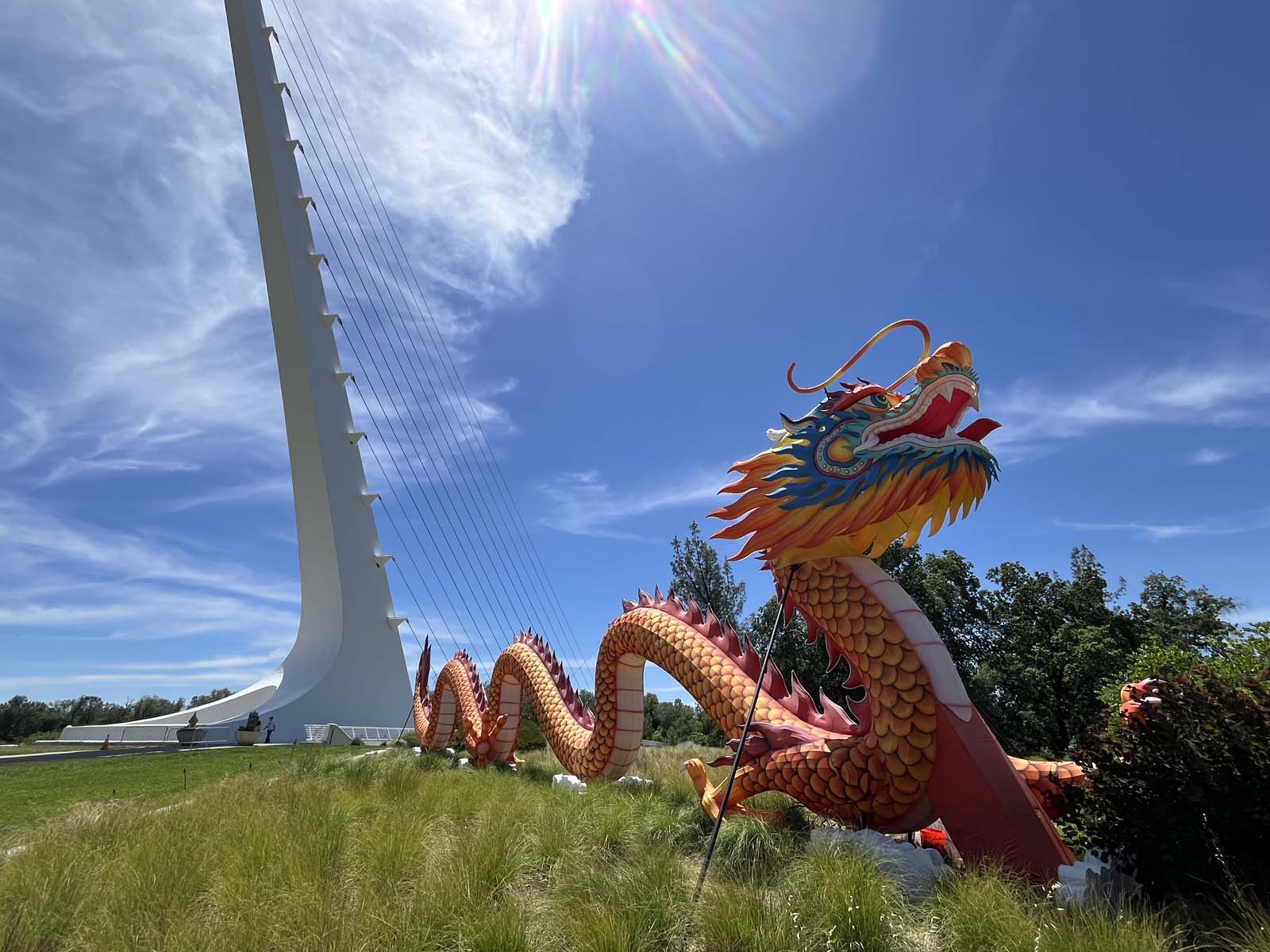
Phew. Don’t have to start with my innervated spiel about art and botanical gardens, sounding like a broken record. As it turns out, the universe of plastic animalia that we walked into by chance, looking for a break during the long drive to Southern California last month, was located in what they call an “Exploration Park.” Turtle Bay Exploration Park in Redding, CA, to be precise. It contains a botanical garden and arboretum, but also features museums, forest camps, a sundial bridge and much more. Amusement, then.
The critters were larger than life, intensely colorful under the bright California sun, but apparently unfolded their real magic a night, when they all lit up for a technicolor spectacle. (You can see a video of it in the link.)
I must admit I had fun walking down the dusty pathways, watching little kids in awe of the oversized fauna. Did they learn anything? Who knows. Must we always learn something? Not really. Sometimes I need to remind myself that there is nothing wrong with simply wallowing in pleasure, on a bright day, surrounded by whimsical assemblies of plastic wildlife.
I did think, though, about oversized animals that do come with a message. Partly because I deeply agree with the message, and partly because I admire the artistic process that underlies the final sculptures. Here are some samples of real art, by sculptor Quentin Garel.
The French artist, who was educated at the Ecole Nationale Superieure des Beaux-Arts in Paris, has it in with hunting for trophies, denouncing “a proud practice of man, a domination over the animal seen only as an object of consumption,” or as an means of inciting status envy and signaling the belonging to the exclusive club of wealthy trophy hunters I might add.
He began working with landscapers and architects for public spaces: sculpting work that is figurative but also anamorphic, playing with size and excerpts. According to his gallery, “Garel claims to be a sculptor of form rather than concept, between art and science, wood and metal, dental surgery and the unrestrained chainsaw.”
Gallery LJ in Paris will open his newest solo show in October 2024 in Paris. Catch it, if you’ll have the chance! With a 15 minutes walk through the Marais you can reward yourself later with the best kosher pastries in Paris, at Boulangerie Murciano, with a divine Apfelstrudel. At least that was possible when I last visited, now too many years ago. But I digress. In between the two locations you can visit Musée Carnavalet that presents the history of Paris.
Garel’s sculptures evolve through initial charcoal drawings, which he then converts into wooden sculptures. From there moulds are taken and cast in bronze. Many of them are now situated in public gardens across France. More information can be found here.
I find the drawings as attractive if not, in some instances, even more so than the sculptures.
It is wonderful work and the artist seems to have a sense of humor that certainly appears in the sculpture as much as in his own demeanor…
Can’t help it, music has to be about the hunt – mainly because there are so many beautiful pieces out there celebrating something that in earlier times was part of stocking the larders, rather than simply catching trophies. Although that was probably always the case as well. Joseph Haydn it shall be, Symphony No. 73 in D major “La chasse”.
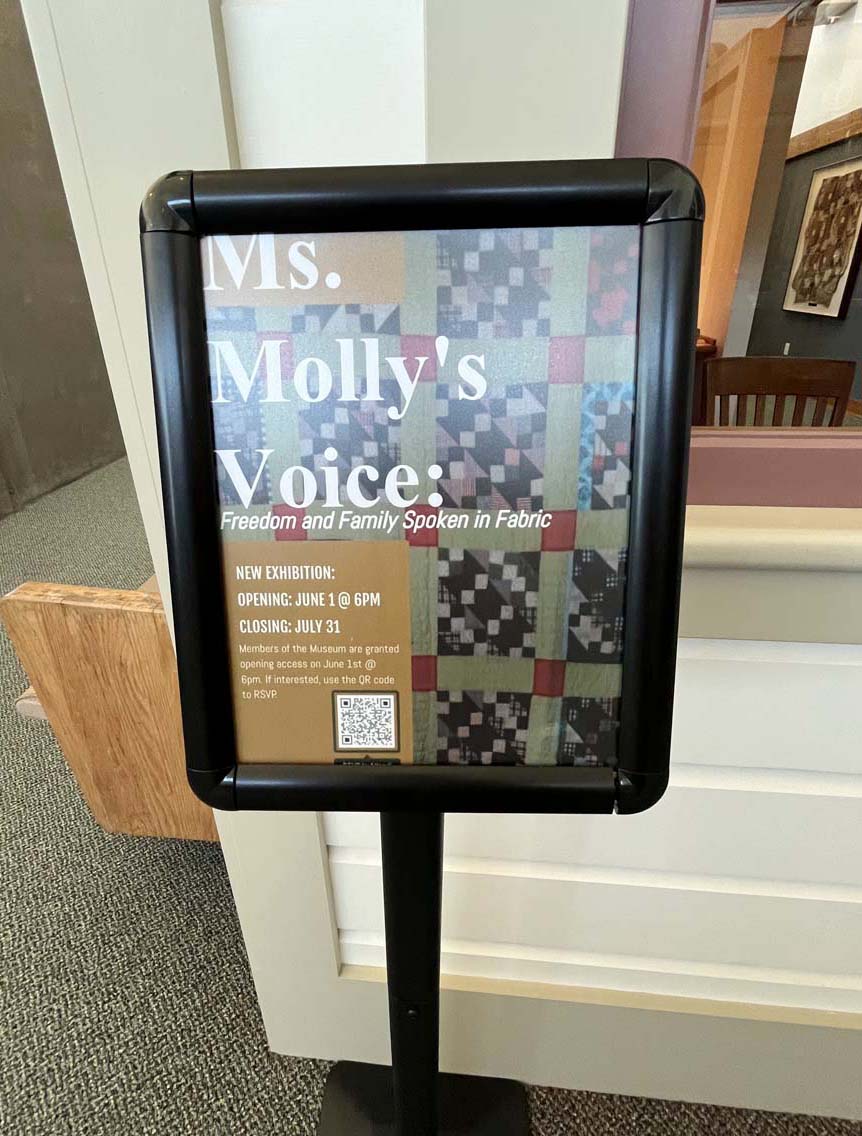
Just a 50 minute drive from Portland, OR, you enter an entirely different world – old growth forest covering the mountains, steep cliffs, the majestic Columbia slowly making its way through a gorge that was carved millennia ago into the landscape. If you happen to visit the Gorge Museum in Stevenson, WA on your way East, you can currently immerse yourself in yet a different world still – a collection of quilts that witness the life, skills and wisdom of a 19th century slave, handed down to next generations. Named the Hartsfield Collection after the family who preserved the legacy of one of their ancestors, a former slave, it serves as an entry into the patterns of both slave life and quilting.
Crossroads Quilt, Late 19th Century
The accumulated heirlooms are part of a collection created and persevered by a family dedicated to witnessing history, including that of their very own ancestor(s.) The current generation is represented by Jim Tharpe, who realized that the quilts, made by five different seamstresses across four generation from 1850 – 1960, were of enormous significance and able to tell a story that resonated beyond what we know theoretically about quilting during slavery. His insights and persistence to bring something of significant historical value to our eyes made it possible that these quilts are now making their rounds in museums keen, among others, on teaching history.
The exhibition is expertly guided by signage that tells you about the provenance and meaning of each quilt (as displayed in my photographs.) You can learn even more detail in a book written by Tharpe and available at the museum, that explains the family history, the creation of the collection and his purpose in investing his passion, time and energy into the preservation of the collection.
The earliest quilt, the Slave Quilt (1850), was made as personal bedding by a thirteen-year old slave, Ms. Molly, who was sold away from her family to a plantation in Whitlock, Tennessee. Close inspection reveals not just use and tear, but also bloodstains. We will never know if from the whip, rape or childbirth – she bore two sons to her Master, who were fortunately not sold away from the household. Faded, easily overlooked, they nonetheless instill a sense of the horrors of the life that then-child must have experienced.
She taught her skills to her own children and in-laws after the Civil War was won. Eventually the family relocated North, but still trecked to Tennessee many years later to visit relatives that remained there, often under the shadow of racism that put travelers in danger.
Danger while traveling was, of course, one of the hallmarks of the Underground Railroad movement, helping slaves to escape their masters and start a new life somewhere supposedly more safe, if not free. One of the ways to prepare, or to warn, or to help people finding their ways and supportive allies, was a language of communication contained in quilts. Specific patterns indicated specific requirements or signals to those on the move.
Expert quilters might be well aware of this history, lots written about it. For the rest of us, even though we are aware of forms of communication not contained in written words – just think of the knotted messages of the Incas, Semaphore or Braille, sign-language or Morse code – we might not know about the meaning of patterns around in quilts. I certainly had no clue, even though I count two expert quilters among my friends.
The exhibition then, really opened my eyes not just to the creativity of individual seamstresses and the beauty of their resulting work, but the meaning behind much of what was in front of me, guiding me into a world that lacked all the privilege of my own and that holds historical lessons we should well heed.
In general, there were ten quilt codes to be used for the journey, with just one displayed at the time. A sampler with all the codes in small form, secretly passed around, served as a teaching device for memorization of the patterns. The quilts were displayed in windows or hung out with the washing to inform the travelers. The backs and fronts were joined by twine tied two inches apart, with patterns of knots mapping the existence and distance of safe houses along the route. (Ref.)
Here are some of the patterns used in the quilts on exhibit (note, there are variations in names across states, not captured here):
The variety of the artistry shown is helpful for us to understand how form, function and aesthetics go hand in hand. The dedication of this family to relating the skills to subsequent generations and preserving, despite many moves across the U.S. what is a treasure, makes it very clear that they know about the importance of history, and the ways its official telling needs to be supplemented by people who’ve actually experienced it from diverse perspectives.
I was particularly moved to see the oldest and most recent of the quilts exhibited in juxtaposition. The latter was a graduation present to Jim Tharpe, with an inconspicuous love letter stitched into the sidebars, just as the blood stains were inconspicuous on the former. It brought home to me that it is not enough to be exposed to something in order to witness. You have to look. Look carefully. Not leave it to those lying at the bottom of the ocean.
The effort to bury parts of our history, efforts yet again sweeping our country in the form of curriculum changes, prohibition of certain books, elimination of programs dedicated to Black History studies and the like, is hopefully counter-acted by exhibitions like the current one. It brings history alive in front of your very eyes and encourages conversations with those you bring to this show, children included, about what is contained in these beautiful quilts and why it had to be kept secret.
Columbia Gorge Museum
Ms Molly’s Voice: Freedom and Family Spoken In Fabric
June 1 – July 31st, 2024
Open Everyday: 10:00am – 5:00pm
990 SW Rock Creek Dr, Stevenson, WA 98648
Special Event:
“In celebration of Juneteenth, the Columbia Gorge Museum will be hosting an open event where attendants will focus on creating quilt patterns in a dialogue with the patterns and skill of Ms. Molly. Take a guided experience through the quilt exhibition and thanks to some amazing Columbia Gorge quilters, create your own family document in a quilt square.
This event takes place June19th between 2 p.m. and 4 p.m. All are welcome!
If you would like to attend this event, simply RSVP here!“
Here is the full poem from which I took the quotation at the beginning of the review.
“A dream you dream alone is only a dream. A dream you dream together is reality.” -Yoko Ono
The next few days (6/7 – 6/10/2024) offer all of us the opportunity to raise our voices in support of a better world, one without violence or suffering. We are invited to interact with SPREAD PEACE: Wish Tree, an art installation by Yoko Ono, manifesting our hopes for peace by writing them on slips of paper and hanging them on 5 Japanese Maple trees specifically provided for the occasion.
5 Japanese Maples at the Plaza of the Cultural Village
It could not have arrived at a more poignant time or a more appropriate place: a time when wars have raised their ugly heads across the world again, a place – Portland Japanese Garden – that was founded to help heal the ruptures and wounds carved by an earlier war.
In addition, we are afforded this interaction in the company of other important public gardens across the globe – Keihanna Commemorative Garden in Japan, Kokoro no Niwa in Chile, and Johannesburg Botanical Gardens in South Africa will all be exhibiting Wish Trees during these four days as well.
The international collaboration with multiple organizations, including the Nobel Peace Center in Oslo, Norway which houses the Yoko Ono: Peace is Power exhibition, is led by Japan Institute of Portland Japanese Garden, our own cultural institution that, in its own words, is focussed on fostering dialogue and bridging divides. (I had written a more detailed history here.)
The Japanese garden is the perfect setting for the installation, and not just due to its historic focus on issues of reconciliation and peace. It currently provides a particularly peaceful atmosphere: rather than the fiery colors of autumn, spring produces softness and calm in most of the garden’s appearance, the muted purples and whites of the last rhododendrons,
the pink and whites of the mountain laurels,
the pink and white of the azaleas,
and the ever graceful dogwoods.
The garden joins the ranks of many other important places chosen across the life-time of the Wish Tree project, started in 1996, now almost 30 years in the making. Some of the previous trees were placed temporarily for exhibition purposes, in museums or cultural institutions, others have found a permanent home in public gardens, still in use, or just beautifying their respective location. I have seen them in New York City, the Arlington Gardens in Pasadena, CA, and at a gallery in Venice,Italy, but they really spread across the entire world, to Europe, South America and Asia.
The instructions are simple:
“Make a wish. Write it down on a piece of paper. Fold it and tie it around a branch of a Wish Tree. Ask your friends to do the same. Keep wishing. Until the branches are covered with wishes.“
The power of wishes has been a theme throughout mythology and literature, just think of the Greek or Norse Pantheon, the Brothers Grimm Fairy Tales or 1001 Arabian Nights, the drama of Dr. Faustus. Whether Gods, fairy godmothers, genies or the devil granted the wishes (often three of them) the warning was about the content of the wishes – driven by greed, longing or lust – and the distinction between cleverness and foolishness, with individuals believing they possessed the former but exhibiting the latter. Be careful what you wish for is often the moral of those tales.
Detail views of the trees that will host the wishes.
The power of Ono’s work lies in the leap from individual desire to collectively expressed hope around a shared dream. Looking at a tree covered with hundreds of pieces of paper provides a sense of collective voice, a gratitude for being joined by many in our very own aspirations. That feeling is multiplied by millions, the number of wishes collected so far, all of whom get deposited in one final resting place: Imagine Peace Tower on Viðey Island in Kollafjörður Bay in Iceland. There is something about shared action that adds value to an experience, whether singing in a group or choir, praying in unison with a congregation, or a shared exposure to cultural events – it provides a qualitative, not just quantitative shift in the way we feel, given that we are a social species.
Group actions, whether through economic alliances or political coalitions, or the structure of societies geared around families or clans, have, of course, shaped cultures in other ways as well. We are all aware that partisanship exists, and that the struggle for power, limited resources, land or revenge for historical slights, can lead to horrid consequences, including war. It is all the more important then to have projects like Ono’s that demonstrate a desire for peace likely crossing the boundaries of partisanship. The majority of people, no matter who we vote for, or where we live, do not want to be exposed to violent harm or inflict it upon others. We will hang our wishes on the tree joined by others who in that moment become simply allies.
I had felt this years ago in another show concerned with interaction around wishes, although not defined solely by a single theme. The New Museum in NYC exhibited work by Brazilian artist Rivane Neuenschwander in 2010. In A Day Like Any Other you entered a room with white walls covered with colorful ribbons on which wishes, previously written by visitors and deposited in small holes in the walls, were printed. You were encouraged to add your own, and permitted to take a ribbon and bind it across your wrist, with three knots, if you shared the particular wish written on it. Lore had it that the wish would come true once the knots dissolved and fell off. (Note: I can confirm that that happened, against my better rational judgement, and yes, you may roll your eyes now.) The main emotion was contained in a sense of shared longing, bound to an unknown companion in a particular hopefulness.
Rivane Neuenschwander A Day Like Any Other (2010)
***
The Tate Modern in London is currently exhibiting a retrospective of Yoko Ono’s work, open until September 1, 2024. Yoko Ono: Music of the Mind received rave reviews both for its content and curation of seven decades of work by this iconoclastic artist. Much of the work expresses a leap of faith around the dichotomy of war and peace, the core focus of her creative imagination. The artist, who grew up In Japan during World War II, a deadly conflict that ended with nuclear bombs destroying Hiroshima, is convinced that WE, the interactive participants in so many of her installations, will, in the end, provide individual contributions to make our world less belligerent.
In April, the nonagenarian has also been awarded the Edward MacDowell Medal, an honor previously given to Stephen Sondheim and Toni Morrison among others. The lifetime achievement prize honored her continuous engagement with her Leitmotiv: Peace. Projects like the one we’re about to experience at Portland Japanese Garden will be a reminder that we all, indeed, can, no, should contribute to this singular goal.
***
Wishing Trees (or for that matter wells) have been around for a long time, across diverse cultures. Many speak to existential issues of love, fertility, poverty, and, of course, war. The wishes can be expressed via words, or pieces of cloth or the donation of coins, depending on custom. Why trees? They might be particularly visible and relatively stable. In many mythologies they are linked to forces of nature or habitats of benevolent grantors, the spirit world.
Clockwise from upper left: Tanabata Festival wishing tree in Japan; Wishing tree from Alaçati, Turkey;Wishing tree hung with Nazar in Anatolia; Wishing tree spiked with coins in Scotland. (Photographs all web sourced.)
Portland has had its very own wishing tree for over a decade now, an ancient chestnut tree at the corner of 7th and NE Morris St. I wrote about it some years ago, puzzling over the diverse sentiments found at the location.
“For me psychologically more interesting is the fact that people like to externalize what could be a private prayer or wish – the very act of making it public, saying it out loud, seems to have some meaning. Maybe the act of sharing makes you feel less alone, or heard, even if the next reader is not the powerful entity that could fulfill your wish. Maybe the act of voicing it defines a problem that you want to be collectively remembered and then collectively tackled (certainly for the wishes for peace or end of poverty.) Maybe putting it in words clarifies, through the very act of verbalizing, the hierarchy of your own needs and provides access to thoughts about action.”
Whatever motivates us, it is Ono’s creative insight that mobilizes a communal agreement about a worthy goal, reminding all of us about the fact that there are some things that are truly at the core of our existence and that they are forever endangered by war. If you have a chance to visit Portland Japanese Garden this weekend, add your voice to the chorus. If you can’t, you can still make yourself heard: here is a link to the Imagine Peace Tower site, where you can send your wishes electronically or with old fashioned postcards.
Then go and take in the peacefulness of Portland Japanese Garden and its current bloom at a more convenient time. It nourishes hope for a better world.
“Poor is the mind that always uses the inventions of others and invents nothing itself. -Hieronymus Bosch, one of the most idiosyncratic painters in all of art history….
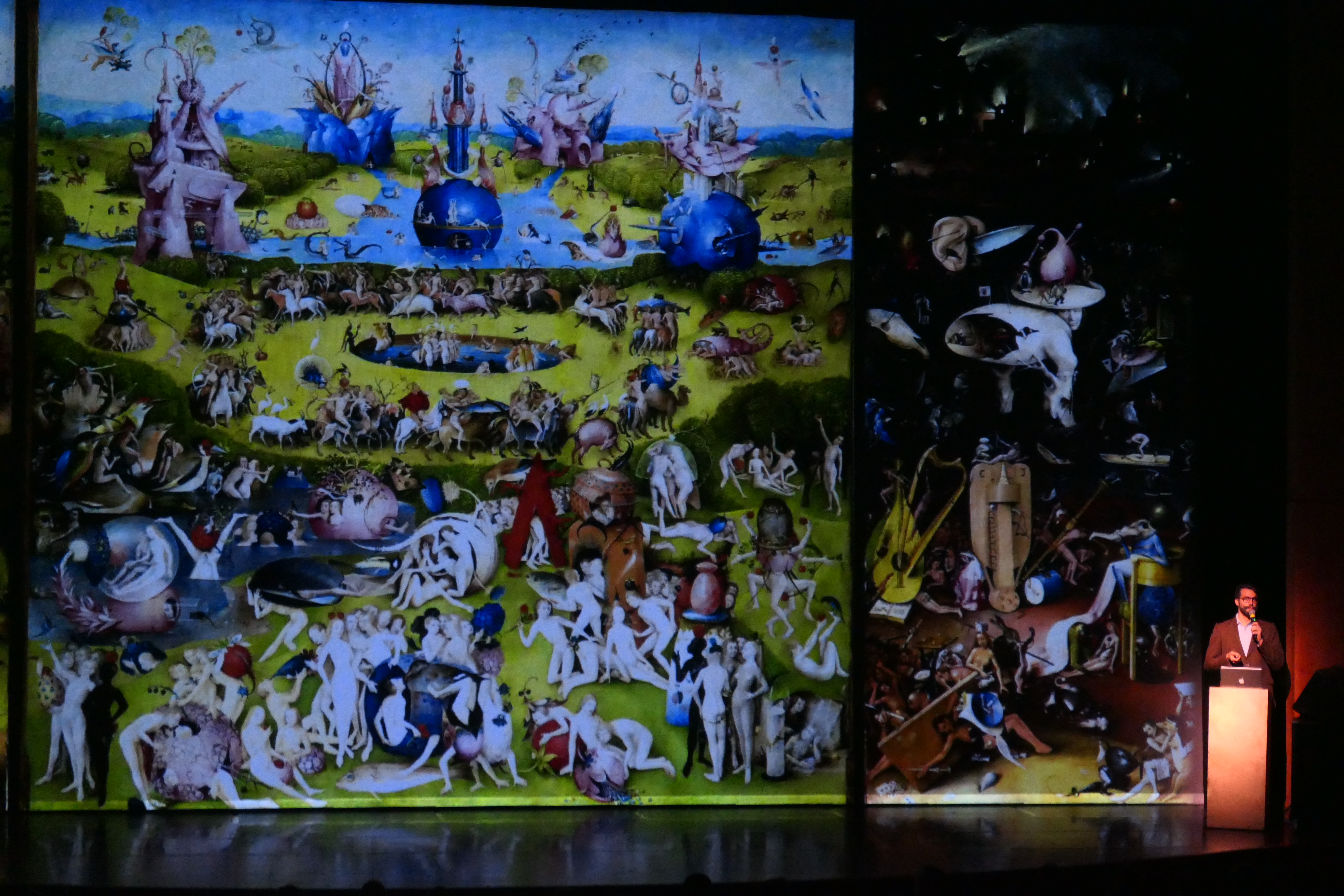
About an hour’s drive north of the village where I grew up lies s’Hertogenbosch, the capital of the Dutch province North Brabant. Its most famous son was probably Hieronymus Bosch (born Jheronimus van Aken, ca. 1450 – 1516 – he renamed himself after the town – the Duke’s Forest.) A permanent Jheronymus Bosch Art Center with reproductions of all his works was opened in a local church in 2002; for the last many years the town has also been hosting an extremely popular festival, the Bosch Parade. (Images are from their website and a Dirkjm Photography from the 2022 festival.)
Floats fashioned by individuals sail for a number of days down the river Dommel, its banks and the medieval city walls lined with spectators. All of the floats re-envision snippets of some of Bosch’s art, dependent on the theme chosen for the bi-annual festivity – this year it is Contemporary Demons. A Garden of Delight serves drinks and foods, there is music, and costumed individuals parade around before climbing into their respective floats that reproduce the fantastical and mysterious creatures from Bosch’s paintings.
Locals’ enthusiasm for 15th century art of one of their own is understandable, but it is widely shared internationally. It’s not just the museums (most of his known 25 paintings and a few drawings are housed in Madrid’s Prado), or books and poster industry. From bags, Doc Martin boots, t-shirts, mouse pads to phone cases, there is a whole range of consumer products with printed excerpts from mostly The Garden of Earthly Delights, his late masterpiece. The only other artists I can think of matching this range is Frida Kahlo. Riddle me that.
Quite a number of surrealist painters cited Bosch’s influence over their own creations. His work has made its way into other visual media as well, dance and circus performances among them. (Photographs below are from my last pre-Covid shoot in Montréal for the circus performance Scenes from Bosch Dreams, a production by Les 7 Doigts, a 500th anniversary commission by the Hieronymus Bosch Society, all of it mounted by TOHU. My write-up can be found here. Video snippets here.)
Ballets capture the ominous quality of the paintings, like Compagnie Marie Chouinard‘s Le Jardin de Délices and digital animations (this one commissioned by the Stedelijk Museum for the 500 year Bosch celebration) translate the ideas into modern movement.
So what is behind the contemporary interest and preoccupation? Spectacle and sex come to mind. The inventiveness of his couplings, bestiary and architectural structures are truly spectacular, and easily divided into self-contained narrative scenes, fit for printing or reconstruction into costumed staging. A boon for commercial exploitation.
The weirdness of it all, coupled with sexually explicit imagery, lent itself to certain conspiracy theories, like the proposal banded about in the 1940s that he was a member of the Adamites, a heretical sex cult, or that he was high on ergotic wheat – eating too much moldy bread, in other words.
Serious art historians place his work into a very different context, that of a committed, faithful catholic who was intent to warn of the wages of sin, using every biblical parable under the sun to make his point. The visual referents, in turn, are mirroring imagery found in the churches and cloisters of his hometown (95 gargoyles, for example, in just the main cathedral.) Drolleries in the side margins of theological books and devotionals, put in by sex obsessed monks in abandon, and pictures of foreign animals found in bestiaries of his time and accessible to him are used as templates to create the scenarios that will lead to hell. If you have time, watch this lecture by a British curator on Bosch’s religious conservatism, I found it truly educational.)
But I believe there is something else at work here. The 16th century saw seismic changes in politics and social structuring of societies, not unlike our own. There was a worry (for some, hope for others) of end times, after a famous astrologer predicted the end of the world in early 1524, to be preceded by catastrophic flooding. Bosch, Albrecht Dürer and many other artists picked up on it, pointing to the Last Judgment. The apocalyptic tone of the work might very well resonate with us, not for its religious implications, but due to recognition that our sense of impending catastrophe is best ignored by engaging in all kinds of distracting activities, however frivolous or lustful they might be. The more, the better in fact, to drone out the sense of helplessness.
It is not poor minds who are too lazy to invent their own ideas, but agile ones that sense the relevance of existing, if 500 years old, imagery for its predictive power of a world gone mad. He should be proud of his art’s longevity and prescience. Then again, pride is a cardinal sin….
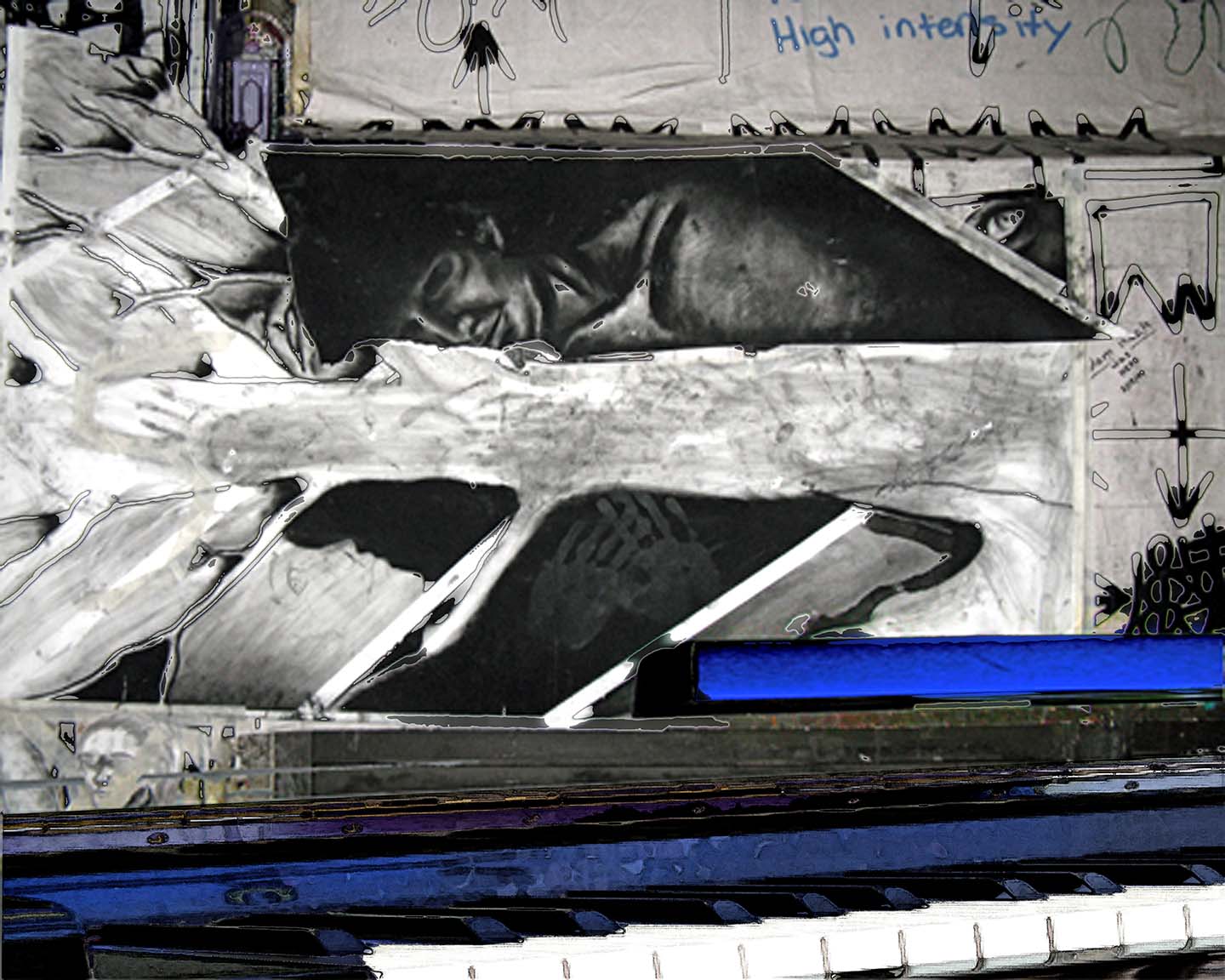
Over a decade ago I exhibited Fugue – The Poetry of Exile at Portland’s Artist Repertory Theatre, photomontage work that attempted to transform poems of exile and displacement, mostly by Holocaust poets, into visual images. The show ran in conjunction with a play by Diane Samuels, Kindertransport, produced by Jewish Theatre Collaborative.
It was early days in my montage-making efforts, with still limited technical skills. But the core components were already in place: visual translation of ideas that invite us, are in need for us to witness.
Here is one of the poems that I chose at the time.
My Blue Piano
At home I have a blue piano. But I can’t play a note.
It’s been in the shadow of the cellar door Ever since the world went rotten.
Four starry hands play harmonies. The Woman in the Moon sang in her boat.
Now only rats dance to the clanks. The keyboard is in bits.
I weep for what is blue. Is dead. Sweet angels, I have eaten
Such bitter bread. Push open The door of heaven. For me, for now —
Although I am still alive — Although it is not allowed.
by Else Lasker-Schüler (translated from the German by Eavan Boland)
(Here is a link to the German original – it is even starker than the translation, requesting permission for dying)
The poet, Else Lasker-Schüler, is one of those people I’d elect to take with me to a deserted island, an artist, activist, risk-taking, and deeply independent woman who supported socialist causes all her life. She left Nazi Germany in 1933, and ended up eventually in Jerusalem, where she wrote some of her best poetry before she died in 1945. Her friends and literary circle there included German-speaking Zionists, such as Martin Buber, Hugo Bergman and Ernst Simon who, like herself, favored a bi-national Palestine.
I was reminded of the poem when I read the insightful ArtsWatch review of an exhibition currently at the Oregon Jewish Museum and Center for Holocaust Education, while staring at another defunct piano during my LA Sabbatical last month (today’s photographs.)
The Burned Piano Project: Creating Music Amidst the Noise of Hate is a collaboration between composer and pianist Jennifer Wright, her husband Matias Brecher and textile artist Bonnie Meltzer. The artists resurrect, refashion, in some ways rebirth a Steinway grand piano that belonged to three generations of a Jewish family whose house in Portland was destroyed by arson in 2022, fueled by antisemitic hate. The torched instrument reemerged as a kind of glassy phoenix from the ashes:
“The Glass Piano was designed to appear as delicate as a glittering butterfly, a creature more of spirit than of the earth, yet it possesses subtle strength and a range of glass rods and hammers and pitched sounds that can be orchestrally combined in unusual ways.”
Meltzer, in turn, created a large tapestry and a smaller banner with inscribed stitching, incorporating wood, torched strings and other bits and pieces of the charred piano into her work.
While the Holocaust poet looks at the remnants of her destroyed life, embodied by the defunct piano, and wants nothing more than for it to end, the two contemporary artists rely on joyful defiance, changing the ruins into some sort of vibrant reminder that the possibility of transformation has not been foreclosed.
One can speculate whether those divergent sentiments are the result of the intensity of the trauma, the actual threat to existence, compared to the reactions of concerned bystanders to the consequences of racist vandalism.
It does not matter, in my mind, though, as long as art forces our own witnessing, insists that we acknowledge the horrors brought by war and hate.
This is central to the work of Jorge Tacla, whose art I continue to explore. His focus on ruins is one of the main themes of another exhibition, A Memoir of Ruins, currently on view at the Coral Gables Museum in Florida. His paintings offer a veritable graveyard of bombed and destroyed architecture across the Middle East, war memorials of a kind that mourn the victims rather than celebrate the victors (if there are any, given the centuries of strife built into the conflicts.) I won’t be able to visit, but I strongly urge my readers in the Miami vicinity to go and take it all in – you have until October 27th, 2024. It is timely work in the light of ongoing destruction of entire swaths of land made uninhabitable by warfare, erasing life, mirrored in paintings devoid of human figure.
The imagery acutely remind us of the violent urge to reduce everything possibly connected to human habitation, urges acted upon by various warring powers. They spring from the wish to annihilate not just human beings, the declared enemy who shall be starved, maimed or killed, but also all that could provide a basis for resurrection of a group with a given identity. If you bomb houses of worship, schools and universities, the libraries, the museums, the archives, all the repositories of cultural, historical and personal memory into oblivion, you generate a displacement that goes beyond loss of place – you truly vanquish the soul of a people.
Tacla’s work is the opposite of what has come to be known as “ruin porn,” the depictions of desolation as a backdrop in artistic endeavors, be they classic paintings that centered ruins as moralistic symbolism, or the photographs of urban decay, or the film sets for dystopian science fiction movies. Capitalizing on the visual salaciousness of melancholic imagery, while ignoring the forces that brought the world to ruin, from poverty to warfare, stands in stark contrast of what Tacla does. Without being photorealistic, the canvases convey a sense of absolute erasure, seamlessly merging into the actual visuals from places like Syria and now Gaza, that hit our screens. There is nothing of the frisson we so cherish when observing something slightly alarming from a distance. There is just dread, slowly seeping into your system, if you stand for any amount of time in front of these monumental canvases.
Our fascination with ruins – as long as we don’t have to live in or next to them – has been an artistic staple since the Renaissance. The focus during romanticism shifted to the potential for renewal. After world war II it became a national rallying cry, like Auferstanden aus Ruinen, From the Ruins Risen, the title of the German Democratic Republic’s Anthem from 1949 to 1990.
We might do well to shift our focus yet again, from ruins to the looming possibility that at some point renewal is no longer possible. At an age where weapons of mass destruction can wipe out life as we know it, we can hit a point of no return. We have certainly gotten sufficient warning. If you look at the aftermath of Chernobyl, not just in the exclusion zone for Reactor 4, which has become a pilgrimage site for disaster junkies, but in the forests surrounding the nuclear power plant, you’ll find some stark revelations (hard now under Russian occupation.) The trees downwind from Chernobyl all died immediately after the disaster. With the entire landscape poisoned, the agents of decay and thus eventual renewal, have also ceased to exist. No more bacteria, fungi and insects that usually recycle a forest’s nutrients and rid it of debris to prepare for new growth. They, too have been erased, and so you are left with ruins that will practically last forever, dead matter that will not renew in any form, looming over our very own extinction when war descends in its final form.
As I have so often stated here – fully aware how many of my readers disagree – I don’t believe art per se can change things, be a political force of the needed magnitude. But it can be a canary in the coal mine, helping us to start questioning, figure out causal connections, and at least implores us to think about solutions that exclude future ruins once and for all.
Nostos There was an apple tree in the yard — this would have been forty years ago — behind, only meadows. Drifts off crocus in the damp grass. I stood at that window: late April. Spring flowers in the neighbor’s yard. How many times, really, did the tree flower on my birthday, the exact day, not before, not after? Substitution of the immutable for the shifting, the evolving. Substitution of the image for relentless earth. What do I know of this place, the role of the tree for decades taken by a bonsai, voices rising from tennis courts — Fields. Smell of the tall grass, new cut. As one expects of a lyric poet. We look at the world once, in childhood. The rest is memory.
I do not agree with Glück’s assessment, “We look at the world once, in childhood. The rest is memory.” We look at the world – able to see it – a million times, if we only move about with intention. Or share in the wonder expressed by next generations. Or allow art to be more than representation, pointing us to the beauty inherent in the real world. Maybe we can’t return to the exact childhood tree, but there are plenty apples around.
In some funny way, the title of the poem, Nostos, makes that very point, doesn’t it? The term comes from ancient Greece and refers to the homecoming of the hero after a prolonged absence (one of the main themes of the Odyssey.) Not remembered, but re-experienced, connected again, the world seen, not just recalled. If it was only about a particular childhood garden, it should have been Nostalgia, the combination of Nostos /homecomingwith the word Algos/pain, although nostalgia most often descends into this sentimental wistfulness that I can’t stand.
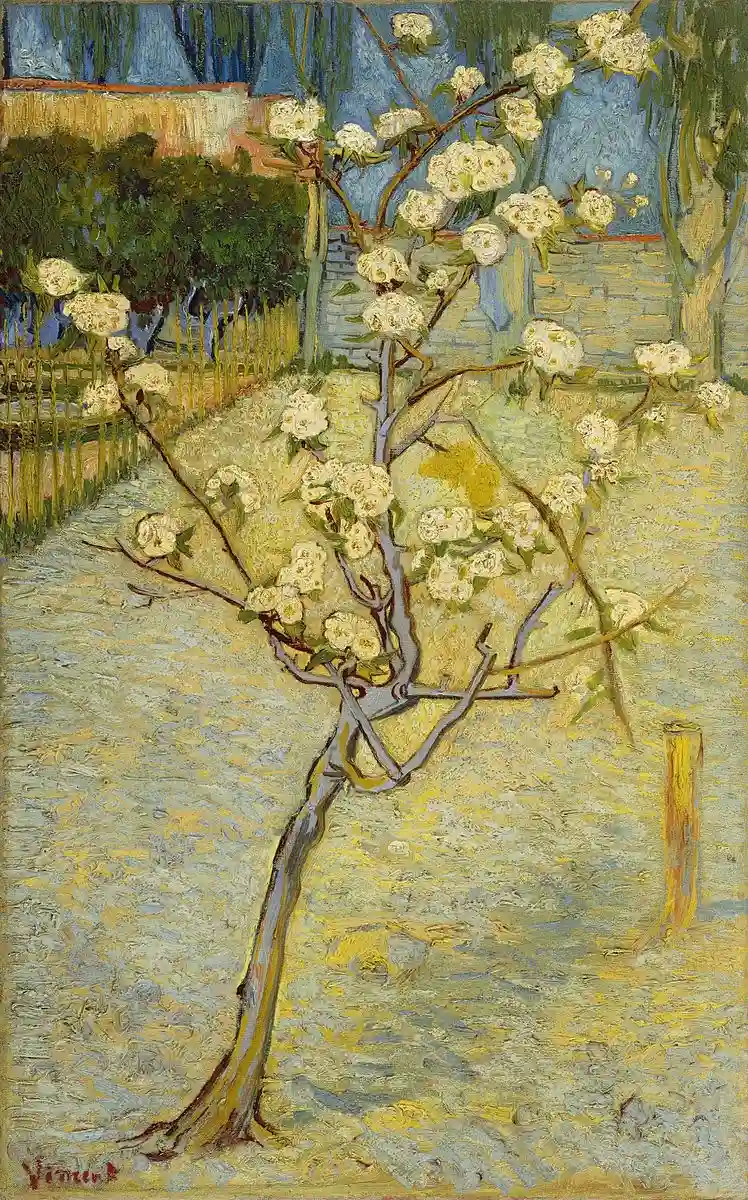
Back to spring: In today’s images, spring has returned, after a long absence. So has this viewer, in my annual exploration of spring’s bounty, seeing it afresh. And so have paintings, that are not molding in museums, but here, in front of our eyes, conveying a shared appreciation of this season. Forget memory! Here are this week’s perceptions, on walks punctuated by heavy rains and sudden reappearance of the sun.
Max Beckmann SPRING NEAR SÜDENDE (1907)
Hawthorne blossoms shimmered through the trees, or exploded in full view.
Dwight William Tryon Spring (1893)
David Hockney Hawthorne Blossom Near Rudston (2008)
Cows were curious as to what I had to offer…
Doris Lee, Blossom Time, 1959
Plants unfurled, echoing van Gogh’s brush strokes.
Vincent van Gogh, Green Wheat Fields, Auvers, 1890
Meadows exploded with Camassia, and other early spring blooms, many reminiscent of rockets, all shooting towards the light.
Janene Walkky Common Camas or Camassia quamash (2013)
Then there are the fruit tree blossoms, holding up their own against the orange bloom,
Vincent van Gogh Orange Blossoms (1890)
Claude Monet Spring (Fruit Trees in Bloom) (1873)
Walking through the woods was a green, dripping, wet experience, then sunbursts the next minute.
Abbott Handerson Thayer Landscape at Fontainebleau Forest (1876)
Did someone say birds? Ducklings! Orioles, yellow rump warblers (butter butts!), kill deer, wood ducks, geese, barn swallows and purple martins all showing off.
Magnus von Wright Mallard Ducklings (1841)
Tracey Emin Believe in Extraordinary (2015)
AUDUBON bird Red-Breasted Nuthatch Purple Martin (1890)