“I can’t go on, I’ll go on.” — Samuel Beckett, “The Unnamable.”
In a recent interview Rebecca Solnit talked about hope amid the climate chaos. She defined the term: “Hope, for me, is just recognizing that the future is being decided to some extent in the present, and what we do matters because of that reality.” She added the observation, “many people are very good at imagining everything falling apart, everything getting worse; they’re good at dystopia, they’re bad at utopia.” Sometimes, I thought, a word of consolation would help, rather than the exhortation for all of us to try even harder during times when despair sets in. The thought was probably triggered by my current reading – I came across the interview while starting a recent book by Michael Ignatieff, The Art of Consolation. How to find solace in dark times. (The link gives you an excerpt of the preface.)
I had liked Ignatieff’s brilliant biography of Isaiah Berlin, but am currently irritated, two chapters into these meditations, about his devotion to religious attempts at consolation with the imperative to just accept the unknowable. No takers for “all has a hidden meaning – only a higher power knows” on this end here. The chapters are organized around a summary and analysis, ordered along a historical time line, of famous people’s dealing with catastrophe and defining forms of consolation, a veritable gallery of the broken and bereaved, as a clever review in The Guardian phrased it. More skeptical review in the NYT here.
Maybe I am just currently irritated in general. Who knows.
In any case, I thought it would be interesting to find some examples of visual representations of consolation. How do you visually translate the moment when we attempt to help someone reverse or shift despair into something more resembling a somewhat normal life, if not hope? The moment when someone or something opens a perspective towards this shift, providing a sense that it is possible, or probable, or even guaranteed that life will be easier to bear at some point?
The search resulted in a mix. It arches from representations of the texts that governed the belief systems of different eras to impressionistic paintings that captured the human interaction associated with comforting, from mannerist paintings to some modern photography. What is art and what is Kitsch I leave to the eye of the beholder.
I’ll start with miniatures from TheGetty relating to Boethius’ Consolation de Philosophie, around1460-70. The Roman philosopher’s book was the most read in Europe after the bible. It contains “a dialogue between its author and the personification of Philosophy, in prison while awaiting trial for treason. Discussing the problem of evil and the conflict between free will and divine providence, Philosophy explains the changeable nature of Fortune and consoles Boethius in his adversity.”
There is Munch, there is always Edvard Munch, who we can count on.
Edvard Munch Consolation (1894)
Compare:
PDX photographer, now based in Brooklyn, Olivia BeeConsolation (2020.)
Any thoughts? And what to make of the image (“Consolation”) of a fetus…. at the center of the exhibition Colpo di Folmine (Struck by Lightning) by Dutch photographer Arno Massee?
I, personally, find solace in the somewhat sarcastic poetry of Heinrich Heine, who, in 1832, reminds a woman staring at the sea with setting sun, that the sun will rise again….translated by no other than Emma Lazarus!
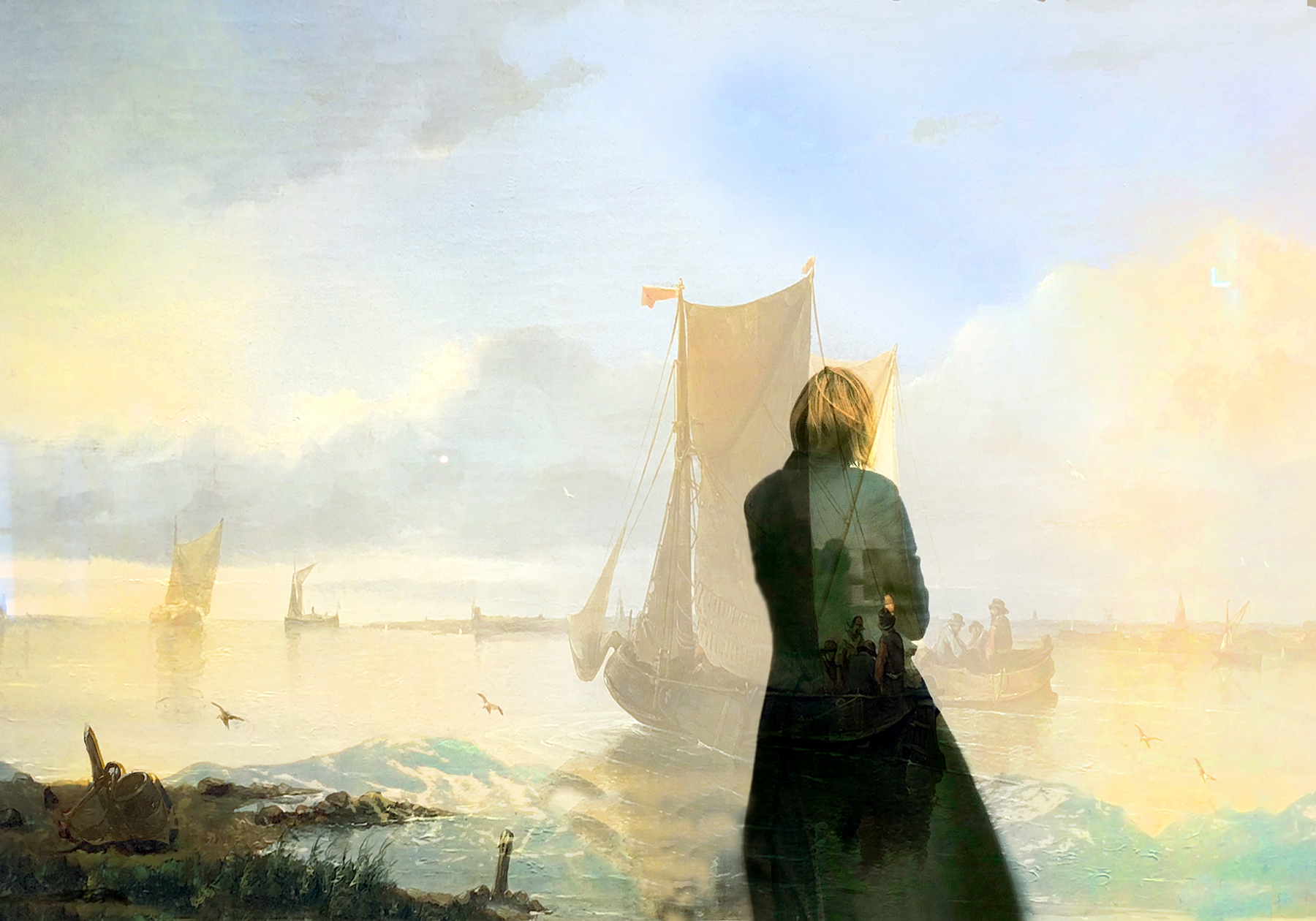
Here is one of Kaspar David Friedrich’s back views, alternatingly titled: Woman in front of the setting sun, Sunset, Sunrise, Morning Sun, Woman in the morning sun. No sea in sight, but the solace of a world still turning. That’s my kind of consolation. Then again, that painting might also be a premonition of a burning planet due to unending fossil fuel consumption – wouldn’t you know it, despair is here to stay.
We are 5,000, here in this little corner of the city. How many are we in all the cities of the world? All of us, our eyes fixed on death. How terrifying is the face of Fascism For them, blood is a medal, carnage is a heroic gesture.
Song, I cannot sing you well When I must sing out of fear. When I am dying of fright. When I find myself in these endless moments. Where silence and cries are the echoes of my song.
Lines written by Chilean artist and political activist Victor Jara before being tortured, his hands chopped with an axe, and murdered by Pinochet’s military henchmen in September 1973 at a stadium holding thousands of people rounded up by the Junta, his body thrown out into the streets of Santiago.
***
I spent several weeks in Chile some 18 months after that fateful date, traveling from Bolivia through the breathtaking, stark beauty of the Atacama desert of the North with its abandoned nitrate – and open-pit copper mines monopolized by British and later American capital. I stayed in Santiago for a while, where bullet holes remained in plain, demonstrative view, riddling the presidential palace, La Moneda, where the democratically elected, socialist President Salvador Allende had been killed during Pinochet’s Coup d’Etat. I knew of the violence of the new regime, fully supported by American industrial giant I.T.T. and the CIA (U.S. banks also extended more than $150‐million in short‐term credits to Chile and the Pentagon sold it 52 jet fighter and combat support planes in those 18 months,) but had no clue to its extent. Today’s officially recognized number of victims of the Junta, people killed, tortured or imprisoned for political reasons, is 40,018. That might not even account for the many “disappeared,” thrown out of helicopters into the sea. Military officers responsible for Jara’s murder were finally sentenced to 15 years in prison, in 2018, almost half a century later. Slow moving wheels of justice and all that. Barely anyone talked to me in 1975, much less about politics, the country seemed frozen in shock or fear and a nightly curfew was still in place.
Jorge Tacla Injury Report/ Informe de lesions, HD film 4:25 (2016 – 2023) Courtesy of Cristin Tierney Gallery
Although the days of the Junta are over, Chile is currently under duress in other ways, equally threatening to its population, particular the working class and the indigenous folks exposed to the consequences of mining. A United Nations report from two months ago states that Chile faces a daunting series of inter-connected environmental crises that violate human rights, including the fundamental right to live in a clean, healthy and sustainable environment. The country is particularly exposed to the effects of the climate crisis, among the 20 nations with the highest level of water stress in the world. Droughts and water pollution around lithium mining are intense, the latter a major export and subject to fierce struggles over ownership, bringing an unprecedented 1.5 million people out into the streets to protest for environmental justice 4 years ago.
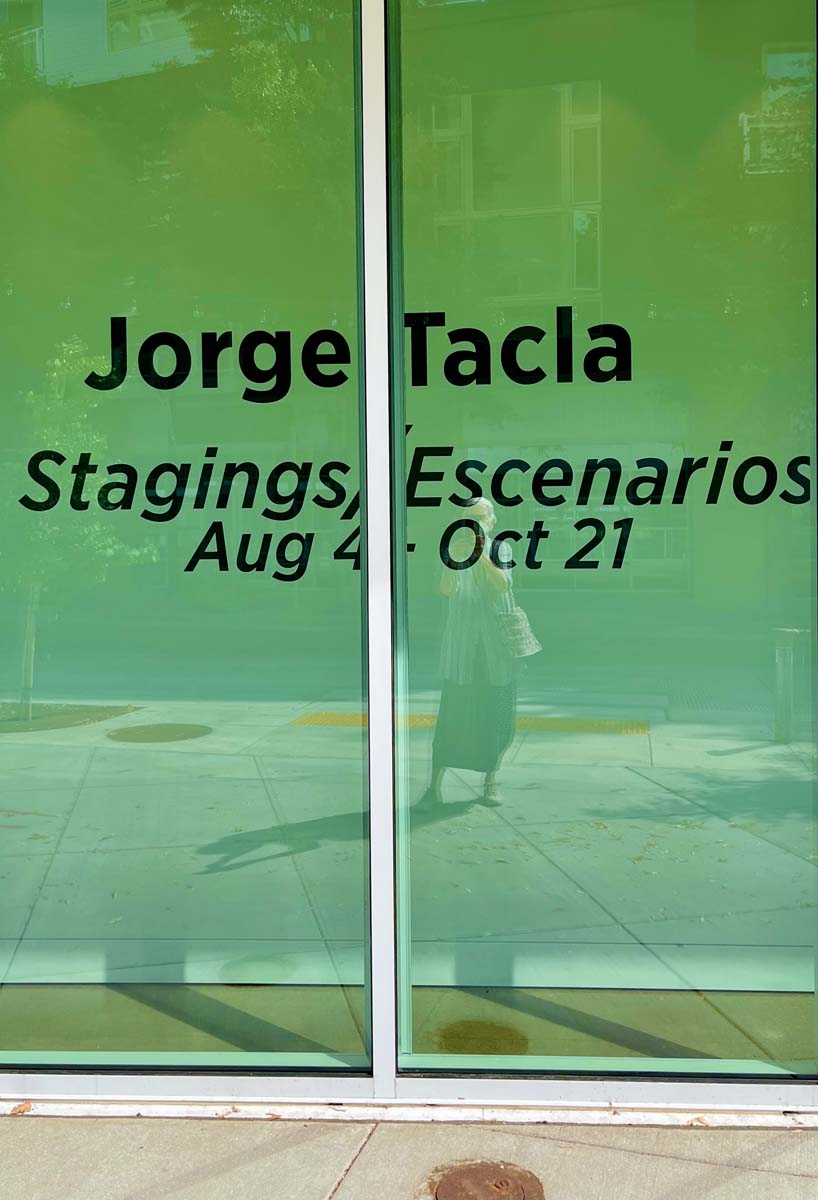
All this as an introduction to Chilean artist Jorge Tacla and his work (his list of many achievements found in the link), currently presented at the Patricia Reser Center for the Arts, in partnership with Converge 45. The local arts organization, comprised of art professionals and business leaders, starts its Biennial officially on August 24, 2023. Planned are 15 exhibitions by international and American artists across multiple venues, tackling, as the organizers put it, “how art interacts with global power shifts in contemporary society, including how art is at the vanguard of societal redefinition and shifts towards more participatory culture.” (Watch for more reviews by various writers on ArtsWatch in weeks to come, covering the full spectrum of the shows.) The list of artist names – I have obviously not yet seen much of the work itself for the upcoming Biennial – suggests a surprising and challenging curation by art critic and author Christian Viveros-Fauné.
I. Jorge Tacla: Stagings/Escenarios.
At a time when the wagons are circled, and exclusionary nationalism (and worse ideological forces) once again raise their ugly head in so many of the countries we thought were steadfast democracies, a transnational approach to art is certainly important. Knowledge of an artist’s background, temporally, geographically and culturally, might help us to gain a greater understanding if not appreciation of his work, surely affected by specific experiential pressures. Tacla came of age in Chile during the time of the military coup and left the country for the United States in 1981, these days sharing his time between New York City and Santiago, Chile. Add to that Syrian and Palestinian ancestry, peoples exposed to inordinate amounts of suffering and oppression across their histories, a heightened sensibility for abuses of power and the consequences of displacement are to be expected. That sensibility indeed influenced the contents of his work that I encountered at The Reser, an exhibition titled Stagings/Escenarios.
There are three exhibits on view, a video, Injury Report/ Informe de lesions, that relates to the book burnings by the Chilean Junta, a timely reminder for us in our own country that the step from banning to burning is but a short one, once autocratic power is fully unleashed, and two paintings. One is extraordinary large, displayed on wooden structures that makes it look like a billboard, the other is traditionally hung. Staging, rather than scenarios, feels like an aptly chosen title for the show, given the way the paintings dramatize catastrophe.
Jorge Tacla Sign of Abandonment/Señal de abandono 60, (Detail) (20121) Oil and cold wax on canvas. Courtesy of Cristin Tierney Gallery
Sign of Abandonment/Señal de abandono 60 (offered with an instruction: interpretation left to the viewer) depicts an interior view of a room that could be a tiled kitchen transformed into a provisional field hospital, or a torture chamber, constructed with hastily thrown together cinderblocks. Central is a kind of operating table, with a side shelf of medical-looking instruments and tinctures, surrounded by amorphous forms that could be shackles or handcuffs, under a hovering cloud of markings that resemble musical notes, the echoes of resounding screams, or, alternatively, buzzing insects attracted by the remnants of bodily fluids. The one unambiguous representation in this monochromatic web of hints and suggestions is the visual anchor of a patch of blood, with a few tiny splashes detectable here or there. It steers our attention to the subjective suffering of a human being, whether harmed in situ or patched back together on a make-shift bed, creating empathy, but also narrowing our focus to victimhood. It forces a gruesome vision of physical harm, drawing us into the literal as well as metaphorical darkness of that chamber. Not much room for interpretation, frankly, if a puddle of blood gets visual place of honor.
Jorge Tacla Sign of Abandonment/Señal de abandono 60, (Details) (20121) Oil and cold wax on canvas. Courtesy of Cristin Tierney Gallery
The larger painting, Sign of Abandonment/Señal de abandono 34, displays a panoramic view of collective suffering, rather than honing in on a singular imagined body under duress. A frontal view of city blocks bombed to shreds evokes the real-life catastrophe of the siege of the Syrian city of Homs, where a three-year-long battle between the military and oppositional forces a decade ago led to indescribable acts of barbarism by Assad’s henchmen, until the rebels withdrew, and the government took hold.
Jorge Tacla Sign of Abandonment/Señal de abandono 34, (2018) Oil and cold wax on canvas Courtesy of Cristin Tierney Gallery
It is a truly interesting painting, despite flirting, at times, with clichéd ambiguity: are the pinks and coral hints at the horizon a hopeful sign of dawn, or are they the glow of still smoldering fires? Are the wispy clouds testimony to an indifferent nature, or plumes of smoke?
Jorge Tacla Sign of Abandonment/Señal de abandono 34, (2018) (Detail) Oil and cold wax on canvas Courtesy of Cristin Tierney Gallery
What made it fascinating to me is the subversive use of columnar arrangements, spatial divisions by means of subtle changes in coloration, vertical lines and actual, distinct columns that overlap on some of the four panels that comprise the entirety of the painting, The columns are enclosed in an unending repetition of violently destroyed human habitat. Columns and repetition were a device of what art historian Meyer Schapiro called “despotic art,” or arts of power, starting with baroque displays of endless columns in churches and cloisters, or colonial architecture in Egypt and India, government buildings with porticos, down to the mass media presentation of his time, then the 1930s, in the new medium of photography capturing hangars filled with rows of airplanes, or military divisions marching en bloc.
Tacla is turning the table, using those elements from the perspective of the displaced, rather than that of the abusive forces, the repetition of block after block of unmitigated destruction inducing horror, rather than awe. In its cityscape expansiveness it called to mind a 19th century painting of another hell, by John Martin – note the columnar repetition of the government buildings or an imaginary reconstruction of cities of antiquity.
Jorge Tacla Sign of Abandonment/Señal de abandono 34, (2018) (Detail) Oil and cold wax on canvas Courtesy of Cristin Tierney Gallery
John Martin Pandemonium (1841), Oil on canvas, 123 x 185 cm. Louvre, Paris. Based on John Milton’s “Paradise Lost”, where Pandemonium is the capital of Hell.
The billboard-like staging reminded me of the billboards seen on many commuter roads, displaying advertisement for (sub)urban neighborhoods: You’d be home now, if you lived here! Well, you’d be dead now, if you lived here, in Homs.
The association includes something of a dialectic, of course. Being reminded of the price of violent political conflict might make you aware of the gathering darkness around us or create empathy for refugees facing a watery Mediterranean grave during their flight. But the reassurance of not living “there” after all, allows us a distancing from those far-away places where genocide happens, enacted by “foreign barbarians,” promoting a false sense of security on our own shores.
The use of cold wax mixed with the oil paints adds to the unnerving feeling caused by the staging. It allows a manipulation of transparency, and so some of what I saw resembled the haze when you look through tears, if not through the dust that gets whipped up when buildings crumble. It also adds body and allows layering; on close inspection, the painting shows scars or buckled skin, as if skin is ripped off or has burnt to the point of melting. The association to skin really was the only direct – and shattering – link to the representation of human beings, rather than architectural ruins.
Jorge Tacla Sign of Abandonment/Señal de abandono 34, (2018) (Details) Oil and cold wax on canvas Courtesy of Cristin Tierney Gallery
I cannot help but wonder how thick-skinned the artist himself must be to make it as a wanderer between worlds, like any displaced person never quite belonging to either the old or the new. Early NYT review doubted his ability to reach high ground as a painter. That didn’t age well. Psychoanalytically absorbed reviewers attest him a profound death anxiety – I guess I’m with Maslow here, “when the only tool you have is a hammer, everything looks like a nail,” including the aesthetics of destruction as a symbol for one’s psyche to acolytes of psychoanalysis. Critics attacked his monumental work at the Museum of Memory and Human Rights in Santiago, a series of plates that memorialized the place of Jara’s murder and is inscribed with his name – Al mismo tiempo, en el mismo lugar (At The Same Time, in The Same Place), 2010, – as too focused on the individual, particularly when the individual in question devoted his life to collective power.
The paintings on view at The Reser suggested to me something quite different, independent of my admiration of the technical prowess to create these monumental constructions and the artist’s resilience when reenacting suffering in the process of painting. In some ways they bear witness, questioning the relationship between the aesthetic and the social, particularly the violence so ubiquitous in our world. They want us to consider, like all good political art, how we bear or enable or resist social imperatives that are associated with power and its requisite tools.
Does art manage to shape our historical thinking, and does its form help us reconfigure our assumptions about the present? Can works of political art ultimately achieve change of a kind, beyond providing a contemporary label that soothes buyers’ conscience by making them feel “progressive”, sort of an art-washing for the soul of the (neo)liberal collector? I will turn to that question in a bit. Before we get there, let me introduce the other two artists on display at The Reser.
***
“A successful work of art is not one which resolves objective contradictions in a spurious harmony, but one which expresses the idea of harmony negatively by embodying the contradictions, pure and un-compromised, in its innermost structure.” ― Theodor W. Adorno, Essays on Music
The quote by Adorno, though focussed on modern music, could equally well be applied to curation. Curation is hard and often does not get the attention and appreciation it deserves, particularly when un-compromising. If you are a renowned curator charged with constructing large assemblies of artists, you have to balance your ideas and concepts with the interests of the organizing institutions, who have partially mercantilistic aspirations. Biennials, art fairs and the like do infuse a place with economic activity, after all. You might also face an embarrassment of riches – die Qual der Wahl is the German phrase, the torture of choice – with regard to the number of artists at your disposal, amongst whom you have to pick and choose, avoiding the dreaded commodification, pushing an important concept and protecting the state of your reputation simultaneously.
If you are a local curator, no matter how talented, your choices, on the other hand, are often somewhat restricted. If you have to combine the available work with that of heavy hitters (and I consider Tacla in that category) how do you protect the other artists from being overshadowed (no matter how good they might be, they are still less known), unless you believe in clichés like “A rising tide lifts all ships?” I don’t know the answer, but there are two comforting thoughts: for one, these lesser known artists will get exposure, that potentially opens up a larger circle of viewers eventually, if the quality of the art holds its own. More importantly, in my view, is the fact that a public confronted with art that is not yet labeled as awe-inspiring or famous, will find it much more approachable, opening interest in art in general. It might be an inspiration to listen to one’s own creative impulses, or an encouragement that early or mid-career work deserves representation. That said, the work of both artists that Karen de Benedetti picked, again showing her sensitivity for pairings as in previous shows that I reviewed, will reward viewers’ scrutiny. (Malia Jensen‘s sculpture was not yet present when I visited.)
II. Karl LeClair Perceptive Omissions // Miroslav Lovric Subconscious Conversations
What unites the work on display by two very different artist, Karl LeClair and Miroslav Lovric, is how it’s grounded in personal memory. For LeClair, intensely attuned to natural environments, drawing is a way to process the changes brought about by frequent relocations, from the East Coast to Idaho and now to the Pacific Northwest. His mixed media, printmaking techniques include intaglio, relief, and monotype (all of which were generously explained to me in my ignorance, including the preparation of the various papers, if using color, with background washes of layers of thinned acrylic, like watercolor).
Perceptive Omissions is presented almost like an installation, allowing direct, unmitigated access to the paper, reinforcing a tactile quality of the prints, the geometric rigidity softened by the occasional colorwash.
Karl LeClair Perceptive Omissions (2023) All works numbered, not labeled.
His drawings and monoprints capture the shifting characteristics of various geographical environments with a surprising tenderness. I sensed a cautious approach to new objects of his affections, trying to learn about a place, as well as a a hint of nostalgia about what had to be left behind.
The pairing of representational scenes and geometric drawings somehow reminded me of Western Esotericism, like the medieval engravings of Paul Yvan. Not sure why I picked up a hint of mysticism, but there you have it. Interpretation left to the viewer…
***
Lovric’s work, Subconscious Conversations, was the most accessible to me, growing up in post-war Europe surrounded by prints of Klee, Kandinsky, Matisse, Calder or Joan Miró. The latter’s simple shapes, strong lines and colors came to mind when I looked at the present paintings and their faint surrealist connotations. Lovric, a refugee from Bosnia, another country with a recent bloody history and unresolved political conflict, works through his displacement with remembering that seems at times indistinguishable from longing. I get it. The acknowledgement that you will never be able to recover what is gone for good, once you have made a life in a different country, does not preclude a yearning for that you left behind, even if it no longer exists.
Miroslav Lovric Soul Catcher #2 (Woman) (2011) Mixed Media on Paper
He stated somewhere that his work is about hope and resilience, and I can certainly pick up a desire for optimism in the saturated, bright colors on display. It will speak to viewers, since we can all use a dose of positivity, even if woes are not grounded in political strife or experiences similar to those of the artists.
From left to right: Miroslav Lovric Autumn Tree (2020) Oil on Canvas; Red Nest (2020) Mixed Media on Paper; Questioning Bird (2015) Mixed Media on Paper.
Miroslav Lovric Garden (2021) Mixed Media on Paper
Yet I thought the strongest of the images on display was one that captured the immediacy of contemporary (pandemic) isolation, not related to the past at all. The monochromatic construction attends to traditional elements of windows and chairs, and adds a body, albeit to my eyes one that’s missing head and heart. There is corporality to the legs, but in the absence of social embrace, of human interaction, the core of a person vanishes. Or is not clearly delineated enough to be easily detected. Tell me about it.
What does it mean to consider “art as global citizenship,” part of the Biennial’s title? Certainly not to have rights, or the corresponding obligations, as expressed in Arendt’s view of what it meant to be a citizen, during an era with many people deprived of any rights as refugees from fascistic regimes. I come back to her, for one, because I’m fussy about terms: citizenship is connected to people, not “art,” with a defined set of political criteria, and secondly, because Arendt’s philosophy is increasingly relevant today in the face of immigration politics, soon to be intensified by climate refugees. Well worth re-reading.
More likely, the intended meaning of “art as global citizenship” runs along the lines of what Hans-Ulrich Obrist, the renowned Swiss curator, uttered here (or everywhere, he utters a lot):
“Art can widen horizons, dissolve borders, is obliged to bring people, ideas, concepts together. A successful piece of art has the power to change expectations and perspectives….(art) is asked to facilitate supranational dialogue.” (My translation.)
Siegfried Kracauer’s phrase from his Weimar Essays, “They were everywhere, and belonged nowhere,” a referral to the masses as a cultural phenomenon during the1920s, could, in my opinion, also be applied to these ubiquitous tropes we hear today when discussing art. One of them, “Entgrenzung,” the act of removing borders and promoting class permeability and global interconnectedness, is among the most frequently used. Can art transcend borders and change perspectives? How would we empirically assess the actual impact of political art, and has anyone done so, beyond simply qualitative reporting that people are moved, or claim to have gained new insights, or flocked to see a particular work of art?
Art as Social Practice: Tania Bruguera and her art movement ‘Arte Útil’ engages in long-term, participatory projects that include a community center, political party for immigrants, and an institution working towards civic literacy and policy change in Cuba.
We have long held that political art, through forms of social commentary, can raise awareness and inspire dialogue. Art, we believe, can provide representation for those who otherwise remain invisible or marginalized, helping to de-stigmatize on occasion. Art can be a form of memorialization of significant events, either transmitting knowledge about them to present generations who are exposed to selective versions of history guarded by those in power, or future generations who can stitch together a picture of past times and events. (I have written about the politics of memory recently here and here.)
Art as instigator: William Blake was one of the first political artists trying to dissolve borders – in this case the church- imposed rigid division between good and evil.
Certainly an early socialist perspective on art suggested artists should serve society by assuming an ethical stance to reveal the workings of ideology by describing the truth. Do we have evidence that it works? Do people still think about new perspectives an hour after they left the museum? How do we find out if people who report being moved or challenged by a piece of art translate that into behavioral changes, voting patterns, a measurable decrease in racist, xenophobic or misogynistic attitudes or some such? If there are data, enlighten me! Me, the social scientist wants to know. Me, the art lover couldn’t care less. (I am excluding visual propaganda here, which has been empirically shown to manipulate people’s values successfully. It differs from single pieces of art by the frequency with which it showers the viewer, being mass produced and co-temporally broadcast across media.)
Art as memorialization: depicting historic events as they unfolded..
Micha Ulman Empty Library (1995) (My photographs)
This is another piece of art to commemorate book burnings, in this case in Germany during the prelude to the Holocaust. The monument at Berlin’s Bebelplatz is an underground library with enough room to fit 20 000 books, totally empty. Unobtrusive, easily missed, it consists of a 5 by 5 by 5 underground space that can be viewed through a glass cover – theoretically. The weather and temperature differential often fogs the glass over, so you only get a glimpse, a vanishing view, just like memory of the era that is slowly disappeared or disappearing.
Maybe the question for evidence of effectiveness is the wrong question. Maybe we should forget about the claimed or actual function of political art, when it is so obvious that artists across history could not help but serve as mirrors for the political and/or philosophical environments and conflicts of their day. Maybe artists are driven to description in face of the uncertainty of their existence within a political system, and really good art goes beyond that by pinpointing what the political functions are of the structures and events their describe: the function of violence, for example, during an authoritarian period, or the function of propaganda to prepare for catastrophe, or the function of assigning value to keep traditional hierarchies intact. It is about expression of the artist’s views on the injustices of the world, or their delineation of possible utopias, not their intended impact on public opinion or belief systems. They have a particular talent or even genius for describing the world as they see it, contemplating possibilities as they weigh them. Whether we, the viewers, actually pick up on that or transform it into action would not affect their production, even if it is desirable that we would.
Max Ernst Europa nach dem Regen (1933) (Europe after the Rain)
Art as premonition: depicted is a post-apocalyptic, new world order with Europe and Asia melting together.
Then again, maybe we can use the fact that art has threatened existing power structures to the point where it was forbidden, persecuted, criminalized or otherwise impeded, as indirect evidence of its effectiveness. The Kampfbund für deutsche Kultur (KfDK, or Fighting League for German Culture), for example, was founded in 1929 by Alfred Rosenberg, with the aim of promoting “German culture” while fighting the cultural threat of liberalism, leading to prohibition of “non-Aryan,” degenerate or progressive political art and the persecution of many artists. Similarly draconian measures can be seen in contemporary Russia or Iran.
Art as warning: Bauhaus artist Mariann Brandt weary of renewed militarization. “They are marching again.”
Art as activism: Photomontage by Hannah Höch Mutter, (1930) shown in the 1931 Berlin exhibition, Women in Distress, which she organized to fight for decriminalization of abortion; the show opened by Käthe Kollwitz.
One thing is empirically established: in times of social rupture, structural change of political systems and power struggles, societies become quite flooded with the depiction of catastrophes. If you look at the Weimar Republic, for example, there was a preoccupation with the visualization and dissection of catastrophes that seemingly emerged from the atrocities experienced during World War I, but seamlessly prepared, in insidious ways, the public for the horrors of its immediate future. The visual politics of people enamored with war and violence as an engine for society, like philosopher Ernst Jünger, filled the zone with imagery that celebrated the moment of danger, the unfolding of catastrophe. The new medium of photography lent itself to such manipulation – its mass distribution was in many cases intended to “produce docile subjects for the dawning spectacle of oppression and war.” (Isabel Gil, The Visuality of Catastrophe in Ernst Jünger’s Der gefährliche Augenblick, KulturPoetik, 2010, Bd. 10,p.87)
The Moment of Danger (Frontal Cover)
Preparing the masses: collective mourning after Lenin’s death, in New York
If we look at the ubiquity of depictions of catastrophes in all their gory details in our own time, with many other parallels to the 1930s looming, one wonders if we are in the process of being desensitized as well. Paintings of destructive consequences of war or torture like Tacla’s might rightfully warn us or make us think about the historical conflicts in parts of the world not our own (though surely underwritten by U.S. hegemonial interests,) or even be premonitions of things to come to our own backyard – I believe his art applies to anyone of those categories. But if they are integrated into a deluge of visual imagery of horror, from art, media and propaganda outlets alike, there might be unintended consequences, including the normalization of catastrophe.
Art as (scientific) witness: Forensic Architecture uses architectural evidence in cases of war crimes or other human rights abuses, often focused on how the narrative justification differs between state and victims. Nominated for the Turner Prize in 2018.
Georg Simmel, another German sociologist and Neo-Kantian philosopher who died in 1918, anticipated something he called the the Tragedy of Culture. He believed that there was a dialectical relationship between “objective culture” – the art out there, or religion, rituals, etc. – and “subjective culture,” our own development as individuals with creative or intellectual abilities. He was convinced that the onslaught of objective cultural products, massive saturation with cultural information, would stunt our psychological growth, with us shutting down in the face of overwhelming stimulation. The idea reverberates with me, and I often find myself in a balancing act when deciding what should be processed and what should be ignored. In the case of the current exhibition at The Reser, I come fully down on the “Give it a shot” side. The work deserves our contemplation.
And here is another Latin American political artist, Facundo Cabral, assassinated some years back, with a song that describes some of the ways of being an artist in the world. “I did not come to explain to the world, I just came to play.”
IT SEEMS TO BE the rule these days: every time I visit a new exhibition at the Oregon Jewish Museum and Center for Holocaust Education (OJMCHE,) my brain picks up speed and my heart gets either heavier or lighter, depending on what’s on display. The most recent visit changed my mind as well. Last month I had declined to review the opening exhibitions in celebration of OMCHE’s expansion and addition of a new permanent gallery dedicated to Human Rights after the Holocaust. I did not want to mingle with crowds, which I very much hoped would be there to honor the museum’s continuing growth. I was spoon-fed on Rembrandt as a child and was not sure I needed to see yet another etching of biblical lore in my life time. And, most importantly, the recent loss of Henk Pander, a close friend, still felt raw. I had written an in-depth review of his penultimate exhibition, The Ordeal, while he was still with us and was not sure if I had anything more to add.
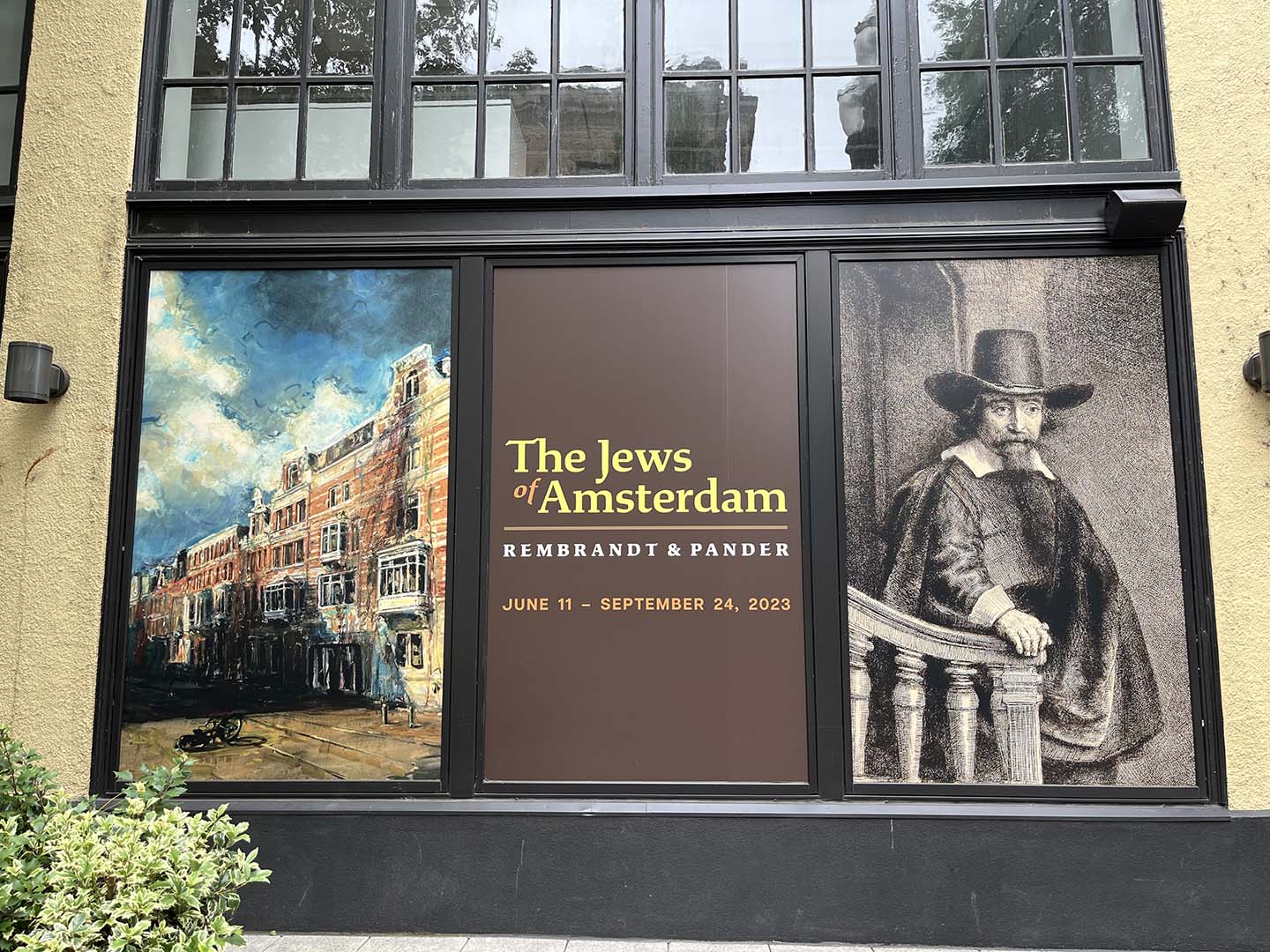
Well, here I am, reviewing after all. The exhibitions were just too interesting and raised important questions while I walked through a thoughtfully curated show during an afternoon when the galleries were empty, trying to put a lid on my unease. Taking in The Jews of Amsterdam, Rembrandt and Pander, as well as But a Dream, Salvador Dalí, turned out to be a challenge on multiple levels, if a rewarding one. That’s what good museums do, right? Make you think and feel and learn, even when some of the topics are difficult to deal with, as has been the case for the majority of the exhibitions I have reviewed for OJMCHE over the last years.
Want to stick with me then, while I’m thinking out loud? (Alternatively, here is a detailed OR ArtsWatch review of the museum re-opening, including Bob Hick’s conversations with museum director Judy Margles explaining some of the choices made, and Bruce Guenther who brought his perceptive touch once again to the selection and arrangement of exhibits.)
Let’s start with the Dalí. It was a bit surreal to enter an exhibition of 25 works, “Aliyah, the Rebirth of Israel,” commissioned by Shorewood Publishers in 1966 for the 20th anniversary of the founding of the State of Israel and mounted in observance of the state’s 75th birthday, when I had read just hours earlier a statement by former Israeli Prime Minister and decorated military officer Ehud Barak in Haaretz: “The moment of truth is upon us. This is the most severe crisis in the history of the state. … with the upcoming vote… we are hours away from a dictatorship.”
Aliyah literally means ascent, but has been the term used for the return of Jewish people to a land they claim their own. Seeing the internal divisions, violent protests, an increasingly desperate fight for democracy and a country accused by B’Tselem, Human Rights Watch and Amnesty International, among others, of practicing apartheid against Palestinians, one can’t but think of descent rather than ascent. Isaac Herzog, the President of Israel, warned of civil war as Netanyahu rejects compromise. Organizers estimated 365,000 people have come out in cities around the country on one day alone to protest the government’s attempted judicial overhaul.
All the more a reason, one could argue, to present a vision of Israel that helps us understand its history, depicts its travails, and confers hope and admiration about the resilience of a people. And how better to accomplish this than with photolitographs based on masterfully executed mixed media paintings, grouped around relevant Zionist history and elucidated by biblical citations at times? (The paintings were displayed at the Huntington Hartford Museum in New York City originally, and then sold; the current whereabouts of many of them are unknown.)
There is just one problem: the artist, Salvador Dalí, was an abominable human being, and his expressed admiration for figures like Hitler and Generalissimo Franco at least indirectly suggest racist and authoritarian preoccupations. Whether he actually was an antisemite is a matter of debate, one the museum, to its credit, does not entirely shy away from. David Blumenthal who, together with his wife, lent the current exhibits to the museum, engaged in serious scholarship around the question of Dalí‘s relationship to Jewish themes, laid out in an essay here. He went through a number of speculations to reject most of them in favor of the conclusion below, with a lingering doubt about motives nonetheless:
So, what was Dali’s commitment to “Aliyah, The Rebirth of Israel”?
It seems to me that it was not an obsession with moneymaking or a desire to develop the “Jewish market.” Nor was it a need to rectify his reputation as an antisemite that brought Dali to use Jewish themes. It seems to me, too, that it was also not a quirk of his or Gala’s ancestry, or sympathy with Jews, Jewish culture and history, or the Jewish State. Rather, as I see it, this was a commission and Dali executed it seriously. Shoreham had commissioned this. Dali had Jewish friends in New York who helped him with the material, though we do not know who these friends were …This, it seems to me, is the most reasonable explanation for Dali’s work on “Aliyah, the Rebirth of Israel” – that this was a serious execution of a serious commission, authentic even if not experimental — though the argument of crass exploitation cannot be ruled out.
***
SHOULD WE SEPARATE the art from the artist? Can we?
On the one hand, we have decisions like Israel’s to deny public performance of Wagner’s music, a composer associated with expressed anti-Semitism and admiration of totalitarian rulers, who adored him in turn. On the other hand, if you look closely, antisemitism was such a run-of-the-mill sentiment across continental Europe that we would have to throw out half of all famous writers and composers, just thinking of Bach, Beethoven, Robert Schumann and Clara Schumann, Chopin, Tchaikovsky and Carl Orff. In literature we couldn’t read Shakespeare’s “The Merchant of Venice”, Dostoyevsky, the poetry of Ezra Pound and T.S. Eliot, to name just some who come to mind readily and all of whom are performed in Israel or read in Hebrew translation. It is, of course, not just a question specific to antisemitism, but one that extends to any repulsive behavior. Do we patronize the movies of a Roman Polanski or Woody Allen, or watch Bill Cosby or Johnny Depp? Do we listen to music by people who have been convicted of various forms of abuse? Do we buy our grandchildren books authored by newly rabid transphobes, even if the literature enchanted entire generations of our own kids?
In some ways, we have to do our homework to decide if a given artist held odious attitudes, or whether there was a deeper, darker impulse at work that really could be tied to evil that manifested in expressed cruelty, both verbally and behaviorally. (Read George Orwell for the details.) For Dalí, some still re-interpret his glorification of fascism, whether Hitler or Franco, as a defiant provocation of his surrealist peers with whom he competed (it did lead them to exclude him from their group, clearly seen as more than just big talk.) But if we look at the witness reports on his violent beatings and sexual assaults of women, torture of animals, necrophilic longings and, expressed admiration (“Hitler turns me on to the highest, Franco is the greatest hero of Spain”) in his book The Unspeakable Confessions of Salvador Dalí, there seems to be enough to decide that he was not just trolling, and thus we do not want to give him and his work more exposure. In fact, read his previously unpublished letter to Andrew Breton, and I bet you will never look at this artist with the same eyes again.
So why do we give the artist a platform? And I don’t just mean the museum folks who make decisions about what would fit into a particular exhibition series embracing art with a Jewish theme, or celebrating Israel’s birthday, or attracting visitors with the lure of famous names, visitors who then learn about Judaism, or truly intending to open the debate about art vs. artist. I also think of the rest of us, who flock to see the famous artist’s work. The simple answer might be: we are interested in the art, admire it, so who cares about the artist, live with it! There are more complicated answers, though. One potential reason could be that our own attraction to spectacle, our hidden desire to make excuses for wanting to witness violence or narcissism in action, can be satisfied if we have something that “justifies” the behavior we observe or unconsciously lust after (think crowds at lynchings, for example.) This something, in the case of artists, can be the belief that “genius” excuses a lot. In a new book, Monsters. A Fan’s Dilemma. author Claire Dederer argues that “genius” is a construct that implies that the artist channels a force larger than him/herself. We give them a pass because that force, the artistic impulse, is so overwhelmingly positive that it makes up for the rest of the sorry picture. This presumed force larger than someone can, of course, be attributed to multiple origins, like when you believe that certain powerful people (and I won’t mention any names) are sent by a deity or fulfill biblical prophecies, and thus have carte blanche to overstep moral boundaries for that very reason.
Another possibility arises from brand new research findings from psychologists at the Humboldt-Universität zu Berlin, Germany. The research team tried to explore empirically how people’s knowledge of abusive behavior by an artist would influence their aesthetic judgement of a piece of art as well as their electrophysiological brain responses. The shortest summary of a very complex and smart experimental design I can offer in our context: receiving negative-social biographical information about an artist will make you like their art less. Yet at the same time the work is physiologically more arousing to you, particularly if the art itself contains a reference to the negative behavior, when you look at our brains’ first spontaneous reactions. Reverberations of disgust? Or the kick of a voyeur?
Independently, we also have to differentiate between those who suffered from an artists’ immorality, Holocaust survivors who had to play Wagner in camp orchestras, or domestic violence survivors who watch a movie star strutting with impunity, compared to those of us for whom this is more of an intellectual enterprise. I have no answers. I know some of the art I love most or that has formed me in my understanding of art was created by people I dislike or even abhor. Dalí‘s art does not belong to the former, but Dalí the person surely resides amongst the latter. I would not ever go to see an exhibition solely presenting his work, being firmly convinced of his embrace of fascism among the rest of his abominations. I was in luck, then, that the remainder of the afternoon provided a much brighter picture, with The Jews of Amsterdam, Rembrandt and Pander.
***
“A new and astonishing poetic secret arose from the idea of juxtaposing related, as opposed to unrelated, things.” René Magritte, 1932
***
WHEN I ENTERED the gallery showing Rembrandt (1606 – 1669) and Henk Pander (1937 – 2023) – neither one of them a Jew, so the title needs a bit of stretching – I couldn’t help but think of Magritte’s 1932 painting Les Affinités électives (Elective Affinities). What triggered the memory was the spatial feel of Rembrandt’s etchings contained in a small, compact space, with little room to breathe, surrounded by the proverbial as well as literal walls of Pander’s paintings lining the perimeter, just like the egg in the cage.
But the combination of the two artistic oeuvres also fit perfectly with Magritte’s musings above, by all reports offered when he had finished this painting after having woken from a dream in a room with a caged bird. The typical surrealist approach of combining unexpected and unconnected subjects to surprise effects had been replaced by a play on relevant relations. The notion of elective affinitieswas originally coined in a novel by Goethe (Die Wahlverwandschaften), but more likely read by Magritte, sympathetic to the communist party for most of his life, in Max Weber’s 1905 book The Protestant Work Ethic and Capitalism. The term was loosely understood as a process through which two cultural forms – religious, intellectual, political or economical – who have certain analogies, intimate kinships or meaning affinities, enter in a relationship of reciprocal attraction and influence, mutual selection, active convergence and mutual reinforcement.
Henk Pander Intersection in Amsterdam East (Set back in time) 2022
There you have it: The painters’ works do relate, converge and reinforce each other, no matter how far apart in style, historical content, execution. Central to both is, in my opinion, a shared focus on what Robert Frank so famously called “the humanity of the moment.” (For him this was a requirement for a good photograph, and he went further: “This kind of photography is realism. But realism is not enough – there has to be vision, and the two together can make a good photograph.”)
Beyond the shared location of Amsterdam, both artists’ output is undisputedly visionary, creating imagery that stands for key moments in the exploration of humanity’s history, whether guided by the episodes derived from the belief system of the (mostly) Old Testament (Rembrandt,) or the photographs taken of his Dutch surround and rendered into historical narratives that represented the desolation of a town under Nazi occupation (Pander.) The humanity of the moment is captured by Pander most vividly in the absence of same, not a person in sight, just left-over detritus hinting at deported burghers, violent actions and hasty departures, (and conveniently setting scale, so that the already ominously lit buildings, some seemingly on fire, take on an imposing height that intensifies the sinister mood. (I am adding a contemporary photograph from some tourist website that shows how small the houses actually are.)
Henk Pander Rembrandthuis, Amsterdam (2022)
The humanity in the moment that is not directly accessible in the pictures because it belongs to the artist more than the subject, is Pander’s homesickness while he painted the streets he once roamed, (a homesickness that one has to assume was shared by the deported Jews who survived the Holocaust.) Henk suffered recurring waves of Heimwee, the Dutch word translated as the aching for home, better capturing a real sense of almost physical pain, rather than a general malaise. It was not nostalgia, after all his childhood had been harsh under German threat and occupation, hungry and consumed with fear. It was not Verlangen, longing for an imaginary golden past that never existed. It was the loss of a sense of place and familiarity with that place, familiarity with a culture, language and certainly the spot in a family tree of many generations of painters descending from the old Masters. He was proud of having come into his own as a mature artist with his very own ways of expression, but also felt like a stranger in a strange land, no matter how much recognition he received or how truely in love he fell with the American landscape of the West.
I vividly remember an occasion where I tried to come up with an interpretation of one of his large oil paintings (not in the current set.) After repeated failures he said, with that impish grin of his’, “it’s just a painting, Friderike!,” which it was and yet wasn’t. They all were, in the sense that often some visual exploration, purely guided by aesthetics, started to take over, intermingling with or even overshadowing the original concept. But there was always a concept, a thought, a communication of something that deserved our attention. A day later I sent him a postcard of Pieter Brueghel the Elder’s painting The Dutch Proverbs as a tease, a painting capturing some 120 concepts all in visual guise, conceptualization on steroids. We explored it together, during one of the long waits in the clinic where I drove him for early cancer treatments long before the pandemic ensued, and were able to identify many of the proverbs which are very similar in German and Dutch. Heimwee descended on both of us, knowing that no-one in our immediate vicinity would know even a few of the proverbs, which were such cornerstones of our childhood.
May his memory be a blessing.
Pieter Brueghel the Elder The Dutch Proverbs (1559) Oil on Oak Panel, Staatliche Museen zu Berlin
***
Voor de wind is het goed zeilen – it’s easy to sail ahead of the wind – If conditions are favorable it is not difficult to achieve your goal.
The little boat in the upper right corner of Brueghel’s compendium embodies this proverb, and it applied to Rembrandt van Rijn’s life and career for many years. Until the winds shifted, when he ended up losing his patrons due to changes in public taste, losing his house and belongings in bankruptcy, and after some more artistically productive years was eventually buried in a pauper’s grave near Amsterdam’s Westerkerk in 1666. As is so often the case, the decline was overdetermined, with multiple factors at work, including financial miscalculations of not having paid debts and overspending for his compulsory collecting of art and antiquities.
Much has been written about the artist, with unlimited admiration or sanctimonious scorn. A genius outsider, for some, making his way from humble origins to the embrace of a wealthy merchant class, a misogynistic exploiter of women, for others, who confined his aging lover who had raised his orphaned son to a prison-like asylum when she started making demands while he was already bedding a 23 year old replacement. Myths about him having secretly adopted Judaism abounded. Hitler and his charges tried to make him into an Aryan hero (and looted his art during the war), to the point where they appointed the horrid propaganda film maker Hans Steinhoff (Hitlerjunge Quex)to make a movie about him in Amsterdam in 1941 with a script appointing three “evil Jews” as the cause for his downfall, with Propaganda Minister Goebbels covering all the cost. (The Dutch Resistance Museum in Amsterdam had a fascinating exhibition about Nazis’ attempt to incorporate the Rembrandt into fascist ideology in 2006.)
Ephraim Bonus, Jewish Physician (1647)
The best introduction I can think of, one successfully arguing that the artist was simply a man of his times, acting within an era-specific and location-determined set of conditions, is historian’s Simon Schama’s book Rembrandt’s Eyes. (For those of us with a shorter attention span, here is a link to a talk he gave that really sums up a lot of information. It is open source and you can download the whole thing.) Schama stresses the general attitude toward Jews in the Amsterdam of the 17th century as one of “benign pluralism.” Of the 200.000 inhabitants in 1672, only 7500 were Jews, with the minority of very wealthy Sephardic Jews (Marranos, forced converts to Catholicism) who had fled the Southern Inquisition at the beginning of the century concentrated in one area, and 5000 much poorer Ashkenazis who by 1620 fled the programs in central and Eastern Europe, speaking Yiddish and keeping to themselves.
The Jewish Quarter, where Rembrandt lived for some twenty successful years had a 40/60 % mix of Gentiles to Jews, with the Sephardic Jews enjoying social equality (although not intermarriage) while enormously contributing to the country’s economy. It was, early on, an exceptionally tolerant age and society, of which Rembrandt was no exception. Again, it is somewhat surreal that I write this while the Dutch government has collapsed over issues of asylum seekers and immigration policies, with a fragile 4-party coalition under Prime Minister Mark Rutte, lasting, in this round, less than 18 months. An extreme right wing party, the Party for Freedom under Geert Wilders, and a populist Farmer-Citizen movement, headed by Caroline van der Plas, are eagerly waiting in the wings for the potential November election. Tolerance for immigrants is at an all time low, making the 17th century look ultra-liberal in comparison.
Rembrandt used some of his Jewish neighbors as models, although it is debated how often, and was often interacting, perhaps even close friends, with Rabbi Manasseh ben Israel, an emphatic proponent of reconciliation between Jews and Christians who commissioned multiple works from the artist, some displayed in the current exhibition. Some might have simply been observations outside his window. It is now claimed that the setting of the artist’s 1648 etching, Jews in the Synagogue (1648) – is not a synagogue but, rather, a street scene in the Jewish Quarter of Amsterdam. It shows only nine Jews, one less than the requisite minyan, but it also centers an isolated figure, potentially remarking on the separation between the established Sephardic Jews, and the Ashkenazi newcomers.
Jews in the Synagogue (Pharisees in the Temple (1648)
Rembrandt’s tolerance or even desire for inclusion extends beyond the Jews to people even lower in the social hierarchy of the times: Blacks. I think this is important to acknowledge, since it describes the artist’s willingness and need to depict the world as it was, forever searching for veracity and empathizing with the human condition.
He created at least twelve paintings, eight etchings, and six drawings in which Black people play roles as spectators or participants in biblical scenes, models likely taken from the street or the household of his Jewish neighbors. (Ref.) As it turns out, the Creole were former slaves on the plantations of the wealthy Marranos, brought back as household help and now just servants since slavery was prohibited in the Dutch provinces. The rich Portuguese Jews were quite involved in the sugar trade, colonial exploits pursued by the Dutch West India Company (WIC) that by 1630 fully engaged in human trafficking to ensure there were laborers for the mills and plantations in the colonies. (Quick aside, I know it’s getting long: acknowledging the specter of colonialism and slavery, museums and art historians have ceased to talk about the era as the “Golden Age.”) Rembrandt must have known this, particularly since he had portrait commissions of some of the most influential Marranos who owned plantations in Brazil. But the fact remained, he depicted his Black subjects without disdain or mockery and gave them central roles in biblical narratives that might have emphasized the possibility of conversion (proselytizing then often used as a justification of slavery.)
If you look at the intimate, small depictions of biblical scenes, or Jewish citizens engaged in religious practice, one thing is clear: not only are people naturalistically depicted, truly as they looked, but they are always caught in a narrative moment that draws the viewer completely in with its drama and impending resolution – the humanity of the moment. That moment is one where things turn, either for good or for bad, the moment before the sacrifice of a son,
Abraham and Isaac (1645(
the moment of receiving forgiveness,
The Return of the Prodigal Son (1636)
the moment of the take-off of the angel, barefoot, no less, and with a gravity-proof robe
The Angel departing from the family of Tobias (1641)
the moment a dangerous seduction might or might not happen.
Joseph and Potiphar’s Wife (1634)
Rembrandt and his compatriots focused in this work on the fragility of our existence, caught in the very moment where something irreversibly changes, never to be the same again, often raging at the claimed inevitability of it all. As I wrote previously while reviewing Henk’s work, the Dutch have a name for that circumstantial reversal, staetveranderinge, a term derived from the Greek word peripeteia, and a concept embraced in Dutch paintings since the 1600s. The change could be in any direction – from anguish to praise, like in Rembrandt’s versions of The Angel appearing to Hagar, but most often captured when circumstances shifted irrevocably to disaster, like Jan Steen’s Esther, Haman, and Ahasuerus from 1668, below.
The preoccupation with “state change” corresponded with the rise of Calvinism, a religion that dominated the Dutch provinces and led to long religious wars against Catholic nations but also to boundless prosperity, shaping the evolution of commerce and empire. Henk Pander certainly inherited and made good use of this narrative concept across his life time, but Rembrandt knew to convey it to perfection. This is how he captures our rapt attention, since we know and fear these situations and are curious to see how they will be resolved, unless we know the biblical stories or re-tellings of mythology by heart, which have, at least in some instances, a good ending, something that hooks us as well.
Selection of illustrations for Menasseh ben Israel’s “Piedra Gloriosa” (1655)
Story tellers, the both of them, across time and historical settings, working magic with light, shadow or color, willing us to be a participant in the solving of the narrative. Simon Schama’s assessment that Rembrandt managed to engage us by upping the intensity of the story through combining the ordinary with the extraordinary holds for Henk Pander as well.
See for yourself. The exhibition will last until September 24, 2023.
***
OREGON JEWISH MUSEUM AND CENTER FOR HOLOCAUST EDUCATION
724 N.W. Davis St., Portland
Hours: 11 a.m.-4 p.m. Wednesdays-Sundays
Lefty’s Cafe museum deli hours: 11 a.m.-3 p.m. Wednesdays-Sundays
Admission: Adults $8, students & seniors $5, members and children under five free
“When you find out that you are ill, your priorities are shattered. One moment you are in a boat, and the next moment you are in the water…. Once you’ve experienced being mortally ill and you’ve come back, you have learned something that’s worth knowing.” – Susan Sontag
***
THESE DAYS I seem to meet survivors wherever I turn. I can’t decide whether that’s a good or a bad thing, good for the outcome, bad for the frequency of affliction. Yet every cancer survivor who I’ve encountered, or for that matter anyone diagnosed with any life-threatening illness, can relate to Sontag’s words. They were uttered in an interview in 1988 when she had successfully navigated a return to the living from metastatic breast cancer, and before she was diagnosed a decade later with an unrelated uterine cancer. Ultimately, the treatment required to fight these cancers led to yet another one, t-MDS or therapy-related myelodysplastic syndrome, a then untreatable variant of leukemia. She died in 2004.
You are in the boat one moment, and the next you are in the water. The possibility of drowning looms large, but there is still a chance to swim, if you are lucky, strong, determined – and were taught to swim in the first place.
I was thinking of that during my visit with Laura Ross-Paul at her studio last week, meeting the artist for the first time to talk about her upcoming exhibition, The BrEaST Show, at The Nine Gallery (inside Blue Sky Center for Photographic Arts.) Ross-Paul found herself in the water in 2003, diagnosed with breast cancer, and after intense research opted for what was then experimental cancer treatment, being the very first breast cancer patient in the U.S. to undergo a procedure called cryo-ablation. She has shared what she learned ever since she’s come back on land, as an activist as well as an artist. It’s worthwhile knowledge for the rest of us as well, and the exhibition will provide the perfect forum to get informed in addition to see a painter yield color with admirable abandon.
Depending on the type of breast cancer, a person’s surgical options are mastectomy (a full removal of the breast,) lumpectomy (removal of a small part that contains the tumor,) and and now cryo-ablation, a surgical procedure that involves inserting a stainless steel probe directly into the tumor. The thin probe carries cold argon gas down an outer tube to the sealed tip of the probe, then the gas expands as it returns through an inner return tube to the gas delivery system. This makes the probe tip extremely cold, which freezes the surrounding tissue into a controlled, spherical shape with safe margins around the tumor to insure that the entire tumor is killed. (You might have encountered a version of this procedure during a visit to the dermatologist, where they use cryo-ablation to freeze off some of the undesirable growth on your skin.)
There are clear advantages to cryosurgery, breast preservation looming large for many women and/or their partners (which turns out to be something of a conundrum: how to proceed if the husband wants breast preservation at all cost, and the wife would like to avoid experimental procedures in the interest of the tried and true, the knife?) Other benefits come in multiple forms: you avoid major surgery with all the potential problems associated with it. Damage to surrounding tissues is limited. It can be used in conjunction with other cancer therapies, including hormone therapies and targeted immunotherapy which activates our body’s own defenses against the cancer. It is much cheaper (although not all insurance policies cover it) and can be done in a relatively quick in and out procedure, often with local anesthesia only, not requiring a hospital stay. And there is some evidence to suggest that the dead cancer cells, absorbed into the body, stimulate the immune system to recognize cancer on further occasions.
The big question, like for any new procedure, is, of course, does it work?
The answer is as you’d expect: it depends. The great news first (great, because it applies to all cancer types, not just a subset, thus helping the largest number of people): it is an extremely effective palliative approach for patients who cannot be cured of the diseases, but who can receive pain relief by destroying large tumors through freezing, or any tumors in locations that cannot be reached by any other surgical means, when the cancer has spread to the bones or the liver. It can buy time for patients who are too old or otherwise not able to survive conventional surgery.
The good news next: it is an option to cure you from cancer, rid you of the scourge, IF certain conditions apply. On averaged, the best candidates for this method are patients whose tumors are smaller than 15 mm, hormone receptor–positive, and HER2-negative, and have NOT metastasized into the lymph system. In other words, if you have a low-risk, non-aggressive cancer that is detected early in its first stages, cryo-ablation is ensuring survival as well as preserving your breast in full. Many clinics and cancer centers in the U.S. are offering the procedure these days, with China having embraced it full scale and developed specific immunotherapies in conjunction with the surgery, as Ross-Paul told me.
There seem to be few side effects, if any; according to the artist who also received the immunotherapy, she was advised to forgo inoculations for other diseases, which might be a problem in the age of pandemics, or age-related vulnerability to other scourges like shingles and pneumonia. There are certainly research data that show a problem for patients with active cancers undergoing immunotherapy who also received the Covid-shots: it can lead to averse reactions, including a flare of tumor growth.
***
ON MY WAY HOME I was searching for a term that best encapsulated my first impressions of the artist. Spirited, curious, plucky, driven – none seemed to fit the bill, until it dawned on me: undaunted.
As a patient, undaunted. As a pioneer subject for medical research, undaunted. As a pedagogue employing art as social practice, undaunted. And last but not least, as a painter, undaunted. Patient, pioneer, pedagogue, painter: colloquially expressed, the woman has balls.
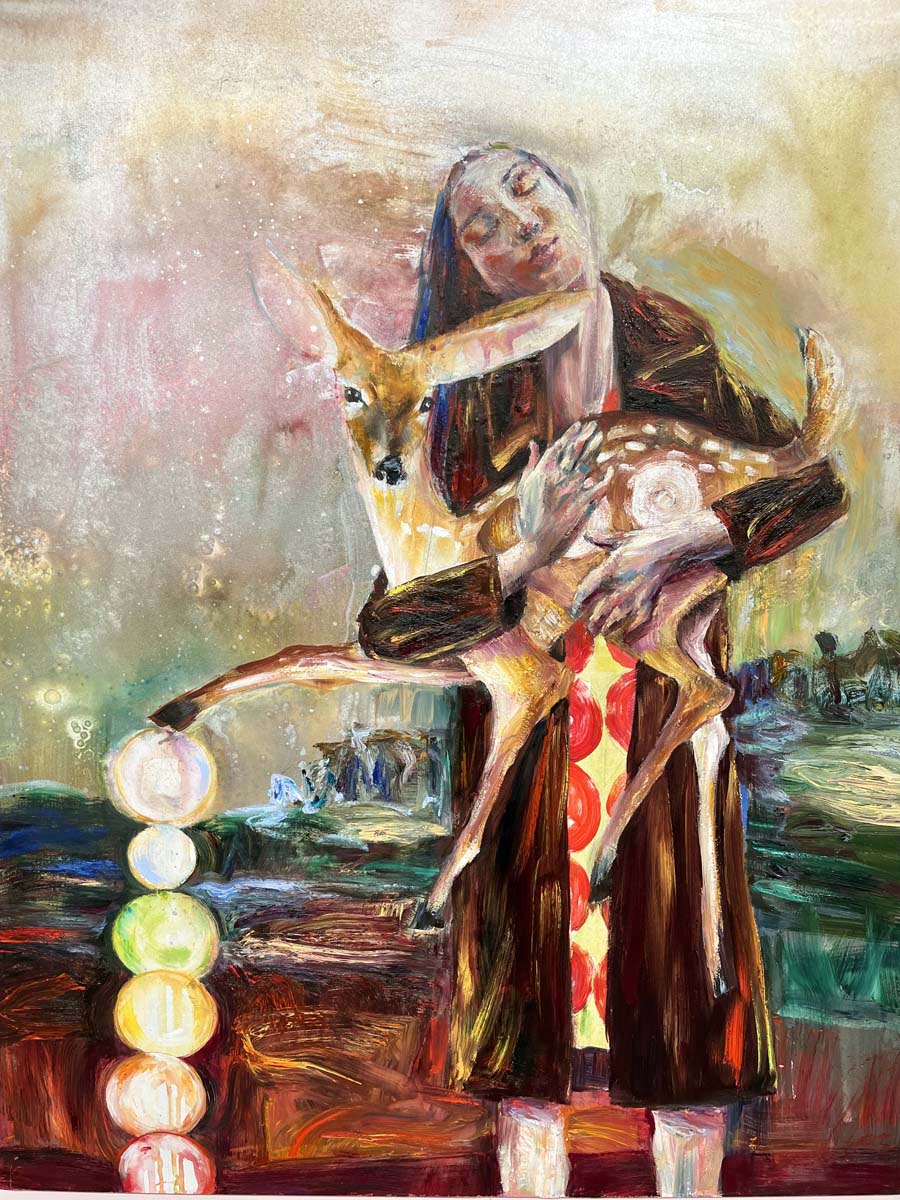
The pun, of course, applies to a recurring motif in the work to be exhibited as well. Balls, spheres, round configurations appear in the paintings as symbols linking to breasts but also the spheres of frozen tissues that saved her life as well as her physical integrity. Pearls of wisdom rain down from various sages emblematic of her learning curve during an extensive period of research to find a way to retain unblemished breasts while staying alive, her husband, award-winning author Alex Paul, and her children foremost on her mind, since she herself was orphaned at a young age.
Balls are on a dress, when exploring the possibilities of many treatment options, trying the freezing bubbles on for size. Balls are stacking up during treatment, patient now enveloped by the argon bubbles of the dress, and balls can be freely juggled, shedding the illness, leaving an impression of joyous return to a more playful life.
Spheres also appear on the cervid companion, for Ross-Paul a symbol of the innocence that is lost when you encounter existential dread. For me it evoked more of a “deer in headlight” reaction, the fear that paralyzes you at times if living with cancer. Wouldn’t want to embrace that. But then again, I’m also on the war path with these creatures who devour my beloved garden in their nightly visits, so not a neutral observer. Real-life Bambis be gone!
The accumulated work gently guides you through the stages of treatment selection and process, with a focus on the importance of collecting data, having a radar for possibilities, making decisions based on scientific information (for me an example of being “taught how to swim” that I mentioned earlier – it takes an educated person aware of resources and able to discern the quality of information.) This is really the part where Ross-Paul’s educational activism comes to the fore – visual pointers so often more effective than a complex written literature on an unfamiliar topic. She communicates ideas that, in turn, allow you to ask questions of your doctor. This is in parallel to a book she co-authored with her husband and her Doctor, Peter Littrup, M.D., which explains the journey in all of its details.
The painterly work extends to “art as social practice,” a domaine that involves participatory engagement between community and artist, when we look at the many portraits she painted in collaboration with sitters who had opted for the experimental treatment, connecting from across the world. In some ways I am reminded of earlier projects that crossed lines between art and education, if on a different scale. Miriam Schapiro and Judy Chicago’s Womanhouse in Los Angeles—which was part art installation, part educational facility, part performance space in the 1970s, comes to mind, given its focus on women’s concerns. Portland State University, by the way, has an increasingly recognized Art and Social PracticeMFA program, with an archive established in 2018, well worth exploring.
***
“There is silver blue, sky blue and thunder blue. Every colour holds within it a soul, which makes me happy or repels me, and which acts as a stimulus. To a person who has no art in him, colours are colours, tones tones…and that is all. All their consequences for the human spirit, which range between heaven to hell, just go unnoticed.” – Emil Nolde, from Emil Nolde: Die Farben sind meine Noten.
***
WHATEVER YOU THINK of Emil Nolde, one of the pioneers of German Expressionism, his work with color reigns supreme. (I have written about his anti-Semitism, his Nazi-affin politics and the incredible research by art historians that went into unraveling the clash between political identity and art of the painter here.) At times his colors do not only sing, they scream. No wonder, that one of the largest retrospectives of his work in 2018 at the National Galleries of Scotland was titled Colour is Life, while a 2019 one at the Hamburger Bahnhof – Nationalgalerie der Gegenwart in Berlin, Germany was called Emil Nolde. A German Legend. The Artist during the Nazi Regime.
The vibrancy and levels of saturation of many of Ross-Paul’s paintings remind me of his work, using electrifying color as a means of communication rather than a tool for verisimilitude. Her exhibits, if you peruse the show in order, will transition from more muted colors to a riotous slate that is the perfect carrier for the emotional palette the artist intends to invoke. When I said earlier that she is an an undaunted painter, I was motivated by the artist’s generous use of pink. Pink on the surface of the paintings, but also on the sides of the canvasses which are embedded in some sort of reflective frames that emanate a kind of rosy halo.
Pink is a curious choice for a breast cancer survivor who is also a progressive activist. Before I explain, let me say that I ended up liking the pink more so than I had anticipated, or maybe I adored the attitude of an artist who ignores symbolism when it interferes with her sheer love of color and her desire to convey some hope on the horizon. Pink, after all, reflects dawn, the beginning of a new day, not a gentle color slide into the night.
Pink is a color associated with breast cancer since the early 1990s, when Evelyn Lauder (of Estée Lauder) established the Breast Cancer Research Foundation, with pink ribbons becoming a universal symbol for the disease. Of course, the disease had been branded before – the American Cancer Society and Imperial Chemical Industries (now part of AstraZeneca, which makes several breast cancer drugs), launched Breast Cancer Awareness Month in 1985, originally intended to encourage women to get regular mammograms.
What was meant to help address the rising number of cancer diagnoses and deaths (over 4 million people have a history of breast cancer in the U.S. alone, with 43.700 expected to die from breast cancer in 2023 in this country,) has, alas, become an exercise in pinkwashing. One of the definitions goes along these lines:
Pinkwasher: (pink’-wah-sher) noun. A company or organization that claims to care about breast cancer by promoting a pink ribbon product, but at the same time produces, manufactures and/or sells products containing chemicals that are linked to the disease. (Ref.)
It is desire for profit, not compassion or education that drives the association between products with pink ribbons and inspirational quotes, particularly during October, Breast Cancer Awareness month. Some companies donate a portion of the income to the cause. Others disappear with the proceeds. We are asked to donate with total uncertainty if the funds arrive at their destination: the patients.
Some of the inspirational words, however, ring true enough that they deserve to be put up on the fridge, where my assorted collection of wisdom resides these days, for the most part.
Breast cancer is a word, not a sentence.
Actually it’s 2 words. As is undaunted painter, who already in 2003 upon diagnosis decided to take her fate into her own hands and acknowledged that her breast mattered and a mutilation of her body was unacceptable, ceteris paribus where survival was concerned. That goes beyond breasts and balls, into the realm of knowing yourself and being willing to fight for something truly existential. It was certainly the message I took home from her work that reinforced my own beliefs about living with cancer. There is no one way, no right way, no indisputable way of dealing with what ails you. Just like grief (and plenty of that to go around with the loss of body parts, or decimation of life expectancy, or simply energy levels that will never resume the status quo), you have to find an approach that honors who you are and how your values manage to survive. Otherwise you might as well jump off a cliff, instead into a life net, provided by whatever therapeutic approach you choose.
“It’s unclear where she’ll land, but she shows trust that she’ll land alright.” – Laura Ross-Paul, July 17, 2003
***
The BrEaST Show Laura Ross-Paul
JULY 6-29, 2023 Opening: Thursday, July 6 5:00-7:30pm
NINE Gallery (inside Blue Sky Gallery) 122 NW 8th Avenue Portland, Oregon 97209
“History is who we are and why we are the way we are.” – David McCullough, American historian (1933- 2022)
***
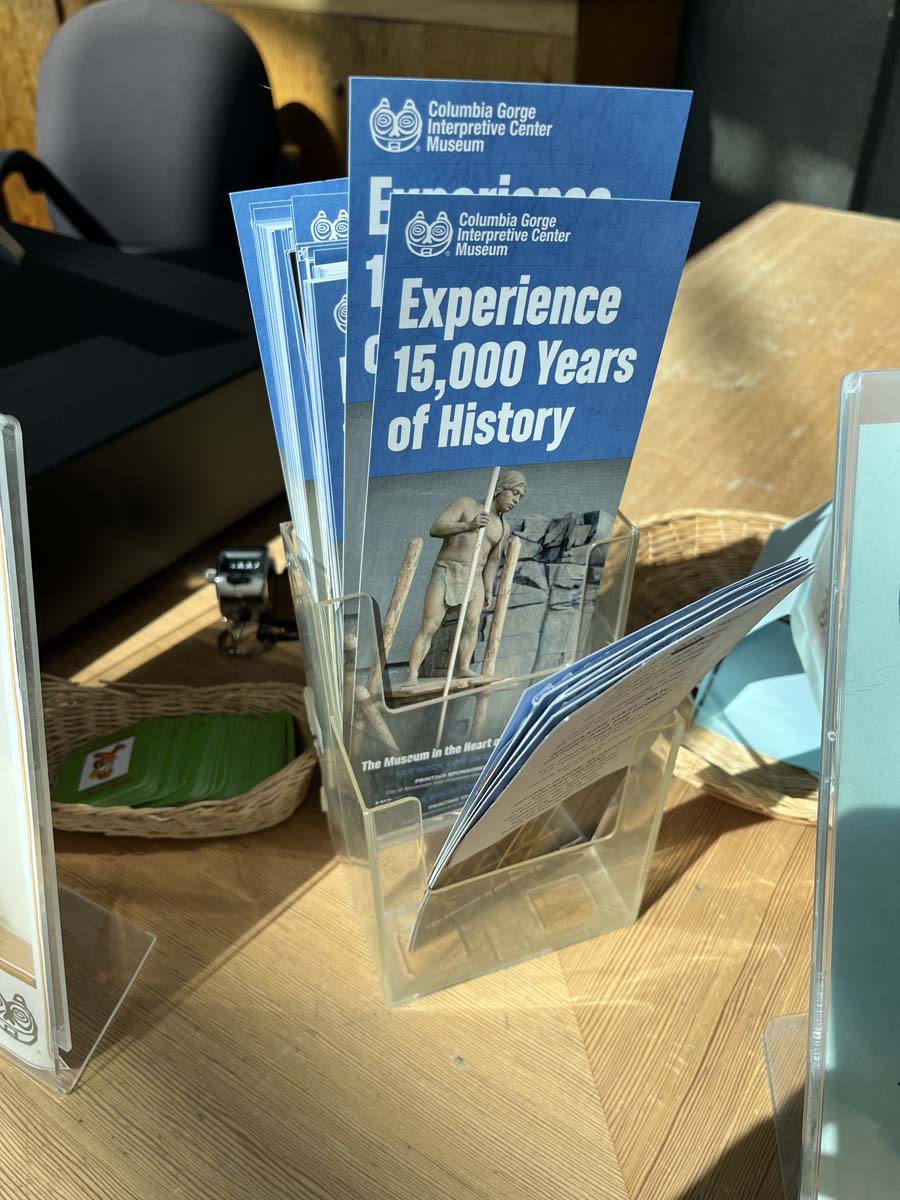
I’m curious: how many of you have ever visited the Columbia Gorge Interpretive Center Museum in Stevenson, WA? A mere 50 minutes from Portland, the drive there takes you through beautiful scenery and ends up at a multiple-acres piece of land adjacent to Skamania Lodge, alongside a small lake dotted with islands and views of the Columbia and the mountains as backdrop. A compact, modern building made of glass and concrete overlooks the property, with some rather large wood carvings and a collection of historical tools and machinery outside, and multiple exhibitions dedicated to the history of the region displayed on the inside.
I had never known the museum existed, much less visited there, until recent changes at the institution brought it onto my radar. That might have simply been my ignorance – wouldn’t be the first time – or it might have had to do with lack of outreach or appealing programming. That is in the process of changing now, under a new executive director, Louise Palermo, who is very much engaged in putting this hidden jewel onto the map beyond its familiar supporters and viewership of long-time residents of the Gorge. (And a heads-up: a new website, reflecting changes, is in the process of being installed and will be up in a few days. Information about location, opening hours and directions have, of course, not changed.)
The building houses numerous collections across two floors, conveying the history of the land and the people, from First Nations to modern settlement, forestry and industrialization of the region. A small theatre shows documentary films, some exploring the geology of the Gorge. There are a few quilts exhibited, and there is an unexpected, one might say quirky, collection of thousands upon thousands of rosaries, spiking my curiosity how some of these, donated by famous people – Lawrence Welk, Al Smith, the first Catholic to run for the office of president in 1928, one donated in memory of Robert Kennedy, who had left it in a small church in Bavaria; and one donated in memory of Dag Hammerskjold, Secretary General of the United Nations from 1953-1961, and one donated by President John F. Kennedy – ended up in cupboards in the Gorge.
You enter the museum through two rooms of exhibits describing the ways of life and fates of the tribal populations of the region.
Much needs to be done, I suggest, to bring this collection and particularly the explanatory signage up to date. Some of the language obscures the consequences of settler colonialism. Pretty much the rest of the museum is teaching us about how the settlers lived and thrived and changed the land, including the rationale for building dams and their fateful consequences.
The Grand Gallery focusses on the way wood was harvested and processed from the surrounding forests down to the mills, much to the delight of visiting school classes who get to see moving and noisy machinery, once you lure them away from the stuffed mountain lion overseeing it all,
or unexpected signs of Big Foot in the corners.
To my delight as well; I had no clue about the complex processes involved and was fascinated by the traditional steam engine, the Corliss, providing power needed to run sawmills. Harvesting of fish is shown by juxtaposing mechanical methods, a fish wheel, and Native American techniques, represented by the model of a native dip netter, at a water feature. This alone would be an interesting starting point for a conversation about extraction and preservation, particular if there were youth programs that would seed not just a love of history but an understanding of each person’s possible role as a steward of the resources of the Gorge.
Louise Palermo instructing 3rd graders
There is also a gift shop that carries arts and craft by local providers in addition to the usual fare. A small gallery offers the opportunity for changing exhibitions, with the current one, Women Artists of the Gorge, being the reason for my recent visit of the place.
PhotoCredit: Kristie Strasen
***
“If you don’t know history, it’s as if you were born yesterday. If you were born yesterday then any leader can tell you anything.” – Howard Zinn, American historian (1924-2010)
I don’t know if these things existed in the U.S., but in my German childhood one of the highlights were the trips to the country fair or the green grocer were you could plunk down your 10 Pfennig and receive a tiny paper packet stuffed with miniature toys, colored puffed rice and small candies. It was called a Wundertüte, a “wonder packet,” full of surprises. (Of course it was also a way to assure that young kids got used to return customer – consumerism, given the inclusion of collectibles, cards or toys.)
The current exhibition Women Artists of the Gorge, brought the analogy to mind. Here is a collection of incredibly varied works hung in a small space, with many of them delectable and some eliciting, well, wonder. Shout out to Jen Smith, who artistically hung a show that ranged across so many dimensions, type of media included, paintings, prints, photography, collage, macrame and woven tapestries in this tight space. Shout out to the folks at the White Salmon Valley Community Library and the White Salmon Arts Council, Ruth Shafer and Kristi Strasen respectively, who had originally conceptualized an exhibition of regional women artists in honor of Women’s History month, from which a subset followed the invitation to show their work at the Columbia Gorge Interpretive Center. Shoutout to the staff who kept the daily visitors happy and helped with the pragmatics of mounting the exhibition. The loudest shout out of them all, of course, goes to the artists:
Julie Beeler, Jillian Brown, Janet Essley, Sally Gilchrist, Daiva Harris, Kristine Pollard, Autumn Quigley, Jacqueline Moreau, Cathleen Rehfeld, Ana Rugani, Jen Smith, Kristie Strasen, Cyndi Strid, Kelly Turso and Jodi Wright.
Their work teaches us history in different, more personalized ways, through love of place and depictions of its beauty up to warnings about environmental protection and the need for inclusion and conflict resolution.
I can obviously not review each and every one of the works, so know that my selections are based on personal interest or curiosity, and not at all linked to the quality of the work. As a photographer, I was drawn to one of the photographs on exhibit which anchored the entire show for me in its depiction of female family members capturing a moment of laughter and joy. For many decades, San Francisco-born Jacqueline Moreau‘s work has documented the lives of Native American peoples along the Columbia River, and their fight to secure the rights afforded to them by a provision in the 1855 (Confederate Tribes of Warm Springs) treaty. The intimacy of this photograph is evidence of how integrated a photographer can become with a subject if respect, empathy and shared values overcome outsider status, enabling new forms of community.
Jacqueline Moreau The Spino family (Mona, Geneva, Andrie, Joyce, and Delores.)
As someone who has worked on documentary film projects about the fossil fuel industry, I was moved by the portrait of an Alaskan native whose land, heritage and fate is intrinsically connected to the future of drilling and pipelines and the havoc they can wreak. Janet Essley, a muralist, teaching artist and activist for justice used dabbed motor oil on paper for the portraits in her series Endangered Species (2004), which features people across the world (Columbian, Indonesian and Tajikestani natives among them) whose lives are touched by oil extraction and production.
Janet Essley Alaska
Two depictions of wildlife caught my attention – Autumn Quigley‘s for the wit and thoughtfulness that went into the collage, which seamlessly combined spring’s trilliums and fall’s seed pods and fallen leaves, and Jen Smith‘s for the obvious concern how shared space can be made a reality for creatures that are still truly wild. Ever encroaching human construction is a true threat to habitats, at the same time that we are in such dire need to provide more housing for ever growing populations.
Autum Quigley Windfall
Jen Smith Queen of the High Country
Last but not least there were tapestries that impressed with motion (the strong Gorge winds, swaying the grasses and echoing the waves of the river, were palpable in the one depicted below,)
Jodi Wright Mount Adams
and coloration, the subtle and beautiful gradations of which could not be fully captured under the light conditions.
Kristie Strasen River Tryptich
(I got a better shot at the intricate color play when I visited Strasen in her studio to learn more about the origins of this communal exhibition that she originally co-mounted. Let me share the beauty.)
A set of pillowcases and a collection of small works done during pandemic isolation, defiantly exuberant.
Sometimes I learned interesting backstories that helped to appreciate a work even more. Driven by her passion for mycology, the science of mushrooms, Julie Beeler, together with some collaborators, created a Mushroom Color Atlas which “is a resource and reference for everyone curious about mushrooms and the beautiful and subtle colors derived from dyeing with mushrooms.” People around the world can use this on-line resource, learning and experimenting with it, being drawn into a growing interest for our natural environment. Beeler also teaches in person in various workshops around the nation and lectures at scientific conferences. The best part: not knowing ANY of this would make no difference for the appreciation of the sheer beauty of her pieces. Well, for this viewer, in any case.
Julie Beeler Fungi Bedrock
***
I photographed the show when it had been hung on the day before before opening night, and so worked in an empty room bereft of people. Yet a sense of community was palpable, since the accumulated works really seemed representative of so many different artists, stages of experience, cross section of interests. By all reports that experience of community was present in squares during the opening reception, with a lot of people attending, fortified by wine generously provided by Domaine Pouillon, and interested in getting to know each other.
In some ways that seems to me an important part of the mission this museum under new leadership could adopt: providing a commons, a platform where people with shared interests or concerns, for that matter, can meet, mingle, learn and exchange ideas. One of the definition of commons is “natural resources that groups of people (communities, user groups) manage for individual and collective benefit.” Here it could simply be the offer of a cultural space, shared by the the many of us.
Artists play an important role in this endeavor. Knowing history is surely something that most people see as important. Yet we live in a time of increasing restrictions on teaching history, at all or in specific ways, depending on who you ask or in which state you live. Teaching the history of a place – here the Columbia Gorge – cannot come from a single source, however richly endowed with objects and artifacts to support a particular claim. It has to be provided with the help of different perspectives, and who better equipped than visual artists to relate something in non-didactic, vivid, personal ways that might register much more easily than dry facts or official story lines. I am not implying that the artists in this show intentionally set out to convey insights about history. But the accumulative power of much of the work suggests something about what it means to live in the Gorge, be exposed to both its beauty and its hurt, its past and its present, its nature and culture that needs stewardship and protection.
If the museum opens a commons, inviting and presenting diverse voices easily found in the rich tapestry of the Gorge population, during fun events or serious shows, it will establish its place on the map in no time, an invaluable resource for all of us.
WOMEN ARTISTS OF THE GORGE
June 17th – September 5th, 2023
Columbia Gorge Interpretive CenterMuseum 990 SW Rock Creek Dr Stevenson, WA 98648
On days when I cannot control the chaos in my brain, I sometimes turn to my desk drawer and tend to the chaos in there instead. Nothing like a bit of sorting and discarding to make yourself believe there can be order in the world, if only for two seconds.
This time I straightened out an accumulation of calendars; as regular readers know, I create one each year as a fundraiser for Streetroots, a PDX organization that produces a weekly paper, working with the houseless, and I also use them as gifts for the many people in my life who deserve one. Well, that sounds abominably condescending. Scratch it. Calendars make for good gifts, how’s that?
Last year’s calendar, Fusion, was all about showcasing some lovely birds I had photographed over time, putting them playfully into settings where they did not belong, still lives for the most part. Note the word playfully. It has taken me a long time to feel confident enough to work with birds without some intellectual excuse, given that the Portland slogan “put a bird on it” resonates with its sneer.
I had done two series with birds before, both concerned with the impact of environmental damage on avian populations, a serious enough concern to warrant working with birds. There was Dreaming, while snared, of Murmuration which displayed starlings symbolically netted.
And there was Denizens of Climate Change, which I had actually exhibited.
So, Fusion seemed like progress, psychologically, incorporating just something that I found beautiful and not in need of justification.
Well, that was short lived. I am working with birds again, this time for a more complex project where they are no longer the main actors, but part of a larger assembly of concepts that will tell a story. And wouldn’t you know it, the unease of being a woman artist who creates beauty with something that could be seen as cute, or pretty, lovable or simply chirpy, has returned in full force.
Pelicans (2023)
Of course, some multimedia artists seem to have no such qualms. Jamaican artist Ebony G. Patterson‘s powerful new show at the New York Botanical Garden is a case in point. (NYC friends, go see it!) Glitter-crusted wakes of vultures roam the flower beds, more than 400, as it turns out, and there’s a strange peacock to be found.
…things come to thrive…in the shedding…in the molting… points to the transitory nature of things, the uncanny intertwined with the undisputed beauty of the flora. There is no hesitation to use birds as messengers. Then again, the ones on display are quite symbolic birds, and not your garden variety starling and finches, golden or not.
***
Female artists often have to contend with a kind of scrutiny that goes beyond what male artists experience. Their work is also still valued less than their male counterparts’, if you look at the rate of both exposure and compensation. (Ref.) Just look at the titles of what you find in the literature exploring this phenomenon. This is what randomly pops up at a first search about double standards.
Male artists dominate galleries. Is it because ‘women don’t paint very well,’ or just discrimination? (Ref.)
The staggering lack of female artists in America’s museums (Ref.)
Race- and gender-based under-representation of creative contributors: art, fashion, film, and music (Ref.)
The Dam (2023)
I’m happy to report, though, that we have a chance to look at the work of female artists across some part of our region, all in one place, likely to defy the gender stereotypes. If you have no other plans, make sure you go to the opening reception of Women Artists of the Gorge this Saturday, June 17th, at the Columbia River Gorge Interpretive Center Museum in Stevenson, WA. It’s a short and easy drive from Portland and the acres surrounding the museum offer beautiful vistas as well.
I will write about this show next week, when the crowds have dispersed. It is a gorgeous place out there, perfect for visiting, and, I happen to know, for photographing birds.
Music today is about Mozart’s starling. Explanation here.
“There is in the universe neither center nor circumference.” – Giordano Bruno, On the Infinite Universe and Worlds, 1584.
JUNE 9th, 2023 was one of my lucky days. After a week that saw so many bleak events across the world, I found myself surrounded by beauty, and urgent reminders that the universe is larger than our tiny selves.
Lucky, because I was alerted to the photographic exhibition by coincidence: an instagram post by the preeminent print studio in town, Pushdot, saying that one of their clients had a show that very day – and only that day – in my neighborhood.
Lucky, because the artist is a friend and colleague who spontaneously agreed to meet me at the venue before official opening, so I could avoid inside crowds.
Lucky, because I got a one-on-one tutorial about how the stunning abstracts on display were created.
From the top: a number of artists and organizations came together to offer a music and art festival at Lewis & Clark College last Friday. EARTH’S PROTECTION, hosted by Resonance Ensemble and featuring special guests, included a drumming and dance demonstration by the Nez Perce performing ensemble Four Directions, information booths from Portland Audubon, and Songs for Celilo by composer Nancy Ives and Poet Ed Edmo – their tribute to the human, cultural, and planetary costs of the 1957 flooding of Celilo Falls which was premiered at The Reser last year and reviewed in OregonArtswatch. At the center of the evening concert was the Oregon premiere of Sarah Kirkland Snider’s Mass for the Endangered, with projections by Joe Cantrell and Deborah Johnson. What would I have given to hear the music – but again, I can still not be inside with lots of people.
Joe Cantrell Jingle Dance (2023)
However, I could visit the art exhibition accompanying the proceedings: Joe Cantrell‘s We are ALL ONE.
Cantrell was born into the Cherokee nation in Tahlequah, Oklahoma, over 70 years ago. He served two tours with the Navy in Vietnam, including as a diving officer in the Mekong Delta, and then worked as a photojournalist in SouthEast Asia until 1986. The pronounced mildness in his eyes and the gentleness of his demeanor belie the traumatizing experiences that defined his younger years. During his decades in Oregon, he taught both, at the Pacific Northwest College of Art and the Oregon College of Art and Craft. He is a photographer of note in so many ways, providing portraiture and event documentation for art organizations around town, but also specializing in Fine Art photography with his exploration of flora and rocks and fossils.
Joe Cantrell
We connected a few years ago over a shared preoccupation with the ways external or internal components of our experience merge to affect our work. Joe has better ways than I to define the process, ways that are rooted in and amplified by his heritage as a Cherokee, focussed on the interconnection of all things, embracing a multitude of perspectives, be it science, philosophy, history, and, of course, art. His work shines not only due to this conceptual grounding, though. He is ever curious to explore and apply technological advancements that allow him to create work that is unusual, and, yes, I repeat myself, stunningly beautiful.
Joe Cantrell Coming Home (2023)
The images on display were photographs of fossils and polished rocks, macro photography that goes deep inside the object to the very last level that can be captured in focus, then the next one, and the next one, until the surface is reached. A new computerized technology then stitches all of these individual takes together until the full image is constituted, abstractions and configurations resulting from stacking of sometimes more than 70 individual photographs of a single layered object. The color is natural and not photoshopped and appears during post-stitching.
Joe Cantrell Peace (2023)
One of the objects for macro exploration.
Clockwise from left: Joe Cantrell Reef (2023), Oregon Wood (2023,) Fourth Dimension (2023)
Joe Cantrell Stasis (2023)
What emerges are worlds of swirling waves, clouds, geometric patterns capturing all the movement of the elements one can imagine going into the formation of these rocks, the ice, the storms, the droughts, the millennia of relentlessly pounding external forces. A mirror image of the photographs we now receive from space through incredible technological advances, of worlds, of universes, here all captured in a single fossil or a fragment of a rock, for us to behold, whether in our hands – the object itself -, our eyes – the art that emerged from the vision, skill, and patience of the artist -, or our minds – the concept that relations can be captured multi-directionally, as long as we give up the notion that we are the center of the world.
Joe Cantrell Barton (2023)
Joe Cantrell The Gates of Hades (Welcome!) (2023)
Joe Cantrell Fractal Playpen (2023)
The stones include Oco, opals, trilobite, and different kinds of agate.
Sometimes natural forms have been preserved in amber or are fossilized in other ways, like these dinosaur feathers and the insect.
Joe Cantrell Dinosaur Feather & Amber – 320 million years old, give or take (2023,) Fungus Gnat (2023)
Joe Cantrell Ammonite (2023)
Again, Giordano Bruno, 16th century scientist, philosopher, heretic:
“There is no top or bottom, no absolute positioning in space. There are only positions that are relative to the others. There is an incessant change in the relative positions throughout the universe and the observer is always at the centre.” On the Infinite Universe and Worlds, 1584.
Let me juxtapose that with Joe’s perspective, in his own words:
“Yet in a universal perspective (whether we are aware or not, the one in which we all exist) our entire planet seems microscopic, and we, with all our “achievements,” and superstitions and egos, an insignificant, self-destructive nothing. BUT, we are part of All That! See!
Resonance Ensemble’s call to action for this festival was dedicated to protecting the earth, learning to be stewards rather than clinging to ownership with the rights to limitless extraction. Joe’s work addressed those issues with a message derived from earth materials themselves: Let us center ourselves a bit less and join the whole a bit more, acknowledging shared origins. The profusion of color, form, movement and subtlety inside all of these photographs will help to do just that, reminding us of one of the ultimate building blocks of the universe we inhabit: cosmic dust linking us all.
Joe Cantrell Lillian (2023)
Music today is a 2020 version of Sarah Kirkland Snyder’s Mass for the Endangered. It is a celebration of, and an elegy for, the natural world—animals, plants, insects, the planet itself—an appeal for greater awareness, urgency, and action. She explains:
“The origin of the Mass is rooted in humanity’s concern for itself, expressed through worship of the divine—which, in the Catholic tradition, is a God in the image of man. Nathaniel and I thought it would be interesting to take the Mass’s musical modes of spiritual contemplation and apply them to concern for non-human life—animals, plants, and the environment. There is an appeal to a higher power—for mercy, forgiveness, and intervention—but that appeal is directed not to God but rather to Nature itself.”
And here is the Agnus Dei from An African-American Requiem by Damien Geter, performed by the Resonance Ensemble some years back.
“If the doors of perception were cleansed every thing would appear to man as it is: infinite./For man has closed himself up, till he sees all things thro’ narrow chinks of his cavern” ― William Blake, The Marriage of Heaven and Hell.
LIKE ANY other segment of the population, artists have not been immune to cancer. The recent loss of one of our own to this disease, Henk Pander, is a painful reminder, grief still rippling through the community. We know of numerous famous painters, including Artemisia Gentileschi, Rembrandt van Rijn, Gustav Klimt, Marc Chagall and David Hockney, who were afflicted. Photographers not far behind, Dorothea Lange among them as well as Ester Bubley, Arthur Rothstein, Ralph Steiner and Gordon Parks, to name just a few. (Here is a more comprehensive selection from a recent art exhibition at the Hillstrom Museum of Art, MN.)
Medical research indicates that, compared to other professional groups, the mortality patterns among male painters shows an increased risk of dying of cancer, manifesting as bladder, colon and brain cancer, and also leukemia. For women painters, it is breast and lung cancer that is found at elevated rates compared to the non-artist population. The causal mechanisms have not been established, but there are likely links to hazardous substances present in the paints and finishes painters use (Ref.) Then again, it could be the immense stress levels from a precarious existence, shared by many artists, that affect the immune system negatively. Substantially increased cancer mortality rates for photographers are clearly associated with chemicals applied in darkrooms while processing film (Ref.)
Cancer was historically something people did not talk about, an abysmal affliction associated with shame, superstition and mortal dread. You find a few portraits in renaissance art that show women who are likely dealing with breast cancer, but none of the type of work that has begun to emerge, finally, since the last century: visual artists dealing with their own illness, processing their experience through their creativity or using their experience as a means of questioning the stereotypes that surround illness and death. From attempts at personal healing to attacking the metaphors associated with the disease – “it’s a fight, a battle, a crusade” – to simply conveying insights so that others can be prepared or warned, you find a variety of artworks that embody our era’s willingness and courage to expose oneself and/or make the personal political. A late, but welcome attempt to heed Blake’s appeal to “cleanse the doors of perception,” revealing underlying truths rather than keeping them out of our field of vision.
The incomparably courageous and smart artist Hannah Wilke documented her experience with Lymphoma in fascinating and brutally honest staged photographs that were evidence for her unsurpassed talent for gesture. May her memory be a blessing.
Hannah Wilke Intra-Venus Triptych 1992-93
Artists do not just expose their diseased bodies, of course. Some prefer narrative paintings that indirectly alert to what is lost, often for entire generations. I very much relate to the painting below that depicts imagined inter-generational connection when the person is no longer there to talk. If you have cancer when your children are young, one of the bottomless fears concerns what will happen to them, accompanied by an overarching sorrow that they will never really get to know you (or you them) on a more equal footing.
Ofer Katz“Things I wanted to tell you – Mark and Aliza Ainis at The Dead Sea” 2021
(This painting, by the way, is part of a project that has been of enormous help to cancer patients trying to overcome isolation. A national organization, Twist Out Cancer, offers a program called Brushes with Cancer.
“… it strategically matches artists with those touched by cancer to create unique pieces of artwork reflective of their journey. Over a period of 4 months, pairs will connect virtually and their relationships are guided and supported by Twist Out Cancer mentors with the intention of creating a support system for both the artist and inspiration. The program finishes on a high note with our signature celebratory art exhibition, gala and auction.”)
Then there is Prune Nourry’s public art signaling healing, to which I am admittedly partial, even though her Catharsisseries skirts the edges of metaphors that I abhor. Amazons are of course warriors, implying an ongoing war with the disease. I continue to be floored by Nourry’s ideas and instantiation of mammoth projects (I wrote about her work I saw in Paris some years back here.) The battle metaphors so lend themselves to focus on winners and losers, victors and victims, survivors and fallen, all of which imply an either/or categorization and a hint of fortitude (or lack thereof) in dealing with the illness. As any cancer patient will tell you, the implications that one isn’t tough enough, fighting enough, optimistic enough, radical enough, tend to add insult to injury.
Here are some images of Nourry’s work processing breast cancer and an explanation from her website.
“Catharsis was born in 2018 with The Amazon, a monumental four-meter concrete sculpture with glass eyes, inspired by an ancient marble statue at the Metropolitan Museum of Art representing an injured amazon. Prune Nourry created the sculpture as a cathartic act in her fight against cancer. Inspired by ex-voto traditions, particularly the Japanese mizuko kuyo, the piece is entirely covered in thousands of incense sticks. During a public performance in the heart of Manhattan, the incense went up in smoke to symbolize healing.”
Breast cancer seems to be the dominant topic for artists processing cancer – perhaps because it is so prevalent, has been suppressed as a subject for so long or, importantly, because patients more often than not live to tell the tale. Gallery shows focus on the resilience of survivors, and museums draw attention to the topic, like this ingenious stunt at the Thyssen-Bornemisza National Museum of Art in Madrid in October last year. They featured an exhibition titled “From the skin to the canvas: another take on breast cancer,” displaying digital copies of works by Francisco de Goya, Peter Paul Rubens and Hans Baldung Grien which had been altered to make it look like the nude subjects have undergone mastectomies. (Unsurprisingly, most of the media reports did block out the images – I really had to hunt to find one….)
Thoughts about breast cancer seem to be manageable, compared to, say, lung cancer which has a far worse prognosis and less visible damage, as well as being associated with un/spoken assumptions that it is your own fault because of bad habits (I wrote about this recently here.) Breast cancer survivors’ day-to-day functioning is not as affected by missing breasts (non-withstanding the emotional losses tied to female beauty ideals, or those of sexual pleasure) once you’ve left the cancer behind you, compared to living with the aftermath of lung cancer. The absence of breasts becomes an integrated norm, with all other physical functions intact, allowing you for long stretches to forget the ordeal. That is not the case with a lung removed which affects every step you take, every breath, really. The knowledge that this dreadful beast tends to spread surreptitiously much more frequently makes ignoring your state near impossible. Seen in that light, the prevalence of breast cancer-related art becomes understandable.
In fact, to my knowledge there seems to be no art by established visual artists engaging with lung cancer, although a few rather depressing novels and autobiographies by afflicted authors exist: “The Quarry” by Iain Banks, “In gratitude” by Jenny Diski “When breath becomes air” by Paul Kalanithi , and “Stadium IV” (Stage IV) by Sander Kollaard. Two authors who died of lung cancer wrote poems about their ordeal: Raymond Carver (“What the doctor said” and John Updike (“Needle biopsy”). Illness perception – in this case one of doom and resignation – has consequences, for coping as a patient as much as for the obviously lacking desire or energy to create an artistic representation of the trauma.
***
“A successful work of art is not one which resolves objective contradictions in a spurious harmony, but one which expresses the idea of harmony negatively by embodying the contradictions, pure and un-compromised, in its innermost structure.” ― Theodor W. Adorno, Essays on Music
PROCESSING the illness experience can have enormous benefits, for artist and beholder alike, regardless what disease gave rise to the art. That point was driven home for me last week when shown the new work by artist and cancer survivor Ruth Ross. I had written about Ross’ thrilling exhibition Red Scare last fall, embroidered fabric and photographic collages about growing up in the shadow of the Rosenberg trials during the McCarthy era, and was curious where she would go next. Once again, her projects fuse the personal with the political, this time embodying contradictions that belie the surface harmony of the portraits.
Photographs of the artist taken during her chemotherapy and transformed into cyanotype prints are embroidered with fanciful, phantasmagorical hats that are often quite beautiful, sometimes resembling overbearingly heavy crowns.
In Ross’s own words:
Marking 11 years out from chemotherapy for breast cancer, I came across a series of stark photos I had asked my husband to take when I was at my weakest and most debilitated. Seeing from those photos how frail I seemed, I created a series of cyanotype prints to silk organdy, a delicate and nearly transparent textile that would reflect my vulnerability.
What if I were to revisit that troubling time with a more tender view? Could layers, image, and stitching, endow that self with what I thought I had lost? Or perhaps with what I never even had? An elaborate hat made of flowers from a far-off paradise. A fanciful silver bird grasping some golden threads. With this work I revisit a difficult time. I can now express joy, self-indulgence. Ignore my judgmental self and invest it with wit, frivolity, and forgiveness.
For me, the work elicited a less personalized interpretation. It embodies contradictions that are structural, not just based in private experience. Hats during chemotherapy are meant to hide the stark nakedness of the head, the ugliness of a skull bereft of one of culture’s (or myth’s, literature’s, religion’s) greatest symbols: hair.
Hair is a powerful signifier of individual identity (lustrous locks signal fertility and health, for example,) as well as gender and group identity – think of hair styles reserved for elites, shorn hair for skin heads but also nuns, indicating celibacy in the latter case, long hair for politically active males in the western 1960s and so on. Women were constrained to certain hair styles before, during or after marriage entering widowhood, cross-culturally so, as anthropologists exploring initiation-, marriage- and mourning rites can attest. And of course, women in multiple religions are not allowed to reveal their hair at all to people outside the family. Hair has a place in witchcraft rituals, and it surely plays a role in the economy: The global hair care market size reached US $82.3 BILLION in 2022. That is a lot of gels, rinses, oils, tonics, serums, masks, dressings, shampoos, conditioners, and sprays, to treat hair to be shiny and voluminous, much to the envy of those of us born with something more resembling chives…
Black hair in this country was also a subject of policies driven by structural racism: only now have we done away with prohibitions of natural hairstyles, like afros, braids, bantu knots, and locs, policies used to justify the removal of Black children from classrooms, and Black adults from their employment. The Crown Act, (Creating a Respectful and Open World for Natural Hair) passed in March 2022, banning hair-related discrimination.
Hair, then, is public, not just private. Drug-induced loss of hair is to be hidden from the public, however, to spare others the reminders of mortality, and to not call attention to what is perceived as our own decimation in (assumed) attractiveness value. In that sense, chemo-caused hair loss is both a public and private representation of the illness. It can cause individual distress as well as societal stigma (honestly, how do you even separate these two variables?) National Institute of Health data reveal as recently as 2 years ago that up to 14% of women refuse life saving chemo treatment because of their fear of hair loss. Risking death because of internalized beauty ideals imposed by a society that judges women by this standard, and easily dismisses those who no longer conform to it, imagine!
Hats, in this context, serve as a means of hiding visible signs of cancer treatment to protect societal denial of illness, and help avoiding dreaded negative attention. Ross’ hats, of course, do the opposite. All attention goes to these flights of fancy, then extending to the transparent emanations of suffering beneath, forced to confront the ravages and all they imply. The contradictions of joy and pain are inextricably linked.
The assumption of one being in the present, the other in the past, however, is an illusion, just like the possibility that these hats could ever not slip off the bald skull unless artificially glued or pricked by pin needles. You might be cancer free at this moment, but you will never be free of the thoughts that it might raise its ugly tentacles again. All you can do is cherish the here and now that is the potential ante-room – and Ross does that with luminous defiance. The choice of materials that simultaneous imply decay and lusciousness in itself is ingenious, with tropical splendor growing out of the ripped fabric of our lives.
The sobering realization that the exuberant blossoming of the flora echos the relentless proliferation of cancer cells is, alas, inevitably not far behind.
The artist’s expressed intention to create these pieces as a way of ending a hard chapter on a high note are a welcome reminder of healing. But there is an implicit way of forcing us to look at the consequences of cancer treatment for women that is radical in her art: part of the suffering during this affliction has to do with stigmatization, and desperate attempts to escape it and the isolation it imposes are often futile.
No hat, however beautiful (or unobtrusive) can make that fact disappear. Might as well bring it to the forefront, then, as Ross does, with gusto. Her work opens our perception to experiences during illness that go beyond the physical affliction or the psychological realm of dread induced by cancer. We are driven to hide our deterioration from the eyes of a world that has made beauty a commodity and reminders of mortality a taboo.
One of Ross’ collages is part of the group exhibition: Not Just: A World Collage Day.
This spring, first Ohio’s and now Tennessee’s Governor signed laws that designate methane gas as “green” or “clean” energy. The legislation is pushed as part of a growing industry-funded strategy to delay climate action by codifying misinformation about natural gas into law – and make no mistake, methane is a fossil fuel, a powerful greenhouse gas. We are following closely in the footsteps of the European Union where this kind of designation meant that billions of dollars that were intended to fund climate-friendly projects could legally be used for methane power plants and terminals. But Tennessee is going a step or two further to serve the interests of the fossil fuel industry:
“The fact that methane gas is now legally “clean energy” in Tennessee is a benefit for TVA and its planned methane gas expansion. And it’s not the only recent bill that benefits TVA. Last month, Rep. Clark Boyd sponsored a bill that makes it a Class C felony to interrupt or interfere with “critical infrastructure” like pipelines. In February, Boyd also sponsored a bill to block any future bans of gas stoves. Last year, Tennessee lawmakers passed the Tennessee Natural Gas Innovation Act, which legally categorized methane gas as a source of “clean energy” for utilities. They also passed laws preventing local governments from blocking fossil fuel infrastructure and the state from working with banks that divest from fossil fuel companies.”(Ref.)
The favoring of capital over science in the context of climate change might have the most dire long term consequences, but an anti-science stance, increasingly and fervently pursued internationally by right-wing forces, has immediate impact as well, as we saw (and see) in the context of the pandemic. Antiscience is the rejection of mainstream scientific views and methods or their replacement with unproven or deliberately misleading theories, often for nefarious and political gains. Antiscience is invading the courts (think about the “un-scientific” reasoning in the S.C.’s Dobbs decision) and the educational system (think about Florida’s purging of text books, for example, or the general push to dismantle public education, so that private schools can pick and choose their curricula.
Historically, antiscience was not an exclusive domain of the Right – if anything one of the greatest antiscience authoritarian of all times was Stalin, whose “beliefs” starved millions of people to death. In the U.S. the Republican Party was actually open to science for some decades: The National Academy of Sciences was founded in the Lincoln administration; NASA in the Eisenhower administration, and PEPFAR (U.S. President’s Emergency Plan for AIDS Relief), PMI (President’s Malaria Initiative) and the NTDs (neglected tropical diseases) program were launched in the George W. Bush Administration. All this has obviously changed since 2015 when anti vaccers took over and “Health Freedom” became a rallying cry – look at the legislation signed this week by Governor DeSantis and weep. Both medical treatment and medical research are adversely affected.
All this swirled through my head when looking at my photographs of Los Angeles’ Griffith Observatory, and its wall and ceiling murals created in 1934 by Hugo Ballin that celebrate science and scientists.
Beyond appreciating the vistas of the approach path to the observatory and the beauty of the building itself, it is really the idea of what science provides and how it moves us forwards, potentially rescuing us, that matters.
The panels on astronomy, aeronautics, navigation, civil engineering, metallurgy and electricity, time, geology and biology, and mathematics and physics celebrate science, and scientists, including path breaking ones from ancient times and non-Western regions. Will kids, traveling in large school classes, who are no longer educated in the history of science or science’s importance even understand why is depicted and why?
Ballin was onto something there, although he was somewhat conservative at heart. In fact his clinging to traditional mural subjects, techniques and representation stood in stark contrast to the progressive muralists of his times, like Diego Rivera, José Clemente Orozco and David Alfaro Siqueiros who conveyed social and political messages on public buildings. Then again, their work was eventually whitewashed, while Ballin’s embrace of the old-fashioned Beaux-Arts style made his work survive.
Born to German Jewish immigrants in NYC, the artist made his way out West to join the silent film industry, with little success. His career as a painter and muralist for civic institutions, on the other hand, took off. His impact and importance for L.A.’s Jewish community is described beautifully here with lots of historical photographs for specific projects (e.g. the observatory here.). I found the link on a generally very helpful site, UCLA’s Mapping Jewish L.A., that has numerous interesting digital exhibitions.
The art itself did not do much for me, but the ideas that propelled it forward and that it represented, did. The same could be said for what I saw this week, on the very last day of the Altered Terrain exhibit at the Patricia Reser Center for the Arts.
Michael Boonstra burn (…fall creek layers…) 2023 with detail
The work by Michael Boonstra and Christine Bourdette is the polar opposite to Ballin’s representational depictions. Both artists abstract the essence of their subjects, but both are clearly informed by science and Boonstra by the impact of humans on the environment, driven, in part, by a rejection of science. Bourdette is deeply interested in geological processes, from gas formations to the creation of geological strata through the massive forces that shape the terrain across millennia.
Christine Bourdette Notch (2023) with detail and Portal (2023) with detail
Boonstra distills his perceptions of forest fires and their aftermath. Both use materials derived from the earth, charcoal, minerals and earthy pigments to capture the colors of the landscapes they care for so deeply.
Michael Boonstra Nowhere/Now here (snowfields) 2018-2022 with detail
The pairing of the two artists worked well, the overall perceptual sparseness of the exhibition provided sufficient (and necessary!) attention for each piece, in short, the curation was spot on.
Given how much I admired the concepts, and the learnedness that went into these works, why did it not resonate on an emotional level? All I can come up with is that it felt so meticulously built-up, acribic, painstaking construction and marking that captured order instead of chaos associated with destruction, whether from fiery infernos or glacial ice-melt floods and volcanic eruptions.
Christine Bourdette Escarpement 1 (2022) with detail
Maybe the creation of beauty in resonance to the fearful natural forces provides a defensive shield, helps to inform or warn the viewer without frightening them away. I, however, could not shake off a sense of sterility, even when looking at gorgeous color palettes. (A more detailed and receptive review by Prudence Roberts, who knows what she is talking about, can be found here.)
Michael Boonstra burn (bootleg) (2023) with details
In any case, having now jumped across topics in the usual fashion again, let me add one more link as a reminder how science-informed art mapped, successfully in my eyes, the alteration of the landscape through external forces. I had written about art, forest fires and the geological Gorge formation here.
Here is Murphy’s Dark Energy, played by the (now disbanded) Linden Quartet, in honor of Einstein’s science.
I BET THE BANK that not a lot of L.A. tourists make it out to Pacoima in the San Fernando Valley, one of the 88 cities comprising L.A. County. Which is too bad, given that there is much to learn and admire when looking at the history of the area. It is also a place where you can explore over 30 murals along a stretch of a busy through-fare, Van Nuys Blvd., the Mural Mile created by local artists who care about their community and acknowledge its history. The works shine like beacons along a neighborhood dominated by auto-repair or appliance repair shops, pawn brokers and payday-loan companies, small bars, pet groomers, florists, laundromats and churches, garages and places to send money back home to the loved ones you left behind in Mexico or El Salvador.
The area has been settled for more than 1500 years, early on by the Tatavians, a tribe with a strong sense of community and gender equality, from what the historians tell us. Disaster arrived in the form of Spanish colonialist destroying much of tribal land and culture.
Painted by the HOOD Sisters (Honoring Ourselves Origins Dreams)
By the late 1880, speculative investors descended in anticipation of the Southern Pacific railroad and a likely real estate boom. They hoped to lure wealthy settlers, but the area was prone to horrific floods and so ended up as an agricultural community, with many Mexicans and later Japanese immigrants doing the hard work. After Wold War II, with jobs provided by Lockheed and General Motors, a lot of Blacks were attracted to move to Pacoima, with a housing tract named after boxer Joe Louis, establishing a large middle-class community.
Today the population of around 90.000 people is about 87% Latino, 4% Asian and 3% Black. Poverty rates are high, crime rates higher than in almost any other community in the San Fernando Valley, and higher education levels way below average compared to the rest of L.A. County. There are reports that nearly 20% of the people in Pacoima live in rented rooms or converted garages. The hidden density extends to single-family houses that are often home to several families, trying to ease the burden of insane mortgage rates. (Ref.)
Homelessness here, as across L.A. County, has increased by over 70% across the last 6 years, with many families living in campers, cars, or tents. Makeshift memorials for victims of violence or the hardship of life on the street are ubiquitous.
The problem that compounds it all is the fact that Pacoima is by far one of the most pollution-exposed neighborhoods in all of California. It has one of the highest rates of air pollution and soil contamination due to the clumps of industrial facilities, garbage dumps, land fills, the small commercial Whiteman airport, Sun Valley Power Plant, a railroad line and the surrounding 3 freeways that enclose the city, I 5, 118 and 210. Diesel trucks emit diesel fumes into heavily residential areas, and weather patterns push and hold air pollution in Pacoima against the San Gabriel and Verdugo Mountains. The geography of the region, a valley, causes air-toxic chemicals, like nitrogen dioxide and ozone to settle near ground level.
Industries using chrome plating, among others, caused immense groundwater pollution, with hexavalent chromium doing its poisonous thing. Daytime heating patterns make it worse: the groundwater is vaporized during the day and then re-condenses at night, leading to the possibility for subsurface vapor intrusion into homes. There are now five Superfund sites in and around Paicoma: American Etching and Manufacturing, D & M Steel, Holchem, Inc., HR Textron-Glenoaks, and Price Pfister, Inc. The former Price-Pfister Faucet Plant Superfund site was recently redesignated as a Brownfield for redevelopment. The gas plant, it was revealed last year, has been leaking methane gas for long periods, affecting the area as well. The results of all this pollution is an unacceptably high level of respiratory illnesses, particularly asthma in young children, in the area and of course the potential that cancer rates are going to skyrocket among exposed individuals.
The skeleton is using an asthma inhaler…
***
THAT IS THE BAD NEWS. THE GOOD NEWS IS that Pacoima has a history of activism that unites many of its citizens in a fight for a better, or, in this case, healthier and more beautiful world, from tackling racist practices to now addressing environmental justice. In 1968 students from Pacoima staged one of the biggest civil rights protests in CA history, forcing massive reforms at the (now) Cal State University Northridge. It also paved the way for the school’s and state’s first Pan-African and Chicano Studies Departments.
Here is a great video introduction to their and others’ activism and a trailer to a documentary about the history of the town. Later, the NAACP and community churches organized and strategized to curtail police brutality and successfully spearheaded bans on the chokehold and use of the battering ram and focused on housing discrimination as well. Patrisse Cullors, one of the co-founders of the Black Lives Matter movement, hails from Pacoima as well.
Shakur
Painted by Kristy Sandoval and the H.O.O.D. Sisters, this mural pays homage to Assata Shakur, Tupac’s godmother and once one of the FBI’s most wanted.
It was five mothers from diverse backgrounds, however, who got together in 1996 to combat the literal toxicity of the place, founding Pacoima Beautiful, an organization that is now successfully fighting for environmental justice on a large scale. Just two months ago, their recommendations to close Whiteman Airport given the frequency of accidents and pollution issues, was heard. “The Re-envision Whiteman Airport Community Advisory Committee (CAC) voted at their final meeting to recommend the LA County Board of Supervisors pursue the closure of Whiteman Airport and immediately implement mitigation measures to prioritize public health and safety in the time leading up to airport closure.” Two years ago, their campaign against the Valley Gas Plant dangers helped deal with methane emissions. “As a result of our the community advocacy and organizing efforts, the Los Angeles Department of Water and Power has agreed to wean its use of natural gas and seek new opportunities for clean energy options at the site. Also there are plans to demolish the red and white smoke stacks.”
The non-profit organizes community clean-ups, Covid- outreach, electric bike programs, and nature access for kids. They also invest in arts education and local artists. Their ARTvertise program, together with OUTFRONT/JCDecaux, is designed to help transit riders experience art at bus shelters along the mural mile of Van Nuys Blvd. They show rotating work from local artists.
Their FaceBook site helps people figure out where to turn or where to participate, from offering opportunities to learn how to organize to announcement of life events of beloved community members. The organization also has 20 volunteer community inspectors who relate grievances to Clean Up Green Up, a 2016 city ordinance that prioritizes health and economic well-being for people living in some of L.A.’s most polluted districts. The ordinance ensures that complaints and violations raised by the inspectors are addressed and provides an ombudsman both for the area’s many industrial businesses trying to operate more cleanly and for the community members trying to enforce changes. (Ref.) All of this effective work to improve the health and living conditions of the community started by individual mothers having had enough. Deepest respect.
***
MANY OF THE MURALS I saw after driving out to Pacoima were produced by two artists, father and son, Hector Ponce and LeviPonce.
Some are by younger artists, like Rah Azul and the gifted Kristy Sandoval. Some murals are easily accessible, others behind fences, on abandoned or guarded lots, respectively.
One friendly guard opened the electric gate so I could photograph a mural directly and told me that the depicted woman’s original cleavage had been so offensive to some part of the citizenry that it needed to be painted over. “Oh,”he said,”Ponce was going to come back and beautify the rest of the walls. I have to give him a call – we like what he is doing for the neighborhood. I have his number.”
Elvira painted by Hector Ponce
There are murals that link back to the history of the area,
“Forgotten Roots,” painted by Juan Pablo Reyes
some are addressing political issues of the presence. Some reference folktales, like the Mona Lisa now clad like La Adelita – the Mexican Revolution saw many women join as soldaderas who embraced the early Maderistas movement, with La Adelita representing them as a stand-in in a famous ballad.
Pacoima’s Art Revolution
Painted by Levi Ponce to declare an arts revolution in the area (during a time where painting murals was illegal in Los Angeles), it stands as a symbol of the fight for the arts.
Real-life luminaries include Danny Trejo, a formerly incarcerated man who became a famous movie star and now owns many local eateries. Some critics didn’t like what they saw as glorification of violence and crime, but Ponce wanted to reflect the community who, after all, had chosen Trejo as the grand marshal of Pacoima’s Christmas parade.
Then there is The day the music died depicting the most famous local musician, Ritchie Valens, who died with Buddy Holly and another bandmate in a plane crash in a cornfield in Iowa during a concert tour in 1959.
There are depictions of Latino culture,
and visions of a better future.
Without Boundaries
Painted by Sarah Ackerley and Levi Ponce. This 33′ x 75′ mural inspires children’s imagination by blurring the boundaries of reality. This variety of flying fish can actually be found off the coast of Santa Monica, CA.
A mural by Ignacio Gomez enumerating locally notable people and other folk can be found in the back of city hall,
while the front alerts to Councilwoman Monica Rodriguez, the first Latina in the city’s history to serve on the Los Angeles City Council in 2017, to represent the 7th district she’s called home her entire life, an active supporter of the mural arts.
There is clearly an important and welcome attempt to protect the community from Covid, given the extra vulnerability of a population prone to pulmonary diseases from pollution,
and there are lots of banners alerting the community to the educational possibilities for the youth.
Some of the murals on view might not have yet reached the level that signifies muralism as an art form, I’m thinking here for example of the three great Mexican muralists Diego Rivera, Jose Clemente Orozco and David Alfaro Siqueiros in the 1930s. But they are done in the same spirit: they keep significant history alive and memorialize the people who mattered to the community. They make public the concerns of a community (particularly when they are debated) and they can alert to the potential for change, when they depict alternate visions of what could be possible, particularly when they focus on inclusivity and are socially conscious. They are also creations of combined efforts of local artists, business people and other citizens, and kids who now own their participation in this community. A seminal essay by Judith Baca, Whose Monuments Where? Public Art in a Many-Cultured Society is well worth a (re)read if you are interested in the function and importance of community murals. All of this makes a difference.
Judith Baca has been one of the most prolific and recognized muralist in SoCal for the last 50 years. Her Neighborhood Pride program encouraged young artists to paint in ways that honor neighborhood history. Her Great Wall of Los Angeles, located just south of Pacoima along the Tujunga Wash and next to Coldwater Canyon Avenue in North Hollywood, is over 2,700 feet long and by far the biggest mural in Southern California. It was painted as “a bold illustration of the history of California from the state’s prehistoric past to the struggles of its ethnic minorities for civil rights and equality.” (Ref.) I have yet to visit. Many other public art projects in Little Tokyo and the Historic Core commemorating forgotten urban history were spearheaded in the late 1980s by yet another organization, The Power of Place, founded by Dolores Hayden, Professor Emerita at Yale University.
Here some more murals from Pacoima:
Levi Ponce’s 2019 monumental mural Rushing Waters follows Baca’s model. It recognizes indigenous and environmental history, and depicts both natural and manmade landmarks in and around Pacoima like Hansen Dam, the Sylmar Aqueduct, San Gabriel Mountains, the Los Angeles River, Whiteman Airport and nearby freeways, with a 25-foot tall Tataviam Village woman pouring her bowl of water onto the land comprising the center of the mural. Councilwoman Monica Rodriguez provided funding, and the mural itself was on the drawing board for over four years, eventually executed by a team of nine artists under Ponce’s leadership.
***
AS THE LATE CULTURAL WRITER and Latino art advocate Ed Fuentes wrote before his death in 2019:
“Murals were designed to be art for the masses, and in the case of ethnic-based murals, spoke for those underrepresented. In Los Angeles, its own identity is lost because it’s a region people come to reinvent the city, and/or reinvent themselves. This current legacy of remaining murals, plus the manifesto of current artists, may not realize their work represents another undervalued voice: The city’s own history.”
You find murals commemorating alternative histories all across L.A., but many are disappearing. It is a nationwide trend – my city of Portland, OR, has seen similar developments. They are not just defaced by taggers or torn down by property owners. There is a whole development aligned with the gentrification of traditional neighborhoods, with newcomers either insensitive to the history captured in the art, or inclined to put up visuals that serve their own interests. A recent essay in The Guardian, Whitewashed: How gentrification continues to erase bold L.A. murals, describes the conflicts over murals between gentrifiers and inhabitants. They are fundamentally linked to other sources of tension, “property prices, the pace of gentrification, tenant evictions, the integrity of once-venerated local artists, and the ability of local city officials to act as honest brokers between the competing interest groups.”
Efforts to protect the history and the art form are direly needed. In L.A. they have the Civic Memory project, a project that pursues the preservation of community knowledge, playing an evermore important role. If you go to their website you find an astonishing volume of projects all interesting in their own ways, public art included, with in-depth debate of how to approach memorializing a past that had been submerged under representations by culturally dominant official” voices that pursued their own agenda.
Forgotten places, Pacoima included, can be resurrected via public art that is emerging from community-based vision, voices, recollections. All we have to do is visit and learn. As Ritchie Valens sang: Come on, let’s go!