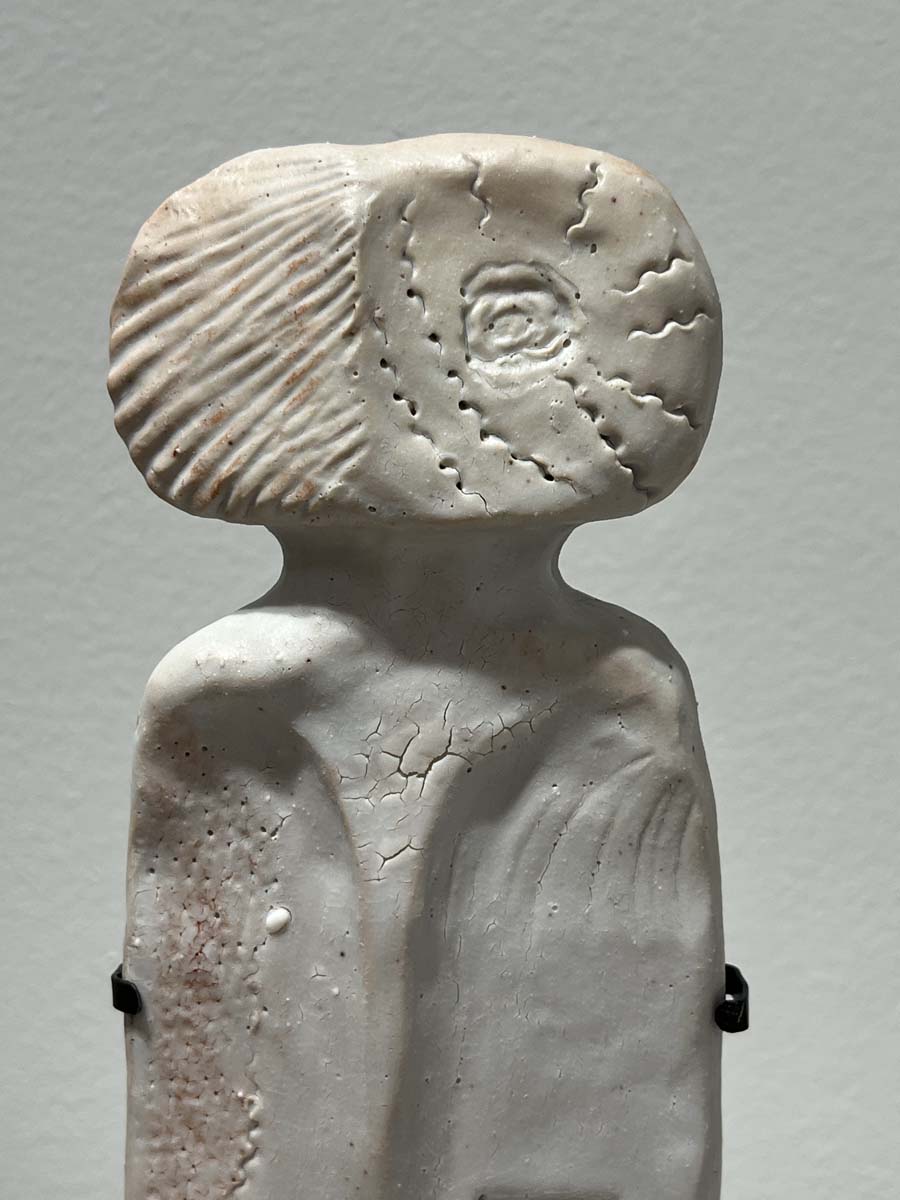
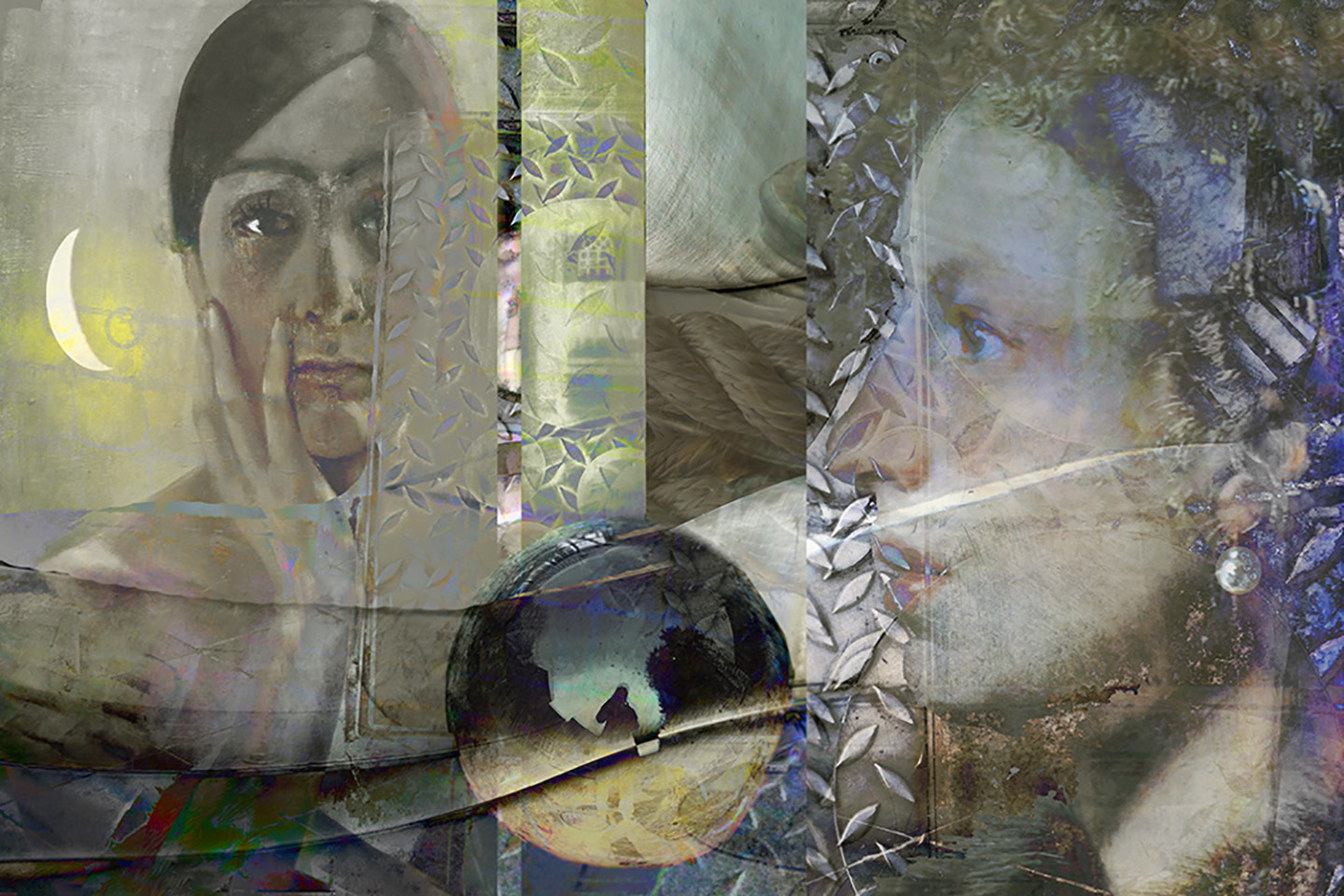
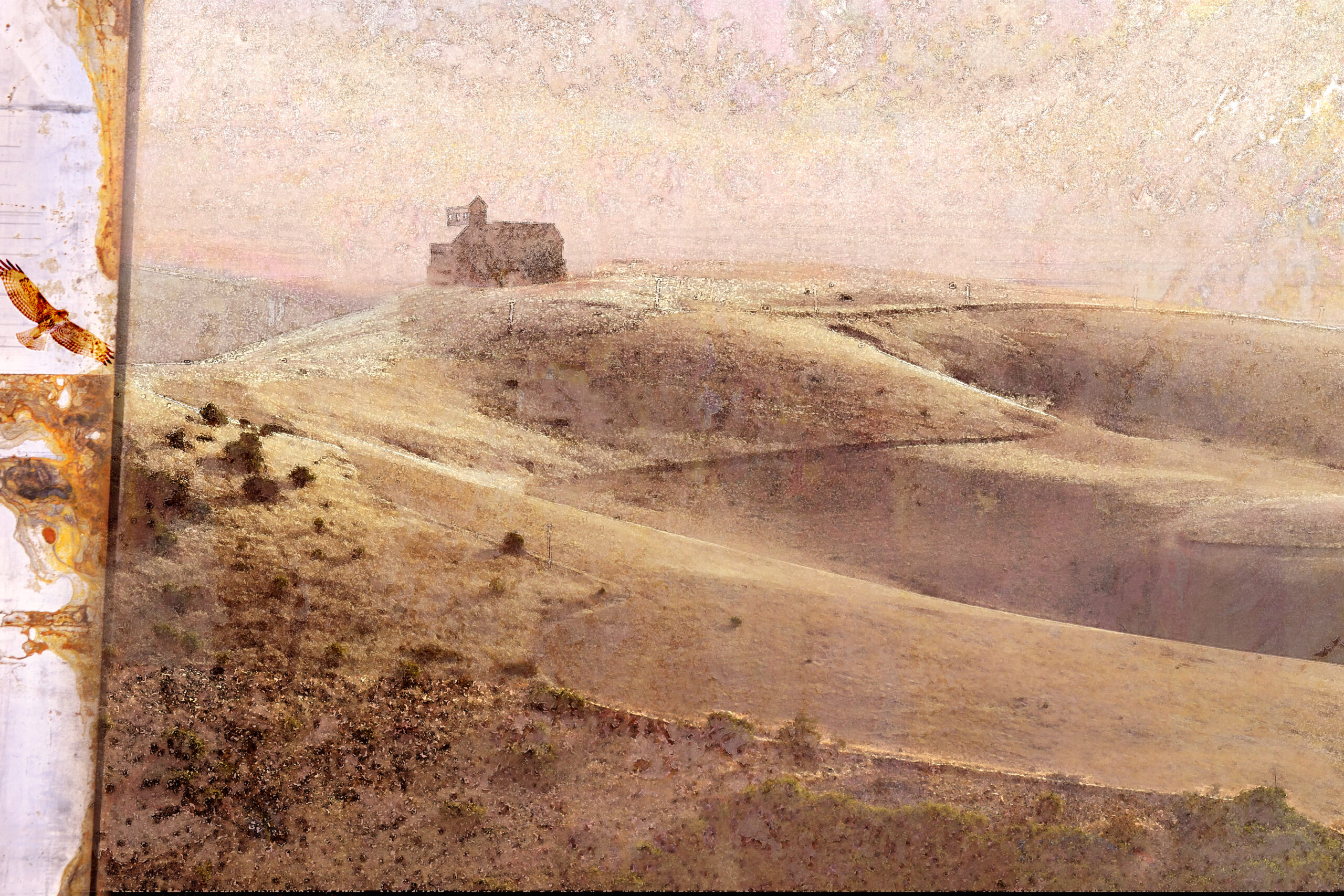
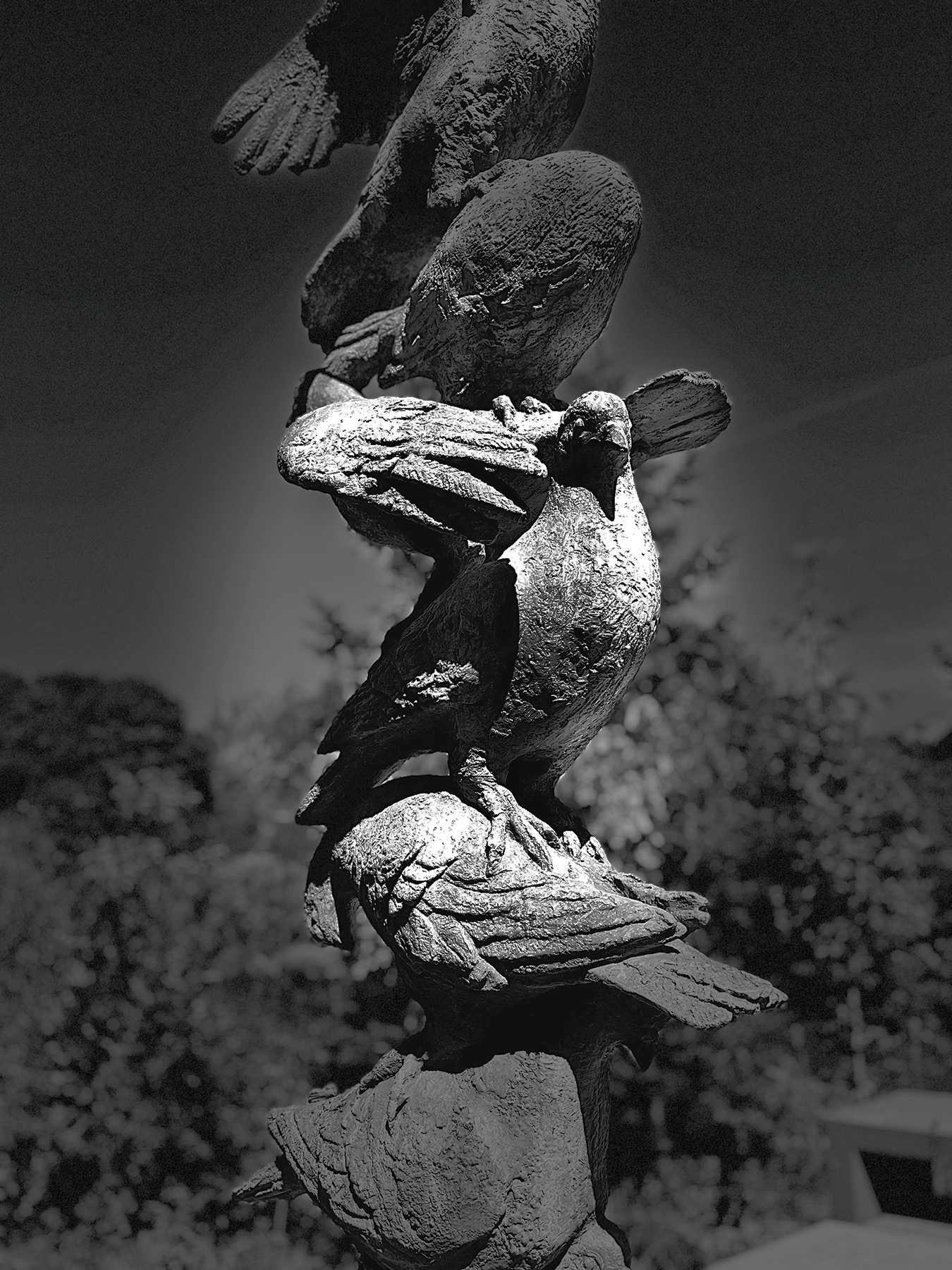
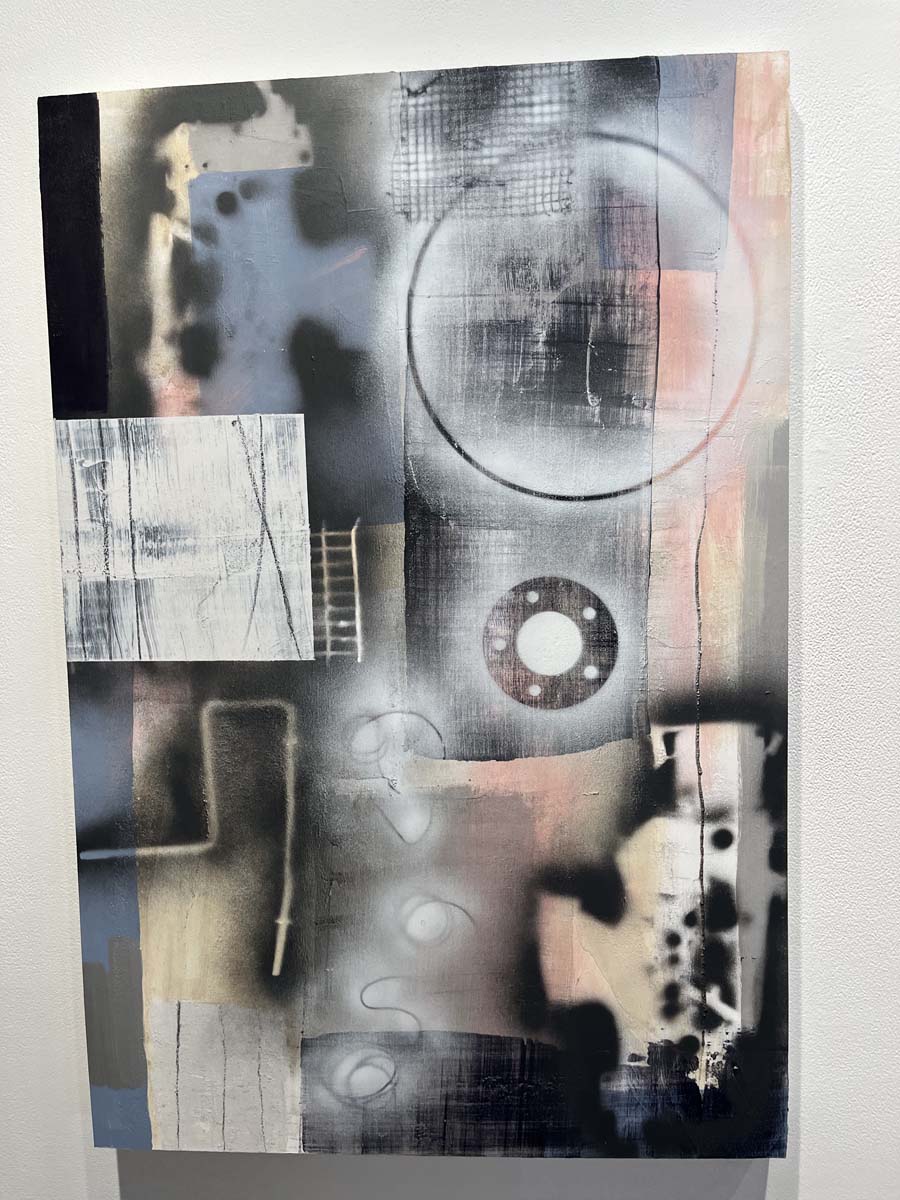
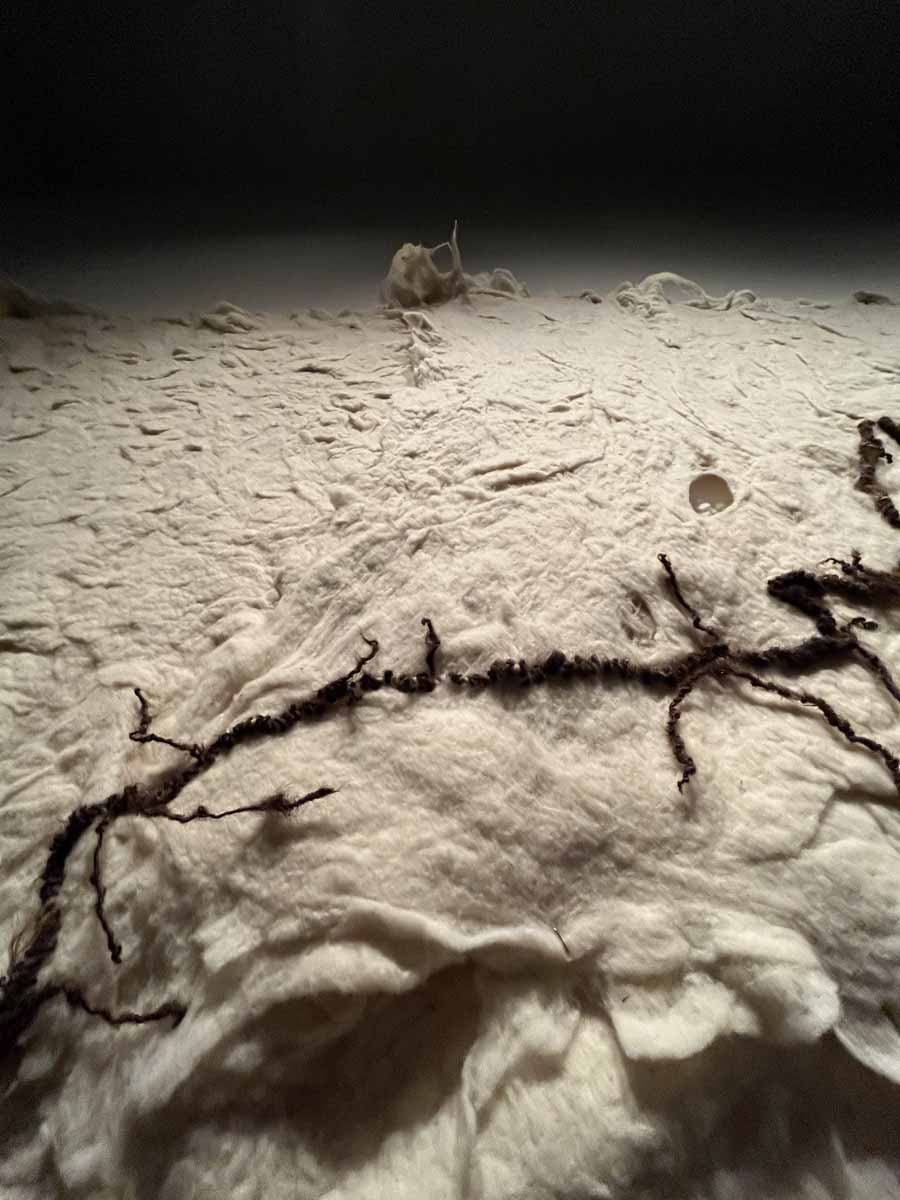
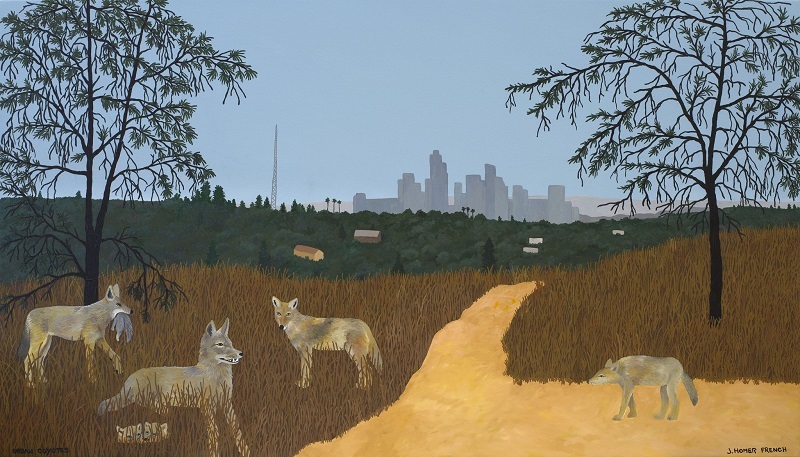
On days when I cannot control the chaos in my brain, I sometimes turn to my desk drawer and tend to the chaos in there instead. Nothing like a bit of sorting and discarding to make yourself believe there can be order in the world, if only for two seconds.
This time I straightened out an accumulation of calendars; as regular readers know, I create one each year as a fundraiser for Streetroots, a PDX organization that produces a weekly paper, working with the houseless, and I also use them as gifts for the many people in my life who deserve one. Well, that sounds abominably condescending. Scratch it. Calendars make for good gifts, how’s that?
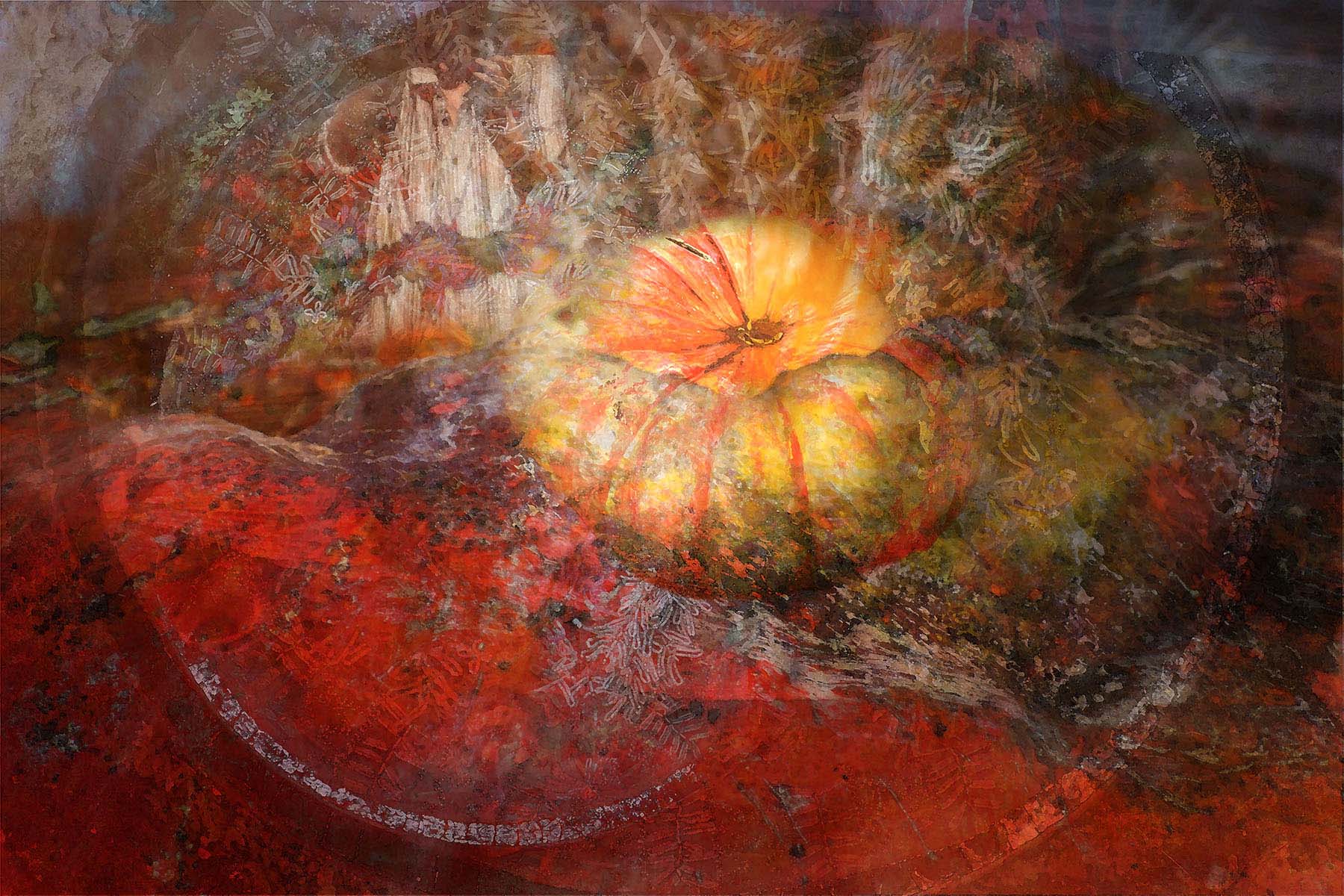
Last year’s calendar, Fusion, was all about showcasing some lovely birds I had photographed over time, putting them playfully into settings where they did not belong, still lives for the most part. Note the word playfully. It has taken me a long time to feel confident enough to work with birds without some intellectual excuse, given that the Portland slogan “put a bird on it” resonates with its sneer.
I had done two series with birds before, both concerned with the impact of environmental damage on avian populations, a serious enough concern to warrant working with birds. There was Dreaming, while snared, of Murmuration which displayed starlings symbolically netted.
And there was Denizens of Climate Change, which I had actually exhibited.
So, Fusion seemed like progress, psychologically, incorporating just something that I found beautiful and not in need of justification.
Well, that was short lived. I am working with birds again, this time for a more complex project where they are no longer the main actors, but part of a larger assembly of concepts that will tell a story. And wouldn’t you know it, the unease of being a woman artist who creates beauty with something that could be seen as cute, or pretty, lovable or simply chirpy, has returned in full force.
Pelicans (2023)
Of course, some multimedia artists seem to have no such qualms. Jamaican artist Ebony G. Patterson‘s powerful new show at the New York Botanical Garden is a case in point. (NYC friends, go see it!) Glitter-crusted wakes of vultures roam the flower beds, more than 400, as it turns out, and there’s a strange peacock to be found.
…things come to thrive…in the shedding…in the molting… points to the transitory nature of things, the uncanny intertwined with the undisputed beauty of the flora. There is no hesitation to use birds as messengers. Then again, the ones on display are quite symbolic birds, and not your garden variety starling and finches, golden or not.
***
Female artists often have to contend with a kind of scrutiny that goes beyond what male artists experience. Their work is also still valued less than their male counterparts’, if you look at the rate of both exposure and compensation. (Ref.) Just look at the titles of what you find in the literature exploring this phenomenon. This is what randomly pops up at a first search about double standards.
Male artists dominate galleries. Is it because ‘women don’t paint very well,’ or just discrimination? (Ref.)
The staggering lack of female artists in America’s museums (Ref.)
Race- and gender-based under-representation of creative contributors: art, fashion, film, and music (Ref.)
The Dam (2023)
I’m happy to report, though, that we have a chance to look at the work of female artists across some part of our region, all in one place, likely to defy the gender stereotypes. If you have no other plans, make sure you go to the opening reception of Women Artists of the Gorge this Saturday, June 17th, at the Columbia River Gorge Interpretive Center Museum in Stevenson, WA. It’s a short and easy drive from Portland and the acres surrounding the museum offer beautiful vistas as well.
I will write about this show next week, when the crowds have dispersed. It is a gorgeous place out there, perfect for visiting, and, I happen to know, for photographing birds.
Music today is about Mozart’s starling. Explanation here.
“There is in the universe neither center nor circumference.” – Giordano Bruno, On the Infinite Universe and Worlds, 1584.
JUNE 9th, 2023 was one of my lucky days. After a week that saw so many bleak events across the world, I found myself surrounded by beauty, and urgent reminders that the universe is larger than our tiny selves.
Lucky, because I was alerted to the photographic exhibition by coincidence: an instagram post by the preeminent print studio in town, Pushdot, saying that one of their clients had a show that very day – and only that day – in my neighborhood.
Lucky, because the artist is a friend and colleague who spontaneously agreed to meet me at the venue before official opening, so I could avoid inside crowds.
Lucky, because I got a one-on-one tutorial about how the stunning abstracts on display were created.
From the top: a number of artists and organizations came together to offer a music and art festival at Lewis & Clark College last Friday. EARTH’S PROTECTION, hosted by Resonance Ensemble and featuring special guests, included a drumming and dance demonstration by the Nez Perce performing ensemble Four Directions, information booths from Portland Audubon, and Songs for Celilo by composer Nancy Ives and Poet Ed Edmo – their tribute to the human, cultural, and planetary costs of the 1957 flooding of Celilo Falls which was premiered at The Reser last year and reviewed in OregonArtswatch. At the center of the evening concert was the Oregon premiere of Sarah Kirkland Snider’s Mass for the Endangered, with projections by Joe Cantrell and Deborah Johnson. What would I have given to hear the music – but again, I can still not be inside with lots of people.
Joe Cantrell Jingle Dance (2023)
However, I could visit the art exhibition accompanying the proceedings: Joe Cantrell‘s We are ALL ONE.
Cantrell was born into the Cherokee nation in Tahlequah, Oklahoma, over 70 years ago. He served two tours with the Navy in Vietnam, including as a diving officer in the Mekong Delta, and then worked as a photojournalist in SouthEast Asia until 1986. The pronounced mildness in his eyes and the gentleness of his demeanor belie the traumatizing experiences that defined his younger years. During his decades in Oregon, he taught both, at the Pacific Northwest College of Art and the Oregon College of Art and Craft. He is a photographer of note in so many ways, providing portraiture and event documentation for art organizations around town, but also specializing in Fine Art photography with his exploration of flora and rocks and fossils.
Joe Cantrell
We connected a few years ago over a shared preoccupation with the ways external or internal components of our experience merge to affect our work. Joe has better ways than I to define the process, ways that are rooted in and amplified by his heritage as a Cherokee, focussed on the interconnection of all things, embracing a multitude of perspectives, be it science, philosophy, history, and, of course, art. His work shines not only due to this conceptual grounding, though. He is ever curious to explore and apply technological advancements that allow him to create work that is unusual, and, yes, I repeat myself, stunningly beautiful.
Joe Cantrell Coming Home (2023)
The images on display were photographs of fossils and polished rocks, macro photography that goes deep inside the object to the very last level that can be captured in focus, then the next one, and the next one, until the surface is reached. A new computerized technology then stitches all of these individual takes together until the full image is constituted, abstractions and configurations resulting from stacking of sometimes more than 70 individual photographs of a single layered object. The color is natural and not photoshopped and appears during post-stitching.
Joe Cantrell Peace (2023)
One of the objects for macro exploration.
Clockwise from left: Joe Cantrell Reef (2023), Oregon Wood (2023,) Fourth Dimension (2023)
Joe Cantrell Stasis (2023)
What emerges are worlds of swirling waves, clouds, geometric patterns capturing all the movement of the elements one can imagine going into the formation of these rocks, the ice, the storms, the droughts, the millennia of relentlessly pounding external forces. A mirror image of the photographs we now receive from space through incredible technological advances, of worlds, of universes, here all captured in a single fossil or a fragment of a rock, for us to behold, whether in our hands – the object itself -, our eyes – the art that emerged from the vision, skill, and patience of the artist -, or our minds – the concept that relations can be captured multi-directionally, as long as we give up the notion that we are the center of the world.
Joe Cantrell Barton (2023)
Joe Cantrell The Gates of Hades (Welcome!) (2023)
Joe Cantrell Fractal Playpen (2023)
The stones include Oco, opals, trilobite, and different kinds of agate.
Sometimes natural forms have been preserved in amber or are fossilized in other ways, like these dinosaur feathers and the insect.
Joe Cantrell Dinosaur Feather & Amber – 320 million years old, give or take (2023,) Fungus Gnat (2023)
Joe Cantrell Ammonite (2023)
Again, Giordano Bruno, 16th century scientist, philosopher, heretic:
“There is no top or bottom, no absolute positioning in space. There are only positions that are relative to the others. There is an incessant change in the relative positions throughout the universe and the observer is always at the centre.” On the Infinite Universe and Worlds, 1584.
Let me juxtapose that with Joe’s perspective, in his own words:
“Yet in a universal perspective (whether we are aware or not, the one in which we all exist) our entire planet seems microscopic, and we, with all our “achievements,” and superstitions and egos, an insignificant, self-destructive nothing. BUT, we are part of All That! See!
Resonance Ensemble’s call to action for this festival was dedicated to protecting the earth, learning to be stewards rather than clinging to ownership with the rights to limitless extraction. Joe’s work addressed those issues with a message derived from earth materials themselves: Let us center ourselves a bit less and join the whole a bit more, acknowledging shared origins. The profusion of color, form, movement and subtlety inside all of these photographs will help to do just that, reminding us of one of the ultimate building blocks of the universe we inhabit: cosmic dust linking us all.
Joe Cantrell Lillian (2023)
Music today is a 2020 version of Sarah Kirkland Snyder’s Mass for the Endangered. It is a celebration of, and an elegy for, the natural world—animals, plants, insects, the planet itself—an appeal for greater awareness, urgency, and action. She explains:
“The origin of the Mass is rooted in humanity’s concern for itself, expressed through worship of the divine—which, in the Catholic tradition, is a God in the image of man. Nathaniel and I thought it would be interesting to take the Mass’s musical modes of spiritual contemplation and apply them to concern for non-human life—animals, plants, and the environment. There is an appeal to a higher power—for mercy, forgiveness, and intervention—but that appeal is directed not to God but rather to Nature itself.”
And here is the Agnus Dei from An African-American Requiem by Damien Geter, performed by the Resonance Ensemble some years back.
“If the doors of perception were cleansed every thing would appear to man as it is: infinite./For man has closed himself up, till he sees all things thro’ narrow chinks of his cavern” ― William Blake, The Marriage of Heaven and Hell.
LIKE ANY other segment of the population, artists have not been immune to cancer. The recent loss of one of our own to this disease, Henk Pander, is a painful reminder, grief still rippling through the community. We know of numerous famous painters, including Artemisia Gentileschi, Rembrandt van Rijn, Gustav Klimt, Marc Chagall and David Hockney, who were afflicted. Photographers not far behind, Dorothea Lange among them as well as Ester Bubley, Arthur Rothstein, Ralph Steiner and Gordon Parks, to name just a few. (Here is a more comprehensive selection from a recent art exhibition at the Hillstrom Museum of Art, MN.)
Medical research indicates that, compared to other professional groups, the mortality patterns among male painters shows an increased risk of dying of cancer, manifesting as bladder, colon and brain cancer, and also leukemia. For women painters, it is breast and lung cancer that is found at elevated rates compared to the non-artist population. The causal mechanisms have not been established, but there are likely links to hazardous substances present in the paints and finishes painters use (Ref.) Then again, it could be the immense stress levels from a precarious existence, shared by many artists, that affect the immune system negatively. Substantially increased cancer mortality rates for photographers are clearly associated with chemicals applied in darkrooms while processing film (Ref.)
Cancer was historically something people did not talk about, an abysmal affliction associated with shame, superstition and mortal dread. You find a few portraits in renaissance art that show women who are likely dealing with breast cancer, but none of the type of work that has begun to emerge, finally, since the last century: visual artists dealing with their own illness, processing their experience through their creativity or using their experience as a means of questioning the stereotypes that surround illness and death. From attempts at personal healing to attacking the metaphors associated with the disease – “it’s a fight, a battle, a crusade” – to simply conveying insights so that others can be prepared or warned, you find a variety of artworks that embody our era’s willingness and courage to expose oneself and/or make the personal political. A late, but welcome attempt to heed Blake’s appeal to “cleanse the doors of perception,” revealing underlying truths rather than keeping them out of our field of vision.
The incomparably courageous and smart artist Hannah Wilke documented her experience with Lymphoma in fascinating and brutally honest staged photographs that were evidence for her unsurpassed talent for gesture. May her memory be a blessing.
Hannah Wilke Intra-Venus Triptych 1992-93
Artists do not just expose their diseased bodies, of course. Some prefer narrative paintings that indirectly alert to what is lost, often for entire generations. I very much relate to the painting below that depicts imagined inter-generational connection when the person is no longer there to talk. If you have cancer when your children are young, one of the bottomless fears concerns what will happen to them, accompanied by an overarching sorrow that they will never really get to know you (or you them) on a more equal footing.
Ofer Katz“Things I wanted to tell you – Mark and Aliza Ainis at The Dead Sea” 2021
(This painting, by the way, is part of a project that has been of enormous help to cancer patients trying to overcome isolation. A national organization, Twist Out Cancer, offers a program called Brushes with Cancer.
“… it strategically matches artists with those touched by cancer to create unique pieces of artwork reflective of their journey. Over a period of 4 months, pairs will connect virtually and their relationships are guided and supported by Twist Out Cancer mentors with the intention of creating a support system for both the artist and inspiration. The program finishes on a high note with our signature celebratory art exhibition, gala and auction.”)
Then there is Prune Nourry’s public art signaling healing, to which I am admittedly partial, even though her Catharsisseries skirts the edges of metaphors that I abhor. Amazons are of course warriors, implying an ongoing war with the disease. I continue to be floored by Nourry’s ideas and instantiation of mammoth projects (I wrote about her work I saw in Paris some years back here.) The battle metaphors so lend themselves to focus on winners and losers, victors and victims, survivors and fallen, all of which imply an either/or categorization and a hint of fortitude (or lack thereof) in dealing with the illness. As any cancer patient will tell you, the implications that one isn’t tough enough, fighting enough, optimistic enough, radical enough, tend to add insult to injury.
Here are some images of Nourry’s work processing breast cancer and an explanation from her website.
“Catharsis was born in 2018 with The Amazon, a monumental four-meter concrete sculpture with glass eyes, inspired by an ancient marble statue at the Metropolitan Museum of Art representing an injured amazon. Prune Nourry created the sculpture as a cathartic act in her fight against cancer. Inspired by ex-voto traditions, particularly the Japanese mizuko kuyo, the piece is entirely covered in thousands of incense sticks. During a public performance in the heart of Manhattan, the incense went up in smoke to symbolize healing.”
Breast cancer seems to be the dominant topic for artists processing cancer – perhaps because it is so prevalent, has been suppressed as a subject for so long or, importantly, because patients more often than not live to tell the tale. Gallery shows focus on the resilience of survivors, and museums draw attention to the topic, like this ingenious stunt at the Thyssen-Bornemisza National Museum of Art in Madrid in October last year. They featured an exhibition titled “From the skin to the canvas: another take on breast cancer,” displaying digital copies of works by Francisco de Goya, Peter Paul Rubens and Hans Baldung Grien which had been altered to make it look like the nude subjects have undergone mastectomies. (Unsurprisingly, most of the media reports did block out the images – I really had to hunt to find one….)
Thoughts about breast cancer seem to be manageable, compared to, say, lung cancer which has a far worse prognosis and less visible damage, as well as being associated with un/spoken assumptions that it is your own fault because of bad habits (I wrote about this recently here.) Breast cancer survivors’ day-to-day functioning is not as affected by missing breasts (non-withstanding the emotional losses tied to female beauty ideals, or those of sexual pleasure) once you’ve left the cancer behind you, compared to living with the aftermath of lung cancer. The absence of breasts becomes an integrated norm, with all other physical functions intact, allowing you for long stretches to forget the ordeal. That is not the case with a lung removed which affects every step you take, every breath, really. The knowledge that this dreadful beast tends to spread surreptitiously much more frequently makes ignoring your state near impossible. Seen in that light, the prevalence of breast cancer-related art becomes understandable.
In fact, to my knowledge there seems to be no art by established visual artists engaging with lung cancer, although a few rather depressing novels and autobiographies by afflicted authors exist: “The Quarry” by Iain Banks, “In gratitude” by Jenny Diski “When breath becomes air” by Paul Kalanithi , and “Stadium IV” (Stage IV) by Sander Kollaard. Two authors who died of lung cancer wrote poems about their ordeal: Raymond Carver (“What the doctor said” and John Updike (“Needle biopsy”). Illness perception – in this case one of doom and resignation – has consequences, for coping as a patient as much as for the obviously lacking desire or energy to create an artistic representation of the trauma.
***
“A successful work of art is not one which resolves objective contradictions in a spurious harmony, but one which expresses the idea of harmony negatively by embodying the contradictions, pure and un-compromised, in its innermost structure.” ― Theodor W. Adorno, Essays on Music
PROCESSING the illness experience can have enormous benefits, for artist and beholder alike, regardless what disease gave rise to the art. That point was driven home for me last week when shown the new work by artist and cancer survivor Ruth Ross. I had written about Ross’ thrilling exhibition Red Scare last fall, embroidered fabric and photographic collages about growing up in the shadow of the Rosenberg trials during the McCarthy era, and was curious where she would go next. Once again, her projects fuse the personal with the political, this time embodying contradictions that belie the surface harmony of the portraits.
Photographs of the artist taken during her chemotherapy and transformed into cyanotype prints are embroidered with fanciful, phantasmagorical hats that are often quite beautiful, sometimes resembling overbearingly heavy crowns.
In Ross’s own words:
Marking 11 years out from chemotherapy for breast cancer, I came across a series of stark photos I had asked my husband to take when I was at my weakest and most debilitated. Seeing from those photos how frail I seemed, I created a series of cyanotype prints to silk organdy, a delicate and nearly transparent textile that would reflect my vulnerability.
What if I were to revisit that troubling time with a more tender view? Could layers, image, and stitching, endow that self with what I thought I had lost? Or perhaps with what I never even had? An elaborate hat made of flowers from a far-off paradise. A fanciful silver bird grasping some golden threads. With this work I revisit a difficult time. I can now express joy, self-indulgence. Ignore my judgmental self and invest it with wit, frivolity, and forgiveness.
For me, the work elicited a less personalized interpretation. It embodies contradictions that are structural, not just based in private experience. Hats during chemotherapy are meant to hide the stark nakedness of the head, the ugliness of a skull bereft of one of culture’s (or myth’s, literature’s, religion’s) greatest symbols: hair.
Hair is a powerful signifier of individual identity (lustrous locks signal fertility and health, for example,) as well as gender and group identity – think of hair styles reserved for elites, shorn hair for skin heads but also nuns, indicating celibacy in the latter case, long hair for politically active males in the western 1960s and so on. Women were constrained to certain hair styles before, during or after marriage entering widowhood, cross-culturally so, as anthropologists exploring initiation-, marriage- and mourning rites can attest. And of course, women in multiple religions are not allowed to reveal their hair at all to people outside the family. Hair has a place in witchcraft rituals, and it surely plays a role in the economy: The global hair care market size reached US $82.3 BILLION in 2022. That is a lot of gels, rinses, oils, tonics, serums, masks, dressings, shampoos, conditioners, and sprays, to treat hair to be shiny and voluminous, much to the envy of those of us born with something more resembling chives…
Black hair in this country was also a subject of policies driven by structural racism: only now have we done away with prohibitions of natural hairstyles, like afros, braids, bantu knots, and locs, policies used to justify the removal of Black children from classrooms, and Black adults from their employment. The Crown Act, (Creating a Respectful and Open World for Natural Hair) passed in March 2022, banning hair-related discrimination.
Hair, then, is public, not just private. Drug-induced loss of hair is to be hidden from the public, however, to spare others the reminders of mortality, and to not call attention to what is perceived as our own decimation in (assumed) attractiveness value. In that sense, chemo-caused hair loss is both a public and private representation of the illness. It can cause individual distress as well as societal stigma (honestly, how do you even separate these two variables?) National Institute of Health data reveal as recently as 2 years ago that up to 14% of women refuse life saving chemo treatment because of their fear of hair loss. Risking death because of internalized beauty ideals imposed by a society that judges women by this standard, and easily dismisses those who no longer conform to it, imagine!
Hats, in this context, serve as a means of hiding visible signs of cancer treatment to protect societal denial of illness, and help avoiding dreaded negative attention. Ross’ hats, of course, do the opposite. All attention goes to these flights of fancy, then extending to the transparent emanations of suffering beneath, forced to confront the ravages and all they imply. The contradictions of joy and pain are inextricably linked.
The assumption of one being in the present, the other in the past, however, is an illusion, just like the possibility that these hats could ever not slip off the bald skull unless artificially glued or pricked by pin needles. You might be cancer free at this moment, but you will never be free of the thoughts that it might raise its ugly tentacles again. All you can do is cherish the here and now that is the potential ante-room – and Ross does that with luminous defiance. The choice of materials that simultaneous imply decay and lusciousness in itself is ingenious, with tropical splendor growing out of the ripped fabric of our lives.
The sobering realization that the exuberant blossoming of the flora echos the relentless proliferation of cancer cells is, alas, inevitably not far behind.
The artist’s expressed intention to create these pieces as a way of ending a hard chapter on a high note are a welcome reminder of healing. But there is an implicit way of forcing us to look at the consequences of cancer treatment for women that is radical in her art: part of the suffering during this affliction has to do with stigmatization, and desperate attempts to escape it and the isolation it imposes are often futile.
No hat, however beautiful (or unobtrusive) can make that fact disappear. Might as well bring it to the forefront, then, as Ross does, with gusto. Her work opens our perception to experiences during illness that go beyond the physical affliction or the psychological realm of dread induced by cancer. We are driven to hide our deterioration from the eyes of a world that has made beauty a commodity and reminders of mortality a taboo.
One of Ross’ collages is part of the group exhibition: Not Just: A World Collage Day.
This spring, first Ohio’s and now Tennessee’s Governor signed laws that designate methane gas as “green” or “clean” energy. The legislation is pushed as part of a growing industry-funded strategy to delay climate action by codifying misinformation about natural gas into law – and make no mistake, methane is a fossil fuel, a powerful greenhouse gas. We are following closely in the footsteps of the European Union where this kind of designation meant that billions of dollars that were intended to fund climate-friendly projects could legally be used for methane power plants and terminals. But Tennessee is going a step or two further to serve the interests of the fossil fuel industry:
“The fact that methane gas is now legally “clean energy” in Tennessee is a benefit for TVA and its planned methane gas expansion. And it’s not the only recent bill that benefits TVA. Last month, Rep. Clark Boyd sponsored a bill that makes it a Class C felony to interrupt or interfere with “critical infrastructure” like pipelines. In February, Boyd also sponsored a bill to block any future bans of gas stoves. Last year, Tennessee lawmakers passed the Tennessee Natural Gas Innovation Act, which legally categorized methane gas as a source of “clean energy” for utilities. They also passed laws preventing local governments from blocking fossil fuel infrastructure and the state from working with banks that divest from fossil fuel companies.”(Ref.)
The favoring of capital over science in the context of climate change might have the most dire long term consequences, but an anti-science stance, increasingly and fervently pursued internationally by right-wing forces, has immediate impact as well, as we saw (and see) in the context of the pandemic. Antiscience is the rejection of mainstream scientific views and methods or their replacement with unproven or deliberately misleading theories, often for nefarious and political gains. Antiscience is invading the courts (think about the “un-scientific” reasoning in the S.C.’s Dobbs decision) and the educational system (think about Florida’s purging of text books, for example, or the general push to dismantle public education, so that private schools can pick and choose their curricula.
Historically, antiscience was not an exclusive domain of the Right – if anything one of the greatest antiscience authoritarian of all times was Stalin, whose “beliefs” starved millions of people to death. In the U.S. the Republican Party was actually open to science for some decades: The National Academy of Sciences was founded in the Lincoln administration; NASA in the Eisenhower administration, and PEPFAR (U.S. President’s Emergency Plan for AIDS Relief), PMI (President’s Malaria Initiative) and the NTDs (neglected tropical diseases) program were launched in the George W. Bush Administration. All this has obviously changed since 2015 when anti vaccers took over and “Health Freedom” became a rallying cry – look at the legislation signed this week by Governor DeSantis and weep. Both medical treatment and medical research are adversely affected.
All this swirled through my head when looking at my photographs of Los Angeles’ Griffith Observatory, and its wall and ceiling murals created in 1934 by Hugo Ballin that celebrate science and scientists.
Beyond appreciating the vistas of the approach path to the observatory and the beauty of the building itself, it is really the idea of what science provides and how it moves us forwards, potentially rescuing us, that matters.
The panels on astronomy, aeronautics, navigation, civil engineering, metallurgy and electricity, time, geology and biology, and mathematics and physics celebrate science, and scientists, including path breaking ones from ancient times and non-Western regions. Will kids, traveling in large school classes, who are no longer educated in the history of science or science’s importance even understand why is depicted and why?
Ballin was onto something there, although he was somewhat conservative at heart. In fact his clinging to traditional mural subjects, techniques and representation stood in stark contrast to the progressive muralists of his times, like Diego Rivera, José Clemente Orozco and David Alfaro Siqueiros who conveyed social and political messages on public buildings. Then again, their work was eventually whitewashed, while Ballin’s embrace of the old-fashioned Beaux-Arts style made his work survive.
Born to German Jewish immigrants in NYC, the artist made his way out West to join the silent film industry, with little success. His career as a painter and muralist for civic institutions, on the other hand, took off. His impact and importance for L.A.’s Jewish community is described beautifully here with lots of historical photographs for specific projects (e.g. the observatory here.). I found the link on a generally very helpful site, UCLA’s Mapping Jewish L.A., that has numerous interesting digital exhibitions.
The art itself did not do much for me, but the ideas that propelled it forward and that it represented, did. The same could be said for what I saw this week, on the very last day of the Altered Terrain exhibit at the Patricia Reser Center for the Arts.
Michael Boonstra burn (…fall creek layers…) 2023 with detail
The work by Michael Boonstra and Christine Bourdette is the polar opposite to Ballin’s representational depictions. Both artists abstract the essence of their subjects, but both are clearly informed by science and Boonstra by the impact of humans on the environment, driven, in part, by a rejection of science. Bourdette is deeply interested in geological processes, from gas formations to the creation of geological strata through the massive forces that shape the terrain across millennia.
Christine Bourdette Notch (2023) with detail and Portal (2023) with detail
Boonstra distills his perceptions of forest fires and their aftermath. Both use materials derived from the earth, charcoal, minerals and earthy pigments to capture the colors of the landscapes they care for so deeply.
Michael Boonstra Nowhere/Now here (snowfields) 2018-2022 with detail
The pairing of the two artists worked well, the overall perceptual sparseness of the exhibition provided sufficient (and necessary!) attention for each piece, in short, the curation was spot on.
Given how much I admired the concepts, and the learnedness that went into these works, why did it not resonate on an emotional level? All I can come up with is that it felt so meticulously built-up, acribic, painstaking construction and marking that captured order instead of chaos associated with destruction, whether from fiery infernos or glacial ice-melt floods and volcanic eruptions.
Christine Bourdette Escarpement 1 (2022) with detail
Maybe the creation of beauty in resonance to the fearful natural forces provides a defensive shield, helps to inform or warn the viewer without frightening them away. I, however, could not shake off a sense of sterility, even when looking at gorgeous color palettes. (A more detailed and receptive review by Prudence Roberts, who knows what she is talking about, can be found here.)
Michael Boonstra burn (bootleg) (2023) with details
In any case, having now jumped across topics in the usual fashion again, let me add one more link as a reminder how science-informed art mapped, successfully in my eyes, the alteration of the landscape through external forces. I had written about art, forest fires and the geological Gorge formation here.
Here is Murphy’s Dark Energy, played by the (now disbanded) Linden Quartet, in honor of Einstein’s science.
I BET THE BANK that not a lot of L.A. tourists make it out to Pacoima in the San Fernando Valley, one of the 88 cities comprising L.A. County. Which is too bad, given that there is much to learn and admire when looking at the history of the area. It is also a place where you can explore over 30 murals along a stretch of a busy through-fare, Van Nuys Blvd., the Mural Mile created by local artists who care about their community and acknowledge its history. The works shine like beacons along a neighborhood dominated by auto-repair or appliance repair shops, pawn brokers and payday-loan companies, small bars, pet groomers, florists, laundromats and churches, garages and places to send money back home to the loved ones you left behind in Mexico or El Salvador.
The area has been settled for more than 1500 years, early on by the Tatavians, a tribe with a strong sense of community and gender equality, from what the historians tell us. Disaster arrived in the form of Spanish colonialist destroying much of tribal land and culture.
Painted by the HOOD Sisters (Honoring Ourselves Origins Dreams)
By the late 1880, speculative investors descended in anticipation of the Southern Pacific railroad and a likely real estate boom. They hoped to lure wealthy settlers, but the area was prone to horrific floods and so ended up as an agricultural community, with many Mexicans and later Japanese immigrants doing the hard work. After Wold War II, with jobs provided by Lockheed and General Motors, a lot of Blacks were attracted to move to Pacoima, with a housing tract named after boxer Joe Louis, establishing a large middle-class community.
Today the population of around 90.000 people is about 87% Latino, 4% Asian and 3% Black. Poverty rates are high, crime rates higher than in almost any other community in the San Fernando Valley, and higher education levels way below average compared to the rest of L.A. County. There are reports that nearly 20% of the people in Pacoima live in rented rooms or converted garages. The hidden density extends to single-family houses that are often home to several families, trying to ease the burden of insane mortgage rates. (Ref.)
Homelessness here, as across L.A. County, has increased by over 70% across the last 6 years, with many families living in campers, cars, or tents. Makeshift memorials for victims of violence or the hardship of life on the street are ubiquitous.
The problem that compounds it all is the fact that Pacoima is by far one of the most pollution-exposed neighborhoods in all of California. It has one of the highest rates of air pollution and soil contamination due to the clumps of industrial facilities, garbage dumps, land fills, the small commercial Whiteman airport, Sun Valley Power Plant, a railroad line and the surrounding 3 freeways that enclose the city, I 5, 118 and 210. Diesel trucks emit diesel fumes into heavily residential areas, and weather patterns push and hold air pollution in Pacoima against the San Gabriel and Verdugo Mountains. The geography of the region, a valley, causes air-toxic chemicals, like nitrogen dioxide and ozone to settle near ground level.
Industries using chrome plating, among others, caused immense groundwater pollution, with hexavalent chromium doing its poisonous thing. Daytime heating patterns make it worse: the groundwater is vaporized during the day and then re-condenses at night, leading to the possibility for subsurface vapor intrusion into homes. There are now five Superfund sites in and around Paicoma: American Etching and Manufacturing, D & M Steel, Holchem, Inc., HR Textron-Glenoaks, and Price Pfister, Inc. The former Price-Pfister Faucet Plant Superfund site was recently redesignated as a Brownfield for redevelopment. The gas plant, it was revealed last year, has been leaking methane gas for long periods, affecting the area as well. The results of all this pollution is an unacceptably high level of respiratory illnesses, particularly asthma in young children, in the area and of course the potential that cancer rates are going to skyrocket among exposed individuals.
The skeleton is using an asthma inhaler…
***
THAT IS THE BAD NEWS. THE GOOD NEWS IS that Pacoima has a history of activism that unites many of its citizens in a fight for a better, or, in this case, healthier and more beautiful world, from tackling racist practices to now addressing environmental justice. In 1968 students from Pacoima staged one of the biggest civil rights protests in CA history, forcing massive reforms at the (now) Cal State University Northridge. It also paved the way for the school’s and state’s first Pan-African and Chicano Studies Departments.
Here is a great video introduction to their and others’ activism and a trailer to a documentary about the history of the town. Later, the NAACP and community churches organized and strategized to curtail police brutality and successfully spearheaded bans on the chokehold and use of the battering ram and focused on housing discrimination as well. Patrisse Cullors, one of the co-founders of the Black Lives Matter movement, hails from Pacoima as well.
Shakur
Painted by Kristy Sandoval and the H.O.O.D. Sisters, this mural pays homage to Assata Shakur, Tupac’s godmother and once one of the FBI’s most wanted.
It was five mothers from diverse backgrounds, however, who got together in 1996 to combat the literal toxicity of the place, founding Pacoima Beautiful, an organization that is now successfully fighting for environmental justice on a large scale. Just two months ago, their recommendations to close Whiteman Airport given the frequency of accidents and pollution issues, was heard. “The Re-envision Whiteman Airport Community Advisory Committee (CAC) voted at their final meeting to recommend the LA County Board of Supervisors pursue the closure of Whiteman Airport and immediately implement mitigation measures to prioritize public health and safety in the time leading up to airport closure.” Two years ago, their campaign against the Valley Gas Plant dangers helped deal with methane emissions. “As a result of our the community advocacy and organizing efforts, the Los Angeles Department of Water and Power has agreed to wean its use of natural gas and seek new opportunities for clean energy options at the site. Also there are plans to demolish the red and white smoke stacks.”
The non-profit organizes community clean-ups, Covid- outreach, electric bike programs, and nature access for kids. They also invest in arts education and local artists. Their ARTvertise program, together with OUTFRONT/JCDecaux, is designed to help transit riders experience art at bus shelters along the mural mile of Van Nuys Blvd. They show rotating work from local artists.
Their FaceBook site helps people figure out where to turn or where to participate, from offering opportunities to learn how to organize to announcement of life events of beloved community members. The organization also has 20 volunteer community inspectors who relate grievances to Clean Up Green Up, a 2016 city ordinance that prioritizes health and economic well-being for people living in some of L.A.’s most polluted districts. The ordinance ensures that complaints and violations raised by the inspectors are addressed and provides an ombudsman both for the area’s many industrial businesses trying to operate more cleanly and for the community members trying to enforce changes. (Ref.) All of this effective work to improve the health and living conditions of the community started by individual mothers having had enough. Deepest respect.
***
MANY OF THE MURALS I saw after driving out to Pacoima were produced by two artists, father and son, Hector Ponce and LeviPonce.
Some are by younger artists, like Rah Azul and the gifted Kristy Sandoval. Some murals are easily accessible, others behind fences, on abandoned or guarded lots, respectively.
One friendly guard opened the electric gate so I could photograph a mural directly and told me that the depicted woman’s original cleavage had been so offensive to some part of the citizenry that it needed to be painted over. “Oh,”he said,”Ponce was going to come back and beautify the rest of the walls. I have to give him a call – we like what he is doing for the neighborhood. I have his number.”
Elvira painted by Hector Ponce
There are murals that link back to the history of the area,
“Forgotten Roots,” painted by Juan Pablo Reyes
some are addressing political issues of the presence. Some reference folktales, like the Mona Lisa now clad like La Adelita – the Mexican Revolution saw many women join as soldaderas who embraced the early Maderistas movement, with La Adelita representing them as a stand-in in a famous ballad.
Pacoima’s Art Revolution
Painted by Levi Ponce to declare an arts revolution in the area (during a time where painting murals was illegal in Los Angeles), it stands as a symbol of the fight for the arts.
Real-life luminaries include Danny Trejo, a formerly incarcerated man who became a famous movie star and now owns many local eateries. Some critics didn’t like what they saw as glorification of violence and crime, but Ponce wanted to reflect the community who, after all, had chosen Trejo as the grand marshal of Pacoima’s Christmas parade.
Then there is The day the music died depicting the most famous local musician, Ritchie Valens, who died with Buddy Holly and another bandmate in a plane crash in a cornfield in Iowa during a concert tour in 1959.
There are depictions of Latino culture,
and visions of a better future.
Without Boundaries
Painted by Sarah Ackerley and Levi Ponce. This 33′ x 75′ mural inspires children’s imagination by blurring the boundaries of reality. This variety of flying fish can actually be found off the coast of Santa Monica, CA.
A mural by Ignacio Gomez enumerating locally notable people and other folk can be found in the back of city hall,
while the front alerts to Councilwoman Monica Rodriguez, the first Latina in the city’s history to serve on the Los Angeles City Council in 2017, to represent the 7th district she’s called home her entire life, an active supporter of the mural arts.
There is clearly an important and welcome attempt to protect the community from Covid, given the extra vulnerability of a population prone to pulmonary diseases from pollution,
and there are lots of banners alerting the community to the educational possibilities for the youth.
Some of the murals on view might not have yet reached the level that signifies muralism as an art form, I’m thinking here for example of the three great Mexican muralists Diego Rivera, Jose Clemente Orozco and David Alfaro Siqueiros in the 1930s. But they are done in the same spirit: they keep significant history alive and memorialize the people who mattered to the community. They make public the concerns of a community (particularly when they are debated) and they can alert to the potential for change, when they depict alternate visions of what could be possible, particularly when they focus on inclusivity and are socially conscious. They are also creations of combined efforts of local artists, business people and other citizens, and kids who now own their participation in this community. A seminal essay by Judith Baca, Whose Monuments Where? Public Art in a Many-Cultured Society is well worth a (re)read if you are interested in the function and importance of community murals. All of this makes a difference.
Judith Baca has been one of the most prolific and recognized muralist in SoCal for the last 50 years. Her Neighborhood Pride program encouraged young artists to paint in ways that honor neighborhood history. Her Great Wall of Los Angeles, located just south of Pacoima along the Tujunga Wash and next to Coldwater Canyon Avenue in North Hollywood, is over 2,700 feet long and by far the biggest mural in Southern California. It was painted as “a bold illustration of the history of California from the state’s prehistoric past to the struggles of its ethnic minorities for civil rights and equality.” (Ref.) I have yet to visit. Many other public art projects in Little Tokyo and the Historic Core commemorating forgotten urban history were spearheaded in the late 1980s by yet another organization, The Power of Place, founded by Dolores Hayden, Professor Emerita at Yale University.
Here some more murals from Pacoima:
Levi Ponce’s 2019 monumental mural Rushing Waters follows Baca’s model. It recognizes indigenous and environmental history, and depicts both natural and manmade landmarks in and around Pacoima like Hansen Dam, the Sylmar Aqueduct, San Gabriel Mountains, the Los Angeles River, Whiteman Airport and nearby freeways, with a 25-foot tall Tataviam Village woman pouring her bowl of water onto the land comprising the center of the mural. Councilwoman Monica Rodriguez provided funding, and the mural itself was on the drawing board for over four years, eventually executed by a team of nine artists under Ponce’s leadership.
***
AS THE LATE CULTURAL WRITER and Latino art advocate Ed Fuentes wrote before his death in 2019:
“Murals were designed to be art for the masses, and in the case of ethnic-based murals, spoke for those underrepresented. In Los Angeles, its own identity is lost because it’s a region people come to reinvent the city, and/or reinvent themselves. This current legacy of remaining murals, plus the manifesto of current artists, may not realize their work represents another undervalued voice: The city’s own history.”
You find murals commemorating alternative histories all across L.A., but many are disappearing. It is a nationwide trend – my city of Portland, OR, has seen similar developments. They are not just defaced by taggers or torn down by property owners. There is a whole development aligned with the gentrification of traditional neighborhoods, with newcomers either insensitive to the history captured in the art, or inclined to put up visuals that serve their own interests. A recent essay in The Guardian, Whitewashed: How gentrification continues to erase bold L.A. murals, describes the conflicts over murals between gentrifiers and inhabitants. They are fundamentally linked to other sources of tension, “property prices, the pace of gentrification, tenant evictions, the integrity of once-venerated local artists, and the ability of local city officials to act as honest brokers between the competing interest groups.”
Efforts to protect the history and the art form are direly needed. In L.A. they have the Civic Memory project, a project that pursues the preservation of community knowledge, playing an evermore important role. If you go to their website you find an astonishing volume of projects all interesting in their own ways, public art included, with in-depth debate of how to approach memorializing a past that had been submerged under representations by culturally dominant official” voices that pursued their own agenda.
Forgotten places, Pacoima included, can be resurrected via public art that is emerging from community-based vision, voices, recollections. All we have to do is visit and learn. As Ritchie Valens sang: Come on, let’s go!
When you travel, even for longer stretches of time, you have to make choices. So much to explore, to learn in Los Angeles, this behemoth of a city – there has to be some selectivity, since not all can be fit in. My own selections are usually based on two basic considerations: get familiar with the history of the place and, of course, seek out stuff that feeds my specific interests, art and politics, as you well know.
I lucked out last week with these endeavors in more ways than one. To understand the history of the greater Los Angeles area, I had read Mike Davis‘ City of Quartz: Excavating the Future of Los Angeles (1990) and slogged through his last book, Set the Night on Fire. L.A. in the Sixties (2020), published before his death in 2022 and co-authored with Jon Wiener. Both are seminal works about the urban history of the place and the powers that shaped it since its inception. Cultural critic, environmental historian and political activist Davis described the intersection of land development and legal or functional racial segregation in Southern California in ways quite accessible to uninformed readers like me, basing his account on interdisciplinary sources, including American history, environmental history, Marxist philosophy, political science, urban geography, architectural and cultural studies. Both books introduce the forms of resistance to segregation in housing and education, from peaceful demonstrations to riots to the engagement of artists and other intellectuals, side by side with famous civil rights fighters, political organizations, union representatives, the ACLU and uncountable numbers of students as young as high school freshmen.
88 cities, approximate 140 unincorporated areas, and communities within the City of Los Angeles.
The author introduces us to the political economy that shaped the urban sprawl, the landscape transformation, resulting in increasing inequality of living conditions and incarcerations rates, making it a dystopian place for those who fell off the wagon of the American Dream, or shall we say, were pushed off by the interest of those defending Fortress L.A. from any influx of non-White and/or poor populations. Land, seemingly endless land was the commodity, providing the base for residential neighborhoods, industry, strip malls and freeways. Richer neighborhoods, in fear of losing their exclusivity, the down-town commercial district’s business owners and realtor- and home owners’ organizations collaborated with investors, local and state politicians, and even Roman Catholic church leaders to make decisions about land-use that protected the interest of the monied classes and ended up with unimaginable sprawl.
Even though fair housing laws existed, racism won when Proposition 14 was adopted by an overwhelming majority of California voters in 1964, scorning equality and discriminating against “undesirable” homeowners and renters who were now easily excluded. The vote allowed prior law, the California Fair Housing Act of 1963, also known as the Rumford Act, to be voided, creating a state constitutional right for persons to refuse to sell, lease, or rent residential properties to other persons. (The Supreme Court declared the Proposition unconstitutional in 1967. The current legal status can be found here.) It was a pivotal moment that brought the efforts of many organizations and individuals fighting for civil rights to a screeching halt at the time.
Later decades saw more subtle ways of achieving the same goals of segregation: zoning laws and security measures kept the poor away from affluent districts. Relentless and cruel, often violent policing kept particularly Black citizens and other POC in their allotted places, both literally and metaphorically. Zoning was also causal for pushing the non-White and poor populations to the perimeters of the county, within or adjacent to more dangerous environments when it comes to pollution, water shortage and now fire danger given climate change-enhanced droughts. I am summarizing these aspects of Davis’ books because it was striking for me to see the described social stratification play out in real space during a drive to East Los Angeles College, a public Community College in Monterey Park, CA.
East Los Angeles College, Monterey Park, CA.
I started in the heart of Pasadena’s historical district, a place full of beautiful, gorgeously maintained and lovingly restored mansions, then drove through the picture book landscape of Pasadena’s craftsman bungalows. 15 minutes later you come through small townships that still have single-lot houses, but now run down and clearly showing signs of economic distress. Another 20 minutes along, and you are surrounded by low income housing apartments. I parked in a strip mall adjacent to the college and was immediately taken in by a striking building that stood out against the dilapidated background: the Vincent Price Art Museum. Part of a Performing and Fine Arts Center that opened in 2011, the museum holds a permanent, major collection of fine art, with substantive work initially donated by actor Vincent Price (he of Hollywood Horror Movie fame, among others, but also a true friend to the arts and the educational efforts required to bestow knowledge of art and art history onto future generations.) By now the museum holds over 9000 objects and has hosted more than 100 shows, singular for a community college, its exhibitions thoughtfully and smartly curated.
I came to see one of them that seemed particularly aligned with the museum’s expressed mission and issues close to my own heart concerned with cultural diversity and critical thinking:
“The mission of the Vincent Price Art Museum at East Los Angeles College is to serve as a unique educational resource for the diverse audiences of the college and the community through the exhibition, interpretation, collection, and preservation of works in all media of the visual arts. VPAM provides an environment to encounter a range of aesthetic expressions that illuminate the depth and diversity of artwork produced by people of the world, both contemporary and past. By presenting thoughtful, innovative and culturally diverse exhibitions and by organizing cross-disciplinary programs on issues of historical, social, and cultural relevance, VPAM seeks to promote knowledge, inspire creative thinking, and deepen an understanding of and appreciation for the visual arts.
What Would You Say?: Activist Graphics from the Los Angeles County Museum of Art presents a selection of political prints from LACMA’s vast archives. The exhibition, which opened March 25th, is free of charge and the visitor gets gifted with a high-quality brochure, covering some of the art with prints and explanatory (bilingual English/Spanish) text that I found helpful.
Graphic art has traditionally been a vehicle for change, challenging as well as influencing political moments. Rather than just depicting, the combination of image and word can inform, comment, persuade or be used for propaganda. It has been a key player in protests against injustice and oppression; the fact that it can be easily, widely and cheaply created and distributed has made it a form that helps to connect to people and promote social change. In the late 19th century, the technology for lithographic printing advanced, and the new power-driven presses, practical techniques of photoengraving and mechanical typesetting devices helped the medium to progress. We have now added photo-typesetting, offset lithography, and silk screening to the repertoire. It has also often been a communal effort, linking artists and participants with shared goals and interest, helping to organize and to educate.
The graphics on the wall ranged from the mid 1960’s to the 2020s, covering the Black Panther’s fight against police brutality and for the empowerment of poor Black neighborhoods,
Left: Emory Douglas Untitled (Sin Titulo) 1970 – Right: Rupert Garcia Libertad para los prisoneros politicas! 1971
the issues of incarceration of innocent people and Latino activism,
Yolanda M. López Free Los Siete 1969
Jessica Sabogal Walls can’t keep out Greatness 2018
the struggle of women and immigrants for equality,
Clockwise from upper left: Yreina D. Cervantez La Voz de la Mujer 1982 – Sheila Levrant de Bretteville, Women in Design: The next Decade 1975 – Yreina D. Cervantez Mujer de mucha enagua 1999 – Krista Sue Pussy Power Hat Pussy Hat Project 2016 – Ernesto Yerena Montejano and Ayse Gursoz We the Resilient 2017
and eventually the protests over the murders of Breonna Taylor, George Floyd and other Black people by police.
Jesus Barraza and Melanie Cervantes of Dignida Rebelled and Mazatl My Name is Trayvon Martin and my Life Matters. 2013
The most dominant topic, however, is expressed in posters and prints protesting war; surprisingly, I could find the issues of racial segregation and land development, so central to the history of L.A. and S.F., only peripherally – one poster about evictions, and one about the displacement of first native people and then a Mexican American community from Chavez Ravine, land appropriated to build the beloved L.A. Dodger stadium.
Favianna Rodriguez Community Control of the Land 2002 – Vote Ik We are still here 2017
The reality of racism, however, is captured by several of the works in ways that hit you hard.
Archie and Brad Boston For a Discriminating Design Organization 1966
David Lance Gaines Qui Tacet Consentit (Silence Gives Consent) 1969
The reality of the price of war, on the other hand, is brought home most strikingly in a print by one of the most famous of the artists in this exhibition, Sister Corita Kent, a member of the Immaculate Heart of Mary (IHM) before she was driven out by Cardinal Francis McIntyre (as were later 90 percent of the order in L.A, some 150 IHM nuns kicked out. According to a report in the Times, the Cardinal, by the way, uttered these words when confronted with his stand on segregation: “…it is not a racial or moral issue. A reason for discrimination is that white parents have a right to protect their daughters…”)
Corita Kent manflowers 1969
Corita Kent’s early silk screenings used bright colors, modulating the style and objects of advertising as stand in for religious concepts. They were shown in galleries and museums across the country, the MET, MOMA and LACMA included. She later moved to political topics, with more muted colors, including the Watts Rebellion and, after multiple encounters with anti-war activist Dan Kerrigan, the Vietnam War. The poster here shows two blinded soldiers, using Peter Seeger’s song lines in despair. Man-power is broken into two words, drawing attention to the single man, all the individuals that made ups the military power, paying with their bodies or their lives.
Posters on video display. The last one above: Primo Angeli/Lars Speyer The Silent Majority 1969
***
I wondered, a few days later, if the choice of concentrating on so many war/peace posters in the VPAM exhibition was perhaps linked to the choices made in another, simultaneous exhibition of graphics from the LACMA archives: Pressing Politics: Revolutionary Graphics from Mexico and Germany.
This exhibition is also shown in a gallery incorporated within an educational setting, this time the Charles White Elementary School on Wilshire Blvd. It presents political imagery that grew out of the reaction to war and revolutionary movements, from Germany’s political developments starting in 1918, to Mexico’s 1930s formation of the Taller de Gráfica Popular (People’s Print Workshop) in Mexico City.
For me it packed an additional emotional punch – I have grown up with the art of Kollwitz, Grosz, Pechstein etc. in post-war Germany and the familiarity and reminiscence of what they meant then added a layer to taking the show in. To look at the warnings expressed by art in the 20s and 30s, to know that the world was dragged into the next war regardless, and to see all this while we are witnessing another contemporaneous war on European soil was unsettling. The unsparing depiction of oppression, violence and human suffering is also strikingly different from most of the American poster selection in the show discussed above.
Some of the graphics would benefit from explanations regarding the relevant language. Take Grosz’ Gesundbeter, for example, which has three titles in different languages (he used these inscriptions fully knowing that they were not translations but expressed different thoughts.) Crucially, though, the obscenity of the action becomes clear when you understand the acronym KV, central to the image. It stands for the German word Kriegs-Verwendungsfähig – literally usable for war or fit for action, applied by the Local Board, desperate for canon fodder, obviously even to corpses.
George Grosz Die Gesundbeter 1918
Here is another title – the German says sunshine and fresh air for the proletariat (a demand by labor unions and social activists for better housing and healthier working conditions,) depicting incarcerated people walking the prison yard.
George Grosz Licht und Luft dem Proletariat 1919
The parallels we see in the German and Mexican depictions originate both from shared experiences, but also an overlap of artists in each others’ spheres. Colonialism led to an entangled history in general, but during the 1930s many German artists associated with the Staatlichem Bauhaus Weimar emigrated to Mexico, welcomed by the government of Lázaro Cárdenas del Río (1934–1940) which built the most democratic state historically experienced in Mexico until the 1990s.
Clockwise from upper left: Alfredo Zalce En Tiempos de Don Porfirio 1945 – Alfredo Zalce La Soldadera 1947 – Käthe Kollwitz Losbruch 1943 – Leopoldo Mendéz Asesinati de Jesus R. Menendez en Cuba 1948 – Käthe Kollwitz Gedenkblatt für Karl Liebknecht 1919-20.
The Cárdenas government sponsored educational program for workers and peasants, led by the Liga de Escritores y Artistas Revolucionarios (LEAR), an association of revolutionary writers and artists that grew out of the “cultural missions” charged with propagating the revolution’s objectives in murals, graphic art and theater productions. The Taller de Gráfica Popular (TGP) came out of this association, and was revitalized by the many migrants that came from Europe, other Latin American countries and the U.S., all adding their own cultural experiences, artistic styles, and preoccupations. In fact, Hannes Meyer, second Bauhaus director, was appointed as head of TGP in 1942.
Erasto Cortez Juarez, Jesus Escobedo, Leopoldo Mendez, Francisco Mora Calaveras aftodas con medias naylon 1947
Leopoldo Mendez En manos de la Gestapo 1942 – Constantin von Mitschke-Collande Freiheit 1919
Arturo Garcia Bustos La industrialización del país 1947
It is a stunning exhibition, offering diversity of depictions balanced by homogeneity of concerns. I was the only one there on a beautiful Saturday afternoon, except for a friendly guard, which was just as well given the tears that welled up. The reality of war, the repeat of history’s darkest moments seemingly unavoidable, some already here, some looming, the resurgence of fascistic ideas and methods seemed to pull the rug out from under the efforts of earlier artists to warn us of dangers and call for change.
Erich Modal Revolution 1920 – Max Pechstein An die Laterne 1919 – Unknown artist: So führt euch Spartakus. Brüder rettet die Revolution. 1919
And yet. There is reason to remain optimistic. Individual commitment to social change still exists. But not just that – in L.A. alone, there have been significant collective successes across the last years. In 2006, 500.000 people protested on Wilshire Blvd. demanding rights for undocumented immigrants, a march called by labor unions, endorsed by catholic Cardinal Roger Mahoney and Antonio Villaraigosa, the city’s first Latino mayor. In January 2017, 750.000 congregated downtown L.A. for the Women’s March. And in 2019, large coalitions of communities and classrooms, teachers and students joined in the successful teachers’ strike that focussed on overcrowded schools, educational disinvestment and drainage of resources to charter schools.
Leopoldo Mendez Retrato de Posada en su taller 1956
Elizabeth Cattle Sharecropper – 1952 – Alberto Beltran El problema agrario en América Latina 1948 – Käthe Kollwitz Poster excerpt
Max Pechstein Dont strangle the newborn freedom through disorder and fratricide, or your children will starve 1919.
Walking around the neighborhood after I left the exhibition, the occasional public or street art made it clear that activism is alive and well. A work in progress, standing on the shoulders of the many activist artists who came before. Grateful that decisive museal curation introduces and reminds us of the modernist vanguard.
LeGuin’s essay on narrative theory is a masterful example of analytic prose describing different types of stories, explaining how and why archetypal heroic tales long held place of honor in our collective imagination. The analysis is interspersed with first person, sometimes lyrical, sometimes funny contemplations by a gatherer who with wit and expressed contempt compares stories of “killing” with stories of “life,” namely stories of origin, myths of creation, trickster stories, folktales or novels. These latter narratives can be seen as a carrier bag, the author argues, gathering up and distributing, saving and sharing, in a non-linear fashion and not necessarily tied to a hero who needs to prove himself in violent combat, linearly leading to victory or defeat, forever memorializing acts of war and destruction.
Barbara Hepworth Assembly of Sea Form, 1972
We need alternative stories, and we also need places that hold them, carrier bags of diverse kinds, museums being among them. At least that is what I thought when I approached the Norton Simon Museum in Pasadena,CA, wondering if it was empty enough for me to dare enter, masked and all. I was in luck, on a late Thursday afternoon, after a Covid-imposed three-year hiatus of such visits, and, frankly, emotionally roiled by the simple fact that I would see art, and art new to me, in the original. So take subsequent ruminations with a grain of salt, they were affected by giddiness, no doubt.
Barbara Hepworth Four-Square (Walk Through) 1966
Parallels between the museum as a vessel and my own carrier bag, a small, beloved backpack given to me by a dear friend years ago, were easily drawn. Both are unpretentious, nicely segmented, and filled with an abundance of seemingly unrelated items. This is of course where the similarity ends – the museum scores with offering an impressive variety of art across several centuries, while my bag simply holds things that might or might not have predictable value. (You never know when that flashlight or that mini umbrella, iron reserve stale candies or a spare camera is needed.)
While the museum’s wings exposit orderly, period- or artistic style-based curations, chaos rules in Heuer’s pouch. Most importantly, the Norton Simon collection contains a mix of masterpieces, as well as an overall remarkable number of lesser, but important works that speak of the eponymous collector who knew what he liked, knew how to acquire it, and knew that the lack of specialization would make this a more, rather than less interesting collection. In contrast to your’s truly who is also an omnivore with regard to liking things, he knew what he was doing – and had the funds to do it.
***
Formerly the Pasadena Art Museum, the building was constructed by the architectural firm of Ladd and Kelsey, with the interior architecture changed in the 1970s by Craig Ellwood, after the industrialist Norton Simon had taken over, changes lost in the 1990s after Frank Gehry redesigned the interior with Simon’s widow, Jennifer Jones Simon, overseeing the renovations in tribute to her late husband. The outside is beautiful: a curvilinear complex of numerous modules, tiled with 115,000 Edith Heath-designed custom brick red and onyx glazed 5 x 15-inch tiles that reflect the light and colors of the surrounding.
The building is surrounded by a sculpture garden with a small pond and outdoors seating area and cafe. The inside contains major exhibition halls lit with skylights and a theater on the main floor, a basement devoted to the Asian art collection, which I did not visit.
You approach the building by running the gamut between rather tall, imposing males, bronze castings of multiple Rodin sculptures. Have your pick: expressions of fury, defiance, status, pride, or vanity in one’s intellectual or physical prowess are all on offer,
Auguste Rodin The Burghers of Calais, 1884-95
Auguste Rodin Monument to Balzac, 1897 — Jean de Finnes, Vetu, 1884-95
although the latter might be short-lived, as the shadow tells a foreboding story of crooked aging.
Auguste Rodin Pierre de Wissant, Nude, 1884-95
A fitting welcoming committee, one might argue, for the founder of this institution as it now exists, Norton Winfred Simon, a wealthy industrialist who discovered art in his 40s and never turned back from collecting it with a passion. Simon was born in 1907 in Portland, OR, into a family of European Jewish immigrants, learning business practices in his father’s store Simon sells for less, a profitable business that allowed Meyer Simon to build a big house in Portland Heights, and Lillian Simon to drive the first ever Cadillac in Portland, by all reports. (I am summarizing what I learned among others from a biography by Suzanne Muchnic,Odd Man In: Norton Simon and the Pursuit of Culture and from a 2009 lecture by the museum’s then chief curator, Carol Togneri.)
Norton Winfred Simon at work.
Equipped with a photographic memory and an uncanny ability to do complicated math in his head, the young Simon was fascinated by and stellar at acquisition: a life-long preoccupation developed with finding bankrupt, or weak, or poorly managed businesses, buying them on the cheap and turning them around with harsh reigns, radical cuts and minute personal decision making until he’d extract enormous profits. A 6 week stint as a college student at Berkeley, once the family had relocated to San Francisco after the death of his mother when he was only 14, was ended by Simon with the declaration that he could do without the education. Which turned out to be true. He became a tycoon, rising from scrap metal collecting business to building the Hunt Foods & Industries empire, quietly buying undervalued stock and winding his way onto Board of Directors to ultimately swallowing organizations whole, extending to truck fleets, real estate, cosmetic giants, and the publishing business in later years.
Staircase to the lower level.
Simon the art collector was clearly driven by more than Simon the businessman’s lust for acquisition and success, but the methods with which he built his collection were inseparable from those used to create his business empires. He was a demanding boss to his staff and advisors, requiring presence at all times and expecting tolerance for micro-managing each and every decision. He was a hard bargainer once he had caught the scent of something that he thought would enrich his collection. The purchases ranged from individual art pieces to the take-over of entire inventories, like the Duveen Brothers Inc. in New York for $15 million. Over the years he amassed close to 7000 pieces – but was as ruthless in selling what didn’t fit, as he was in using unusual methods to buying what he wanted (reports of episodes of aggressive, if not scandalous behavior during auctions abound.) Sales produced enormous profits – in turn, he was one of the first to establish several tax-exempt foundations to buy art for public display. Before he had a museum, he created a “museum without walls” that loaned works from the foundation’s collection that enabled traveling exhibitions.
Entrance Hall
His involvement in, build-up of and generosity towards the L.A. art scene was appreciated, and the fact acknowledged, that he offered one of the most important collections of the West Coast, but he did not necessarily make only friends. Controversy raged when he took over the museum we are looking at here, then the Pasadena Art Museum deeply in debt, and badly managed in his eyes. Supporters of the failed museum who saw their donated art sold at auction because Simon did not think they belonged in the collection were in uproar, with the remaining Board members resigning and former Trustees bringing a civil suit “charging Simon with cannibalizing the permanent collection and manipulating the museum’s assets for personal gain,” a suit which they lost. (Ref.)
Pablo Picasso Woman with a Book, 1932
The museum itself is no stranger to lawsuits either – there was a protracted multimillion-dollar battle over two Renaissance masterworks—”Adam” and “Eve”—painted by Lucas Cranach the Elder and acquired by the museum in the early 1970s. The art was looted by the Nazis after their invasion of Holland, and the heir to the robbed art dealer sued multiple agencies, the Dutch government and the museum included. She lost her case after it was heard eventually at the 9th U.s.Circuit Court of Appeals 5 years ago, based on a legal technicality of U.S. Courts not being allowed to invalidate the official acts of the Dutch Government. “The act of state doctrine,” limits the ability of U.S. courts, in certain instances, from determining the legality of the acts of a sovereign state within that sovereign’s own territory and is often applied in appropriations disputes which immunizes foreign nations from the jurisdiction of U.S. courts when certain conditions are satisfied. (9th U.S. Circuit Court of Appeals, No. 16-58308.)The art stayed at the Norton Simon Museum.
The 1970s saw a few few years of personal upheaval for Simon, a divorce after 37 years of marriage, preceded by the suicide of one of his sons, a failed bid to be elected as a Republican for the Senate, a whirlwind courtship and marriage to a movie star, Jennifer Jones, and eventually being afflicted with Guillain Barre, a neurological disorder that confined him to a wheelchair. Why there isn’t a Hollywood movie depicting this quintessential (not quite)rags-to-riches American biography is a mystery to me.
***
The collection is truly impressive, much of it focussed on beauty rather than art historical education or particular fame or theoretical richness, although some famous paintings are present and admirably placed without ado or spot-lighting among the rest of the art (like Rembrandt’s Portrait of a boy – Titus, for example.) The absence of fanfare allows for an unbiased approach and appreciation of those who do not know the genesis of these paintings. Distinguished paintings by pre-Renaissance and Renaissance artists, Old Masters, Impressionists and Post-Impressionists, an extensive assembly of South Asian sculpture; monumental bronzes by Auguste Rodin and Henry Moore; bronze studies of ballet dancers and related works on paper by Edgar Degas are all placed in ways that signal the collector’s focus. As it turns out, during his life time Simon would often rearrange the curation by himself during visits, curious what would emerge in novel placements.
Rembrandt van Rijn Portrait of a Boy, 1655-60 (Titus)
If we apply LeGuin’s distinction between literary fiction’s stories that “contain sticks, spears, and swords, the things to bash and poke an hit with, the long hard things,” and those about “things to put things in, the container for the thing contained” to the visual art on offer, Simon gifted us with a few types of the former and very, very many of the latter. Just as an example of the ancient hero worship template, we have Peter Paul Ruben’s 1618 painting of Meleager and Atalanta and the Hunt of the Calydonian Boar. Plenty of long hard things to poke and bash with, plenty of embedding in a cultural scaffold that needs to be known in detail to makes sense of the scene opening up in front of you (predictably triggering my “oh, another Where’s Waldo?” association that tends to rise up when I see these kinds of mythological depictions.
Peter Paul Rubens Meleager and Atalanta and the Hunt of the Calydonian Boar, c. 1618-19
As an example of visual narratives that rely on your emotional reaction, rather than your cognitive assessment or general learnedness, we have many to choose from, including renaissance still lives, some fine Lionel Feiningers (I’m partial – here a street scene from Weimar:)
Lyonel Feininger Near the Palace 1914-1915
and the one I eventually settled on, painted by American painter Sam Francis in 1956: Basel Mural I (and two fragments of Basel Mural III.) These paintings are containers that invite you to fill them with new kinds of stories, offering to hold your spontaneous experience. You project your interpretation, if one emerges, or simply your feelings about the beauty that surrounds you into the empty or, perhaps more accurately, quiet spaces of these vessels, spaced that leave enough room next to the configured patterns to hold your connection and absorb it. The beauty loosens something, granting the freedom to abandon demands for deciphering. You can immerse yourself and be moved, without fear of appearing moronic to self or others, because you are unfamiliar with the canon.
Sam Francis Basel Mural I 1956-58
Released from analysis you tend to be more open for surprises – the discovery, for example, that in the clouds of primary colors of red, blue, yellow hovering over the white negative spaces all kinds of dots and spots and sparks of other colors hide, including purples and turquoise darkening into some shade of cyan, joyful hints of a diverse universe to be found by looking closely. New stories unfold – well, I am describing my own reaction to a painter I had never seen before outside of print.
More information and exposure will be available to people in this area when a new exhibition, organized by the Los Angeles County Museum of Art in association with the Sam Francis Foundation, opens on April 9th at the Broad Contemporary Art Museum: Sam Francis and Japan: Emptiness Overflowing, organized by yet another Portland-linked person, Richard Speer, who also wrote a book about the Painter: The Space of Effusion: Sam Francis in Japan.
Sam Francis Basel Mural I Excerpt and Basel Mural III, 1956 – 58, Fragment
Norton Simon, who died in 1993, was after beauty, and knew when he found it. He was also aware what beauty does with people, what it teaches them and how they are able to change under its tutelage. To accomplish those interactions was the core goal, and ruthless methods of amassing the necessary funds can be forgiven, in my book, when building a brilliant collection, and endowing organizations like the museum to display and share it, serve that goal.
“Still there are seeds to be gathered and room in the bag of stars.”
The collector would have probably agreed with this closing sentence of Ursula LeGuin’s essay, forever searching for the seeds of beauty, perhaps these days collecting them in bags among the stars, riding on the extraordinary Bird in Space by Brancusi, one of the central sculptures in the museum’s collection. We are quite fortunate to be able to experience what he left behind.
Constantin Brancusi Bird in Space 1931 Excerpt
The Norton Simon Museum
411 W. Colorado Blvd, Pasadena, CA 91105
Hours: 12-5 pm Sunday Monday, Thursday, Friday. 12-7 pm Saturday. Closed Tuesdays and Wednesdays. Detailed visit information here.
Don’t you believe everything you read….nothing is closed, things are just going to switch to travel mode. I will be reporting from the road, intermittently first, then hopefully on a more regular schedule again.
***
In the meantime you have several cultural riches to choose from in March:
Do NOT miss the special showing of our newest documentary at Cinema 21:
WHEN: March 12, 2023 at 3-5 p.m. Informational tables start at 2:30 p.m., film starts at 3 p.m.
WHERE: Cinema 21, 616 NW 21st Ave, Portland, OR 97209
I had written about the project and shown part of my set photography here along the Hanford site at the Columbia River earlier. Below is the official description from the film makers:
ATOMIC BAMBOOZLE is a feature-length documentary which exposes the claims of the nuclear energy industry to be a cure for the climate crisis.
This film grew out of the NECESSITY project @necessitythemovie as tribal communities raised concerns over false solutions to the climate crisis being presented in the form of small-modular reactors and a renaissance of nuclear power. Members of the core NECESSITY team found a need to share the story of nuclear resistance in the Northwest and chronicle the development of advertising aimed at convincing the public to trust nuclear power.
We are pleased to bring this story to the big screen with the premiere of ATOMIC BAMBOOZLE at @cinema21_portland. Join us for the premiere which will include a screening of a short film by Vanessa Renwicke, as well as a panel discussion to follow.
These are the slated speakers:
Jan Haaken, director, professor emeritus of psychology at Portland State University, a clinical psychologist, and documentary filmmaker
Lauren Goldberg, executive director for Columbia Riverkeeper with over a decade of experience advocating for Hanford Nuclear Site cleanup
Lloyd Marbet, executive director Oregon Conservancy Foundation and longtime anti-nuclear activist
Cathy Sampson-Kruse, associate producer, enrolled member of the Waluulapum Tribe of the Confederated Tribes of the Umatilla Indian Reservation, retired social worker, and a champion in protecting clean water from fossil fuels and nuclear waste
Greg Kafoury, attorney in private practice with Kafoury & McDoougal Attorneys, served as Co-Director of Don’t Waste Oregon
Moderated by Dr. Patricia Kullberg, former medical director of Multnomah County Health Department and member of Oregon Physicians for Social Responsibility
Also in March you can visit Bonnie Meltzer’s newest show tied to water and land, providing a retrospective of 15 years of work.
And if you happen to live in the NorthEast: God made my Face: A Collective Portrait of James Baldwin would be my first choice of all there is to explore:
“This group exhibition is a special iteration of God Made My Face, originally organized by Hilton Als for David Zwirner Gallery in 2019. It presents works from iconic artists such as Richard Avedon, Marlene Dumas, and Kara Walker alongside archival materials in order to explore the life, work, and legacy of James Baldwin (1924–1987). Baldwin’s ways of seeing and being evolved through his relationships and exposure to the work of visual artists, during an era when the harsh realities of racial oppression were confronted with aesthetics emphasizing self-love, pride, and validation. God Made My Face explores Baldwin through his words, relationships, and the works of other artists produced during his own lifetime and today.
Unbeknownst to many, Baldwin served as professor and Distinguished Fellow at the Institute for Advanced Study in the Humanities at UMass Amherst from 1983-86, finding a home within the W.E.B. Du Bois Department of Afro-American Studies and teaching students from across the Five Colleges. This period of Baldwin’s life highlights how far his reach extended beyond the cultural capitals of Paris and New York, where he resided for much of his life, as a writer. Baldwin’s engagements as an educator convey his legacy as a mentor to generations of intellectual and creative communities.”
In the meantime, I’ll be sending dispatches from the road, and eventually L.A. if all goes according to plan. Stay tuned!
Music appropriately Mahler’s songs of a wayfarer (one of my favorite song cycles of all time.)
⅔ into Black History month I figured it’s time to contemplate cultural offerings that embody what’s encapsulated by the terms above. Coincidentally, my friend Catón Lyle posted photographs I had taken of him and his students 8 years ago this week on Facebook, images of people I deeply care about and worked with, now likely strong and resilient young adults either in Highschool or off to college. Institutions where Black history is no longer guaranteed to be taught across the country.
Catón Lyes, drummer extraordinaire
Let’s look at possibilities to learn about Black History outside of the educational settings, then. When it comes to ferocious women, none portrays them better than Viola Davis in her magnum opus, now on Netflix, The Woman King. The actress is a marvel (in everything she touches). Here she was training in her late 50s for a physically demanding role as an African warrior leading an army of women in the State of Dahomey (now Benin) in battle and for the political future of a kingdom contemplating to step away from participating in the slave trade.
The film is an epic mix of action movie, intergenerational, intra- and inter-tribal conflict, serious depiction of slavery, with a hint of romance thrown in, involving a non-African man at the behest of the studio bosses who wanted a White man role for sales points and settled for someone with a White father and a Black mother. Various, really numerous, subplots tug on every emotional register imaginable.
Davis and director Gina Prince-Bythewood together with screenwriter Dana Stevens had to fight for 6 years to get this film made, and only got green light after the success of the Black Panther pointed to the possibility of having this kind of film be a box-office success. It was “the product of a thousand battles.” The obstacles the production team faced when pitching a historical epic centered on strong Black women and a State that celebrated gender equity until the French colonialists crushed it, are at length described in this review in the Smithsonian. The public reaction to the finished product has also been fierce: the extremist Right condemned it for Black women killing White men. Some Black organizations found fault with the depiction of African nations actively participating in the slave trade, which is of course historically correct, and brave to be acknowledged in a Hollywood film that wants to convey history, if you ask me. But the worry remains in the eyes of many, that it partly absolves the Euro-American slavers from their responsibility.
Then there is the complaint that the film’s narrative alters what actually happened, making the Kingdom of Dahomey into a place that abandoned the slave trade, when it actually didn’t. A general complaint regards the fact that a major Blockbuster Movie could have chosen a positive event in Black history, rather than one marred by complexity of historical trade alliances.
The film’s take on history is indeed stretched and to be taken with a grain of salt, or with the understanding that movies need to entertain, and have some lines that help us identify with good or evil. The choice of featuring a female standing army, the historically real Agoodjies with all their strength and complicated lives, though, should be a boost to a current generation of women who are searching for role models in an era that is dead set to roll back both women’s and civil rights (not necessarily in the setting of the military, but fighting everyday challenges.) If you want to learn more details about the actual history of the Agoodijes, there is a smart guideline, The Woman King Syllabus, provided by a group of US-based historians, Ana Lucia Araujo, Vanessa Holden, Jessica Marie Johnson and Alex Gil.
***
When it comes to brave women, do I have a book for you. Organize, Fight, Win: Black Communist Women’s Political Writing is a stellar compendium of sources that help us understand the Black radical tradition, from the early 1920s to the late 1980s. If we can, for a moment, put aside our immediate reaction to the term “communist” in the title, still associated with extreme negative reactions, we might particularly benefit from the section that exposes how White supremacists have always successfully used the tool of the communist specter as a weapon in their political crusade. The book, edited by Charisse Burden-Stelly and Jodi Dean, also teaches a lot about the fight against fascism on the one hand, and organizing of labor on the other, both topics of obvious contemporary relevance.
***
And last but not least, when we look for resilience and decisive action, there is a new, digitally available, resource that I strongly urge you to sign up for: Hammer and Hope, a magazine of Black Politics and Culture, founded by Jen Parker and Keeanga-Yamahtta Taylor.
Or at least read the poem, Come In, by Ashley M. Jones, the current poet laureate of Alabama, in call and response with an image by photographer and performance artists Carrie Mae Weems, who was born in Portland, OR 69 years ago and is one of our most impactful and famous contemporary artists. It sets the tone and invites all of us to cross a threshold into a community of diverse backgrounds but shared goals.
The name for the new magazine, suggested by Derecka Purnell, a brilliant young lawyer and abolitionist, is a riff on a book, Hammer and Hoe, by Robin D. G. Kelley, a professor of American history at U.C.L.A.
The goals could not be clearer and more decisive:
“….a hammer to smash myths and illusions.”
“And our hope? It is not the false optimism of liberals or the fatalism of armchair revolutionaries or the pessimism of pundits waiting for the end of the world. James Baldwin understood hope as determination in the face of catastrophe: “I can’t be a pessimist because I’m alive. To be a pessimist means that you have agreed that human life is an academic matter, so I’m forced to be an optimist. I’m forced to believe that we can survive whatever we must survive.” … victory is never certain but if we don’t fight, we can only lose. Hammer & Hope is here to fight.”
Real love at home, virtual love that is exhibited around the world, what more could a person want for Valentine’s Day, you ask? To be honest, being able to see in person what’s shown out there wouldn’t be half bad. But I am content for now to help those who are still able to travel to visit some promising shows.
Love has, of course, been a topic for artists since time immemorial. There are some artist/wife/husband/partner relationships that have been famously immortalized.
Many paintings capture an astounding amount of details emanating from relationships.
Suzuki HarunoboLovers Beneath an Umbrella in the Snow, 1764-77Pablo PicassoFigures on a Beach, 1931 Kerry James MarshallStill Life with Wedding Portrait, 2015, (Harriet and John Tubman)
There is photography that floors me. Every time I look at it, I am in awe of skill with which it insinuates that which is not immediately visible.
Josef and Anni Albers at Black Mountain College, circa 1935. Photographer unknown.
Ellen Auerbach Elaine and Willem de Kooning in New York, 1944.Florence Homolka’s “Double Wedding Portrait (Man Ray, Juliet Man Ray, Max Ernst and Dorothea Tanning),” 1946Painters Jacob Lawrence and Gwendolyn Knight photographed by Irving Penn in New York, 1947.
Here is a whole series that lovers took of each other.
***
This spring offers a variety of exhibitions that are concerned with love or its trappings.
One might first travel in March to Tokyo, to see Painting Love in the Louvre Collections, a show of 73 paintings carefully selected from the vast collections of the Musée du Louvre, exhibiting Western artists from the 16th century to mid-19th century.
Alternatively, you could visit Greece and go to the National Museum of Contemporary Art Athens (ΕΜΣΤ). Modern Love (or Love in the Age of Cold Intimacies) is o display until the end of May, a major group exhibition which focuses on digital technology and its influence on intimate human relationships. In the curator’s words:
The subtitle of the exhibition is a reference to Eva Illouz’s book, Cold Intimacies: The Making of Emotional Capitalism, which argues that these relationships have become increasingly defined by economic and political models of bargaining, exchange, and equity. Modern Love (or Love in the Age of Cold Intimacies) explores the state of love and human bonds in the age of the Internet, social media, and high capitalism, probing how the digital sphere, the impact of technology giants, and neo-liberal practices have transformed love, social relations, and the way we interact with one another.
Here is a short teaser video – the show looks thought-provoking and the array of internationally curated artists is impressive.
Of course you know me. Won’t offer the joys of love without the caution of what comes after the happy – or not so happy- ending. Aiming at balanced reporting, after all…
Off to London, then, where you can take in Natasha Caruana’s Fairytale for Sale at the Centre for British Photography until April 22, 2023.
The artist connected with women advertising their used wedding dresses for sale on the internet, with photographs that block out their faces for privacy.
“ The images reveal the fantasy, performance and trophy moments of the traditional big day. The smiling faces of the bride, groom and their entourages’ are blocked out in white, cloned over, smothered in blue tac or scratched off in a bid to disguise and make anonymous their private day now in the public arena. What remains are bizarre theatres of marriage; white-faced performers have taken to the stage and act out emblematic scenes. The brides reveal that the artefacts of the big day are being discarded; sold for money to de-clutter the wardrobe, make space for births or in some cases because the dresses are now tainted with divorce. Their words punctuate the images.“
And if we want to know what happens when things really got off the rails, there is always the option of visiting Zagreb or Los Angeles to go to the Museum of Broken Relationships (MBR). On display are items that anyone can provide to express their heartbreak or to get rid of emotional burdensome artifacts. And in case you think this is a joke,” it is a global, crowd-sourced project that gathers anonymous donations and stories of experience with love and loss from around the world. While MBR has a brick-and-mortar museum in Zagreb, Croatia, MBR’s co-founders Olinka Vištica and Dražen Grubištič regularly travel to places around the world to create community-based, local exhibitions that each blend community donations and themes with those from other countries in thought-provoking ways. Each exhibition becomes a unique exploration of love, loss, and growth by merging individual, communal, and universal perspectives.”
Indiana University’s Museum Study Department in Indianapolis is currently partnering with MBR to create an interdisciplinary project featuring an exhibition and related public programs that will open at the Herron Galleries at IUPUI and at sites around Indianapolis in early 2023. Stay tuned! (And in the meantime marvel at the artifacts in the collection, many virtually accessible. )
Wishing you, Valentine’s Day or not, a sense of connectedness, to whoever or whatever in the universe! No heels or other props required.