Originally, I meant to write about my Trouble with Change. I decided to get a grip instead – let me explain.
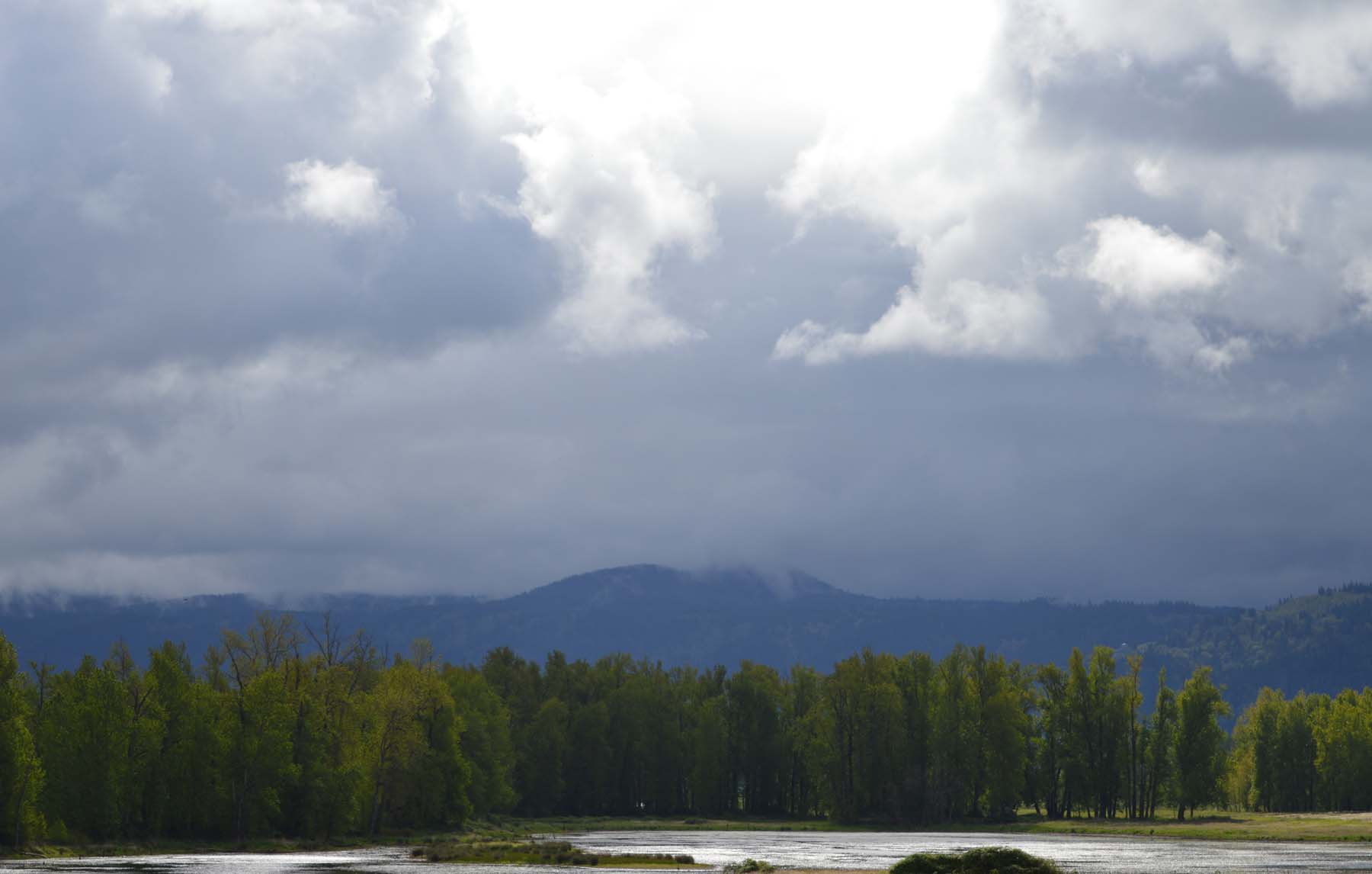
Columbia River, looking East
Two of my regular haunts, the Steigerwald Lake National Wildlife Preserve in WA, and parts of the Tualatin River National Wildlife Preserve south of Portland closed a while ago for considerable amounts of time, 3 and 1.5 years respectively, to restructure the landscape, reconnecting the rivers with floodplains. Altogether important environmental improvements, with me (and others) moping about years of lost access even while acknowledging the need, and now celebrating the re-opening.
Restored flood plain and lake, respectively
When I first learned about the closures in 2019, I was upset that everything changes, even landscapes, usually reliable points of constancy. In fact, hiking through both preserves this week, I was again sad about some paths no longer accessible, while others were rerouted and still bore signs of human construction and interference, which will soon disappear, I guess.
Harrier Hawk
I consider myself a person pretty open to change, even if it is not always chosen by myself. I have lived through and adapted to major changes, the types of environments I lived in, from small rural German village-life to years in metropoles like New York City, the languages I have spoken, careers that came and went, constellations within my household, rise and decline of friendships and last, but not least, changing capacities of an ailing body. All taken, with the exception of short interims of sadness or agitation, in stride. So why is the change in the faces of familiar landscapes such an issue? You tell me.
Herded goslings and flock of lesser yellowlegs, I think
Plain old ducks
It makes me embarrassed. Almost ashamed, given the intense demands for adaptation to change required by the many refugees in this war- and misery-torn world of 2022. Think about the psychological burdens for any given refugee, with Ukraine of course holding a special place in my consciousness right now. The trauma load often consists of the pre-flight part, where violent events, threat to life or loss of loved ones and destruction of home are experienced. Then the flight itself whether under a carpet of bombing, or across ocean with unstable boats, drowning in the Mediterranean, burning to death in dry Greek island camps or freezing to death at closed Polish borders, you name it. Then the arrival in the host country, which reacts to despondency with varying degrees of helpfulness, often dependent on the color of your skin, the (dis)similarity of religious and cultural practices, your ability to speak or learn the language and degree of prior education.
Northern flicker, joined by swallows
Add to this forms of survivor guilt, that you escape a dreaded fate that others didn’t (think of the large number of Afghans who were left behind by those who were allowed to flee,) the separation of family units (men not allowed to leave their country of origin, for example, to be recruited) and the complete loss of trust when your very own friends and neighbors became the enemy who killed you and yours (think Bosnia, for example,) or refused to believe the reality of your plight (your Russian family not accepting that war occurs in Ukraine.) It is no surprise, then, that studies indicate that depression and anxiety are at least as common as post-traumatic stress disorder (PTSD)and suggest that one or a combination of these conditions affects at least one in three refugees. (Ref.) One in three…
Turtles
Of course there are exceptions – here is a well-told story of a Syrian refugee in Germany whose intelligence, achievement orientation and a good portion of luck enabled successful adaption despite cultural and bureaucratic obstacles. Here is a thoughtful document for professionals how to help children through the acculturation process that speaks to a larger, more general need and seems to have been successful. (Source is Canadian, the only thing I could find in English.)
Blue herons roosting
In any case: the burden of required change while under psychological duress, or even traumatized, is immense.
My own reaction to changes in nature should be nothing but endless gratitude for what I have and what I’m spared. Duly noted. Grip gotten.
Common yellow throat
Yellow-rumped warbler (Butter butt!)
Music today is a favorite cello concerto. War horse, I know, doesn’t make it less beautiful.
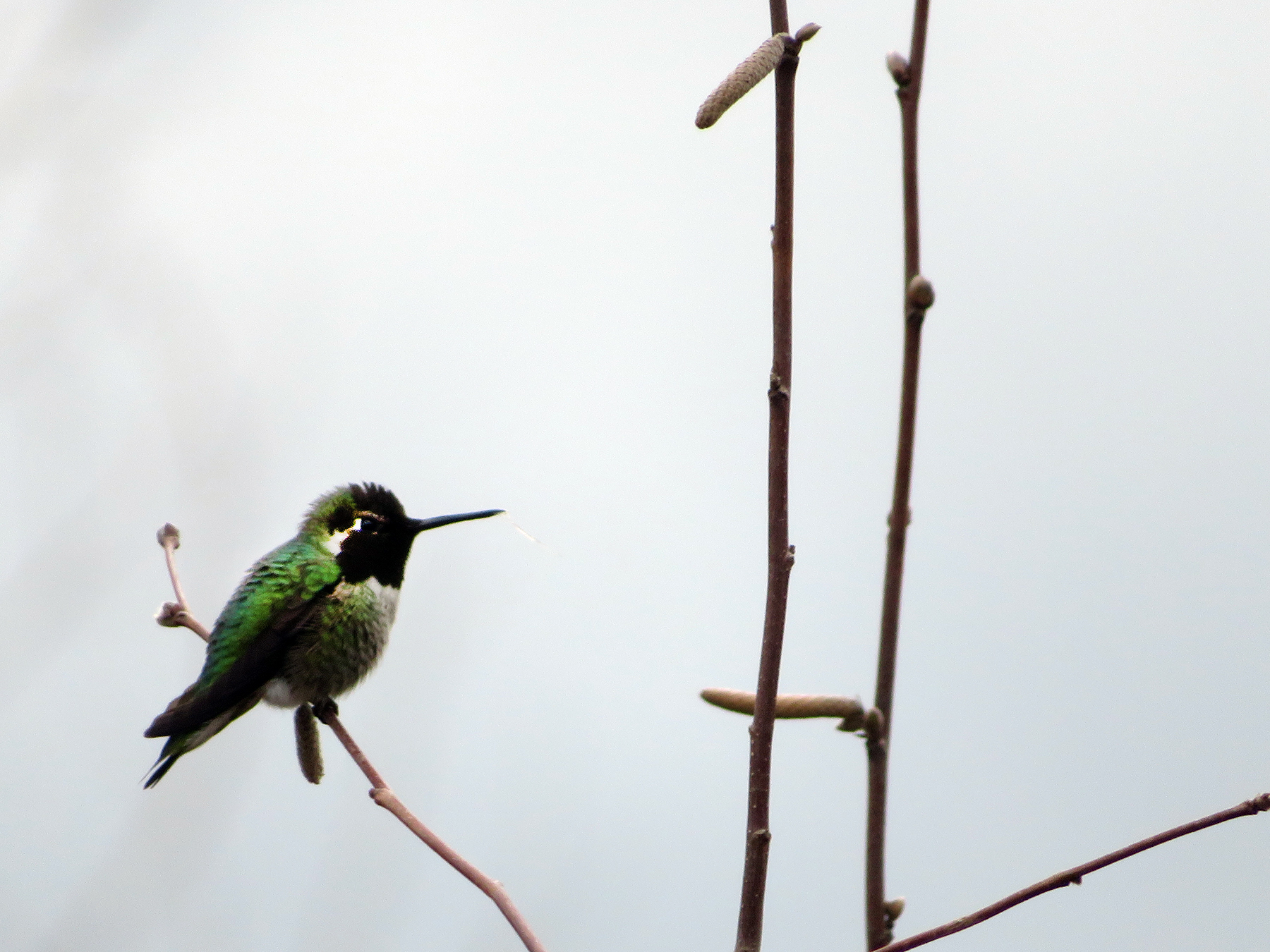
And here is someone waiting for the mosquitoes to enter his beak:
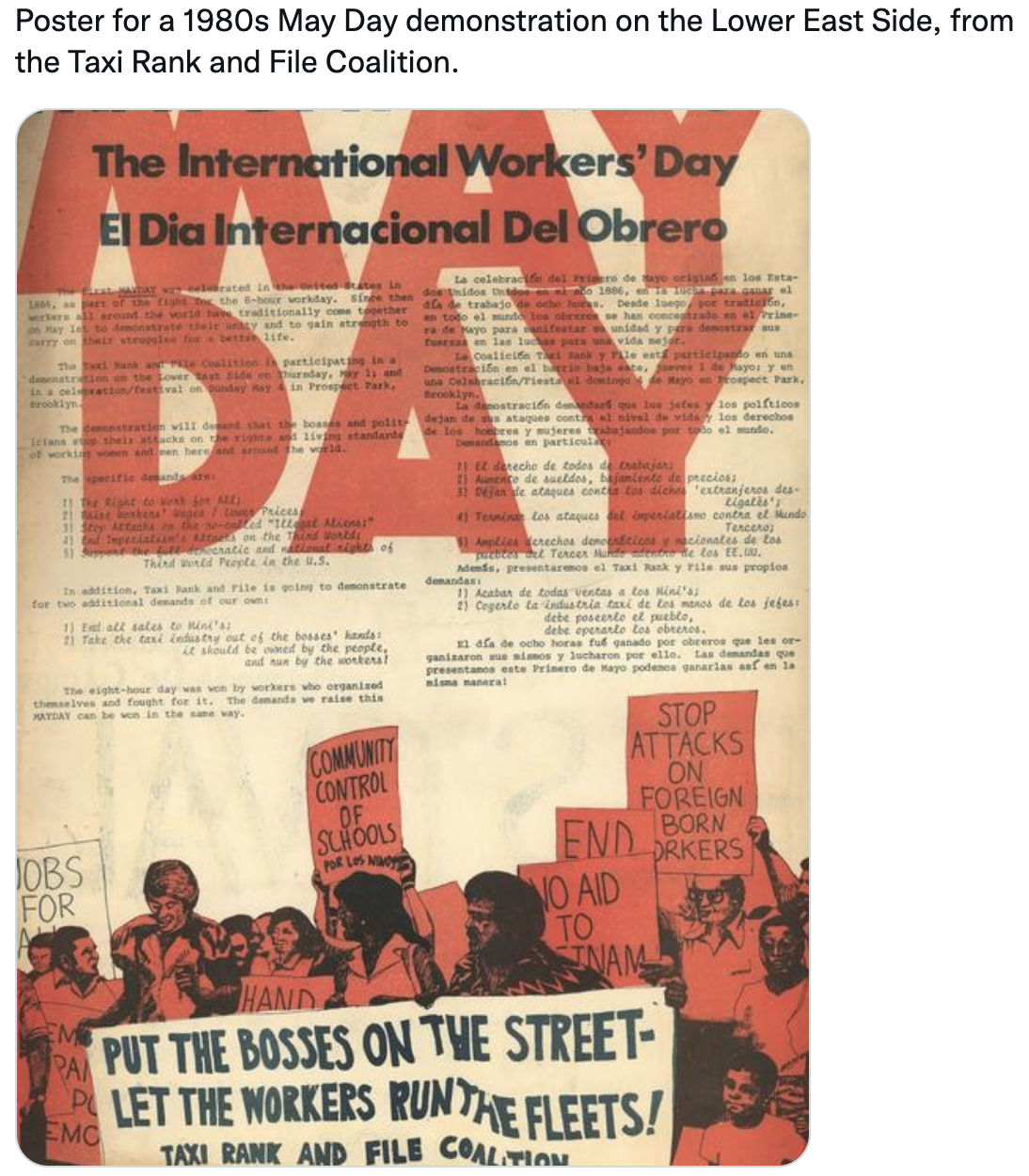
Yesterday was May 1st, International Labor Day, the traditional day for honoring workers and workers’ movements internationally. It originated, interestingly enough, out of the labor union movement in the U.S. in the late 1800s, calling for an 8 hour work day. Would’t you know it, the day is not officially recognized in this country today, since any sort of emboldening international solidarity is resisted.
(In honor of May 1st, today’s images are of posters around the world, found in postings by @Jacobin.)
In any case, it is a day that sees protest marches around the world, not all related to labor issues but more generally questioning capitalist rules or political developments (in France, for example both the left and the extreme right were protesting yesterday against Macron’s victory, in Germany large blocs of people protested against housing prices and policies and in favor of feminist politics.) These protests often see large police contingents posted to intervene if violence breaks out, to arrest those perceived to break laws and to protect interests of the state. In Berlin alone, 6000 police officers were posted across the weekend.
When those arrested are brought to trial, the police are called on to testify as eyewitnesses. This brings me to the actual focus of today’s blog, the many myths surrounding the evidence provided by police in general criminal proceedings, as described in a paper by psychologists Kathy Pezdek & Dan Reisberg, Psychological Myths about Evidence in the Legal System: How Should Researchers Respond?, to be published in the Journal of Applied Research in Memory & Cognition in June.
The article describes some of the myths that pervade the legal system. I will alert you to the myths that are listed and why it is important that we become aware that they, as it turns out, have no basis in fact. I will not reiterate the scientific literature that shows how these myths are debunked, which is the core of the scientific paper, but would go beyond the scope of a blog. (Preprints for the whole article can be requested here: Kathy.Pezdek@cgu.edu, or here: reisberg@reed.edu.)
Myth #1: Officers are More Accurate Eyewitnesses than Civilians
Judges, jurors, and many others believe that law enforcement personnel are more credible than other witnesses when they testify in court and, moreover, that officers are more accurate eyewitnesses than civilians. A related claim is that identification evidence provided by police officers is more reliable than identification evidence provided by civilians, and thus the safeguards generally required when civilians are asked to make an identification – safeguards that include proper instructions before the identification, a properly constructed lineup, and so on, are not needed for police officers.
The reality: Police officers have no advantage as eyewitnesses in identifying the perpetrator. Some studies even suggest they are at a disadvantage.
Myth #2: High Stress Improves the Accuracy of Memory
Many people buy into the belief that stressful events are better remembered – and, in fact, are remembered accurately, completely, and with little or no forgetting as time goes by. Ain’t so, and that goes for police officers as well. If anything, high stress impairs memory, rather than enhances it. In addition, memory for stressful events, just like memory overall, can be influenced (and distorted) by post-event misinformation, so holds no special status.
In other words, then: officers suffer perceptual and memory distortions when under stress, just as civilians do.
Myth #3: A Sleep Cycle after a Use-of-force Incident Improves Memory
There are many policy proposals supported by state legislatures and police unions that there should be a “cooling off period” after the use of force before questioning the involved officer, periods trending in length from 72 hours to 10 days. Often this proposal is part of a policy termed the “police officers’ bill of rights.” The claim is that this delay will improve memory, in addition to helping the officer regain composure and get some rest. This stands in conflict with what the evidence shows: delayed reporting is inferior to reporting immediately after an event. Memory fades, folks.
In addition, delay in reporting creates a risk that the officer (or any other witness) will encounter information that can merge with their original memory, undermining memory accuracy. Confusing the source from which you gained knowledge is also enhanced with he passage of time. Even if one did not eye these proposals suspiciously as a tool for the involved officers to get their act together and prepare and coordinate testimony, the suggested delay will hurt not help the finders of fact and the legal proceedings in general.
Myth #4: Double-Blind Lineups are Unnecessary
For photographic lineups, a double-blind procedure is one in which the lineup is administered by someone not involved in the investigation, so that neither the administrator nor the witness is told which photo shows the police suspect. With this procedure in place, the witness makes a selection guided only (one hopes) by the witness’s recollection of the actual culprit’s appearance, and not due to some (involuntary or voluntary) cues or hints by the administrator, and this does diminish bias in identification procedures. Despite their protestations, police officers are not immune to the effects of non-blind lineups. In other words, they, too, should be asked to identify culprits using the double-blind procedure.
Myth #5: Viewing BWC Footage Does Not Contaminate Officers’ Memory
After using force, law enforcement officers are asked to write a report, describing the episode. In many jurisdictions, police insist that they should write the report only after reviewing their body worn camera videos. Any suggestion to the contrary has been strongly rejected by police organizations. This refusal ignores the data that show how memory accuracy is contaminated by seeing the video. It provides the officers with actually-not-remembered information, and this information is simply absorbed into their eventual “memory” report – exactly the pattern expected based on decades of research on post-event suggestion.
Myth #6: Police Officers Can Accurately Detect Deception
There is a widespread notion that police officers are trained to detect liars and are better than your average civilian at doing so. Just for the record: we are all pretty lousy at detecting deception: on average not much better than tossing a coin. Law enforcement officers are not much better in their performance – but do assume that they are. Their confidence levels in their ability to detect lies stand in little correlation to their actual abilities. Training or experience do little to improve these skills, but they seem to feed into false assurance about skill levels.
Why does all this matter?
For one, if legal decisions are made based on false assumptions (evidence given by police witnesses is superior, thus can be trusted over diverging evidence, for example,) we are in trouble. Educating judges, attorneys, jurors and the police themselves seems important to avoid false conclusions that decide people’s fate. These myths are also often reflected in policy documents that govern both law enforcement and legal procedures. It seems important to debunk the mistaken beliefs of policy makers as well, given how consequential these myths are.
The quality something has when it is possible for you to know in advance that it will happen or what it will be like
(often disapproving) the quality somebody/something has when they are exactly as you would expect and therefore boring – Oxford English Dictionary
It has been quite a while since I wrote my last Art on the Road essay, more than two years, in fact. Predictably so, given the pandemic’s impact on traveling. I am still restricted to short car trips, but mobile now, and so hopefully have interesting things to report across the next months.
Sculpture near the artist’s wood shop
Predictability and its opposite, unpredictability, currently loom large in my mind, given the fact that we’ve seen such sudden changes in a world that considered itself, at least from Western nations’ privileged perspectives, relatively stable. Now the horrors of millions dead from or afflicted by the lasting damage of a virus have been joined by the terror of an unprovoked war in Europe, with unpredictable outcomes in a world filled with nuclear weapons.
Sculpture near the artist’s wood shop
Humans like predictability, given its relation to something we crave: a sense of control and protection from randomness which threatens our longing for a rational, just world. As societies we have created norms, both legally and customary, to allow us to predict and trust. Those who defy these norms are usually disliked at best, punished at worst. This rule comes with exceptions, though. People versed in political or militaristic power struggles often favor unpredictability to seed chaos and fear. And those in the sciences and the arts who approach problem solving or creation in unpredictable ways often come up with the most creative solutions.
Sculpture on the artist’s house wall
Another dimension of predictability is what we are trying to predict, based on our understanding of how the world works. Once upon a time, Newton gave us a basic model for prediction: express the immutable laws of the universe in formulas, plug in the data, and do the math. That might work if we want to know when a dropped ball hits the ground, but that’s not nearly the full spectrum. We have trouble predicting psychological behavior given the many visible and invisible factors that affect our minds. And when we do predict outcomes we often have no clue about the underlying cause – just look at the internet’s prediction markets that allow people to place bets on future events. The resulting odds can accurately predict outcomes (who gets elected, what show will thrive) without giving us insight as to why these things will happen.
Sculpture near the artist’s wood shop
And then there is the (un)predictability of the material one works with. Which brings us at long last to the artist I want to introduce today, sculptor and woodturner Christian Burchard. He works with wet and unstable wood which often, if not always, behaves in unpredictable ways. (In fact, today’s title is a riff on the title of a lecture, Predictable Unpredictability, he and another artist, Pascal Oudet, gave at the prestigious Chicago’s SOFA (Sculptural Objects Functional Art & Design Fair) some years back.)
***
I met with the artist at his Southern Oregon wood shop and house, which hold vast collections of his work. It was pretty much a chance encounter. I had come to Ashland to interview his partner and was introduced to Burchard who graciously agreed to talk to me as well and show me around the next day. The beauty of the accumulated wooden objects, turned, carved, polished, raw, strewn about or stashed in shelves outside the usual formal displays one encounters in exhibitions and galleries, caught my eye as an artist. The story behind them caught my ear as a writer. No titles, no dates, no artist statements about this or that series, just the artist and his creations, addressed as “my acrobats” here or “my books” there, a tangible relationship.
Burchard collects, cuts, turns, dreams wood. Almost exclusively the wood of one of the Pacific Northwest’s most distinctive, evergreen hardwood trees, Arbutus menziesii, known as Madrone. It grows on drier, lower elevation sites, coastal bluffs and in the mountains. Drought tolerant, it doesn’t need particularly rich soil and can live up to 200 years, growing to about 75 feet or more in height under ideal conditions. Madrone is culturally significant to the PNW Coast Salish First Nations. Legend has it that during the great flood Madrona trees provided an anchor for their canoes to hold steady and not drift away.
According to Elder Dave Elliot in Saltwater People, “W̱SÁNEĆ peoples traditionally do not burn Arbutus for firewood because it is an important actor in the origin of their people. Some elements of the trees could be used, such as the bark and leaves for medicines. The extent of this tree’s meaning as a symbol of life and resilience cannot be measured.” (Ref.)
Madrone trees that I photographed along the Pacific Coast
The tree, seeking sun, often grows in crooked ways, with lots of burls, interesting shapes, perfect for a sculptor exploring new form. Working with the wood when it is still green, though, introduces not just unpredictable outcomes: how will it warp and flex when it dries? It also contains a serious element of risk – when you put it to the lathe, careful to turn, creating a form, will it snap and break at the last minute? All the work in vain, a good piece of wood ruined? Will charring or bleaching, carving or chiseling enhance the character of the wood or obscure it?
From the series Baskets and Vessels
Burchard is not a stranger to risk taking, in fact I am tempted to describe him as a perennial risk taker, on many levels of a life intensely lived. Judging by the results, and the deep laugh lines around his eyes, it has served him well. Then again, the concurrent losses might not be visible to the stranger, even one who felt the familiarity that so often spontaneously arises when one ex-pat meets another.
Christian Burchard, sculptor and woodturner
The artist and I are both of the same generation, have left our shared country, Germany, within three years of each other some 40 years ago, lived in the same city, and had the travel bug even before we emigrated, spending some chunks of time abroad (Australia and Asia for him, South America and Africa for me.) It cannot have been easy for Burchard. He comes from a distinguished family of politicians, bankers and lawyers who played a significant role in the history of the Hanseatic League, a great-grandfather serving as mayor of its largest city, Hamburg and its immense harbor. Think Thomas Mann’s seminal novel The Buddenbrooks, just in a different town. The small network of patrician families ruled for centuries as a kind of oligarchy, providing mayors, senators, clergy and lawyers, fed by the wealth of a huge merchant imperium and shipping companies. Aristocracy was disdained, as were Jews, even assimilated ones, and a strict separated class system was de-facto maintained despite the official version that in the Hanseatic city each and every inhabitant was of equal standing. You could purchase the right to be a citizen of higher standing (Großbürgerrecht) only with true wealth and that right was then inherited by male heirs, allowing you to serve in political office.
From the Series Spherical
True democracy was, in other words, in short supply, pride, on the other hand, was not. There are reports of Burchard’s ancestor, the mayor Johann Heinrich Burchard, that he ordered the portrait painter Heinrich Kugelberg during the creation of a mural in the ballroom of Hamburg’s city hall to remove the image of a young man kneeling to receive baptism because “Hamburg’s citizens don’t kneel in front of anyone.” (Ref.)
This is a montage depicting the Hamburg City Hall, seat of the mayor, from my series Seeing Strange (2018)
There was some rise and fall of individual families, but across the centuries it was a prestigious, exclusive lot that ran the city’s business, courts and politics, intermarried, and accumulated wealth. Diligence, responsibility, reliability and predictability were all high on the list of values of the Hanseatic classes as was devoted service to their city and a cooly analytic approach to trade. To be born into this world came not just with silver spoons but also intense pressure to perform and uphold those class privileges. If you did not, complete ostracism was one of the possible consequences. I remember the years after my uncle (by marriage), a descendent of another famous Hamburg mayor, Heinrich Kellinghusen, walked out on my aunt, unannounced on Christmas Eve, no less, to move in with – the scandal ! – a purported prostitute, and I was told that no-one ever talked to him again.
From the series Vessels
Others, however, seemed to escape that fate. Another Hamburg lawyer and senator of the Burchard branch, Wilhelm Amsinck Burchard-Motz, became deputy mayor of Hamburg in 1933. The election of the new Senate under Nazi leadership that March prompted him to switch party allegiance from the DVP to the NSDAP. That seemed not to matter in post-war Germany where he served as the chairman for the German Association for International Maritime Law and as Vice President of the German Golf Association and Chairman of the Hamburg Country and Golf Club in the Lüneburg Heath, as exclusive a club as they came at the time.
(Here is his portrait by artist Anita Rée, an insanely gifted avant-garde painter in the 1920s. An assimilated Jew, she converted to Christianity and was expressly anti-semitic herself, only to get sucked into the maws of rising fascism. She committed suicide in 1933.)
Portrait of Wilhelm Amsinck Burchard-Motz by Anita Rée, late 1920s
Another mayor who served the city recently for 7 years is now the German chancellor tasked to bring the world away from the brink of nuclear war. Here is a perceptive portrait of the man from the New Statesman Journal, describing Olaf Scholz’ hanseatic profile and demeanor, assumed to bring us safely through this crisis.
***
To defy the strong expectations to follow in the footsteps of your forbears and give up much privilege if you don’t, must have required an iron will by Christian Burchard, an intense wish to control his own fate, or a kind of desperation to get away from it all. After apprenticing as a furniture maker in Germany, he escaped to the US in 1978, at age 23, studying sculpture and drawing at the Museum School in Boston and at the Emily Carr College of Art and Design in Vancouver BC.
Burchard’s Wood Shop
Burchard opened his own studio in Southern Oregon in 1982, supplementing his income with furniture making and house construction, building a house for his own young family, all the while garnering more and more recognition as a gifted wood sculptor. The list of exhibitions is long, he is represented in various private and public collections, and he regularly is invited to the important craft shows of the Smithsonian, or the American Association of Woodturners. In fact, preparations for a cross-country trip, bringing new work to the Smithsonian in D.C., were in full swing during my visit.
***
It is pretty predictable that you find common ground when you share the experience of immigration. There is a tacit understanding that things are lost as much as gained. There is an unspoken agreement that you know some things that are hard to explain to those who did not leave a complicated past behind. In our conversation this became explicit only due to the timing of Putin’s unpredicted, if feared, invasion of Ukraine that very day. The topic of war and its associated frights and horrors was inescapable during a post-war German childhood, stifling and paralyzing at times, guilt-laden or guilt-avoidant, depending on your family, always hovering in the background. Nothing we could control, it controlled us.
All the more it is interesting to see an artist commit to a path – working with unstable wood – where control is ephemeral as well. Maybe it is exactly the balance he craves: where lack of control once created sorrow, here it results in visceral beauty. Something emerges, authentic, if scarred, from unpredictability and takes on a life of its own.
The Lathe
There is a vitality to his small books, a fluttering sense of just opening or just closing, as you wish. But Burchard exerts spatial control as well, introducing his own visual blueprint in his latest framings within quilt-like configurations or wall sculptures. A sense of order direly needed in an environment where climate change has become an agent of chaos.
Wall Sculpture and objects from the Books and Pages series
The beautiful land that he and his partner live on, the goats he rears for making cheese, the pond that is necessary for sustaining their independence with a vegetable garden, are all affected. To meet the danger of the ever closer, encroaching fires, they had to rip out many trees, bushes, much vegetation, fire proofing the buildings. He – half-jokingly – referred to a recently acquired van as something useful for flight, should it become necessary, which brought me full circle to the imagery of our childhoods as related by our parents, the firestorm from bombs destroying large parts of Hamburg and the flight from the invading forces in Berlin and parts further East.
The artist with his goats, and views from his property
Recent psychological research in the study of memory has turned from looking at memory exclusively as the processes involved in preserving the past, to exploring how it is used to predict the future. We have the tools – and the choice – of looking back or looking forward.
The meaning I found in Burchard’s work reflected that dual function. It also reminded me of Antonio Gramsci’s future-oriented declaration:
“I’m a pessimist because of intelligence, but an optimist because of will.” ― Antonio Gramsci, Antonio Gramsci: Prison Letters
The sculptures express the optimistic view that the imperfect, the warped and twisted and charred can all connect us to a vision of nature’s beauty, but they also point to the possibility of acquiring a new life after an old one ceased to exist.
Acrobats
***
On my 5-hour drive home from Ashland I left the highway for a break and found a small pond with picnic benches, close to a campground. (Why anyone would want to camp next to I-5 is a mystery to me. Solving it has to wait for another day.) I stopped next to a park-service van and took the left-over from the previous day’s sandwich to the bench. A woman in park service uniform was pacing at the edge of the water, searching for something. It turned out she had nursed a duck, severely injured by aggressive geese, back to health the previous summer, driving over 40 miles every other day to bring food, water and splints for the creature. She had seen the duck during the winter as well, fully restored, but now it was gone. I got the story in more detail than I can relate, her worry for the bird gushing out of her. Her final words before she drove away were willfully optimistic: “Perhaps he found a nice wife and they are off to build a nest.”
Wherever I go I predictably meet people who are passionate about something. What that something might be – a life devoted to being independent and making art, a year devoted to saving a duck – is unpredictable. What I do know, though, is that I am glad to be on the road again, encouraged by people who put their faith in a possible future, during times when dark forces try to drag us back into an oppressive past.
Below is a presentation by the artist.
Music today is by Tuvan Throat singers which hold a special place in Burchard’s life.
Preface: I debated long and hard if it was frivolous to post today’s musings, written at the beginning of the week, given the grim news out of Ukraine as Putin’s forces have fully invaded the country and appear intent on regime change. But I do believe we need to take care of our mental health by not exclusively thinking about terrifying things, and so thought this would be 10 minutes of your day to focus on something else. I will, however, add at the end some sources that support Ukrainians from a variety of perspectives.
————————————————————–
A lot of people I know are happy to buy old photographs they find at flea markets or antique stores. Not the artistic kind, mind you, but snapshots of people who they never met, who have probably walked on long ago, and whose families had no interest in keepsakes. I have always felt that it was intrusive, somehow crossing a border into someone’s privacy, not quite kosher.
Nonetheless, I very much enjoy it when collectors actually come up with some interesting aggregate that tells us something about similarities and differences across time, or capture a Zeitgeist, or point to some inexplicable curiosity. I know, I’m not consistent, but then who is….
One of those accumulations of discarded photographs was published in 2015 by a Frenchman, Jean-Marie Donat, who had searched for and found photographs of people posing with others, costumed as polar bears, in Germany from the 1920s to the 1960s. The book’s limited edition, a collection of over 200 found photographs weirdly titled TeddyBears, is sold out. Thus I cannot tell if the mystery of such a strange prop was ever revealed.
There is speculation, though, that the hype started with 2 beloved polar bears in the Berlin Zoo in the early 1920s, and costumed employees taking pictures with themselves and visitors to increase zoo attendance. From there it spread.
I can personally vouch for the presence of such creatures in Berlin with this 1928 picture of my then 4-year old mother, posing to the left of the bear. How the album survived war and flight, I don’t know. If that picture had landed at a flea market, perhaps I’d be glad for an interested collector who would keep that smile around.
Another edition of snapshots – this time of women in trees – was recently showcased in The Marginalian (formerly Brainpickings.) Described as “Sweet and Subversive Vintage Photographs of Defiant Delight,” Popova offers both some of the photographs and her, as always, thoughtful commentary on the nature of tree climbing and taking photographs of unusual activities or circumstances.
The collector Joachim Raiss eventually jumped on the polar bear train as well, it looks like. Irresistible flea market finds, I guess. The views of women in trees appealed to me, someone known to have climbed a tree or two in better times, as a display of discarding of norms and exuberant recklessness, even if Sunday finery was involved.
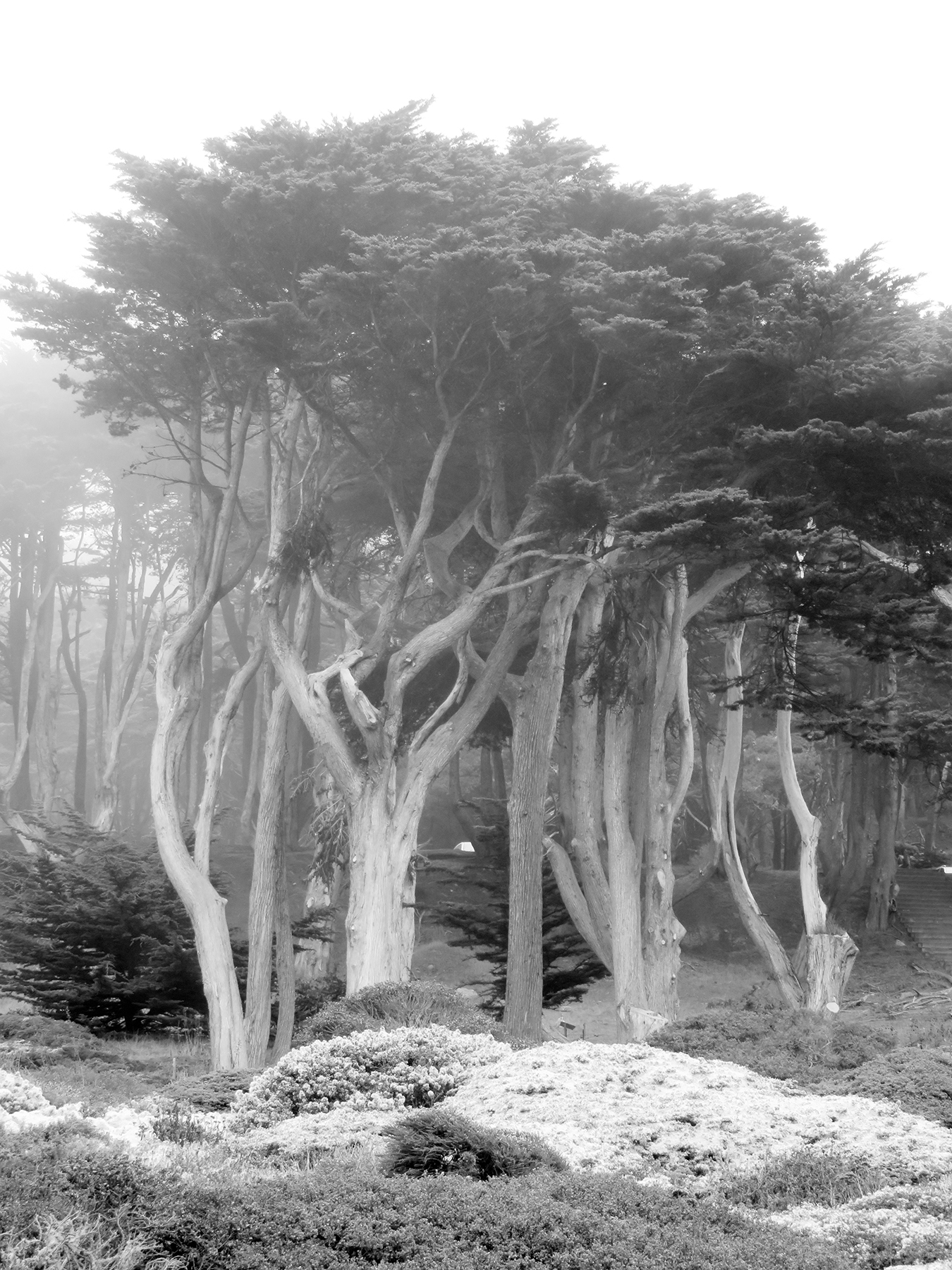
(My photographs today are of unclimbed but admired trees, pines and eucalyptus, in San Francisco’s Golden Gate Park and along the Pacific coast.)
Speaking of reckless and tree climbing: How does this bit of science journalism sound to you?
“Climbing a tree or balancing on a beam can dramatically improve cognitive skills, according to a study recently conducted by researchers in the Department of Psychology at the University of North Florida. Working memory capacity increase of 50 percent found in research.” (Ref.)
These assertions refer to a study that looked at a group of adults who were given training exercises that focussed on proprioception, the awareness of body orientation and positioning. They engaged in activities that required both attention to body position and physical exertion – lifting, running, balancing, crawling, specific new sequences of movements. Their working memory (how you process and remember facts currently in your view) was tested before and after the training and it improved! Control groups either listened, while seated, to a lecture, or did a gentle form of Hatha Yoga, Kripula Yoga, which focusses on body posture and awareness, contraction of muscles and breathing, and neither control group showed a gain in working memory capacity.
Shall we rejoice – hey, all we need is the right exercise and our decrepit memory picks up… or shall we give the study a closer look?
For one, no mention of tree climbing in the methods section – where did that come from? Secondly, the groups were extremely small, just 18 participants in the experimental condition of movement training, larger control groups, but still underpowered and in any case not the same number of participants.
Groups also varied along so many dimensions that any comparison is very hard to link back to a causal factor. The age composition was different, the gender composition was almost reversed between training group and one control group.
The duration of the experiment was much longer for the training group (2 and 2.5 hrs respectively for training, while only one session for one hour at yoga.) The training exercises were new, the yoga control, however, was intermediate, in other words familiar with the moves. (It is also inexplicable why this study did not find a beneficial effect of Yoga on working memory, when many other studies of Hatha Yoga have…).
And last but not least, the task they used to assess memory improvement is not one of the better ones, we’ve had more precise tools in our tool box for the last 20 years.
I am summarizing these things not only so you don’t have to slog through a methods section. More importantly, I don’t just want to point out that there is weak research out there and data interpretations that cannot be trusted – I assume we all agree on that.
I am trying to stress the issue of reckless science reporting, that papers over ambiguous results or introduces bad data, and will soon be contradicted when the next result is out that points in a different direction. The public, in general, is mostly not aware of what constitutes reliable science and what should never have made it through the review process. Seeing conflicting results, ever changing tacks on this or that claim, will undermine trust in science, at a time when that trust is already at a low point, politically expedient for some, no doubt.
Shouting not from the rooftops, but the tops of trees: check the science before jumping to conclusions and writing it up for cheap effects in the news. Scientist in tree insists!
Music today is from Berlin in the 1920s where many of the snapshots were taken, Kurt Weill’s Dreigroschen Oper original version.
And here is another Weill song, covered by David Bowie who lived in Berlin and performed live there.
And no, I did not really climb that tree! I climb heights with photoshop these days…. But I did photograph the tree.
Almost out of the door, I grabbed the small point&shoot camera despite knowing better. It had been a bad week of painful lymphedema in chest and arm around the incisions, and I really should not lift my arm too much. Oh well. Was I ever glad I had at least this camera with me when doing the familiar round at Oaks Bottom. Come join me!
They were out, my cherished crows, in masses, hanging in the trees squawking, strutting through the meadow. Which should be much less straw colored in February, reminding me that we’ve now had four years in a row where rainfall was way below average.
Entering the wooded path, the beauty – Japanese print-like – of the duckweed on reflecting water was inspiring, even with the knowledge that it is found growing in water associated with cropping and fertilizer washout, or down stream from human activities, particularly from sewage works, housed animal production systems and to some extent industrial plants.
Given the color, I was not sure if it was common duckweed or more likely azolla, red water fern. The ducks didn’t care, and neither should we. Both are fascinating plants, providing nutrients and helping ecosystems.
Gadwalls, I learn. They live in the Great Plains but migrate through here.
The herons were unperturbed, out for lunch, ignoring me walking but a few meters away from them. I guess the loudly singing tree frogs at the pond’s rim were on the menu.
Beaver activity was visible everywhere,
but I think this fellow was a muskrat.
I can never tell. A kilometer further down I spotted this guy, and given his lunch, a fish, the likelihood was otter. As I said, cheap camera, not the resolution one would have wished for with this sight. I mean how often do you see an otter eating fish 15 minutes downtown from city center?
When I got to the viewpoint, the extent of the drought became more visible. This should be a lake, folks, not a dry hole in the ground.
If you are like me, it gives you the creeps. If you are like many of our compatriots, it instills fear, sometimes to the point of a condition that the the American Psychological Association (APA) defined as eco-anxiety, ”a chronic fear of environmental doom.” It is not listed in the Diagnostic and Statistical Manual of Mental Disorders (DSM-5,) but clinicians all over report attempts to treat it.
Not sure if this was the doe or one of her fawns that I regularly saw last summer
Last April, an article in the Scientific American described in depth what therapists are facing and how they have to make decisions about how to treat the massively increased numbers of patients who present fear if not panic in the face of climate catastrophe. A 2020 poll by the American Psychiatric Association showed that “more than two-thirds of Americans (67%) are somewhat or extremely anxious about the impact of climate change on the planet, and more than half (55%*) are somewhat or extremely anxious about the impact of climate change on their own mental health.”
Red-tailed hawk
The NYT joined the topic with an article last week, describing the treatment approach by one of the earliest proponents of a necessary treatment approach to eco-anxiety.
Here is the dilemma: there is a tension between eco-anxiety’s role as a rational response to an existing threat, on the one hand, but also a potentially debilitating response, on the other hand.
There’s no clear, standard definition as to when eco-anxiety is unhealthy. It is rational to be fearful in view of a threat, and the threat is real. It is, however, unhealthy if it paralyzes your daily function, as it now does for scores of people. There is also the question of therapists’ own (political) beliefs. If they think your analysis of the threat is exaggerated or delusional (they don’t believe in climate change or its imminence) they will pathologize your response, which will have an impact on your therapeutic relationship.
Scrub Jay
Therapists themselves also feel unable to cope with their own feelings about environmental destruction. “When a therapist hasn’t begun to come to terms with their own emotions around climate change, it can add to the emotional turmoil of clients coping with overwhelming grief and anxiety, said Tree Staunton, a climate psychotherapist in Bath, England. For example, a therapist’s own grief, anxiety or guilt might come off as defensiveness or withdrawal.“ (Ref.)
Then there are the cases of people, in particular children, who have been personally impacted by traumatic events like fires, flood and tornados or hurricanes caused or aggravated by climate change, who are living with actual PTSD that needs to be treated while the threat of these events is ongoing.
Willamette River bank bordering Oaks Bottom on the Westside
The trolls were out, en masse, in the comment section for the NYT article. But so were thoughtful letters to the editor (2 examples below,) that highlighted important facts found both in and beyond the article.
“… the corporate construct that cleverly shifts the responsibility of a carbon footprint onto each individual. This is similar to the way the petrochemical and plastics industries have shifted all responsibility for recycling, particularly of the packaging they create, onto the individual, although the responsibility for recycling plastics should lie with the manufacturers.” (Mary Englert, Portland, Ore. The writer is a retired licensed professional counselor.)
“youth distress is directly related to the experience of governmental dismissal of and inaction on climate change. Young people are essentially reporting that their governments are gaslighting them by dismissing and devaluing their concerns, and by falsely stating that they are taking necessary action.This has significant political implications. Multiple reviews of the mental health effects of climate change (this is not a new topic in academia) all predict civil unrest and conflict as the long-term outcome. Politicians have a chance to correct course, honor their young constituents’ fears and act decisively. While therapy matters, preventing climate catastrophe matters more.” Mary G. Burke, San Francisco. The writer is a professor in the department of psychiatry at the University of California, San Francisco and a member of the university’s Climate Change and Mental Health Task Force.
Baldies
It is easy to feel helpless and anxious when thinking what we can do about the destruction of our world, when really a few large corporations—and complicit politicians—call the shots. But there ARE things one can do, and in the doing alleviate some of the anxiety.
There are some political moves that can help activists. Science is contributing tools to fight collective helplessness.
There is important information that you can read, outlining possible next steps. Earthtrack, for example, offers tons of information about governmental subsidies that harm the environment. Environmentally harmful subsidies (EHS) are government actions that by design or effect accelerate the production or consumption of natural resources or undermine broader ecosystems supporting planetary health. The data show at least $1.9 Trillion a year (2% of global GDP) being dished out to Energy, Mining(non-energy), Fisheries, Forestry, Water, Construction, and Transportation industries. The organization informs about both the beneficiaries of such subsidies, worldwide, and reports on possible actions against them.
Anna’s Hummingbird
And then there is art. The hole in the ground where the Oaks Bottom Lake should be reminded me of this project from L.A. last year.
Cara Levine and associated artists provided their week-long participatory event as a communal reaction to and lifting of grief over the losses incurred during the pandemic – including the land, where the dig took place, of The Shalom Institute campus – which was devastated by the Woolsey Fire of 2018. Might as well throw our eco – fear into the mix, or the hole as the case may be, being strengthened by knowing we are not alone.
Or we could be digging ourselves OUT of a hole by collective action. You know where you find me doing just that.
Scrub Jay
Music today is one of my picks when I try to deal with surges of anxiety.
“Deliver my soul from the sword; my darling from the power of the dog. Save me from the lion’s mouth: for thou hast heard me from the horns of the unicorns.”Psalm 22:20-21
If you want to see The Power of the Dog, Jane Campion’s newest film now playing on Netflix, without prejudice, hints or spoilers, stopreading right here. Peruse this screamingly funny review of Christmas Movies instead, and come back to the blog once you have been seduced by Campion’s latest.
—————————————————————————————————————-
Full disclosure, I used to be an avid Jane Campion fan. The director and screen writer, who earned degrees in anthropology and sculpture in addition to one in film studies, has always struck me as the perfect mix of intellectual powerhouse and visual artist who knows how to use space, color, atmospherics in ways that doubled and tripled the impact of her already intense plot lines. The Piano and more recently the 2 part series Top of the Lake count among my favorites, for visual magic as much as feminist approaches to the conflicted states women experience when they try to free themselves from patriarchal violence and restrictions.
I also watched a lot of Westerns. The strange, far away America came to the German TV screens, still black and white in the 1960s, with visions of John Wayne’s law and order and the Cartwright family in Bonanza (I almost choked on my coffee when I read the Wikipedia description that the show was “known for presenting pressing moral dilemmas.” The only dilemma I encountered was when we 12-year-old girls fought over who had first dibs on Little Joe…)
In the 70s I was drawn into Spaghetti Westerns. I used to watch them late at night in a small, smoke-filled movie house in a suburb of Hamburg, together with like-minded students who were exploring socialist politics and enchanted with the Westerns’ subversion of the American genre’s archetypes and the films’ revolutionary messages, particularly in the Zapata movies. These parables using the Mexican Civil War at the turn of the century as a vehicle for left-wing optimism and dreams fit right into the late 60s, early 70s in Europe when we had a lot of hope for change. As did Ennio Morricone’s film music, a constant on the turntable.
Many decades later, I saw Brokeback Mountain in the movie theatre (which I rarely went to, always worried that exposure to a large screen would emotionally overwhelm me – I like my films on a computer screen that helps me modulate my reactions.) And I am not averse to filling sleepless hours with unassuming commercial fare like Longmire. There, I admitted it.
And now comes The Power of the Dog, a Western by Jane Campion. Stellar acting, brilliant camera work, a languid story told in chapters, almost like a dream that slowly, unstoppably, turns into a nightmare. Think psycho-drama against a backdrop of the Rocky Mountains, with every Jungian archetype conceivable and clever symbolism to boot, gloves, ropes, scissors, traps and ominous landscapes included. Then share my surprise when myth-buster Campion, champion of strong, self-determined women, falls right back into depictions that are conventional female stereotypes, while focusing on the complicated, tortured souls of men. The only woman who lets her hair hang down, is one who is dead – miraculously growing golden locks in her coffin, or so it is reported, as if Rapunzel meets Snow White, no further prince needed.) There is an insensitivity to women who are depicted as violated or objectified that felt jarring, going against expectations set by Campion’s previous oeuvre.
The basic story describes the fate of four people. Two adult brothers own a successful ranch in Colorado in the early 1900s. One is a Yale-educated classicist who is the quintessential Western cowboy, toxic masculinity and all. The other is a reserved, politically aspiring businessman, who might soon climb into the ranks of robber barons or state politicians. Their shared bedroom is emptied, when the business man, George (Jesse Plemmons,) decides to marry a widow with a teenage son. Phil (Benedict Cumberbatch) is aghast at the change in the household and does everything he can to taunt and torture the newcomers, deemed gold digger and weakling, respectively.
Rose (Kirsten Dunst), who was a perfectly competent restaurant owner and former piano player in a movie pit, shrinks from the limelight she is thrown into when having to host important people. Moreover, she is deeply hurt and frightened by her brother-in-law’s meanness and slowly descends into serious alcohol abuse. Her husband hovers protectively when he’s there, although he seems to vanish increasingly from the scene the more the triangular tensions become apparent. Rose’s son Pete (Kodi Smit-McPhee) also does everything imaginable to protect his mother who lost her first husband, his father, when he committed suicide.
We soon learn that cowboy Phil was shaped by an intense relationship with his mentor, Bronco Henry, with likely homoerotic leanings, or at least unconscious desires. It is hard work for Phil to suppress his longings, particularly when he is surrounded by display of male beauty right out of Thomas Eakins’ or Henry Scott Tuke’s paintings.
Thomas Eakins The Swimming Hole)Henry Scott Tuke The Sunbathers
The teenager discovers this and makes use of this knowledge when he meticulously and cautiously plans to get rid of the tormentor to ensure his mother’s happiness. Letting himself be taunted as a “faggot” and a “Nancy” by the ranch hands, he stirs something in Phil that leads him to envision a relationship like he had with his mentor, now roles reversed. He wants to toughen up the waif-like youngster, rope him in, projecting onto him the possibility of ending loneliness. We see Phil change in front of our very eyes from bullying macho to vulnerable loner exhausted from repressing his sexual inclinations.
The boy, on the other hand, so seemingly vulnerable, stiff and thin, with a glaring lack of detectable sensuality, turns out to be made of steel, something that his father had always feared. He kills wildlife without hesitation, does autopsies to learn about biology, systematically gets the necessary tools and ingredients to kill with impunity, and eventually claims his target. His overarching desire to help his mother is not matched by any insights into what she wants or fears, just driven by his own interests, including a medical career with access to decisions over life and death.
A key scene where he walks amidst catcalling cowboys to inspect a nest of magpies gives it pretty much away. The symbolism of magpies does not just include extreme intelligence and trickery, it also stands for self-awareness. Magpies are the only non-mammals that pass the mirror test, a way to assess if an animal has self-awareness. Pete knows who he is and what he wants, no conflict between his conscious and unconscious, so prevalent in the rest of them. Dressed always in the black and white of the (NZ) magpies, with a similarly elongated shape that we mistake for a scare crow, he is the master of everyone’s fate.
While we still cringe at his executioner’s demeanor that grants a last cigarette to the condemned, smoked in alternation by Pete and Phil like a post-coital ritual that was never enacted, we soon wonder why he peruses the biblical verse exclaimed by Christ himself during cruxifixction, calling for help from the Almighty. “Deliver me from the power of the dog,” the pull of Satan’s seduction, “save me from the lion’s mouth,” the threat to Rose’s happiness, he’s dealt with all of them like a higher power himself.
The film does not just employ the various tropes of Jungian psychology, the ideas of persona and shadow, of anima and animus, or the concept of contrasexuality that was quite progressive for its time. The idea that masculinity and femininity can be contained in one person, and not correspond to being male or female, is really the focus of the narrative set in a world that abhorred that concept.
C.G. Jung was also steeped in biblical knowledge – his father was clergy, his mother came from a long line of theologians – but saw the bible more as describing psychological processes rather than revealing G-d’s word. So ending the story with a verse that refers to a cry for help at the same time that that help was delivered (as evil act, no less) is really something of a horn of the unicorn, something mysterious, inexplicable, rare.
So is Campion’s wizardry when it come to dropping clues. If the film was a dream, an analyst would have a field day. Maybe the Jungian dream analyst Campion repeatedly visited during the film shoot would agree. The symbolisms sure made my brain work, while my eyes feasted. Now can we please go back and use the director’s considerable skill-set to model for us the empowering of women? Psalm 22 could be of continued usefulness to set the stage:
But I am a worm, and no man; a reproach of men, and despised of the people. Psalm 22:6
Here’s the soundtrack. Composed by (Radiohead’s) Johnny Greenwood, with clear echoes of his fascination with Krzysztof Penderecki. Beautiful music.Disquieting too, like so much in that film.
Photographs from the American West, although not Colorado, which I still haven’t seen, nor have I visited New Zealand where the film was shot.
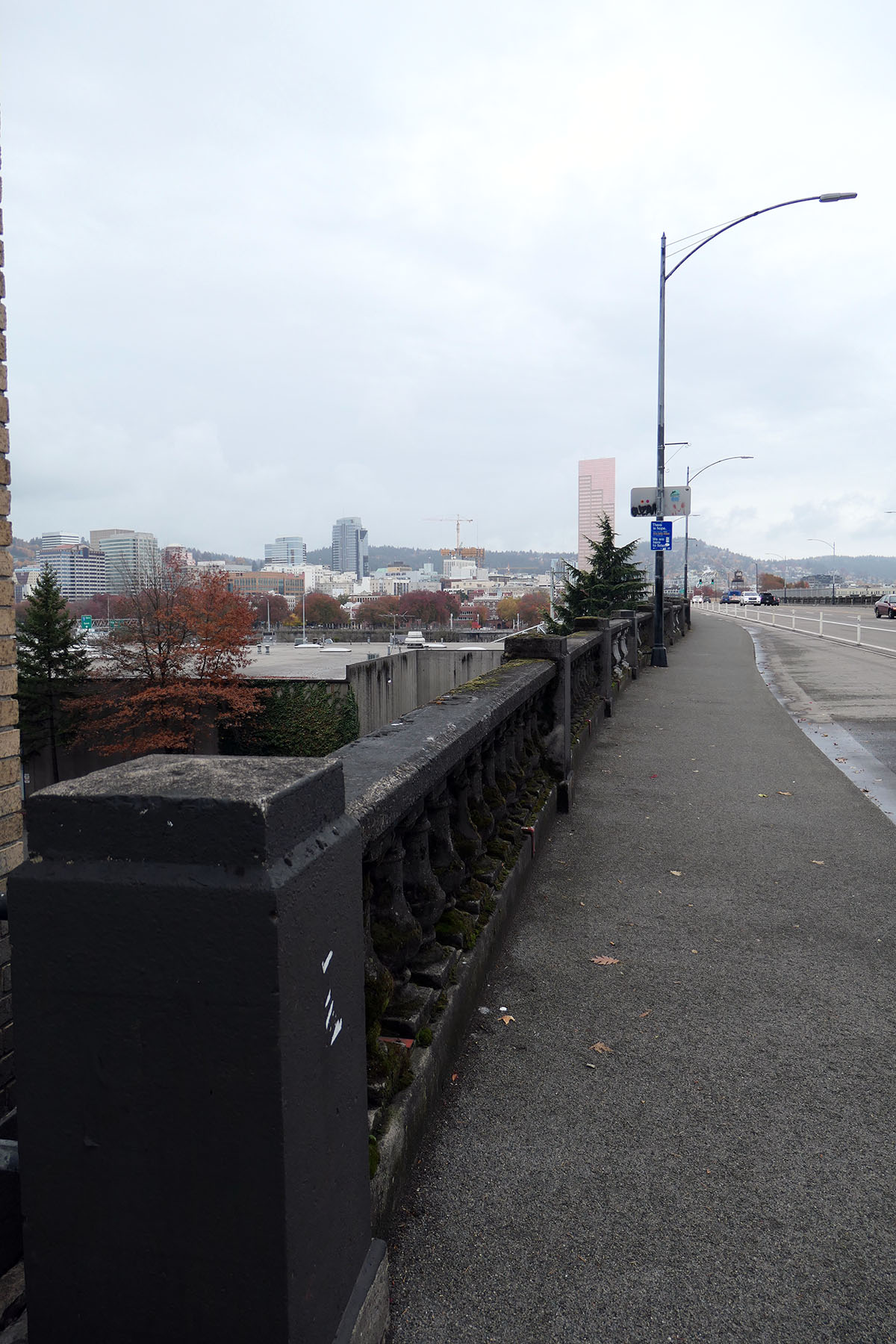
Once you have crossed Portland’s Burnside Bridge you will encounter a building on the Eastside that has large sheets of paper hanging in its windows. They are printed with a poem by Oregon’s current poet laureate, Anis Mojgani. It is an appeal which addresses us with loving flattery, perceptive about potential burdens we might carry, and enthusiastic in its belief that there are remedies that can help you drop the stones of your heart, as he puts it.
The suggestions made me smile, made me frown, made me feel seen as one of the multitudes who experience themselves these days as “dark and angsty” as he says. (The word angsty, by the way, from the German word Angst (anxiety) was introduced as early as 1849 by English writer George Eliot. But it became popular in the 1940s when translations of Freud’s work promoted it in the context of neurotic fear, guilt and remorse.)
I was in a dark mood indeed, having been accused of neurotic fear, well, not in those words, but in a closely related term, namely being prone to conspiracy theories. Heated voices had been raised over an essay that I tried to summarize and that found nothing but scorn in the ear of my listener. The essay was published by Timothy Snyder, author of an interesting series of essays currently on the web, Thinking Aloud. He teaches history at Yale, and is a tenured fellow at the Institute for Human Sciences in Vienna. His work concerns East European history, the Holocaust, the history of the Soviet Union, and the history of Ukraine, and he has been published in the NYT, the L.A.Times, the Guardian, Christian Science Monitor and many more. I dwell on the pedigree so we can agree this is not some random fantasist, dabbling in pseudo-Freudian analysis, or simply a moron (one of the less condescending terms emerging in our “debate.”) Not that learned people cannot be idiots, but I think there is something else going on here. Hear me out.
The essay is titled Killing Parents in Bad Faith. – How historians will remember the pandemic.The main argument offered is that reckless behavior of maskless younger people endangering their older relatives, or reckless refusal of politicians to implement measures that protect the elderly and anyone else against the ravages of the virus is not simply based on stupidity. Instead it is a return to the (falsely applied) maxim of the survival of the fittest with the added benefit that it triggers wealth transfer that is direly needed by a younger generation who has seen the promise of upward mobility ground into the dust by decades of Republican politics. The author goes so far to talk about elder cleansing and generational harvesting, which would be clearly revealed in retrospect by future historians.
An extreme position, not backed up by empirical evidence, yes, I understand the varied reactions ranging from crap to idiocy I have heard when I talked about it with people. So why do I, not the most irrational person on the planet, see reason to keep an eye on the argument with a possibility that it might be true? Why do people who fully acknowledge that Republicans have embraced Social Darwinism, have refused vaccinations on the basis of non-scientific, ideologically driven beliefs, have shown publicly a willingness to sacrifice older generations, can’t go as far as acknowledging that there might be a condoning acceptance of lethal consequences when younger folks expose their elders to the virus,(if intentional parricide is a step too far?)
I wonder if Snyder’s arguments are deeply influenced by his immersion into Holocaust research, and my openness to them affected by being German. The US Holocaust Memorial Museum has a whole section devoted to the way Nazism, German people, average citizens like you and I, betrayed people deemed unworthy of life in ways that insured economic benefit to the perpetrators. As early as 1933, laws were established to force the sterilization of all persons who lived with diseases considered hereditary, such as mental illness, learning disabilities, physical deformity, epilepsy, blindness, deafness, and severe alcoholism. These people were colloquially called useless eaters.
Daily cost of feeding a disabled person and a healthy family.
The program escalated but 6 years later with Operation T 4, which instated “mercy death” of non-Jewish German and Austrian citizens by gassing. By the end of the war an estimated 275.000 people living with disabilities had been murdered. These included people who were brought to the authorities by their families for no other reason than being “difficult” spouses or defiant daughters (blamed to have mental illness) or elders who did not want to dish out an early inheritance. The euthanasia program explicitly included incurably ill, physically or mentally disabled, emotionally distraught, and elderly people.
There has been a lot of psychological research looking at how the elderly are valued over younger lives, with decisions made by participants across the world that IF they have to sacrifice some life, it will be the elderly over the teens. Those sentiments are enhanced during times of crisis. Public discourse during the epidemic (social media content analyzed by scientists) showed an increasing amount of ageism with some proportion alluding to senicide (the killing of or abandoning to death of the elderly.) Real life scenarios certainly happened in several countries across the pandemic where a lack of ventilators forced doctors to do triage with a cut-off of age as low as 65 in some places where you were no longer eligible to have your life saved. Princeton Psychologist Susan Fiske who studies prejudice and ageism finds in her surveys that “younger people want to be sure that the elderly don’t hog a disproportionate amount of time and resources. Older people are expected to step aside.” The only American cultures that have consistently positive views of the elderly are African Americans and Native Americans.
Prejudice against old people is of course a far cry away from stepping up and actually killing the old by active measures. One can look at the moral deprivation of murder at one extreme of the scale. On the other end of the continuum would be the morally justified decisions by doctors to grant survival to those who benefit most of it, the young, when means to ensure survival are limited. Then there is the vast area in-between. There is morally unacceptable action – the decision to expose vulnerable populations to maskless visitors, say or state decrees forbidding mask mandates. Or equally debatable inaction of the authorities to demand protective devices or order vaccinations mandates for people who come in contact with vulnerable populations, or the personal decisions by police, firefighters or nurses not to get vaccinated.
To get back to Snyder’s Covid scenario, yes, it might be .0002 % or whatever tiny proportion of maskless visitors to retirement homes who have consciously nefarious motives. Bad apples, etc. pp. Once a political administration justifies the sacrificing of this or that constituency under the mantle of Social Darwinism, however, personal motives can find political backing, ruthlessness can be uncorked, as history has shown. And we are very few steps away from such an administration in the years to come. Looking at some State governments, we are there already.
Stones on my heart, indeed.
Music more representative of fall than spring, but there’s still hope that spring might be rushing back….
I wish judges like this didn’t exist, much less be allowed to practice law.
Some of my wishes are colored by regret: I wish we had more information about what our actions actually engender. Case in point: Ordering stuff on-line with the full expectation that we can send it back if it doesn’t work out and it will be restocked.
I actually never ever ordered things on-line pre-pandemic, other than getting bed linens from L.L.Bean or some such. I still rarely do it, but felt horrible when I chanced on information that explained the environmental cost of ordering on line right after sending back pants that were too big. And no, we are not just talking cost of transport, the trucks and trailers and planes and container ships wasting fuel and polluting in order to deal with the return of things that did not fit or did not please.
Here is a detailed description of what all these returns amount to: they are thrown into the garbage. Inspection cost (were items worn or damaged,) repacking and restocking cost are so high for the manufacturers that they simply forgo those options for the returned merchandise valued more than $ 100 billion, last year alone. Some items might be stripped for valuable parts, but a lot of it goes directly into the landfill. That is particularly true for clothing.
Why don’t companies donate the returned items to charity, so at least they get a tax write off? Brand dilution! If paying folks see their brand names displayed by the homeless they will no longer buy that brand…many companies now tell you even to keep the unwanted merchandise and they refund you nonetheless, hoping to save the cost, time, and labor to deal with it and leave it to you to dispose of it, pretending that they are generous. In the meantime, people who are not aware of the damage, order in multiple colors and sizes, keeping only the perfect fit and send the rest back.
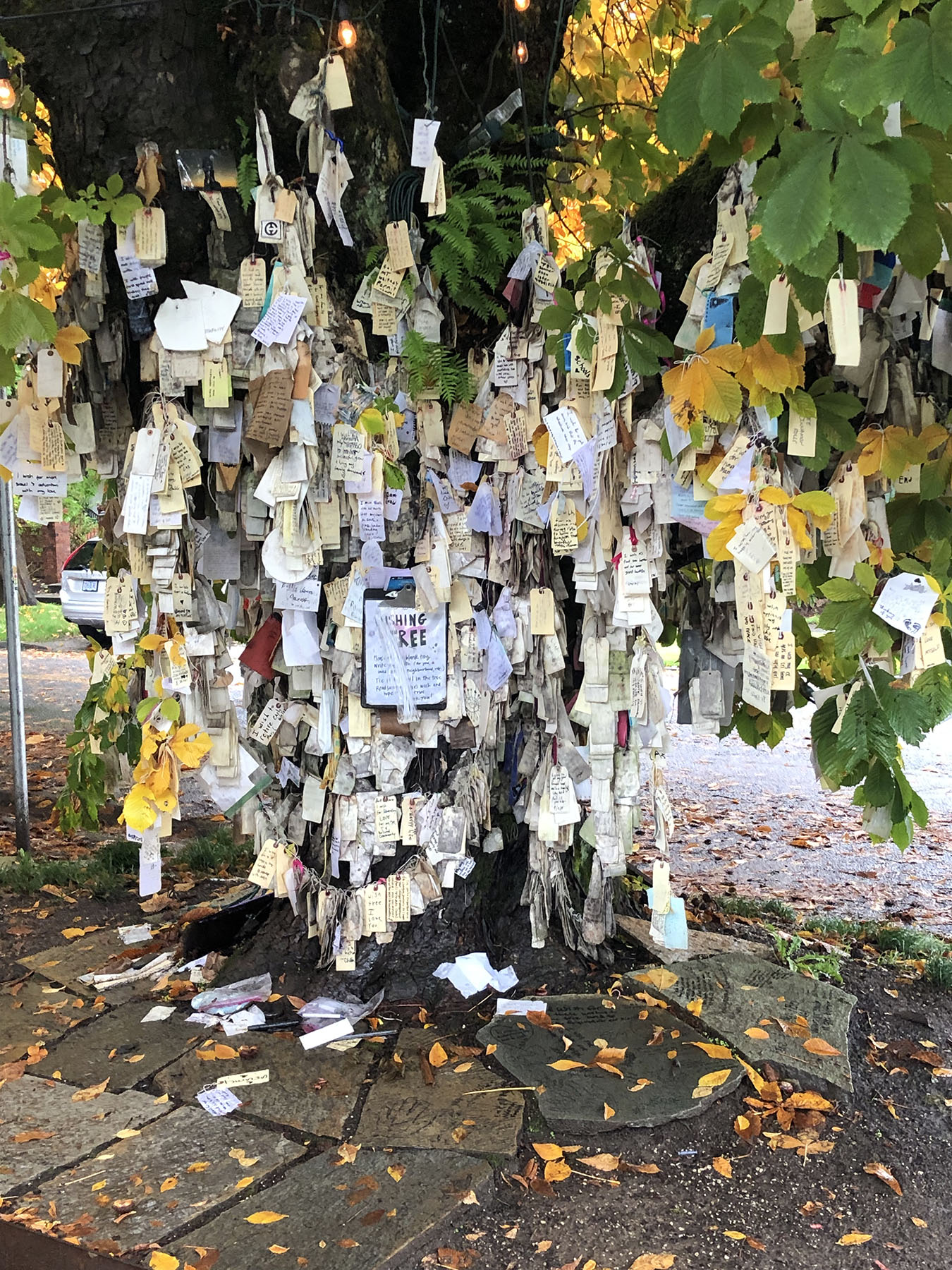
I wish I had known, I wish more of us knew these things. But these are unlikely thoughts to be found on the scraps of paper hanging from wishing trees, like the ancient horse chestnut tree on the corner of 7th and NE Morris St. Established by property owner Nicole Helprin in 2013, this tree has seen so many wishes and dreams added over the years. Rumor has it that the occasional paper blown away into the streets represents a wish fulfilled.
Wishing trees have been around for a long time, across diverse cultures, many concerned with issues of love, fertility, safety, and some with peace. People deposit expressed words, or pieces of cloth, or coins, depending on custom.
Wishing tree from Alaçati, Turkey (source on web)Tanabata Festival wishing tree in Japan (source on web)Wishing tree spiked with coins in Scotland ( source on web)Wishing tree hung with Nazar in Anatolia
Why trees? Association with powerful forces (of nature) or home to otherworldly powers that could make wishes come true? In their height closer to the heavens, home to benevolent grantors? Antennas?
For me psychologically more interesting is the fact that people like to externalize what could be a private prayer or wish – the very act of making it public, saying it out loud, seems to have some meaning. Maybe the act of sharing makes you feel less alone, or heard, even if the next reader is not the powerful entity that could fulfill your wish. Maybe the act of voicing it defines a problem that you want to be collectively remembered and then collectively tackled (certainly for the wishes for peace or end of poverty.) Maybe putting it in words clarifies, through the very act of verbalizing, the hierarchy of your own needs and provides access to thoughts about action.
I wish I knew.
If you don’t have handy access to a wishing tree you can easily send your wishes to a project dedicated to putting up wishes, or, as the case may be, filling a well with them. Yoko Ono started an interactive art work in 1996 asking people to write down their wishes, hang them on trees displayed around museums and civic spaces. Over a million of them are preserved and stored in the wishing well, adjacent to a light sculpture called the Imagine Peace Tower in Island, a beam that is lit up at certain times of the year. Here is the link to send your’s in if that would make a difference.
Mine, in the meantime:
Looks like my adventure is cut short….
And here is Roger waters of Pink Floyd fame with Three Wishes.
You get a reprieve, dear reader. In my ongoing quest to figure out how the mind works, I was going to write about new theories of consciousness proposed by neuroscientist Anil Seth. His work is the most recent iteration of figuring out the mind/body problem. He discusses the fact that what we perceive consciously is both informative – that one given experience is different from everything else you ever have or ever will perceive – and integrated, every aspect of perception is tied into a whole in fundamental ways. He also has become known for his claim that our brains in some way hallucinate our conscious reality.
But then I thought,”Nah, it’s Friday, let’s do something less demanding. If they want to read up on it, a good intro can be found here.” Let’s just cite one bit since it relates to some of the motivation behind my montage work, which often attempts to take one perception and create one of the many possible alternatives.
“Each (conscious experience) rules out the occurrence of a very, very large repertoire of alternative possible conscious experiences. It’s the reduction of uncertainty among a repertoire of alternative possibilities.“
I guess art is then the search through the repertoire of alternative possibilities….
On to something more entertaining – with montages that were chosen today as a counterweight to the words below: pumpkins bringing color and light to words describing darkness.
What words do we know about the fading or absence of light? Isn’t that question perfect for a stygian, rainy weekend? Stygian, you know, extremely dark, gloomy, or forbidding? From the river Styx where souls are ferried to the underworld? Well, this English-as-a-second language writer hadn’t heard of it either. (I found all of them in the Merriam Webster dictionary.)
I did know umbra, though, from the Latin word for shadow. Not versed in its many variations, however. Adumbrate (to foreshadow; to suggest; to obscure,) inumbrate (to put in shadow,)sombra (the shady side of a bullfight arena – tickets cost more?)burnt umber (a dark brown color,) umbrage (shade; suspicion; resentment,) and last but not least umbrella (device for protecting from rain.)
Next we have tenebrous which means “shut off from the light,” a synonym of dark or murky. Which leads to feeling somber, (gloomy, sullen, melancholy, or dejected in appearance or mood.)
There is caliginous (misty, dark,) and its cousins fuliginous (dark, having the color of soot,) and carbonous (“brittle and dark or almost black in color.”)
Maybe we should focus on crepuscule, a fancy word for twilight or gloaming which is a synonym of “twilight” or “dusk.” There’s at least a smidgen of light still there. And gloaming comes from the Old English word “glōm,” which is akin to “glōwan,” meaning “to glow,” which is what my patient pumpkins try to do in their new visual roles. May they bring cheer!
Music: Liszt’s Nuages Gris (Grey clouds) seem the right fit, in original piano score and then a version for guitar which is actually interesting. And when you’re done with everything else, go out and pick some pumpkins! Just don’t wait until it gets dark….
In case you still wondered about joking patterns in this household, with someone downstairs in the study, the other at her place of writing, a.k.a. “the bed,” here is last weekend’s exchange (my part in blue.)
What are we talking about? The Myers Briggs Personality Test, which became a topic of interest with us after discovering some of its history. You might have heard about the test, for all I know you might have taken it during your life time. It is one of the most used personality tests in the world, taken by about 2 million people annually and generating income for the industry to the tune of $20 million a year. Fortune 100 companies, universities, hospitals, churches, and the military all use it.
Before I list what the test claims to measure, let me put it as gently as I can: the test is completely useless. In contrast to what is claimed by the industry that makes money off it, it does not predict how you’ll feel or perform or handle situations or fare in career choices. It does not reliably assess who you are – the results from taking it are inconsistent across time for the majority of people, even if they space session only a month apart. Importantly, it ignores the complexity of human personality by forcing you into categories rather than allowing for measurement along a range or a continuum.
In other words, you are asked to make binary choices along 4 dimensions: are you an introvert or an extrovert, someone who intuits or senses, a perceiver or a judger, do you think or feel. The answers push you into discrete categories, and all have some positive slant (you’re a thinker, an explorer, a dreamer – never a sadist or a narcissist or some such) – one of the reasons people are happy with the test. They also feel that the test must be accurate because after all it spits right back at you what you just reported – hey, they got you right!
These binaries are artificial, of course – none among us is only thinking or feeling, judging all the time or any other of these variables. Psychologists, with rare exceptions, look at personality (and test it accordingly) along a continuum, considering a five-factor model that measures people’s openness, conscientiousness, extroversion, agreeableness, and neuroticism — factors that do differ widely among people, according to actual data collected and that are predictive for performance.
Here is the simplest example I can come up with to explain the difference between being put in a category vs. on a continuum. Take three people, their height being 4.9, 5.1 and 6.2 ft. respectively. If I artificially set a cut-off at 5.0 and everybody above it is tall and everybody below is short, then 5.1 and 6.2 are grouped together as tall people. Yet you surely agree that 4.9 and 5.1. have much more resemblance to each other than 5.1 and 6.2. If measured on a continuum the appropriate placing relative to each other is maintained. You can find a short, fun podcast on the personality test topic here.
What is fascinating about the Myers Briggs is its history, though, laid out in detail in a book about the mother daughter pair who invented the test in the 1920s. The mom, Katherine Cook Briggs, a homemaker, was an ardent fan of psychologist Carl Jung; her daughter, Isabel Myers Briggs wrote detective novels (with intense racist premises, no less) and was eager to bring her mother’s insights about Jungian psychology (not exactly shared by Jung himself who always warned of putting people into too neatly designed categories and refused to help the mother/daughter pair) into the mainstream and use it as a tool for “personology” as they called it. Neither had scientific training. Their work took off in the mid 1940s and has been mainstream in hiring decisions across the nation ever since. Here is a trailer for an HBO documentary on the politics (and dangers) of personality testing. Not sure I could stomach watching the whole film, given my current desire to avoid any more bad news….
And since you are dying to know: I am (for now – the assessment would likely change 4 weeks from now) a
As the testing site told me: “Few personality types are as creative and charismatic as Campaigners (ENFPs). Known for their idealism and enthusiasm, these personalities excel at dealing with unexpected challenges and brightening the lives of those around them. Yet Campaigners can be tripped up in certain areas of their lives. When it comes to building relationships, choosing a career, or turning their dreams into reality, people with this personality type may need to consciously address their weaknesses and gain new skills – even as they draw on their many strengths.”
Try it out for yourself, for free and for fun, not science. And remember, YOU just told them how you see yourself, so to no-one’s surprise their echoing it back sounds like they’ve hit on something.
Music today is fittingly devoted to the Four Temperaments, (Melancholy : Sanguine : Phlegmatic : Choleric), Hindemith’s score commissioned for a George Balanchine Ballet from 1946. Here is a seductive review of what one can expect to see and hear tonight regarding this piece, if you are lucky enough to have scored tickets to OBT’s season opening. Two more performances on Saturday.
Photographs are the last of the clematis, reminding me with their gracefulness and little tutus of ballerinas.