Browsing Category

Art

Seeing and not seeing.

My mother, working on her dissertation in the field of agricultural sciences, conducted a series of experiments in the university greenhouse in 1948. I don’t think I ever learned the details of the experimental set up – differences in light exposure, application of fertilizers, varying combination of seedlings? – but I do remember her strong affect even in the repeat retelling of the tale: one night towards the end of the experiments, a rabbit snuck inside and consumed the crops, nothing left to measure and document the effects of independent variables, a full year of work down the drain. Or into the bunny’s belly, as the case may be.

The memory emerged when I got notice about an ongoing art project that sounds fascinating – and vulnerable to similar and other external forces. London-based artist Almudena Romero, in collaboration with the Institut national de recherche pour l’agriculture, l’alimentation et l’environnement (INRAE), is creating a huge living photograph of a human eye, visible in the South of France next summer, a project titled Farming Photographs.

The image is formed by growing plants, a biological rather than mechanical process, fragile but sustainable in the sense that image creation can happen anywhere, at any time, without using chemical resources for production and preservation. The artist carefully chose old and contemporary varieties of wheatgrass plants with differing genetic pigmentation. They were planted in a huge field, with photosynthesis producing emerging colors that create, in turn, the contours and planes of the image. (Demonstrations are from her website.) By the end of the season the wheat will be milled and the flour distributed for consumption to the surrounding communities.

The mix of land art, focus on ecological responsibility, and reference to the scientific functions of eyes in nature (think, for example, eyespot mimicry, where butterflies and other animals display eye-like patterns in their wings or plumage to deter predators,) is a smart combination. In some ways it is ironic, though, that the immense photograph will only be visible from a perspective high above – unless it is planted in a valley surrounded by hilltops, the visual angle that encompasses all 5 acres of pixels will require an airplane or drone – adieu sustainability….

I am fully admiring, though, of the artist’s willingness to take risks – so much can go wrong with environmentally based art. Beyond rabbits, deer, and other species fond of greenery or trampling paths to water sources, think pests, think vandals, and last but not least weather, from drought to deluges. A very courageous woman!

Seeing, being seen, not seeing – here a a few other thoughts, randomly associated, that occupied my brain these last days, with varying degrees of dismay. Weather first, since that was just mentioned. The devastation that the current rains and ensuing floods have brought to both, Washington and Oregon, are immense. Barely a blip in the national media, consumed with all the other bad news in our world, but also part of a trend to simply hide bad facts, with the intent that ignorance will lead to less push back. The flooding and landslides have hit poor communities particularly hard, and we know that FEMA, eviscerated by the current administration, will be of little help.

Photocredit Reuters

Soon, we no longer have to hide data – we simply refuse to collect them in the first place. The Trump administration has decided to shut down our premier research institution around climate and weather, the National Center for Atmospheric Science in Colorado. Director of the Office of Management and Budget Russell Vought told a reporter that the center is “one of the largest sources of climate alarmism in the country” and that the government will break it up.

All grants to them have been terminated, and it will be dissolved. There has never been a time when that kind of research was more urgent – fire and flood prediction are directly link to possible protection of lives and livelihoods. The political decision to deny the existence of climate change translated directly into harm done to communities all over the country, the entire nation.

Since 1960, NCAR scientists have studied Earth’s atmosphere, meteorology, climate science, the Sun, and the impacts of weather and climate on the environment and society. Climate scientist Katharine Hayhoe wrote that “[d]ismantling NCAR is like taking a sledgehammer to the keystone holding up our scientific understanding of the planet.” (Ref.)

Being seen: ICE accidentally published a watch list of immigration lawyers. Doing your job now qualifies you to be on an enemy list, open for being spied on and harassed. Nothing to see here.

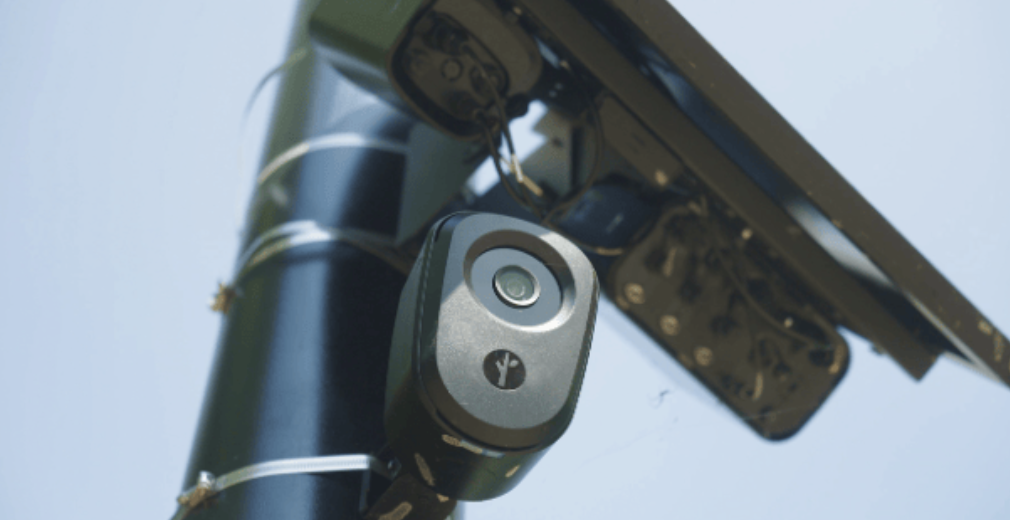
And talking of spying: Have you heard about FLOCK?

Flock Safety is a company that makes specialized Automatic License Plate Reader systems, designed to scan and photograph every plate that passes, 24/7. Unlike gated-community or private driveway cameras, Flock systems stream footage to off-site servers, where it’s processed, analyzed, and added to a growing cloud database. Currently, there are probably well over 100,000 Flock cameras installed in the United States and increasingly rapidly. To put this in perspective, that’s one Flock camera for every 4,000 US citizens. And each camera tracks twice as many vehicles on average with no set limit. (Ref. ) Have you seen one in your neighborhood?

Here is the issue: so far, Flock tracks License plate numbers, vehicle color/make/model, time, location. Some cameras can capture broader footage; some are strictly plate readers. But there is no reason to believe it cannot be extended to tracking who sits in the car, who drives it, etc. And while these cameras don’t capture people right now, “they do capture patterns, like vehicles entering or leaving a neighborhood. That can reveal routines, habits, and movement over time, logging every one of our daily trips, including gym runs, carpool, and errands. Not harmful on its own, but enough to make you realize how detailed a picture these systems build of ordinary life.”

Who has access to these data? Using Flock’s cloud, only “authorized users”, which can include community leaders and law enforcement, ideally with proper permissions or warrants, can view footage. Residents can make requests for someone to determine privileges. Flock claims they don’t sell data, but it’s stored off-site, raising the stakes of a breach. The bigger the database, the more appealing it is to hackers. Unlike a home security camera that you can control, these systems by design track everyone who comes and goes…not just the “bad guys.”

If you think footage was misused (hacked, leaked online, used by people to stalk you or harass you) you can request an audit or raise it with your HOA or local law enforcement. By then, though, the damage is done.

Out of sight: here is a news item that really raise my blood pressure through the roof: The CDC is funding a study on the Hepatitis B Vaccine inGuinea – Bisseau (West Africa). For screaming out loud: this is unethical!

An unsolicited (!) grant for Bandim Health Project, a research company in Denmark with ties to the anti-vaccine movement, allows a study with randomized, controlled trials in which you withhold a proven, life-saving vaccine from newborn babies. WE KNOW that the vaccine works, and so withholding this from half of the babies in the study condemns them to possible life long illness and liver failure, if they contract the disease – a possibility which is hugely more likely in a poor African nation where it is rampant. It is countries like these, with a 12 % prevalence rate of Hep B, where the birth dose of vaccination matters most. and according to UNICEF, Guinea Bissau has one of the highest infant mortality rates in the entire world.

Anyone wonders, why this is not done with little white American babies if needs to be done at all?

Can’t take our eyes off them for one second …. an oldie confirms, although this music refers to someone positive!

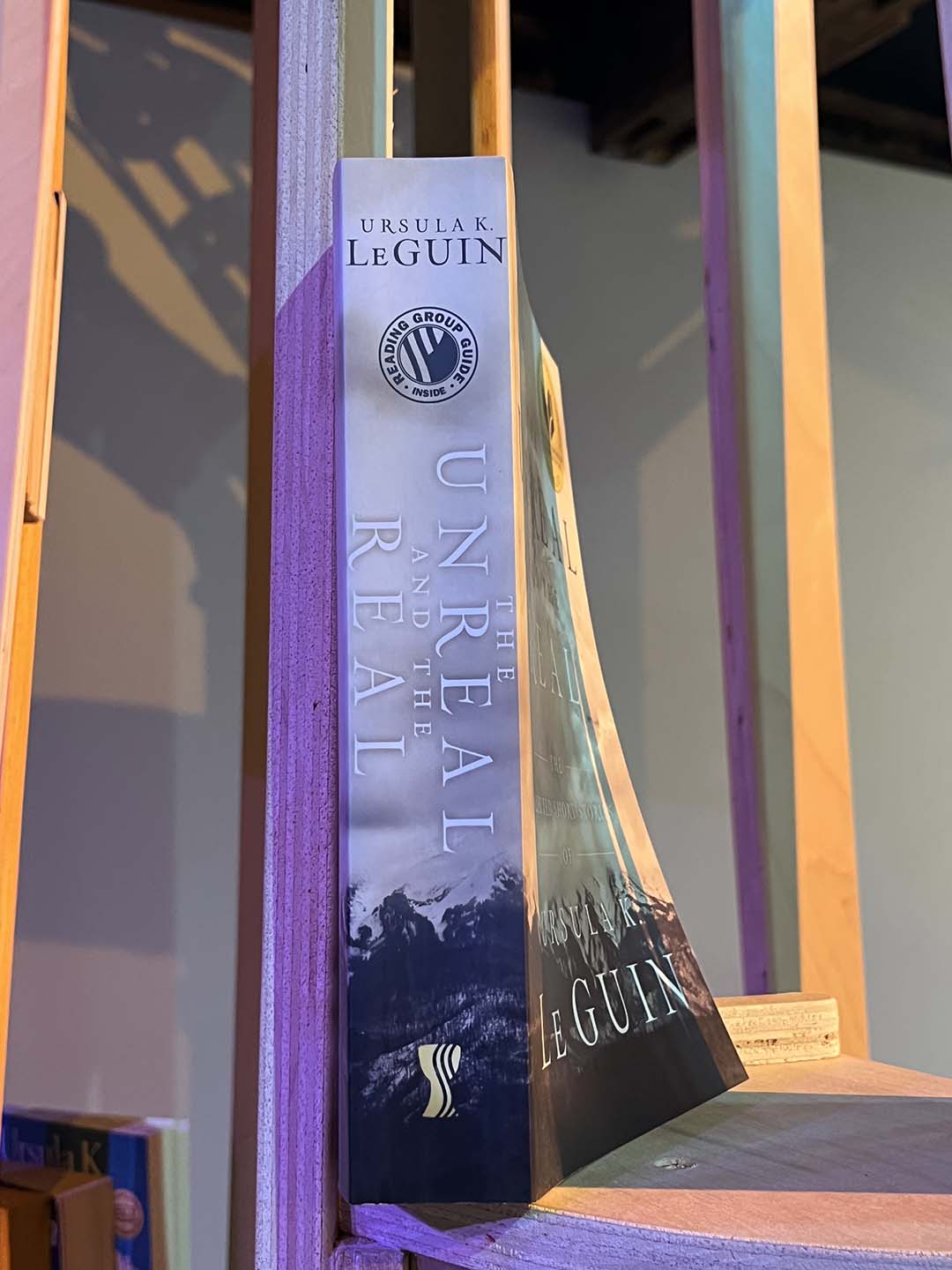
The Unreal and the Real.

· Oregon Contemporary presents: A Larger Reality: Ursula K. Le Guin ·

And eyes beholding radiance.
And the gnats’ flickering dance.
And the seas’ expanse.
And death, and chance.

Ursula K. Le Guin, second stanza in A Hymn to Time (From Late in the Day Poems 2010 – 2014)

Some people spend their entire lives reading but never get beyond reading the words on the page, they don’t understand that the words are merely stepping stones placed across a fast-flowing river, and the reason they’re there is so that we can reach the farther shore, it’s the other side that matters…

by José Saramago The Cave (p.60), (2003)

A few years ago I visited the Sigmund Freud Museum in Vienna’s Berg Gasse. Driven by a somewhat morbid curiosity, I guess, given that I ain’t buying what the man was selling. His claims of offering “science” out of step with how science proceeds, his concepts of memory often completely inaccurate, his assertions about children and child development flatly wrong, his analytic method for the therapeutic process, involving class and traditional gender stereotypes, having done more harm than good. I do concede, however, that the he was a literary giant, converting his extensive humanistic education into far-reaching and complex contemplations that challenge readers to think hard about his suggestions.

What can an exhibition about a literary figure, (or for those so inclined, the father of Psychoanalysis,) convey? A recreation of his environments, the typewriter here, the ashtrays there, the proverbial couch long moved to England, various photographs of different life stages, copies of manuscripts or even original pages, earned awards, and everywhere the collection of knick-knacks, or artifacts from ancient cultures: it all struck me as detritus of a life forced to abandon, or a shed carapace with the substance – his towering intellect – missing in the room.

Then again, the exhibition certainly fed our eternal craving for human interest stories, opening a window into the life of an (in)famous man, if not his mind (or even at the expense thereof.) And having opened this window into the personal details of an existence might, in turn, lure you to open the door into the more interesting part of the house: actually engaging with his writings.

All this came back to me, with trepidation, when I planned to visit a recently opened exhibition at Portland’s Oregon Contemporary. Another literary great on view, and one, in contrast, who I greatly admire: the author, poet, blogger and all around renaissance woman regarding creative modalities: Ursula K. Le Guin (1929 – 2018).

To come straight to the point: this exhibition is much more successful on many levels, although, it, too, suffers from the structural constraints around conveying at least some of the heft and style of the intellectual output of its literary protagonist. There were many things I delighted in, and there were some I sorely missed, that might or might not have been possible to introduce.

(I will skip biographic details that can be easily learned from her website. A compact overview was also recently offered by one of the talented StreetRoots writers – shout out to our local street newspaper! By her counting, it is pretty amazing to look at the volume of Le Guin’s output: 21 novels, 11 volumes of short stories, 12 children’s books (please see the popular picture book “Catwings”), four collections of essays, multiple volumes of poetry, and four of translation, including the Chinese classic text Lao Tzu: Tao Te Ching and the poems of Gabriela Mistral.)

The exhibition title A Larger Reality is ambiguously open to multiple interpretations, but LARGE unambiguously ruled sensory perceptions. The visitor enters a cavernous space, greeted by a larger than life portrait of the author. A brilliant choice among the many photographs available of a strikingly photogenic woman across her life-span, depicting Le Guin as we knew her during the last years of her life, no shying away from old age skin and sagging features. No pretense here, no softening of reality. I cannot think of a better promise that this will be no hagiographic show, but an uncompromising honoring of the truth embodied by this face, a face exuding wisdom and zest in equal measure.

An enormous dragon stretching across almost an entire wall, grabs your attention next – a fanciful mural that embodies the playfulness so prominent in the written work. The scales are dotted with photographs of the author across a lifetime, many including her family. The dragon spikes on top, or whatever they are called, contain the titles of her most successful output.

Small display cases accompany the mural, offering personal benchmarks, and glimpses of activities that cannot be separated from her life as a writer, or that mattered in addition to her professional career. I’ll get back to that in a bit.

Next we encounter a large accumulation of drawings of maps, all preceding the various worlds Le Guin created in her novels and stories. The facility with drawing, and as shown in subsequent display cases, water colors and sketches is enviable – but not as enviable as the fact that the quality of prose is absolutely matched by the quality of her poetry (something you would not learn from this show.) It was a smart curatorial choice not to dilute the impact of the geographic inventions and depictions by other illustrative output. The stunning variability of the maps themselves can be better appreciated this way. (Readers in GB: You can see some of this work as well. Open through December 6: The Word for World: The Maps of Ursula K. Le Guin at the Architectural Association Gallery, London, UK.)

Not done with large yet. There is Mother Oak, a humongous tree where you can sit and read her stories or listen to her voice (what a gift to have those recordings. I so miss the voice of my parents, unable to recreate them accurately in my mind, much more so than visual memories.) In contrast to the oak tree in her book Direction on the Road, this one does not expand and shrink depending on the approach or departure of people interested in its stories. It is just a – large – reality.

Multiple interactive stations invite the visitor to engage with some of the science fiction and fantasy ideas. A recreation of the author’s workspace, including the view out of her window, familiarizes us with her environment. Videos add more introductions to visual creativity.

In the next room we encounter numerous display cases offering ephemera of her various interests. The walls are exhibiting pieces by very different artists done in response to Le Guin’s work, and yet another large mural depicts a variety of people and anthropomorphic creatures offering books that had some impact on the author. Framed in pink, no less. It did not work for me, too contrived, and lacking the intellectual elegance that I so associate with the writer and that was captured in the mural by the entrance.

A wizard’s cape, created by one of Le Guin’s daughters, reminds us of the abolition of genders in Earthsea, times for great celebration marked by such a robe. She fashioned it from various hoods of doctoral gowns worn by the writer who received no fewer than 8 honorary doctorates. Smartly conceived and beautiful in one fell swoop!

***

Political writing of the highest order is rare. Moments at which a particular language is opened to a further range of possibilities – a new tone, a new conception of human purposes, a sharper or wilder rhetorical ascent – in any case happen very infrequently.

T.J. Clark Those Passions: On Art and Politics, p.327

The gallery website introduces the exhibition as such: “A Larger Reality: Ursula K. Le Guin offers a biographical and poetical portrait of one of Oregon’s best known artists. Examining important moments and themes in Le Guin’s life and oeuvre, the exhibition encompasses a rich variety of media, immersing guests in the ideas, playfulness and hope that course through Ursula K. Le Guin’s art.

The exhibition scores on most of those points. Yet, the important themes in her oeuvre just weren’t exposed enough (and, mind you, I am always willing to admit maybe I missed the relevant info. I will happily stand corrected.) For example, Le Guin’s political advocacy is represented with a variety of buttons on a bag with a tongue in cheek printing of “I have abandoned truth and am now looking for a good fantasy.” The signage there reads that she was advocating for a variety of causes in her life, from anti-war movements to tree preservation. The description of her as an anti-capitalist is softened with the humorous referral to her love of shopping, particularly shoes. These attenuations might bring her closer to the rest of us mortals, but they really underplay the intensity or progressiveness of her positions as they appear in her writings. Cloaked in science fiction, her writing was political of the highest order.

It would have been great to introduce, particularly to those new to her, the variety of political topics that forever reappeared, and associate them with particular books, to catch new readers’ interest. Curious about feminism or gender identity? Read Lavinia, or The Left Hand of Darkness, or The Wizard of Earthsea. Thinking about the evil of colonialism? Read The Word for World is Forest or Always coming Home. Can anarchism work as a form of political entity? Find out in The Dispossessed. I could go on about issues of power, our relations to the natural, world, you name it. But here is one I care about most: Want to know why the writer is considered by so many as the queen of moral dilemmas? Go straight to The Ones who walked away from Omelas, a short story that won the 1974 Hugo Award for Best Short Story, given annually for a ​science fiction or fantasy story, and appeared a year later in The Wind’s Twelve Quarters.

A city full of joy, prosperity, security relies on its citizens’ complicit acceptance that it is all maintained by a single child being tortured and kept in permanent isolation in a fetid hole. Only a select few walk away from the city and its immoral bargain after viewing the child, towards an unknown fate beyond the perimeters of “paradise.” We have obviously graduated from one child to several million who we currently willingly starve in our own country, or kill by omission around the world with the abandonment of USAID, or murder by commission of weapons sales for the Gazan genocide, which brings the issue of complicity in ever sharper focus.

Pat Barker, another inimitable writer, voiced in an interview with the Guardian’s Susanna Rustin almost 20 years ago: “Fiction should be about moral dilemmas that are so bloody difficult that the author doesn’t know the answer. What I hate in fiction is when the author knows better than the characters what they should do.”

I can’t think of a single novel that I’ve read of Le Guin’s that does not directly or indirectly force us to face a moral or ethical quandary and think through the consequences of free will, or the constraints on destinies imposed by oppressive powers.

The real is imported into the unreal, and vice versa.

What makes her so impressively different is the fact that none of this involves didactic scolding, or condescension, but always, always offers glimpses of hope, the possibility of change if courageously – and collectively – pursued. No defined solutions, but no Antigones for Le Guin either!

At the same time, she could be quite cutting in her answers to those of us (yes, myself included) who asked apparently stupid questions during readings and lectures. She did not suffer fools.

The refusal to accept black & white answers or cling rigidly to positions, made up for that. I remember vividly my college students’ reactions year after year, when we discussed a video of her talking about gender issues in my Social Psychology or Psychology of Women classes. The expected outline of the difficult position of women in societies organized around patriarchal principles was always counterbalanced by Le Guin holding forth on the fate of young men in those very same societies – they are expendable, good for canon fodder. Male and female students alike felt seen and were able to engage in much less defensive discussions.

And speaking of young people, it would have been great to have some knowledgeable sources provide an overview of how much of an influence this author has had on younger, aspiring writers across the years, including the awards given to them, like the 2025 Ursula K. Le Guin Prize for Fiction, which you can see for yourself here. Her breadth of interests is certainly reflected in the composition of nominees.

***

Theo Downes Le Guin introduces the prize ceremony in the video link above. He is also the main curator for the exhibition portraying his mother, with his sisters offering major contributions as well. I cannot help but wonder how you find a balance between (on one side) the desire for proud public display of your mother and all she achieved, and (on the other side) the need for privacy not just regarding the subject of the show, but your own relationship to a parent who, by public decree, was a Living Legend. 

Portland was hometown of all the Le Guin’s, with near cult status afforded to the elder sitting alongside of the fact that the younger ones have considerable standing in their own right. If curatorial interests clash between what is opportune for public display and what is important both for privacy and for keeping the spotlight on the mother, how do you solve the dilemma?

I have earlier described in Oregon ArtsWatch Theo’s curatorial prowess, but the current situation is unique, with a number of potential vulnerabilities. What does it imply psychologically when you set your task to be one of describing comprehensively the importance of your mother, while also mourning the absence of a beloved person, gone for good? Digging through life-long archives inevitably entails reminders of a childhood shared with her profession, no matter how often (and in this exhibition repeatedly stressed) she voiced her conviction that parenting and authoring were perfectly compatible, even complementary. What does it mean to be in the wake of your mother’s departing ship, likely happily engaged as her literary executor, building the Foundation, arranging traveling exhibitions (at least I hope, for this one should find a broader audience) but – as a result of all of this — no longer able to devote full energy to pursuing what you used to do?

These are all questions brought to mind in a year that has seen its share of biographies about larger-than-life mothers and the complexities of filial love – the off-putting How To Lose Your Mother: A Daughter’s Memoir by Molly Jong-Fast and the fascinating Mother Mary Comes to Me by the brilliant Arundhati Roy the most prominent ones.

I experienced the Le Guins’ curation as an act of generosity as well as a public service, keeping an important voice alive for all of us. Cannot imagine that it hasn’t been hard, though.

One last shout-out: Oregon Contemporary’s Executive Director Blake Shell not only checked people personally into the exhibition, but approached with serious interest at the end of my round, offering to engage in conversation. I was pressed for time and so had to leave promptly, but would have enjoyed that interaction with someone so intimately involved in the whole enterprise. The gallery is facing hard times, like so many of our cultural institutions. The National Endowment for the Arts revoked its federal funding for the 2026 Artists’ Biennial that was intent to showcase a diverse group of Oregon artists, many expected to defy the administration’s imperative to deprive us of “DEI” associated art. You can learn more and help here.

Oregon Contemporary
8371 N. Interstate Ave
Portland, OR 97217

Hours
Fri / Sat / Sun, Noon–5pm
Free and open to the public / ADA accessible

Suggested Donation $14.90 for those who can.

Additional events:

Saturday, December 6th
Event: First Saturday, Talk with Michelle Ruiz Keil & Ashley Stull Meyers and Screening of CROSSLUCID’s Vaster than Empires
Time: 5:00-8:00pm, 6:00pm start of event

Saturday, February 7th
Event: Todd Barton performance of Music and Poetry of the Kesh by Ursula K. Le Guin & Todd Barton with a screening of Kesh, a short film by Rankin Renwick
Time: 5:00-8:00pm, 6:00pm start of event

Lazy Monday.

· Silly Pictures - Few Words. ·

I started to look at memes which are sprouting after the Louvre heist, but then thought they are probably all in your view already, related by everyone from OPB to Town and Country Magazine….

I also found myself thoroughly out of touch with the dominant meme references to a Bollywood movie called Dhoom 2, featuring similarly daring jewel robberies and managing to make more money than any previous action caper at the time. I’m getting old or out of mainstream – probably both. Apparently the cinematic thieves were given another chance at (a reformed) life. We wait to see what happens to the real life suspects apprehended yesterday.

The heist had come up in the context of thinking about museum staff or leadership who are currently sacked or deciding to resign for far more worrisome reasons – refused censorship among them – than lack of museum security. But then I was simply too lazy to dredge up all the examples that had accumulated in my inbox across the last months.

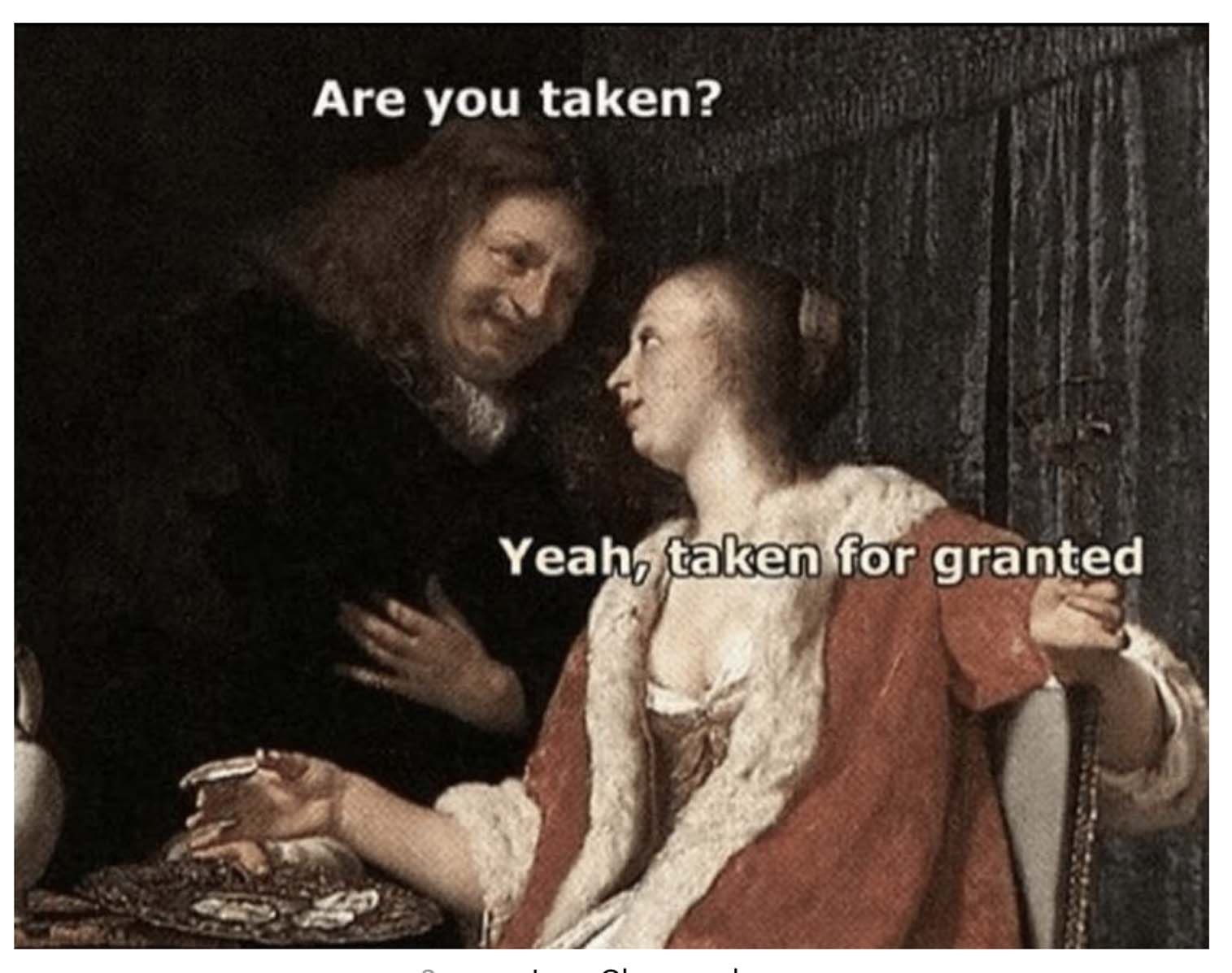
So I turned to a more familiar and easier knowledge base instead: memes about classical works of art. For your amusement, then, some images dedicated to several friends of mine (you know who you are!) and one of self portraiture – you may guess.

Given the medley of memes, starting with the Louvre heist, music today is a medley of French composers, some famous opera music included, mostly warhorses. Which brings me to the educational part of Monday:

Here is a hilarious introduction to all that’s wrong with contemporary opera…..

Thank you, L., for sending this. Made me snap out of it.

And in the interesting people department….

About time we introduce some new members to that idiosyncratically chosen group, don’t you think?

The first person should have been known to me, but wasn’t. I only learned about them when a dear friend sent me a bundle of postcards from a current blockbuster exhibition in Hamburg, Germany. She knew how much I wished to see Rendevous of Dreams at the Hamburger Kunsthalle, celebrating a century of Surrealism and juxtaposing some of the works with those of German Romanticists who were influenced by some of the same inspirations as the more modern movement.

 “The supernatural and irrational, dreams and chance, a feeling of community and encounters with a changing natural world were vital sources of inspiration for German Romanticism and shaped international Surrealism differently a century later.” (Ref.)

Toyen The Dream (1937)

If you live in northern Germany, go see paintings by Max Ernst, Meret Oppenheim, René Magritte, Salvador Dalí, Valentine Hugo, Toyen, André Masson, Paul Klee and Caspar David Friedrich (1774–1840) and Philipp Otto Runge (1777–1810,) while I longingly stare at the postcards.

So: here is Toyen, a name that means “it is he” in Czech, but could also be a play on the French citoyen,) chosen by a painter originally named Marie Čermínová (1902 -1980) who refused to use any feminine endings in her own language (which contains linguistic gender differentiation). They were a firebrand, left home as a young teenager and followed progressive political movements while attending  UMPRUM (Academy of Arts, Architecture and Design) in Prague. They worked closely with fellow Surrealist poet and artist Jindřich Štyrský until Štyrský’s death, collaborated with the future Nobel prize-winning poet Jaroslav Seifert, and poet František Halas. Living for some years in Paris, they and Styrsky founded an artistic alternative to Abstraction and Surrealism, which they dubbed Artificialism.

Toyen Among the Long Shadows (1943)

Their output was prolific, in paintings, drawings and book illustrations even during the years when they went underground during the Nazi Occupation in Prague, sheltering Jewish poet Jindřich Heisler. The two moved to Paris permanently after the war and joined the Paris Surrealists. Even when fascism struck and attacked a person and their work, they did not give an inch, much less capitulated. I am so grateful for models that indicate you can – and must – follow your passion, even under the most dire of circumstances.

The work is ravishing. If you live in Great Britain, you had a chance to see some of it at Richard Saltoun Gallery in London. Dreaming in the Margins was up until October 4th (this blog got delayed, alas, by reports on more pressing current events…) You can still look at the website, though.

Toyen THE LAW OF SILENCE (1953)

Toyen’s sexuality is unknown, since they avoided revealing any details about their personal life, creating a mysterious persona, but their public styling cut across gender boundaries. This fluidity was one of the factors that led to an artistic focus on themes of gender, politics, and eroticism, but they also created highly political art that addressed women’s experiences, misogyny and the destructive effects of war and authoritarian regimes. Here is a longer biographical sketch of the artist which labels Toyen as transgender.

Toyen Eclipse (1968)

***

I really can’t figure out how that artist escaped me, given my preoccupation with Surrealism this year with all those centennial celebrations (and prior to that just my affinity to some of the female artists of that movement before they were introduced to mainstream audiences.)

I am less perturbed by the fact that I had never encountered Frank Menchaca, the second person for today’s addition to the interesting people department, a composer who turns out also to be a visual artist, a poet and writer, with a foot in the sustainable energy business and education. Talk about a renaissance man. His visual art work can be perused on his website (link in name) that offers some 14 galleries. I came across his music first; just like Toyen cross-referenced poetry in her illustrations and other works, Menchaca links some of his compositions to poetry, in direct and indirect ways. As you know, I am a sucker for cross overs. And I feel certainly encouraged by people who do not restrict themselves to one creative or intellectual area only, even if standards of excellence might differ across media. I allow myself too often to beg off of some project just because I am not good (enough) at it, and it is so easy to retreat to the familiar.

What brought me to Menchaka is a piece titled Crows listening to Wallace Stevens. It can be found on an album The Demon rubs his Palm which I have listened to so often now that I can whistle in the demon’s company. By all descriptions, the music relates to multiple contemporary composers like John Luther Adams, for example. I wouldn’t know. I do know Steven’s 13 Ways of looking at a Blackbird, though, given that I spent an entire spring 15 years ago creating drawings and montages for the stanzas of this poem that I found wonderfully challenging to interpret. Early days for me regarding the craft, but I still like the ideas.

Here is my exhibition statement from 2011:

Wallace Stevens’ poem Thirteen Ways of Looking at a Blackbird, first published in 1913, has been hailed as an imagistic masterpiece. Stevens himself called it “a collection not of epigrams or ideas, but of sensations.” A first reading of the 13 stanzas, each mentioning the blackbird, offers indeed a multitude of sensory modes and perceptions. On closer inspection, though, the poem hints, as so much of Stevens’ work, at the relation between the perceivers and the world they perceive, extending our focus beyond perception to thoughts and feelings as well. Yet the text is challenging, frequently switching perspectives between who does the looking and who beholds whom in knowledge of the world. For good measure, Stevens adds the occasional barb, sufficiently opaque to leave the reader even more unsettled. Who would know that “the bards of euphony” refers to his critics (Stanza X) or that the men of Haddam, a hamlet in Connecticut, embarked on a futile search for gold (Stanza VII).

My challenge was to provide sufficiently representational images to echo the content of the stanzas, but to stay abstract enough to mirror the reticence of the poem’s language. I tried to convey my sense of the poem as a whole, taking as my guide the notion that our perception inevitably goes “beyond the information given,” such that the phenomenal world can never be objectively represented but consists rather of a chain of apperceptions guided by interpretation. To accomplish this goal, I, among other things, replaced the poem’s blackbird with glass marbles that were montaged into my drawings and photographs from my daily environment.

Thirteen Ways of Looking at a Blackbird

I
Among twenty snowy mountains,
The only moving thing
Was the eye of the blackbird.


II
I was of three minds,
Like a tree
In which there are three blackbirds.


III
The blackbird whirled in the autumn winds.
It was a small part of the pantomime.


IV
A man and a woman
Are one.
A man and a woman and a blackbird
Are one.


V
I do not know which to prefer,
The beauty of inflections
Or the beauty of innuendoes,
The blackbird whistling
Or just after.


VI
Icicles filled the long window
With barbaric glass.
The shadow of the blackbird
Crossed it, to and fro.
The mood
Traced in the shadow
An indecipherable cause.


VII
O thin men of Haddam,
Why do you imagine golden birds?
Do you not see how the blackbird
Walks around the feet
Of the women about you?


VIII
I know noble accents
And lucid, inescapable rhythms;
But I know, too,
That the blackbird is involved
In what I know.


IX
When the blackbird flew out of sight,
It marked the edge
Of one of many circles.


X
At the sight of blackbirds
Flying in a green light,
Even the bawds of euphony
Would cry out sharply.


XI
He rode over Connecticut
In a glass coach.
Once, a fear pierced him,
In that he mistook
The shadow of his equipage
For blackbirds.


XII
The river is moving.
The blackbird must be flying.


XIII
It was evening all afternoon.
It was snowing
And it was going to snow.
The blackbird sat
In the cedar-limbs.

BY WALLACE STEVENS

Again, here is the full album, best listened to without interruptions, and on multiple occasions, when the connections become ever more visible, or should I say audible, rooted in a poem performed at the end.

“As real as it gets.”

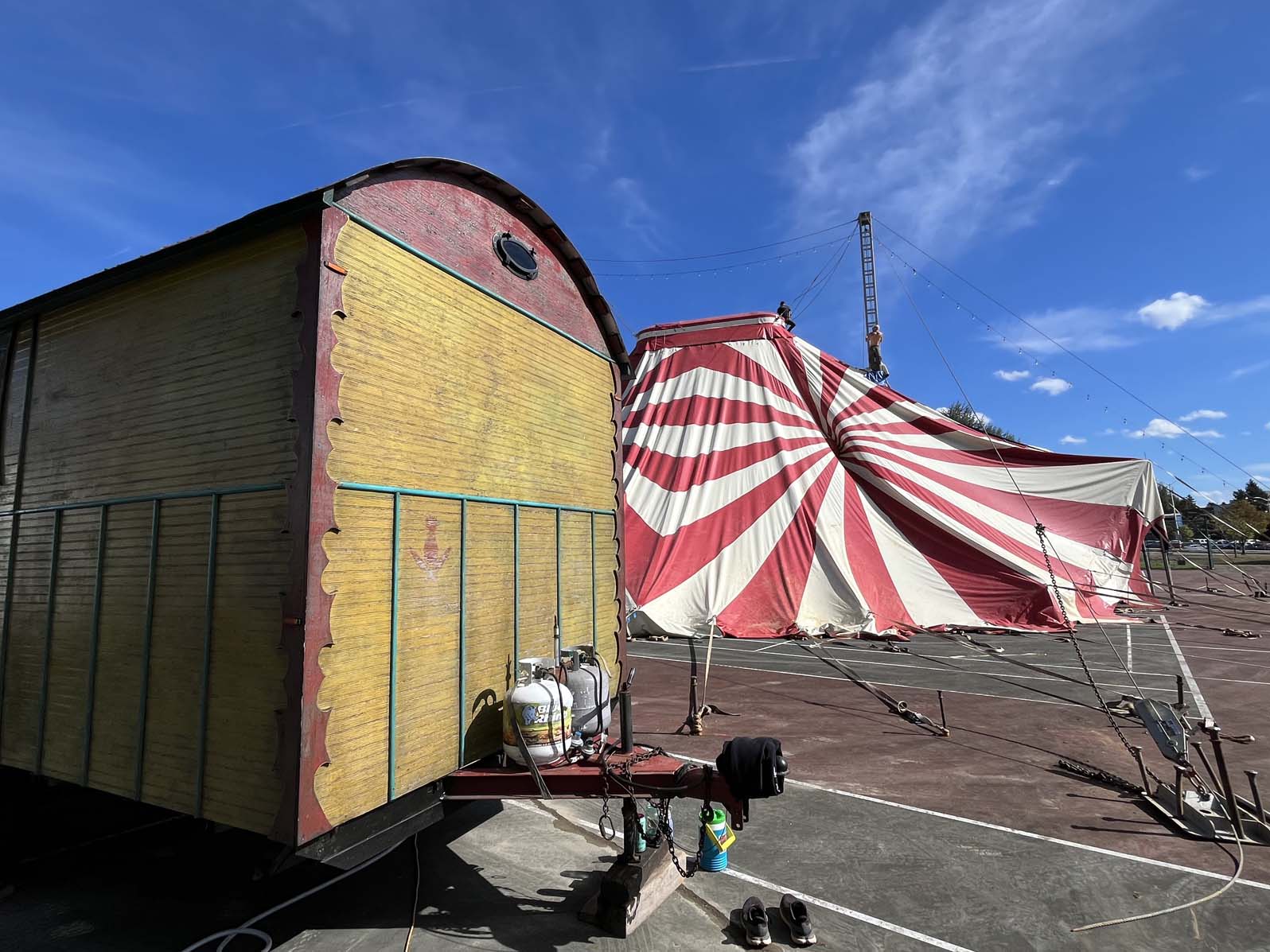
“As real as it gets!” were the words of Ruth Wikler, Clark College Foundation’s Director of Arts Programming, Partnerships and Philanthropy, when we mused about the differences between shallow Artificial Intelligence-created entertainment, called art by some, and what surrounds us when we actually experience a performance. A conversation brought on by standing on tennis courts generously provided by the facility folks at Clark College in Vancouver, WA, before refurbishing the courts. Yesterday morning it was the site of a large circus tent in the process of being erected, by invitation of the Clark College Foundation.

Pitching the big top tent.

In an era where access to higher education gets increasingly difficult, often for economic reasons, philanthropy-oriented foundations play an ever more important role. Clark College Foundation, an independent, self-governed nonprofit that partners with Clark College to improve higher education access, student success, and community engagement, distributed $1.8 million in scholarships, special awards, and financial support to hundreds of students in the 2024-2025 school year alone. The Foundation contributed $5.1 million in total support to the college that same year. In the process, the foundation brings a variety of engaging cultural events to town for the rest of us. Wikler, founder of Boom Arts and from 2019 – 2023 Director of Programming, Circus Arts at TOHU, has been innovative and creative in her new role, able to capitalize on an extensive net of connections she has made in the national and international art world to draw top notch performers to Vancouver.

Blaze Birge and Ruth Wikler in conversation.

This summer, the foundation presented Arts&Clark, a series of amazing performances at the Vancouver Arts&Music Festival. This week, they brought the circus to town. A unique one, at that – AI, eat your heart out!

Flynn Creek Circus has been touring the country for more than 20 years, a small, independent, self-contained organization with artists living on site and the entire ensemble helping with all chores, from providing pre-tour support, generating lighting, costumes, music and props, pitching and pulling down the tents, postering and advertising the show, staffing the ticket office or ushering pre-show.

Importantly, the circus seeks out rural areas and is focussed on next generations – both in terms of programming but also educating the artists of the future: the circus supports Circus Mentors Inc., which experientially engages rural youth in the arts, particularly physical arts; the circus also has an apprenticeship program which promotes mentorship relationships between new artists and seasoned professionals.

Clark College Foundation, together with Clark College Athletics, attempts to raise the next generations as well, fundraising for Clark College Athletics Scholarships with this circus visit. A portion of each ticket, and all proceeds from opening night, support this cause, helping promising athletes from across our region to participate in higher education. The college offers both transfer degrees and vocational degrees – and circus has a long history of vocational education. Circus is, of course, a fitting venue in the most direct way for this cause – all artists there are athletes (some have arrived from professional sports), training rigorously and working as a team to deliver safe shows many times week.

Blaze Birge and David Jones, founders of Flynn Creek Circus.

The founders, Blaze Birge and David Jones, had impressive solo and partnered artistic engagements to show for before they built this traditional circus community. The many awards presented to them do not just recognize exceptional physical or theatric skills, however. Flynn Creek Circus is also recognized in the larger community for its history of combining physical acts with narratives that echo the treasure trove of collective human wisdom, from myth to fairytales. Binding physical artistry into story telling, sometimes funny, sometimes gut-wrenchingly emotional, creates a shared world between performers and audience: a specific physical world and one of shared feelings, something AI is simply unable to generate, being located outside that present universe.

I imagine living the life of traditional wayfarers for more than two decades cannot always be easy. There is hard physical labor inside and outside of the top tent, unpredictability in sales and income (and depending on it to stay independent,) there are likely not always friendly social encounters as experienced by all seasonal travelers. Age gets to your body, with acts likely to have to be retired at some point. Responsibilities add up, for the collective and gear alike. Yet this duo shows nothing but passion for maintaining the traveling circus tradition, feeding our need for story telling, and investing in education for the physical arts as well as all the technical and managerial issues associated with it. They frequently serve as jurors in circus competitions, are contributing members to the American Circus Alliance and
engage in multiple nonprofit projects to support performing arts in the U.S.

It is as real as it gets.

Of course, it is not just the relationship between audience and artists. The interplay between the performers onstage, the collaboration, the in-the-moment reaction to risk or needs is utterly absent from artificial intelligence which has no agency in any given moment. Intelligence, or having a skill set is not enough – you need to be curious, and leaning into anticipatory sensitivity, if you don’t want to risk your life/health or that of you partners during dangerous maneuvers, something still unique to humans, as far as I can tell.

Again, as real as it gets.

I had a chance to photograph the pitching of the tent and talk to the founders just 2 days before the performances start. It brought back thoughts from many years ago, when I was writing about a different circus world, in Montreal, Canada and reminisced back to the small traveling circuses of my child hood in Germany. I figured I’m allowed to repeat them here, since they feel as fresh and as applicable as then, particularly since Flynn Creek Circus is in some ways so similar in set up to the 195Os self contained wandering shows visiting my rural village. Here it is breathing 21st century energy into a great American tradition: the traveling tented circus. No need for animals to put on a great show. Coming together under the big top still makes for a terrific night out, now perhaps more than ever, since we are so increasingly isolated from group experiences.

From my own childhood experience:

There was a clown or two, some jugglers, and high wire and trapeze acts that went to the core of the experience: a shared range of emotions between members of the audience and the performers. There was distributed anticipatory anxiety, moments of collective breath holding and then exuberant relief by one and all when once again the laws of nature were seemingly defied, or at least nature’s wrath held at bay. 

There was an immediacy to the experience, and a connectivity, that for me defines this discipline in contrast to many other endeavors in the performing arts: not just skill acquired over years of practice, a sense of the possible, a tackling of the impossible (all of which can be said for musicians, actors and dancers as well who personally interact at least in theory with the audience before them)  – but an element of elective risk taking that in the moment is understood by both acrobat and audience to entail danger, to depend on the confidence and skill or strength of the performer and which is open to, potentially catastrophic, failure.

It does not matter if the connection is made because you admire the daring, or long for the physical prowess or marvel at the creativity of the act. It does not matter, although perhaps plays a role, that circus comes to you – at least during its traditional history and these days when performed in public spaces. What matters is that a bond is established between acrobats and audience, where at any given moment our knowledge of what is norm for a human body, and what is pushing it to the extreme, allows us to connect to those who challenge those norms in front of our very eyes, making us an accomplice to triumph or failure. Circus at its truest conjures empathy between humans who share physical boundaries and an emotional economy, both now challenged. 

Circus has come a long way since I sat trembling in the village bleachers. Like any other art form it is struggling to evolve in ways that are meaningful and evocative and to secure autonomy in a world that has made culture a commodity. I certainly got glimpses of the possibility of something radical, utopian, critical and emancipatory in contemporary circus – all that we demand from art. 

Inside the tent.


You have a chance to see all of this unfold in this week’s performances of The Bridge, a tale of wolf and man inspired by nordic folklore and fairy tale characters.

Tickets start at $23 and some performances are geared towards kids, others are adults only, Oct 2-5 at Clark College Tennis Courts, Corner of Fort Vancouver Way & E. McLoughlin, Vancouver, WA 9866. (Clark College Purple Parking Lot is close and convenient.) Wheelchair accessible.

Do yourself, your family and friends a favor and secure those tickets!

In addition to the Jones duo, there is a large cast of diverse artists, apprentices and support staff.

Jesse Patterson as the Red Countess.
Cory Blackthe Puppy
Nick Hardenthe Emperor
Jessica Perry Millerthe Star
Rylan Rydenourthe Troll
Jeremy Cifoniethe Ferry Man
Jacy Jonesthe Raven
Katie RussoWolf in Sheep Clothing
Shem Biggiethe Wolf
David Jonesthe Goat
Blaze Birgethe Goat’s Shadow
Richie AldereteBunnyboy
Ilana Rosethe Witch
Donna Lukinthe Mushroom
Dave Wagarthe Lantern
Rachel Birgethe Sheep Lady
Bodhie Devriesthe Wolf
Maya DeLocheTent Assistant
Laurie WulfekhuleCostumes
Esther de MontefloresMarketing Research

Apples and Honey.

Shanah tovah umetukah – may the New Year be sweet.

Given the current state of the world I even settle for tolerable. Ardently hoping for peace.

I usually send out a photomontage containing apples on the eve of Rosh Hashanah. It is the traditional food, combined with sweet honey, to greet the Jewish New Year. This year, one of my favorite art websites – Yoyo Maeght, owner of a contemporary art gallery in France – had a series of paintings of apples just in time, one more beautiful than the next. So I went and looked for some more – you have to provide your own honey, while we marvel at centuries of perceptively detailed, enticing depictions of my favorite fruit.

Peter Claesz Still Life with Fruit and Roemer (1644)

Gustave Courbet - Still Life with Apples

Gustave Courbet Still Life with Apples (1872) These look the ones on my tree….. the worms, meanwhile, have moved over to politics.

Paul Cezanne still Life with 7 apples and tube of paint (1879)

Still Life with Basket of Apples, 1887 - Vincent van Gogh - WikiArt.org

Vincent van Gogh Still Life with Basket of Apples (1887)

Alexej von Jawlensky - Still-life with apples and blue cup

Aleksej von Jawlensky Still Life with apples and blue cup (1904)

Pablo Picasso — Apple, 1914

Pablo Picasso Apple (1914)

Bowl of Apples on a Table (1916) by Henri Matisse - Artchive

Henri Matisse Apples on a Table (1916)

Alberto Giacometti. Apple on the Sideboard. 1937. Oil on canvas on board. 10 5/8 × 10 5/8" (27 × ...

Alberto Giacometti Apple on the Sideboard (1937)

Sold at Auction: Raoul Martinez, Raoul Martinez (Dutch 1876 - 1974). Still life with apples and ...

Raoul Martinez Still Life with Apples and Pears in front of a Window (1944)

Henk Bos | Paintings for Sale | Still life with apple and walnut

Henk Bos Still Life with Apple and Walnut (Date unknown, 20th Century)

Henk Pander The Light (2017) Apples central and yet almost disappearing in this riotous accumulation of props.

Looking at apples led to thoughts of apple pie, conjuring thoughts of kitchen romance, making me want us all to read this essay on why strongmen rely on women at home (thank you, Leila F., for sending this on!). Let us enter the New Year open-eyed to snake-oil vendors and false promises.

Music today is the Prayer by Ernest Bloch, from a 2023 Berlin Philharmonic benefit concert for Israeli and Palestinian peace organizations: “Woman Wage Peace” and “Women of the Sun.”

Reshuffling the Natural World.

· Vögel, höret die Signale! ·

I don’t know about you, but when I go to aquariums or zoos there are a lot of conflicted feelings – from what it means to deprive animals of their freedom and often put them in torturously narrow cages deprived of stimulation, to what it means to have this way of keeping species alive when they are no longer safe in their natural environments. I sometimes wonder if the decorations we find in various tanks and cages are an expression of humor to distract from the zoo keepers’ own conflicted feelings, or if there are yet another sign that we have to put our “civilization” stamp on everything…..

Cue Zed Nelson’s new photo book  “The Anthropocene Illusion.” I read a captivating review of it in the New Yorker, a magazine that I avoided to subscribe to for 44 years, long story. Clearly my loss, now that I discover the power of Elizabeth Kolbert’s writing – but I digress. Again.

(Link here to Nelson’s spectacular photography – all the captions below the photographs are provided in his book.)

Polar bear. Dalian Forest Zoo. China.
Polar bears are the largest land carnivore in the world, weighing up to 800kg and growing up to 3 metres in length.
The typical zoo enclosure for a polar bear is one-millionth the size of its range in the wild, which can reach 31,000 square miles (80,290 km²).
Polar bears live in Arctic regions in Canada, Alaska, Russia, Greenland and Norway, in temperatures as low as -46°C (-50.8°F)


The book displays photographs taken across the world of settings containing or pointing to animals, settings that try to reproduce the natural world they would inhabit if free. The attempts at providing verisimilitude are, of course, futile, and the photographer very much hones in on the artificiality of the backdrops. In addition, there is magnificent photography capturing civilization encroaching on habitat, or humans making encounters with nature into a distraction, at best.

Railway bridge. Nairobi National Park.Kenya Nairobi National Park, established in 1946, is the only national park in the world bordering a major capital city. Home to lions, rhinos, giraffe and the remnants of a once-thriving wildebeest migration, the park has faced increasing pressure from urban expansion and infrastructure projects. The Chinese-built Nairobi-Mombasa railway now cuts through the park on an elevated bridge, prioritising cost-saving over conservation. Further developments, including proposed hotels and fencing plans, threaten to sever the park from critical wildlife corridors, turning a once-open ecosystem into an enclosed and managed space.

Kolbert summarizes Nelson’s main message:

But Nelson’s point seems to be that all efforts to reproduce the natural world, whether motivated by crassly commercial interests or ones that are, ostensibly, more edifying, are much alike in the end. The Anthropocene illusion is that we can somehow connect with the natural world at the same time that we have, as Nelson puts it, “turned our back” on it.”

Niagara Falls. Ontario, Canada.

Established in 1885, Niagara Falls is the oldest state park in America. Over 8 million visitors visit annually. More than 5,000 bodies, mostly suicides, have been found at the foot of Niagara Falls.

Or as Nelson himself phrases it:

“While we destroy the natural world around us, we have become masters of a stage-managed, artificial ‘experience’ of nature – a reassuring spectacle, an illusion.”

Kolbert again:

From the mountains to the savanna, it’s alienation all the way down. The volume’s power lies in its relentless impulse toward disenchantment. Wonder isn’t really an option.

Polar bear tours. Hudson Bay, Canada.

On the southern edge of the Arctic, Hudson Bay is known as the ‘polar bear capital of the world’. Bears come ashore here in the summer when the sea ice melts, to wait for the ice to return in November.
Tour companies cater to an annual influx of tourists eager to see polar bears during the six-week ‘bear season’, when the bears roam the shoreline, waiting for the sea ice freeze over.

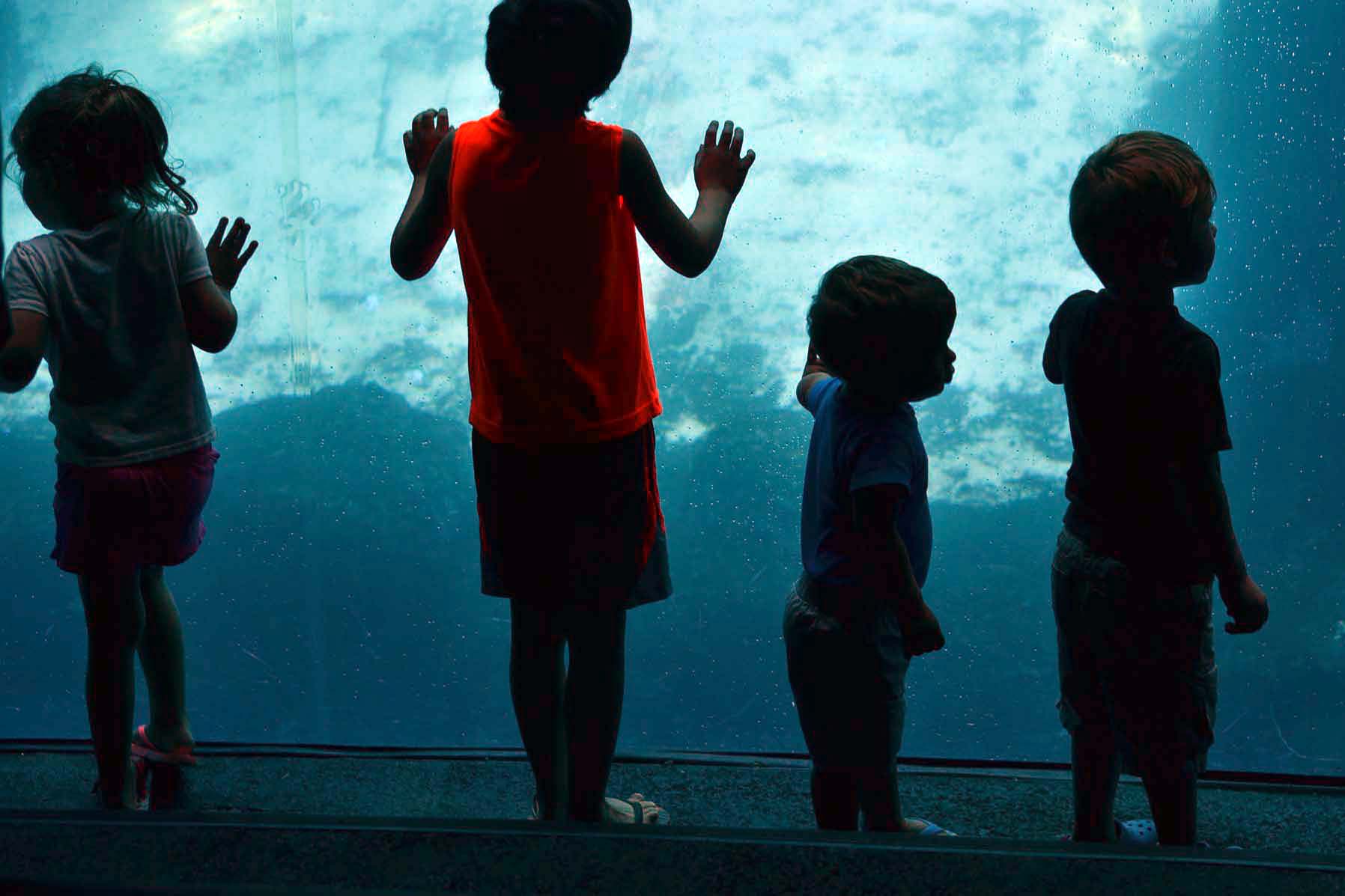
I see that somewhat differently, having just taken a beloved 2.5 year-old to the zoo, including their fish tank. There is still wonder galore, even if it is somewhat restricted to the short set. And there is something unsettlingly privileged about the claim that connection to nature is lost if it is presented in artificial environments. For inner city kids and poor families in general, the only access to seeing a live animal and not just something on a screen, might very well be the zoo or a cage in a city park. That experience, in turn, might make them more interested and engaged in thinking about habitats or what we do to species other than our own.

Restaurant with live penguin display. Penguin Hotel. Guangdong, China.

At the Chimelong Penguin Hotel in China, visitors can dine alongside captive penguins in a 1,600-seat, glacier-themed restaurant. While guests enjoy a curated spectacle of nature, wild emperor penguins face an uncertain future. The slow-evolving birds have survived for millions of years, yet nearly 70% of their colonies could vanish by 2050 as a result of climate change.
The hotel also offers close-up penguin encounters at the Penguin Pavilion and a Penguins on Parade show at the Penguin Ice Palace Theatre.

I am the first to mourn our devastation of nature, as my blog’s writing over and over demonstrates.

Here, for example, is the latest compilation of all the assaults on the environment committed by the current administration. Read it and weep.

But experience with something alive, even if corseted in artificial settings, might teach future generations that there is something worth rescuing.

***

The relationship between nature and human interference has been one of the main topics of art, through the ages, but is particularly prominent in contemporary art informed by climate action. Regular readers might remember that I offered a somewhat whimsical series some years back, focussed on the way habitat is encroached by cities, and animals, in turn, intruding closer into our spaces, a destructive development in both direction, but heavily weighted against them. For Guardians of the Towers (Turmwächter) my photographs of cityscapes were combined with the wild life I captured elsewhere.

There are many more serious approaches, with strong work presented in Germany by, among others, Dennis Siering. His 2022 exhibition Unnatural territories, speculative landscapes was enthusiastically reviewed at the time.

He has turned to a different version of reshuffling nature this year. Together with experts in ornithology, bioacoustics (Andre Siering), audio design (Aleksei Maier), and artificial intelligence (Bastian Kämmer), he has developed sound installations – Radical Climate Action Birds – that translate melodies composed by humans into artificial bird calls.

The synthetic bird songs are broadcasted with solar power for about three hours a day in a public park in Karlsruhe (Supported by the UNESCO City of Media Arts Karlsruhe Project Funding Program for Media Arts), potentially leading to uptake by the birds: mimicking the melodies and gradually importing them into their repertoire. I have no clue if this is actually happening, or if the claims that black bird were the fastest learners, is verified as more than wishful thinking.

Here is the fun part of this installation, though: the melodies are all from anti-fascist protest songs. Bella Ciao, whistled by a black bird, might be quite the wake up call! The idea is, of course, that the resurgence of nationalist and neo-fascist ideas, generally inclined to extract rather than protect natural resources, should be of concern to all of us, with direct reminders from nature itself as brilliant a messenger medium as is conceivable. Instead of illusions of nature transplanted into human environments, it is illusions of culture transplanted into nature itself then, in theory. Would be a riot if it worked….

(For non-German readers: my subtitle “Vögel, höret die Signale! plays on a line in the German version of the International, which says Völker, höret die Signale! Birds (people) listen to the call!

Völker, hört die Signale!
Auf, zum letzten Gefecht!
Die Internationale
Erkämpft das Menschenrecht!

In the English text, the refrain begins with:

So comrades, come rally
And the last fight let us face
The Internationale unites the human race.

The original French refrain: (the anthem was written by Eugène Pottier, in Paris, June 1871; he was a refugee from the Paris Commune, who wrote the poem while in hiding in the aftermath of the massacre of the Communards. It was set to music 2 years after his death by Pierre Degeyter in 1889.)

C’est la lutte finale
Groupons-nous et demain
L’Internationale
Sera le genre humain.

Here is the anthem sung in German for today’s music. And here is Bella Ciao.

Let’s hope the birds are fast learners!

History Lesson, anyone?

It could not have been more perfect. The light was right, the temperature warm, but not hot, there was a feeling of adventure in the air. After way too many days listlessly stuck at home with the oppressive heat, I was exploring the sandstone cliffs of Cape Kiwanda, located some 2 hours southwest of Portland at the shores of the Pacific.

The colors and configurations were breathtaking, I could have photographed all day long. Much of it reminded me of Paul Klee (and so some of today’s images are overlays of his art and nature, just to give you the idea.)

The association had probably been triggered by the fact that I had yearned to visit an exhibition that recently closed in Berlin, and was stuck with thinking around the issues it raised, without being able to travel to see it.

This photograph of a sandstone angel overlooking the bombed-out city of Dresden in 1945 was part of the show at the Bode Museum, which brought together images of angels from the Berlin museums that were damaged or burned during the Second World War.

Richard Peter Sr. View from the town hall tower to the south, 1945 © Deutsche Fotothek / Richard Peter sen.

The Angel of History: Walter Benjamin, Paul Klee and the Berlin Angels 80 Years after World War II centered around Paul Klee’s most famous artwork Angelus Novus and Benjamin’s texts laying out his thoughts on the “angel of history,” as he called him. The exhibition also showed excerpts of Wim Wenders’ Wings of Desire(1987), a film in which two angels stand watch over a divided Berlin and in which explicit reference is made to Klee’s 1920 watercolor and Benjamin’s interpretation of the artwork.

Here is what Benjamin wrote in the ninth thesis of his 1940 essay “Theses on the Philosophy of History”:

A Klee painting named Angelus Novus shows an angel looking as though he is about to move away from something he is fixedly contemplating. His eyes are staring, his mouth is open, his wings are spread. This is how one pictures the angel of history. His face is turned toward the past. Where we perceive a chain of events, he sees one single catastrophe which keeps piling wreckage upon wreckage and hurls it in front of his feet. The angel would like to stay, awaken the dead, and make whole what has been smashed. But a storm is blowing from Paradise; it has got caught in his wings with such violence that the angel can no longer close them. The storm irresistibly propels him into the future to which his back is turned, while the pile of debris before him grows skyward. This storm is what we call progress.[3]

The piles of debris are, of course, not restricted to the past – we see them growing skyward all around us, in the present, if we don’t close our eyes in desperation.

***

The look backwards towards the past, however, is under (re)construction – what we are allowed to see now depends on the whims of those who think they own the interpretation of the past.

President Trump’s executive order, titled “Restoring Truth and Sanity to American History,” aims to review and align the Smithsonian Institution’s exhibitions and materials with his interpretation of American history, focusing on removing what he calls “improper ideology.” This initiative is part of a broader effort to ensure that national museums reflect a narrative of American exceptionalism and unity ahead of the 250th anniversary of the United States. The White House

Whether it is controlling the Smithsonian, other museums or our universities, the National Park Service or the National Endowments for the Arts, Public Broadcasting or the Voice of America or shifting public to private education – it boils down to preventing people to gain knowledge and engage in independent thought – both reviled by authoritarians. (I had previously written about fascism and education in more detail here.)

While we still can, let’s look back at history not so long ago.

(My sources for today are the general education you get when visiting the site of the U.S. Holocaust Museum, Michael Burleigh’s The Third Reich: A New History, a moral history reasserting the existence of a totalitarian dictatorship in Germany, Sebastian Haffner’s Defying Hitler: A Memoir, and, most importantly, Richard. J. Evans’ The Coming of the Third Reich. It is an intellectually rich guide, written in totally accessible language and structured in ways that really cover all aspects of the German people falling for the lure of Nazism.)


From its very beginnings, the National Socialist regime of Germany tried to shape cultural displays and production, trying to force German culture into the frame of the preferred ideology. Art that did not conform to the Nazi norms was declared degenerate, confiscated and/or destroyed, Paul Klee’s works among them (and he was fired from his position as a professor at a prestigious art school). Work was sold on the international market to enrich the regime and pay for war preparations. This was, of course, just one facet of societal control.

If we look at the larger picture, the goal was to amass absolute power right off the bat – handily provided by the Enabling Act which got passed in 1933. It allowed Hitler to pass laws without the consent of the Reichstag, basically eliminating all power for our parliament. If you look at power consolidation here, now, you will not have to venture far from the text of Project 2025, or, for that matter, the Supreme Court decisions of late.

One of the Nazi regime’s early undertakings was to identify minorities who could be dehumanized, labeled as them to create an us, both through rhetoric and through punitive actions of cleaning the streets of subhumans (Untermenschen) and later people with disabilities – we know what ultimately followed. (Rounding up the homeless in Washington, D.C. anyone? Putting immigrants or political opponents on trial or in deportation camps?)

Parallel to that, there were purges of the civil service, firing all who were deemed illegal or simply disloyal from professional institutions. The Law for the Restoration of the Professional Civil Service from 1933 allowed the immediate removal of Jews and political opponents. (Just peruse the jobless numbers in Washington D.C. right now. Or look at the state of the Veterans’ Administration.)

At the same time, Hitler confronted military leaders and started to shape the military as his own power tool. Here is a link to the historical time line of submission of the military, documented in the encyclopedia of the U.S. Holocaust Museum. (As of this writing, military personnel from numerous states have been deployed in Washington, D.C. Armed, no less.)

In addition to the military, the Nazi regime established the Geheime Staatspolizei, the Gestapo. They wanted a centralized political police force that would be directly reporting to Nazi leadership, undermining state and local police. It took but three years, to 1936, to form such a force; that summer it was combined with the criminal police (what would here be the feds) under SS leader Himmler and his deputy Heydrich. The Gestapo’s mission was to “investigate and combat all attempts to threaten the state.” It could arrest, try and send those who criticized the regime to camps, under the 1934 law that made it illegal to criticize the Nazi Party. It could monitor individual behavior, and even send people directly to camps, under a mechanism called protective custody. They were allowed arbitrary warrantless searches and surveillance on mail and telephone calls. (Here is a smart piece on why it is risky to form analogies between ICE and the Gestapo, yet commonly seen these days.)

Note that the vast majority of Aryan Germans did not encounter or even expect to encounter the Gestapo during the 1930s. But the Gestapo was a constant threat for political opponents, religious dissenters, homosexuals, people of color and Jews. In fact, both Klee and Benjamin had to flee their country. Paul Klee left for Switzerland in 1935 and got very ill very fast. He died in June 1940, after 5 painful and increasingly debilitating years, from an autoimmune disorder triggered by stress as one factor, a disease that destroyed his body; his friend, admirer and collector Walter Benjamin took his own life but three months later, stranded in Spain while trying to escape the Nazis.

***

Exhibitions like the one in Berlin allow us to look back at the horrors brought upon human kind and the environment by a fascistic regime. They bear witness to the death, the loss, the damage wrought by war, and make us think about the reach this suffering had for subsequent generations. It is this kind of honest assessment about the ravages of historical events that many fear will be suppressed by the administration’s executive orders and institutions bending the knees.

What I don’t understand, though, is that we seem to be oblivious to this history even while we are still able to look at it, read about it, being taught about it. How can we so blindly follow the play book that brought us darkness once and is likely to bring it again in one form or another? A play book, step by step mirrored by the one now catapulted into use under the guidance of the Federalist society? Amassing absolute power, destroying democratic norms, ignoring the rule of law, marginalizing and demonizing scape goats to speak to the baser instincts of people who feel powerless, has plunged the world into catastrophe. What prevents us from learning from this? Honest question, not a rhetorical one.

Richard J. Evans, citing journalist Sebastian Haffner who interviewed contemporary witnesses, provides some hint at how the process of voluntary subjugation psychologically unfolds:

Lawyer Raimund Pretzel asked himself what had happened to the 56 per cent of Germans who had voted against the Nazis in the elections of 5 March 1933. How was it, he wondered, that this majority had caved in so rapidly? Why had virtually every social, political and economic institution in Germany fallen into the hands of the Nazis with such apparent ease? ‘The simplest, and, if you looked deeper, nearly always the most basic reason’, he concluded, ‘was fear. Join the thugs to avoid being beaten up. Less clear was a kind of exhilaration, the intoxication of unity, the magnetism of the masses.’ Many, he also thought, had felt betrayed by the weakness of their political leaders, from Braun and Severing to Hugenberg and Hindenburg, and they joined the Nazis in a perverse act of revenge. Some were impressed by the fact that everything the Nazis had predicted seemed to be coming true. ‘There was also (particularly among intellectuals) the belief that they could change the face of the Nazi Party by becoming a member, even now shift its direction. Then of course many jumped on the bandwagon, wanted to be part of a perceived success.’ In the circumstances of the Depression, when times were hard and jobs were scarce, people clung to the mechanical routine ofdaily life as the only form of security: not to have gone along with the Nazis would have meant risking one’s livelihood and prospects, to have resisted could mean risking one’s life. “( Haffner, S. Defying Hitler pg. 111-114.)

***

So the angel of history looks at piles of debris. Sandstone is also a pile of debris, generally speaking. It is made out of fragments of other minerals or rocks, grains from quartz and feldspar flying through the air and accumulation for eons, then cemented by silica, calcite, and iron oxide, which contribute to the color the we see. Silica and calcite are general very light in color or even colorless, iron oxide, however, is rust-red and often stains the sandstone that way.

The cliffs at Cape Kiwanda are made of some 18-million-year-old particles, and the fact that these formations still stand has to do with their position relative to a haystack rock in front of them – it breaks up the wave action, sheltering the walls from the ever eroding surf, although erosion is not stopped completely.

Bits and pieces are constantly worn away, and sometimes massive sections drop off into the ocean. Two years ago, two large sinkhole appeared with months of each other on top of the cliffs, forcing a costly re-fencing to protect the public wandering around there.

Climate change makes it all worse. More frequent storms whipping the waves, longer periods of rain, heavier rainfall in general during climate patterns like the El Niño Southern Oscillation (ENSO) which is brought about by rising temperatures, create more and more damage. Of course, whether we will learn about climate change or support science to combat it, is another question that warrants looking at historical precedents. Doesn’t look too good. The Angel of History is at this point probably better off flying around with the pelicans to distract him/herself rather than be glued in horror to the views of wreckage accumulating around them…..

Then again, Robert Reich reminds us: “Remember: If we allow ourselves to fall into fatalism, or wallow in disappointment, or become resigned to what is rather than what should be, we will lose the long game. The greatest enemy of positive social change is cynicism about what can be changed.”

What he says.

Music today are George Crumb compositions reacting to some of Klee’s paintings. Here, an here.

Peaches

Last week I went peach picking. To reach the orchards you had to drive some miles across dusty dirt roads, arriving at a little farm stand in the shadow of a gargantuan oak tree. Acres and acres of peach trees, bending over from the weight of the fruit, to the point of boughs breaking off. A spectacular abundance.

iPhone pictures today – I did not want to be encumbered by camera while picking fruit.

I was the only one there, surrounded by the buzzing of hundreds of wasps and bees, all feasting. Was thinking about how these fruit are depicted in art, which paintings I remembered. Rachel Ruysch came to mind, her glorious still lifes, probably triggered by the fact that she has a major retrospective now traveling in the U.S. (will open August 23, 2025 at the Museum of Fine Art in Boston) and smart people writing about her life and career. This 17th century painter was more successful in paid commission at the time than many of her more famous contemporaries, Rembrandt van Rijn, Vermeer, Frans Hals and other titans of the Golden Age.

She was, however, not as free to pick her subjects as her male counterparts, constrained to painting flowers and fruit by fiat of her elders and other men in her life. Managed, though, to smuggle in the occasional reminder of the vagaries and dangers of life, in the form of sneaky salamanders, bees ready to sting, all kinds of eerily realistic creepy crawlies. And yet forgotten for the longest time, as so many other women artists.

Telling women what they can and cannot do: why would that remind me of the news that our Secretary of Defense, Peter Hegseth, reposted a preacher’s cry for the revocation of the 19th Amendment? Women should NOT be allowed to vote, was the demand. We have long known about Hegseth’s ties to Peter Wilson who advocates for a Christian nation and the need for women to be submissive to men, “head of household” in particular. According to Hegseth, women are obviously not welcome in the military, either. He has fired them left and right, all the while instituting weekly Christian prayer meetings at the Pentagon. But I digress.

If you look at Ruysch’s paintings, the peaches express hints of their extreme vulnerability, these fruits prone to bruises, splits, mold infestations like few others. Here is one she painted at the age of 19 (!): they are showing little scars and brown discoloration already.

Rachel Ruysch Peaches, grapes and plums with a dragonfly, snail, caterpillar, butterfly and other insects on a stone ledge (1683)

Rachel Ruysch Flowers in a Glass Vase, with Insects and Peaches, on a Marble Tabletop (1701)

In both paintings, she documents peach leaf curl and leaf rust; the trees are extremely susceptible to blight, which often leads to diseased fruit, rotting when still connected. At the orchard, the views of decaying fruit, on the trees and above all, or should we say below – on the ground, were upsetting. So much food gone to waste.

Some of the ones that had fallen were still perfectly intact, good for canning if not eaten fresh. I wondered, of course, if the help that used to pick these orchards in time, has disappeared for fear of deportation. A quick look at the statistics confirmed some suspicions: we have a significant shortage of peaches in the stores this year (down almost 25% from the average year), due to a combination of adverse weather conditions, labor availability and shortages, increased production costs, and economic disruptions, each intensifying the pressure on peach production in key regions such as Georgia, South Carolina, and California’s Central Valley. So could they not allow gleaners in, at least, collecting for the food bank?

***

When I perused painting of peaches, the depictions were, overall, divided. Many show the glory of the fruit on the trees or the voluptuous, velvety globules completely intact.


Wittregde Worthington Peaches (1894)

William Vareika Still Life of Peaches (1867)

Auguste Renoir Still Life with Peaches (1881)

Some reveal canning habits that seem to put the whole fruit with pit inside into the mason jars. Seems strange given the high cyanide content of those pits.

Claude Monet Jar of Peaches (1886)

Others acknowledge reality: peaches bruise all too easily.

Henri Matisse Peaches (1945)

Paul Gauguin Still Life with Peaches (1889)

And then there is Cézanne, always to be counted on when longing for transformation of a natural object into something altogether different, luminous from the inside, abstracted to its essence.

Paul Cézanne Still Life with Apples and Peaches (1905)


Compare this to D.H. Lawrence’s poem below.

The Peach

Would you like to throw a stone at me?
Here, take all that’s left of my peach.

Blood-red, deep:
Heaven knows how it came to pass.
Somebody’s pound of flesh rendered up.

Wrinkled with secrets
And hard with the intention to keep them.

Why, from silvery peach-bloom,
From that shallow-silvery wine-glass on a short stem
This rolling, dropping, heavy globule?

I am thinking, of course, of the peach before I ate it.

Why so velvety, why so voluptuous heavy?
Why hanging with such inordinate weight?
Why so indented?

Why the groove?
Why the lovely, bivalve roundnesses?
Why the ripple down the sphere?
Why the suggestion of incision?

Why was not my peach round and finished like a billiard ball?
It would have been if man had made it.
Though I’ve eaten it now.

But it wasn’t round and finished like a billiard ball;
And because I say so, you would like to throw something at me.

Here, you can have my peach stone.

by D.H. Lawrence, from his Birds, Beasts and Flowers collection of 1923.

In this modernist (almost) prose poem, he insist on describing the perceived features of the single fruit in verisimilitude, demanding that we ignore man’s desire to make everything perfect, without nooks and crannies, slightly misshapen, indented and heavy – let’s take the peach as is, not round and unblemished.

I wonder if there was the temptation to read slight sexualized connotation into these lines, if it weren’t for the name and thus the reputation of their author. I also ask myself why did I remember and pick this poem from an acknowledged misogynist, a man full of rage and struggle, linked to a hard life full of poverty, illness and persecution by those who did not want his truth telling and revolutionary upheaval of literature to succeed?

Here’s why. He was curious about the world and courageous, traits I value above all. His travel writing speaks volumes to openness to the new, the different, to search and exploration, a keen observer if there ever was one. And the poem itself has that wonderful sense of defiance – “Hey, wanna throw a pit at me? I’ll even provide one, but it won’t change my mind that the imperfect wins over perfection any old day! Let nature rule.”

All of this, and more, I wish for the newest member added to the family, the day after the peach picking excursion. May he be curious and courageous, open and flexible, perceptive and defiant when called for, in a life that will not all be peaches and cream in this world of climate change, wars and the rise of authoritarianism. May he enjoy music (which I listened to on the day he was born) by a composer who shares his birth date.


István Szelényi‘s Sonatina is full of energy, resolves discordances always with an element of surprise, is full of humor and deadly serious at the same time. Good things to be developed in a new life as well, don’t you think? Welcome to this world, little A.

Framing.

Framingn. the process of defining the context or issues surrounding a question, problem, or event in a way that serves to influence how the context or issues are perceived and evaluated. Also called framing effect.  – APA Dictionary of Psychology

***

I have been thinking a lot about framing lately. The notion of framing plays a large role in traditional areas in psychology, judgement and decision making and cognitive behavioral therapy, respectively. In decision making, our responses are very much influenced by how a question is framed – emphasizing a gain, or a loss, for example. The very same content information can lead to very different choices, depending on the way it is phrased. We are prone to a kind of cognitive bias, where the salience of certain features, or the stress on positive or negative outcomes, influences our response. We know, for example, that framing significantly influences the choice of cancer treatment by altering how options are presented, such as emphasizing survival rates versus mortality rates. Patients often prefer a treatment framed in terms of the probability of living rather than dying, even if the underlying statistics are identical.

Framing also plays a role in visual art – affecting both, the understanding and appreciation of a work of art.

Some of these thoughts were triggered when I visited an exhibition at the Benton Museum of Art/Pomona College some weeks ago. (The show is now closed. Here are upcoming offerings, equally interesting.)

Doubles: Prints and Drawings from the Museum Collections presented paired works that had been selected by graduate students and young professionals during a seminar introducing works on paper. The approach of “compare & contrast” is a traditional one in art education, with instructions to focus on everything from compositional features, perspective, techniques to comparisons between art movements, different art historical eras, or different approaches to the same topic. What we see in one picture often frames our response to the other one.

Doubles exhibited pairs that most frequently juxtaposed different artists along the lines of either shared topic or shared visual expression. Each selection had a very short statement by the student that explained their choices, with varying degrees of success and/or sophistication. The power of the exhibition came from the accumulation of pairings that made it abundantly clear how juxtaposition can affect your own perception of each individual art work. In some instances, that is, not all of them. Graphic similarities, for example, were cleverly selected, but did not necessarily frame the interpretation of each piece.

Roger Vail Untitled (Figure in Profile) (1970 Photolithograph on paper – Kenji Ueda Untitled (abstraction) (1972) Lithograph on paper

(Be warned, most photos today have lots of reflections due to unfortunate lighting conditions in the galleries, fluorescent strips dominating the rooms.)

Robert Cottingham F. W. Woolworth, 1975 Aquatint on paper – Edward Ruscha Street Meets Avenue, 2000 Lithograph on Rives BFK paper

Thematic pairs – war, the flag, colonial oppression, then and now – came closer to having an impact on each other, although they mostly seemed to be coming from a shared viewpoint, rather than exposing a rift between perspectives.

Francisco de Goya y Lucientes Los Desastres de la Guerra, Plate 66, Extraña devocion! (Strange devotion!), printed 1863 Etching and drypoint on paper

Enrique Chagoya Homage to Goya II: Disasters of War (Plate 33: Goya conoce a Posada), 1983-2003 Etching and aquatint on paper

Fernando Marti American Flag, 2017 Serigraph on paper Barbara Kruger Untitled (Questions) from Celebrating 20 Years of Explosive Graphics series, 2009 Serigraph on paper

(Out in the real world, this photograph of LAPD units assembling to “quell the protests”, with Kruger’s Questions mural in the background (on MOCA’s wall), was taken around the same time of my visit, by Jay L. Clenendin. Pulitzer prize material, if you ask me….)

Jesse Purcell War Is Trauma Grenade, 2011 Serigraph on paper Mary Tremonte Battle Cross over Iraq, 2011 Serigraph on paper – both from War Is Trauma portfolio, Produced by the Justseeds Artists’ Cooperative

Umar Rashid (Frohawk Two Feathers) Map of the West Indies, 1790. Born Alone, Die Alone, 2024 Archival pigment print hand-finished with acrylic paint – Enrique Chagoya Escape from Fantasylandia: An Illegal Aliens Survival Guide, 2011. Lithograph and gold metallic powder on paper

(One of my favorite examples for framing that tags different perspectives instead, comes from the Virginia Museum of Fine Arts in their educational tools about perspectives in art. Their explanation is found in the link above.

***

The most fascinating double in the Benton exhibition was a juxtaposition of work by Lorna Simpson and Naomi Savage.

Lorna Simpson 9 Props (complete set of 9), 1995 Waterless lithograph on wool felt panel – Naomi Savage Upper Torso, 1969 Embossed paper

It was intellectually challenging on multiple levels, with the framing centered on absence rather than presence. Naomi Savage was a photographer, niece to Man Ray, who is represented here with a relief print rather than her photographic work. It was chosen with a focus on “invisibility” because the embossing technique makes the image barely perceptible at numerous angles or in different light conditions.

The usual presence of visual clarity in photography is also turned on its head by the work of Lorna Simpson. Here is The MET’s description of the work, held in their collection:

In 9 Props Simpson challenges preconceived notions about what constitutes a portrait. Rather than depicting actual people, she photographs nine surrogates—vases and bowls that are based on objects in the portraits taken by famed Harlem photographer James VanDerZee in the 1920s, 30s, and 80s. Working with the artisans at Pilchuck Glass School in Seattle, where she was an artist-in-residence, Simpson had the photograph vessels replicated in black glass. Her captions below each “prop” describe the people, clothing, and furnishings in VanDerZee’s original photographs. Unlike VanDerZee’s pictures, however, which seem tied to a particular time and place, Simpson’s conceptual portraits are enigmatic and open-ended, relying on the incongruity of her words and images to suggest meaning and context, but without providing obvious answers.

James VanDerZee 1926 photograph that is referred to. I had to dig those up, just as examples, they were not shown for comparison at the Benton.

(Here are some examples of VanDerZee’s portraiture in general.)

A contemporary Black photographer translating the portraits of well-to-do Blacks by a 20th century Black photographer into black objects that obscure any individuality, just enigmatic stand-ins. She provides narratives seemingly unconnected to the objects in view, if you do not know the history of the referent art. Something visible (mis)representing something invisible to the current viewer, framing the experience as one of searching for connections in the absence of visual clarification. Lack of knowledge of the history fundamentally defines our experience as well as our ability to interpret correctly what is in front of us.

Excerpt of James VanDerZee’s 1923 photograph that is referred to.

For me, then, the larger framing was one of the erasure of historical Black experience with the eradication of visibility. My “framing” of her art was perhaps affected by our present day experience of the obliteration of Black visibility and agency in the public sphere.

300 000 Black women alone have lost their jobs in the federal work force across the last 6 months, work that provided middle-class stability. Black top officers and other senior officials at the Pentagon, fired, historical records about Black achievement in the military, purged. The least diverse Cabinet of any in recent history.

In any case, what is visible in an image, or what needs to be imagined to make sense of it, will have large implications for our own interpretation the art. Drawing conclusions, based on our own available framing, often biased by our previous experiences, or our access or embrace of different versions of history, will guide what we see and what we feel. Pairing black and white pieces, defined by absence more than presence, was a clever, clever way to make that point.

***

Framing affects not only the appreciation of art, but also its creation. In my own case, how do I frame the intent to flag environmental fragility and the need for protection, for example, in a photograph or photomontage? Do I depict loss, or do I depict the possibility of positive outcomes? What can represent each of these states, and do they need to be integral to the landscape or can they be extraneous? Do they need to be literal or can they be symbolic, in order to create the largest affective impact? Do I frame the issues and my respective choices verbally as well for the viewer, or do I let them frame it themselves? All this has me preoccupied as we speak.

You can judge the results for yourself here.

In any event, whether art or life: a reminder to those of my soulmates also prone to catastrophic thinking – framing is a choice, and there are multiple frames to choose from, most often. Pick a perspective that brings you forward, rather than holds you back in waves of anticipatory anxiety.

Let’s do a musical pairing as well, one that shows very different sonatas by the same composer, Beethoven’s Piano Sonata #1 and #32.

PS: Housekeeping: I will be down to 2 postings per week for the summer months. So the next iteration will come next Monday.