However you vote – do it, do it early, and bring your ballot to one of the drop boxes to avoid any complications introduced by the post office. They can be found at many libraries, or public squares.
Music today is Schubert’s Winterreise. The song cycle was composed during a time of political unrest and social change in Germany. As wikipedia noted… “The work reflects themes of alienation and the emotional struggles of the individual in a challenging environment.” Sounds apropos, no?
In my field we differentiate between two kinds of disgust. Psychologists call strong reactions to pathogens, toxins or parasites physical or core disgust. It’s the kind you have likely experienced when you came upon rotten food, or corners filled with the smell of urine or vomit. Our revulsion when we encounter bad smells or horrible sights has likely an evolutionary advantage: it protects us from getting infected or contaminated.
The second kind of disgust is called moral disgust. When we see a blatant violation of moral norms we react with disgust as well. Think cannibalism, or bestiality, or betrayal, for example. Since it is linked to “norms”, it is potentially malleable – it can change when norms evolve. Consider society’s relationship, overall, to homosexuality, for example. The majority of people luckily no longer feel moral disgust, when that used to be the status quo.
Scientists have been eagerly exploring the brain mechanisms behind disgust reactions, and in particular whether core and moral disgust share neural pathways. (Short answer: some studies say yes, others say no, pointing to confounds in the kind of stimuli used to test these hypotheses.)
You know what: I couldn’t care less. What I am curious about is whether there is a hierarchy of moral disgust topics, and if people who vary on other dimensions (how conservative they are, how risk tolerant they are, where they fit on social anxiety scales, or any number of such variables that make us the person we are,) have certain things that disgust them more than others. I am no longer actively involved in research, so I will not be able to answer these questions. But I can provide an example of what I mean.
Quick: What breach of ethics really gets to you? What is the most morally revulsive thing you’ve come across in the last weeks? (Note the first question could be answered in the abstract, from experiences across a lifetime. The second question relates to something that is happening now. I make that distinction, because I experience multiple cases of revulsion just listening to the current news. That was not always the case. For example, corruption would not have been particularly salient in my mind some 20 years ago.)
In any case, I would have come up with two different answers to the second question, dependent on when you’d asked me. About a week ago, very, very high on the list would have been the immeasurable damage done to vulnerable, young populations by discouraging or withholding vaccinations or other health measures proven to stave off suffering. The willful dismissal of scientific data, the eugenic underpinnings of withholding of care, all are ethical breaches that disgust me. We have seen it here with the explosion of measles. Gentle reminder: the disease not only kills some people, it also can sterilize young boys never to be parents, and wipes your body’s memory of prior infections, leaving you without built-up immunity against multiple prior illnesses. It is also the case that the loss of herd immunity, with not enough people getting vaccinated, is potentially lethal to those who are NOT ABLE to be vaccinated.
It gets worse, though. With the help of a Danish research group, long-time vaccine opponent RFK Jr, secretary of the US Department of Health and Human Services (HHS), is now experimenting with withholding hepatitis B vaccines from some African newborns. (They could never do this research in the US – so far at least, for lack of ethics.) The plan is to enroll 14,000 infants in Guinea-Bissau (a country where Hepatitis B is rampant) in the trial, giving the hepatitis B vaccine to half of the babies at birth and withholding it from the others for the first six weeks of life. (A plan that caused international uproar last year, and has now somehow been green lit by pressure from and funding by the US government.)
“You are now enrolling newborns in a lottery to test a hypothesis,” said one of the researchers who resigned in protest from the organization, together with several other colleagues. ” The children who are randomly selected not to receive the birth dose of the vaccine, those who “lost the lottery,” face in their earliest days the risk of contracting hepatitis B, which can cause irreversible lifelong damage. “They contract hepatitis B in the context of being part of a research project, which made their infection happen, in effect, “by design”. (Ref.) We do know, after all, that the vaccine works and protect against the disease!
If you asked me about what ethical transgression disgusts me most this week, the answer would be not the recent betrayal of our ally Ukraine (inconceivable, on so many dimensions), but the suggested live-streaming of a public execution by firing squad of a paralyzed man in a wheelchair. In this instance I am joined by many, not just a bunch of ethical Danish researchers. The Pope, heads of major Catholic (USCCB), evangelical (NAE), mainline (Episcopal Church) and Jewish (Union for Reform Judaism) orgs/denominations have all come out against the planned public execution. So did retired Admiral William H. McRaven, calling it shameless and ignoble.
It is particularly dire in the historical context of lynchings in this country. Public killings have a racial history, after all.
We are joining Iran, Afghanistan, Somalia, North Korea and Saudi America with this act (should it take place.) As Ruth Ben – Ghiat, a historian of fascism explained: “This is an escalation of an attempt to normalize extreme violence, ritualize violence, militarize the country, and make violence entertaining, so when they ask you to commit violence in their name, you will be ready.”
(The word fascism, by the way, has its root in the Italian term fascia: a bundle of sticks or sheaf, with an ax. It is symbolic for state violence and execution. The demonstrative exposure of state cruelty is one of the hallmarks of fascism.)
The best explanation of why this spectacle is undermining everything our nation claims to stand for, can be found here: historian Tim Snyder lays out what is wrong with public executions. He explains why it is psychologically, politically and historically wrong, He ends by describing the ethical horror it promotes:
It is wrong ethically. It will not be hard to find external authorities who can help us to see this. The United Nations human rights office can remind us that a public execution is a form of torture. The president of the US Conference of Catholic Bishops can tell us that a livestreamed public execution is a “barbaric promotion of a culture of death.” But we, all of us, all Americans, are being invited to observe and thus participate; the ethics of this are accessible to each of us, personally, as living human beings. The end of life is a mystery, one which arises from the dignity of life. No matter what an individual has done, the end of each life should be respected, for the sake of the dignity of life itself.
Death as a spectacle is, plain and simple, disgusting.
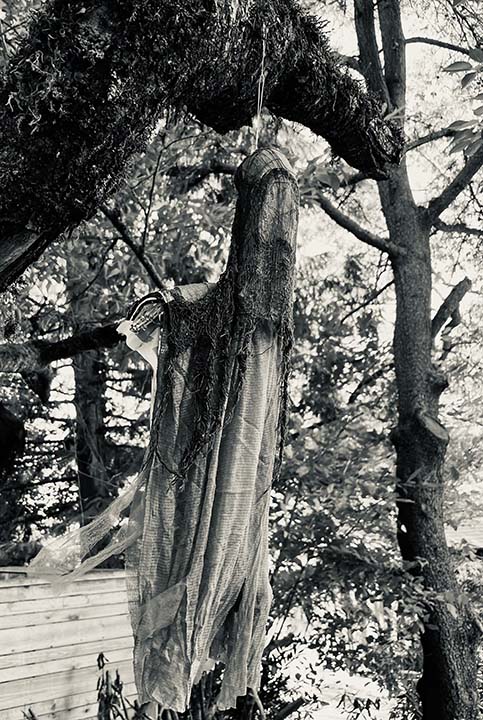
Music today is the newest album of Berlin-based Ghost Dubs, echoing the Halloween photographs from my neighborhood.
If you are interested in textile design and live on the West Coast, you are currently in luck. The Los Angeles County Museum of Art (LACMA) just opened a major retrospective of works of the collective design studio NUNO, headed by Reiko Sudō. Textile Alchemy: The Art of Reiko Sudō & NUNOpresents over 100 limited edition textiles, many of which are drawn from LACMA’s collection, including sketches, raw materials, tools, mock-ups, and prototypes. At the center of the exhibition hall is a retail store that allows visitors to purchase items associated with the studio, a recreation of the original 1984 NUNO shop offering textiles, clothing, and accessories. Rather than being irritated at the consumerism urged on visitors, we can celebrate that this arrangement stresses the fact that NUNO’s creations are primarily about function. Their beauty and innovation non-withstanding, these fabrics are meant to be applied, whether in wardrobes, interiors or as architectural design features.
Closer to home, Portland Japanese Garden features a smaller, compact presentation of the output of the studio, artist and artisans. Weaving Time: NUNO – Textiles of Tradition and Transformation is a lovely introduction to these famous Japanese fabrics. The visitor is not only offered a rich visual environment, but also encouraged to experience the fabrics tactilely, using our sense of touch to understand the variability of much that is produced by NUNO. Reiko Sudō is clearly not just en vogue, but also in last month’s Vogue, which featured an informative biography of the designer, who traveled a complicated path despite her stunning talent and visionary energy.
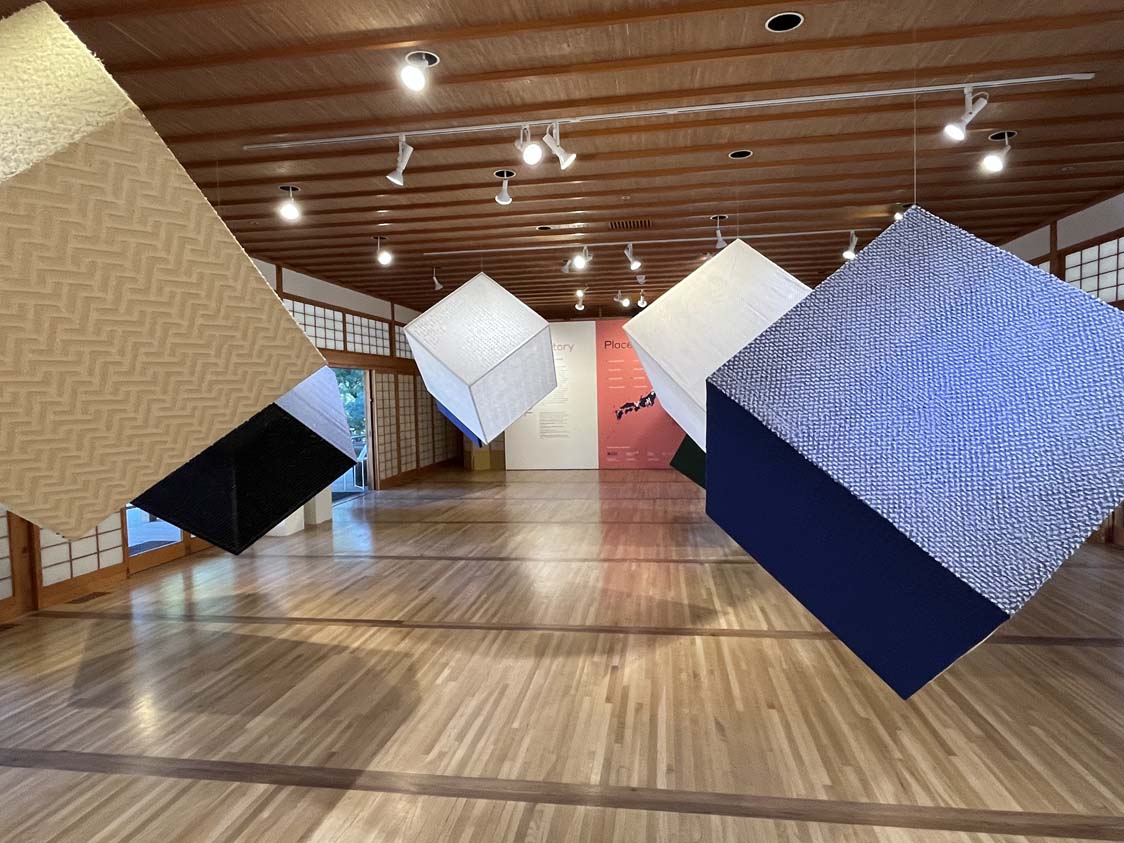
The Pavilion is filled with large, colorful cubes, suspended from the ceiling. They slightly sway and shift when the sliders to the outside are open, creating an impression of floating in space. Each stands for one of eight regions of Japan that are associated with distinct styles of textile production, with the cubes’ respective six sides covered by cloths representative of a region. It is an efficient use of limited space.
One of the side walls holds samples to touch, and explanations about the points of origins for these fabrics. The other side wall informs visitors about the processes used to bring traditional ware into modernity, including cutting edge chemical and physical processes revolutionizing the production of fabrics that combine beauty with function.
The choice of the Portland Japanese Garden exhibition title – Weaving Time – seemed fortuitous to me. It includes both variables that are special about Sudō and her collective: a look backwards aimed at stewardship of traditional process and a leap forwards in employing cutting edge new technologies to produce futuristic materials. For the newly opened David Geffen Galleries at LACMA, for example, she created a set of curtains that guaranteed transparency but also protected art work from harmful sunlight. The sputter-plated chrome textile they created is fire-resistant (the codes are rigorous), and has an interesting metallic sheen, in both matte and gloss varieties. No wonder they went for the Alchemy exhibit title – there is something about the fusion of materials and her and NUNO’s role as catalysts. I still like “our” title better, though, since the preservation of history is such an important role in a world that tends to ignore the old crafts at best, and relegates them to the dustbin at worst.
The curtains in front of the Garden’s Pavilion are made of nore material. The way they swayed and softened the view of the surrounding landscape while still somewhat transparent, was the best transition to the fall garden that I could imagine.
I consider this time in the garden as floating into fall. The softness of the coloration is not yet superseded by the full saturated fireworks of color change. Leaves seem tentative,
floating in sunshine and shade alike,
or gathering on the many water features.
Yet there is still solidity in the canopy, with only the occasional renegade leaf starting its earthbound descent.
Curtains and cubes around and within the pavilion echo that visual or perhaps even emotional impression.
***
I reached the Japanese Learning Center at the end of my walk. A small portion features NUNO textiles caged in bamboo, created by master woodworker Chūzō Tozawa of Hinoki Kougei. The row of paravents are entirely monochromatic and meant to evoke the Pacific Northwest’s rainy season.
The cynic in me often wonders if these titular allocations are made to please a specific audience – I could have just as well bought the idea that these fabrics relate to the snow at Fujiten, Niseko or Hakuba Valley, or the cherry blossoms’ shades of white. Better to ignore the labeling and immerse myself visually – these fabrics are etherial and almost hypnotizing if you stare at them for a long time. Again, despite their objectively static nature in those frames, they can induce perceptual floating if you hold your gaze just long enough.
***
I’ll let others debate where the boundaries are between design and art. For the record, her work’s status as art remains complicated for Sudō herself. “I want to make textiles that move people, emotionally,” she explains. “But fundamentally, I really want my fabrics to be used.” (Ref.)
It is the case, though, that fiber arts have made a huge impact on the art scene across the last decade or two, with their visibility ever rising. That can include the use of specific textiles to create installations, as Sudō herself did with Adrian Gardère, for example, for MUJI stores (she sits on the Board of the company.)
Reiko Sudo and Adrian Gardère Koi Continuum (2026) Photocredit Phillip Reed
More often it means the use of any kind of fiber in ever more creative configurations, with myriad processes employed. (For a quick overview of the variability of contemporary fiber arts, check out this, examples ranging from cute to uncanny.)
One intellectual and artistic lodestar for the fiber arts is the Fiber Arts Biennale From Lausanne to Beijing, showing the most accomplished artists at the museum of Tsinghua University in China. Interwoven Horizons, the most recent 13th Biennale, stated as a profile:
This edition explores the convergence of fiber art within material culture, ecological ethics, and technological evolution, examining how the fiber medium carries tactile experiences and cultural heritage in contemporary expression while bridging local and global contexts, tradition and future.
Seems to echo much I’ve learned about NUNO’s approach. Here is a link to the exhibition view (embedded in the conference report.) The images are stunning.
You have to travel a bit less – Leeds in West Yorkshire, rather than Beijing – to see a current exhibition at the Henry Moore Institute, that shows the sculptural qualities fiber art. One of my favorite contemporary fiber artists, NYC- based Sagarika Sundaram exhibits Reservoir . The center piece of the show is a 23 ft (7 meters) felted structure, Blue Mountain 2026, which looks to me (I’ve only seen photographs) more like a wave, and thus leads us back to floating. Spectacularly beautiful in its drape and undulations.
I am bringing up the global context because I have repeatedly felt that the exhibitions I review at Portland Japanese Garden, even though dedicated to Japanese artists, bring themes and creative processes to our attention that overcome insular preoccupations. Just like the microcosm of a sculptured and carefully maintained Japanese garden reflects the larger configuration of nature that surrounds us, the small but smart exhibitions we encounter in the Pavilion address themes that cross borders. Questions of material culture, cultural heritage, historical correlations or the impact of a globalized world on nations’ development are all raised from various artistic perspectives. For me, who loves the garden as a natural place, its role as a stimulant for thought through art and design has taken on an almost equally important value. Some exhibitions more so than others, of course, but then again, some seasons register more so than others. The current one is a favorite: floating towards fall.
In May 1947, Poetry – A magazine of verse published a poem by Clara Brussel (1921 – 1983). She was an accomplished translator of German authors (under her married name of Clara Winston), including Thomas Mann, Hanna Arendt, Herman Hesse and Franz Kafka. The young woman nonetheless continued to write poems, something she had started in high school in New York City, before attending Brooklyn College. Much of her work was affected by the horrors of a world at war, the plight of displaced refugees (including some of the authors she translated) and the role of women in societies that went through major upheaval.
An instrument to be sold, its accidental survival incomprehensible, compared to the children who perished in a country destroyed by war. Real and empty at the same time, an “unstrung husk,” per chance leading to barter that might help survival during famine. Completely divorced from its musical function, a symbol for extreme anguish and senseless fate.
Much to think through. Today’s poem, however, only came to mind because I was introduced to how guitars are made. The recent ArtsWatch road trip provided me with the unusual opportunity to learn how string instruments are build and how that craft is affected by modern economic and scientific, as well as traditional educational factors.
No anguish or any other negative sentiment on view during a visit to Breedlove, a company in Bend, OR, that makes its guitars by hand for the most part. Through the 30 years of its existence, the company has changed ownership a few times, with each new owner bringing improvements and different focus to the process. (You can learn about their history here.)
Mother of pearl and abalone inlay hand placed on necks.
Their instruments come in various versions, from root to artisan to collector series, and range in prices from about $3000 to 5-figure numbers, if you have personalized desires. Dreadnoughts, concert and concert cutaway guitars use different tone woods, top finishes, and custom-made inlays of abalone or mother of pearl for the necks. All instruments can be equipped to work with electronic amplifiers.
Breedlove guitars are known for their sound optimization, with each instrument’s top and back hand-tuned dependent on the unique properties of the selected woods, giving each an individual sound.
Some technological advances like CNC (Computer Numerical Control), a machining process that uses programmed commands to precisely cut and shape guitar bodies, help create parts of the instruments. But it is the hand work of the luthiers, who put it all together and work on the hand-tuning and finishing.
These skills are learned through years of apprenticeship and practical application, with many a botched instrument discarded until you reach perfection. It takes patience, passion, an eye for geometry and an ear for sound, never mind dexterity, to become a successful luthier. Hats off to those who make it.
To keep up with a competitive world, pricing has to be balanced between the quality you achieve and the time it takes to produce a sufficient number of guitars to bring to market. Not an easy task when much of the market is saturated with cheaper imports that use way more production line techniques and computerized processes.
***
Guitars and their relatives, the gittern and the lute, have been around for a long time. One of the oldest predecessors of the guitar is the tanbur, believed to have originated in Mesopotamia over 4,000 years ago. The first guitar as we know them today emerged during the 19th century, built by Antonio Torres. Contemporary concert guitars use nylon strings, blues and rock guitars use steel strings, but it is the form of the body, the hollow, and the shape of the neck that affect the overall sound we associate with guitars.
15 years ago, the Metropolitan Museum had a fascinating show of guitars and their makers, work that dated back to renaissance Italy and progressed to 20th century America.
They looked like art objects, rather than instruments and remind me of art: painters certainly have been fascinated by string instruments and depicted them through the ages.
Johannes Vermeer Woman with a Lute (1662)
Bartolomeo Veneto Lady Playing Lute (active 1502 – 1546)
Frans Hals Buffon playing Lute
Pablo Picasso The Old Guitarist (1903)
So why are guitars so popular? The best speculation I read came from here:
For “immediacy” is why a guitar is a folk instrument, i.e. the instrument of folks. The guitar is lightweight, cheap, easy to play. Anyone — and I would like to stress anyone — with two hands and the inclination can spend an afternoon learning three major chords (A D E is a good combo or D A G) and be then well equipped to instantly rock scores of songs from “Back in Black” to “You Are My Sunshine.” (Like the old ‘70s fanzine said: “This is a chord, this is another, this is a third. Now form a band.”) This is not so with the piano, nor the drums, the flute, the fiddle. Flung over the heart or across the back, the guitar is good for anywhere and any occasion. The guitar is a folk instrument because it is an easy extension of our bodies, and therefore an easy expression of our humanity. The guitar — and all its predecessors and incarnations: the bouzouki, the saz, the oud, the guitarrón — represents the parts of us that are spontaneous, angry, lazy, joyous, raw, unsophisticated and unadorned. The only other instrument that surpasses the guitar in capturing this immediacy is the voice. Which is the final reason why the guitar is not just a folk instrument but the folk instrument — it’s an easy companion to singing.
Let’s sing the praise of the guitar and listen to music by guitarists who mastered a bit more than three cords….
Really? Talk about ghosts? What kind of ghosts? There are no ghosts!
Of course there are no ghosts. I use the term metaphorically, to talk about intrusions into our consciousness, or the realms close to it, like dreams, or inklings, or vague memories. But there are also representations of ghosts used by artists to get a point across that would be hard to convey otherwise.
This brings me to three films that I watched across the last weeks, with nods to ghosts as an artistic tool in two of them, and my own private “ghosts” being triggered by the third.
The latter, The Perfect Lie, is psychodrama disguised as a murder mystery. Good entertainment, if you go for that sort of stuff (as I do.) The other two, My Sad Dead and The Sound of Falling (In die Sonne schauen) are something altogether different. Both are immeasurably cruel and gory in images and message, and will linger in your head for months to come. The best – and paradoxically most beautiful – cinematography I have seen in a long time. Heartbreaking, as a package.
Why am I writing these reviews? I guess to consolidate my thoughts and get them out of my system. My prediction is that most of my readers will not want to expose themselves to fare that is violent and painful. But for the few who might, you will be amply rewarded. There is something about being in the presence of true art and hard questions that cannot be found anywhere else, and might change how you think about things.
***
The Perfect Lie is one of those typical slick Netflix productions that showcase the filthy rich having the same problems as us average mortals. (“See, the rich suffer too, no need to be envious of them…”)
Sex, drugs, partying and consumerism cannot hide the rot underneath, which eventually leads to the fiery death of one partner and the attempted murder of another in a tight group of four couples. The WHODUNNIT ensues, with each episode being told from the point of view of the remaining participants. No spoiler alert on my part – it is unclear how it ends for at least one of the victims, since Season 2 is waiting in the wings….
Why did I watch glitzy fare like that? It was filmed in a small village at the Dutch North Sea, a place where I spent my childhood summers. At that time it was still a sleepy artist colony, just opening up to tourism. Wide, sandy beaches, dunes and conifer forests that were protected as National Park, endless opportunity to be outside, play with other kids without curfew and eat lots of french fries and ice cream. Bliss, on the surface of it.
Friderike Heuer Mirage (2017) (Series: The Refugees’ Dreams) Dune Villa photographed in Bergen aan Zee, the site of the film.
I have been back there a few times as an adult, the last time almost a decade ago. It was just for short visits with family, centered on strolling the lanes, walking on the beach, the occasional short hike through the dunes. The film captures wide swaths of the landscape with a lot of drone footage, including landmark buildings that stand as strong as they did in 1959. The distinct (often stark) nature of the area is poignantly depicted.
Did those images ever trigger the ghosts in the machine. So many emotions flooded to the surface, crowding out any rational reactions in my mind. These summers were the first time when I sensed that something was wrong, observed adults being crippled and fragile, not just strong, protective parents. Could not put any name to it yet – the notion of the damage WW II had induced, including perpetual PTSD, came along much later in my young adult years. The core message of the film, that constant adult lying or subterfuge provokes unease and confusion (and eventually catastrophe), perfectly mirrored the state of this 7-year-old trying to make sense of a world that was volatile.
For anyone else watching this series as just another glimpse into European regions and lifestyles, it might be a perfectly entertaining romp.
Friderike Heuer Ghosts (2017) (Series: The Refugees’ Dreams) Landscape photographed in Bergen aan Zee, the site of the film.
***
Spoiler Alerts
“Real” ghosts populate the screen in My Sad Dead, another Netflix production of a very different kind. Directed by Pablo Larrain and filmed by Sergio Armstrong, it is closer to an arthouse movie with social criticism at its core and political analysis on the side lines. If that sounds like an intellectual construct – it is not. It is an emotional, empathetic art work that captures some essential parts of what it means to be human in our own times. Based on a selection of short stories by Mariana Enriquez, the series introduces a 60-year-old doctor living in Buenos Aires, who has been able to see and talk to the dead since she was a child. The viewer also sees these ghosts behind slightly obfuscating veils. They are not happy or complacent, but relive the painful moments of their deaths, exposing the doctor (and us) to their constant agony.
Friderike Heuer What’s Left Behind (2017) (Series: The Refugees’ Dreams)
Bit by bit, we learn that Ema lost her hospital job after having engaged in triage of patients during Covid, letting some die to help others with better survival chances to get access to the oxygen tanks. We realize that her fraught relationship with her daughter who seems as lonely and isolated as the mother, has partially to do with the daughter’s participation in a lethal overdose of her boyfriend. And we meet her estranged sister who visits from far away Oregon with her family. She is bringing her daughter for medical treatment, available for free in Argentina. The young woman is morbidly obese and deemed mentally ill because she, too, sees ghosts, and has a circle of close friends among them, with all continuously engaging in noisy group sex. (Yes, we see that too, if we can bring ourselves to watch, confronting our own body image prejudices.)
Ema intermittently lives in the house of her mother who recently died, in a suburban neighborhood surrounded by projects that teem with poverty and crime, leading the middle-class neighbors to embrace ever more fascistic means to defend themselves. (Historical references to Argentina’s past and presently rising fascism, including neighborhood brownshirts, abound.) Ema’s niece escapes her psychiatric confinement and chooses to end her life in a water tower that supplies the entire neighborhood. Her mother abandons her, even in death, pretending she is still alive, insisting that she cannot handle abnormality, or deviation from body norms, literally striking her very memory from her life and fleeing the country.
Soon everyone can hear the cries of the dead after having consumed the water, and the doctor is constantly called to quiet them down and send them away. The eager demand of her extraordinary skill turns into a witch hunt when it becomes clear that it was her niece who contaminated the water. The menacing mood is amplified by spectacular cinematography that focusses on the hostile architecture of the projects and industrial sites in muddled grey and browns. But it also circles back over and over to the clear, determined, unflappable face of the doctor, who just dons her bright blue scarf and brings peace to the ghosts as well as her neighbors.
Friderike Heuer Border Crossings (2017) (Series: The Refugees’ Dreams)
In the end she and her daughter sit with the now happy ghosts of her niece and her mother contentedly around the dinner table, having an ordinary meal. Almost like a reminder that if you acknowledge the suffering brought on by horrible societal forces and don’t avert your gaze, courageously engage in some form of remediation, you will not be haunted by instantiated memories.
No didacticism detected. Just a subtle underlying narrative that reminds us of the possibility (and the rewards) of being an ethical human being, even under oppressive circumstances, forced gender roles and class divisions.
***
The Sound of Falling (In die Sonne schauen) is a German film directed by Mascha Schilinski with Fabian Gamper behind the camera. It won the Jury Prize in Cannes in 2025, the year of its release, and was nominated for multiple categories at the Oscars. I have now watched it multiple times and am still uncertain how the filmmakers pulled it off: they tell a coherent story with the use of mosaic-like snippets, both visually and thematically, that follow no straight time line. The film involve endless characters that contribute to the narrative unfolding in ways that are almost undetectable at first viewing, many of them children filmed in a way that we see the world – literally – from their eye level.
Set on an old farmstead in the East of Germany (in the state that just voted for right-wing extremist AfD), the film follows the fate of four girls and their families across a century, starting in the years before WW I, and ending in our own time. Even though there are no actual ghosts depicted, the framing and jumps across time in the same location – the kitchen, the house, the hayloft, the river that eventually divides East from West Germany – leads to a sense that the remnants of previous lives and deaths are contained in the material world. The walls, the hallways, the underwater current in the river all affect subsequent generations, united by the only escape open to them from suffocating and violent fates – a willing encounter with death.
Although the theme as it unfolds has to do with how women are subjugated, sexually abused, shamed and silenced, the film starts with a reminder that men were not exempt from harm – the oldest son of the farm is mutilated by his parents to escape being drafted for WW I. A small boy is unceremoniously lying in state in a barn with other children playing around him without inhibition – death being part of their lives. We meet little Alma who discovers a photograph of her look-alike sister, also named Alma and long gone. She worries she will be next, but it is one of her older sisters who takes her own life by jumping off a rolling hay wagon. She was “traded”as a farm girl to a neighboring farmer who had sustained her family after a bad harvest. These farm girls were forcibly sterilized – historical fact – so that they could be sexually used by any of the male farmhands without getting pregnant, which would have interrupted their ability to provide hard labor. Alma’s sister cannot live, literally, facing that fate.
Also historical fact was that many women of the next generation, now in the 1940s shortly before the end of WW II, went in groups into the rivers. Laden with stones, they drowned themselves, to avoid being raped by the incoming Russian army. Erika is among them. Her sister survived, never to be mentally intact again or able to protect her own daughter, Angelika. A teenager in the 1980s, she is sexually abused by her uncle and harassed by her cousin. We last see her like a ghost on a family photograph before she left the farm – it remains unclear if she swam through the mined river towards freedom (there was prior information that she was a very strong swimmer) or if she, too, drowned herself. She is never heard from again.
The last views of farm and river come through the eyes of a young teen, Lenka, who grapples with growing up under the leering eye of adult males. Her parents and a younger sister all moved out from Berlin to renovate the now empty farm, with the mother destroying precious tiled ovens with a pickax and a degree of fury that you wonder what she will do next. Lenka’s younger sister Nelly is plagued by nightmares and anxiety, and eventually climbs the height of the hay barn to tumble to her death, ambiguously shown in ways that could be either intentional or accidental.
Friderike Heuer Shelter (2017) (Series: The Refugees’ Dreams)
The German title of the film is Looking into the sun. What happens when you look into the sun? You are blinded. Are we the ones blinded? Blinded to cruel undercurrents when the imagery we see is incredible beautiful? Willingly ignorant of the fact that nothing much has changed across a century when it comes to the victimization of women? Blind to the reality that life was cruel, when we are yearning for the so-called good old times? Grateful for blinders that protect us from the eerie possibility that place contains traces of memory independent of rememberers (a question the filmmakers asked themselves)? The film successfully rips those blinders off, exposing us to what we so very much don’t want to see.
The English title, The Sound of Falling, elicits some speculation as well. There is very little sound in the film, other than music. Few lines are spoken, some of them in a language (a version of low German) that practically no longer exists, and so is incomprehensible. And you don’t hear the impact of the various falls, much less any sound in the process of the falling. Have we closed our ears, as well as our eyes, to suffering? These are sounds that cannot be imagined, un-real – just like ghosts. What haunts us here, though, is not ghosts but an inescapable co-experiencing of people’s lives, people who had no real means of escape.
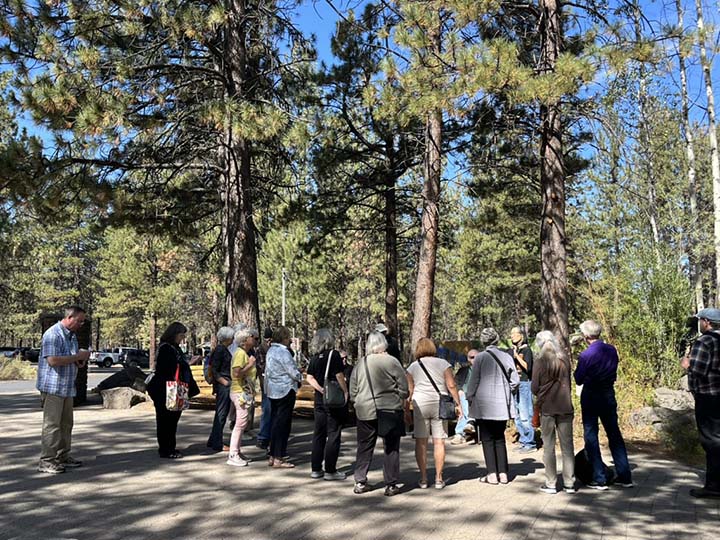
Last week OregonArtsWatch offered a roadtrip for some 20 participants to explore an exhibition at Clackamas Community College, the Museum at Warm Springs, the High Desert Museum, and various galleries and studios in eastern Oregon. Superbly organized, it provided glimpses into a wide range of artworks, art forms, encounters with artists and art administrators. For those able to attend, there was also the chance to see a play, hear a concert, and have a conversation with Ellen Waterston, current Oregon Poet Laureate from Bend.
A truly fun as well as educational trip. I was able to participate in some of these visits, having to cut short the trip when I started feeling under the weather.
What I marveled at: so many artists, such community efforts to gather and support the arts, so much success in preserving regional traditions and practices on various levels.
What I was surprised by: the focus on animals by the overwhelming majority of the art I encountered. I have never seen so many owl, raven or horse representations congregate on so few square miles in my life. Before anyone jumps to conclusions that I mean this condescendingly – let me differentiate. I wondered not about what I saw, but what I didn’t see.
Animals have played a role in art since people started to put paintings on cave walls. Originally likely provided with informational or spiritual intent by prehistoric societies, they later served as props to indicate status, or were meticulously drawn to inform about the natural world. They were used as codes for religious or political narratives, or simply depicted for the love of them. If you check out the animals in art overview by the MET, their 600 some items are stunning in their diversity and detail across the ages.
If animals are part of your cultural traditions, then their representations have symbolic value or help younger generations to preserve tribal knowledge.
Elizabeth Woody Sisters of Compassion 1 (1994) – part of the current exhibition at the Warm Springs Museum celebrating Lillian Pitt: Art, Memory, Home.
If your goal is an introduction to regional history and ecosystems, fauna and flora, then representing the relevant species is important and educational.
Battle of the Elks at High Desert Museum, Bend, OR
If your work is concerned with how we abuse our environment and how nature tries to find ways of healing, telling the story via a bit of animal magic is a compelling tool. (For PNW readers, run, don’t walk to Hilary Pfeiffer’s current exhibition, Microclimates, at the Alexander Gallery at Clackamas Community College. One of the most interesting shows I’ve seen in a while. More on that at some later point.)
Hilary Pfeiffer Timber (2026)
Artist Statement:
What are the reasons, though, for so many people who simply depict animals? An expression of emotional attachment, a love for nature the artist wants to share, a bit of escapism from the realities around us, focusing on whimsical distractions? Where is the line where whimsey crosses over into Kitsch?
Not that I mind whimsey in these times – here is one of the cutest examples that I was shown….
Owls ruled the back alleys of Bend, in public art.
Birds were a mainstay at up-scale galleries, and collaborative studios.
The High Desert Museum offered another example, Art in the West, a Fine Art Exhibition and Online Auction (still open for bidding!) that helps fundraise for artists and education programs. Look for yourself – here is the entire collection.
Todd Horton How to Craft a Poem (2026)
Critters galore, some of them exquisite, some leaving you wonder. One of the few contemporary works dealing with cultural/social issues was Frank Buffalo Hyde’s, a gifted painter and astute observer whose art I first encountered in New Mexico in 2017.
(The museum itself has excellent coverage of native history as well as the plight of immigrant workers in a terrific special exhibit – Miguel Almeida: Las Manos que dan de Comer (The Hands That Feed), just to be clear. I am talking here about what a call for art received as contributions.)
Karen Straight Stillness (2026) (needle and wet felted wool painting)
I am not asking for the presence of the likes of artists like Frida Kahlo, Kaethe Kollwitz, Carrie Mae Weems or Barbara Kruger, to name a few famous ones who deal(t) explicitly and predominantly with the issues of their time. But why have the current ecological disasters, from water shortage to wild fires across the West, the depletion of fish runs, the threat of species extinction, or the deportation of so many who were successfully and seamlessly integrated into communities, not made a proportional appearance? Any appearance?
There is a case to be made that depicting what you love – animals – might preserve your sanity in times that are challenging, to say the least. You focus on something positive and of value, rather than threats. It might also provide imagery of what is worth fighting for, once you return your focus to the realities of a country, or an administration that puts extreme stress on the environment and skimps protection for what is vulnerable within.
Yet I wonder: Are more directly political artworks avoided because we are saturated with bad news and need distraction, or are they absent for fear of stepping on toes? And are they avoided by artists, or are they limited by those who select artists for showing?
***
The road trip did not provide the answers. It did, however, offer one exception to the rule when we were invited to visit Scalehouse, a collaborative for the arts in Bend.
The 501(c)3 nonprofit organization was the brainchild of master printmaker, professor and arts advocate Patricia Clark, one of the instrumental co-founders who believed that creativity was not just a beneficial but an essential part of meeting the challenges of contemporary life. Some 15 years ago this group of innovators decided to create something more than exhibition space: they hoped to provide a platform for creative and intellectual exchange between artists, designers, scientists and community at large. Their programs include gallery space, an art lab education program, public art projects, and Bend Design, a conference that assembles problem-solving workshops, talks and films to instigate new ways of thinking for the future of design. Since 2015 thousands of participants have benefited from the offers.
In their own words: “Scalehouse promotes collaborations through a multidisciplinary and contemporary lens, encompassing visual and performing arts, architecture and design, film and storytelling, conceptual art and activism. From exhibitions to talks to the annual Bend Design conference, our programs catalyze a creative synthesis that’s impossible in isolation.”
The main gallery featured works by the community’s young. I spent my time, however, in the adjacent Patricia Clark Studio, which provides 6-months residencies to 2 artists with free workspace. One of them, artist and graphic designer Lona Owemo, has created a multidisciplinary collaboration between several local poets, the community at large and Owemo’s own visual representations of the poetry in chapbooks.
Drawings of Lona Owemo on Studio Wall
Mirrors of Disseminationwas first revealed on the last day of April, National Poetry Month. Eight local poets read from their work in the studio, poetry that had been collected into chapbooks that Owemo designed and furbished. The public was invited to read or record their own reactions to the ideas on the walls of the gallery, which also hold many of the artist’s own graphite drawings.
Here is a typical example of the chapbooks, featuring poetry by Mello Versiz, a transplant from Queens, NY, who provides a contemporary voice with scathing insights and occasional truly lyrical phrasings despite fraught subject matter (heavily copyrighted, so I will not publish a poem.)
The figures looked to me like ever more abstracted versions of cubist portraits, reminiscent, for example, of Diego Riviera’s output once he had moved to Paris. I couldn’t decide if fractals were also at work. I looked up the definition: In mathematics, a fractal is a geometric shape containing detailed structure at arbitrarily small scales, usually having a fractal dimension strictly exceeding the topological dimension. In philosophy, Fractalism is a concept, roughly, that everything is connected to and communicates with everything else.
Diego Rivera Young Man with Stylograph – (1914)
Whatever applies, the project’s title certainly pointed to communication: Mirrors of Dissemination. Dissemination has its root in Latin, the scattering of seeds. A seeding of ideas, here, harvested by diverse audiences. Connection between communicator and listeners is not the only one, however. Mirrors have taken on an ever-central role in the visual arts as tools for communal interaction between artist and viewers.
Originally used as props, just like animals were, mirrors shifted from being depicted objects to becoming integral parts of the art works. You have the infinite reflections of Kusama’s Infinity mirror rooms.
I was photographing a Kusama installation at The Broad, L.A., I think in 2019
You have Michelangelo Pistoletto’s Mirror Paintings which use reflective surfaces, making the viewer part of the painting once they step up to look. There are Graham Caldwell’s mirrors, which reflect unstable fragmentations of the observer, to mention just a few.
The artist, the work and the audience are interacting, destabilizing the role of the creator and producing a communal output instead, however distorted by the chosen lens.
Owemo’s portraits are obviously not using actual mirrors, but the artist’s choice of title and the fragmentation of the portraits urge us to construct a percept rather than rely on a provided one. There is a collective, interactive dimension, then, that echoes that of the poetry project overall, as well as the general philosophy behind Scalehouse’s contribution to the Eastern Oregon community.
Thoughtful work, managing to draw us away from our constant preoccupation with self – as found in the various captured depictions in reflective surfaces so prevalent on social media – towards thinking about what others are about or have to say.
Grateful that the ArtsWatch road trip made the introduction!
I am off for a short road trip to visit with artists in Eastern Oregon and get my annual dose of smelling the pines of the High Desert.
In the meantime I leave you with an essay that can serve as a follow-up to my own post last week on what is happening in Europe, this week’s thoughts on what gets remembered in this country, and my posts here and here some years back specifically on memory culture. Where I confined myself last week to talk about the German election in the small state of Saxony-Anhalt, Seth Cotlar’s essay is providing wider comparisons in much more in depth. He is a historian who is a professor at Willamette University, currently teaching abroad, in Strasbourg.
Cotlar conveys historical and current political facts, but also guides us to the differences in memorial culture between European nations and our own. He addresses pivotal moments in history, the way things change, often unpredictably, and how we seem to ignore the lessons about how to forstall disruptive and destructive change. It is a learned analysis, as would be expected from a historian, but also an astute, empathetic capture of the moment, with smidgens of optimism. And very cool photographs. Much recommended read. Every time I open Rightlandia, Cotlar’s blog since 2025, I certainly learn something new.
Or should I once again (mis)quote: History is written by the ones in power?
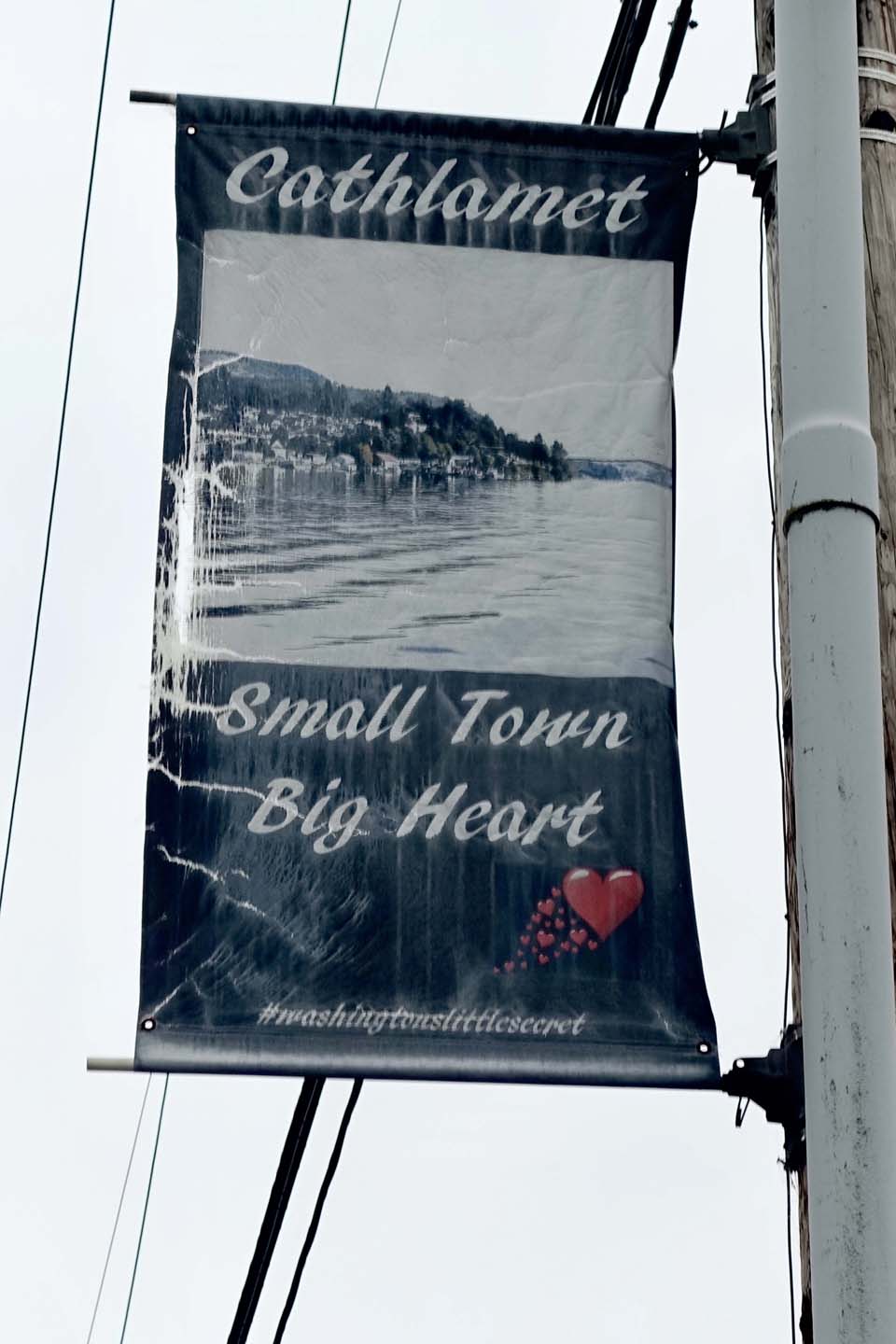
Last week I visited a small historic town,Cathlamet, WA, located on a similarly named channel of the Columbia River. About an hour-and-a-half’s drive north west of Portland, through beautiful landscape once you hit the western edge of Washington State.
Old pilings from Douglas Fir trees used in the sorting and rafting process in 19th century logging.
It has a small marina for boating and fishing, some industrial tug boats still working in the harbor, and 19th century buildings that are well preserved.
The place was settled by early pioneers in 1846 and the Washington Territorial Legislature established Wahkiakum County in 1854, naming it after the native people who had for centuries lived along the river (some 6000 still by1820, the combined population of the Wahkiakums, Cathlamets, and Clatsops and Chinooks.) They had been decimated by the arrival of earlier explorers who brought small pox, observed by the Lewis&Clark expedition, but nothing like the epidemic to follow: in 1830 some 90 percent of the tribal populations got wiped out but what historians believe to be malaria.
Settlers arrived and took over the land, and, equally important, the river. Logging and fishing industries blossomed after 1870, with the majority of homesteaders now coming from Scandinavia, where hunger and poverty drove scores of people to emigrate. These settlers, and later large companies drawn by the riches of the temperate rain forest, cut millions of trees, and drained the wetlands, ignoring their importance for a flourishing ecosystem. The Nordic immigrants were expert fishermen, but also brought a lot of knowledge about dairy farming and organizing as cooperatives to stay in business that became quite competitive. Puget Island, in the middle of the river across from Cathlamet, was even called “little Norway.”
There is a lot written about these early settlers, their hardship, their skills. These days, the major companies who absorbed their labor, logging forests to make paper, have left the region. The fish are gone as well, at least in the numbers that sustained whole communities. Overfishing, environmental degradation in general, ever further pushes of the urban boundary into spawning grounds, and, most importantly, building endless dams upriver, have had severe impacts.
The small town now relies on tourism, providing a marina for fishing boats, or just generell water sports. Many people commute to larger cities to find work, or take on jobs as fishermen on trawlers that fish in Alaska, being gone for months on end.
When I say many people, let’s face that the entire population of the town is 520 people, as of the last census I could find. About 95 percent of them are White with a median annual income of $35.000 or so, a high poverty rate, and about 60% of them are voting for the Republican party.
***
There is a lovingly preserved church, a courthouse, a few memorial markers for tribal populations, or citizens who were killed in world wars.
There is also a small museum, which has historical logging and farming equipment outside and a boat that served as a hub for decades, teaching young men to fish for salmon, sturgeon, silverbacks and all the other species running the Columbia River. (I did not venture inside, if it was open at all, since I forgot my mask in the car.)
Nowhere to be found was a trace of remembrance of the Chinese pioneers who contributed so much to the Pacific Northwest.
At least not what I saw, might have missed it?
We know that in Astoria, OR, some 45 minutes west of Cathlamet, they brought the railroad, they built the river walls and the jetties, they put in the sewer system and worked in the canneries or other fish processing jobs long before the Scandinavians arrived. Some 22% of the population was Chinese at the time. There they are remembered in The Garden of Surging Waves.
We know the cannery industry boomed in the 1870s along Wahkiakum’s Columbia River shoreline as well. We know that Chinese immigrants comprised a high percentage of the workforce. By 1880 there were 500 Chinese workers located in Wahkiakum County as well (today there are 5 (yes, five) Asians counted in the census of 520 inhabitants of Cathlamet.) They were first hired as butchering crews for the local canneries. In Cathlamet they lived in what was called The China House located next to the cannery. (Ref.)
And then? Wherever you look, you find sentences like: “few remained after that.”
Once again, you have to figure out history on your own, when it comes to dealing with violent parts of the evolution of this country. What happened is not just the racist treatment of Chinese migrants, their literal killing and maiming in so many townships on the West Coast across the centuries. There was specifically the Chinese Exclusion Act of 1882.
“U.S. federal law that was the first and only major federal legislation to explicitly suspend immigration for a specific nationality. The basic exclusion law prohibited Chinese labourers—defined as “both skilled and unskilled laborers and Chinese employed in mining”—from entering the country. Subsequent amendments to the law prevented Chinese labourers who had left the UnitedStates from returning. The passage of the act represented the outcome of years of racial hostility and anti-immigrant agitation by white Americans, set the precedent for later restrictions against immigration of other nationalities, and started a new era in which the United States changed from a country that welcomed almost all immigrants to a gatekeeping one.”
If you read the entire entry on the act (in the link above) you’ll learn that it was repealed and amended in 1943. Here is the thing, though: two months ago, the Trump administration published a 162-page report in which it defended the 1882 Chinese Exclusion Act as a necessary tool for protecting American workers and sovereignty. It did so in the context of trying to force our cultural institutions, like the Smithsonian and other museums, to revise their narratives about the supremacist bend of exclusion laws. It explicitly wants to eliminate all mention of historical oppression. I guess it has to order the Library of Congress as well… here is their entry on the plight of Chinese migrants:
“Even as they struggled to find work, Chinese immigrants were also fighting for their lives. During their first few decades in the United States, they endured an “epidemic of violent racist attacks, a campaign of persecution and murder that today seems shocking. From Seattle to Los Angeles, from Wyoming to the small towns of California, immigrants from China were forced out of business, run out of town, beaten, tortured, lynched, and massacred, usually with little hope of help from the law. Racial hatred, an uncertain economy, and weak government in the new territories all contributed to this climate of terror and bloodshed. The perpetrators of these crimes, which included Americans from many segments of society, largely went unpunished. Exact statistics for this period are difficult to come by, but a case can be made that Chinese immigrants suffered worse treatment than any other group that came voluntarily to the U.S.”
It is, of course, not just versions of history that can be shaped by those in power. It is the ongoing attempt to manipulate who gets to live and work in this country that was founded by immigrants. The Trump Administration has now floated a $100,000 fee for Optional Practical Training (OPT), aiming to deter international students from working in the U.S. post-graduation. As Forbes reported,
“This proposal faces opposition from educators, economists and businesses, who highlight students’ contributions to innovation and the economy. Critics also question its legality, especially after a federal judge recently struck down a similar $100,000 H-1B fee, deeming it an unconstitutional tax. Research shows international students on OPT do not harm American job prospects but rather boost employment and innovation. Such a fee would likely harm U.S. competitiveness and drive talent to other countries. The policy’s future remains uncertain.”
China, as of 2024, had the second highest number of International students, some 277.000, in the US, only topped by India. Think of all that talent, all that potential for scientific research lost, should the proposal gain traction and would be considered legal.
It is mind boggling.
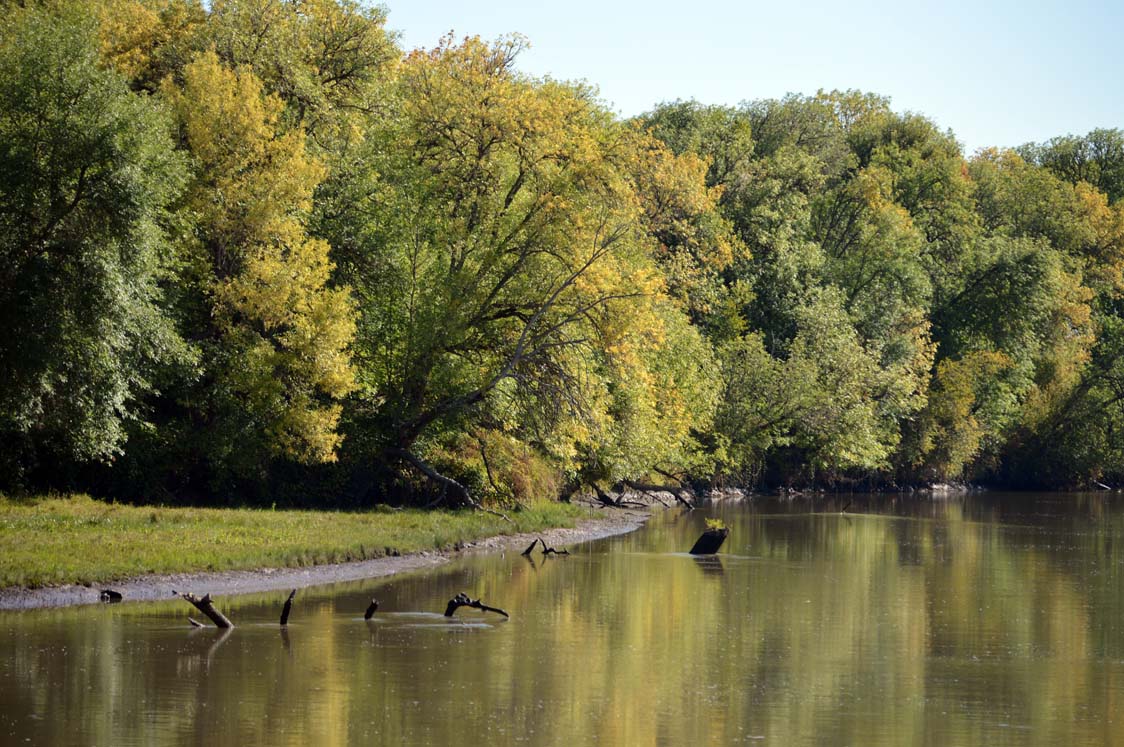
So was the view along the river, the green once again soothing a brain boiling with irritation. The kingfisher did his tricks, the clouds slowly lifted. It was still warm, a hint of rain in the air.
We live in a spectacular place. Why on earth won’t we share it?
We live in a complicated world, and are, of course, not the only ones who have a complicated history. Music today is also complicated, but mesmerizing.
Walk with me. It is still a warm day, but the trees are tinged with yellow.
The path meanders along a small channel, a tributary to the Willamette river.
Occasionally it veers off into the woods,
where trees chose to air out their roots,
or, better still, hug themselves.
The water is quiet, and extremely low.
Eventually I reach what is supposed to be a lake, but now only mud flats after this dry summer. I am thinking about the Jewish New Year that starts for us tomorrow. About the joys that the last year brought, the challenges, the losses, all making my personal life rich and complicated at once. Nothing but gratitude for that. Add to that sorrow for a world at the brink, with wars, natural catastrophes, potential dangers from technologies, anti-science policies, racist policing and vigilante violence all vying for first place in the destruction game.
I spook an osprey, it’s flying away, catching my eye, before I turn to the view up North.
Mount St. Helens is in glorious view, with some pelicans parked in front of it, echoing the white of the snow cap. Hard to square this peaceful view with the violent eruption of this volcano in 1980. 57 people were killed and 200 homes, 47 bridges, 15 miles (24 km) of railways, and 185 miles (298 km) of highway were destroyed. A massive debris avalanche, triggered by a magnitude 5.1 earthquake, caused a lateral eruption. I did not live in Portland then, but know people who to this day tell stories of the ashes covering their gardens, 57 miles to the South.
I can’t help but think about how we know there is danger around, but can’t predict when it becomes lethal. How we remember situations that were unspeakably destructive (particularly if there are still eyewitnesses around to tell the story) and yet we blindly ignore the signs that they are likely on repeat. In fact, through our willful ignorance or indifference make them more likely to occur again.
I am, of course, thinking about the fall of the fire wall against fascism, an event that happened in a German state election 5 days ago, with the help of over half a million people voting for a a party that is extremely right wing, infused with Nazi ideology and personell connections to actual neo-Nazi organizations. An election victory happily praised by the US President, the Vice President and Elon Musk, who has been shaping and guiding the Alternative for Germany (AfD) for several years now. It is a party that preaches hate, pursues the removal of long fought-for rights of many different populations, is willing to undermine the constitution, and showered citizens with promises that are all but impossible to keep. It achieved 44% of the vote and will be able to govern if only three more people jump ship in the five remaining other parties, and join the extremists.
Since around 2010 they built a movement embracing the grievances and siege mentality of East Germans (and now those in the West as well) who felt betrayed by the government, worried about the economy, fearful of crime, at a loss with the speed that technology unfolded, likely to threaten an already precarious status quo. Add to that a sense of betrayal that they believed to be treated as second class citizens by their Western counterparts, who swooped in and took what wasn’t nailed down after the fall of the actual wall.
Never mind the facts: crime rates in Saxony-Anhalt went down by 46% across the last ten years. Unemployment decreased by over 7%. Net income rose by 137%. Life expectancy rose by 5 years, overall. The percentage of non-German in the state is around 7%. Also the facts, for balanced reporting: rents have increased, education is getting worse, mass transportation, particularly the railway, is in a sad state and infrastructure is crumbling. The conservative national government is threatening to reduce many of the welfare state offerings everyone was used to, wants to increase the retirement age and is spending massive amounts on re-armament instead, in view of the belligerent threats of an Eastern neighbor.
As always, when fears grow, and insecurity festers, people who offer simple solutions for complex problems seem to score. They do so particularly if anger and resentment against a current government and an ever widening gap between the rich and everyone else, is not met with open ears, willingness to listen, or, most importantly, alternative proposals that have more realistic ways of implementation and tackle the rich rather than squeezing out more from the middle- and working class. There is a lot of rage around, and it has been ignored.
The AfD swooped in with promises, including visions of decreased rent and increased wages, and neighborhood emptied of “faces that don’t belong.” The party has two wings, an economic one and an ideologically extremist one. The first one takes care of the rich Germans, the other takes care of a German Reich. (The German version, by social critic and author Francesco Garita) is a clever wordplay: Der eine Flügel kümmert sich um reiche Deutsche, der andere um das Deutsche Reich.) Their economic policies align with oligarchs (see their support from Musk or, it is reported, Putin) – they want to increase free market competition, weaken the welfare state and deregulate big business. They discuss a departure from the EU, a return to a national currency, thus endangering the European project as a whole.
Their political wing provides convenient enemies to create in-group/outgroup cohesion and division, respectively, stoking hatred and existing prejudices in the population. Refugees, migrants, queer people, the poor, even women, all serve as scape goats and reminders that the fear of status loss is justified. The party stands for a revival of the hierarchies of the past, particularly for men. Men with German blood – as they publicly proclaim. They promise nationalism instead of justice, revenge instead of integration, authoritarian shortcuts instead of democracy. Importantly, they revive racist concepts of the past, allowing many people to voice them freely, or through permanent dogwhistles, be it agains Jews or Muslims, or Blacks. (It has only been a few years since a synagogue was attacked and two people killed in Halle, the second largest city in Saxony Anhalt. Even after this hate crime the local administration has been complaining about the cost for protecting the synagogue. They will be left on their own under the new regime.)
One of the main AfD promises are acts of “Remigration” – throwing people out of the country regardless of their immigration status. Something in other contexts more familiarly known as ethnic cleansing. Not mentioned: the annual cost of migration is around 50 million Euros. Migrants contribute about 706 million Euros to the economy – 14 times the cost and about 1/6 of the total gross domestic product. The current Chancellor, Merz, the biggest loser of these state elections, now accuses the AfD of unconstitutional moves. I will not get into the details of how much his party has bend to the populist right and normalized their programs, debating them over and over in “civilized settings”, making them socially acceptable, moving the Overton window to the right – or my head will explode.
***
On my walks, I saw egrets lining up, catching some warmth in the sun.
They reminded me of school children, standing in line, waiting to be called up in gym class or some such. Kids, then, shall be an example for a typical AfD program to bring us back to a brown past. (And in case you think associations to Nazis are far fetched – a legal opinion by the Society for Civil Liberties (Gesellschaft Für Freiheitsrechte) sees good chances of a successful AfD ban procedure before the Federal Constitutional Court. The report comes to the “clear conclusion that the AfD is unconstitutional, “showing parallels to national socialistic, racist ideology and programs. (The Society for Civil Liberties is a non-profit association founded in 2015 and based in Berlin. It aims to achieve the preservation and expansion of fundamental and human rights through strategic litigation. The GFF was founded as an association of lawyers and Internet politicians and cooperates with other non-governmental organizations in its lawsuits.)
Kids:
The AfD in Saxony Anhalt wants to do away with the general obligation to attend public or accredited private school and allow anyone to homeschool without any supervisory control.
Children of immigrants and refugees are to be separated from “German” children into different schools where they are to be “prepared for repatriation.” They want this even for kids who were born in Germany and/or have lived in the country for many years.
Kids living with disabilities are no longer to be mainstreamed. They are to be educated in special schools, isolated from the public schools. The quality of that education is of course likely to be different, and smart kids, perhaps wheelchair bound, will not have a chance to unfold their intellectual potential. (This is, by the way, illegal according to United Nation conventions for people with disabilities….)
AfD: we protect your (blond) children (with Hitler Gruss, if necessary, just look at the arms!)
Mt. Adams visible, still on my list of places I have to visit.
Nature tries to divert my visions of “brown” (even though the AfD chose light blue as their trademark color, claiming it symbolizes a new beginning…). Green, green, green nature shouts – and the occasional egret decides to move on, suggesting I’d do the same.
Tiny little asters everywhere. I try to absorb the beauty of it all, calming my nerves so rattled by what’s happening in the world.
Let us not be discouraged, withdraw, shut up – or they have won.
There is still much left for us to cherish on a daily basis, here, now, filling us with strength and determination.
L’Shanah Tovah – Happy New Year 5787
(My first act in the new year shall be to remind you all to deliver your ballots to a collection box, vote early. Just vote and drop it in the box! It would be negligent to entrust them to the post office!!!!)
Music today is an album by Hourloupe, Last Lost Words. I still have a few words left…..
Four years ago I wrote a post about disaster porn, contemplating how we react to disaster movies and how we are prepared by them for what is happening in real life. It was one of my most clicked posts of all times – the word porn must have had a magnetic effect… – but I doubt that it was one of the most read ones, given its analytical rather than pornographic content.
I had meant to get back to the topic after watching a wildly successful Norwegian disaster film from 2016, The Wave, that eerily sketches a scenario we have now observed in real life. A mountain crumbling (in Nepal and Tibet a glacier melting that led to tectonic shifts and a rockslide), causing a catastrophic movement of water, a mudslide in real life, a tsunami in the movie. The unstoppable wave took everything in its path.
What happened in the Himalayas is in detail described here by folks who monitor and assess geological risks. Nepal is calling for climate compensation, as a moral obligation for India, China and the US who are world’s top industrial emitters of carbon dioxide. Their acceleration of climate change makes countries who are far less contributing to the world’s warming far more likely to be harmed by its effects. Thousands have died in the August Rasuwa flood, and more than 6000 are still missing. That is not counting all those who were physically harmed, or the loss of possession, physical structures, and economic disruption.
The disaster movie keeps us in the dark about how many people were killed by the environmental catastrophe. It focuses on human connections – on heroic people and people less so, who happen to meet “just ends” for their failures. The film is overall splendidly done, visually enticing, at the right level of narrative speed, some real scary action shots, sympathetic and talented actors
It drove me nuts, though, in its function to seed thoughts that good people, those you identify with from the beginning, almost always survive. Minimal outline: smart scientist and his family about to leave a touristy village where he worked in risk assessment as a geologist. He senses something is wrong when his team ignores data, partially afraid that a false alarm might disturb the village’s summer income from all those visitors. When the intuited catastrophe hits, he and his 7 year-old daughter miraculously survive the tsunami. Much focus on communal mutual aid during the escape scenes, and one or another peripheral character dies. Hero’s wife and their older son are trapped in the bomb shelter of the hotel where she works. He goes in to rescue them – after some drama, happy ending for the nuclear family.
The message here? If only they had heeded the warning, more could have escaped. (Wake-up call: in real life, those warnings often don’t exist, or the means to distribute them are absent, or escape routes are unavailable.) Catastrophes occur, but there will always be survivors! (This is true, but gives the false hope that you must be among them, through identification with the narrators through whose eyes you see the story unfold.) Good guys get rewarded, bad guys get their just desserts. (Not how life works.) Each one of those messages undermines our willingness to tackle the causes of disaster, climate change in particular, before it is too late.
***
Well, today’s focus is now on an entirely different wave, a destructive force of a different kind. A small German state had an election yesterday, with almost 78% of the voters casting a ballot (up from 60% 4 years ago.) The right-wing extremist party AfD (Alternative for Deutschland) got almost 44% of the vote, 3 seats short of a majority government in that state. For the remaining parties to be able to gain the majority for governing, all 5 would have to unite, which is incomprehensible given their ideologically differences.
It was a shock, if not a surprise. The most conservative party that currently leads the country with chancellor Merz, got absolutely trashed, despite their political maneuvering of adapting to, if not plain adopting some of the topics of AfD during the election campaigns, with ever increasing hatred towards immigrants and culturally “woke” populations. Calls for a prohibition of the AfD were ignored or seen as counter productive.
Here is the deal: In contrast to the United States, Germany has restrictions of what people can say and do, if those things undermine the democratic constituents of our legal order, endanger democracy itself. This was the hard won lesson from having succumbed to fascism (with Sachsen Anhalt, that same state, by the way, also electing the Nazis with 44% in 1933.) Never again was written all over these constitutional restrictions. In fact, people tried to prohibit a Nazi-aligned party, the NPD, under these guidelines, which the German Constitutional Court (our Supreme Court) denied. The core idea is that we cannot allow a majority vote for something that in turn establishes anti-democratic rule, no matter how many people buy into the authoritarian ideology and would be happy to give up their democratic rights if only their other needs – economic, psychological, tribal – are met.
I will attempt to describe the AfD party program in detail in my next blog, including their false promises and their copycat talking points containing Nazi benchmarks. I’ll also try to understand why so many people contributed to this brown wave, in a country that lived through the horrors of the first one, not so long ago. For now, I just need respond to the many messages I got last night, with people wondering about the parallels between here and there, the seeming rise of an authoritarian Right across the globe, now in a country that, of all of them, should know better.
Music today by Telemann who was born in what is today Sachsen Anhalt.
Here is a Poem for my German readers –
Bei Hitlers brennt noch Licht. Es ist nie ganz erloschen, nur eine kurze, ruhige Zeit war’s Fenster fest verschlossen. Nur ab und zu, ganz schüchtern fast, kaum hörbar, ein Gewisper… Man nahm’s kaum wahr und dachte sich: „Was soll’s? Da ist noch Licht an.“ Bei Hitlers brennt noch Licht – Jetzt treten sie ans Fenster. Jetzt sieht man sie, jetzt hört man sie … das sind keine Gespenster. Ganz stolz und lautstark steh’n sie da, entzünden und krakeelen. Und ihre Drohung ist ganz klar: „WIR GEHEN WIEDER WÄHLEN!“ Bei Hitlers brennt noch Licht. Vernunft wo bist Du? Wo? Komm‘ raus und hilf … und schalt‘ es aus. … sonst brennt es lichterloh.
Simon Pearce or Erich Kästner – debates about origins….