In February 2022, Russia blockaded Ukraine’s Black Sea ports through which all Ukrainian bulk exports were being shipped, part of an ongoing attempt to wage war on global food security in the context of its invasion of Ukraine. In addition, the ports, through which mostly grain is exported, were mined. The Atlantic Council estimated then that globally about 47 million people were threatened with starvation due to these actions.
The likelihood of a hunger catastrophe has now stratospherically increased because of what happened in the early morning hours of June 6th, 2023, concurrent with the start of a Ukrainian offensive to push back against the Russian invaders: the Nova Kakhovka dam at the river Dnipro and connected power stations were exploded, leading to a flood of biblical proportions. For the last 15 months Russia have been killing Ukrainian civilians and destroying civil infra-structure. At the time of the explosion, which could have only worked fron the inside of the physical structure, it was in control of the dam. Destroying it brings only advantages to the Russians, not the Ukrainians – either to block a Ukrainian offensive or to cover up a retreat, or progress to a strategy of scorched earth. The desire to wipe Ukraine off the map, whether by occupation or destruction, has been expressed often enough. Locals reported an unusual accumulation of Russian troops directly adjacent to the dam and the power station the night before.
It is a war crime, and one of epic proportions. Tens of thousands of people are threatened right now and need to be evacuated, with longterm damage to their towns and villages, some irreparably ruined, and no clean water for years to come. It is not just the flooding, and the flooding with water that contains poisonous chemicals (they expect up to 400 tons of engine oil from the plant alone are mixed in the floods), there are also mines carried by the floods that now dot the landscape.
It would already be a disaster of major proportions in peace times. Ukrainian forces and international rescue organizations are, as I write this, evacuating people in the affected region under ongoing Russian shelling. Some 80 villages with almost 1000 houses are already submerged. Further South, the grain basket of Ukraine will not only be flooded – watering systems will be destroyed that leave the land parched for decades to come, making agriculture impossible. Almost half a million people will potentially lack water that is safe to drink in addition to the effects on their livelihood, agriculture.
About 150 km upriver is the Russian-held Zaporizhzhia nuclear plant, which relies on cooling water from the now emptying reservoir. So far the IAEA says there is no immediate concern for a melt down, but the danger has to be assessed on an ongoing basis.
As so often, some small details captured my attention that really made the tears flow. It was not the mention of all of the animals (but the swans and ducks) drowning in the Kherson city zoo. Rather one environmental report stated that it is the worst time for animals in the wild to have been exposed: countless spring-born rabbits, foxes, fawns were too young to escape the flood wave of 11.5 feet (3.5. meters) and ground nesting bird nests were destroyed by the water. It is truly apocalyptic, comparable to the Chernobyl disaster in 1986. Maybe it is because you can imagine a drowning fawn and the compactness of that moment of death for a whole region, literally thousands of fawns, while your mind refuses to wrap itself around starving children across the continents, little by little dying from hunger. Refugee waves from hunger zones that will be accosted and returned at the borders if their faces are not white enough. A small country, Ukraine, that lost a high percentage of the generations actively involved in military defense. A country that will be flooded by maimed soldiers for decades to come. The trauma of Ukrainian children who have been growing up under constant threat of death all around them not just the battle fields.
There is historical precedent. In 1941 the Red Army exploded the Zaporizhzhia dam to stop the advance of Hitler’s army. At the time a wave several meters high descended on the Dnipro valley, killing 10.000s of people, some say over 100.000, even though the Zaporizhzhia lake contained far less water than the Kakhovka reservoir today (it had more than the Salt Lake in Utah.) The disregard for life, human or otherwise, from flooding or starving a people into submission, like Stalin did with the Holodomor, a man-made famine that convulsed the Soviet republic of Ukraine from 1932 to 1933, is just incomprehensible. Let us not forget, though, that the U.S. is no stranger to those actions. According to the Times of Israel, on March 6, 2017, a covert United States military unit reportedly targeted a massive dam (Tabqa Dam) in Syria controlled by the Islamic State with some of the largest conventional bombs in the army’s arsenal, despite the levee being on a “no-strike list” given that flooding could put the lives of tens of thousands at risk. Apparently a catastrophe was avoided because some of the bombs did not explode.
Looks like similar luck did not extend to the Crimea and the poor people of the region and city of Kherson.
Music today: The Ukrainian anthem is called ‘Ukraine is Not Yet Dead’, composed in 1863 by Mykhailo Verbytsky to a patriotic poem by ethnographer Pavlo Chubynsky. It was the short-lived anthem of the Ukrainian National Republic in 1917 and restored as such after the restoration of independence in 1992.
I VERY much recommend listening to Yale Professor Timothy Snyder’s lecture series the Making of Modern Ukraine which is an analysis that puts the daily horrors events of this war in a historical context.
After the catastrophe in Fukushima, Germany’s governing parties, abiding by a societal consensus reached as early as Chernobyl, decided in 2011 to phase out the last remaining nuclear reactors. It finally happened exactly a month ago, on April 15th, 2023.
Nuclear Power in Germany: Finally History!
Not so for the rest of Europe, where 12 of the 27 EU-nations insist that nuclear power is the way to go. They prolong the run times for old power plants and build new ones, with Poland planning to react 6 new reactors, and Holland, Great Britain Hungary and Slovakia not far behind. The largest producer of nuclear energy, 2nd only to the U.S., is, of course, France. They have 56 reactors, with 14 new ones in the planning stages.
This is all the more astounding since France has been facing a fiasco: they do not have enough electricity to meet domestic needs, much less export for economic gain, since in 2022 more than half of its reactors had to be shut down, at least temporarily, because of grave cracks, corrosion and general decay in its aging facilities, and because the summer heat and drought affected the cooling towers, with not enough water available, forcing them to be turned off. They are also grappling with political scandals around the falsification of documents that assured the safety of faulty construction materials for new reactors.
The fact that one clings to a path once chosen even if it makes no longer any sense is called “escalating commitment.” If done by you or me – “hey I stick with a job I don’t love, because I invested so much to get to this position in the first place” – it will only harm ourselves. Done by governments, it can harm a nation, or more.
Here in the U.S. we are seeing a version of this, with people granting that the old nuclear plants were bad, but also loudly proclaiming that the new small modular reactors (SMRs) will solve our energy crisis and propel us into a cleaner, cheaper future.
It ain’t so.
To find out why, you can watch Atomic Bamboozle at the Hollywood Theatre or at the Kiggins Theatre in Vancouver, WA, in case you missed the showing at Cinema 21 that I also advertised, some 2 months earlier. Highly recommended, given my vested interest in this film as part of the production team. The documentary will be shown in conjunction with PORTRAIT 2: TROJAN, a meditative short film on the day that the Trojan Nuclear Plant was imploded and decommissioned, by Portland-based artist and filmmaker Vanessa Renwick. In case my recommendation isn’t enough, here’s on from a more familiar name:
Of particular interest for the upcoming showings are several speakers, Joshua Frank and Kamil Khan among them, who will, in turn, introduce the project, and participated in a panel discussion.
Joshua Frank wrote Atomic Days – The Untold Story of the most Toxic Place in America. The book conveys the calamitous risks and staggering costs attached to nuclear power. The author is emphatically describing the threats implicit to all forms of nuclear energy production, not just from the left over underground tanks iat Hanford, currently corroding during ever delayed clean-up activities tagged at $677 billion and growing, tanks that are leaking radioactive broth from its 56 millions of radioactive waste into the ground water and Columbia river at Hanford, and that before the damage from a potential catastrophic earthquake.
There are also related, but perhaps less familiar perspectives that need to be amplified. Here is one of the relevant commentaries on the book:
Frank, by the way, will be also on site for a discussion/community reading of his book on Saturday, June 10th 3:30 – 5 pm at the Goldendale Community Library in the context of one of the most interesting and effective programs offered by the Fort Vancouver Regional Libraries: Revolutionary Reads. (Details in link.)
Kamil Khan is the new executive director of Oregon Physicians for Social Responsibility, who just recently moved to Portland. Hailing originally from Pakistan, a nuclear-capable power, he is, in his own words, aware of some of the implications of its use.
“What those celebrations of (underground nuclear testing) did not factor was the environmental and social costs of testing, maintaining, and expanding the nuclear arsenal. I firsthand saw the ramifications of a bloated military budget and the divestment from necessary social programs as a result. I was also privy to the lack of political stability and scapegoating of “enemy” countries; this nuclear flexing was a compounded abomination to the very real human suffering occurring on the daily.”
Other speakers and panel discussants are
• Jan Haaken, director and documentary filmmaker • Samantha Praus, producer • Lloyd Marbet, executive director Oregon Conservancy Foundation • Patricia Kullberg, Oregon Physicians for Social Responsibility, moderator.
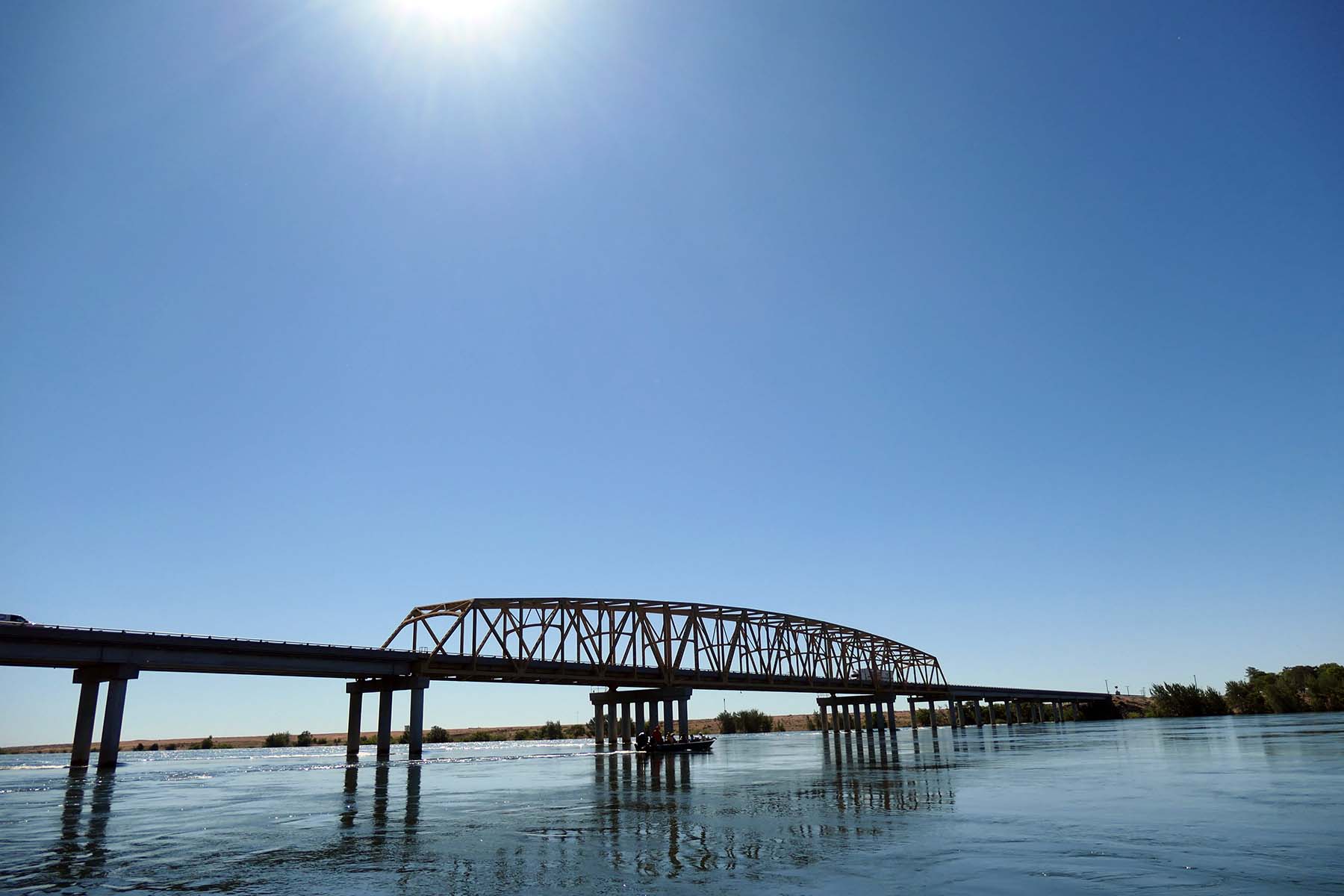
Photographs today are from the Hanford site and region, where the documentary film crew spent time last summer. Music is self explanatory…
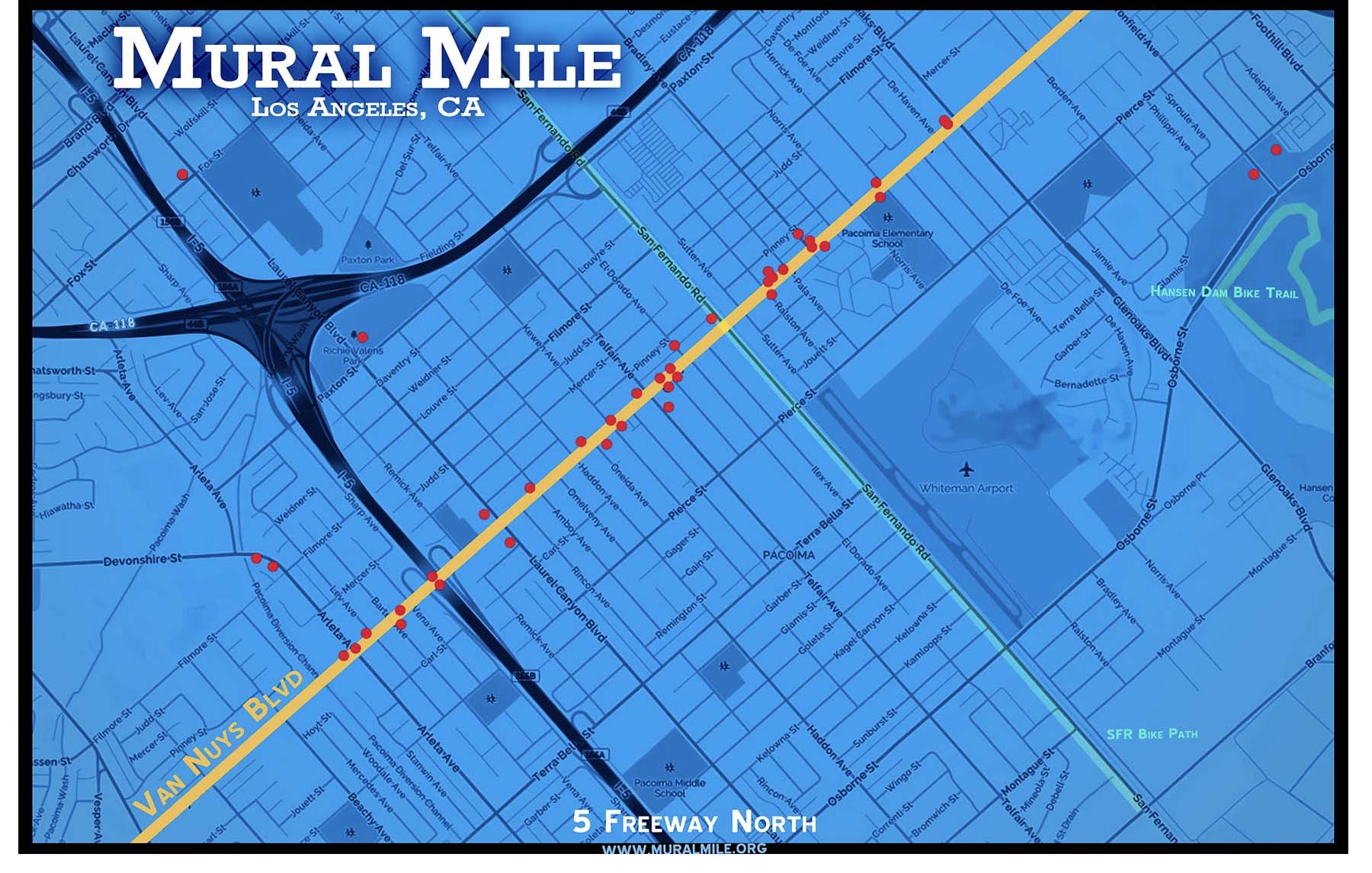
I BET THE BANK that not a lot of L.A. tourists make it out to Pacoima in the San Fernando Valley, one of the 88 cities comprising L.A. County. Which is too bad, given that there is much to learn and admire when looking at the history of the area. It is also a place where you can explore over 30 murals along a stretch of a busy through-fare, Van Nuys Blvd., the Mural Mile created by local artists who care about their community and acknowledge its history. The works shine like beacons along a neighborhood dominated by auto-repair or appliance repair shops, pawn brokers and payday-loan companies, small bars, pet groomers, florists, laundromats and churches, garages and places to send money back home to the loved ones you left behind in Mexico or El Salvador.
The area has been settled for more than 1500 years, early on by the Tatavians, a tribe with a strong sense of community and gender equality, from what the historians tell us. Disaster arrived in the form of Spanish colonialist destroying much of tribal land and culture.
Painted by the HOOD Sisters (Honoring Ourselves Origins Dreams)
By the late 1880, speculative investors descended in anticipation of the Southern Pacific railroad and a likely real estate boom. They hoped to lure wealthy settlers, but the area was prone to horrific floods and so ended up as an agricultural community, with many Mexicans and later Japanese immigrants doing the hard work. After Wold War II, with jobs provided by Lockheed and General Motors, a lot of Blacks were attracted to move to Pacoima, with a housing tract named after boxer Joe Louis, establishing a large middle-class community.
Today the population of around 90.000 people is about 87% Latino, 4% Asian and 3% Black. Poverty rates are high, crime rates higher than in almost any other community in the San Fernando Valley, and higher education levels way below average compared to the rest of L.A. County. There are reports that nearly 20% of the people in Pacoima live in rented rooms or converted garages. The hidden density extends to single-family houses that are often home to several families, trying to ease the burden of insane mortgage rates. (Ref.)
Homelessness here, as across L.A. County, has increased by over 70% across the last 6 years, with many families living in campers, cars, or tents. Makeshift memorials for victims of violence or the hardship of life on the street are ubiquitous.
The problem that compounds it all is the fact that Pacoima is by far one of the most pollution-exposed neighborhoods in all of California. It has one of the highest rates of air pollution and soil contamination due to the clumps of industrial facilities, garbage dumps, land fills, the small commercial Whiteman airport, Sun Valley Power Plant, a railroad line and the surrounding 3 freeways that enclose the city, I 5, 118 and 210. Diesel trucks emit diesel fumes into heavily residential areas, and weather patterns push and hold air pollution in Pacoima against the San Gabriel and Verdugo Mountains. The geography of the region, a valley, causes air-toxic chemicals, like nitrogen dioxide and ozone to settle near ground level.
Industries using chrome plating, among others, caused immense groundwater pollution, with hexavalent chromium doing its poisonous thing. Daytime heating patterns make it worse: the groundwater is vaporized during the day and then re-condenses at night, leading to the possibility for subsurface vapor intrusion into homes. There are now five Superfund sites in and around Paicoma: American Etching and Manufacturing, D & M Steel, Holchem, Inc., HR Textron-Glenoaks, and Price Pfister, Inc. The former Price-Pfister Faucet Plant Superfund site was recently redesignated as a Brownfield for redevelopment. The gas plant, it was revealed last year, has been leaking methane gas for long periods, affecting the area as well. The results of all this pollution is an unacceptably high level of respiratory illnesses, particularly asthma in young children, in the area and of course the potential that cancer rates are going to skyrocket among exposed individuals.
The skeleton is using an asthma inhaler…
***
THAT IS THE BAD NEWS. THE GOOD NEWS IS that Pacoima has a history of activism that unites many of its citizens in a fight for a better, or, in this case, healthier and more beautiful world, from tackling racist practices to now addressing environmental justice. In 1968 students from Pacoima staged one of the biggest civil rights protests in CA history, forcing massive reforms at the (now) Cal State University Northridge. It also paved the way for the school’s and state’s first Pan-African and Chicano Studies Departments.
Here is a great video introduction to their and others’ activism and a trailer to a documentary about the history of the town. Later, the NAACP and community churches organized and strategized to curtail police brutality and successfully spearheaded bans on the chokehold and use of the battering ram and focused on housing discrimination as well. Patrisse Cullors, one of the co-founders of the Black Lives Matter movement, hails from Pacoima as well.
Shakur
Painted by Kristy Sandoval and the H.O.O.D. Sisters, this mural pays homage to Assata Shakur, Tupac’s godmother and once one of the FBI’s most wanted.
It was five mothers from diverse backgrounds, however, who got together in 1996 to combat the literal toxicity of the place, founding Pacoima Beautiful, an organization that is now successfully fighting for environmental justice on a large scale. Just two months ago, their recommendations to close Whiteman Airport given the frequency of accidents and pollution issues, was heard. “The Re-envision Whiteman Airport Community Advisory Committee (CAC) voted at their final meeting to recommend the LA County Board of Supervisors pursue the closure of Whiteman Airport and immediately implement mitigation measures to prioritize public health and safety in the time leading up to airport closure.” Two years ago, their campaign against the Valley Gas Plant dangers helped deal with methane emissions. “As a result of our the community advocacy and organizing efforts, the Los Angeles Department of Water and Power has agreed to wean its use of natural gas and seek new opportunities for clean energy options at the site. Also there are plans to demolish the red and white smoke stacks.”
The non-profit organizes community clean-ups, Covid- outreach, electric bike programs, and nature access for kids. They also invest in arts education and local artists. Their ARTvertise program, together with OUTFRONT/JCDecaux, is designed to help transit riders experience art at bus shelters along the mural mile of Van Nuys Blvd. They show rotating work from local artists.
Their FaceBook site helps people figure out where to turn or where to participate, from offering opportunities to learn how to organize to announcement of life events of beloved community members. The organization also has 20 volunteer community inspectors who relate grievances to Clean Up Green Up, a 2016 city ordinance that prioritizes health and economic well-being for people living in some of L.A.’s most polluted districts. The ordinance ensures that complaints and violations raised by the inspectors are addressed and provides an ombudsman both for the area’s many industrial businesses trying to operate more cleanly and for the community members trying to enforce changes. (Ref.) All of this effective work to improve the health and living conditions of the community started by individual mothers having had enough. Deepest respect.
***
MANY OF THE MURALS I saw after driving out to Pacoima were produced by two artists, father and son, Hector Ponce and LeviPonce.
Some are by younger artists, like Rah Azul and the gifted Kristy Sandoval. Some murals are easily accessible, others behind fences, on abandoned or guarded lots, respectively.
One friendly guard opened the electric gate so I could photograph a mural directly and told me that the depicted woman’s original cleavage had been so offensive to some part of the citizenry that it needed to be painted over. “Oh,”he said,”Ponce was going to come back and beautify the rest of the walls. I have to give him a call – we like what he is doing for the neighborhood. I have his number.”
Elvira painted by Hector Ponce
There are murals that link back to the history of the area,
“Forgotten Roots,” painted by Juan Pablo Reyes
some are addressing political issues of the presence. Some reference folktales, like the Mona Lisa now clad like La Adelita – the Mexican Revolution saw many women join as soldaderas who embraced the early Maderistas movement, with La Adelita representing them as a stand-in in a famous ballad.
Pacoima’s Art Revolution
Painted by Levi Ponce to declare an arts revolution in the area (during a time where painting murals was illegal in Los Angeles), it stands as a symbol of the fight for the arts.
Real-life luminaries include Danny Trejo, a formerly incarcerated man who became a famous movie star and now owns many local eateries. Some critics didn’t like what they saw as glorification of violence and crime, but Ponce wanted to reflect the community who, after all, had chosen Trejo as the grand marshal of Pacoima’s Christmas parade.
Then there is The day the music died depicting the most famous local musician, Ritchie Valens, who died with Buddy Holly and another bandmate in a plane crash in a cornfield in Iowa during a concert tour in 1959.
There are depictions of Latino culture,
and visions of a better future.
Without Boundaries
Painted by Sarah Ackerley and Levi Ponce. This 33′ x 75′ mural inspires children’s imagination by blurring the boundaries of reality. This variety of flying fish can actually be found off the coast of Santa Monica, CA.
A mural by Ignacio Gomez enumerating locally notable people and other folk can be found in the back of city hall,
while the front alerts to Councilwoman Monica Rodriguez, the first Latina in the city’s history to serve on the Los Angeles City Council in 2017, to represent the 7th district she’s called home her entire life, an active supporter of the mural arts.
There is clearly an important and welcome attempt to protect the community from Covid, given the extra vulnerability of a population prone to pulmonary diseases from pollution,
and there are lots of banners alerting the community to the educational possibilities for the youth.
Some of the murals on view might not have yet reached the level that signifies muralism as an art form, I’m thinking here for example of the three great Mexican muralists Diego Rivera, Jose Clemente Orozco and David Alfaro Siqueiros in the 1930s. But they are done in the same spirit: they keep significant history alive and memorialize the people who mattered to the community. They make public the concerns of a community (particularly when they are debated) and they can alert to the potential for change, when they depict alternate visions of what could be possible, particularly when they focus on inclusivity and are socially conscious. They are also creations of combined efforts of local artists, business people and other citizens, and kids who now own their participation in this community. A seminal essay by Judith Baca, Whose Monuments Where? Public Art in a Many-Cultured Society is well worth a (re)read if you are interested in the function and importance of community murals. All of this makes a difference.
Judith Baca has been one of the most prolific and recognized muralist in SoCal for the last 50 years. Her Neighborhood Pride program encouraged young artists to paint in ways that honor neighborhood history. Her Great Wall of Los Angeles, located just south of Pacoima along the Tujunga Wash and next to Coldwater Canyon Avenue in North Hollywood, is over 2,700 feet long and by far the biggest mural in Southern California. It was painted as “a bold illustration of the history of California from the state’s prehistoric past to the struggles of its ethnic minorities for civil rights and equality.” (Ref.) I have yet to visit. Many other public art projects in Little Tokyo and the Historic Core commemorating forgotten urban history were spearheaded in the late 1980s by yet another organization, The Power of Place, founded by Dolores Hayden, Professor Emerita at Yale University.
Here some more murals from Pacoima:
Levi Ponce’s 2019 monumental mural Rushing Waters follows Baca’s model. It recognizes indigenous and environmental history, and depicts both natural and manmade landmarks in and around Pacoima like Hansen Dam, the Sylmar Aqueduct, San Gabriel Mountains, the Los Angeles River, Whiteman Airport and nearby freeways, with a 25-foot tall Tataviam Village woman pouring her bowl of water onto the land comprising the center of the mural. Councilwoman Monica Rodriguez provided funding, and the mural itself was on the drawing board for over four years, eventually executed by a team of nine artists under Ponce’s leadership.
***
AS THE LATE CULTURAL WRITER and Latino art advocate Ed Fuentes wrote before his death in 2019:
“Murals were designed to be art for the masses, and in the case of ethnic-based murals, spoke for those underrepresented. In Los Angeles, its own identity is lost because it’s a region people come to reinvent the city, and/or reinvent themselves. This current legacy of remaining murals, plus the manifesto of current artists, may not realize their work represents another undervalued voice: The city’s own history.”
You find murals commemorating alternative histories all across L.A., but many are disappearing. It is a nationwide trend – my city of Portland, OR, has seen similar developments. They are not just defaced by taggers or torn down by property owners. There is a whole development aligned with the gentrification of traditional neighborhoods, with newcomers either insensitive to the history captured in the art, or inclined to put up visuals that serve their own interests. A recent essay in The Guardian, Whitewashed: How gentrification continues to erase bold L.A. murals, describes the conflicts over murals between gentrifiers and inhabitants. They are fundamentally linked to other sources of tension, “property prices, the pace of gentrification, tenant evictions, the integrity of once-venerated local artists, and the ability of local city officials to act as honest brokers between the competing interest groups.”
Efforts to protect the history and the art form are direly needed. In L.A. they have the Civic Memory project, a project that pursues the preservation of community knowledge, playing an evermore important role. If you go to their website you find an astonishing volume of projects all interesting in their own ways, public art included, with in-depth debate of how to approach memorializing a past that had been submerged under representations by culturally dominant official” voices that pursued their own agenda.
Forgotten places, Pacoima included, can be resurrected via public art that is emerging from community-based vision, voices, recollections. All we have to do is visit and learn. As Ritchie Valens sang: Come on, let’s go!
When you travel, even for longer stretches of time, you have to make choices. So much to explore, to learn in Los Angeles, this behemoth of a city – there has to be some selectivity, since not all can be fit in. My own selections are usually based on two basic considerations: get familiar with the history of the place and, of course, seek out stuff that feeds my specific interests, art and politics, as you well know.
I lucked out last week with these endeavors in more ways than one. To understand the history of the greater Los Angeles area, I had read Mike Davis‘ City of Quartz: Excavating the Future of Los Angeles (1990) and slogged through his last book, Set the Night on Fire. L.A. in the Sixties (2020), published before his death in 2022 and co-authored with Jon Wiener. Both are seminal works about the urban history of the place and the powers that shaped it since its inception. Cultural critic, environmental historian and political activist Davis described the intersection of land development and legal or functional racial segregation in Southern California in ways quite accessible to uninformed readers like me, basing his account on interdisciplinary sources, including American history, environmental history, Marxist philosophy, political science, urban geography, architectural and cultural studies. Both books introduce the forms of resistance to segregation in housing and education, from peaceful demonstrations to riots to the engagement of artists and other intellectuals, side by side with famous civil rights fighters, political organizations, union representatives, the ACLU and uncountable numbers of students as young as high school freshmen.
88 cities, approximate 140 unincorporated areas, and communities within the City of Los Angeles.
The author introduces us to the political economy that shaped the urban sprawl, the landscape transformation, resulting in increasing inequality of living conditions and incarcerations rates, making it a dystopian place for those who fell off the wagon of the American Dream, or shall we say, were pushed off by the interest of those defending Fortress L.A. from any influx of non-White and/or poor populations. Land, seemingly endless land was the commodity, providing the base for residential neighborhoods, industry, strip malls and freeways. Richer neighborhoods, in fear of losing their exclusivity, the down-town commercial district’s business owners and realtor- and home owners’ organizations collaborated with investors, local and state politicians, and even Roman Catholic church leaders to make decisions about land-use that protected the interest of the monied classes and ended up with unimaginable sprawl.
Even though fair housing laws existed, racism won when Proposition 14 was adopted by an overwhelming majority of California voters in 1964, scorning equality and discriminating against “undesirable” homeowners and renters who were now easily excluded. The vote allowed prior law, the California Fair Housing Act of 1963, also known as the Rumford Act, to be voided, creating a state constitutional right for persons to refuse to sell, lease, or rent residential properties to other persons. (The Supreme Court declared the Proposition unconstitutional in 1967. The current legal status can be found here.) It was a pivotal moment that brought the efforts of many organizations and individuals fighting for civil rights to a screeching halt at the time.
Later decades saw more subtle ways of achieving the same goals of segregation: zoning laws and security measures kept the poor away from affluent districts. Relentless and cruel, often violent policing kept particularly Black citizens and other POC in their allotted places, both literally and metaphorically. Zoning was also causal for pushing the non-White and poor populations to the perimeters of the county, within or adjacent to more dangerous environments when it comes to pollution, water shortage and now fire danger given climate change-enhanced droughts. I am summarizing these aspects of Davis’ books because it was striking for me to see the described social stratification play out in real space during a drive to East Los Angeles College, a public Community College in Monterey Park, CA.
East Los Angeles College, Monterey Park, CA.
I started in the heart of Pasadena’s historical district, a place full of beautiful, gorgeously maintained and lovingly restored mansions, then drove through the picture book landscape of Pasadena’s craftsman bungalows. 15 minutes later you come through small townships that still have single-lot houses, but now run down and clearly showing signs of economic distress. Another 20 minutes along, and you are surrounded by low income housing apartments. I parked in a strip mall adjacent to the college and was immediately taken in by a striking building that stood out against the dilapidated background: the Vincent Price Art Museum. Part of a Performing and Fine Arts Center that opened in 2011, the museum holds a permanent, major collection of fine art, with substantive work initially donated by actor Vincent Price (he of Hollywood Horror Movie fame, among others, but also a true friend to the arts and the educational efforts required to bestow knowledge of art and art history onto future generations.) By now the museum holds over 9000 objects and has hosted more than 100 shows, singular for a community college, its exhibitions thoughtfully and smartly curated.
I came to see one of them that seemed particularly aligned with the museum’s expressed mission and issues close to my own heart concerned with cultural diversity and critical thinking:
“The mission of the Vincent Price Art Museum at East Los Angeles College is to serve as a unique educational resource for the diverse audiences of the college and the community through the exhibition, interpretation, collection, and preservation of works in all media of the visual arts. VPAM provides an environment to encounter a range of aesthetic expressions that illuminate the depth and diversity of artwork produced by people of the world, both contemporary and past. By presenting thoughtful, innovative and culturally diverse exhibitions and by organizing cross-disciplinary programs on issues of historical, social, and cultural relevance, VPAM seeks to promote knowledge, inspire creative thinking, and deepen an understanding of and appreciation for the visual arts.
What Would You Say?: Activist Graphics from the Los Angeles County Museum of Art presents a selection of political prints from LACMA’s vast archives. The exhibition, which opened March 25th, is free of charge and the visitor gets gifted with a high-quality brochure, covering some of the art with prints and explanatory (bilingual English/Spanish) text that I found helpful.
Graphic art has traditionally been a vehicle for change, challenging as well as influencing political moments. Rather than just depicting, the combination of image and word can inform, comment, persuade or be used for propaganda. It has been a key player in protests against injustice and oppression; the fact that it can be easily, widely and cheaply created and distributed has made it a form that helps to connect to people and promote social change. In the late 19th century, the technology for lithographic printing advanced, and the new power-driven presses, practical techniques of photoengraving and mechanical typesetting devices helped the medium to progress. We have now added photo-typesetting, offset lithography, and silk screening to the repertoire. It has also often been a communal effort, linking artists and participants with shared goals and interest, helping to organize and to educate.
The graphics on the wall ranged from the mid 1960’s to the 2020s, covering the Black Panther’s fight against police brutality and for the empowerment of poor Black neighborhoods,
Left: Emory Douglas Untitled (Sin Titulo) 1970 – Right: Rupert Garcia Libertad para los prisoneros politicas! 1971
the issues of incarceration of innocent people and Latino activism,
Yolanda M. López Free Los Siete 1969
Jessica Sabogal Walls can’t keep out Greatness 2018
the struggle of women and immigrants for equality,
Clockwise from upper left: Yreina D. Cervantez La Voz de la Mujer 1982 – Sheila Levrant de Bretteville, Women in Design: The next Decade 1975 – Yreina D. Cervantez Mujer de mucha enagua 1999 – Krista Sue Pussy Power Hat Pussy Hat Project 2016 – Ernesto Yerena Montejano and Ayse Gursoz We the Resilient 2017
and eventually the protests over the murders of Breonna Taylor, George Floyd and other Black people by police.
Jesus Barraza and Melanie Cervantes of Dignida Rebelled and Mazatl My Name is Trayvon Martin and my Life Matters. 2013
The most dominant topic, however, is expressed in posters and prints protesting war; surprisingly, I could find the issues of racial segregation and land development, so central to the history of L.A. and S.F., only peripherally – one poster about evictions, and one about the displacement of first native people and then a Mexican American community from Chavez Ravine, land appropriated to build the beloved L.A. Dodger stadium.
Favianna Rodriguez Community Control of the Land 2002 – Vote Ik We are still here 2017
The reality of racism, however, is captured by several of the works in ways that hit you hard.
Archie and Brad Boston For a Discriminating Design Organization 1966
David Lance Gaines Qui Tacet Consentit (Silence Gives Consent) 1969
The reality of the price of war, on the other hand, is brought home most strikingly in a print by one of the most famous of the artists in this exhibition, Sister Corita Kent, a member of the Immaculate Heart of Mary (IHM) before she was driven out by Cardinal Francis McIntyre (as were later 90 percent of the order in L.A, some 150 IHM nuns kicked out. According to a report in the Times, the Cardinal, by the way, uttered these words when confronted with his stand on segregation: “…it is not a racial or moral issue. A reason for discrimination is that white parents have a right to protect their daughters…”)
Corita Kent manflowers 1969
Corita Kent’s early silk screenings used bright colors, modulating the style and objects of advertising as stand in for religious concepts. They were shown in galleries and museums across the country, the MET, MOMA and LACMA included. She later moved to political topics, with more muted colors, including the Watts Rebellion and, after multiple encounters with anti-war activist Dan Kerrigan, the Vietnam War. The poster here shows two blinded soldiers, using Peter Seeger’s song lines in despair. Man-power is broken into two words, drawing attention to the single man, all the individuals that made ups the military power, paying with their bodies or their lives.
Posters on video display. The last one above: Primo Angeli/Lars Speyer The Silent Majority 1969
***
I wondered, a few days later, if the choice of concentrating on so many war/peace posters in the VPAM exhibition was perhaps linked to the choices made in another, simultaneous exhibition of graphics from the LACMA archives: Pressing Politics: Revolutionary Graphics from Mexico and Germany.
This exhibition is also shown in a gallery incorporated within an educational setting, this time the Charles White Elementary School on Wilshire Blvd. It presents political imagery that grew out of the reaction to war and revolutionary movements, from Germany’s political developments starting in 1918, to Mexico’s 1930s formation of the Taller de Gráfica Popular (People’s Print Workshop) in Mexico City.
For me it packed an additional emotional punch – I have grown up with the art of Kollwitz, Grosz, Pechstein etc. in post-war Germany and the familiarity and reminiscence of what they meant then added a layer to taking the show in. To look at the warnings expressed by art in the 20s and 30s, to know that the world was dragged into the next war regardless, and to see all this while we are witnessing another contemporaneous war on European soil was unsettling. The unsparing depiction of oppression, violence and human suffering is also strikingly different from most of the American poster selection in the show discussed above.
Some of the graphics would benefit from explanations regarding the relevant language. Take Grosz’ Gesundbeter, for example, which has three titles in different languages (he used these inscriptions fully knowing that they were not translations but expressed different thoughts.) Crucially, though, the obscenity of the action becomes clear when you understand the acronym KV, central to the image. It stands for the German word Kriegs-Verwendungsfähig – literally usable for war or fit for action, applied by the Local Board, desperate for canon fodder, obviously even to corpses.
George Grosz Die Gesundbeter 1918
Here is another title – the German says sunshine and fresh air for the proletariat (a demand by labor unions and social activists for better housing and healthier working conditions,) depicting incarcerated people walking the prison yard.
George Grosz Licht und Luft dem Proletariat 1919
The parallels we see in the German and Mexican depictions originate both from shared experiences, but also an overlap of artists in each others’ spheres. Colonialism led to an entangled history in general, but during the 1930s many German artists associated with the Staatlichem Bauhaus Weimar emigrated to Mexico, welcomed by the government of Lázaro Cárdenas del Río (1934–1940) which built the most democratic state historically experienced in Mexico until the 1990s.
Clockwise from upper left: Alfredo Zalce En Tiempos de Don Porfirio 1945 – Alfredo Zalce La Soldadera 1947 – Käthe Kollwitz Losbruch 1943 – Leopoldo Mendéz Asesinati de Jesus R. Menendez en Cuba 1948 – Käthe Kollwitz Gedenkblatt für Karl Liebknecht 1919-20.
The Cárdenas government sponsored educational program for workers and peasants, led by the Liga de Escritores y Artistas Revolucionarios (LEAR), an association of revolutionary writers and artists that grew out of the “cultural missions” charged with propagating the revolution’s objectives in murals, graphic art and theater productions. The Taller de Gráfica Popular (TGP) came out of this association, and was revitalized by the many migrants that came from Europe, other Latin American countries and the U.S., all adding their own cultural experiences, artistic styles, and preoccupations. In fact, Hannes Meyer, second Bauhaus director, was appointed as head of TGP in 1942.
Erasto Cortez Juarez, Jesus Escobedo, Leopoldo Mendez, Francisco Mora Calaveras aftodas con medias naylon 1947
Leopoldo Mendez En manos de la Gestapo 1942 – Constantin von Mitschke-Collande Freiheit 1919
Arturo Garcia Bustos La industrialización del país 1947
It is a stunning exhibition, offering diversity of depictions balanced by homogeneity of concerns. I was the only one there on a beautiful Saturday afternoon, except for a friendly guard, which was just as well given the tears that welled up. The reality of war, the repeat of history’s darkest moments seemingly unavoidable, some already here, some looming, the resurgence of fascistic ideas and methods seemed to pull the rug out from under the efforts of earlier artists to warn us of dangers and call for change.
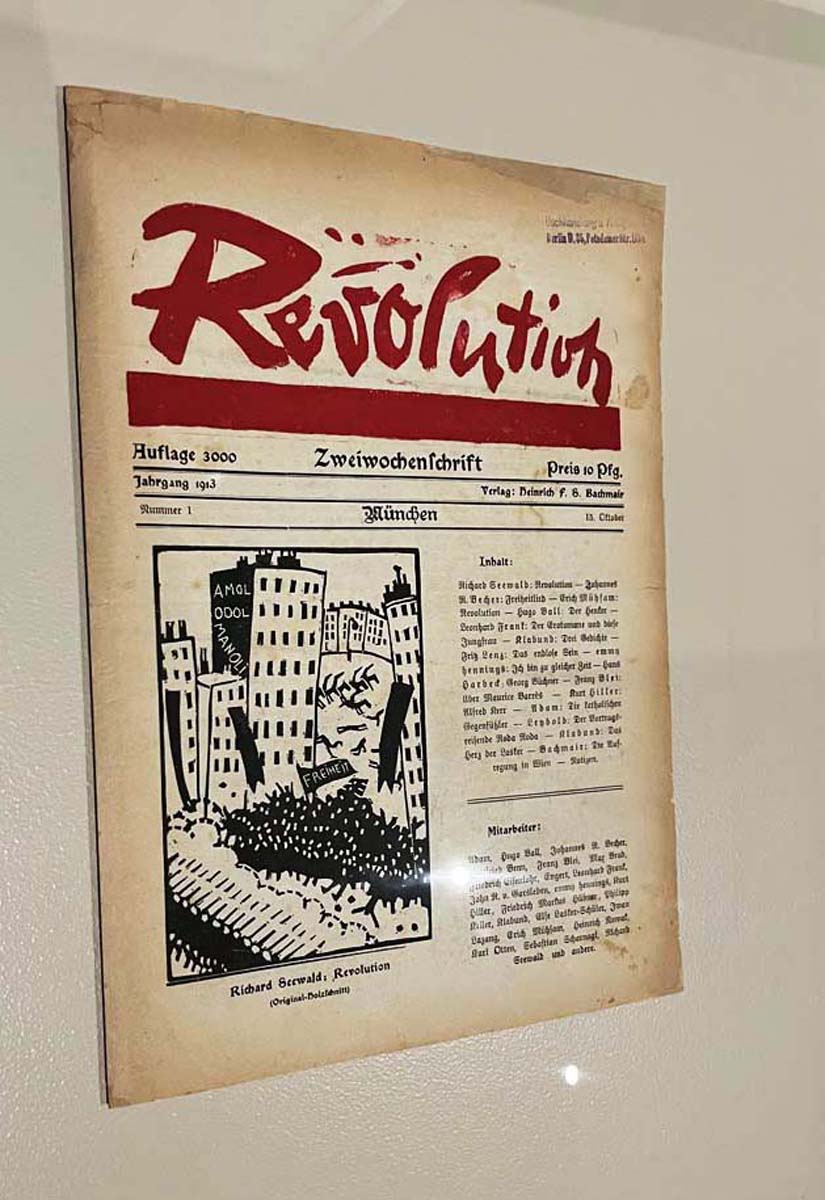
Erich Modal Revolution 1920 – Max Pechstein An die Laterne 1919 – Unknown artist: So führt euch Spartakus. Brüder rettet die Revolution. 1919
And yet. There is reason to remain optimistic. Individual commitment to social change still exists. But not just that – in L.A. alone, there have been significant collective successes across the last years. In 2006, 500.000 people protested on Wilshire Blvd. demanding rights for undocumented immigrants, a march called by labor unions, endorsed by catholic Cardinal Roger Mahoney and Antonio Villaraigosa, the city’s first Latino mayor. In January 2017, 750.000 congregated downtown L.A. for the Women’s March. And in 2019, large coalitions of communities and classrooms, teachers and students joined in the successful teachers’ strike that focussed on overcrowded schools, educational disinvestment and drainage of resources to charter schools.
Leopoldo Mendez Retrato de Posada en su taller 1956
Elizabeth Cattle Sharecropper – 1952 – Alberto Beltran El problema agrario en América Latina 1948 – Käthe Kollwitz Poster excerpt
Max Pechstein Dont strangle the newborn freedom through disorder and fratricide, or your children will starve 1919.
Walking around the neighborhood after I left the exhibition, the occasional public or street art made it clear that activism is alive and well. A work in progress, standing on the shoulders of the many activist artists who came before. Grateful that decisive museal curation introduces and reminds us of the modernist vanguard.
“The ideas of the ruling class are in every epoch the ruling ideas, i.e., the class which is the ruling material force of society, is at the same time its ruling intellectual force.” – Karl Marx The German Ideology (1845)
—
“As a matter of fact indeed, this generation, that grew up with the “end of history” of Francis Fukuyama, does not seem to be affected by the central historical events of their life time in any enduring way … [This generation is] pragmatic, history-less, free from economic and ideological system conflicts of the Cold War, grown up after the “end of history”. If you look at this generation through the lens of the events of its history, it does not afford any strong “interrelation”, no strong generational “narrative”. – Anna Sauerbrey, Machtwechsel: Wie eine neue Politikgeneration das Land Verändert. (Change in Power: How a new Generation of Politicians changes the Country.) (2022)
—
“Let us remember we will never truly breathe whole breaths, as whole beings, as a whole country and people, until we reach a collective reckoning, and repair … until we become whole and so can exhale into a place of healing at the depths of the blood and marrow in our bones. Imagine that breath.” – traci kato-kiriyama Navigating With(out) Instruments. (2021)
I WOULD HAVE have almost missed the small plaque, easy to escape my attention that was held by so many other sights: a gorgeous botanical garden unusually laid out across steep slopes, an indescribably beautiful location, a forest of blooming camellias, bulwarks of birds of paradise hedges, lazy lizards, groves of mulberry trees, surrounded by pristine canyons, with a green sheen after all this rain.
Having spotted it, however, and later reading up on what was hinted at, led to contemplation of memory cultures and their variable perspectives, depending on who you ask. Or who has the power to shape the narrative, as the case may be. All that happened during a visit to the 165- acres Descanso Gardens in La Cañada Flintridge, CA, some 10 minutes outside of Pasadena, which contains one of the world’s largest camellia collection with some 800 species and as many as half a million camellias in bloom simultaneously, if you visit in the early months of the year. A spectacular sight.
One might be pleased to see an acknowledgement of the history that transpired after President Roosevelt issued his infamous Executive Order 9066 in March 1942, authorizing the removal and incarceration of over 120.000 Japanese American women, men and children on suspicion of being potentially dangerous enemy aliens. Some 70.000 of those rounded up with lightning speed were actual American citizens.
Or one might wonder why the text refers to War Relocation Centers instead of Internment camps, or even concentrations camps as Roosevelt himself and other U.S. officials referred to them. The War Relocation Authority, the federal agency created to manage the incarceration process, succeeded with a political spin and created euphemistic terms, calling the forced removal an “evacuation,” incarceration “internment,” and the facilities “relocation centers,” rather than concentration camps. (Certain American Jewish institutions, the National Holocaust Museum among them, reject the term concentration camp, fearing that it invites false analogies to the Holocaust, demeaning history. Others, like Michael Rothberg, a UCLA professor of English and comparative literature who holds the 1939 Society Samuel Goetz Chair in Holocaust Studies, point to the fact that not only Jews were detained in concentration camps, and defines them as “mass detentions of civilians without trials,” many of which happened before the German atrocities – e.g. the 19th century Spanish in Cuba, the British in South Africa during the Boer wars, or China’s extrajudicial camps for millions of Muslim Uighurs who face systematic brutality and dehumanization.) (Ref.)
Moreover, one might wonder what is implied in the simple statement that the founder of this garden, newspaper publisher E. Manchester Boddy, purchased plants from Japanese nurserymen, namely the contents of Star Nurseries, headed by Francis Miyosaku Uyematsu and Mission Nursery, headed by Fred Waichi Yoshimura. If you go to the history section of the garden’s website, (and who does, pray tell?) you get a few more sentences: “These people’s terrible loss, reflecting years of labor, was Rancho del Descanso’s immediate gain. The purchase of their plant inventories became the basis for Descanso Gardens’ first signature collection.”
“Can’t you just for once enjoy a garden and help us vicariously admire the scenery?” I hear from the back rows. You know me. Or should, by now. Nope! Important history to convey.
IF YOU LOOK AT scholarly exploration of what actually happened, including archival research, oral histories and interviews with surviving members of the families, a different narrative emerges. (I am indebted to Wendy Cheng, Associate Professor of American Studies at Scripps College, who gave me access to her 2020 article Landscapes of beauty and plunder: Japanese American flower growers and an elite public garden in Los Angeles, a combination of factual revelations and incisive analysis that taught me a lot.) Summarizing best I can, the original official story around Boddy’s acquisition was that of a friend of the Japanese community paying a “fair price” for priceless treasure during hard times, his generosity appreciated, the ruling narrative goes, by those who had few other choices before seeing their entire stock destroyed.
Alternatively, one can see this act as a form of plunder, reminiscent to me, as a German, of the forced sales of Jewish art and property to Nazi vultures or collaborating opportunists. Legality aside (hey, these people did nothing illegal, if they acquired stuff on the cheap as the opportunity arose…) plunder can be defined as a dishonest acquisition of property, whether through violent dispossession of native lands or orderly transfer in business settings during structurally disordered conditions that allowed to prey on vulnerable minority groups. The losses incurred by Japanese Americans? Estimates are that 75% of those incarcerated lost all of their property. Overall economic losses (not adjusted for inflation) are presumed to lie in the $1 to $3 billion range. Half of the total number of flower growers in the L.A. region were Japanese, some 90% of them working on leased land due to racist tenancy laws instituted in 1913 (Alien Land Law.) Businesses on that land were taken over by Whites, after Pearl Harbor.
There is a small but well designed Japanese garden wit the tallest flowering cherry tree I have ever seen.
Boddy’s “fair price,” as the term appeared in the narrative of the garden (rescinded only 4 years ago), was in reality likely a 5th of what the stock of mostly camellia and ranunculus from three different nurseries was worth. Some 300-320000 plants changed hand for the Uyematsu nursery alone (the garden gives a far lower number) from a horticulturist known across Asia as one of the most gifted and successful cultivators. They included seedlings that Uyematsu had nursed for over 12 years and that Boddy propagated at Descanso, and eventually named, an implicit assertion that he was the original cultivator. As far as we know, no further tracing of the actual provenance has been undertaken since the 1942 transaction.
In addition, even though Boddy acknowledged publicly that the historic circumstances were unjust, there is archival evidence that his dissatisfaction with the camellia deal led him to try and shut the nursery down for other sales, offering lower whole sale prices for gardenias and azaleas. He also initiated a bitter and long-lasting law suit against a third nursery, the Yokomizos, for breach of contract after they returned from the camps, suing them for land and damages – a suit that was settled shortly before trial. That story seems not to be included in the history of the garden at all.
***
WHY IS IT IMPORTANT to get the facts right and display them in a fashion that allows, or even forces people to remember? Has our nation not done enough to acknowledge the injustice committed against Japanese Americans? Official narratives – – the ruling ideas as Marx would have it — admit to wrongdoing, but also defend its necessity (legal cases) or claim that it was an aberration (congressional acts), or point to the fact that victims were given compensation, or point to a larger arc of progress in the U.S. that has incrementally increased diversity, equality and inclusion, insisting we have left the dark past behind.
Except, we haven’t. Hate crimes against Asian Americans have risen sharply across the last years and countless political groups as well as state governors fight against DEI policies across the nation, never mind attempting to constrain education about the actual history of this country by radically privatizing it, blackballing facts that are not congruent with the ideas of American exceptionalism and the moral superiority of those living on the shining hill.
Different memory work, not the official narrative, needs to get done in the area of Japanese incarceration, argues Erin Aoyama in the L.A. Review of Book, as “a process of locating and listening to stories about the past, reckoning with how they shape our families and communities in the present, and then sharing these stories and our experiences within them with others.” The first generation of imprisoned Japanese Americans often preferred to be silent about their incarceration in the early postwar years,”burying the shame, the fear, and the pain to rebuild their lives.” But new generations, she argues, can and do embrace memory work as a way of engaging with the past that impels each of us to action in the present, questioning the official story.
Image from the JANM website announcing the exhibition.
Some museums pick up on that as well, and it is worthwhile exploring exhibitions that open a door to the past, like the current one, Don’t fence me in, at the Japanese American National Museum in L.A.
***
However, we also need to be aware of a paradox, namely that any specific memory culture alone does not promote change, and even might provoke a backlash. Looking to Germany as an example that I know, we see a country that has by far more Holocaust memorials and Jewish museums than other European countries, Holocaust education as part of every school curriculum, and official commemorations of historic dates that spelled doom for its Jewish citizens. Yet antisemitism and Holocaust denial or relativization thrive, and according to the World Jewish Congress in 2019, 41% of Germans thought Jews talk too much about the Holocaust. The notion of Germans as victims holds a special place in certain political circles, and the joke among German Jews that all of us know not a single German who didn’t claim they personally rescued a Jew or are related to someone who did, doesn’t come out of thin air.
There is a funny disconnect between the fact that non-fiction books about third-Reich related history reliably win prizes and journalist Anna Sauerbrey’s observation, listed above, that current generations of politicians are not anchored in the history of the country. In 2022 alone we saw winners of the German Non-Fiction Prize and the highest award in his field, the Prize of the Historisches Kolleg (Institute for Advanced Study in History) go to authors dealing with the political developments between 1918 and 1945.
Some scholars claim that we need to go beyond dichotomizing victims and perpetrators to understand the increase in “virulent racism and racist violence” even in the presence of a memory culture that is dedicated to educating about historical trauma. For A Memory Culture beyond Victims and Perpetrators, an essay written by Michael Rothberg, as an introduction to Valentina Pisanty’s book The Guardians of Memory (CPL Editions, 2021), helped me understand some of the issue – and also link back to the case of Manchester Boddy, friend to and plunderer of Japanese Americans.
Rather than solely distinguishing between evil and innocence, we need to look at the complexities of roles assigned or assumed during historic conflicts. There are not just victims, perpetrators, bystanders and the Just. Rothberg suggests another category, that of the implicated subject, those who enable, benefit from, and perpetuate injustice and inequality without being direct perpetrators and without controlling the regimes that produce injustice. Failure to intervene, or cooperating and consenting to the horrors that are committed, indirectly entangles us. Many of us are in some ways also implicated because we have inherited the history of oppression and violence of the past:
“…implicated subjects are certainly not guilty of the crimes of those who came before them, but by virtue of their membership and participation in national collectives they bear historical and political responsibility for those wrongs — and for the legacies they leave behind. One of the shortcomings of the familiar Holocaust memory culture, we might say, is its inability to activate recognition of our ethical and political implication in injustices — not just those that are past, like the Nazi genocide, but those in which we continue to live.”
We have a collective responsibility that goes far beyond the individual one of the Boddy’s of the world — non-evil people just out to make a deal, telling themselves that they are on the morally right side by giving hand-outs to friends in distress –to assess history in all its painful truth involving colonialism, slavery and racism, to reveal our own implication, the way we perpetuate to this day the inequalities they have wrought. Only then can we hope to breathe whole breaths, as Japanese American poet, author and activist traci kato-kiriyama envisions our future.
A good thing to contemplate in an extraordinary garden.
Explore with me, for a second time this week. Checking out a community garden in Altadena that allots parcels of land for growing all kinds of things, though mostly vegetables. And then visiting Arlington Garden in Pasadena, three acres that the city entrusted to a non-profit that collaborated with a host of other groups to establish a botanical garden. The city of Pasadena, Pasadena Department of Public Works, and Pasadena Water & Power, with help from Pasadena Beautiful Foundation, the Mediterranean Garden Society, garden clubs, local businesses, nurseries, neighbors and friends established the garden and continually support the maintenance of the site.
Community gardens provide a terrific way of growing inexpensive, nutritious and organic food. Wait lists are long, because people enjoy the possibility of working their own little plot just as much as the output. Health benefits are not restricted to better food, though. These gardens serve as meeting places where people mix, get to know each other, share common interests and often join to improve local conditions, all of which combats isolation and other adverse psychological states.
Arlington Garden is a bit more ambitious in creating an environment for an entire community, not just plot leasers who happen to cooperate here or there. The garden introduces different forms of landscapes, thus teaching about botany and water efficient gardening.
It has locally sourced art positioned throughout, magnets for kids who squeal over the discovery of yet another frog, and grounds for benign amusement for discerning adults…
Poor St Francis of Assisi has a crack in his neck….
Importantly, it has tons of opportunities for sitting and enjoying the garden, from single chairs to large groups of furniture, inviting friends in. As a certified wildlife habitat garden it attracts tons of insects and birds – I am sure to hang out there quite a bit with the camera in the coming weeks.
The communal aspect is of considerable interest given that we have new archeological findings that document the advantage of communal efforts. It’s actually fascinating stuff. A group of archeologists investigated 24 central places in prehistoric (1000 – 300 BCE) Mesoamerica (now Mexico,) some of which lasted for over 1000 years. The researchers were interested in why some of these cities existed longer than others, and looked at a number of variables that might have contributed to or deterred from the sustainability of these centers. Some of the key factors that contributed to longevity were early infrastructural investments, high degrees of economic interdependence and collaboration between domestic units, and collective governance. In other words, autocratically governed cities were disadvantaged during antiquity.
The establishment of housing that was densely built and connected with paths to each other and the creation of large, central, open plazas were two of the factors that helped cities to flourish. In addition to these architectural specifics they found this:
” In general, more collective organizations were funded by internal financing—labor drafts and staple goods exacted from local populations. This contrasts with the external resourcing associated with more autocratic regimes, dependent on elite estates, monopolization of the exchange of precious goods, and war booty. Collective governance tended to be ‘faceless,’ associated with offices rather than aggrandized individuals, with power distributed. Concentrated power arrangements tended to be personalized, frequently tied to descent and often conspicuous in individualized funerary treatments and monuments to specific rulers. Whereas autocratic governance frequently was focused on the palaces or mortuary monuments of individual rulers, characterized by restricted access to non-elites, more collective formations tended to be associated with accessible plazas, open access ways, and disseminations of public goods.“
Public spaces mattered, for contemplation, information exchange and communal expression. Some of the longest lasting centers had up to 20 ball courts where people could meet, and all had central plazas. Pooled labor mattered, since terracing for food production and appropriate drainage could only be achieved communally. The interconnectedness between households prevented population flight, keeping population density high which in turn helped to produce labor that fed and maintained the citizenry.
It makes, of course a difference if you have 40.000 people, or 3.8 million, like the greater L.A. area, for the ability to make communal decisions, and not govern from above. But we should pause and think through the principles that conferred resilience to these ancient population centers, many of which lead back to connectedness and openings for communication. What you find, on a micro-level, when hanging out in a free, communal botanical garden.
Here is some music reminiscent of mesoamerican traditions.
⅔ into Black History month I figured it’s time to contemplate cultural offerings that embody what’s encapsulated by the terms above. Coincidentally, my friend Catón Lyle posted photographs I had taken of him and his students 8 years ago this week on Facebook, images of people I deeply care about and worked with, now likely strong and resilient young adults either in Highschool or off to college. Institutions where Black history is no longer guaranteed to be taught across the country.
Catón Lyes, drummer extraordinaire
Let’s look at possibilities to learn about Black History outside of the educational settings, then. When it comes to ferocious women, none portrays them better than Viola Davis in her magnum opus, now on Netflix, The Woman King. The actress is a marvel (in everything she touches). Here she was training in her late 50s for a physically demanding role as an African warrior leading an army of women in the State of Dahomey (now Benin) in battle and for the political future of a kingdom contemplating to step away from participating in the slave trade.
The film is an epic mix of action movie, intergenerational, intra- and inter-tribal conflict, serious depiction of slavery, with a hint of romance thrown in, involving a non-African man at the behest of the studio bosses who wanted a White man role for sales points and settled for someone with a White father and a Black mother. Various, really numerous, subplots tug on every emotional register imaginable.
Davis and director Gina Prince-Bythewood together with screenwriter Dana Stevens had to fight for 6 years to get this film made, and only got green light after the success of the Black Panther pointed to the possibility of having this kind of film be a box-office success. It was “the product of a thousand battles.” The obstacles the production team faced when pitching a historical epic centered on strong Black women and a State that celebrated gender equity until the French colonialists crushed it, are at length described in this review in the Smithsonian. The public reaction to the finished product has also been fierce: the extremist Right condemned it for Black women killing White men. Some Black organizations found fault with the depiction of African nations actively participating in the slave trade, which is of course historically correct, and brave to be acknowledged in a Hollywood film that wants to convey history, if you ask me. But the worry remains in the eyes of many, that it partly absolves the Euro-American slavers from their responsibility.
Then there is the complaint that the film’s narrative alters what actually happened, making the Kingdom of Dahomey into a place that abandoned the slave trade, when it actually didn’t. A general complaint regards the fact that a major Blockbuster Movie could have chosen a positive event in Black history, rather than one marred by complexity of historical trade alliances.
The film’s take on history is indeed stretched and to be taken with a grain of salt, or with the understanding that movies need to entertain, and have some lines that help us identify with good or evil. The choice of featuring a female standing army, the historically real Agoodjies with all their strength and complicated lives, though, should be a boost to a current generation of women who are searching for role models in an era that is dead set to roll back both women’s and civil rights (not necessarily in the setting of the military, but fighting everyday challenges.) If you want to learn more details about the actual history of the Agoodijes, there is a smart guideline, The Woman King Syllabus, provided by a group of US-based historians, Ana Lucia Araujo, Vanessa Holden, Jessica Marie Johnson and Alex Gil.
***
When it comes to brave women, do I have a book for you. Organize, Fight, Win: Black Communist Women’s Political Writing is a stellar compendium of sources that help us understand the Black radical tradition, from the early 1920s to the late 1980s. If we can, for a moment, put aside our immediate reaction to the term “communist” in the title, still associated with extreme negative reactions, we might particularly benefit from the section that exposes how White supremacists have always successfully used the tool of the communist specter as a weapon in their political crusade. The book, edited by Charisse Burden-Stelly and Jodi Dean, also teaches a lot about the fight against fascism on the one hand, and organizing of labor on the other, both topics of obvious contemporary relevance.
***
And last but not least, when we look for resilience and decisive action, there is a new, digitally available, resource that I strongly urge you to sign up for: Hammer and Hope, a magazine of Black Politics and Culture, founded by Jen Parker and Keeanga-Yamahtta Taylor.
Or at least read the poem, Come In, by Ashley M. Jones, the current poet laureate of Alabama, in call and response with an image by photographer and performance artists Carrie Mae Weems, who was born in Portland, OR 69 years ago and is one of our most impactful and famous contemporary artists. It sets the tone and invites all of us to cross a threshold into a community of diverse backgrounds but shared goals.
The name for the new magazine, suggested by Derecka Purnell, a brilliant young lawyer and abolitionist, is a riff on a book, Hammer and Hoe, by Robin D. G. Kelley, a professor of American history at U.C.L.A.
The goals could not be clearer and more decisive:
“….a hammer to smash myths and illusions.”
“And our hope? It is not the false optimism of liberals or the fatalism of armchair revolutionaries or the pessimism of pundits waiting for the end of the world. James Baldwin understood hope as determination in the face of catastrophe: “I can’t be a pessimist because I’m alive. To be a pessimist means that you have agreed that human life is an academic matter, so I’m forced to be an optimist. I’m forced to believe that we can survive whatever we must survive.” … victory is never certain but if we don’t fight, we can only lose. Hammer & Hope is here to fight.”
“Our mission is to collect, preserve and share the stories, oral histories and artifacts of Portland’s Chinatown as a catalyst for exploring and interpreting the history of past, present and future immigrant experiences.” – Portland Chinatown Museum (PCM) Mission Statement
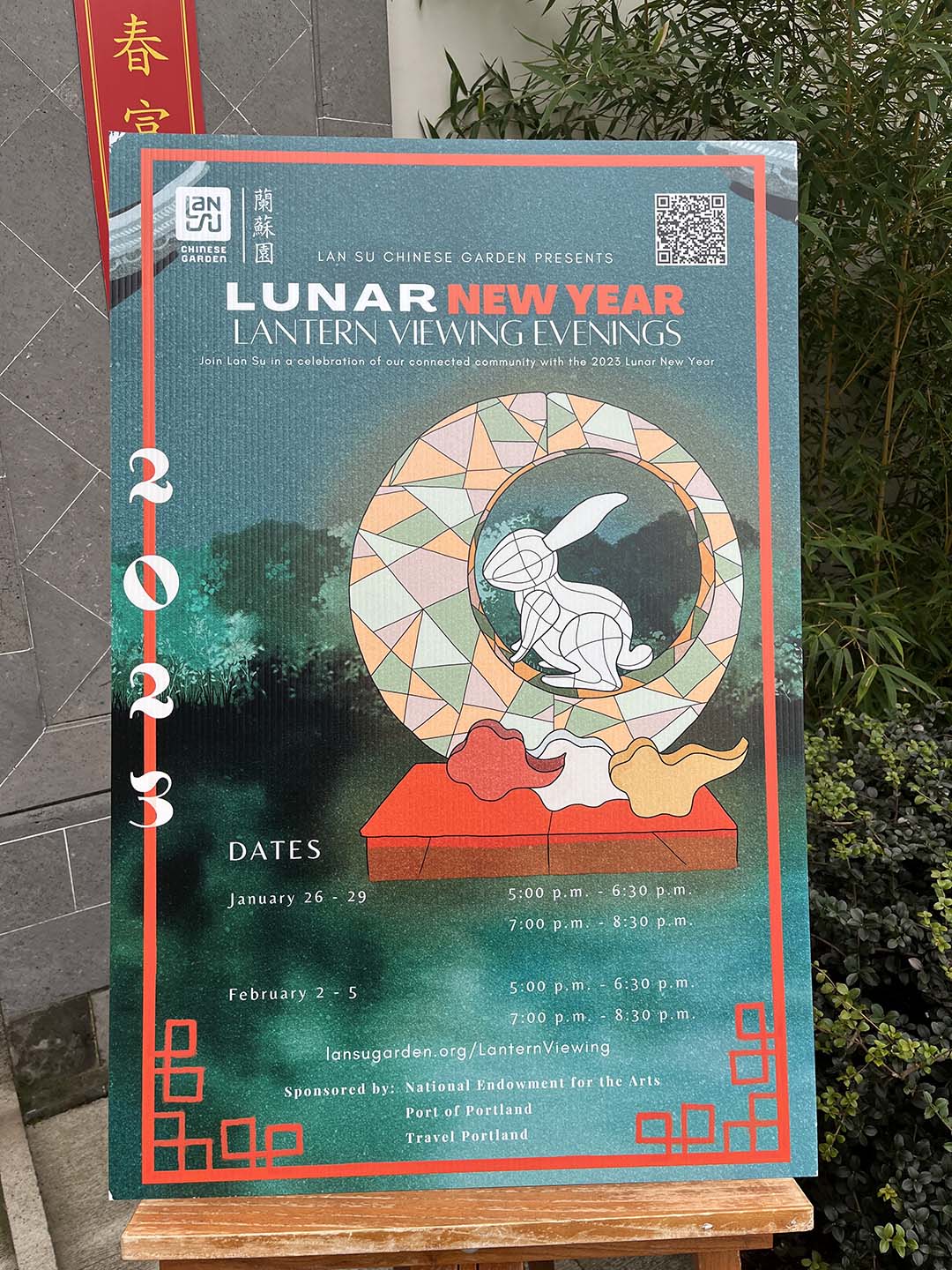
The Lunar New Year – The Year of the Water Rabbit – started yesterday and the Chinese government expects about 2.1 billion journeys to be made in Asia during a 40-day travel period around the celebration as people rush back for the traditional reunion dinner on the eve of the new year. I took a short trip to Portland’s Old Town Chinatown instead on Friday, an annual pilgrimage to admire the beauty of Lan Su Chinese Garden with its festive decorations for the occasion.
This year I added a second stop, a first visit to PortlandChinatownMuseum (PCM,) which is just a block away on NW Third Ave, and not too far from the Chinatown Gateway. The museum opened in 2018 and did not appear on my radar during the pandemic years. I cannot recommend a visit strongly enough: opening hours are limited from Friday to Sunday, and the current temporary exhibition will close on January 29th. So if you can, make it down there next Friday or Saturday between 11 am-3 pm, there is some revelatory art on display.
The history of the museum’s founding can be found here. Like other Old Town institutions devoted to collecting and preserving immigrants’ histories, the Japanese American Museum of Oregon and the Oregon Jewish Museum and Center for Holocaust Education among them, PCM offers a permanent exhibition depicting the lives and plight of the Chinese immigrants. Beyond the Gate: A Tale of Portland’s Historic Chinatowns provides a comprehensive look at historical artifacts, some arranged in diverse dioramas, and guides you through the various aspects of the immigrant experience with informative exhibition texts and archival photographs.
***
Two separate galleries provide space for the work of contemporary Asian American artists, currently showing Illuminating Time, installations by three different artists-in-residence working with different media. The exhibition is exquisitely curated by Horatio Law, one of the PNW’s premier public art and installation artist who serves as the Artist Residency Director. It echoes the permanent exhibitions’s themes of loss, hope and belonging, so familiar to all immigrants.
___
一方有难,八方支援 “When trouble occurs at one spot, help comes from all quarters.” – Chinese Proverb
The theme of community, integral to collectivist cultures and so prominent in the museum’s permanent exhibition of historic Chinatown’s structural support systems, is picked up by Alex Chiu. Known to many of us for his vibrant murals that can be found across PDX, he undertook a series of ink drawings of community members that are displayed in the entrance hall of the museum. Placed against the backdrop of a stylized rendering of the Chinatown gateway, they depict a range of characters of all ages and degrees of visibility, pointing to the diversity of Portland’s Chinese population. Expressive and detailed, these portraits are a lively counterpart to the archival photographs of the Chinese ancestors who set foot here in the 1800s.
The juxtaposition between the traditional valuing of community and the artist’s modern ways of portraying individuals reminded me of the current trends in social psychology exploring the status of young Chinese who grow up in a world where the traditional collectivism of their culture and the modern demands and offers of Western individualism intersect. It is interesting work, based on spontaneous recollection of Chinese proverbs by these college students, reflecting which values come to mind first and how they are weighted. A changing world, yet heavily anchored still in tradition.
Clockwise from upper left: Portland Chinese Community Portrait Series: Billy Lee, Beatrix Li, Roberta Wong, Terry Lee.
***
“Take care of each other. Take care of the soil.” Shu-Ju Wang, in conversation.
Off to the side of the front venue is a room dedicated to Shu-Ju Wang‘s exploration of the history of Tanner Creek and its connection to the Chinese laborers and farmers who tended to its surrounding fertile soil to grow vegetables for both, sale and consumption. Her installation consists of multiple parts, prominently displaying a wooden slide constructed to represent the topography of the waterway with its angles and gradient. It is actually a marble run, and visitors are invited to play around, connecting through interaction. Above it hangs a mobile, made from silkscreen and gouache with a top part that was embroidered on paper tinted with gouache as well. It represents rain drops, a sense of fluidity enhanced by the aqua color range and the lightness of the material that slightly trembles in the draft. The sturdiness of the wood and the fragility of the paper assembly complement each other, rather than being opposed, representing aspects of nature that remind us of its power as much as its vulnerability.
Wang’s interest in and facility with science is evident in the exhibition posters that provide facts about the history of the creek within the build-up of Portland, the encroachment endangering the creek’s initial free run and displacing those human communities that had respected natural cycles of flooding necessary for fertile ground. Creatively, these narrative are told in letters from the creek to us, making a personal statement in a voice that I can see as particularly effective for young minds, children feeling addressed and drawn in. That said, it sure got my attention. The remaining walls are hung with the artist’s recent paintings and printings of nature-related topics, the theme of the need for environmental stewardship pervasive, meticulously and insistingly expressed.
Left to right: A fold-up book Castor and Sapient; A Study of Home (2021) Silk screen, pressure print and collage; a basket by Sara Siestreem (Hanis Coos) woven from native plant materials to catch the marbles.
I walked out with a plant cutting in hand, small annuals which are offered for free – by March, when this part of the exhibition is likely still on, it will be vegetable plantings to connect to the Chinese farmers’ history at Tanner Creek.
If we link the immigrant experience to the past, present and future, as the museum intends to do, then Wang’s depiction of the past and Chiu’s capture of the present is joined by Roxas-Chua’s work incorporating the future. That might seem counterintuitive given the prevalence of allusions to memory, including the title for some of the major works.
Yet I was flooded with an impression that the work was about opening towards something, with the release that comes with the acknowledgement and acceptance of grief.
Detail: Gold Lighting and Lullaby Scripts
Part of that might have been triggered by the realization of the ephemeral character of both materials used and conceptual expression. The artist will destroy all that was presented by the end of the exhibition’s run and bury it at its source, the places in nature from which materials for the ink and paper were borrowed, and from which the inspiration was drawn. What is gone makes room for the new.
Left and RightL Gold Lighting and Lullaby Scripts. Center: Stone Satellites over an Excavation Site in John Day, Oregon.
Part of it can be found in the way Roxas-Chua’s calligraphy is open to interpretation. The technique of asemic writing that he uses is a form of communication that is unconstrained by syntax or semantics, an aesthetic rather than a verbal expression. It is the perfect medium for someone who is overburdened by the demands of too many languages (In Roxas-Chua’s case four) or too little rootedness in each.
Excerpt: Three Oranges and Blue Mountains Moon
For the viewer this opens space to connect to the calligraphy in ways unrestricted by formal demands. Unsurprisingly for me, who has spent her scientific research years studying memory, the art appeared as patterns of synaptic connections, but also of plaques causing retrieval failure, of parallel processing and encoding bias. The malleability of memory was perfectly caught in the flow of these marks, the way how present context is re-shaping, even altering what is remembered, ultimately influencing an assessment of the future.
How we approach the future is not just guided by how much our memory has changed over time, shifting away from facts and towards a narrative that helps emotional adaptation. How much any of us can remember the specifics of our past also plays a big role.
In many realms, all of our thinking about the future is rooted in memory. Policy planners, for example, routinely contemplate past patterns as a way of anticipating things to come. At a much more personal level, researchers suggest that a sense of hopefulness, or its lack, depends on how specifically we remember the past. Think about someone saying, “I cannot see how that could possibly happen,” or the opposite, “I can easily imagine how that can come to be.” That step of imagination is arguably central to how hopeful someone will be about the future, or not. And that ability to project is clearly linked to the specificity of your memory of how things unfolded in the past. Remembering opening the path to hope.
Excerpt: Three Oranges and Blue Mountains Moon
For the artist it was perhaps a way of connecting to the various landscapes and human sources that linked to the past of Chinese immigrants, from John Day to Astoria, where he interviewed people and recorded soundscapes of the environment (QR codes direct you to a listening experiences that captures these sounds, or music, or the artist’s poetry, providing additional levels of experience of the Gesamtkunstwerk, the totality of each artwork.)
Loss and re-emergence are central to the work. It was, I believe, most urgently captured in The Weeping Script.Please Be Guided Accordingly, the poem that accompanies the calligraphy, seizes the stages at which death rips a loved one away from you, bit by bit. There’s a release provided by inklings of hope and uplift in the future, though tempered by the knowledge that it will be a cold, lonely run. Maybe not the entire three year mourning period proscribed by Confucius, but the concession that grief exists and yet can be turned around. It calmly points to opening of new horizons.
For anyone mourning it will be brutally moving, and yet it is incredibly beautiful, hopeful work.
***
And now we turn to the elephant in the room. If the consummation of loss is part of the art inside the museum, wait until you see it instantiated in the suffering of the houseless in real life outside. The many houseless in the neighborhood, their tents, their misery, their detritus, are something the Old Town businesses are trying to deal with.
City plans almost a decade in the making have not yielded visible results, even though the mayor’s office claims progress. In October 2021, spurred by the rise in crime, violence and public camping in the Old Town neighborhood, the leaders of four cultural institutions — Lan Su Chinese Garden, the Japanese American Museum of Oregon, Oregon Jewish Museum and Center for Holocaust Education and Portland Chinatown Museum — wrote a joint open letter asking each city and county commissioner for immediate help. In March of last year, Old Town Community leaders unveiled a plan to repair and reopen the neighborhood, which included goals like reducing 911 call answering times, improving lighting in the area, and reducing tent camping by one-third.
The right words were said: “As Portland’s oldest neighborhood, home to immigrants who overcame decades of discrimination and indignity, and today, home to so many who are fighting just to stay alive, we must to whatever we can to respond to the crisis of humanity unfolding around us. And we must do it today,” said Elizabeth Nye, the executive director of Lan Su Chinese Garden, “the local government’s inability to safeguard Old Town disrespects its history.It is particularly devastating to our houseless neighbors who deserve more from their government.”
Mural on NW Davis St
The subsequent reality, however, amounted to an exponential increase in sweeps of the neighborhood. The 90-day “re-set” led to a particular form of camp removal, structure abatement sweeps, that can be ordered by the police chief or engineers in two different bureaus overseen by city commissioners. The standard Homelessness and Urban Camping Impact Reduction Program, or HUCIRP, sweep provides at least 72 hours’ notice to unhoused Portlanders so they can gather their belongings and voluntarily move before city contractors remove them from a given area. The structure abatement approach extends 1 hour warning, if that. If you happen to be away from your tent or belonging, all is lost. (For a detailed description of the way things unfolded last summer, here is a report by advocates from Streetroots, an organization where I taught writing workshops for the houseless until the pandemic started.) Shelter referrals given during or after sweeps are not enough – you can stay for one night, after having been completely uprooted. Many feel unsafe in shelters even for that one night, or can’t apply because they have pets.
Mural on NW Davis St depicting the view South on NW 4th Ave
Do these sweeps help solve the situation? Of course not. They clean up the streets for a short time or for a particular event, while making people less stable, re-traumatizing them, and shifting the entire problem just to a different location. Mayor Ted Wheeler and Commissioner Dan Ryan’s five October 2022 resolutions on homelessness included a ban on unsanctioned camping and the construction of compulsory mass homeless encampments, which would host up to 250 people. This can only be seen as a way to circumvent the Supreme Court decision letting the 9th Circuit Court of Appeals re Martin v. Boise decision stand, stating that a houseless persons cannot be punished for sleeping outside on public property in absence of alternatives.
Mural on NW Davis St
Of the six promised safe-rest villages only 2 have opened so far. Evictions from rental properties have skyrocketed since the renter protection during the pandemic was lifted – in the first 10 months of 2022 alone there were 18.831 evictions, as reported by a PSU research group. According to the 2022 Multnomah County Point-in-Time Count report, 24% of those experiencing unsheltered homelessness reported COVID-related reasons as the cause, adding to increased inflation and rising rent costs. Despite the stereotype, these are not all people with criminal records, or mental illness, or living with substance abuse problems. And even if they were, they would have the same human right to shelter as we all do. On top of it all, Senator Wyden’s DASH Act, (Decent, Affordable, Safe Housing for All) languishes in committee, even though it has support from all sides, business owners, land lord organizations and advocates for the houseless included.
I completely understand the need for businesses and institutions to be able to function in a safe environment and one that does not interfere with business under the specter of violence and crime. But let us acknowledge that the reaction so far has been to try and disperse the unhoused, without providing sufficient, actual housing, the only permanent solution to homelessness.
Archival photograph of NW Fourth Avenue
Until something changes structurally and expediently, I fear museums like the Portland Chinatown Museum will not get the exposure they deserve because many people hesitate to visit Old Town. It is truly sad, given what is on offer. But it is heartbreaking to see the suffering and loss in the surrounding streets, with poverty levels probably comparable to those experienced by the very first Chinese immigrants that came to seek a better life in a new home, leaving famine and disease behind. Past, present and future connected at the most basic level of human experience, daily survival.
Portland Chinatown Museum
127 NW Third Avenue Portland, OR 97209
Friday – Sunday 11:00 AM – 3:00 PM
Docent-led group tours are Friday through Sunday by reservation only.
Current exhibition Illuminating Time closes on January 29th.
Join the museum on Saturday, January 28 at 10:00 a.m. for the seventh annual Lunar New Year Dragon Dance Parade and Celebration, presented in partnership with the Oregon Historical Society.
The 150-foot dragon will be celebrating the holiday with lion dancers, performers, and a lively community parade through Old Town, Downtown, and up to the Oregon Historical Society Park
I was born in the year of the cop-out, double speak, dust bunny, group think, fairness doctrine, junk food, mass-market, neoconservative, split decision, swing state, tax shelter and wrongful death, among others. Don’t believe me? The Thesaurus offers the fun opportunity to enter your birth year and be presented with all the words that were first used in print that year. Oh, I forgot, kvell was amongst them, the yiddish term for being extraordinarily proud of something. The word is derived from the German word “Quelle,” a source of water erupting. Kvell’s counterpart is kvetch, habitually complaining, as I am known to do. It is derived from the German word “quetschen,” to squeeze to the point of pain. This as an entry, you guessed it, to another round of griping while reveling in the inventiveness of the German/Yiddish language. (Patience, we get to politics in a minute…)
Thinking of words was triggered by reading about the numerous phrases that German holds for pedantry or nit picking. Pea counters (Erbsenzähler) is among them, as is Korinthenkacker (‘currant crapper’) and Paragraphenreiter, which means ‘paragraph rider,’ related to the ways laws are numbered (§), laws that you insist on while doing it by the book, context be damned. Of course, pedantry about applying the law only occurs if it suits those who dispense it.
Take Germany, for example, and consider how unevenly justice was meted out for individuals and corporations that engaged in profiteering during the Nazi era. A new book by investigative journalist David de Jong, Nazi Billionaires, explores the ways how fortunes were made by German tycoons working within the Third Reich’s business and industrial structures. Already rich industrialists (with the exception of the founders of Porsche cars who started poor) profited from the production of weapons (forbidden by the Treaty of Versailles.) Then, with the introduction of the Nürnberg Race Laws, they disenfranchised and eventually expropriated Jewish businesses. Robbery and theft of business assets continued once foreign territories were occupied in those countries.
By 1941, they also used “forced slave labor from mass deportations of people from European countries and Russia, some 12 – 20 million people of whom more than 2.5 million died from horrific working conditions in factories, mines and work camps.” Besides deportations and prisoners of war, concentration camps provided slave labor for private companies, a collaboration of the SS with big companies like BMW, Daimler, Volkswagen, IG Farben, Siemens, Krupp, Dr. Oetker, and companies controlled by Günther Quandt and Friedrich Flick.(Ref.)
What happened to the these corporate perpetrators of crimes against humanity after the war? The book explores how only three trials were held, bringing Friedrich Flick and his managers, Alfred Krupp and his managers, and the entire executive board of IG Farben to justice. All other trials were canceled by the Americans, because they had policy interests that trumped justice. “The Americans limited the number of trials against industrialists because they didn’t want to put capitalism on trial. At that time, the Cold War was getting started, and the Americans made this policy decision where they wanted to rebuild West Germany as a democratically viable and economically strong state, which would act as a buffer against the Soviet Union and the encroachment of communism.”
So people were not dragged into court, were allowed to keep their assets (in the West) to stabilize the newly created republic, and never had to admit to culpability or take responsibility for their crimes. Historians believe that to be true for hundreds of thousands of people who escaped de-nazification under the sheltering embrace of the American occupying forces. Nowadays, some rich families do damage control (some billionaires give away money to relevant charities) often after public outcry. Others create foundations that investigate issues associated with macro-violence, or even recompense forced laborers directly, out of moral obligation, like the heir to the Reemtsma fortunes, fortunes which were partially derived from using slave labor in their factories. Before it went public at the stock exchange last September, Porsche, as another example, tried to remedy parts of its history by negotiations with the heirs of Adolf Rosenberger, the company’s cofounder, who was pushed out of Porsche in 1935 and erased from Porsche company history for being Jewish. But these are drops in the bucket compared to the overall numbers.
I wonder, of course, how much the dispensation of justice – or absence thereof – via the legal system, criminal courts, impeachment trials, ethics commissions and so on is guided by the very same mechanisms right here and now in the U.S. Putting our trust into the likes of the Muellers, Garlands, Smiths of the world might be naive in light of historical precedents that showed nations willing to sacrifice justice on the altar of economic and political imperatives. With the arrival of the 118th house of representatives and their interest in protecting the monied elites we will not even be able to hope for justice. As I write this, the Trump Org CFO Weisselberg was sentenced to five months jail for 15 years of tax fraud, in exchange for a guilty plea and testimony that concerned the Trump organization, but did not flip on Trump personally. The original charges implied a prison sentence up to 25 years. On a five month sentence, he’ll serve approximately 100 days. Compare that to a typical NYC public defense case where people are sentenced to 3-6 years (and will serve 1500+ days) for stealing a jacket. Justice?
70 years after the words first appeared in print, tax shelter, cop-out, double speak and fairness doctrine are as relevant concepts as ever. And now I go and chase dust bunnies.
It was not only industrialists who turned Nazi collaborators. So did the musical world overnight. Here is a Deutsche Welle documentary film (translated into English) that looks at some aspects of music in that era, including how it saved the lives of camp inmates.
We were iced in for a bit last week, although thankfully not for long or as intensely as much of the rest of the country. Photography was restricted to what was available out of the windows, ample traffic given the cold. All those birds made me think of my unhealthy preoccupation with the demise of the bird app: TWITTER.
Nuthatches galore (Kleiber)
Scold me all you want (you know who you are), my time spent on that medium was not preoccupied with “doom scrolling.” It has been a source of information about politics I care about that would have been – is – otherwise unavailable. A lot of the European news are behind paywalls, and some not published in the main media at all, as for example a lot of the discussions among young, progressive Jewish voices in Germany. A lot of Black voices opened new horizons not easily accessible otherwise.
Twitter has been indeed a platform that allowed marginalized voices to communicate and to be heard, internationally it was the choice for many movements that were able to organize this way and get the news out. With the arrival of Emperor Musk, as many call him, although I prefer Elmo, the safety of those voices is endangered. Next to the monopolized print press in large parts of the world, a platform that allowed new collectives to form has now become the plaything of yet another oligarch, his whims defining the rules.
Plaything is too harmless a word – the site is now a weaponized tool that can wield large influence, not least over the upcoming 2024 election in this country. But it can also wreak havoc abroad. Major investors in Musk’s take-over of the company are Saudi prince Alwaleed bin Talal, the Quatar Investment Company and Binance, the massive crypto finance company founded in China. They have been given special access to confidential company information. (Ref.) There is a huge worry that so far anonymous voices of dissidents will be outed, leading to their persecution. In Saudi-Arabia alone, 40% of all citizens are on twitter, anonymously.
As owner and CEO, Musk has removed the entire human rights team, as well as the team dedicated to disabled users, and the old content curation team which dealt with fighting disinformation. His next move was to ban the accounts of people publicly critical of him, journalists included. The re-admission of previously banned, extremist sites en masse has of course led to explosions of lies, racist and anti-Semitic tropes and disinformation, much to the satisfaction of the owner who encouraged voters to choose far right candidates during the mid-term elections. Just yesterday he tweeted, once again, a word that squarely panders to the extremist belief system that nefarious Jewish powers plan to replace the white US population with Brown people.
Flicker (Goldspecht)
Wren (Zaunkönig)
Importantly, and that is why I think I am so preoccupied with it all, there are no mechanisms that could curb the whims of an emperor. Maybe the financial chaos, with advertisers leaving as well as the important content providers, will lead to bankruptcy. But given that there is a network of unimaginably rich individual and state entities across the world that support his political ambitions, I don’t believe lack of money will be the downfall. Unfathomable riches of a few allow manipulation of public opinion and elimination of critics, quite literally.
Likely a hermit thrush, I learned, an unusual bird here at this time of year (Drossel)
Here is one of my favorite political reviews of the year that speaks to the choices the powerful have, reminding us of and analyzing a biting poem by Browning in this context, no less. Greg Olear’s column Prevailhas been a recent discovery for me and a source of pleasure. So are the birds, to which I will now return, hidden behind the window frame, camera in hand.