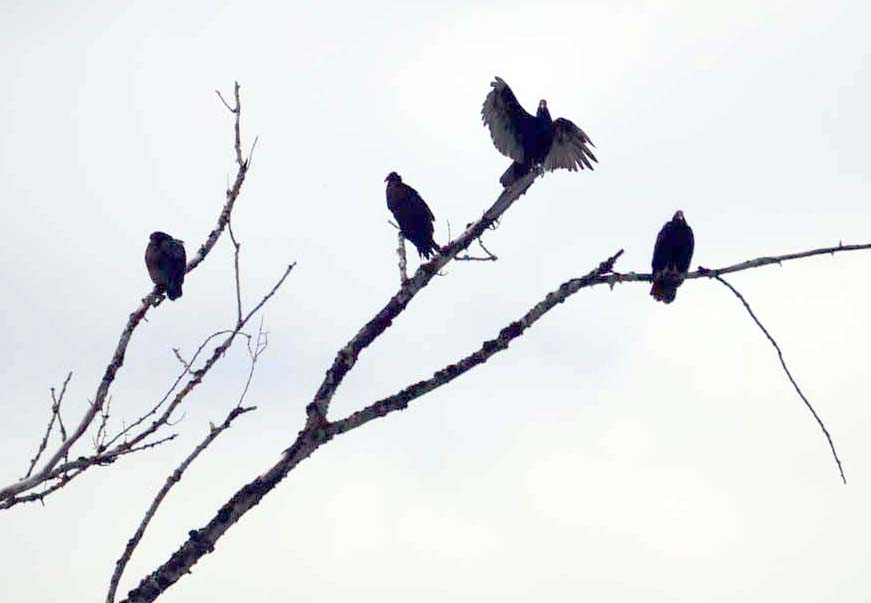
You know how it is, one thing leads to another. This time it started with the birds, so many of them, different ones. The vultures dominated, though, hanging out in the trees along the Columbia river among the bald eagles and ospreys, all ready to swoop down, all eerily quiet.
Then I saw the object of their concentration, or, more likely, their desire. A beached sturgeon, still fresh, no visible wounds other than a torn fin. A spectacular specimen. Perhaps killed by the ever surging water temperatures and dropping water levels – that warming was one of the causes for the recent die-off of sturgeons in our waters, both in 2015 and 2019. Sturgeons can get to be up to 100 years old, but they only spawn every 8-12 years, so their populations are extremely vulnerable at this point, despite many efforts by states, fisheries and environmental organizations to protect them.
In any case, I had just read a book review that started with the phrase “a beached sturgeon of ungodly proportions,” a phrase I found enticing. What followed had me rush to put my name on the library wait list (54 holds on 3 copies – what are you thinking, Multnomah County library?) for The Hounding, a debut novel by XenobePurvis. Set in 18th century England, it describes the fate of five sisters who are accused to be witches or worse, having caused a “season of strangeness,” claimed to transform themselves into dogs, now hunted by their neighbors. They try to save that fish, to no avail, and a man eventually kills it by violently stomping on the sturgeon’s head.
Apparently – again, I have yet to read it – many literary examples of sisters are invoked, from Pride and Prejudice, Mansfield Park to Hester Prynne. The main theme, though, seems to be the traditional one: the way society treats women, assigns them magical powers for which they are subsequently prosecuted, harms them by clinging to beliefs of malevolent witchcraft. And this brings me to a book about a different group of siblings that I just finished, The Sisters, by Jonas Hassen Khemiri.
It is a long, complicated novel, with constant shifts in time and several narrators, one of whom, the single male and potential half-brother to Ina, Evelyn and Anastasia, increasingly reveals himself to be quite the unreliable chronicler of the tale. Set in our own time, across Sweden, Tunisia and the U.S., its plot – if there is one, really – is also driven by superstitious beliefs in the supernatural. The sisters themselves believe that their family was cursed, and this guides their lives and decision making. The novel ropes us into deeply detailed worlds, both of behaviors and emotional interiors; it also makes it very clear that self-fulfilling prophecies interact with structural characteristics of misogynistic, patriarchal societies, exponentially affecting outcomes for women.
The book was not expressly plot-driven. I was more reminded of Susan Sontag’s adage that novels are education of feelings – they help us to escape the ever narrowing versions of ourselves, tied to habits in thinking and interactions. It certainly reminded me of how sibling relationships are fundamental to our existence, but their mechanisms are much more easily discerned when you observe other sibling relationships from the outside. In this case, the author managed to makeeach oneof them increasingly more sympathetic, despite some being closer to me, the reader, in personality than the others. He also showed the futile or destructive power of competition, when they could have helped each other all along. But the novel’s real success lies in the ability to convey how potentially neutral or positive life outcomes can be thrown into disarray by the persistence of false beliefs, no matter how rational you try to be. Let that sink in.
***
I have one sister who I admire, and we love each other deeply, despite being very different from each other, but I also feel sisterly bonds to several of my friends. I thought this was described best in Adrienne Rich’s poetry. In the first poem, she alludes to a shared history (siblings are, after all the ones who know you longest and suffered the same family dynamics, even if in different roles), but does that allow you to claim true knowledge of the sibling? Is the stranger she uses as comparison really a travel acquaintance, or another version of the sister, or is it the poet herself, claiming we are unknowable even to ourselves in the end? Too complicated for my heat-addled brain.
Much more decipherable, then, and a hymn to sisterhood whether by biological bond or not, is this for me:
“Women”
My three sisters are sitting on rocks of black obsidian. For the first time, in this light, I can see who they are.
My first sister is sewing her costume for the procession. She is going as the Transparent lady and all her nerves will be visible.
My second sister is also sewing, at the seam over her heart which has never healed entirely, At last, she hopes, this tightness in her chest will ease.
My third sister is gazing at a dark-red crust spreading westward far out on the sea. Her stockings are torn but she is beautiful.
Here are three sisters sitting at the water’s edge, (no sturgeon in sight, alas,) on rocks of black obsidian. Obsidian is, of course, sharp volcanic glass formed by quickly cooling molten lava, used since the Stone age for weapons, daggers, spears and knives included, but also as ornaments. In the realm of supernatural beliefs, it is associated with healing, protecting us from negative influences. “Its reflective properties are thought to help us recognize false beliefs we may have about ourselves so they can be released.” (Ref.) Hmm.
So, here they sit, on top of those symbols of mostly violent destruction, and yet healing dominates associations. Stitching together a costume that reveals rather than masks you, vulnerabilities and all, being true to yourself, in public no less.
Stitching the scars of your broken heart, sewing as reparative action, such a familiar trope for women’s duties, but now these women mend themselves.
The third sister has gone far beyond: she can leave the torn stockings as they are, seeing the scab from her wounds drift off towards the horizon, self-generated skin a strong enough renewal. She might have fallen, but picked herself up. She might have been violated, but wounds will heal.
And given how most women I know see themselves reflected in one or the other of “our” sisters depicted here (on the mirror surface of the obsidian and in the hurt), this poem is a gift of encouragement and manifesting, with no further need for belief in talismans or other mystical powers. We might be fumbling towards repair, but we do have the power to heal ourselves.
Then again, being able to turn yourself into a dog on occasion, hunting with the pack of your sisters, might be quite the thrill, no?
I’ll report more when I’ve read The Hounding.
Music today is a phenomenal collaboration: Sisters doing it for themselves….
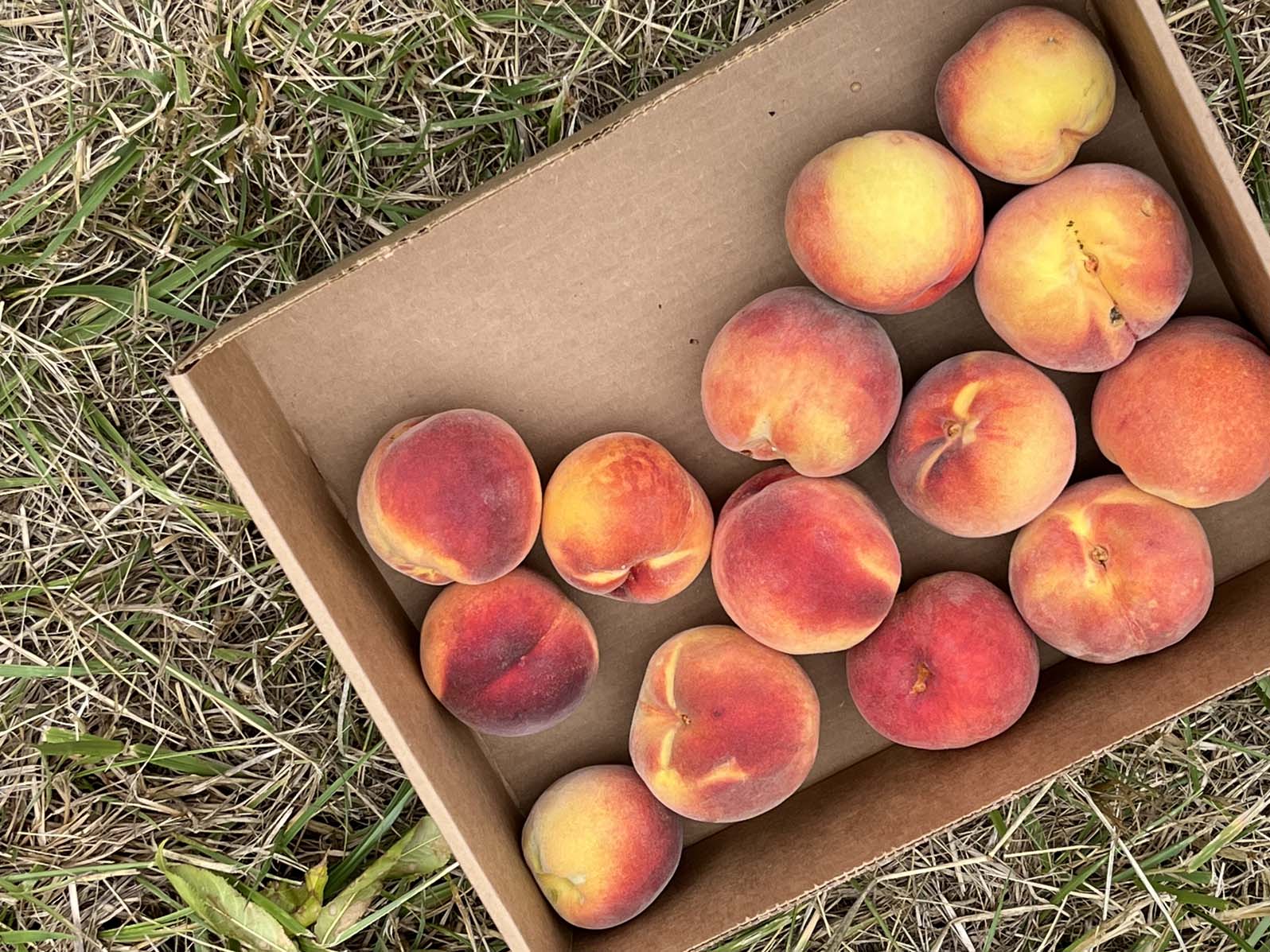
Last week I went peach picking. To reach the orchards you had to drive some miles across dusty dirt roads, arriving at a little farm stand in the shadow of a gargantuan oak tree. Acres and acres of peach trees, bending over from the weight of the fruit, to the point of boughs breaking off. A spectacular abundance.
iPhone pictures today – I did not want to be encumbered by camera while picking fruit.
I was the only one there, surrounded by the buzzing of hundreds of wasps and bees, all feasting. Was thinking about how these fruit are depicted in art, which paintings I remembered. Rachel Ruysch came to mind, her glorious still lifes, probably triggered by the fact that she has a major retrospective now traveling in the U.S. (will open August 23, 2025 at the Museum of Fine Art in Boston) and smart people writing about her life and career. This 17th century painter was more successful in paid commission at the time than many of her more famous contemporaries, Rembrandt van Rijn, Vermeer, Frans Hals and other titans of the Golden Age.
She was, however, not as free to pick her subjects as her male counterparts, constrained to painting flowers and fruit by fiat of her elders and other men in her life. Managed, though, to smuggle in the occasional reminder of the vagaries and dangers of life, in the form of sneaky salamanders, bees ready to sting, all kinds of eerily realistic creepy crawlies. And yet forgotten for the longest time, as so many other women artists.
Telling women what they can and cannot do: why would that remind me of the news that our Secretary of Defense, Peter Hegseth, reposted a preacher’s cry for the revocation of the 19th Amendment? Women should NOT be allowed to vote, was the demand. We have long known about Hegseth’s ties to Peter Wilson who advocates for a Christian nation and the need for women to be submissive to men, “head of household” in particular. According to Hegseth, women are obviously not welcome in the military, either. He has fired them left and right, all the while instituting weekly Christian prayer meetings at the Pentagon. But I digress.
If you look at Ruysch’s paintings, the peaches express hints of their extreme vulnerability, these fruits prone to bruises, splits, mold infestations like few others. Here is one she painted at the age of 19 (!): they are showing little scars and brown discoloration already.
Rachel Ruysch Peaches, grapes and plums with a dragonfly, snail, caterpillar, butterfly and other insects on a stone ledge (1683)
Rachel Ruysch Flowers in a Glass Vase, with Insects and Peaches, on a Marble Tabletop (1701)
In both paintings, she documents peach leaf curl and leaf rust; the trees are extremely susceptible to blight, which often leads to diseased fruit, rotting when still connected. At the orchard, the views of decaying fruit, on the trees and above all, or should we say below – on the ground, were upsetting. So much food gone to waste.
Some of the ones that had fallen were still perfectly intact, good for canning if not eaten fresh. I wondered, of course, if the help that used to pick these orchards in time, has disappeared for fear of deportation. A quick look at the statistics confirmed some suspicions: we have a significant shortage of peaches in the stores this year (down almost 25% from the average year), due to a combination of adverse weather conditions, labor availability and shortages, increased production costs, and economic disruptions, each intensifying the pressure on peach production in key regions such as Georgia, South Carolina, and California’s Central Valley. So could they not allow gleaners in, at least, collecting for the food bank?
***
When I perused painting of peaches, the depictions were, overall, divided. Many show the glory of the fruit on the trees or the voluptuous, velvety globules completely intact.
Wittregde Worthington Peaches (1894)
William Vareika Still Life of Peaches (1867)
Auguste Renoir Still Life with Peaches (1881)
Some reveal canning habits that seem to put the whole fruit with pit inside into the mason jars. Seems strange given the high cyanide content of those pits.
Claude Monet Jar of Peaches (1886)
Others acknowledge reality: peaches bruise all too easily.
Henri Matisse Peaches (1945)
Paul Gauguin Still Life with Peaches (1889)
And then there is Cézanne, always to be counted on when longing for transformation of a natural object into something altogether different, luminous from the inside, abstracted to its essence.
Paul Cézanne Still Life with Apples and Peaches (1905)
Compare this to D.H. Lawrence’s poem below.
The Peach
Would you like to throw a stone at me? Here, take all that’s left of my peach.
Blood-red, deep: Heaven knows how it came to pass. Somebody’s pound of flesh rendered up.
Wrinkled with secrets And hard with the intention to keep them.
Why, from silvery peach-bloom, From that shallow-silvery wine-glass on a short stem This rolling, dropping, heavy globule?
I am thinking, of course, of the peach before I ate it.
Why so velvety, why so voluptuous heavy? Why hanging with such inordinate weight? Why so indented?
Why the groove? Why the lovely, bivalve roundnesses? Why the ripple down the sphere? Why the suggestion of incision?
Why was not my peach round and finished like a billiard ball? It would have been if man had made it. Though I’ve eaten it now.
But it wasn’t round and finished like a billiard ball; And because I say so, you would like to throw something at me.
Here, you can have my peach stone.
by D.H. Lawrence, from his Birds, Beasts and Flowers collection of 1923.
In this modernist (almost) prose poem, he insist on describing the perceived features of the single fruit in verisimilitude, demanding that we ignore man’s desire to make everything perfect, without nooks and crannies, slightly misshapen, indented and heavy – let’s take the peach as is, not round and unblemished.
I wonder if there was the temptation to read slight sexualized connotation into these lines, if it weren’t for the name and thus the reputation of their author. I also ask myself why did I remember and pick this poem from an acknowledged misogynist, a man full of rage and struggle, linked to a hard life full of poverty, illness and persecution by those who did not want his truth telling and revolutionary upheaval of literature to succeed?
Here’s why. He was curious about the world and courageous, traits I value above all. His travel writing speaks volumes to openness to the new, the different, to search and exploration, a keen observer if there ever was one. And the poem itself has that wonderful sense of defiance – “Hey, wanna throw a pit at me? I’ll even provide one, but it won’t change my mind that the imperfect wins over perfection any old day! Let nature rule.”
All of this, and more, I wish for the newest member added to the family, the day after the peach picking excursion. May he be curious and courageous, open and flexible, perceptive and defiant when called for, in a life that will not all be peaches and cream in this world of climate change, wars and the rise of authoritarianism. May he enjoy music (which I listened to on the day he was born) by a composer who shares his birth date.
István Szelényi‘s Sonatina is full of energy, resolves discordances always with an element of surprise, is full of humor and deadly serious at the same time. Good things to be developed in a new life as well, don’t you think? Welcome to this world, little A.
Leave it to Larkin to imbue the glory of renewal with melancholic reminders that nothing will last, not even trees, not time, least of all we, ourselves. Even greenness is a kind of grief. And yet: here is a new round, let’s start from scratch, if only for this cycle, knowing full well that all cycles eventually cease.
Afresh, afresh, afresh.
It sure felt that way when I walked my first full round of 2025 at Jackson Bottom yesterday. Trees in leaf, wildflowers covering the pathways and meadows, dog roses climbing ever higher.
There were the last of the irises, the first of the asters,
mallows and forget-me-nots – and varieties of small sunflowers.
There were clover and clumps of hemlock,
cowslip and my beloved daisies.
The darn infection of my ribs, refusing to heal completely, made it painful to lift the camera, but how could I not?
Wildlife was fully present to greet the sunny day, bunny ears lined with blood vessels,
wood ducks tending their young,
as were the swallows.
Minnows darted around,
Scrub jay brandished a nice morsel, and the little guys tried to come into their own.
Deer was shy but present until it wasn’t,
and the crowning encounter was that of a coyote hunting, giving me the eye in no uncertain terms that I was interfering with his lunch.
***
That morning a local artist who I respect a lot for who he is as much as what he creates, had posted something on IG, with multiple comments of people acknowledging that they felt the very same way.
I certainly don’t feel like a coward – that would imply that there is the possibility of effective action and I were too scared to take it. But I do feel the same helplessness in view of the tremendous suffering all around us – I simply don’t know what I could do.
Then again, witnessing is a first step, acknowledging the horrors unfolding is a commitment to truth, and focussing on the fact that throughout history things have been evolving to the cyclical nature of ALL there is, helps to not succumb to despair. It is not just the living beings – whether trees or people – that die. It is also tyrants, war mongers, colonialist or generally oppressive systems that eventually bite the dust. Rome fell, so did the Spanish Inquisition. Stalinism is gone, so is Mao; republics have supplanted kings. Yes, some ideologies have only gone underground, ready to reemerge, and yes, there are scum who would like to reintroduce segregation and continue to use indented labor in the penal system if not outright slavery. There are those who pursue ethnic cleansing and genocide for clinging to personal power. But change has happened across Millenia, and human rights have surged in places previously very dark.
Afresh, afresh, afresh. Nature (and poetry) as a reminder that cycles will unfold, no matter how inevitable everything looks like now with power in evil hands. It will not bring back to life those who were brutally killed, it will not change our helpless mourning that currently colors every aspect of our lives, but a more just world can evolve along this historical spiral.
Maybe the artist’s simple uttering of those words allowed some other people not to feel alone, hearing sentiments that matched their own. That is the first step to build community that shares an assessment of facts, making us less vulnerable to manipulation of how we experience reality. There is nothing cowardly about the paralysis so many of us experience, but we have the choice to put our energy into hope, instead, and into local action. Do something for someone – here I cling to the words of Emily Dickinson:
If I can stop one heart from breaking
If I can stop one heart from breaking, I shall not live in vain; If I can ease one life the aching, Or cool one pain, Or help one fainting robin Unto his nest again, I shall not live in vain.
Must admit, I felt lousy yesterday. Not sure if I am coming down with the crud or if the regular culprits are acting up, fact is, I was in pain and I needed a boost. So I splurged, bought a new album on Bandcamp and can now pretend that my head spinning comes from some truly captivating music, rather than a shot immune system.
Not so many words then, today, to give you more time to listen. Just an introduction to the young composer who posesses what I count as some of my most admired attributes: curiosity and an integration of learning across categorical boundaries. Said more simply: during the isolation of the Covid epidemic, the guy devoured literature, poetry and film from a particular historical era (the 1930s), listened to classical music from same period, and then synthesized all of this into music for an octet. The jazz album has now come to fruition: For these Streets, by Adam O’Farrill.
His trumpet is embedded in a stellar cast, with Tyrone Allen II on double bass, Patricia Brennan on vibraphone, Tomas Fujiwara on drums, Mary Halvorson on guitar, David Leon on alto saxophone & flute, Kalun Leung on trombone & euphonium and Kevin Sun on tenor saxophone & clarinet. So much talent in one place, often split up in sub-sections, so it always feels intimate, not overpoweringly loud.
So much insight, too, into the realities, despair and precoccupation of an era some 60 years before the composer was even born, now just 30 years old. From what I have read, he explored books about wanderers, Miller’s Tropic of Cancer, describing the loneliness and isolation of the expat walking the nightly streets, and Steinbeck’s The Grapes of Wrath witnessing the misery of the Depression (4 tracks echo this novel, Swimmers, Migration, The Break had not come, and Rose, like a mini Suite.) Virginia Woolf’s The Waves was absorbed, as was the poetry of Octavio Paz.
The track Nocturno, 1932 riffs off one of his poems, “Nocturne of Saint Ildefonso,” that is a contemplation of the evolution of one’s life time, a circular tale about origins and endings, walking the streets of Mexico. It is a tricky feat of temporal dislocation, embedded in the poet’s ever recurring theme of searching for one’s identity. The central square in Mexico City is focal, thus today’s photographs of the Zócalo and surrounding streets. Linked to at the end of the post.
The musician watched Charlie Chaplin’s City Lights, and listened to various classic composers who found their way into his tracks: Carlos Chavez’s Preludes for Piano, Messiaen’s “Diptych,” Ravel’s Piano Concerto in G Major and Stravinsky’s “Dumbarton Oaks” chamber concerto among them. Probably my imagination, but I hear late Frank Zappa here as well. Christopher Laws at Culturedarm has a more learned review. (I would not be able to identify the particular pieces, just the likely classical composers.)
This was a poster I photographed at the Hotel Majestic. My shots of the Zócalo were from their restaurant balcony.
I can only describe impressions, after just a few rounds of listening, obviously. The music captures some of the despair of the era, the hectic brought on by industrialization and the introspective quality of artists thrown into a time not unlike our’s, when big changes loom, and external forces close in, depriving us of the ability to prosper psychologically as well as existentially. But the album also conveys, besides the imagery of walking the streets at night in anguish, the freedom of walking through environments that stimulate you and feel like home. I used to walk in New York at night, during the various years I lived there, and remember that feeling of both, being safe among all those people, part of some amorphous sense of shared humanity, but also alone, always a foreigner.
Very, very grateful to this music for bringing back those memories. I am reminded of a freer, more adventurous, more optimistic self, instead of today’s aching crone who hasn’t walked at night in I don’t know how long. Must change that. Except here I’d be in the company of coyotes…
Then again, I am determined not to get sucked into reminiscence tunnels, leaving that to Paz. Here and now: a brilliant album by one of Brooklyn’s most promising young musicians. I feel better already.
Here is the original Spanish version and here the English translation of the Octavio Paz poem. Yes, I lied. More to read. I’m keeping up with posting long poems this week…)
“Poetry is not a resting on the given, but a questing toward what might otherwise be.” – Adrienne Rich
A dear friend sent me a poem by Adrienne Rich (1929-2012) some months ago. I have been mulling over it and tried to read up on the poet, going beyond my previous cursory knowledge. I thought about the poem again today (I am writing on Mother’s Day) because of the huge identity shift that happens when you become a parent. But it also applies to something that many artists, myself included, struggle with: how to progress, change view points, accept ruptures or even seek them out, so you don’t end up stale, but evolve.
The poem is called Transcendental Etude, and it is long, posted below in full. It is dedicated to Rich’s life-long, much younger partner, after she had divorced her husband and started to explore her lesbianism. The title is an allusion to Liszt’s Transcendental Études, a set of technically (eventually) extremely challenging studies that were composed across 25 years of his life (starting at age 13) and meant to build performing skills. They are also quite narrative, providing a glimpse into a set of images in time, and constantly moving, like all etudes.
Ken Hochfeld #40 (Series Leaning) (2025)
Rich’s mother was a performing concert pianist, until her dominant husband, a pathologist and department head at Johns Hopkins, put an end to it; he was a demanding and overbearing father as well, according to the biography I read, and both pushed the child into a life of achievement, with brilliance assumed to be a given. She played Mozart and wrote her first lines as a 4 year-old, no less. The poet later dealt in much of her writing with the issues of authoritarian dominance as a form of abuse, as well as the challenges to her Jewish identity, motherhood (it radicalized her, three sons before her thirtieth birthday, later renowned for her book on motherhood as an institution, Of Woman Born) and her evolution into a lesbian (her first, doomed, love-affair was with her psychoanalyst (ethics, anyone?), Lilly Engler, who was still closeted.
Here is a short version of her biography from The New Yorker. She succeeded early in life, surrounded by minds as brilliant as her own at Ratcliff (Ursula LeGuin among them), won publications and awards while still being rather conventional in the 1950s, then evolving as a poet, as the NYT obituary called her, “of towering reputation and towering rage.” No matter how difficult a person she might have been, burdened with chronic pain from rheumatoid arthritis and the trauma of her husband’s suicide after their divorce, her intellectual curiosity and commitment to feminism are surely remarkable.
In any case, this is not about Adrienne Rich. This is about words that make you think about how life changes you, or, for that matter, your art. The first page contains lyrical descriptions of landscape, nature, man’s interference, and musings on the fleetingness of time, its short duration not allowing us full comprehension.
Ken Hochfeld #4 (Series Leaning) (2025)
The second page is more anguished: instead of being able to study our lives like the evolution of the Liszt etudes – from simple to difficult – we are thrown into the full harshness of it, after a few months of security at our mothers’ breast and lap, then nothing but wrenching apart and isolation.
“Everything else seems beyond us, we aren’t ready for it, nothing that was said is true for us, caught naked in the argument, the counterpoint, trying to sightread what our fingers can’t keep us with, learn by heart what we can’t even read. And yet it is this we were born to. We aren’t virtuosi or child prodigies, there are no prodigies in this realm, only a half-blind, stubborn cleaving to the timbre, the tones of what we are – even when all the texts describe it differently.
And we’re not performers, like Liszt, competing against the world for speed and brilliance (the 79-year-old pianist said, when I asked her What makes a virtuoso? – Competitiveness.)
The longer I live the more I mistrust theatricality, the false glamour cast by performance, the more I know its poverty beside the truths we are salvaging from the splitting-open of our lives.”
There comes a point, though, she argues on the next page, where we have to take ourselves seriously, or cease to exist. We have to be true to ourselves, in other words, rather than adhere to the scripts provided by society or fill the expectations laid out by others. We WILL find ourselves in free fall, but she argues that this fate was in store for us in the old ways of being as well – we have to take a leap into the unknown to be able to reconnect, ultimately to the love embodied by the symbol of a mother.
Ken Hochfeld #31 (Series Leaning) (2025)
And now we enter the most beautiful part of the poem: a description how we can integrate ever so many ways of beings, if we acknowledge how multifacted we are, rather than conforming to a single assigned role. I am the lover and the loved (agent and subject), home and wanderer (haven and world), she who splitsfirewood and she who knocks (the strong one and the one seeking help), a stranger in the storm, two women, eye to eye measuring each other’s spirit, each other’s limitless desire,” – all images of parts forming a whole. Remember, this was lived and written during the years when open acknowledgement of radical feminism and homosexuality was not yet tolerated as some decades later.
The poem goes on with a return to descriptions of what is in sight, but this time focused on the boundless ability to create – a woman constructing a quilt-like collage out of wondrous objects, natural ingredients, luminous colors. She is no longer concerned with achieving a masterwork, “something of greatness, brilliance,” but rather attends an integrative task, arranging bird feathers, wasp nests, shells and sea weed, among others. The bucolic descriptions of exterior landscape from the first page, marred by man’s destruction, now transposed into an interior realm, seemingly whole.
“pulling the tenets of a life together with no mere will to mastery, only care for the many-lived, unending forms in which she finds herself”
The poem has a tall order, matched by a tall promise. Cut yourself loose from societal expectations, regarding a single gendered or professional role, as well as demands of outstanding performance/mastery. Replace with a discovery and integration of facets of self, despite the price paid for defying norms. Allow it to unfold over time, (like Liszt’s program of etudes) and you will be rewarded by an unleashing of creativity and the potential of return to the unconditional love of a female, back to the beginnings.
Tall dreams.
Ken Hochfeld #38 (Series Leaning) (2025)
***
As I said at the beginning, Mother’s Day was a trigger for today’s musings. It is hard enough to discover who you are and how to bring that into the world, if it contradicts expectations and convention. It is even harder, when a new role of parenthood dominates for the mere reason that a loved, helpless little being is completley dependent on you, and the magnitude of the task is both physically and emotionally draining. It is made all the more difficult by society’s rigid proscription as to what constitutes a “good mother” (or father.) I strongy believe there are many different ways to be a good parent, all of which have room to unfold only if you are true to yourself. Ignore the performance aspect – the need to please or to oblige – and work with what you have and can deliver. After all, if you want your offspring to be tuly free to be who they are, and have the strength to reach for that even if it goes agaist prevailing rules, you need to model.
Ken Hochfeld #10 (Series Leaning) (2025)
Which is, or course, the impetus for true art as well. When you start to deviate from norms – particularly established and touted in the community of landscape photographers, I fear – you are clearly in free fall, as Rich describes it. Today’s images by Portland photographer Ken Hochfeld are a gripping example of an attempt for new ways of expression. The focus of this work, Leanings, the way I interpret it, is on the un-seen, brought into being by what is visually defined – a seeming contradiction in terms.
“A questing for what otherwise might be,” as I introduced Rich’s writings above, seems to be an apt descriptor here. The threshold between depiction and imagination is increasingly permeable in these photographs, without sacrificing defining elements of photography in terms of spatial layout, contrast effects or composition. Strong, beautiful work, and an evolutionary leap from his previous output.
This August evening I’ve been driving over backroads fringed with queen anne’s lace my car startling young deer in meadows – one gave a hoarse intake of her breath and all four fawns sprang after her into the dark maples. Three months from today they’ll be fair game for the hit-and-run hunters, glorying in a weekend’s destructive power, triggers fingered by drunken gunmen, sometimes so inept as to leave the shattered animal stunned in her blood. But this evening deep in summer the deer are still alive and free, nibbling apples from early-laden boughs so weighted, so englobed with already yellowing fruit they seem eternal, Hesperidean in the clear-tuned, cricket throbbing air.
Later I stood in the dooryard, my nerves singing the immense fragility of all this sweetness, this green world already sentimentalized, photographed, advertised to death. Yet, it persists
stubbornly beyond the fake Vermont of antique barnboards glazed into discothèques, artificial snow, the sick Vermont of children conceived in apathy, grown to winters of rotgut violence, poverty gnashing its teeth like a blind cat at their lives. Still, it persists. Turning off onto a dirt road from the raw cuts bulldozed through a quiet village for the tourist run to Canada, I’ve sat on a stone fence above a great, soft, sloping field of musing heifers, a farmstead slanting its planes calmly in the calm light, a dead elm raising bleached arms above a green so dense with life, minute, momentary life – slugs, moles, pheasants, gnats, spiders, moths, hummingbirds, groundhogs, butterflies – a lifetime is too narrow to understand it all, beginning with the huge rockshelves that underlie all that life.
No one ever told us we had to study our lives, make of our lives a study, as if learning natural history or music, that we should begin with the simple exercises first and slowly go on trying the hard ones, practicing till strength and accuracy became one with the daring to leap into transcendence, take the chance of breaking down in the wild arpeggio or faulting the full sentence of the fugue. – And in fact we can’t live like that: we take on everything at once before we’ve even begun to read or mark time, we’re forced to begin in the midst of the hardest movement, the one already sounding as we are born. At most we’re allowed a few months of simply listening to the simple line of a woman’s voice singing a child against her heart. Everything else is too soon, too sudden, the wrenching-apart, that woman’s heartbeat heard ever after from a distance, the loss of that ground-note echoing whenever we are happy, or in despair.
Everything else seems beyond us, we aren’t ready for it, nothing that was said is true for us, caught naked in the argument, the counterpoint, trying to sightread what our fingers can’t keep us with, learn by heart what we can’t even read. And yet it is this we were born to. We aren’t virtuosi or child prodigies, there are no prodigies in this realm, only a half-blind, stubborn cleaving to the timbre, the tones of what we are – even when all the texts describe it differently.
And we’re not performers, like Liszt, competing against the world for speed and brilliance (the 79-year-old pianist said, when I asked her What makes a virtuoso? – Competitiveness.)
The longer I live the more I mistrust theatricality, the false glamour cast by performance, the more I know its poverty beside the truths we are salvaging from the splitting-open of our lives. The woman who sits watching, listening, eyes moving in the darkness is rehearsing in her body, hearing-out in her blood a score touched off in her perhaps by some words, a few chords, from the stage: a tale only she can tell.
But there come times—perhaps this is one of them –
when we have to take ourselves more seriously or die;
when we have to pull back from the incantations, rhythms we’ve moved to thoughtlessly,
and disenthrall ourselves, bestow ourselves to silence, or a deeper listening, cleansed of oratory, formulas, choruses, laments, static crowding the wires. We cut the wires, find ourselves in free-fall, as if our true home were the undimensional solitudes, the rift in the Great Nebula. No one who survives to speak new language, has avoided this: the cutting-away of an old force that held her rooted to an old ground the pitch of utter loneliness where she herself and all creation seem equally dispersed, weightless, her being a cry to which no echo comes or can ever come.
But in fact we were always like this, rootless, dismembered, knowing it makes the difference. Birth stripped our birthright from us, tore us from a woman, from women, from ourselves so early on and the whole chorus throbbing at our ears like midges, told us nothing, nothing of origins, nothing we needed to know, nothing that could re-member us.
Only: that it is unnatural, the homesickness for a woman, for ourselves, for that acute joy at the shadow her head and arms cast on a wall, her heavy or slender thighs on which we lay, flesh against flesh, eyes steady of on the face of love; smell of her milk, her sweat,
terror of her disappearance, all fused in this hunger for the element they have called most dangerous, to be lifted breathtaken on her breast, to rock within her – even if beaten back, stranded again, to apprehend in a sudden brine-clear thought trembling like the tiny, orbed, endangered egg-sac of a new world: This is what she was to me, and this is how I can love myself – as only a woman can love me.
Homesick for myself, for her – as, after the heatwave breaks, the clear tones of the world
manifest: cloud, bough, wall, insect, the very soul of light: homesick as the fluted vault of desire articulates itself: I am the lover and the loved, home and wanderer, she who splits
firewood and she who knocks, a stranger in the storm, two women, eye to eye measuring each other’s spirit, each other’s limitless desire, a whole new poetry beginning here.
Vision begins to happen in such a life as if a woman quietly walked away from the argument and jargon in a room and sitting down in the kitchen, began turning in her lap
bits of yarn, calico and velvet scraps,
laying them out absently on the scrubbed boards in the lamplight, with small rainbow-colored shells sent in cotton-wool from somewhere far away, and skeins of milkweed from the nearest meadow – original domestic silk, the finest findings – and the darkblue petal of the petunia, and dry darkbrown lace of seaweed; not forgotten either, the shed silver whisker of the cat, the spiral of paper-wasp-nest curling beside the finch’s yellow feather. Such a composition has nothing to do with eternity, The striving for greatness, brilliance – only with the musing of a mind one with her body, experienced fingers quietly pushing dark against bright, silk against roughness, pulling the tenets of a life together with no mere will to mastery, only care for the many-lived, unending forms in which she finds herself, becoming now the sherd of broken glass slicing light in a corner, dangerous to flesh, now the plentiful, soft leaf that wrapped round the throbbing finger, soothes the wound; and now the stone foundation, rockshelf further forming underneath everything that grows.
By Adrienne Rich – The Dream of a Common Language: Poems 1974-1977. New York: W.W. Norton & Company, Inc.
(For sticklers – I got as close to the correct format as I could. There area few line breaks that are not entirely accurate. Couldnt figure it out in the word program.)
A resolution to mark May 5th, 2025 as National Day of Awareness for Missing and Murdered Indigenous Women and Girls passed the Senate on Monday. This was good news among a torrent of bad news regarding Indigenous rights. I want to introduce two voices today, who singularly inform, on an intellectual and an emotional level, respectively, about the issues involving Native Americans.
All images today by Nicole Merton.
Let’s start with the latter, a photographer and activist of Mescalero Apache descent, Nicole Merton. She focuses her photographic work on the MMIWP Movement (Missing and Murdered Indigenous Women & People) with cultural photography and recordings of untold stories, doing field work across the nation. Her photography depicts women who have payed tribute to memories of their lost loved ones, and their strength to stand for others who can’t. Within these photos there is a red hand print which evokes solidarity and a moment of silence for the ones lost. The symbol that has taken off internationally to point to the growing MMIW movement. It stands for all the missing women and girls whose voices are not heard. It also stands for the silence of the media and law enforcement in the midst of this crisis.
“For the last few decades there has been a massive attack on indigenous women of the United States as well as Canada, and parts of Mexico. These women have been taken and forced into sex trafficking, have been sexually assaulted, and some are murdered. Many have been reported missing with little to nothing being done about it. In the record breaking year of 2016 there were 5,712 missing women reported by tribal officials but only 116 where actually recorded in the United States Department of Justice, the number of missing and murdered women are still rising. A small percentage of those women who have gone missing have been girls as young as the age of 10. Native American women under the age of 35 are at a higher risk of being murdered than many other groups which makes it the third most prevalent cause of death among indigenous women. 95% of these cases never make it to the media, it is my determination to make changes and bring forth awareness, and to change lives.”
The images I am posting today come from Merton’s website, which has an amazing breadth of portraiture, but also from an exhibition where I first encountered her work, 1.5 years ago. Red Earth Gaze was shown at the Angle’s Gate Art Center in San Pedro, CA. Unfortunately I did not note the titles of the photographs, too immersed at the time in their emotional impact.
***
The other person of note is Rebecca Nagle (Cherokee), a Native American activist, writer, and public speaker. I summarize below information from her site Welcome to Native America. Her book By the Fire We Carry was a finalist for the National Book Critics Circle Award, and claimed as the New Yorker’s Best Books of 2024, a Publishers Weekly Top 10 Book of the Year, an NPR 2024 “Books We Loved” Pick, an Esquire Best Book of the Year and a Kirkus Best Nonfiction Book of 2024.
“The author recounts the generations-long fight for tribal land and sovereignty in eastern Oklahoma. By chronicling both the contemporary legal battle and historic acts of Indigenous resistance, By the Fire We Carry stands as a landmark work of American history. The story it tells exposes both the wrongs that our nation has committed and the Native-led battle for justice that has shaped our country.”
Here is the current situation from Nagle’s reporting: Nationally, there are 4,200 unsolved cases of missing and murdered Indigenous people. Meanwhile, as part of the Trump admin’s purge of “DEI” information on government websites, it has taken down a federal report on Missing and Murdered Indigenous People. The task force behind the report was created by Congress.
Trump has unveiled a plan to close the EPA Office of Research and Development in Ada, Oklahoma. It is the nation’s only federal groundwater research lab. This will have disproportionate impacts for tribes, where the majority of drinking water systems utilize groundwater.
The Trump-proposed SAVE Act is heading to the Senate. If passed, it will disenfranchise millions of citizens, including Native voters. Under the Act, tribal IDs will be insufficient to prove citizenship and will require additional documentation and rural Native voters will need to travel hours to register to vote in person, or even to update their address or party affiliation. Check out Protect the Sacred, which registered hundreds of Indigenous voters in 2024 through the Ride to the Polls campaign.
***
I am always encouraged by the singular reach that people who passionately pursue a cause, can have. Once individual voices add up to a chorus, maybe the message will get loud enough so that it can no longer be ignored. The victims deserve it.
Then again, justice is not easy to come by. For Native women, murder is the third leading cause of death. Native women living on reservations are murdered at a rate 10 times higher than the national average. 97% of the people who perpetrate these crimes are non-Native. Part of the problem is the legal gray zone of who is responsible for prosecuting these crimes, with diffuse criminal jurisdiction.
I am summarizing Nagle again: Tribes cannot prosecute non-Natives (the most frequent perpetrators) for most crimes. And there are legal limits for the prosecution of tribal members by tribes – even for murder you can only sentence to three years in prison. (Let us for a moment ignore the issue of abolition, ok?) The federal government can prosecute “major” crimes on tribal land, like murder, assault, kidnapping, child abuse, and robbery. The problem here is that historically the federal authorities don’t take up this power – over a third of all Indian Country cases are declined, and for some years the rate is as high as 67%, not pursuing sexual assault cases, for example.
It gets more complicated: as of a 2022 Supreme Court decision, all states have the authority to prosecute crimes where the perpetrator is non-Native, but the victim is Native. Yet only 15 states have prosecutorial power on Native land. And And finally, some tribes can prosecute some crimes (sexual assault, sex trafficking, stalking, and child abuse) committed by non-Natives on their land, but only if they meet certain criteria and seek and receive federal approval. As of 2022, 31 tribes across the U.S. had passed this hurdle – 31 out of 574. Confused yet?
And we wonder why crime rates against tribal women are excessive.
If you are interested in how contemporary poets confront the epidemic of missing indigenous women, I urge you to read this essay that will link to various poems.
Instead of music today here is a poem in audio form. I liked the way the words conjure up a powerful woman, not a victim.
She Is Spitting a Mouthful of Stars (nikâwi’s Song)
She is spitting a mouthful of stars She is laughing more than the men who beat her She is ten horses breaking open the day She is new to her bones She is holy in the dust
She is spitting a mouthful of stars She is singing louder than the men who raped her She is waking beyond the Milky Way She is new to her breath She is sacred in this breathing
She is spitting a mouthful of stars She is holding the light more than those who despised her She is folding clouds in her movement She is new to this sound She is unbroken flesh
She is spitting a mouthful of stars She is laughing more than those who shamed her She is ten horses breaking open the day She is new to these bones She is holy in their dust
My apple tree – lucky if we get three apples after the birds and squirrels have at it.
I figured I spare those of you not interested in politics today, by putting the poem out in front, accompanied by photographs of what is currently in bloom in my garden and the local parks, a celebration of spring. Enjoy her beautiful words that capture the essence of the season: light over darkness, rebirth, an ephemeral presence of something Holy, even if you’re not attached to Sacraments.
If you’re curious why this poem came to mind and how it is connected to thoughts about what is happening around us, on the other hand, read on. I’ll try to be concise and let the various links do the talking.
Neighborhood rhododendron
The poet warns us that there are spiritual things that science cannot “overtake” or measure, but that are rather felt by humans. I have no problem with that – I am perfectly willing to consider that not all can be explained by science. Before you allow those distrusting science in general to appropriate this poet, though, let me remind you that she also wrote in Fascicle Ten: “Faith is a fine invention / For Gentlemen who see — / But Microscopes are prudent / In an Emergency!”
Science matters. We in the scientific community, but also most everyone I talk to who is not a scientist, are horrified by the current administration’s assault on all things scientific. What affects the largest number of people, the planet, really, is, of course, anything climate related. Policies weakened, rolled back, eliminated. Data collection abandoned, particularly where they’d demonstrate negative impact of climate change or industrial pollution on vulnerable populations (air quality, lead exposure), but also weather and dangerous conditions in general. Grants for research programs canceled, thousands of scientists fired for good. Research meetings prohibited, advisory committees dissolved, scientists no longer allowed to talk to “foreigners” (e.g. the research community that collaborates or the WHO.) Fire fighting and disaster mitigation curbed or canceled. Green initiatives kneecapped. Fossil fuel extraction resumed and encouraged, even in previously protected natural areas like our National Parks, and despite their impact on increased environmental pollution. Dickinson is likely spinning in her grave.
Daisies cover our meadow
Let’s look at health next. Again, thousands of employees terminated, including high ranking scientists and advisory boards. That includes the entire Board of Scientific Advisors for the National Cancer Institute. Brain drain, with many of those now courted by universities abroad leaving for sure. Acts instituted by an institution headed by cabinet secretary RFK Jr., who claims that ADD, ADHD, Tourette’s, Narcolepsy and Autism was unfamiliar when he was a child. ADD/ADHD was named in 1980, Tourette’s Syndrome was named in 1885, Narcolepsy was named in 1880, Autism was named in 1912…. The same person who believes a new “origins of autism” research study can be completed by September of this year.
Earlier this month, the administration formally rescinded the National Institutes of Health (NIH) scientific integrity policy, which had been created to protect federal scientists from political interference and retaliation. (In a timely fashion, then, note the letter sent by he acting U.S. attorney for the District of Columbia this week to the editor of a scientific journal, implying that the journal was partisan and asking a series of questions about how the publication protects the public from misinformation, whether it included competing viewpoints and whether it was influenced by funders or advertisers. Suppression of scientific freedom, if you don’t like the results they publish? And do we now need to add crackpot studies that spew misinformation for “fair and balanced” reporting ?)
How many blueberries will there be – taking bets.
Grants terminated (and not just that, but completely, irretrievably deleted from data bases), all references to certain vaccines prohibited. And speaking of vaccines: not only are they no longer officially recommended (causing measles and other avoidable childhood diseases to soar), or are accused of causing autism (long disproven,) they are now actively undermined in their development. Instead of approving the tweaking of existing vaccines for new variants of Covid, for example, just like the CDC did every year for flu vaccines, the pharmacological industry is now asked to run full new trials. Not only would that cost millions of dollars but also would not be possible to do for the next season when shots are most urgently needed, in fall. So the administration can claim there is no “prohibition” of vaccination, but in reality vaccination delayed is health (survival!) denied….
If you neglect research into cancer, infectious and heart diseases, as well as Alzheimers (all of whom have been defunded) how much do you actually care about public health? If you ignore the numbers on Covid infections, maternal deaths, or sexually transmitted diseases like HIV, or prevent treatment of acute drug addiction (Narcan program is canceled), many wonder if they are interested in getting rid of disease, or rather getting rid of sick people.
The magnolia is an ancient tree and on its last leg….
I forgot: food safety inspections – gone. And following $1 billion in food aid cuts by Trump, anti-hunger programs across the U.S. are struggling to feed vulnerable communities, with charities forced to replace nutritious meals with crackers, dried cranberries, and thin soup. The cutting of vital food assistance threatens the health and dignity of millions of low-income Americans.
If you prohibit mask wearing despite the scientifically demonstrate protection they provide against infectious diseases, what is your justification, particularly for vulnerable populations like the elderly and immune-compromised? When is the line crossed to applied eugenics?
The bans limiting exposure to toxic chemicals touch most facets of daily life, prohibiting everything from bisphenol in children’s products to mercury in personal care products to PFAS in food packagingand clothing. The administration is moving to kill the bans on PFAS. The location of thousands of high-risk chemical plant now shielded from public view. Car safety rules? Loosened.
Medicaid? House Republicans are considering slashing the federal government’s 90% funding match for Medicaid expansion under the Affordable Care Act — a move that could strip millions of low-income Americans of their health insurance, shifting massive costs onto states, dismantling a pillar of Obamacare.
Frontyard lilac.
Here is a site where you can find most actions taken by the administration regarding our health, sorted by month since the inauguration.
And here is a nifty general tracker that is constantly updated, where you can look at what is changing in many aspects of our daily and legal universe for yourself. In case you aren’t depressed enough yet. Every single claim made above, by the way, can also be found in the news, newspapers, journals and radio and TV programs alike. There is nothing hidden about it. I just don’t have the patience to add all the links.
I do, however, recommend reading a longer piece that made quite a bit of sense to me in explaining where the anti-science attitude originated. Hint, the claim is that it was born from an anti-governmental ideology long anchored in conservative thinking. An interesting analysis from 3 years ago by a Harvard Historian of Science and a NASA historian at CalTech.
However, what we are seeing now is going beyond that. If you undermine public health, disaster response, and climate crisis mitigation, you harm the nation you are supposed to protect. The amassing of power when you dismantle independent agencies and academic scientific research, and surround yourself with sycophants rather than experts who know what they are doing, might be the goal, but it will not lead to an advancement of the common good, the health, safety and perhaps prosperity of all of us. The few who benefit might have the illusion that they can retreat to their private islands, their luxury bunkers or another planet – but reality will catch up even with them, if only after many of us have been harmed by the denial of science and the tools it offers for our survival.
Music today is meant to cheer us all, with one of the most incredible drummers of our time – Yussef Dayes. There is light in that greenhouse – and that music – the would be familiar to Dickinson…..
You have to walk without me today, since I am busy tackling the jungle of weeds that pretends to be my garden. But my very happy dog will keep you company on your sojourn along the beaches and coast of the Pacific around the Southern border of Oregon and Northern parts of California.
The coast never fails to impress with its reminders of the power of nature – the swells, the dangerous rocks,
the provision of food if you know where to find it (and who to share it with.)
Vulture and gulls working on a big fish….
Nor does it hesitate to impress with its beauty – the colorization alone of rocks and oceans, scotch broom in bloom on the surrounding hills, the shades of water at different depths.
People, as always, can’t help but leave signs of their existence.
Geese, on the other hand, are forever on the lookout for the existence of others – thus their role as guardians of the gates during the Roman empire.
One lonely goose on top….
Which brings me to today’s poem that I had linked to in an overly optimistic blog not so long ago. For today, the association between the Barbarians at the gates and the guardian geese prompted me to offer it again, in its full sarcastic splendor. How it currently applies to all of us, needs, I fear, no further elaboration.
Waiting for the Barbarians
What are we waiting for, assembled in the forum?
The barbarians are due here today.
Why isn’t anything going on in the senate? Why are the senators sitting there without legislating?
Because the barbarians are coming today. What’s the point of senators making laws now? Once the barbarians are here, they’ll do the legislating.
Why did our emperor get up so early, and why is he sitting enthroned at the city’s main gate, in state, wearing the crown?
Because the barbarians are coming today and the emperor’s waiting to receive their leader. He’s even got a scroll to give him, loaded with titles, with imposing names.
Why have our two consuls and praetors come out today wearing their embroidered, their scarlet togas? Why have they put on bracelets with so many amethysts, rings sparkling with magnificent emeralds? Why are they carrying elegant canes beautifully worked in silver and gold?
Because the barbarians are coming today and things like that dazzle the barbarians.
Why don’t our distinguished orators turn up as usual to make their speeches, say what they have to say?
Because the barbarians are coming today and they’re bored by rhetoric and public speaking.
Why this sudden bewilderment, this confusion? (How serious people’s faces have become.) Why are the streets and squares emptying so rapidly, everyone going home lost in thought?
Because night has fallen and the barbarians haven’t come. And some of our men just in from the border say there are no barbarians any longer.
Now what’s going to happen to us without barbarians? Those people were a kind of solution.
“It is the fundamental task of art to fight against alienation – to go to bat for authentic hearing, seeing, feeling, thinking against the stereotypes and societal patterns that are full of hostility towards being thoughtful and perceptive.” – Erich Fried in Rudolf Wolff (Hrsg.): Erich Fried. Gespräche und Kritiken, 1986. (My translation.)
***
If you look up the meaning of the word “authentic,” the Thesaurus suggests this: genuine, honest, true, real, original, unmistakable, historical. I cannot think of a better description of the art of Ceija Stojka (1933-2013) a Roma artist, Holocaust survivor, and activist whose work is increasingly displayed by major venues, providing welcome contrast to so much of the inauthentic hokum out there.
Ceija Stojka The Mama (detail with gallery entrance reflected in the glass covering the painting.)
Across the last few years the artist’s paintings, drawings and journaling were on view at Gallery Christophe Gaillard in Brussels, the Museum of the City of Lodz in Poland, at the European Roma Institute for Arts and Culture, at the 35th Bienal de São Paulo, at Kassel’s Documenta 15 in Germany, among others. Opening in April, they are at the Bibliothèque Nationale de France, Paris, in a group exhibition, Apocalypse. Yesterday and Tomorrow.
Luckily, we dont have to travel that far. Some of Stojka’s work is currently shown at the Vancouver, WA gallery Art at the Cave, together with exhibits by Daniel Baker and Sam Marroquin, and short videos about the artists by Erin Aquarian, in a show titled “Seeking Warmth.”
Stojka’s father was murdered by the Nazis even before the entire family was imprisoned in concentration camps. She, her mother and all siblings but one brother survived, despite being routed through Auschwitz, Ravensbrück and ultimately Bergen-Belsen. A miracle, given that out of 12 000 Austrian Roma, between 9000 and 10 000 perished during the Holocaust. After liberation, she attended school for a few years before she had her first child at age 15. She became a successful carpet merchant, and had two more children within the decade (two of whom preceded her in death, adding more tragedy.) It was only in her mid-fifties that she started to put her traumatic experiences into diverse forms of expression, music, self-taught visual art and journaling. It is no exaggeration to say her memories poured out, with over a thousand works of art and writing composed during the decades before her death at age 79 in 2013.
Ceija Stojka Untitled (Wagon in Forest)
Before I turn to her art, a grateful acknowledgement that individual people accompanied this artist to express herself and help bring about the prominence she has achieved. One of Austria’s most distinguished documentarian film makers, Karin Berger, was the first to engage with Stojka in the late eighties. A full documentary about the artist and her trauma, Ceija Stojka: Portrait of a Roma, was published in 1999. Lorely French, who taught German language and literature, as well as film and Roma writers, retiring this May after 39 years at Pacific University, was the artist’s friend. Importantly, she translated the first English version of the memoirs of Ceija Stojka, and is a founding member and member of the board of the Ceija Stojka International Association.
The art on display in the current exhibition is a small-scale version of Stojka’s oeuvre as a whole: there are the paintings that represent a “bright cycle” – scenes referencing life as the Romani people experienced it before the descent into the hell of the Holocaust. The acrylics are expressive, colorful, reminiscent of folk-art, and often quite sophisticated in their perspective for a self-taught artist. They report what was seen, but also communicate a sense of longing for a way of life that no longer exists. Wagons, streams, summer meadows, birds and flowers everywhere, and many people forming community around chores, more often seemingly idyllic than not. Exactly a way a child would experience her childhood, without the adult knowledge of how the Roma had to fight against prejudice and persecution long before the fascists arrived on the scene. It is a remarkable feat as an artist to be able to reproduce that experience from a memory store that by all means should have been overwritten by the horrors that followed.
Ceija Stojka Untitled (Wagon with people at stream)
These very horrors are captured in Stojka’s “dark cycle,” drawings in ink and some other materials that comprise the other half of her output. These drawings are often accompanied by text. For clarity, the English translations are repeating the meaning of the words, accurately conveying what was said (a choice I would have made as well.) What gets inevitably lost – and the part that makes her texts so indelibly authentic – is the orthography of the artist. Having had but a few years of school, after liberation and before she had her first child, Stojka writes how one hears the words, phonetically, and not according to our spelling and grammar rules. It gives the texts a texture of spontaneity and intensity, of words tumbling out of a mouth rather than a pen, providing the message with an amount of urgency that can simply not be captured in translation.
These two cycles, bright and dark, interact to magnify the void caused by evil, by offering us the memorial building blocs of a remembered childhood, catapulted into the abyss. The longing for the wholeness of life before is drawing us in, and then spitting us out into the agony of what came after, or the bitterness of the realization of what the artist had to endure. The yearning for the remembered ideal frames the depicted trauma caused by genocide, multiplying the horror exponentially.
Ceija Stojka They devoured us.
We find both, personal grief and political anger in Stojka’s drawings and texts. What makes her so effective as a messenger is the concreteness of her reporting. She did seek warmth by resting amongst the dead (hence the title of the exhibition), shielding her from the wind. She fought off starvation by chewing and swallowing little balls of wool her mother had unraveled from the sweaters still on the corpses, or by eating grass pried from under the floorboards of the barracks, or sap clawed from trees. She banned despair by clinging to hope, perceived by her to be what gave them strength.
Ceija Stojka Hope – that was what gave us strength 1944
***
“Was wir suchen ist schwer zu finden. Die Angst, die müssen wir nicht suchen. Die ist da.” “What we are searching for is hard to find. We don’t have to search for the fear. That is there.” (Translation by Lorely French.)
***
Stojka’s relationship to fear is more complex. On the one hand, she models for all of us an incomprehensible amount of fierceness and courage in poems like this.
On the other hand, she describes, again concretely, a typical behavior that is the result of her experience: “You can’t walk along the street without looking over your shoulder.” (This sentence was juxtaposed with a quote by the poet Erich Fried, an Austrian compatriot who fled into exile after the Nazis killed his father and who survived the war in England. “For I cannot think without remembering.”)
Fear permeates the past, her book titled: Even Death is terrified of Auschwitz. It seeps into the presence – already in the year 2000, she worries about next generations forgetting history, and the fact that a far-right party joins the government coalition.
She proclaims soon after: “Ich habe Angst, dass Europa seine Vergangenheit vergisst und das Auschwitz nur am Schlafen ist. Anti-ziganistische Bedrohnungen, Vorgänge und Taten beunruhigen mich und machen mich sehr traurig.” (“I fear that Europe is forgetting its past and that Auschwitz is only asleep. Anti-Romani threats, happenings and attacks worry me and make me quite sad.”) (Ref.)
The fear, however, seems to be one of the motors for her activism to educate Austrians and the world about the history and the plight of the Romani people, activism for which she received accolades and awards. To this day, Austria has not officially recognized the Holocaust or the Samudaripen/Porajmos – in Austria referred to as the Holocaust of the Roma – through any legislative act; the Holocaust of the Roma is instead recognized as an integral part of the Holocaust as such. (Ref.)The Romani people, assumed to have originated in Asia, most likely Punjab or Kashmir, and who have never identified themselves with a homeland, have been persecuted since the middle ages within the various countries where they traveled and traded. The Porajmos saw up to half a million Roma murdered. Like Jews, they were segregated into ghettos before transport to extermination camps. After the war they were forced to settle in various locations. In post-war Czechoslovakia, where they were considered a “socially degraded stratum”, Romani women were sterilized as part of a state policy to reduce their population. As recently as the 1990s, Germany deported tens of thousands of migrants to Central and Eastern Europe, with large percentages of the Romanians among them being Roma.
Postcard work of Ceija Stojka (which I consider some of her strongest communications.)
Fast forward to our own times, where for the first time ever since 1945, Austria saw this far-right party, the FPÖ (Austrian Freedom Party,) win the most seats in national elections with garnering almost 30% of the vote last September. (The centrist parties managed to form a governing coalition some many months later that excludes the extremists.) A member of the FPÖ had only a few years back distributed anti- Romani, hate-filled videos on social media, but could not be criminally indicted since he is protected by immunity as a member of congress.) Anti-Roma hate crimes are frequent occurrences across Europe, with assault and arson attacks against homes physically endangering people. Ethnic hatred and claims of “Gypsy criminality” are clearly making a comeback in tandem with rising anti-Semitic sentiments fostered by extremists movements and now parties.
Fear can be a tool. It can motivate us to (re)act and fight for justice, as the artist did. It can be both, exploited and imposed by draconian measures and persecution, as radical right ideologies have successfully discovered. Fear of others, of globalization and immigration, of status loss or “replacement,” can be turned into hatred of scapegoats, often ethnicities other than one’s own. Fear of consequences of protest or non-conformity can smooth the path of authoritarians who want to consolidate power.
Ceija Stojka knew that, expressed that, resisted that. In life and in art.
***
Daniel Baker is a Roma artist and theorist of renown who lives in the U.K. He uses metalised polyethelene rescue blankets, sometimes sculpted, sometimes crocheted, to combine conceptual issues related to survival strategies and practices with a visual aesthetic that echos Romani patterns. Part of his theoretical work concerns the (in)visibility of ethnic minorities, particularly those that are not geographically anchored. In a somewhat ironic turn, his work could have been displayed a bit more visibly in the gallery – you had to work to discover it.
Daniel Baker Emergency Artefacts.
Sam Marroquin shows her series The Madness of War in the upper parts of the gallery. An astonishingly large number of charcoal and acrylic paintings were fitted into the space without overcrowding. Kudos to whoever hung this, likely Sharon Svec, whose curation of this exhibition is splendid overall. The paintings are simplified reproductions of scenes depicted on videos and print material of first hand experiences by those living through the hell that is contemporary Gaza. Put on paper with the artist’s non-dominant hand, they appear more like the drawing of a younger person, a lack of perfection and child-like approach that parallels what we see in the paintings of Stojka. Here, too, are concrete depictions of humans in existentially threatening situations, their bodies and spirits bombed into extinction, their grief more than a single life time can hold. Block letters introduce the artist’s suggestions of the emotions and thoughts likely experienced, all universal enough that they promise verisimilitude.
Sam Marroquin Paintings along the Gallery Wall from the series The Madness of War.
The work makes several strong points. For one, any claim that we have moved beyond atrocities imposed on any one group is moot. The indiscriminate killing of men, women and children, of rescue personnel and journalists/reporters is not a thing of the past, intentional starvation included. Secondly, the suffering depicted is universal, even if it is applied in this case to the particulars of the fate of Palestinians. We could as well be looking at Syria, Ukraine, Sudan or the Republic of Congo. And, importantly, Marroquin’s drawings reveal a humanity of the victims that will elicit empathy in all but the most hardened, allowing a sense of shared humanity across borders.
Sam Marroquin Paintings from the series The Madness of War
The issue, then, is the fact that all of these images were, as “originals,” available in public sources, live-reported during this conflict. They never made their way to those fixated on selective mass media or social media sources that are ideologically inclined to show some sides of suffering but not others. The polarization experienced in a country divided about our political future, is reflected in the visual diet that we consume, basically determined by what the powers that be put into the relevant “larders.” In some way, then, art that is not explicitly associated with media that we deem trustworthy or disreputable, respectively, might inform consumers whose minds can be opened if approaching artistic depictions without easily triggered prejudice. In theory. In practice, of course, we have to mourn the fact that the likely distribution of this important body of work pales in comparison to that of even the smallest partisan social media outlet.
Sam Marroquin Paintings from the series The Madness of War
Before we despair, and in honor of the remarkable resilience of Ceija Stojka and others exposed to existential threats, let me close with a poem (Ertrag is the German title) by Erich Fried, whose words introduced this review. (And yes, I’ve been a fan since my teens, when he was first published by the German publishing house Klaus Wagenbach, before anyone else took on his poetry.)
Dividend
Gathering hope from solvable problems from possibilities from all that which holds promise
Reserving strength for only that which truly requires action
Is the way to amass quietly a supply of despair never spent.
-by Erich Fried
SEEKING WARMTH
March 2025
ART AT THE CAVE, 108 EAST EVERGREEN BOULEVARD, VANCOUVER, WA, 98660, UNITED STATES360-314-6506 GALLERY@ARTATTHECAVE.COM
HOURS: TUES-THURS 11-5PM, FRI AND SAT 11-6
For specific upcoming programs related to the exhibition, go here.
Would you like to walk with me, or, as the case may be, drive from Oregon’s West across the mountain passes to the High Desert? We’ll see varied beauty of landscapes moving from winter to spring, with remnants of snow offset by greening pastures and budding trees.
Once we have crossed Mt. Hood, the Sisters’ and Mt. Bachelor’s snowcapped peaks form the background for grazing horses, some looking decidedly in search for a prince. Soon you start driving along the Deschutes river, not yet raging at full strength expected after the snowmelt.
If you are curious enough for a small detour, we can visit the Pelton Dam, which impounds the waters of the Deschutes to create the deep Lake Simtustus, filling a narrow canyon about 7 miles (11 km) back to the Round Butte Dam built in 1964. The water is intensely green in parts, despite blue skies, making you wonder about algae. The surrounding rock formations are majestic. See me wince when I assume the name “Simtustus” honors a Native American, and then learn that it does indeed, but one who scouted for the U.S. Army during the 1867–68 campaign against the Paiute Indians. The Snake War, as it was known, has been ignored by historians, concentrating on the contemporaneous American Civil War and its aftermath, instead. Yet the Snake War was statistically the deadliest of the Indian Wars in the West in terms of casualties. By the end, a total of 1,762 men were known to have been killed, wounded, and captured on both sides. By comparison, the Battle of the Little Bighorn produced about 847 casualties. The Paiutes fought bitterly against the encroachment of colonial settlers onto their territory.
Driving further South, we eventually land in Sunriver, a community near Bend, and a favorite vacation spot for outdoors enthusiasts and families who love being in nature with their kids, but also enjoy the amenities of pools, nature centers, tennis and golf courts, maintained bike paths and the like.
One of the most amazing natural sights, next to deep ponderosa pine forests and the river itself,
are the lava fields produced by one of the largest High Desert volcanoes, the Newberry Volcano. Three million years old, it covers more than 2,000 square miles and sent basalt flows down the canyon of the Deschutes River as far as 65 miles from the main crater (overall it just looks like a mountain chain rather than a dome.)
The U.S. Geological Survey (USGS) considers it to be a very high threat volcano because of its recent volcanic activity (within the past 1,500 years) in an area where numerous people live. Up until now it has been regularly monitored to detect seismic activity, measuring swelling or deflation of the ground, and trying to detect distinctive volcanic earthquakes caused by molten rock (magma) movement beneath the volcano. Who knows if those services have fallen prey to Musk’s chainsaw as well. (I checked, the answer is YES.)
It is a strange feeling to walk on top of this sleeping giant, something I last did a decade ago, and now again, as if nothing had changed in-between, except for my (reduced) speed and level of fatigue after a ridiculously short hike. I was then and still am a speck in space and time, a particle, a glimmer, given the dimensions of this geological behemoth. And I am still in awe of the beauty around me, the sense of grandeur between the expanse of the High Desert landscape and the height of the surrounding mountains.
Yet I am also aware of human achievement, if lasting so many fewer years, reaching across millennia nonetheless. Thinking here of a poem related to volcanoes, by a smart, formerly East-german poet who weaves into his dry observations allusions to Greek mythology and writing – knowledge transmitted throughout the generations (although who knows if we will see it on U.S curricula after this administration is done, installing the Christian Bible as a textbook instead…)
Active
Then someone says crater and you’re tumbling down. A word from ancient Greek, a fragment, it means The pitcher, in which they mixed water and wine. The volcanic abyss, Empedocles’s tomb.
No more than a word, a splinter, and you see the sandals Perched on the crater’s rim. Peering down through The hole in the skullcap at the grey matter.—These pallid Pockmarks puncturing the map of the moon.
You just hear the word crater—there’s a crack, And the ear conjures myths out of ceramic and molten rock. Hephaestus, the smith, in scenes with figures of red. Or Hades, dragging Persephone down to the dead.
BY DURS GRÜNBEIN Translated by Karin Leeder from the German, below
“Aktiv”
Da sagt jemand Krater, und schon stürzt du hinab. Ein Wort aus dem Griechischen, Bruchstück, es meint Einen Krug, in dem mischten sie Wasser und Wein. Den vulkanischen Abgrund, Empedokles’ Grab.
Ein Wort nur, ein Splitter, und du siehst die Sandalen Am Trichterrand. Starrst durchs Loch in der Schädeldecke Auf die graue Substanz. – Diese riesigen, fahlen, Im Mondatlas abgebildeten, pockennarbigen Flecken.
Du hörst nur Krater – es knirscht, und das Ohr, Aus Keramik und Lavaschutt, zaubert Mythen hervor. Rotfigurige Szenen mit Hephaistos, dem Schmied. Oder Hades, der Persephone in sein Totenreich zieht
The poem is, unfortunately, rather badly translated, which is surprising given the talent and caliber of this award-winning translator.
In my own understanding of the German, the first line describes a rather more violent, instantaneous crashing than tumbling down the slopes of a crater at the mere mention of the word. This sets the tone for the juxtaposition of “active” and “reflexive” or passive, that runs through the poem. In the second verse, the word crater is no longer a fragment but compared to a shard (not a splinter, fitting way better into the theme of the ceramic pitcher). At the end of the verse the poet refers to actually printed maps of the moon on which huge pallid flecks look like pock marks and which hung in children’s bedrooms during the poet’s youth . In the last verse, the translator uses “crack” instead of “crunch”, which is far more applicable to the crumbling lava and ceramic mix that conjures myths. But maybe I’m nit-picking. Let’s look at the references that really make this a memorable poem.
Both meanings of the word crater, volcano and ceramic pitcher, weave through the poem. Both are provided with references to Ancient Greek mythology, from writing, or found in the imagery painted onto the vessels.
The reaction to the mention of “crater” is linked to Empedocles, a philosopher who, as far as we know, was the first to offer a theory about the connection between light and vision, something picked up and developed later by Euclid. He was a strict vegetarian, had some significant ideas about human psychology and was said to have jumped into an active volcano to prove that he was immortal and live on as a God, leaving his sandals at the rim to “prove” that he had departed. There are numerous version about his demise, some claiming he faked it, others attributing it to an erupting Vesuvius which blasted his sandals up to the rim.
Empedocles’ example of a voluntary jump into the abyss provides a clear contrast to the narrator’s sense that he is inescapably falling into the depth. His imagination is active, but the experience is reflexively forced on him.
The next allusions pick up the theme of catastrophic endings by active means or passive experience. Remember who Hephaestus was, so often depicted as a red silhouette on a black vase? He was the God of fire, volcanoes, metalworking, artisans, metallurgy, carpenters, forges, sculpting, and blacksmiths, creating all the tools needed for unleashing war. And if that was not enough, he also brought a first gift to man: Pandora and her miserable box. All of it drowning the world in evil by active design. Contrast this with Persephone, who was abducted into the Underworld, tricked into eating some pomegranate seeds so that she had to stay there for most of the year, no active resistance possible.
Then again, not all is black and white, or red on black, as the case may be. Persephone still helped to bring spring and harvest about together with her mother, upon her temporary jaunts back into the world, and was Queen rather than pure victim in the underworld.
And Pandora, sent to us by a God who also provided us with habitat and tools as well as the weapons of war? She used to be a life-bringing goddess in early renderings of the Greek cosmos (in fact her name means “all-giving”), before she was eclipsed by the death-bringing human Pandora. And in contrast to the misery she unleashed, one thing stayed permanently in the box, not irretrievably dispersed across the corners of the earth: HOPE, still available.
Maybe we feel like being sucked into craters, drowned by evil that has existed amongst humans since people started to record their histories, left with a torched and jagged, infertile landscape. But we have choices: the choice to think of something as providing sustenance rather than demise (pitcher vs crater), the choice to focus on hope rather than conditioned fears that drag us down the slopes of the volcano. And we have all this because the ancients laid out the maps, and our schools taught us the history. The grey matter might be pockmarked, but it can still be put to use. Let it be active and lead to the right moves.
Chem trails in just the right position….
Music today is a life version of Genesis’ Dance on the Volcano. Here is another song from that album that remains one of my favorite of years gone by, Trick of the Tail.